1.14 Complex roots and De Moivre’s theorem · IB Maths AA | Augment Education
1.14 Complex roots and De Moivre’s theorem
Use the conjugate root theorem to solve and form polynomial equations with real coefficients, raise complex numbers to powers with De Moivre's theorem, and find all nth roots of a complex number, including the roots of unity.
IB Mathematics: Analysis and Approaches
Part of 1 Number and algebra
HL only
Key terms introduced here
Each is in the Maths AA glossary, with every other term in the subject.
For any integer n, [r(cosθ+isinθ)]n=rn(cosnθ+isinnθ): to raise a complex number to a power, raise the modulus to that power and multiply the argument by it.
The n distinct solutions of zn=w for a non-zero complex number w. They have equal modulus ∣w∣1/n and arguments spaced n2π apart, forming a regular polygon centred on the origin.
The n solutions of zn=1, given by z=e2kπi/n for k=0,1,…,n−1. They lie on the unit circle at the vertices of a regular n-sided polygon, and their sum is 0 for n≥2.
Notes on 1.14 Complex roots and De Moivre’s theorem
24 min readLast reviewed
Complex numbers were introduced so that every quadratic equation has solutions. They do much more than that: every polynomial equation of degree n has exactly n roots in C, and when the coefficients are real the non-real roots come in conjugate pairs. Polar form turns powers and roots into simple operations on the modulus and argument, which is the content of De Moivre's theorem. The roots of a complex number then turn out to be spaced evenly round a circle, at the vertices of a regular polygon, a link between algebra and geometry that is used in fields from signal processing to the design of symmetric patterns.
Complex roots of polynomial equations
A polynomial equation of degree n, such as z3−7z2+17z−15=0, may have fewer than n
The conjugate root theorem
The quadratic formula shows that the non-real roots of a quadratic with real coefficients are a conjugate pair, p±qi. The same is true for polynomials of any degree.
The proof uses two properties of conjugates from 1.12: the conjugate of a sum is the sum of the conjugates, and the conjugate of a product is the product of the conjugates. So (zk)∗=(z∗)k, and for a real number c
(cnwn+⋯+c1w+c0)∗=0∗⟹cn(w∗)n+⋯+c1w∗+c0=0
That is, P(w∗)=0, so w∗ is also a root. The step ck∗=ck
Several consequences follow.
Non-real roots of a real polynomial come in pairs, so the number of non-real roots is even.
A real polynomial of odd degree (a cubic, a quintic) has at least one real root.
Each conjugate pair p±qi gives a real quadratic factor:
(z−(p+qi))(z−(p−qi))=(z−p)2+q2=z2−2pz+(p2+q2)
The quadratic factor has coefficients −(sum of the pair) and product of the pair, which is the quickest way to write it down.
Finding the remaining roots
When one non-real root of a real polynomial is known, its conjugate is a second root, and the real quadratic factor they form can be divided out. The quotient has lower degree and gives the remaining roots.
The graph of the cubic shows the same information from the real point of view. The curve y=x3−7x2+17x−15 crosses the x-axis only once, at the real root
Forming polynomials from roots
To build a polynomial with real coefficients from given roots, include the conjugate of every non-real root, pair each root with its conjugate into a real quadratic factor, and multiply the factors.
Finding unknown coefficients
When a root is given and the coefficients contain unknowns, either substitute the root and equate real and imaginary parts, or use the factor formed by the conjugate pair.
For a quartic with one given non-real root, the same method leaves a quadratic quotient, which may have real or complex roots of its own.
De Moivre's theorem
In polar form, multiplying complex numbers multiplies the moduli and adds the arguments (1.13). Multiplying z=rcisθ by itself n times therefore multiplies r by itself n times and adds θ
The theorem is in the formula booklet. In Euler form it is simply the index law (reiθ)n=rneinθ
For negative integers, write n=−m with m∈Z+. Since cisϕ1=cis(−ϕ)
z−m=zm1=rmcismθ1=r−mcis(−mθ)
which is the theorem with n=−m. For n=0 both sides equal 1.
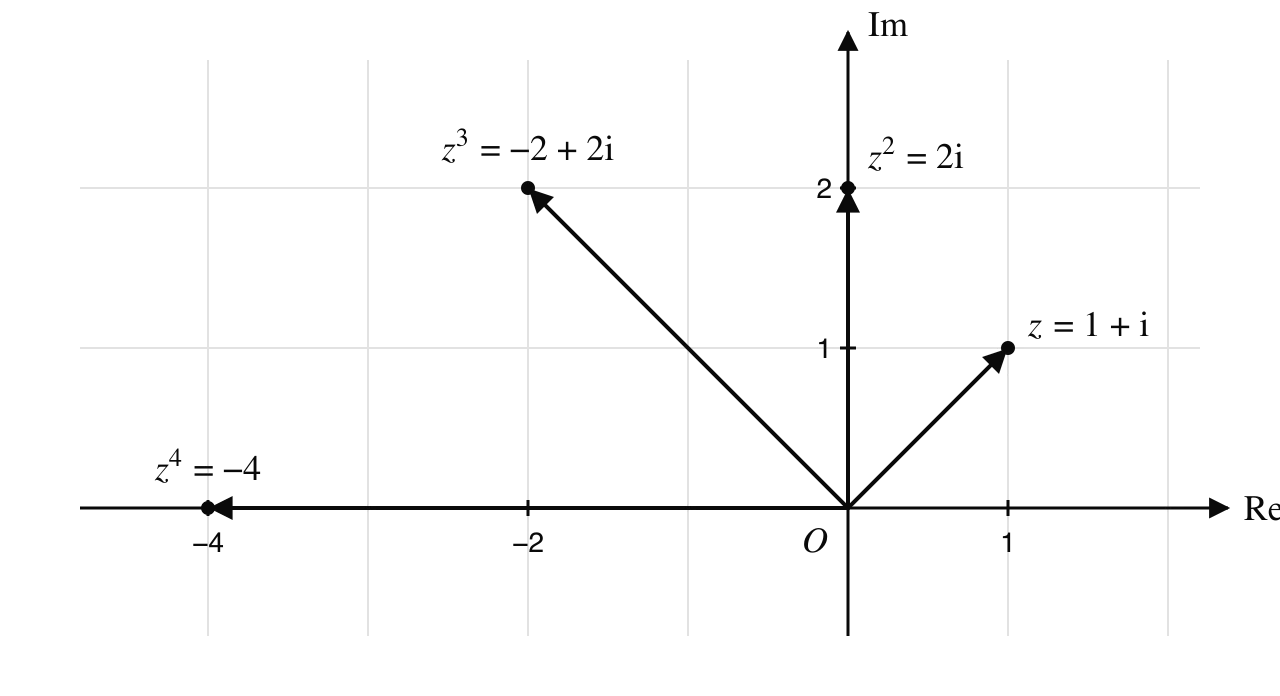
Each power of 1 + i is √2 times further from O and a further π/4 anticlockwise, so after four steps the point reaches −4 on the negative real axis.
Calculating powers
To find zn for a number given in Cartesian form, convert to polar form, apply the theorem, and convert back if the answer is needed as a+bi. This is far quicker than repeated multiplication or the binomial expansion.
Powers that are real or imaginary
A power zn is real when its argument nθ is a multiple of π, and purely imaginary when nθ is an odd multiple of 2π
Multiple angle formulae
De Moivre's theorem gives cosnθ+isinnθ=(cosθ+isinθ)n. Expanding the right side with the binomial theorem (1.9) and equating real and imaginary parts expresses cosnθ
The reverse process writes a power such as cos4θ in terms of multiple angles, which is useful for integration. For z=cisθ, De Moivre's theorem gives zn=cisnθ
zn+zn1=2cosnθ,zn−zn1=2isinnθ
Roots of complex numbers
The equation zn=w, for a given non-zero complex number w, asks for the nth roots of w. By the fundamental theorem of algebra there are exactly n
Finding the nth roots
Write w=Rcisϕ and look for roots z=rcisθ. De Moivre's theorem turns zn=w
rncisnθ=Rcisϕ
Equal complex numbers have equal moduli, so rn=R and r=R1/n (the positive real root). Their arguments, however, need only be equal up to a multiple of 2π
nθ=ϕ+2kπ⟹θ=nϕ+2kπ,k∈Z
The values k=0,1,…,n−1 give n different directions, each n2π
This is the extension of De Moivre's theorem to rational exponents. Applying the theorem with exponent n1 to Rcisϕ gives one root, R1/ncisnϕ
When the modulus or argument of w is not a special value, give the roots in polar or Euler form, or as decimals if a calculator is allowed.
Roots of unity
The simplest case of zn=w is w=1. Since 1=cis(0+2kπ)
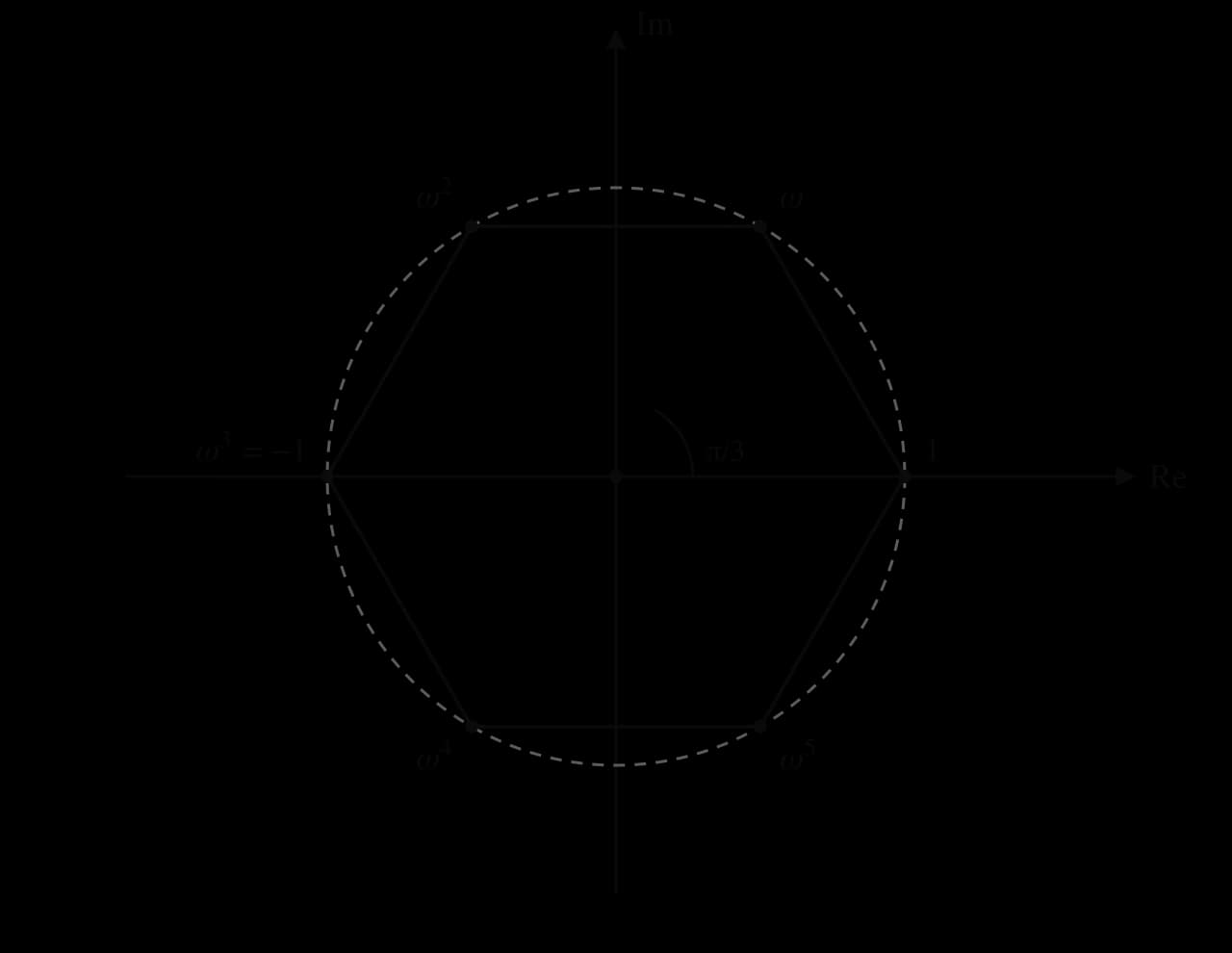
By De Moivre's theorem, ωk=cisn2kπ, so every root of unity is a power of ω: each step round the polygon is a further multiplication by
The sixth roots of unity are the powers of ω = e^(iπ/3). Each multiplication by ω turns a vertex π/3 further round the regular hexagon.
The cube roots of unity
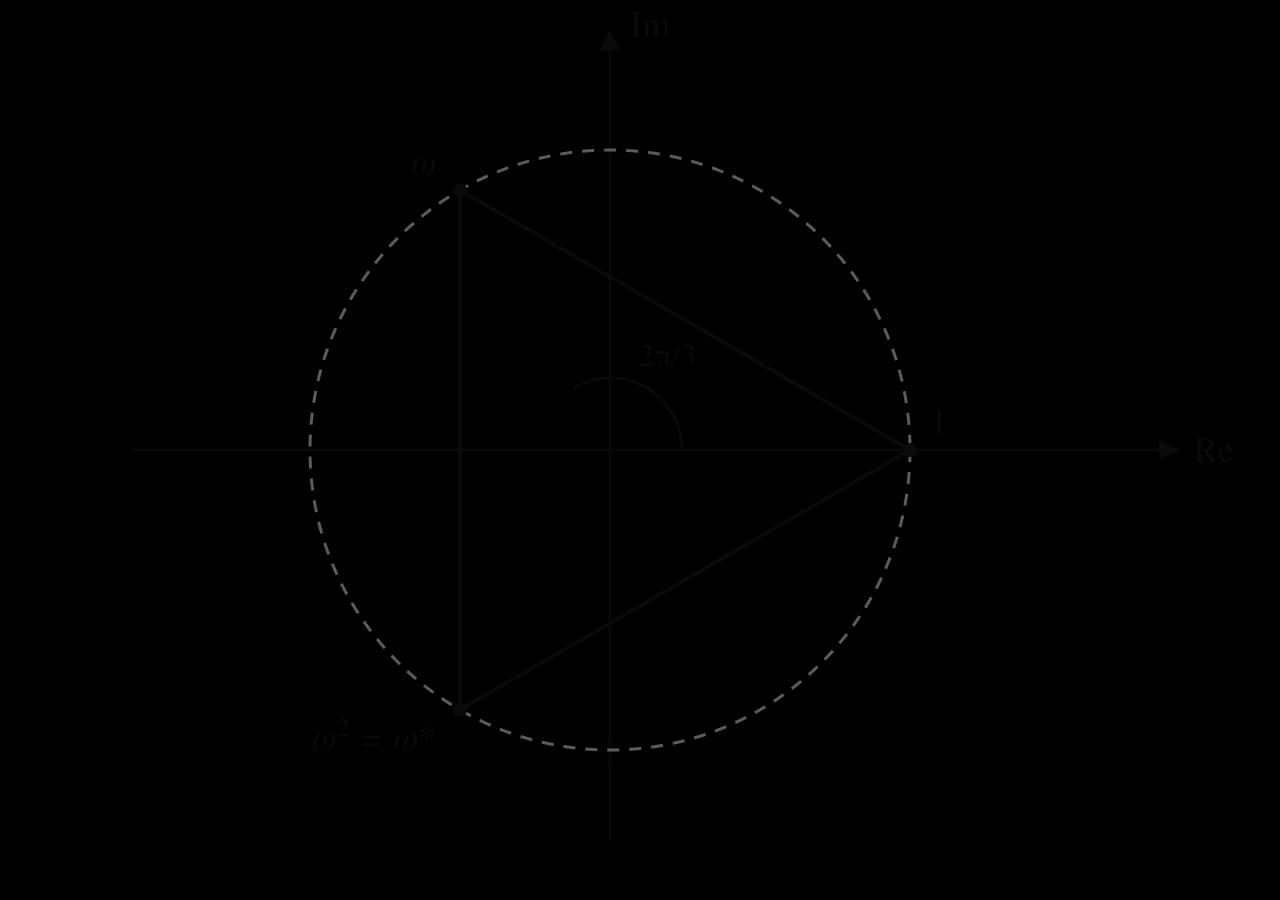
For n=3, ω=cis32π=−21+23i
ω3=1,1+ω+ω2=0,ω2=ω∗=ω1
The second follows from factorising z3−1=(z−1)(z2+z+1)
The cube roots of unity form an equilateral triangle. The two non-real roots are conjugates, so ω² = ω*.
The sum of the roots of unity
For any n≥2, the nth roots of unity add up to zero:
1+ω+ω2+⋯+ωn−1=0
This is a geometric series with common ratio ω=1, so its sum is
1−ω1−ωn=1−ω1−1=0
because ωn=1. Geometrically, the vectors from the centre of a regular polygon to its vertices balance each other out, so their resultant is zero. Taking real parts gives trigonometric results; for n=5, the real parts give 1+2cos52π+2cos54π=0
Roots of any number from the roots of unity
If z0 is one solution of zn=w, then so is z0ωk
Exam-style questions on complex roots and De Moivre's theorem
Longer questions on this content usually chain several ideas: find roots with De Moivre's theorem, recognise conjugate pairs, and deduce a factorisation or a trigonometric value.
The last question is a typical calculator question: it combines finding roots with the geometry of the polygon they form.
Self-check
To do:
I can state the conjugate root theorem, explain why it needs real coefficients, and use it to find the remaining roots of a cubic or quartic.
To do:
I can form a polynomial with real coefficients from given roots, using real quadratic factors z2−2pz+(p2+q2)
Questions on 1.14
33 exam-style questions on this subtopic, written in the style of the IB papers. The first has its markscheme open. Counted on
Question 1 · AA-000056 marks
Let z=1+3i.
(a)
Express z in the form reiθ, where r>0 and −π<θ≤π
Question 2 · AA-007777 marks
Consider the complex numbers z1=3+3i
Question 3 · AA-0078717 marks
Let w=0.72+0.54i.
The points P0,P1,P2,…
Try a quick-fire question
One of 34 short multiple-choice questions on 1.14. Pick an answer to see why it's right or wrong.
The solutions of z6=64i lie on a circle centred at O. What are the circle's radius and the angle between neighbouring solutions?
From the formula booklet
The entries of the mathematics: analysis and approaches formula booklet that 1.14 uses. Each opens in the explained booklet.
They all have modulus R1/n, and their arguments differ by n2π, so on an Argand diagram they are the vertices of a regular n-sided polygon centred at the origin.
; writing
w
with each of its arguments
ϕ+2kπ
before taking the power gives all of them. In general,
(rcisθ)p/q
has
q
different values, so the rational form of the theorem describes a set of roots, not a single number.
. Include all its arguments:
8i=8cis(2π+2kπ)
.
By De Moivre's theorem the roots have modulus 81/3=2 and arguments
θ=3π/2+2kπ=6π+32kπ,k=0,1,2
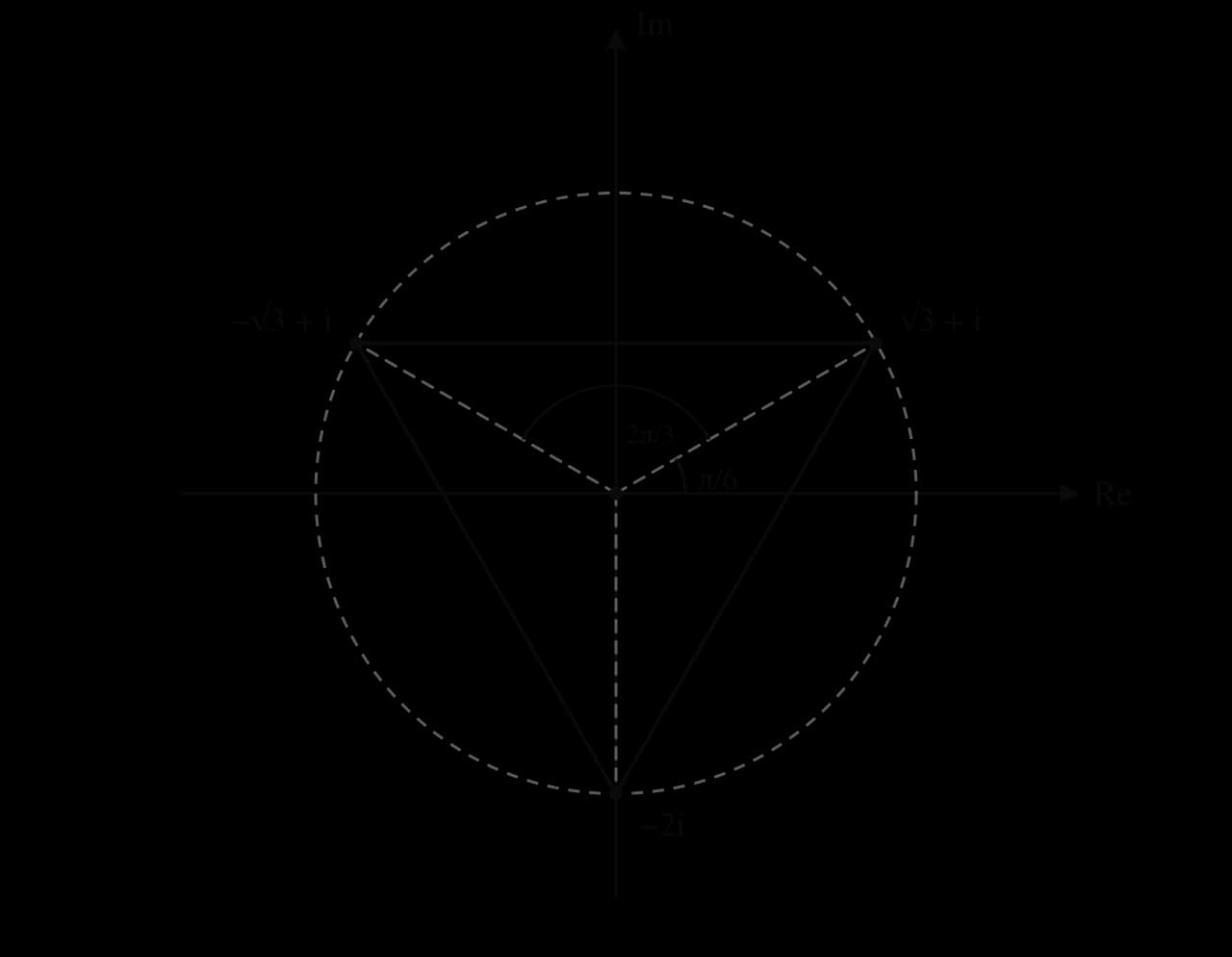
k=0: 2cis6π=2(23+21i)=3+i
k=1: 2cis65π=−3+i
k=2: 2cis23π=2cis(−2π)=−2i
Check one root: (−2i)3=−8i3=8i. ✓
The three cube roots of 8i lie on the circle of radius 2, spaced 2π/3 apart, at the vertices of an equilateral triangle.
in the final answers.
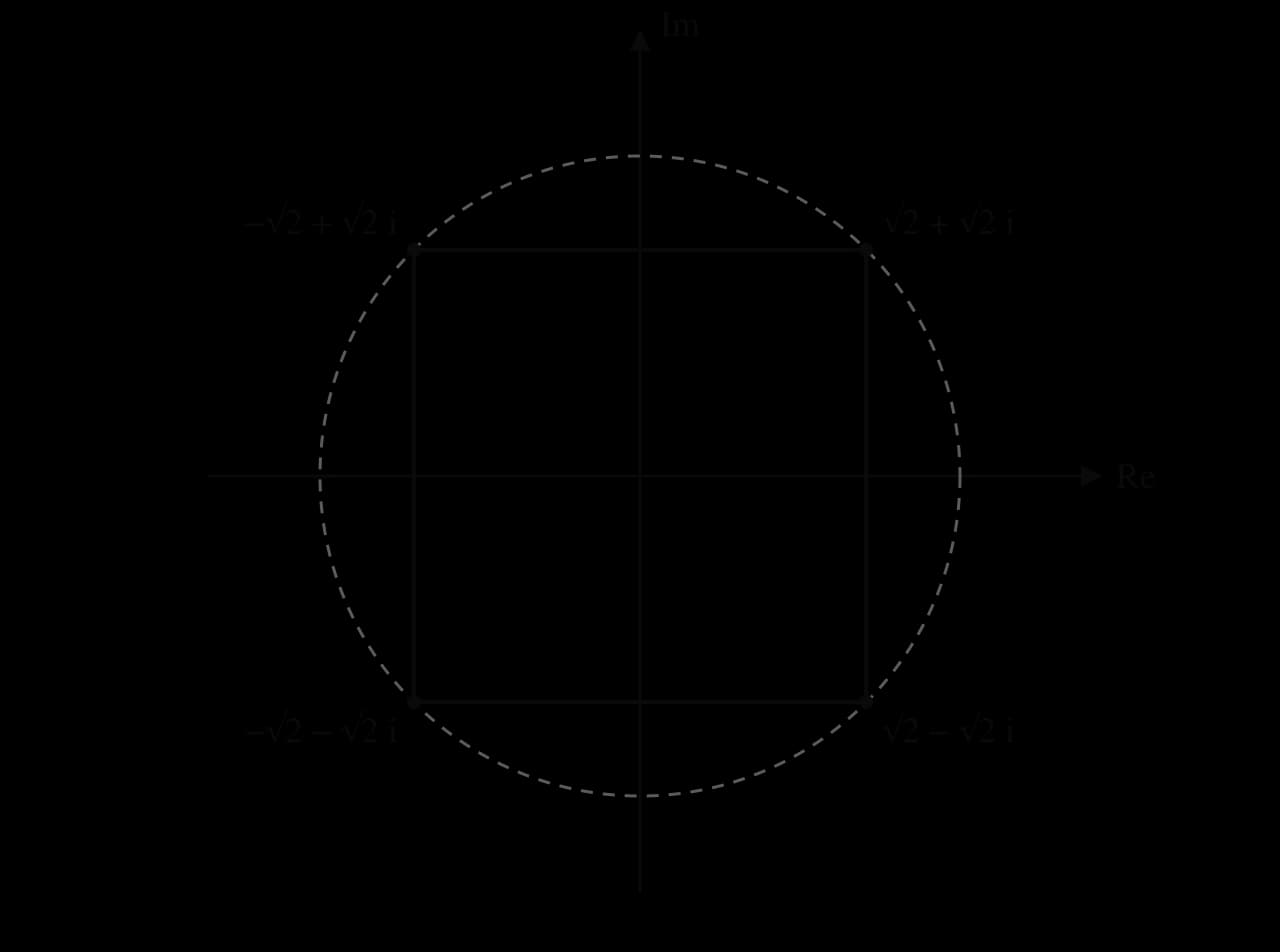
and arguments
θ=4π+2kπ=4π+2kπ,k=0,1,2,3
giving 4π,43π,45π,47π. As principal arguments these are 4π,43π,−43π,−4π.
With cos4π=sin4π=22, the roots are
z=2+2i,−2+2i,−2−2i,2−2i
that is, z=±2±2i. They form two conjugate pairs, as they must, since z4+16=0 has real coefficients.
The fourth roots of −16 are the vertices of a square inscribed in the circle of radius 2.
and
arg(2+2i)=4π
. The modulus of each root is
(22)1/3=(23/2)1/3=21/2=2
The arguments are 3π/4+2kπ=12π+32kπ for k=0,1,2, that is 12π, 43π and 1217π; the last is −127π as a principal argument.
The roots are 2cis12π, 2cis43π and 2cis(−127π).
The second has an exact Cartesian form: 2cis43π=2(−22+22i)=−1+i.
Check: (−1+i)2=−2i, so (−1+i)3=−2i(−1+i)=2i+2=2+2i. ✓
The cube roots of 2 + 2i form an equilateral triangle on the circle of radius √2; only −1 + i has simple exact coordinates.
and then add
2kπ
(instead of
n2kπ
), which gives the same point
n
times.
, its
n
th roots have modulus
1
and arguments
n2kπ
.
Writing ω=e2πi/n, they are 1,ω,ω2,…,ωn−1. They lie on the unit circle at the vertices of a regular n-sided polygon, with one vertex at 1.
ω
, a rotation through
n2π
.
, and the three cube roots of unity are
1
,
ω
and
ω2=−21−23i
. They satisfy several identities that are used constantly:
: the non-real roots
ω
and
ω2
satisfy
z2+z+1=0
. The third holds because
ω2
is the reflection of
ω
in the real axis, and
ω×ω2=1
.
(1+ω2)5
Show the solution
100=3×33+1, so ω100=(ω3)33ω=ω.
Expand and use ω3=1 and 1+ω+ω2=0:
(1+ω)(1+ω2)=1+ω2+ω+ω3=(1+ω+ω2)+1=1
From 1+ω+ω2=0, 1+ω2=−ω
(1+ω2)5=(−ω)5=−ω5=−ω3ω2=−ω2
.
also add to
0
for
n≥2
, because they are one root multiplied by each of the
n
th roots of unity.
for each
k
, since
(z0ωk)n=z0n(ωn)k=w
. So all
n
roots can be found by finding one root and rotating it repeatedly through
n2π
about the origin. This is how a regular polygon centred at the origin is built from one vertex.
about the origin, that is, multiplying by
ω=−21+23i
and by
ω2=−21−23i
:
4iω=4i(−21+23i)=−2i−23=−23−2i
4iω2=4i(−21−23i)=−2i+23=23−2i
Each vertex z satisfies z3=(4i)3=64i3=−64i. So the equation is z3=−64i.
Check: the three vertices add to 4i−23−2i+23−2i=0, as roots of z3=w must.
.
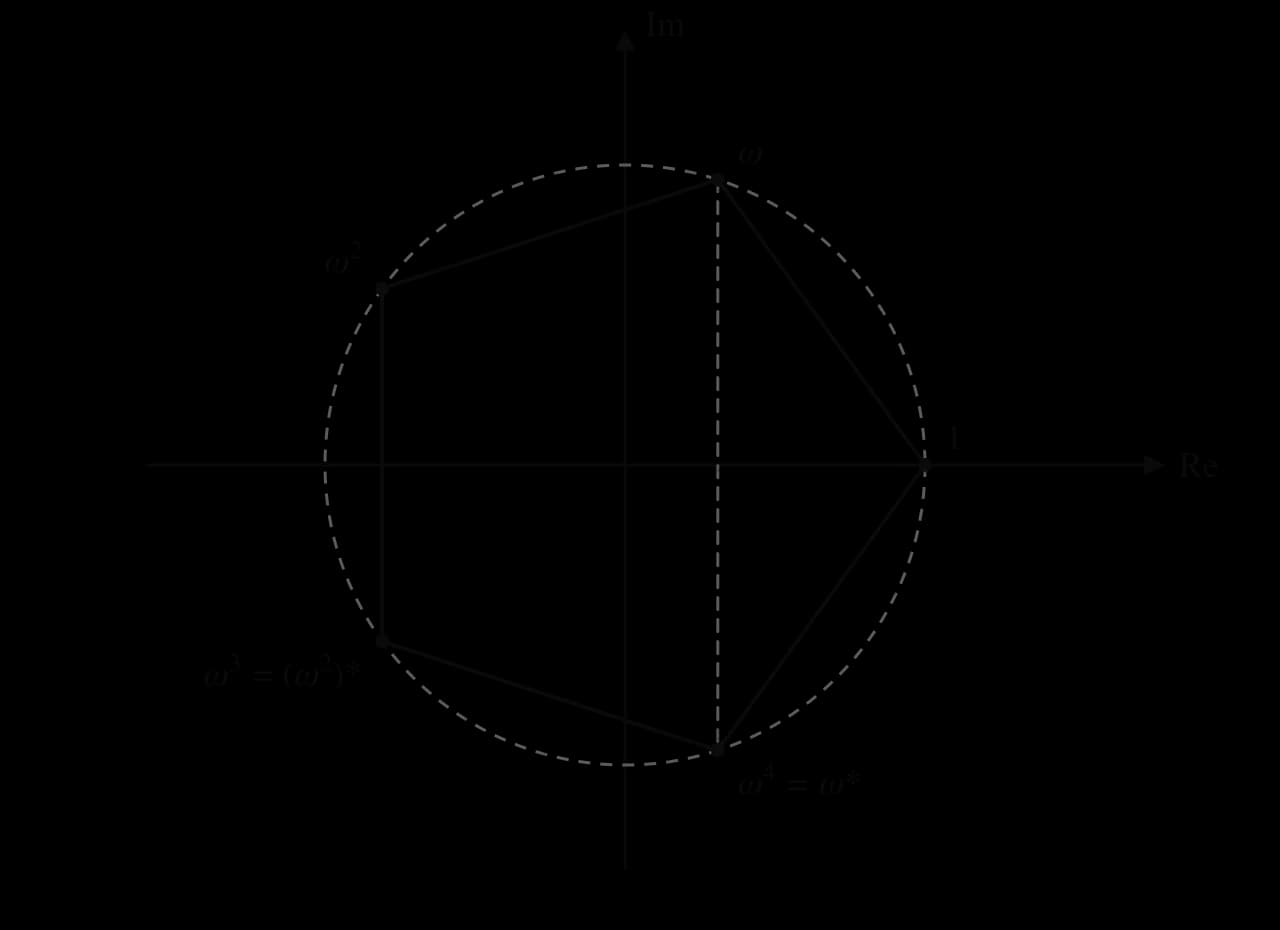
Let ω=e2πi/5. Show that ω4=ω∗ and ω3=(ω2)∗.
Hence show that z5−1=(z−1)(z2−2cos52πz+1)(z2−2cos54πz+1).
Deduce that cos52π+cos54π=−21.
Show the solution
1=e2kπi, so z=e2kπi/5 for k=0,1,2,3,4. With principal arguments, the roots are
1,e2πi/5,e4πi/5,e−4πi/5,e−2πi/5
ω4=e8πi/5=e8πi/5−2πi=e−2πi/5
z5−1=(z−1)(z2−2cos52πz+1)(z2−2cos54πz+1)
which is the given result.
The sum of the fifth roots of unity is 0:
1+(ω+ω∗)+(ω2+(ω2)∗)=1+2cos52π+2cos54π=0
So cos52π+cos54π=−21
The fifth roots of unity are symmetric in the real axis: ω and ω⁴ are conjugates, as are ω² and ω³, which is why z⁵ − 1 splits into real quadratic factors.
, giving the roots in the form
cosα
.
Show the solution
By De Moivre's theorem, cos3θ+isin3θ=(cosθ+isinθ)3. Expanding with c=cosθ, s=sinθ:
(c+is)3=c3+3ic2s−3cs2−is3
Equating real parts and using s2=1−c2:
cos3θ=c3−3c(1−c2)=4cos3θ−3cosθ
Substitute x=cosθ:
8cos3θ−6cosθ−1=0⟹2(4cos3θ−3cosθ)=1⟹cos3θ=21
For 0≤θ≤π (so that each value of cosθ appears once), 0≤3θ≤3π and
3θ=3π,35π,37π⟹θ=9π,95π,97π
These give three different values of cosθ, and a cubic has at most three roots, so the roots are
x=cos9π,cos95π,cos97π
A GDC check, if available, gives 0.940, −0.174 and −0.766, which are the decimal values of these cosines.
.
Find the length of AB and the area of triangle ABC.
Show the solution
8i=8cis2π, so the roots have modulus 2 and arguments 6π+32kπ for k=0,1,2:
2cis6π=3+i,2cis65π=−3+i,2cis(−2π)=−2i
Let A=3+i and B=−3+i
The roots are equally spaced on a circle, so ABC is equilateral with side 23. Its area is
21(23)2sin3π=21×12×23=33≈5.20
and the fact that the
n
roots form a regular polygon; a quick sketch of the polygon is a good check that the arguments are evenly spaced.
.
To do:
I can find unknown coefficients by substituting a complex root and equating real and imaginary parts.
To do:
I can state De Moivre's theorem and use it to evaluate positive and negative powers of complex numbers.
To do:
I can use De Moivre's theorem and the binomial theorem to derive formulae such as cos3θ=4cos3θ−3cosθ.
To do:
I can find all n roots of zn=w and show them as a regular polygon on an Argand diagram.
To do:
I can find the nth roots of unity, use 1+ω+ω2=0 for cube roots, and prove that the roots of unity add up to zero.
.
[3]3 marks
Markscheme (a)
r=2A1
θ=3πA1
z=2eiπ/3A1
(b)
Hence find z6.
[3]3 marks
Markscheme (b)
z6=26ei2πM1
=64A1A1
and
z2=−2+23i
.
(a)
Express z1 and z2 in the form reiθ, where r>0 and −π<θ≤π.
[3]3 marks
(b)
Hence write down z1z2 in the form reiθ.
[1]1 mark
(c)(i)
Find the least positive integer n for which (z1z2)n is purely imaginary.
is never an integer. So no positive integer power of
z
is purely imaginary.
:
.
. So
, which is the conjugate of
e2πi/5=ω
. Similarly
ω3=e6πi/5=e−4πi/5=(e4πi/5)∗=(ω2)∗
.
The roots of z5−1=0 are 1 and the two conjugate pairs ω,ω∗ and ω2,(ω2)∗. For a pair e±iα, the sum is 2cosα and the product is 1, so the quadratic factor is z2−2cosαz+1. With α=52π and α=54π:
.
. Then
AB=∣A−B∣=∣23∣=23≈3.46
.
.
[3]3 marks
, then to
P3
, and so on indefinitely.
Find the total distance travelled by the particle.