1.12 Complex numbers in Cartesian form · IB Maths AA | Augment Education
1.12 Complex numbers in Cartesian form
Work with complex numbers a + bi: simplify powers of i, add, multiply and divide, plot numbers on an Argand diagram, find the modulus, solve equations by equating parts, and solve quadratics with negative discriminant.
IB Mathematics: Analysis and Approaches
Part of 1 Number and algebra
HL only
Key terms introduced here
Each is in the Maths AA glossary, with every other term in the subject.
A plane with a horizontal real axis (Re) and a vertical imaginary axis (Im), on which the complex number a+bi is shown as the point (a,b) or as the vector from the origin to that point.
For z=a+bi, the number z∗=a−bi, with the sign of the imaginary part changed. On an Argand diagram it is the reflection of z in the real axis, and zz∗=a2+b2 is real.
For z=a+bi with a,b∈R, the real number a, written Re(z).
Notes on 1.12 Complex numbers in Cartesian form
32 min readLast reviewed
The real numbers are not enough to solve every polynomial equation: no real number squared gives −1, so x2+1=0 has no real solution. Complex numbers extend the real numbers with one new number, i, whose square is −1. With this single addition, every quadratic equation has solutions, and (as later results show) so does every polynomial equation. Complex numbers are also a working tool outside pure mathematics: electrical engineers use them to describe alternating current, and they appear throughout signal processing and quantum physics.
The imaginary unit
For every real number x, x2≥0. A negative number therefore has no real square root, and an equation such as x2=−9 has no real solution. Complex numbers are built by adding one number to the real numbers that removes this obstacle.
Once i exists, every negative number has square roots. For a>0, the number −a is defined as ia
Powers of i
Multiplying by i repeatedly produces a cycle of four values:
i1=i,i2=−1,i3=i2×i=−i,i4=i2×i2=1
After i4=1, the cycle starts again: i5=i4×i=i
Remainder when n is divided by 4
0
1
2
3
in
1
i
−1
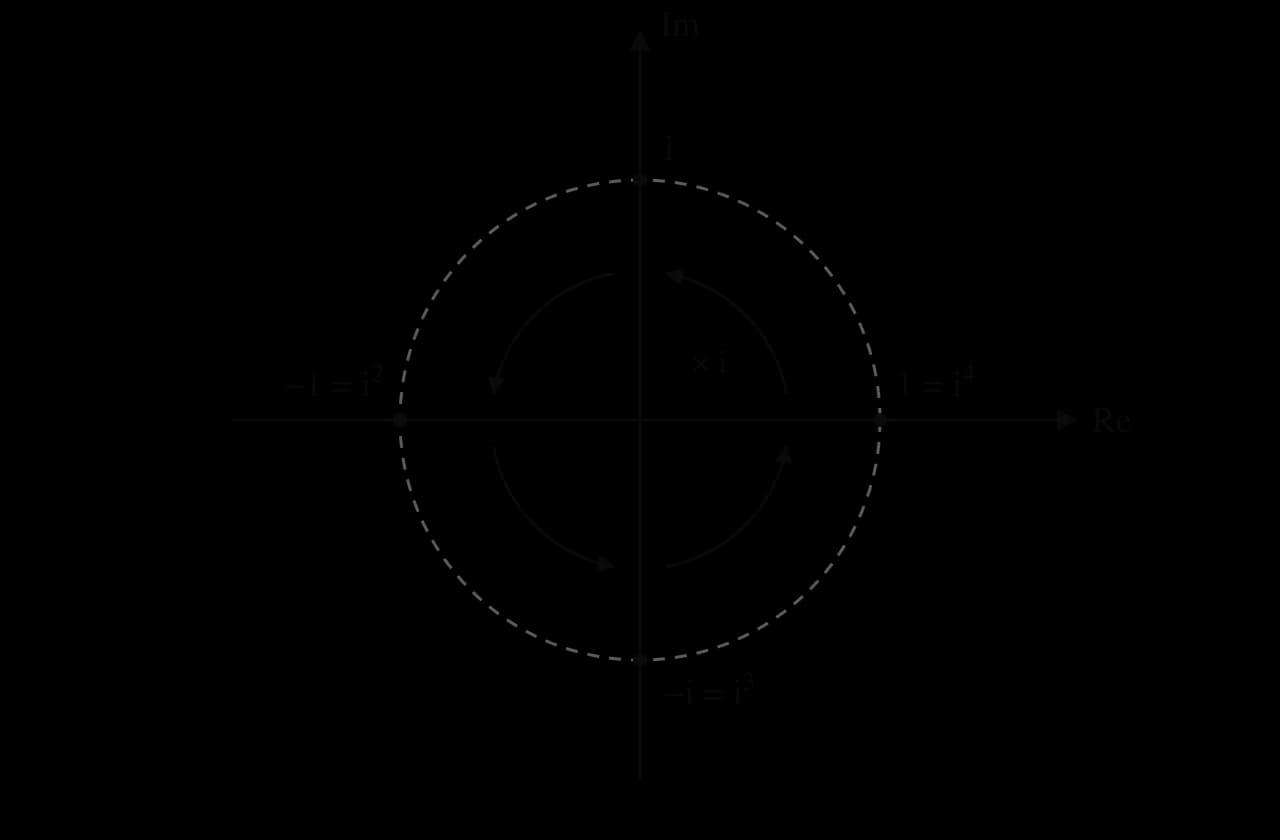
The cycle has a geometric meaning. On an Argand diagram the four values 1,i,−1,−i sit on the axes, each a quarter turn anticlockwise from the one before, so multiplying by i acts as a rotation through 90° about the origin. This rotation idea is developed fully in 1.13.
Each multiplication by i turns a number a quarter turn anticlockwise about the origin, so the powers of i repeat every four steps.
Negative powers follow the same pattern, since i−1=i1=i2i=−i
The four values in the cycle add up to zero: i+(−1)+(−i)+1=0. Any four consecutive powers of i therefore also add up to zero, which makes long sums of powers quick to evaluate.
Complex numbers in Cartesian form
Combining real numbers with real multiples of i gives a new, larger set of numbers.
For z=4−7i, Re(z)=4 and Im(z)=−7
Two special cases have their own names. When b=0, the number z=a is real, so every real number is also a complex number: R is a subset of C, and the chain of number sets becomes N⊂Z⊂Q⊂R⊂C
Equality of complex numbers
Two complex numbers are equal when, and only when, their real parts are equal and their imaginary parts are equal:
a+bi=c+di⟺a=c and b=d(a,b,c,d∈R)
The reason is that if a+bi=c+di then a−c=(d−b)i. The left side is real. If
This fact turns one equation in complex numbers into two equations in real numbers. It is the basis of many methods for solving complex equations, and it is used repeatedly in the rest of the topic.
The Argand diagram
A real number can be shown as a point on a number line. A complex number a+bi needs two real numbers to describe it, so it is shown as a point in a plane.
Real numbers lie on the real axis, and purely imaginary numbers lie on the imaginary axis. Representing z as a vector (ab) from the origin is often more useful than representing it as a point, because addition of complex numbers then matches addition of vectors.
Modulus
The distance of a complex number from the origin on the Argand diagram measures its size. By Pythagoras' theorem, the point (a,b) is at distance a2+b2
For a real number z=a, the modulus is a2=∣a∣
Argument
The position of z on the Argand diagram is also fixed by its distance from the origin together with its direction. The direction is measured by an angle.
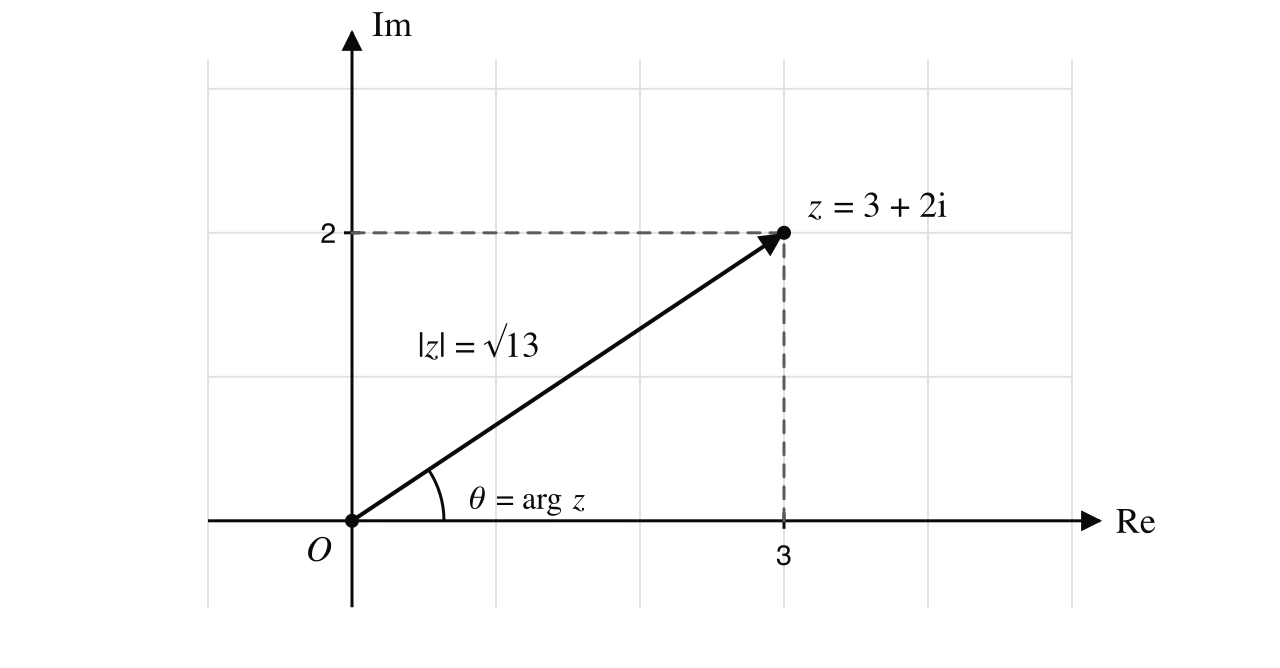
The number 3 + 2i is the point (3, 2). Its modulus is the length of the vector from O, and its argument is the angle that vector makes with the positive real axis.
Some arguments can be read straight from an Argand diagram: a positive real number has argument 0, argi=2π, arg(−1)=π
Adding and subtracting complex numbers
Complex numbers are added and subtracted by combining real parts and imaginary parts separately, in the same way as collecting like terms in algebra:
(a+bi)+(c+di)=(a+c)+(b+d)i
(a+bi)−(c+di)=(a−c)+(b−d)i
For example, (3−2i)+(−5+6i)=−2+4i and (3−2i)−(−5+6i)=8−8i
Addition and subtraction as vectors
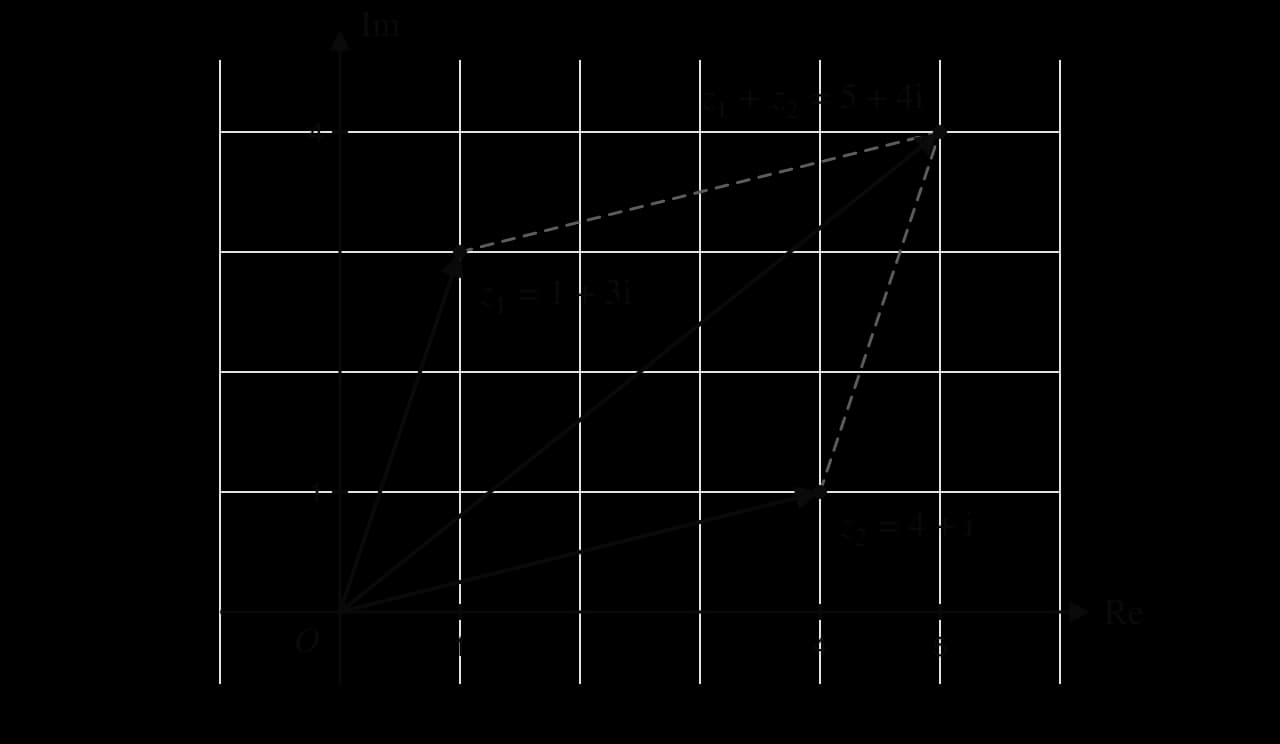
On an Argand diagram, adding complex numbers is the same as adding their vectors. With z1=1+3i and z2=4+i
The sum z₁ + z₂ is the diagonal of the parallelogram formed by z₁ and z₂, exactly as in vector addition.
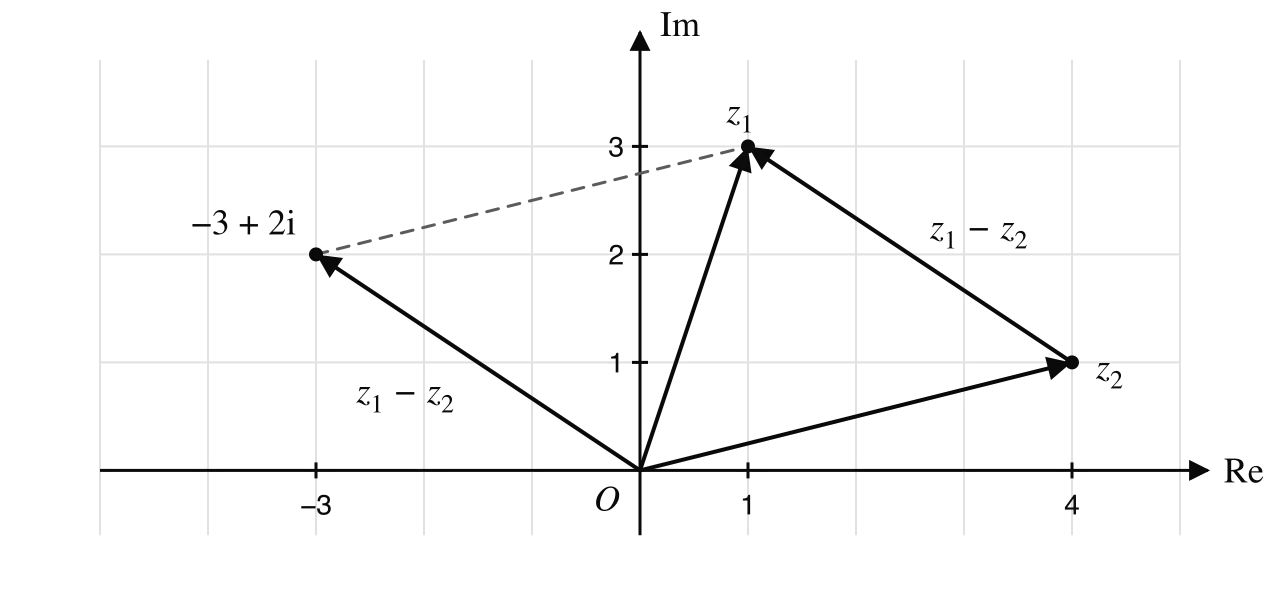
Subtraction works in the same way. Since z2+(z1−z2)=z1
The difference z₁ − z₂ is the vector from z₂ to z₁. Moved to start at O, it ends at the point −3 + 2i.
A useful consequence follows. The length of the vector from z2 to z1 is ∣z1−z2∣
Multiplying complex numbers
To multiply two complex numbers, expand the brackets as in ordinary algebra and then replace i2 by −1:
(a+bi)(c+di)=ac+adi+bci+bdi2=(ac−bd)+(ad+bc)i
There is no need to memorise this formula; expanding each time is just as quick and less error-prone. Multiplying by a real number k multiplies both parts by k, so k(a+bi)=ka+kbi, which on the Argand diagram is an enlargement of the vector by scale factor k
Part 3 of this example shows the rotation property again: 3+2i is the point (3,2), and i(3+2i)=−2+3i
The complex conjugate
Changing the sign of the imaginary part of a complex number gives a closely related number with very useful properties.
For example, (3+2i)∗=3−2i, (−4−i)∗=−4+i
The conjugate z* is the mirror image of z in the real axis: it has the same modulus and the opposite argument.
Properties of the conjugate
For z=a+bi:
z+z∗=2a=2Re(z),z−z∗=2bi=2iIm(z)
zz∗=(a+bi)(a−bi)=a2−b2i2=a2+b2=∣z∣2
The last result is the most useful, because it shows that the product of a complex number and its conjugate is always a non-negative real number. The conjugate also behaves well with arithmetic: (z1+z2)∗=z1∗+z2∗
The identities z+z∗=2Re(z) and zz∗=∣z∣2
Dividing complex numbers
Division uses the fact that zz∗ is real. To divide by c+di, multiply the numerator and the denominator by the conjugate of the denominator, c−di. The denominator becomes the real number c2+d2
The method is the same idea as rationalising a denominator such as 2+31 by multiplying by 2−3
The result of part 2 gives a general formula for the reciprocal: z1=∣z∣2z∗
When ∣z∣=1, the formula z1=∣z∣2z∗
An application: impedance in AC circuits
In an alternating current (AC) circuit, each component resists the current by an amount called its impedance, which has two parts: a resistance R that dissipates energy, and a reactance X caused by coils and capacitors, which shifts the timing of the current relative to the voltage. Engineers combine the two into one complex number, Z=R+Xi (they write j for i
Solving equations by equating parts
Many equations in a complex unknown z can be solved by writing z=x+yi with x,y∈R, simplifying each side into the form real part +
Equations involving z and its conjugate
When an equation contains both z and z∗, it usually cannot be solved by rearranging for z, because z and z∗
Square roots of a complex number
The equation z2=w asks for the square roots of the complex number w. Writing z=x+yi gives z2=(x2−y2)+2xyi
The two square roots are negatives of each other, just as ±3 are the square roots of 9. A shortcut avoids the quartic equation. Taking the modulus of both sides of z2=w gives ∣z∣2=∣w∣
Simultaneous equations
Linear simultaneous equations with complex coefficients are solved by substitution or elimination, exactly as with real coefficients. Divisions by complex numbers are carried out with the conjugate.
Quadratic equations with complex roots
For the quadratic equation az2+bz+c=0 with real coefficients, the discriminant Δ=b2−4ac
z=2a−b±i−Δ=−2ab±2a4ac−b2i
The roots have the same real part and opposite imaginary parts, so they are a conjugate pair.
Discriminant
Roots of az2+bz+c=0 (a,b,c∈R
The graph of y=x2−4x+13 shows why there are no real roots: its minimum point is (2,9), so the curve never reaches the x-axis. The real part of the complex roots,
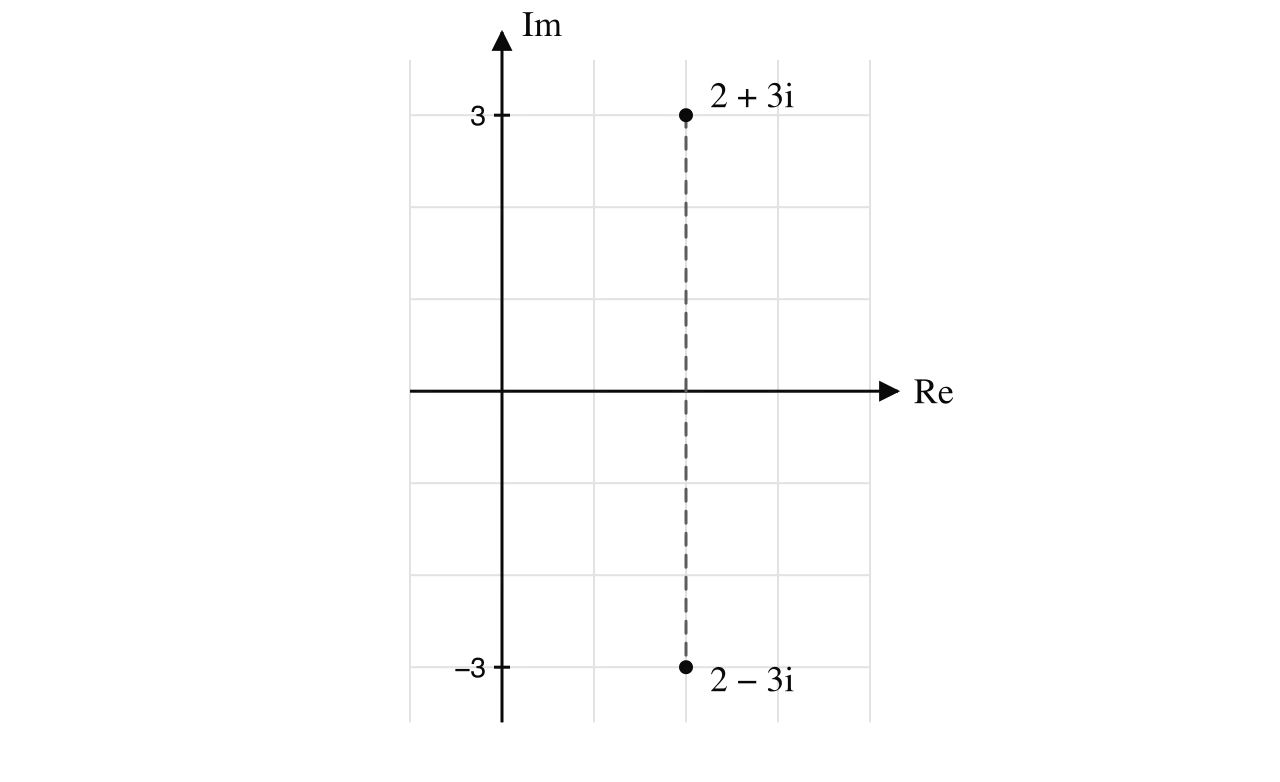
On an Argand diagram the two roots 2±3i are reflections of each other in the real axis.
The roots of a quadratic with real coefficients and negative discriminant are mirror images in the real axis.
Some equations of higher degree are quadratics in disguise. An equation such as z4+pz2+q=0 is a quadratic in z2
Forming a quadratic from a complex root
For roots p±qi, the sum is 2p and the product is (p+qi)(p−qi)=p2+q2
z2−2pz+(p2+q2)=0
with real coefficients. Conversely, if a quadratic with real coefficients has one non-real root, the quadratic formula shows that the other root is its conjugate.
Exam-style questions on complex numbers in Cartesian form
Questions on this content appear on both calculator and non-calculator papers. On a non-calculator paper every step of complex arithmetic must be shown. Where a graphic display calculator (GDC) is allowed, its complex mode can check divisions and powers, but questions that say "show that" or ask for exact values still need full working.
The next question is a typical parameter question: a condition such as "purely imaginary" or "real" is a statement about one of the two parts, which gives an equation for the unknown.
Self-check
To do:
I can simplify in for any integer n and write square roots of negative numbers in terms of i.
To do:
I can state the real part, imaginary part, conjugate and modulus of z=a+bi
Questions on 1.12
24 exam-style questions on this subtopic, written in the style of the IB papers. The first has its markscheme open. Counted on
Question 1 · AA-007576 marks
Consider the complex number z=2+4i5−3i.
(a)
Express z in the form a+bi, where a,b∈Q.
[2]2 marks
Markscheme (a)
multiplying numerator and denominator by 2−4i(M1)
20(5−3i)(2−4i)=20−2−26i
(b)
Find the exact value of ∣z∣.
[2]2 marks
Markscheme (b)
∣z∣=(−101)2+(−1013)2
(c)
Find argz, where −π<argz≤π.
[2]2 marks
Markscheme (c)
z lies in the third quadrant, so argz=−π+arctan13
Question 2 · AA-007585 marks
The real numbers p and q satisfy the equation (p+2i)(3−i)=q(1+i)
Question 3 · AA-007596 marks
Consider the equation 2z+3iz∗=7+8i, where z∈C
Try a quick-fire question
One of 39 short multiple-choice questions on 1.12. Pick an answer to see why it's right or wrong.
A complex number satisfies z=z∗. What must be true of z?
From the formula booklet
The entries of the mathematics: analysis and approaches formula booklet that 1.12 uses. Each opens in the explained booklet.
and use the remainder, because every complete group of four factors multiplies to
i4=1
.
−i
, which is the same as
i3
.
i101+i102
Show the solution
7=4×1+3, so i7=(i4)1×i3=1×(−i)=−i.
26=4×6+2, so i26=i2=−1
Multiply the numerator and denominator by i:
i−1=i1=i2i=−1i=−i
101=4×25+1 and 102=4×25+2, so
i101+i102=i+(−1)=−1+i
.
Show the solution
Group the terms in fours from the start. Each group i4k+1+i4k+2+i4k+3+i4k+4=i−1−i+1=0.
There are 102 terms; 100 of them make 25 complete groups, each adding to 0. Two terms remain:
i101+i102=i−1
So the sum is −1+i.
As a check, the terms form a geometric series with first term i and common ratio i, so
S102=1−ii(1−i102)=1−ii(1−(−1))=1−i2i
Dividing by 1−i (multiply the numerator and the denominator by 1+i, the standard method for dividing complex numbers) gives 22i(1+i)=i+i2=−1+i
. The real number
a
is the
real part
of
z
, written
Re(z)
, and the real number
b
is the
imaginary part
, written
Im(z)
. The set of all complex numbers is
C
.
. The letter
z
(and
w
) is used for complex numbers in the same way that
x
is used for real numbers.
. When
a=0
and
b=0
, the number
z=bi
is a
purely imaginary
number, such as
3i
or
−21i
.
, write
Im(z)=−2
. Writing
Im(z)=−2i
is a common error that leads to sign and factor mistakes when equating parts.
d−b
were not zero, squaring both sides would give
(a−c)2=−(d−b)2
, a non-negative number equal to a negative one, which is impossible. So
d=b
, and then
a=c
.
.
Show the solution
Since x and y are real, x+2y is the real part of the left side and 3x−y is its imaginary part. Equate real parts and imaginary parts:
x+2y3x−y=4=5
From the second equation, y=3x−5. Substituting into the first:
x+2(3x−5)=4⟹7x=14⟹x=2
Then y=3(2)−5=1.
Check: x+2y=2+2=4 and 3x−y=6−1=5
,
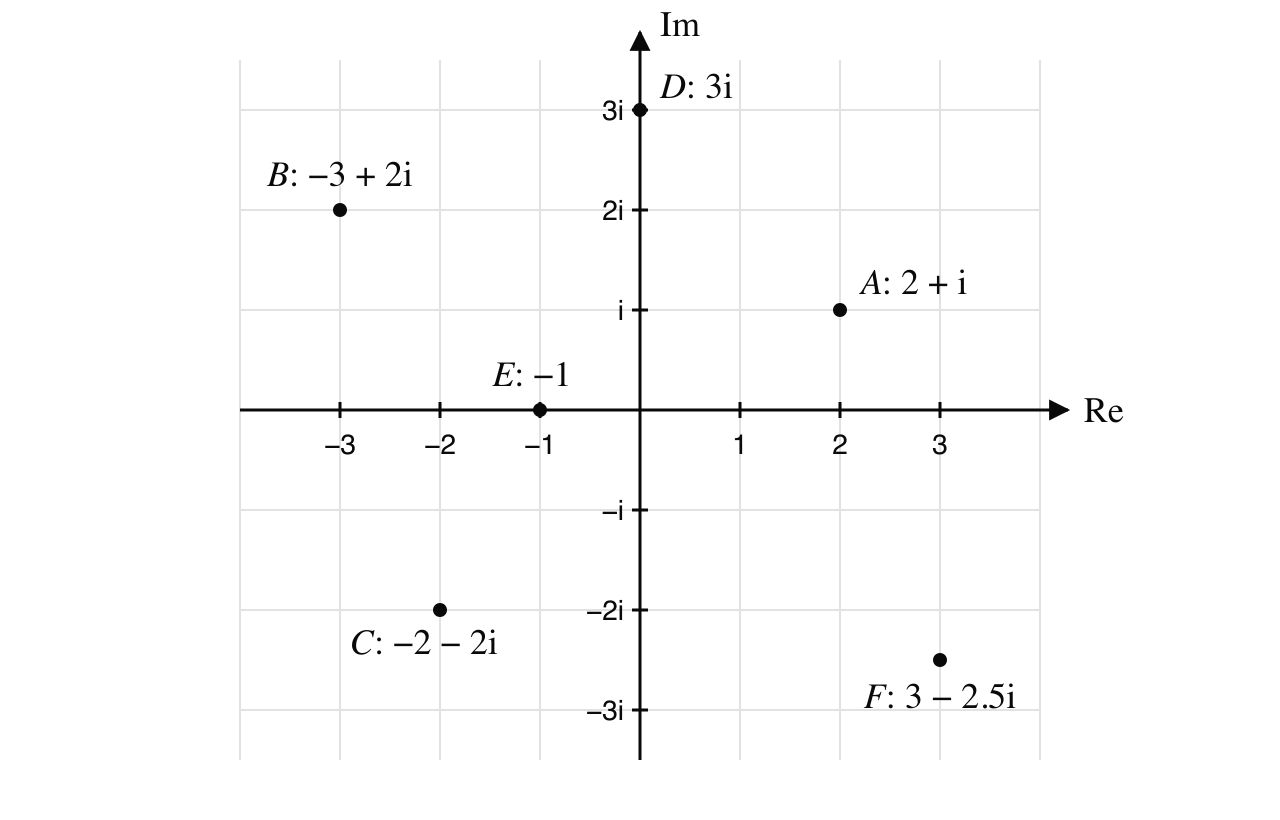
D:3i
,
E:−1
,
F:3−2.5i
Show the solution
Each number a+bi is the point (a,b): move a units along the real axis and b units parallel to the imaginary axis.
A is (2,1) and B is (−3,2).
C is (−2,−2), in the third quadrant.
D=3i=0+3i is (0,3), on the imaginary axis.
E=−1=−1+0i is (−1,0), on the real axis.
F is (3,−2.5).
Real numbers such as −1 lie on the real axis; purely imaginary numbers such as 3i lie on the imaginary axis.
from the origin.
It is the distance from the origin to the point representing z, so ∣z∣≥0, with ∣z∣=0 only when z=0.
, the usual absolute value. The modulus of a complex number therefore extends the idea of absolute value from the number line to the plane.
Show the solution
Use ∣a+bi∣=a2+b2, squaring the real and imaginary parts (not including i).
∣3+4i∣=32+42=25=5
produces the square root of a negative number, which a distance can never be. The modulus uses the imaginary part
b=4
, so
∣z∣=9+16=5
.
; clockwise angles are negative.
and
arg(−i)=−2π
. For a number in the first quadrant, such as
z=3+2i
, the right-angled triangle formed by
O
, the point
(3,2)
and the real axis gives
tanθ=32
, so
argz=arctan32≈0.588
. For
1+i
the triangle is isosceles and
arg(1+i)=4π
. The number
0
has no argument, because it has no direction. Finding the argument of a number in any quadrant, and writing
z
in terms of its modulus and argument, are the subject of 1.13.
.
, the sum
z1+z2=5+4i
is the diagonal of the parallelogram with sides
z1
and
z2
, because the vector
(13)+(41)=(54)
.
, the difference
z1−z2
is the vector that goes from the point
z2
to the point
z1
. Drawn from the origin instead, the same vector ends at
z1−z2=−3+2i
.
, so
∣z1−z2∣
is the distance between the points representing
z1
and
z2
on the Argand diagram.
. Find the distance
PQ
.
Show the solution
The distance between the points is the modulus of the difference.
p−q=(2−(−1))+(5−1)i=3+4i
PQ=∣p−q∣=32+42=5
This is the same calculation as the distance formula between (2,5) and (−1,1).
.
i(3+2i)
(1+i)4
Show the solution
Expand, then use i2=−1:
(3+2i)(1−4i)=3−12i+2i−8i2=3−10i+8=11−10i
(2−i)2=4−4i+i2=4−4i−1=3−4i
(1+i)4=((1+i)2)2=(2i)2=4i2=−4
is the point
(−2,3)
, which is
(3,2)
turned through
90°
anticlockwise about the origin. Part 4 is a first hint that powers of complex numbers can give simple answers; De Moivre's theorem in 1.14 explains why.
and
(a+bi)(a−bi)=a2+b2
. The second one is the key to division.
is the reflection of
z
in the real axis.
,
(5i)∗=−5i
and
7∗=7
. A complex number is real exactly when it equals its own conjugate. The reflection keeps the distance from the origin the same, so
∣z∗∣=∣z∣
, and it reverses the direction of the angle, so
argz∗=−argz
(for
z
not on the negative real axis).
and
(z1z2)∗=z1∗z2∗
. These two rules are the reason why non-real roots of real polynomial equations come in conjugate pairs, a result proved in 1.14.
, where
a,b,c,d∈R
. Show that
(z1z2)∗=z1∗z2∗
.
Show the solution
Find each side separately and show that they are equal.
Check by multiplying back: (−1+2i)(1−2i)=−1+2i+2i−4i2=3+4i
Multiply by 2−3i2−3i:
2+3i1=4+92−3i=132−133i
The conjugate of i is −i, but multiplying the numerator and denominator by i works just as well:
i5=i25i=−15i=−5i
as
c2−d2
: because
i2=−1
, it is
c2+d2
.
for any
z=0
. It is often quicker than repeating the method.
.
Show the solution
First find the reciprocal: ∣z∣2=22+(−1)2=5 and z∗=2+i, so
z1=∣z∣2z∗=52+i=52+51i
Then add real parts and imaginary parts:
z+z1=(2+52)+(−1+51)i=512−54i
simplifies to
z1=z∗
. Numbers with modulus
1
lie on the unit circle on the Argand diagram, and they play a central role in 1.13 and 1.14.
,
zz∗=∣z∣2=1
, so
z1=z∗
. Then
z+z1=z+z∗=2Re(z)
which is a real number.
For example, with z=53+54i (modulus 1), z1=53−54i and z+z1=56.
, keeping
i
for current). Impedances in series add,
Z=Z1+Z2
, and impedances in parallel combine as
Z=Z1+Z2Z1Z2
, the same rules as for resistors, but now with complex arithmetic. The modulus
∣Z∣
gives the ratio of the peak voltage to the peak current.
ohms.
Find ∣Z1∣.
Find the total impedance Z=Z1+Z2Z1Z2, and state what is special about it.
Show the solution
∣Z1∣=302+402=2500=50 ohms.
Z2 is the conjugate of Z1, so the product is Z1Z2=∣Z1∣2=2500
Z1+Z2=60
Therefore
Z=602500=3125≈41.7 ohms
The total impedance is purely real: the reactances of the two branches cancel, so the circuit as a whole behaves like a single resistor of about 41.7 ohms.
imaginary part
×i
, and then equating real and imaginary parts. One complex equation becomes two real equations in
x
and
y
.
are different numbers. Writing
z=x+yi
and
z∗=x−yi
makes it routine.
, where
x,y∈R
. Then
z∗=x−yi
and
iz∗=ix−i2y=y+xi
Substitute into the equation and collect real and imaginary parts:
2x+2yi+y+xi=3⟹(2x+y)+(x+2y)i=3+0i
Equate real parts and imaginary parts:
2x+yx+2y=3=0
From the second equation x=−2y, so −4y+y=3, giving y=−1 and x=2.
So z=2−i.
Check: 2(2−i)+i(2+i)=4−2i+2i+i2=4−1=3. ✓
, and equating parts gives a pair of simultaneous equations.
, where
x,y∈R
. Then
z2=x2+2xyi+y2i2=(x2−y2)+2xyi
Equate with 3+4i:
x2−y2=3and2xy=4
From the second equation, y=x2 (note x=0). Substitute into the first and multiply through by x2:
x2−x24=3⟹x4−3x2−4=0⟹(x2−4)(x2+1)=0
Since x is real, x2=−1 is impossible, so x2=4 and x=±2.
x=2 gives y=1.
x=−2 gives y=−1.
So z=2+i or z=−2−i, that is, z=±(2+i).
Check: (2+i)2=4+4i+i2=3+4i. ✓
, that is,
x2+y2=∣w∣
. Combined with
x2−y2=Re(w)
, adding and subtracting gives
x2
and
y2
directly; the sign of
xy
then decides which signs go together.
, where
x,y∈R
. Equating parts:
x2−y2=−5and2xy=−12
Using the modulus, x2+y2=∣−5−12i∣=25+144=13.
Adding x2−y2=−5 and x2+y2=13 gives 2x2=8, so x2=4. Subtracting gives 2y2=18, so y2=9.
So x=±2 and y=±3. Since xy=−6<0, x and y have opposite signs: x=2,y=−3 or x=−2,y=3.
The square roots are 2−3i and −2+3i, that is, ±(2−3i).
Check: (2−3i)2=4−12i+9i2=−5−12i. ✓
Show the solution
From the second equation, z=2+i−(1−i)w. Substitute into the first:
i(2+i)−i(1−i)w+2w=3
Simplify each term: i(2+i)=2i−1 and i(1−i)=i−i2=1+i
2i−1−(1+i)w+2w=3⟹(1−i)w=4−2i
Divide using the conjugate of 1−i:
w=1−i4−2i×1+i1+i=24+4i−2i−2i2=26+2i=3+i
Then
z=2+i−(1−i)(3+i)=2+i−(3+i−3i−i2)=2+i−(4−2i)=−2+3i
Check in the first equation: i(−2+3i)+2(3+i)=−2i−3+6+2i=3
So z=−2+3i and w=3+i.
decides the nature of the roots. When
Δ<0
there are no real roots, and the graph of
y=ax2+bx+c
does not meet the
x
-axis. With complex numbers, the quadratic formula still works:
Δ
is
i−Δ
, and the two roots are
)
Δ>0
Two distinct real roots
Δ=0
One repeated real root
Δ<0
Two non-real complex roots, conjugates of each other
,
c=13
, so
Δ=(−4)2−4(1)(13)=16−52=−36
. Since
Δ<0
, the roots are not real. Use the quadratic formula with
−36=6i
:
z=24±6i=2±3i
Alternatively, complete the square: (z−2)2+9=0, so (z−2)2=−9 and z−2=±3i.
The roots are z=2+3i and z=2−3i.
2
, is the
x
-coordinate of the vertex, because both are
−2ab
.
y = x² − 4x + 13
The parabola stays above the x-axis, so the equation has no real roots. Its axis of symmetry, x = 2, gives the common real part of the complex roots 2 ± 3i.
, so
Δ=6i
.
z=2×2−2±6i=4−2±6i=−21±23i
Check the sum and product: the roots add to −1=−ab and multiply to 41+49=25=ac. ✓
: solve for
z2
first, then take square roots, remembering that a negative value of
z2
now gives two imaginary roots instead of none.
.
Show the solution
Treat the equation as a quadratic in z2 and factorise:
(z2−9)(z2+4)=0
So z2=9 or z2=−4.
z2=9 gives z=±3.
z2=−4
The four roots are z=3,−3,2i,−2i. Over the real numbers only ±3 would be found; working in C gives all four roots of the degree-4 equation.
. A quadratic with leading coefficient
1
and these roots is therefore
. Find
b
and
c
.
Show the solution
The coefficients are real, so the other root is the conjugate, 3+2i.
Sum of roots: (3−2i)+(3+2i)=6. Product of roots: (3−2i)(3+2i)=9+4=13.
So the equation is z2−6z+13=0, giving b=−6 and c=13
Check: (3−2i)2−6(3−2i)+13=(5−12i)−18+12i+13=0
, and its roots are
z=22i±2=1+i
and
−1+i
, which are not conjugates. Check that every coefficient is real before using the conjugate of a root.
, where
a,b∈Z
.
Find ∣z∣ and write down z∗.
Show that z2+4z+13=0.
Hence write down the other root of the equation z2+4z+13=0, giving a reason.
Show the solution
Multiply the numerator and the denominator by 1+i, the conjugate of the denominator:
The imaginary part is then 51.5+6=1.5=0, so the number is 1.5i, which is purely imaginary as stated.
unsimplified loses the final mark. Exact values, such as
132−133i
, are expected unless the question says otherwise.
.
To do:
I can plot complex numbers on an Argand diagram and explain addition, subtraction and conjugation as vector addition, vector subtraction and reflection.
To do:
I can find the distance between two points on an Argand diagram using ∣z1−z2∣.
To do:
I can add, subtract, multiply and divide complex numbers, and give answers in the form a+bi.
To do:
I can solve equations involving z and z∗ by writing z=x+yi and equating real and imaginary parts.
To do:
I can find the square roots of a complex number such as 3+4i.
To do:
I can solve quadratic equations with negative discriminant and form a quadratic with real coefficients from one complex root.
z=−101−1013iA1
Note: Accept −0.1−1.3i.
(M1)
=10170(=1.7)A1
Note: Accept 2034 from ∣2+4i∣∣5−3i∣, or any exact equivalent.
(M1)
argz=−1.65(−1.64756…)A1
Note: Award (M1)A0 for 1.49 or −1.49 (wrong quadrant). Accept −94.4°.