Notes on 1.11 Partial fractions
Adding two fractions such as and gives a single fraction,
The simpler fractions are much easier to work with. Each has a denominator that is a single linear factor, so it can be integrated directly, expanded as a binomial series, or cancelled against neighbouring terms in a long sum. Partial fractions are a tool rather than an end in themselves, and they reappear in integration (5.15) and in work on rational functions (2.13).
Proper and improper algebraic fractions
Algebraic fractions
An algebraic fraction has a polynomial in its numerator and in its denominator, such as ; it is a rational function written as a fraction. Just as numerical fractions are classified as proper (
The methods for partial fractions apply directly to proper fractions only. An improper fraction is first written as a polynomial plus a proper fraction, in the same way that .
From two fractions to one
Adding fractions with linear denominators uses a common denominator.
The result is always a proper fraction: the numerator is linear (or constant) and the denominator is quadratic. Reversing this addition is the aim of the subtopic.
The symbol shows that the two sides form an identity: they are equal for every value of for which both sides are defined, not only for particular solutions. Every method for finding partial fractions depends on this.
The form of the partial fractions
For a proper fraction with two distinct linear factors in the denominator, the partial fractions have constant numerators.
The numerators are constants because of the degrees involved. Recombining gives the numerator
Multiplying both sides of the identity by removes every fraction and gives a polynomial identity:
There are two ways to find and from this identity: substituting convenient values of , and equating coefficients.
Finding the constants by substitution
Substituting the roots of the factors
The polynomial identity holds for every value of , so any value can be substituted. The best values make one of the brackets zero, which removes one unknown at a time. Choosing
The substitutions and are values at which the original fraction is undefined, which can seem surprising. They are substituted into the polynomial identity
The cover-up method
The substitution method has a well-known shortcut. To find the numerator over a factor, cover up that factor in the original fraction and substitute the value of that makes the covered factor zero into what remains. This is the cover-up method.
For , covering and substituting
Finding the constants by equating coefficients
The method
Two polynomials are identically equal only if the coefficients of each power of are equal. Expanding the right-hand side of and matching coefficients gives a pair of simultaneous equations for
Fractional constants are common. Writing as
Choosing a method
Both methods always work for two distinct linear factors, and they can be mixed: one substitution to find , then a single coefficient comparison to find .
Method | Steps | Best when |
|---|---|---|
Substitution (cover-up) | Substitute the root of each factor into the identity | The roots are simple numbers; fastest in most cases |
Equating coefficients | Expand, match coefficients of and the constant, solve | The roots are awkward fractions, or as a second method to check |
Factorising the denominator first
Often the denominator is given as a quadratic, not as a product. Factorise it first; the methods then apply as before. A difference of two squares, , is a common case.
A constant numerator is still a proper fraction: its degree, 0, is less than the degree of the denominator. The method is unchanged, with .
Checking by recombining
The most complete check is to add the partial fractions back together and compare with the original fraction. For the previous answer:
which is the original fraction. Recombining takes a few lines and confirms both constants at once, so it is worth doing whenever time allows.
Recombining also answers questions that run the process backwards, where the partial fractions are given and the original fraction contains unknown constants.
The bracket around in matters: the subtraction applies to the whole numerator of the second fraction, giving and not
Improper fractions (extension)
When the degree of the numerator is not less than the degree of the denominator, the fraction is improper, and the form
The constant 1 in the answer is the horizontal asymptote of the graph of the original function, a link explored for rational functions in 2.13.
Uses of partial fractions
Understanding the graph of a rational function
Near each vertical asymptote, one partial fraction becomes very large while the other stays bounded. The behaviour of the whole function close to that asymptote is therefore controlled by a single partial fraction. The graph shows , equal to
Integration
A fraction with a linear denominator integrates to a natural logarithm, so a split into partial fractions turns an integral that has no standard form into two that do. For example,
This is the most common use of partial fractions; it is developed fully in 5.15.
Series expansions
Each partial fraction can be expanded with the extended binomial theorem of 1.10, and the two expansions added. Expanding the original fraction directly would mean multiplying two infinite series together, which is longer and more error-prone.
Sums of series: telescoping
A sum such as looks difficult, but partial fractions give
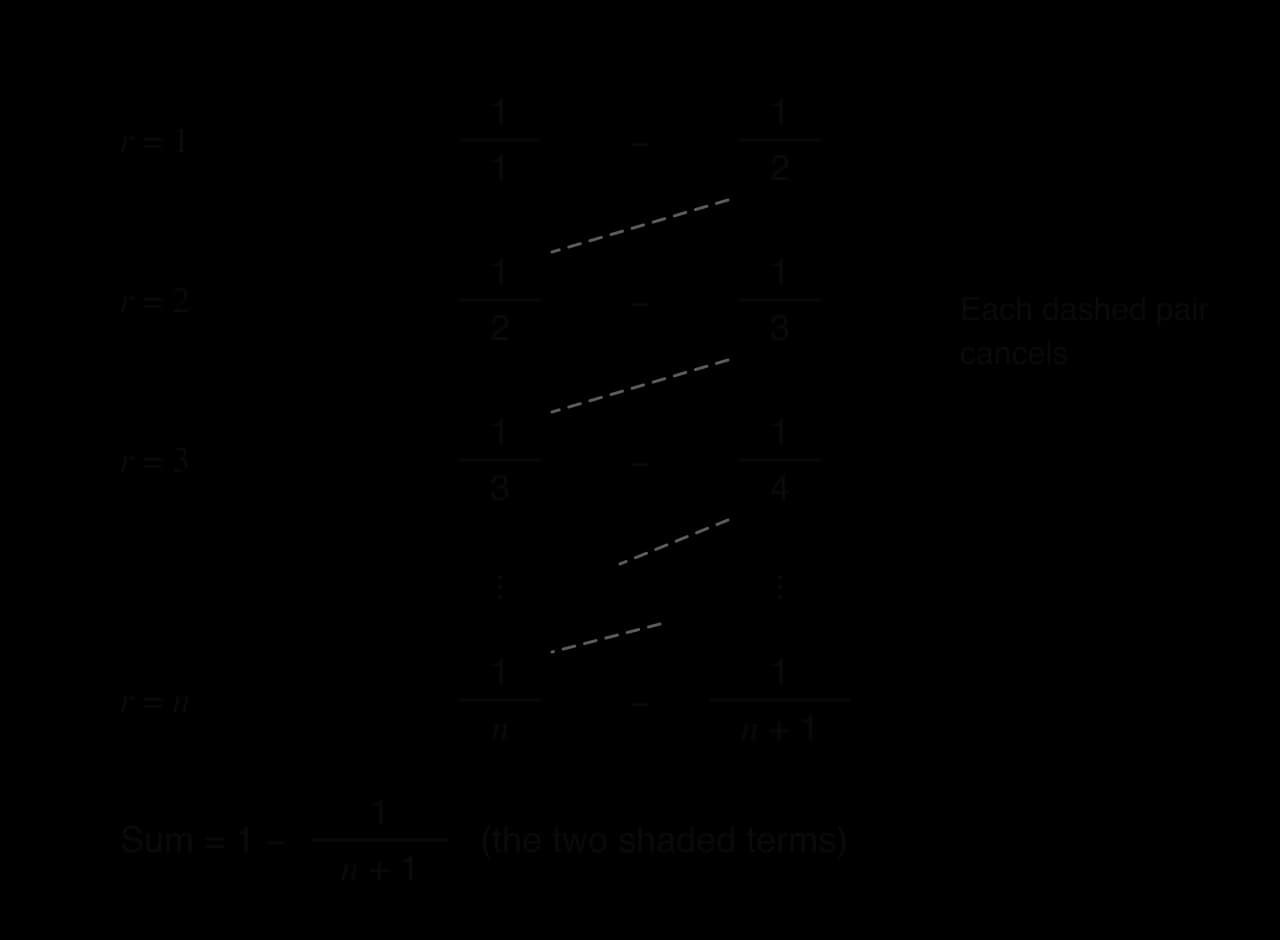
As increases, approaches 0, so the infinite series
Exam-style questions on partial fractions
Partial fractions questions are usually short first parts that set up a longer "hence" part: an integral, a series expansion or the sum of a series. The decomposition must be right, because everything after it depends on it.
A sum of series question follows the same pattern, with the cancellation set out clearly.
Self-check
- To do:
I can decide whether an algebraic fraction is proper or improper.
- To do:
I can write down the correct form
