3.5 The unit circle · IB Maths AA | Augment Education
3.5 The unit circle
Define sine, cosine and tangent for any angle using the unit circle, find exact values and signs in each quadrant, use related angles, and handle the ambiguous case of the sine rule.
IB Mathematics: Analysis and Approaches
Part of 3 Geometry and trigonometry
SL and HL
Key terms introduced here
Each is in the Maths AA glossary, with every other term in the subject.
The situation in which two sides and a non-included acute angle of a triangle fit two different triangles, so the sine rule gives two possible values (acute and obtuse) for an angle.
The acute angle between the radius to a point on the unit circle and the x-axis. Angles with the same related angle have trigonometric ratios equal in size, differing at most in sign.
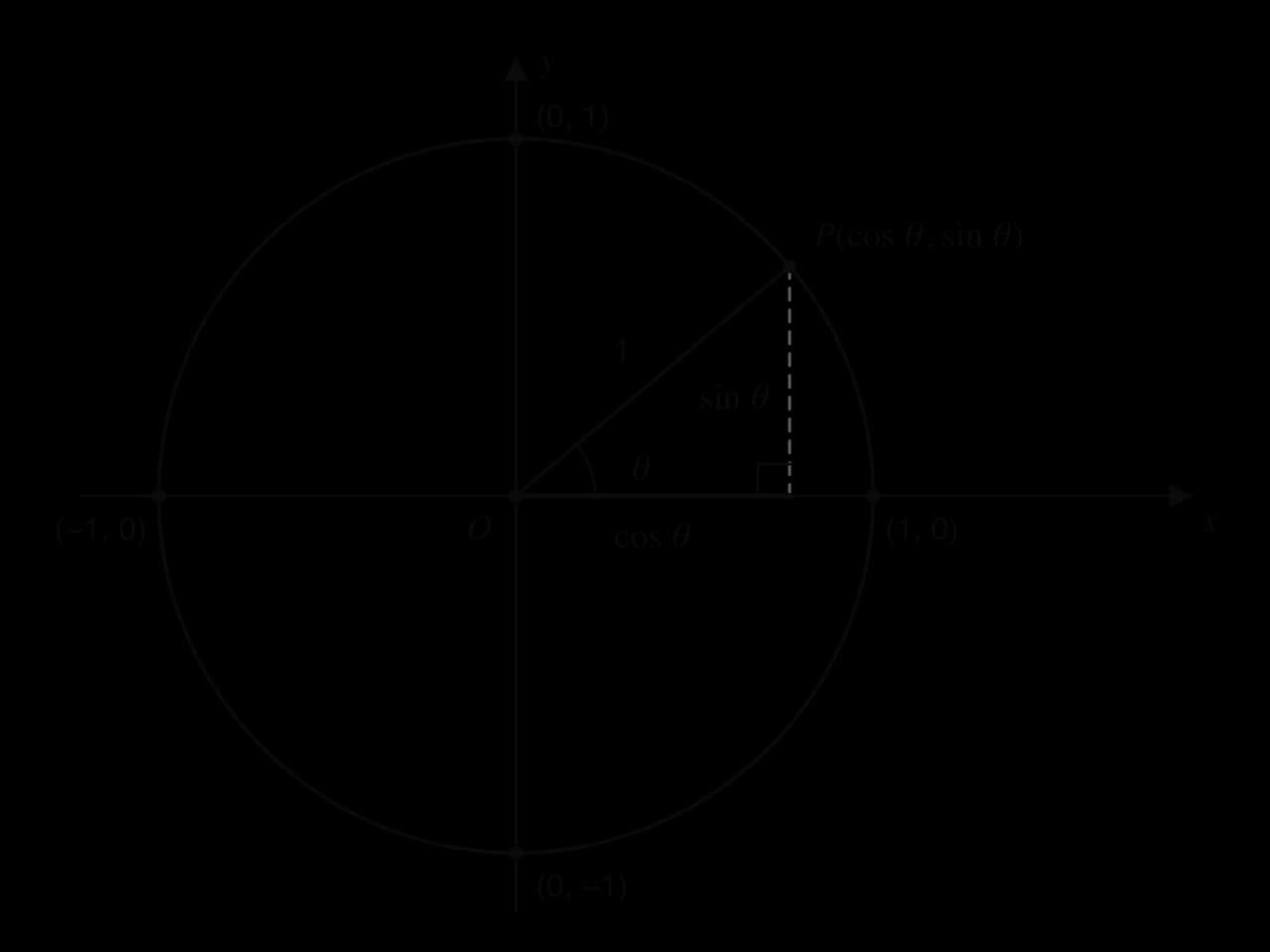
The circle of radius 1 centred at the origin. A point on it at angle θ anticlockwise from the positive x-axis has coordinates (cosθ,sinθ).
.
Derive the exact values of the trigonometric ratios of 0, 6π, 4π, 3π and 2π from special triangles.
Determine the sign of sinθ, cosθ and tanθ in each quadrant.
Use the related angles π−θ, π+θ and 2π−θ to find exact values for angles of any size.
Find the coordinates of a point on a circle from its radius and angle.
Determine when the sine rule gives two possible triangles, and find both.
In right-angled triangles, sine, cosine and tangent are ratios of sides, so they only make sense for angles between 0 and 2π (0° and 90°). Many situations involve larger angles: the obtuse angle of a triangle, the position of a point on a turning wheel after several revolutions, or a direction measured clockwise. The unit circle extends the three ratios to every angle, positive or negative, in a way that agrees with the right-angled triangle definitions for acute angles.
This extended definition underlies the graphs of the circular functions, the solution of trigonometric equations and the identities that link the ratios. It also explains why the sine rule can give two different triangles from the same information.
Angles of any size
Measuring angles from the positive x-axis
On a coordinate grid, an angle is measured from the positive x-axis. A radius starts along the positive x-axis and turns about the origin. An anticlockwise turn gives a positive angle, and a clockwise turn gives a negative angle. A turn of more than 2π (one full revolution) is also allowed: an angle of 25π is one full turn followed by a further 2π.
The axes divide the plane into four quadrants, numbered anticlockwise starting from the top right.
Angles that differ by a whole number of turns end in the same position. For example, 3π, 37π and −35π all leave the radius pointing in the same direction, because 37π=3π+2π and −35π=3π−2π.
The unit circle definitions
Sine and cosine as coordinates
The unit circle is the circle of radius 1 with its centre at the origin. When a radius turns through an angle θ, its end point P lies on this circle.
The horizontal distance of P from the y-axis is cos θ and its height above the x-axis is sin θ.
For an acute angle, this definition agrees with the ratios from right-angled triangles. Dropping a perpendicular from P to the x-axis gives a right-angled triangle with hypotenuse 1. Its adjacent side is 1adjacent=cosθ and its opposite side is 1opposite=sinθ. The new definition gives the same values for acute angles and also works for every other angle, because every angle has an end point on the circle.
Because every point of the unit circle has coordinates between −1 and 1,
−1≤sinθ≤1and−1≤cosθ≤1
for every angle θ. An equation such as sinθ=1.2 has no solution.
Tangent
The tangent of an angle is defined from the sine and cosine.
Since P is (cosθ,sinθ) and O is the origin, cosθsinθ is the rise over the run from O to P. So tanθ is the gradient of the radius OP. This gives a quick picture of its behaviour: the gradient is positive when OP slopes upwards to the right (first and third quadrants), negative when it slopes downwards (second and fourth quadrants), and undefined when OP is vertical, at θ=2π and θ=23π. Unlike sine and cosine, tanθ can take any real value.
The ratios at the axes
When P lies on an axis, its coordinates can be read straight from the circle.
θ
0
2π
π
23π
2π
Point P
(1,0)
(0,1)
(−1,0)
(0,−1)
cosθ
1
0
−1
0
1
sinθ
0
1
0
−1
0
tanθ
0
undefined
0
undefined
0
Points on a circle of any radius
A circle of radius r centred at the origin is the unit circle enlarged by a scale factor r. The point at angle θ on it is therefore
(rcosθ,rsinθ)
This describes the position of anything moving in a circle, such as a capsule on an observation wheel or the tip of a rotating blade, and it is the starting point for the circular function models in 3.7.
Exact values from special triangles
Two special triangles
The trigonometric ratios of most angles are irrational numbers that a calculator gives only approximately. For the angles 6π, 4π and 3π (30°, 45° and 60°) the ratios have exact values involving simple surds, which come from two triangles.
The first triangle is half of an equilateral triangle with sides 2. An equilateral triangle has three angles of 3π. Cutting it in half along a line of symmetry gives a right-angled triangle with hypotenuse 2, shortest side 1 and angles 6π and 3π. Pythagoras's theorem gives the third side: 22−12=3.
The second triangle is an isosceles right-angled triangle with two sides of 1. Its other two angles are equal, so each is 4π, and its hypotenuse is 12+12=2.
Every exact value for π/6, π/4 and π/3 can be read from these two triangles with SOH CAH TOA.
Reading the ratios from these triangles gives the table of exact values. The values at 0 and 2π come from the unit circle.
θ
0
6π (30°)
4π (45°)
3π (60°)
2π (90°)
sinθ
0
21
22
cosθ
1
23
tanθ
0
31=33
The value 22 is the same as 21, obtained by rationalising the denominator; both forms are correct.
The patterns in the table have a reason. Since 6π and 3π are the two acute angles of the same right-angled triangle, the side opposite one is adjacent to the other, so sin6π=cos3π and cos6π=sin3π. In general, sinθ=cos(2π−θ) for complementary angles; the "co" in cosine stands for "complement".
Signs of the ratios in each quadrant
The CAST diagram
The sign of each ratio depends only on the quadrant in which P lies. Since cosθ is the x-coordinate, it is positive to the right of the y-axis (first and fourth quadrants). Since sinθ is the y-coordinate, it is positive above the x-axis (first and second quadrants). And tanθ=cosθsinθ is positive when the two have the same sign (first and third quadrants).
Reading anticlockwise from the fourth quadrant spells CAST: the letter in each quadrant names the ratio that is positive there.
Quadrant
Angle
sinθ
cosθ
tanθ
First
0<θ<2π
+
+
+
Second
2π<θ<π
+
−
Third
π<θ<23π
−
−
Fourth
23π<θ<2π
−
+
Related angles
Symmetry of the unit circle
The unit circle is symmetric in both axes and about the origin. A point P at angle θ in the first quadrant therefore has three mirror images, one in each other quadrant, each making the same acute angle θ with the x-axis. This acute angle is the related angle (also called the reference angle).
The four points are reflections of each other in the axes, so their coordinates differ only in sign.
Reading the coordinates from the diagram gives the related angle results. Each row follows from the position of the point and the CAST signs.
Angle
Quadrant (for acute θ)
sin
cos
tan
π−θ
Second
sin(π−θ)=sinθ
cos(π−θ)=−cosθ
tan(π−θ)=−tanθ
π+θ
Third
sin(π+θ)=−sinθ
cos(π+θ)=−cosθ
2π−θ
Fourth
sin(2π−θ)=−sinθ
cos(2π−θ)=cosθ
−θ
Fourth
sin(−θ)=−sinθ
cos(−θ)=cosθ
These results hold for every value of θ, not only acute ones; the quadrant column describes the picture when θ is acute. The angle −θ ends at the same point as 2π−θ, so its row matches. In degrees the same results read sin(180°−θ)=sinθ, cos(180°−θ)=−cosθ, and so on.
Finding the ratio of any angle
To find an exact value for any angle, work through three steps:
Find the quadrant in which the angle ends (subtract multiples of 2π first if the angle is larger than 2π or negative).
Find the related angle, the acute angle to the x-axis.
Take the ratio of the related angle and attach the sign given by CAST.
Every standard angle has coordinates built from 0, 1/2, √2/2, √3/2 and 1; only the signs change from quadrant to quadrant.
Angles outside the interval 0 to 2π are handled in the same way after adding or subtracting whole turns, since a whole turn returns P to the same point.
Expressions with an unknown angle
The related angle results also simplify expressions in which the angle is a letter.
Two angles with the same ratio
Reversing the process, each value of a ratio between −1 and 1 (other than ±1) comes from exactly two angles in 0≤θ<2π: one in each of the two quadrants where the ratio has that sign. The graph of y=sinx shows this for sinx=21: the line y=21 meets the curve at x=6π and x=π−6π=65π.
y = sin x
The curve is symmetric about x = π/2, so sin(π − θ) = sin θ. Between π and 2π the sine is negative, matching the third and fourth quadrants.
The ambiguous case of the sine rule
Why two triangles can fit
The sine rule from 3.2 finds an unknown angle from its sine:
asinA=bsinB=csinC
Because sin(180°−θ)=sinθ, a value such as sinB=0.8333 is produced by an acute angle B≈56.4° and also by the obtuse angle 180°−56.4°=123.6°. A calculator gives only the acute one. Sometimes both angles fit a triangle with the given measurements; this is the ambiguous case.
A 6 cm side swinging from C meets the base line twice, giving triangle AB₁C with an obtuse angle at B₁ and triangle AB₂C with an acute angle at B₂.
The diagram shows the geometry. The side AC and the angle at A are fixed. The third side, CB=6 cm, can swing like a hinge about C, and its end meets the base line at two points. The two triangles AB1C and AB2C both have A=30°, AC=10 cm and BC=6 cm. The triangle B1CB2 is isosceles, so the angles at B1 and B2 are supplementary: one is acute and the other obtuse.
When does the ambiguous case occur?
Suppose angle A (acute), side b=AC and side a=BC, opposite A, are given. The distance from C to the base line is bsinA. Comparing a with this distance and with b decides how many triangles exist.
Condition on a
Number of triangles
Reason
a<bsinA
none
a is too short to reach the base line
a=bsinA
one (right-angled at B)
a just touches the base line
bsinA<a<b
two
a meets the base line at two points on the same side of A
a≥b
one
the second point lies behind A, so it does not form a triangle
In practice, there is no need to memorise this table. Find the acute angle from the sine rule, form the obtuse alternative 180°−θ, and check whether the angles of each triangle add up to less than 180°.
The obtuse alternative does not always survive the check, as the next example shows.
The conditions can also be used in reverse, to find which lengths give two triangles.
Exam-style questions on the unit circle
Questions on this content come in two kinds: short non-calculator questions on exact values and signs, and longer calculator questions in which the sine rule gives two triangles.
Self-check
To do:
I can define sinθ and cosθ as the coordinates of a point on the unit circle, and tanθ as cosθsinθ, the gradient of the radius.
To do:
I can derive the exact values for 6π, 4π and 3π
To do:
I can state the sign of each ratio in each quadrant using CAST.
To do:
I can find the exact value of a ratio of any angle, including negative angles and angles larger than 2π, using related angles.
To do:
I can simplify expressions such as sin(π−α), cos(π+α) and tan(2π−α)
To do:
I can find the coordinates (rcosθ,rsinθ) of a point on a circle of radius r.
To do:
I can decide whether the sine rule gives zero, one or two triangles, and find all the possible triangles.
. The point
D
lies on
[BC]
such that
AD^B=60°
.
Find the exact length of [DC].
[4]4 marks
Markscheme
tan30°=BC6 OR BC=tan30°6(M1)
BC=63A1
BD=tan60°6=36(=23)
DC=63−23=43
Note: Accept the alternative: triangle ADC is isosceles (as DA^C=30°=AC^D), so DC=AD=sin60°6=43
Question 2 · AA-000807 marks
In triangle ABC, AB=x cm, AC=(x+4) cm and BA^C=150°. The area of the triangle is 15 cm2.