3.6 Trigonometric identities · IB Maths AA | Augment Education
3.6 Trigonometric identities
Use the Pythagorean identity and the double angle identities to find one ratio from another, simplify expressions, find exact values and prove trigonometric identities.
IB Mathematics: Analysis and Approaches
Part of 3 Geometry and trigonometry
SL and HL
Key terms introduced here
Each is in the Maths AA glossary, with every other term in the subject.
The identity cos2θ+sin2θ=1, true for every angle θ. It follows from Pythagoras's theorem applied to a point on the unit circle.
from the unit circle.
Find the exact values of the other ratios of an angle from one ratio and the quadrant of the angle.
Use the double angle identities for sin2θ and cos2θ, choosing the most useful form of cos2θ.
Simplify trigonometric expressions using tanθ=cosθsinθ and the identities.
Prove trigonometric identities by working from one side to the other.
Use identities to find exact values and to rewrite equations in terms of a single ratio.
The ratios sinθ, cosθ and tanθ are not independent of each other. They are coordinates and a gradient taken from the same point on the unit circle, so they are linked by equations that hold for every angle. These equations, called trigonometric identities, allow one ratio to be found from another, turn complicated expressions into simple ones and change an equation into a form that can be solved.
Identities are a clear example of equivalence: two expressions that look different but take the same value for every input. The same identities are used again to solve trigonometric equations, to differentiate and integrate the circular functions, and to model waves.
Identities and equations
An equation such as sinθ=21 is true only for particular values of θ, which are found by solving it. An identity is true for every value of the variable for which both sides are defined. The symbol ≡ ("is identically equal to") is sometimes used to stress this, as in tanθ≡cosθsinθ.
The difference matters for how each is handled. An equation is solved. An identity is proved, by showing that one side can be turned into the other using results already known (see 1.6). A single value of θ for which the two sides differ, a counterexample, is enough to show that a statement is not an identity.
The graphs of y=sin2x and y=2sinx make the same point: the curves are different, and they meet only at isolated points.
y = sin 2x
y = 2 sin x
sin 2x has twice as many waves as sin x, while 2 sin x is twice as tall. The two curves meet only where sin x = 0.
The tangent identity
The definition of tangent from 3.5 is the first identity:
tanθ=cosθsinθ,cosθ=0
It is in the formula booklet. It is used to replace tanθ whenever an expression mixes tangent with sine and cosine, since a mixture of different ratios is usually easier to handle once everything is written in terms of sinθ and cosθ.
The Pythagorean identity
Derivation from the unit circle
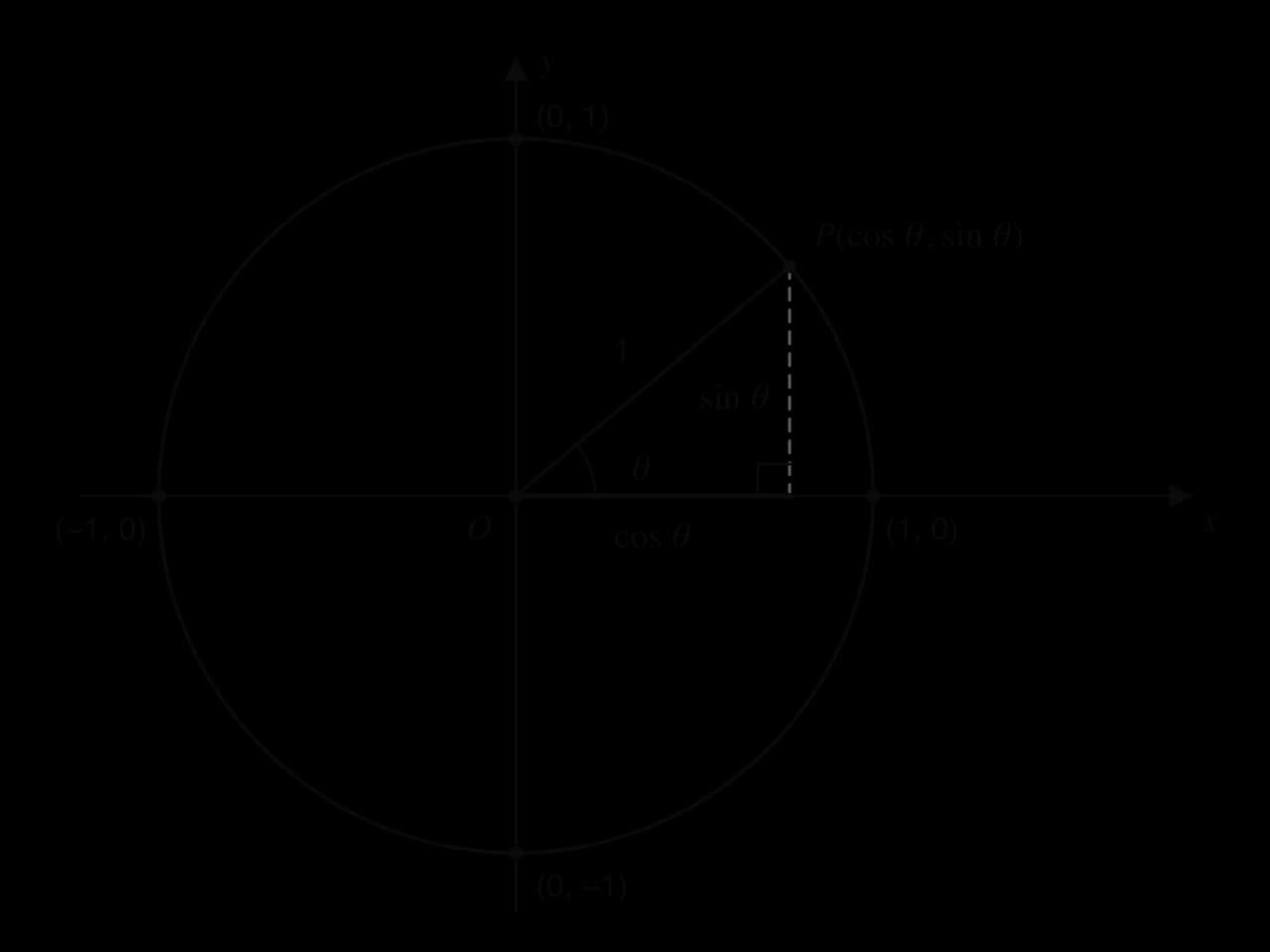
A point P on the unit circle at angle θ has coordinates (cosθ,sinθ). Every point on the unit circle satisfies x2+y2=1, because its distance from the origin is 1. Substituting the coordinates of P gives the Pythagorean identity.
The right-angled triangle has legs cos θ and sin θ and hypotenuse 1, so Pythagoras's theorem gives cos²θ + sin²θ = 1.
For an acute angle this is Pythagoras's theorem in the right-angled triangle with hypotenuse 1. The unit circle argument shows more: it holds in every quadrant, because the signs of cosθ and sinθ disappear when they are squared. The identity is in the formula booklet.
Rearranged forms
The identity is often used in one of its rearranged forms:
sin2θ=1−cos2θcos2θ=1−sin2θ
These replace one squared ratio by the other, which is how an expression or an equation containing both sinθ and cos2θ is turned into one containing only sinθ.
Finding one ratio from another
When one ratio of an angle is known, the Pythagorean identity gives the square of another. Taking the square root gives two possible values, positive and negative, and the quadrant of the angle decides which sign is correct.
The method:
Use cos2θ+sin2θ=1 to find the square of the unknown ratio.
Take the square root, keeping both signs.
Use the given quadrant (and CAST from 3.5) to choose the sign.
If tanθ is needed, use tanθ=cosθsinθ.
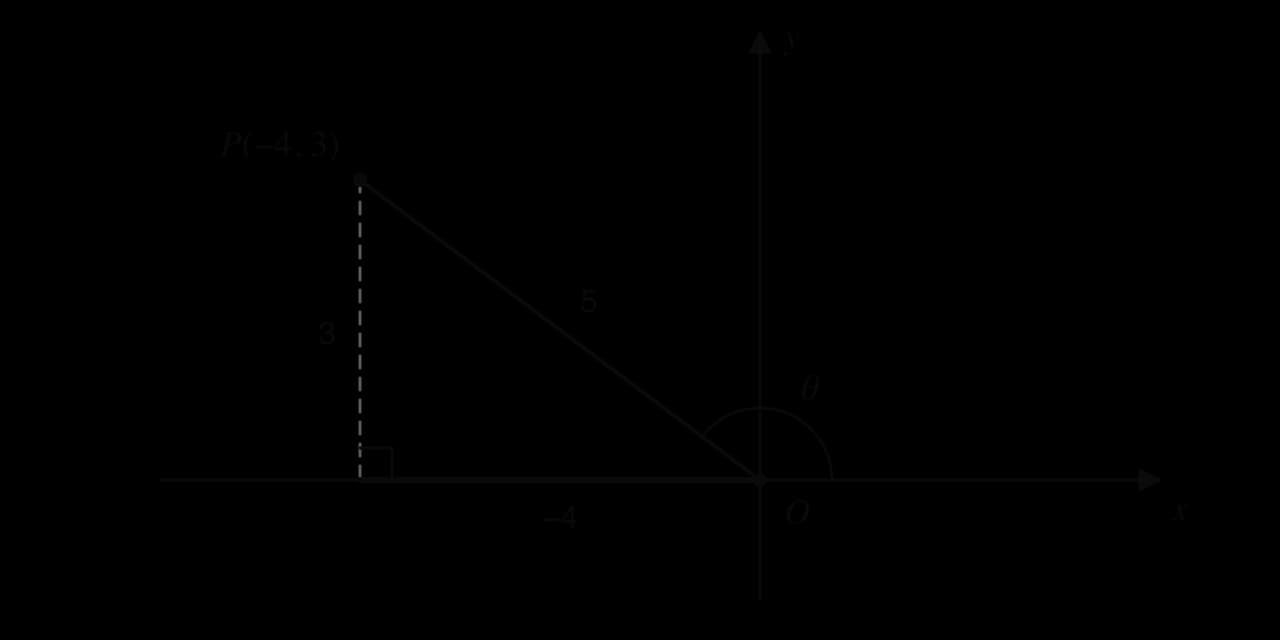
The same result can be seen geometrically. The point at angle θ on a circle of radius 5 has a y-coordinate of 3, so it is P(−4,3), in the second quadrant.
With sin θ = 3/5 and θ obtuse, P lies at (−4, 3) on a circle of radius 5, so cos θ = −4/5 and tan θ = 3/(−4).
When the given ratio is the tangent, it is often quicker to draw a right-angled triangle for the related angle than to use the identity, then attach the signs from CAST.
Questions can also give the ratio as a letter. The method is the same; the answer is an expression in that letter.
Double angle identities
The identities
The double angle identities express the ratios of 2θ in terms of the ratios of θ. Both are in the formula booklet.
Where the identities come from
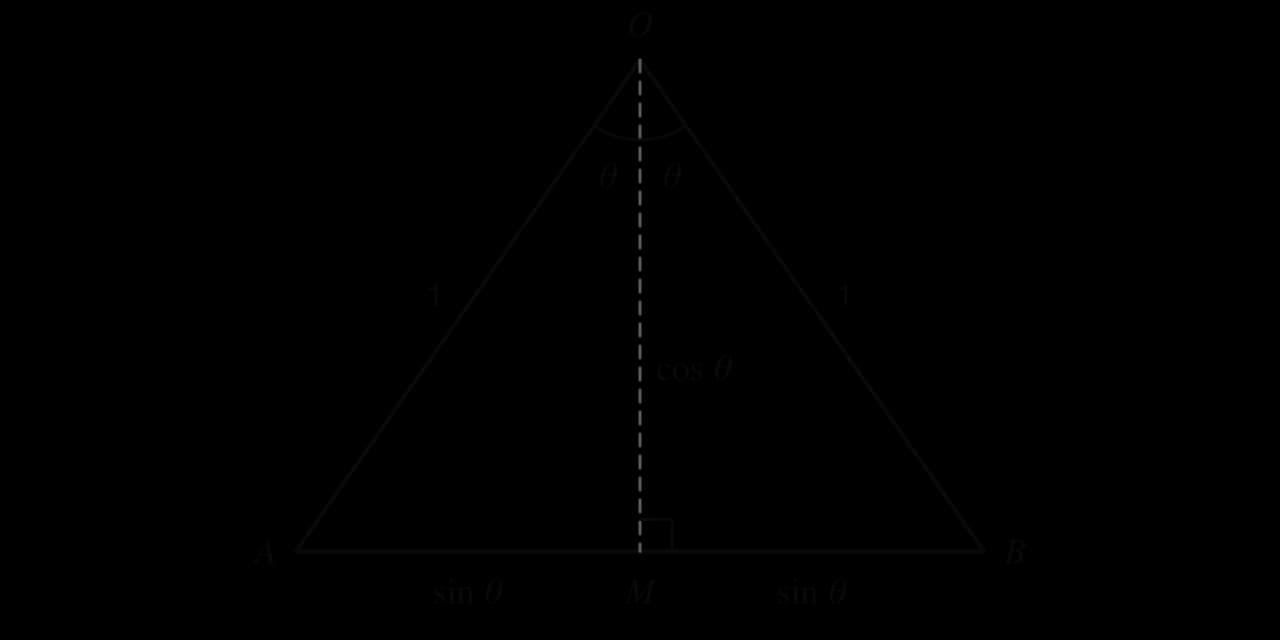
For 0<θ<2π, both identities can be seen in one isosceles triangle. Take triangle OAB with OA=OB=1 and angle 2θ at O. The altitude OM bisects the angle at O and the base AB, splitting the triangle into two right-angled triangles, each with hypotenuse 1 and angle θ at O. In each, AM=MB=sinθ and OM=cosθ.
The triangle has two sides of 1 with angle 2θ between them, and base 2 sin θ. Finding its area and its base in two ways gives the double angle identities.
Sine. The area of triangle OAB can be found in two ways. Using 21absinC with the two sides of length 1 and the angle 2θ between them gives 21sin2θ. Using 21×base×height gives 21×2sinθ×cosθ=sinθcosθ. Setting these equal:
21sin2θ=sinθcosθ⇒sin2θ=2sinθcosθ
Cosine. The base AB can also be found in two ways. The cosine rule in triangle OAB gives AB2=12+12−2cos2θ=2−2cos2θ. From the diagram, AB=2sinθ, so AB2=4sin2θ. Setting these equal:
2−2cos2θ=4sin2θ⇒cos2θ=1−2sin2θ
This argument only covers acute θ, but the identities hold for every angle. A general proof uses the compound angle identities for sin(A+B) and cos(A+B) with A=B=θ, which HL students meet in 3.10.
The three forms of cos 2θ
The other two forms of cos2θ follow from 1−2sin2θ by the Pythagorean identity. Replacing 1 by cos2θ+sin2θ:
cos2θ=cos2θ+sin2θ−2sin2θ=cos2θ−sin2θ
Replacing sin2θ by 1−cos2θ:
cos2θ=1−2(1−cos2θ)=2cos2θ−1
Form
Most useful when
cos2θ=cos2θ−sin2θ
both sinθ and cosθ are known, or an expression has cos2θ−sin2θ
cos2θ=2cos2θ−1
only cosθ is known, or the result must be in terms of cosθ
cos2θ=1−2sin2θ
only sinθ is known, or the result must be in terms of sinθ
Finding double angle ratios
Other multiples of the angle
"Double" is relative: the identities link any angle with its half. Replacing θ by 2x, 3x or 2x gives, for example,
sin4x=2sin2xcos2xcos6x=1−2sin23xcosx=2cos22x−1
Writing squares in terms of cos 2θ
Rearranging the two single-ratio forms of cos2θ gives expressions for cos2θ and sin2θ with no squares in them:
cos2θ=21+cos2θsin2θ=21−cos2θ
These are used to integrate sin2x and cos2x in calculus, and to find exact values for half of a standard angle. The graph shows that y=cos2x and y=21+21cos2x are the same curve.
y = cos² x
y = ½ + ½ cos 2x
The two curves lie exactly on top of each other: cos² x is a cosine wave with half the height and twice the frequency, centred on y = 1/2.
A double angle in a model
Double angles appear naturally in models. A ball launched with speed v at an angle θ above horizontal ground, with air resistance ignored, lands at a horizontal distance
R=g2v2sinθcosθ
where g≈9.8 m s⁻² is the acceleration due to gravity. The double angle identity turns this into R=gv2sin2θ, which shows at once how the range depends on the angle.
Proving identities
The method
To prove an identity, start from one side and transform it, step by step, into the other side. Each step uses algebra or an identity that is already known. The usual approach:
Start with the more complicated side; there is more to simplify.
Write tanθ as cosθsinθ, so that only sines and cosines remain.
Replace double angles by single angles (or the other way round) so that all the angles match.
Look for cos2θ+sin2θ, which can be replaced by 1, or for 1, which can be replaced by cos2θ+sin2θ.
Use algebra: expand brackets, factorise, add fractions over a common denominator, cancel common factors.
End with "= RHS" (or "= LHS") so it is clear that the proof is complete.
Identities with fractions
When an identity contains a fraction with a double angle, choose the form of cos2θ that simplifies the numerator or the denominator. In 1−cos2θ, the form 1−2sin2θ makes the 1s cancel; in 1+cos2θ, the form 2cos2θ−1 does the same.
When one side contains a sum of fractions, adding them over a common denominator usually produces sin2θ+cos2θ or 1−sin2θ in the numerator or denominator.
Denominators of the form 1−sinθ and 1+sinθ multiply to a difference of two squares, 1−sin2θ, which the Pythagorean identity turns into cos2θ. The same happens with 1±cosθ.
Rewriting equations with identities
Identities are also used to rewrite an equation so that it contains only one trigonometric ratio of one angle, ready to be solved as in 3.8. Typical steps are replacing cos2x by 1−sin2x and replacing cos2x by the form that matches the rest of the equation.
Exam-style questions on identities
Identity questions are usually set without a calculator and in several linked parts: find one ratio from another, use it in a double angle identity, then prove or apply a related result.
Self-check
To do:
I can explain why cos2θ+sin2θ=1 for every angle, using the unit circle.
To do:
I can find sinθ, cosθ or tanθ from one other ratio, choosing the sign from the quadrant.
To do:
I can state sin2θ=2sinθcosθ and the three forms of cos2θ, and choose the most useful form.
To do:
I can find the exact values of sin2θ, cos2θ and tan2θ from one ratio of θ.
To do:
I can recognise expressions such as 2sinAcosA, cos2A−sin2A and 1−2sin2A
To do:
I can prove an identity by working from one side to the other in a single chain of equalities.
To do:
I can use identities to rewrite an equation in terms of a single trigonometric ratio.
(c) Expand as a difference of two squares, then use the identity.
(1−sinθ)(1+sinθ)=1−sin2θ=cos2θ
cosθ=±54
An obtuse angle lies in the second quadrant, where cosine is negative, so
cosθ=−54
Then
tanθ=cosθsinθ=−5453=−43
The angle is in the third quadrant, where sine is negative, so sinθ=−1312.
tanθ=−135−1312=512
This is positive, as expected: tangent is positive in the third quadrant.
.
The angle is in the fourth quadrant, where cosine is positive and sine is negative.
sinθ=−52=−525cosθ=51=55
Check: cosθsinθ=1/5−2/5=−2, and sin2θ+cos2θ=54+51=1.
In the second quadrant cosine is negative, so
cosx=−1−k2tanx=−1−k2k=−1−k2k
alone
alone
cos2θ=1−2sin2θ=1−2×259=257
tan2θ=cos2θsin2θ=257−2524=−724
A check on the signs: θ≈143.1°, so 2θ≈286.3°, in the fourth quadrant, where sine is negative and cosine is positive.
For sin2θ, first find sinθ. In the first quadrant sine is positive:
sinθ=1−91=98=322
sin2θ=2×322×31=942
(b) cos2θ−sin2θ=cos2θ, so
cos28π−sin28π=cos4π=22
(c) 1−2sin2θ=cos2θ, so
1−2sin275°=cos150°=−cos30°=−23
.
cos4π=2cos28π−1⇒cos28π=21+22=42+2
The angle 8π is in the first quadrant, so the cosine is positive.
cos8π=42+2=22+2
A calculator check: both cos8π and 22+2 equal 0.92388….
, so
R=9.8400sin2θ
.
(b) The largest value of sin2θ is 1, when 2θ=90°, so θ=45°.
Rmax=9.8400=40.8 m(3 s.f.)
(c) For θ=30°, sin2θ=sin60°; for θ=60°, sin2θ=sin120°=sin(180°−60°)=sin60°. The ranges are equal:
R=9.8400sin60°=9.8400×23=35.3 m(3 s.f.)
In general, complementary angles θ and 90°−θ give the same range, since sin(180°−2θ)=sin2θ. The model is a simplification: with air resistance, the best angle is lower than 45°.
Multiplying the numerator and denominator by 2 in the last line creates the 2sinθcosθ of the double angle identity.
2−2sin2x+sinx−1=0
−2sin2x+sinx+1=0
Multiply by −1:
2sin2x−sinx−1=0
This is a quadratic equation in sinx, which factorises as (2sinx+1)(sinx−1)=0.
x is in the second quadrant, where sine is positive, so sinx=35.
(b) sin2x=2sinxcosx=2×35×(−32)=−945
(c) Only cosx was given, so use the form in cosx:
cos2x=2cos2x−1=2×94−1=−91
(d) tan2x=cos2xsin2x=−91−945=45
, where
a,b∈Z
. [4]
(b) "Hence" means use part (a) with θ=8π, so that 2θ=4π.
tan8π=1+cos4πsin4π=1+2222=2+22
Rationalise the denominator by multiplying by 2−22−2: