A straight line segment joining two points on a curve. On a circle the longest chord is a diameter; on the graph of a function, the gradient of a chord is the average rate of change between its two endpoints.
The region of a circle bounded by a chord and the arc it cuts off. Its area is the sector area minus the triangle area: 21r2(θ−sinθ).
.
Find the area of a segment as the area of a sector minus the area of a triangle.
Determine an unknown radius or angle from a given arc length, area or perimeter.
Solve problems involving circles in context, such as wheels, clock hands and overlapping circles.
Degrees divide a full turn into 360 equal parts, a choice inherited from ancient astronomy rather than from any property of the circle. The radian measures an angle by comparing the length of an arc with the radius of its circle, which makes it the natural unit for any angle that comes from turning. With angles in radians, the length of an arc and the area of a sector have very short formulas, and in calculus the derivatives of sinx and cosx take their simple forms only when x is in radians.
Arcs and sectors appear wherever something turns: the distance travelled by a point on a wheel, the region swept by a windscreen wiper, the slice of a pie chart, or the curved bend of a running track.
The parts of a circle
A circle is the set of points at a fixed distance, the radius r, from a fixed point, the centre O. Several parts of a circle have names that are used throughout this subtopic.
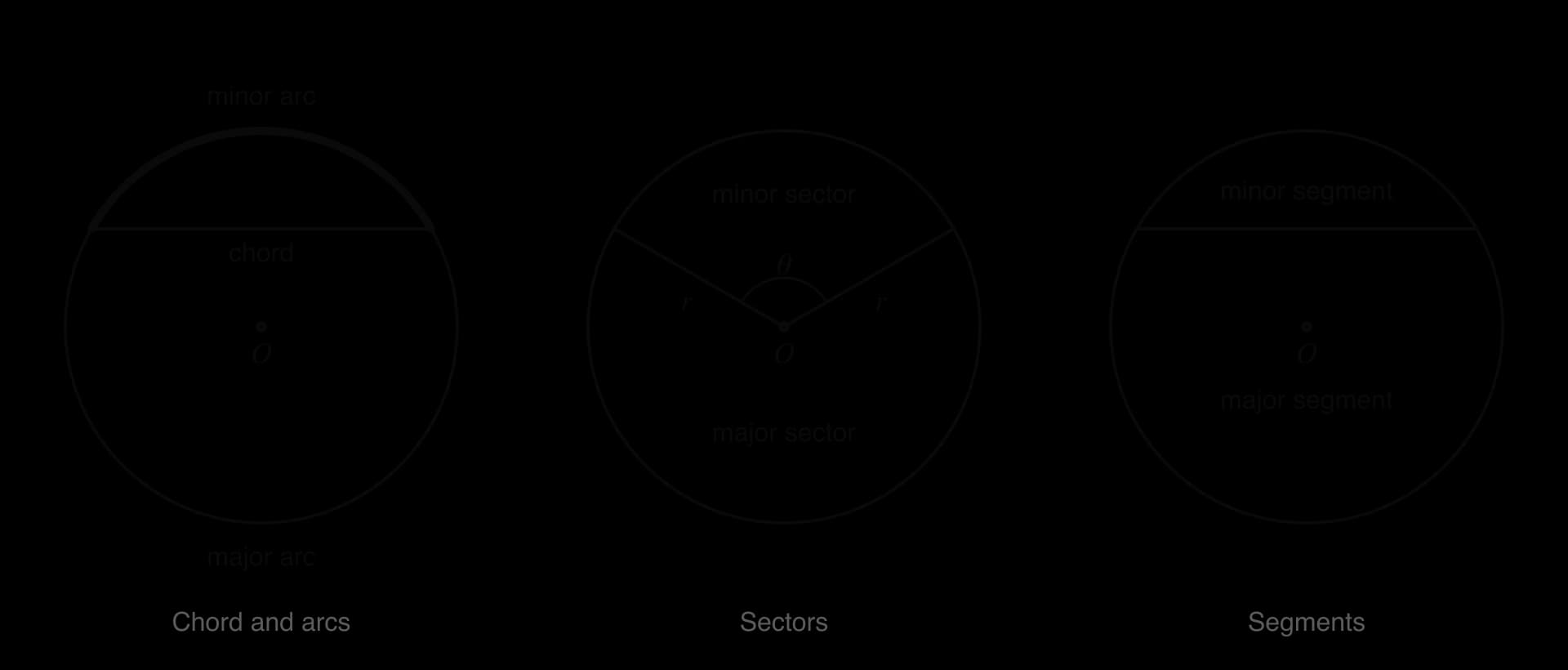
A chord is a straight line segment joining two points on the circle. A chord through the centre is a diameter.
An arc is a part of the circumference between two points. The shorter one is the minor arc and the longer one is the major arc.
A sector is the region between two radii and an arc, shaped like a slice of pizza.
A segment is the region between a chord and an arc.
An arc is part of the edge, a sector is cut off by two radii, and a segment is cut off by a chord. Each comes in a minor (smaller) and a major (larger) version.
The angle θ between the two radii, measured at the centre, is called the angle subtended by the arc at the centre. Arc lengths, sector areas and segment areas are all calculated from this angle and the radius.
Radian measure
Defining the radian
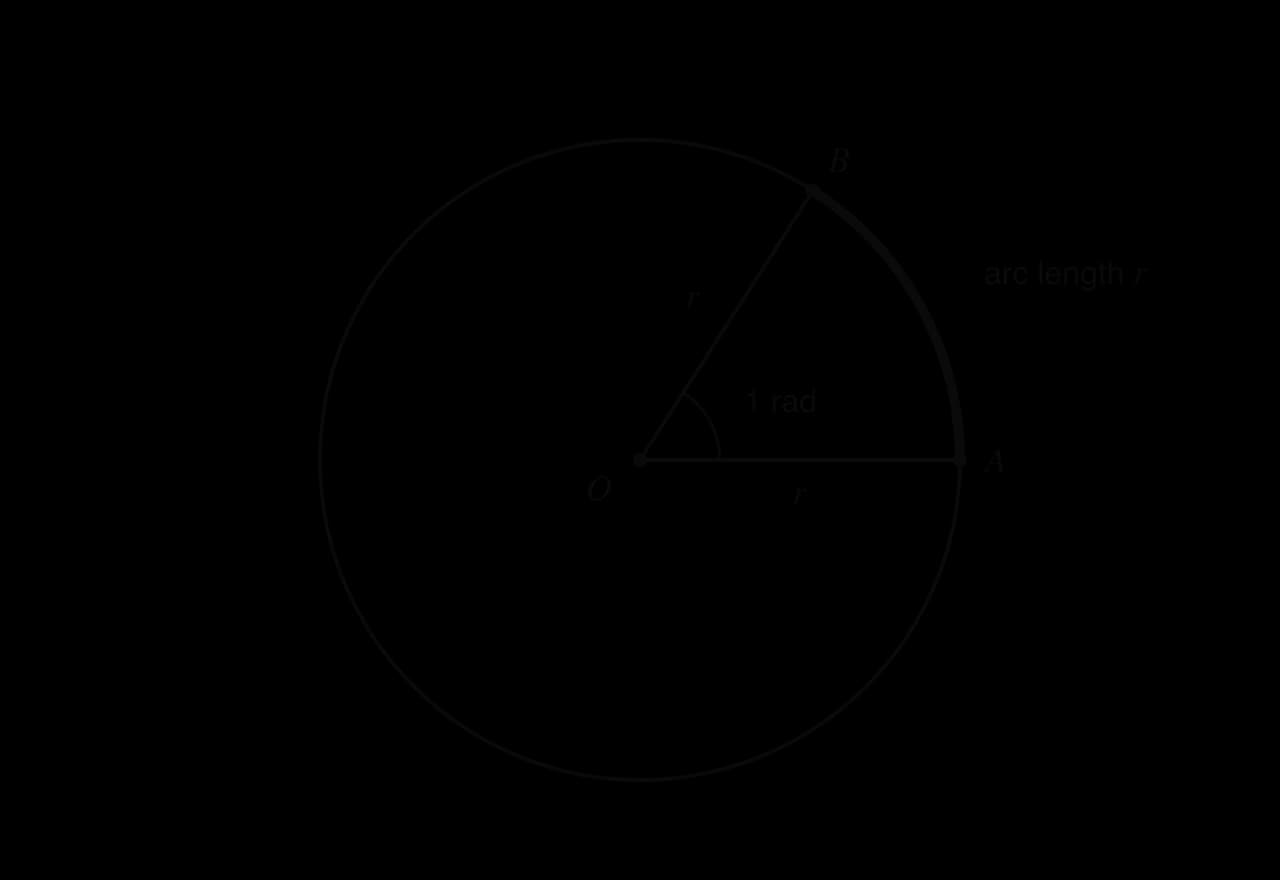
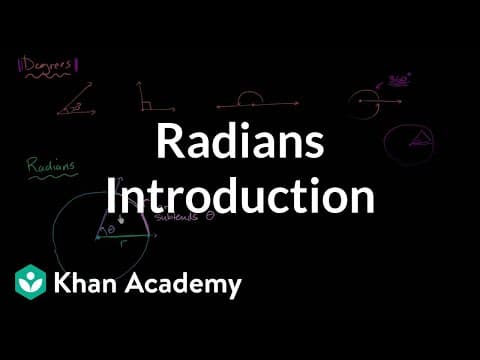
Take a circle of radius r and mark off an arc whose length is exactly r. The angle at the centre between the radii to the ends of this arc is one radian.
Bending one radius around the edge of the circle gives an arc that subtends exactly 1 radian at the centre, a little under 60°.
Because the definition compares two lengths, the size of a radian does not depend on the size of the circle. A larger circle has a longer radius and a proportionally longer arc, so the angle is the same. This is why a radian is a pure number: an angle in radians is the ratio radiusarc length, and the units of length cancel.
How many radians in a full turn
The whole circumference has length 2πr. The number of radius-lengths that fit around the circle is therefore
r2πr=2π
so a full turn is 2π radians, a little more than 6.28 rad. Since a full turn is also 360°,
2π rad=360°and soπ rad=180°
This single fact, π radians equals 180°, is all that is needed to convert in either direction. Dividing by π gives the size of one radian in degrees:
1 rad=π180°≈57.3°
Converting between degrees and radians
To convert, multiply by the ratio that cancels the unit being removed.
Conversion
Multiply by
Example
Degrees to radians
180π
60°=60×180π=3π
Radians to degrees
π180
43π=43π×π180=135°
When the angle in degrees is a simple fraction of 180°, the answer in radians is best left as an exact value, a fraction of π. The angles in the next table occur so often that it is worth knowing them by heart.
Degrees
0°
30°
45°
60°
90°
120°
135°
150°
180°
270°
360°
Radians
0
6π
4π
Radian mode on a calculator
A graphic display calculator (GDC) works in either degree mode or radian mode, and the same keystrokes give different answers in each. In degree mode sin2 means the sine of 2°, about 0.0349; in radian mode it means the sine of 2 radians, about 0.909. Whenever an angle is given in radians, or whenever a formula such as the segment area formula mixes θ with sinθ, the calculator must be in radian mode.
Arc length
Deriving the formula
An arc that subtends an angle θ at the centre is a fraction of the full circumference. The fraction is the angle divided by a full turn, 2πθ in radians or 360θ in degrees. So the length of the arc is
l=2πθ×2πr=rθ
The 2π cancels, leaving one of the shortest formulas in geometry. The derivation also agrees with the definition of a radian: when θ=1, the arc length is r.
The formula l=rθ can be rearranged to find either the radius or the angle: r=θl and θ=rl. The second of these is exactly the definition of radian measure, angle = arc length ÷ radius.
The perimeter of a sector
The boundary of a sector is made of two radii and one arc, so its perimeter is
P=2r+rθ
Leaving out the two radii is the most common error with sector perimeters.
Arc length in context
A point on the rim of a wheel, a capsule on an observation wheel and the tip of a clock hand all move along arcs. The distance travelled is the arc length, whereas the straight-line distance from start to finish is the length of a chord, which is always shorter.
Arc length also converts angles into distances on the Earth. Along a line of longitude, the distance between two places is an arc of a circle whose radius is the Earth's radius, about 6371 km. One degree of latitude is 180π radians, so it corresponds to about 6371×180π≈111 km on the ground. This is the reason a nautical mile was originally defined as one-sixtieth of a degree of latitude.
Area of a sector
Deriving the formula
A sector with angle θ at the centre is the same fraction 2πθ of the whole disc as its arc is of the circumference. Its area is therefore
A=2πθ×πr2=21r2θ
Both l=rθ and A=21r2θ are in the formula booklet, with θ in radians. Combining them gives a useful link: since rθ=l, the area can also be written as A=21rl. This mirrors the area of a triangle, 21×base×height, with the arc as the base and the radius as the height; a thin sector is very nearly a triangle.
Finding the radius or the angle from an area
When the area is known, rearrange A=21r2θ. To find the angle, θ=r22A; to find the radius, r=θ2A, taking the positive root because a radius is a length.
Sectors in context
The hands of a clock sweep out sectors. The minute hand turns through a full turn, 2π radians, every 60 minutes, so it turns through 30π radians each minute. The hour hand turns through 2π every 12 hours, which is 360π radians each minute.
Regions between two arcs
Some shapes are the difference between two sectors with the same centre and angle, such as the region swept by a windscreen wiper blade or a curved path around a flower bed. Their area is the area of the larger sector minus the area of the smaller one:
A=21R2θ−21r2θ=21(R2−r2)θ
Area of a segment
Sector minus triangle
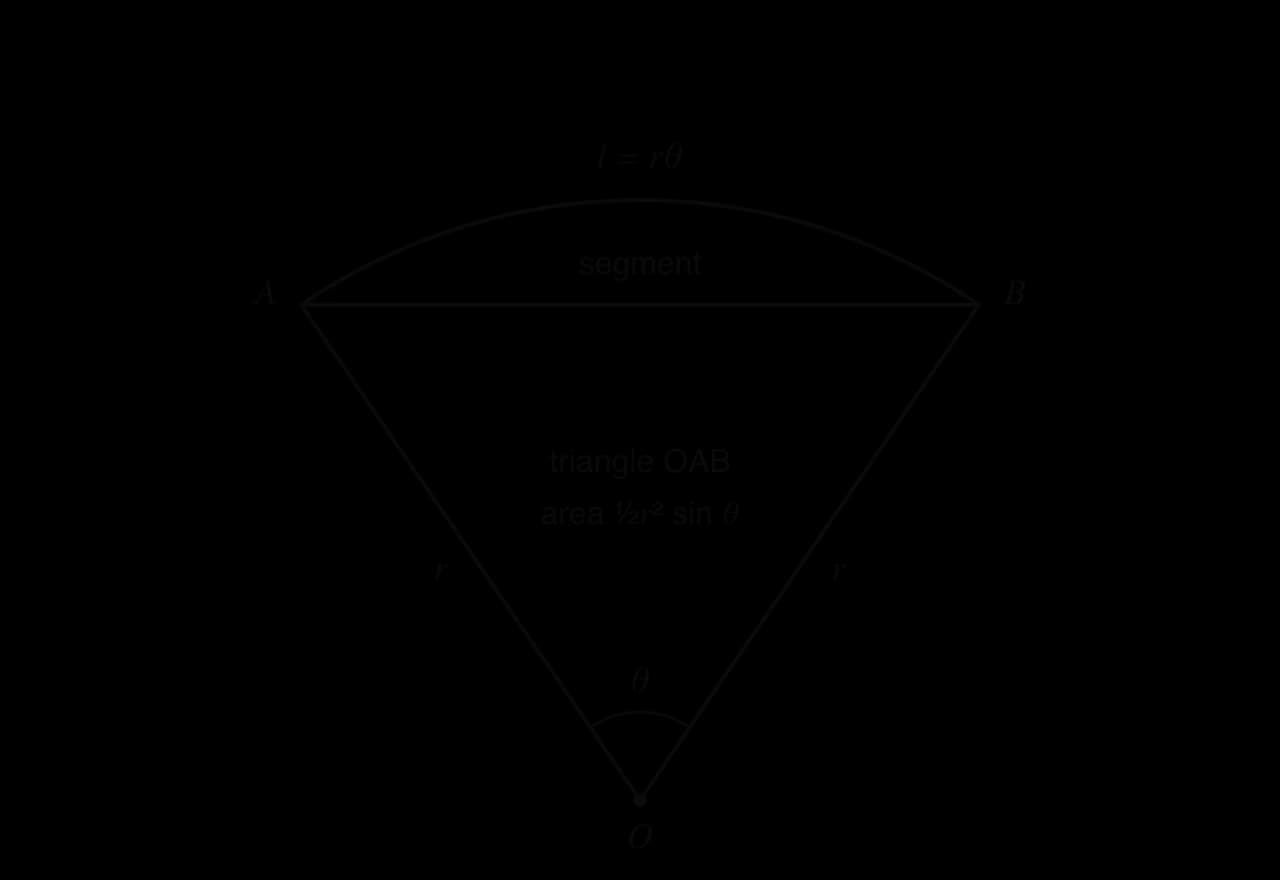
A minor segment is the part of a sector that lies outside the triangle formed by the two radii and the chord. Its area is therefore the area of the sector minus the area of triangle OAB. The triangle has two sides of length r with the angle θ between them, so by the formula 21absinC from 3.2 its area is 21r2sinθ.
The chord AB cuts the sector into a triangle and a segment, so the segment is what remains after the triangle is removed.
Area of segment=21r2θ−21r2sinθ=21r2(θ−sinθ)
This formula is not in the formula booklet, but it follows in one line from two that are. Both terms use the same angle θ, so the calculator must be in radian mode when evaluating sinθ.
Major segments
The major segment is everything in the circle outside the minor segment, so its area is
πr2−21r2(θ−sinθ)
The segment formula also works directly with the reflex angle 2π−θ. Since sin(2π−θ)=−sinθ, it gives 21r2(2π−θ+sinθ), which simplifies to the same expression. For a reflex angle the "triangle" term is negative and is added on, because the triangle now lies inside the major segment.
Segment area as a function of the angle
For a circle of radius 1, the segment area is 21(θ−sinθ). It grows from 0 when θ=0 to 2π (half the disc) when θ=π, and to π (the whole disc) when θ=2π. The equation θ−sinθ=k cannot be rearranged to make θ the subject, so questions that give a segment area and ask for the angle are solved with a GDC, by graphing or with an equation solver.
segment area, r = 1
The segment area increases with θ, slowly at first. A quarter of the disc (area π/4) is cut off when θ ≈ 2.31, not when θ = π/2.
Problems with unknown radius and angle
When two facts about a sector are given, such as its perimeter and its area, each gives an equation in r and θ. Solving them simultaneously finds both, and the solutions must then be checked against the geometry: r>0 and 0<θ<2π.
The next type combines a length condition and an area condition, leading to a quadratic equation in r (see 2.7). One of its roots often fails the condition θ<2π.
Why radians are used
Degrees remain convenient in triangle problems and for bearings, and most triangle questions in 3.2 and 3.3 use them. Radians are preferred elsewhere for two reasons. First, they make the circle formulas simple: l=rθ and A=21r2θ need no factor of 180π. Second, in calculus the result dxd(sinx)=cosx holds only when x is in radians; in degrees an awkward factor of 180π appears in every derivative. For this reason the circular functions in 3.7 and all of the calculus in Topic 5 use radians.
For small angles, the radian also explains a useful approximation. The arc rθ and the half-chord rsinθ become almost equal as θ gets close to zero, so sinθ≈θ when θ is small and in radians. For example, sin0.1=0.0998…, very close to 0.1.
YouTube
Watch how one radius, bent around the circle, marks off one radian, and why a full turn is 2π radians.
Exam-style questions on arcs, sectors and segments
The longer questions on this content combine arc length, sector area and triangle trigonometry (the cosine rule and 21absinC) in several linked parts. The two worked questions show both a calculator and a non-calculator question.
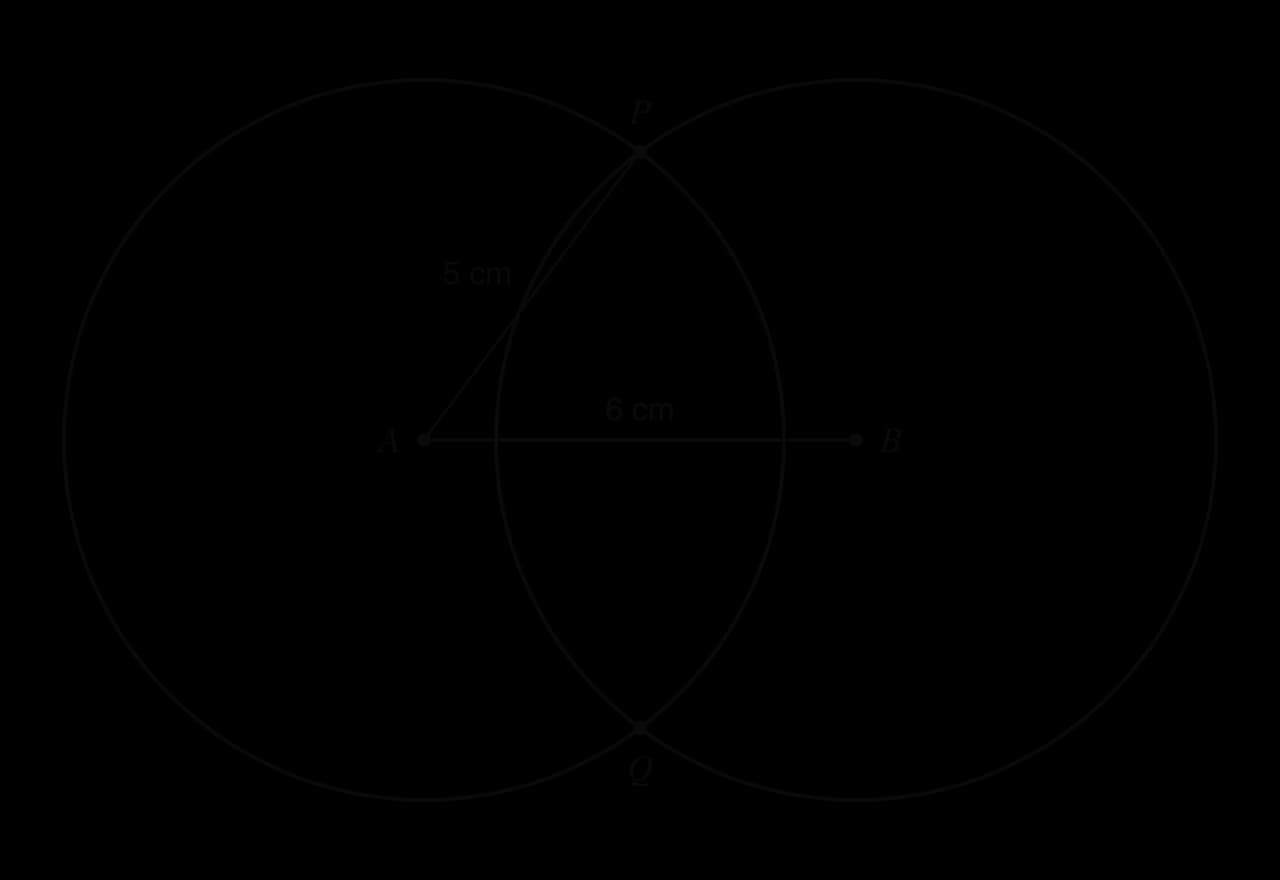
The first question is about two equal circles that overlap.
The shaded region is made of two equal segments, one from each circle, both cut off by the common chord PQ.
Self-check
To do:
I can state the definition of a radian and explain why π radians equals 180°.
To do:
I can convert angles between degrees and radians, giving exact answers in terms of π.
To do:
I can find an arc length with l=rθ and the perimeter of a sector with 2r+rθ.
To do:
I can find the area of a sector with A=21r2θ, and rearrange it to find r or θ
To do:
I can find the area of a segment as sector minus triangle, 21r2(θ−sinθ).
To do:
I can find the area of a region between two arcs, or of a region made of two segments.
To do:
I can solve simultaneous equations in r and θ and reject values that do not give a valid sector.
To do:
I can set my GDC to the correct angle mode and use it to solve equations such as θ−sinθ=k.
radians. The edges
[OA]
and
[OB]
are joined, without overlap, to form the curved surface of a right cone with no base. The base radius of the cone is
6
cm.
(a)
Find the value of θ.
[2]2 marks
Markscheme (a)
arc length AB equals the circumference of the base: 10θ=2π×6(M1)
θ=56π(=3.77)A1
(b)
Find the exact area of the sector AOB.
[2]2 marks
Markscheme (b)
EITHER
21×102×56π
(c)
Find the exact volume of the space enclosed by the hat and its circular base.
[2]2 marks
Markscheme (c)
height =102−62=8
Question 2 · AA-0007314 marks
A drinking cup is made from paper in the shape of the curved surface of a right cone, with no lid. The cone has base radius r cm and height h cm. The cup holds 250 cm3 when full.
(a)
Express h in terms of r.
[2]2 marks
(b)
Let A cm2 be the area of paper used to make the cup. Show that A=π2r4+r2562500
(c)
Find the value of r that minimises A, and the minimum value of A.
[3]3 marks
(d)
For the cup with minimum area, find the angle between the slanting side of the cup and its vertical axis.
[3]3 marks
(e)
Each cup is cut from a sector of a circle of paper and the two straight edges are joined without overlap. For the cup with minimum area, find the angle of the sector, in degrees.
In (c) and (d) there is no π in the angle, so these are not "nice" fractions of a turn and the answer is a decimal.
at the centre, the chord is
A≈3530 cm2
Triangle: 21×102×sin32π=50×23=253, using the exact value sin32π=23 from 3.5.
Segment:
3100π−253≈104.72−43.30=61.4 cm2
:
and substitute.
, so it is not a possible sector angle; reject it.
cm and area
21×64×0.5=16
cm².
:
cosPA^B=APAM=53
PA^B=arccos0.6=0.927295…≈0.927 rad
In a "show that", write the unrounded value before rounding to the given answer. The cosine rule in triangle APB gives the same result: cosPA^B=2×5×652+62−52=6036=0.6.
(b) By symmetry, PA^Q=2×0.927295…=1.854590… rad.
Sector APQ=21×52×1.854590…=23.18…≈23.2 cm2
(c) The shaded region consists of two identical segments, one in each circle, each cut off by the chord PQ. One segment is sector APQ minus triangle APQ.
Triangle APQ=21×52×sin(1.854590…)=12.5×0.96=12
Segment=23.182…−12=11.182…
Shaded area=2×11.182…=22.4 cm2(3 s.f.)
(The triangle has base PQ=8 cm and height AM=3 cm, which confirms its area of 12 cm².)
(d) The boundary is two equal arcs, each of radius 5 cm and angle 1.854590… rad.
P=2×5×1.854590…=18.5 cm(3 s.f.)
and substitute
rθ=6
:
21r×6=12⇒3r=12⇒r=4
Then θ=46=23 radians. This lies between 0 and 2π, so it is valid.
(b) Segment area = sector area − triangle area.
12−21×42×sin23=12−8sin23 cm2
This is the exact answer: sin23 is not one of the special values, so it stays as it is. (With a calculator it is about 4.02 cm², a useful check.)
 YouTube