3.3 Applications of trigonometry · IB Maths AA | Augment Education
3.3 Applications of trigonometry
Turn written descriptions into labelled diagrams, and use right-angled and non-right-angled trigonometry with angles of elevation and depression, three-figure bearings and three-dimensional figures to solve real problems.
IB Mathematics: Analysis and Approaches
Part of 3 Geometry and trigonometry
SL and HL
Key terms introduced here
Each is in the Maths AA glossary, with every other term in the subject.
Finding a distance or position that cannot be measured directly by measuring angles from the two ends of a baseline of known length and solving the triangle formed.
Notes on 3.3 Applications of trigonometry
23 min readLast reviewed
Trigonometry began as a practical tool for measuring distances that cannot be measured directly: the height of a mountain, the width of a river, the distance to a ship at sea. Surveyors, navigators, architects and engineers still use the same methods, now built into laser rangefinders, GPS receivers and mapping software. In each case a few measured angles and one measured length are enough to calculate everything else.
Applications of trigonometry follow the same pattern. The words of the problem are turned into a diagram, the diagram is broken into triangles, and each triangle is solved with the tools already available: Pythagoras's theorem, the trigonometric ratios, the sine rule, the cosine rule and the area formula.
From words to a diagram
Questions on 3.3
29 exam-style questions on this subtopic, written in the style of the IB papers. The first has its markscheme open. Counted on
Question 1 · AA-0008915 marks
A farmer owns a field in the shape of a quadrilateral ABCD. The diagonal [AC] divides the field into two triangles. AB=85 m, BC=110
Try a quick-fire question
One of 32 short multiple-choice questions on 3.3. Pick an answer to see why it's right or wrong.
Triangulation finds the distance to a point that can’t be reached. Which measurements does it use?
Carry on with 3.3 in Augment
With a free account, Augment remembers where you stopped and what you have practiced.
Most application problems are given in words, and the diagram is the most important step of the solution. A good diagram shows every given length and angle in the right place, marks every right angle, labels the unknown, and is roughly to scale, so that an answer that is obviously wrong stands out.
A reliable routine for drawing one:
Draw the horizontal ground (or sea level) first, then vertical objects such as towers, cliffs and people at right angles to it.
Place each point named in the question and label it with its letter.
Mark every given length and angle, with units, and mark right angles with a small square.
Label the unknown with a letter such as x, h or θ.
Look for triangles that contain the unknown and enough known information to solve them.
Angles of elevation and depression
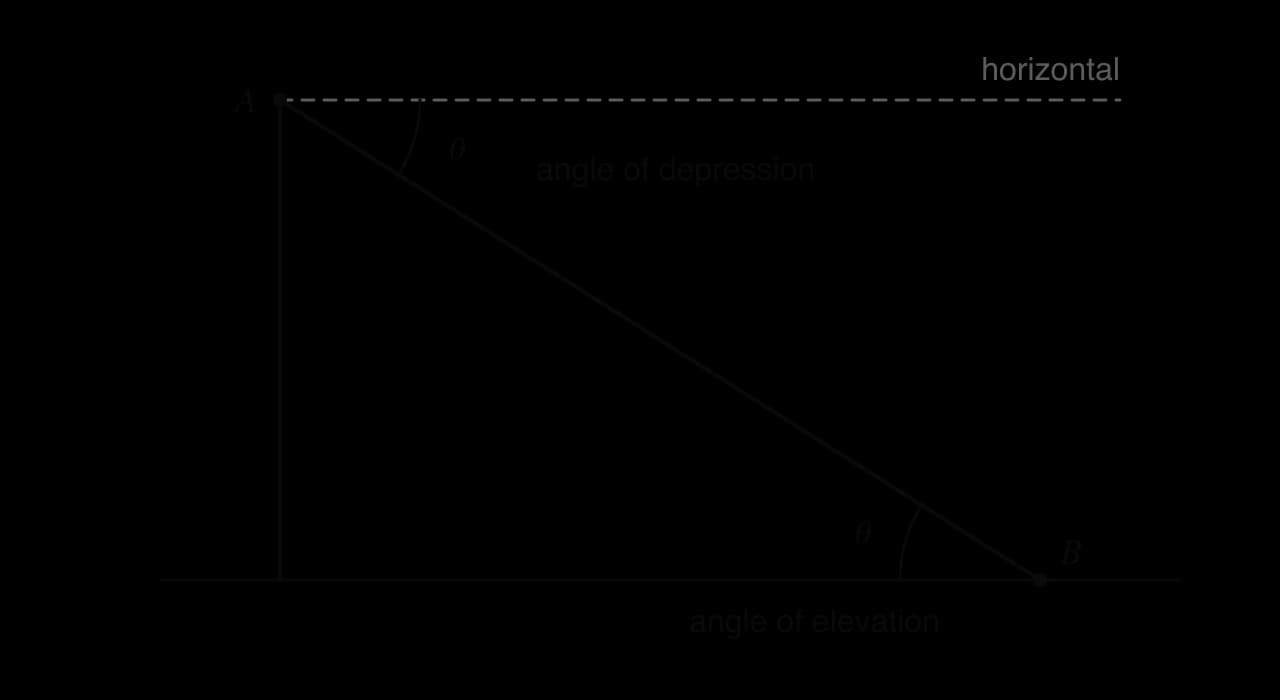
When an observer looks up at an object, the line of sight rises above the horizontal; when they look down, it falls below it. The angle is always measured from the horizontal, never from the vertical.
In the figure, an observer at A on top of a cliff looks down at a boat B. The angle of depression of B from A is measured below the horizontal through A. From the boat, the angle of elevation of A is measured above the sea, which is also horizontal.
The horizontal at A and the sea level at B are parallel, so the angle of depression from A equals the angle of elevation from B.
The two horizontal lines are parallel, and the line of sight crosses both of them. The angle of depression and the angle of elevation are therefore alternate angles, and they are equal. This is useful because the angle of depression is outside the right-angled triangle formed by the cliff, the sea and the line of sight, while the equal angle of elevation is inside it.
Heights of objects that cannot be reached
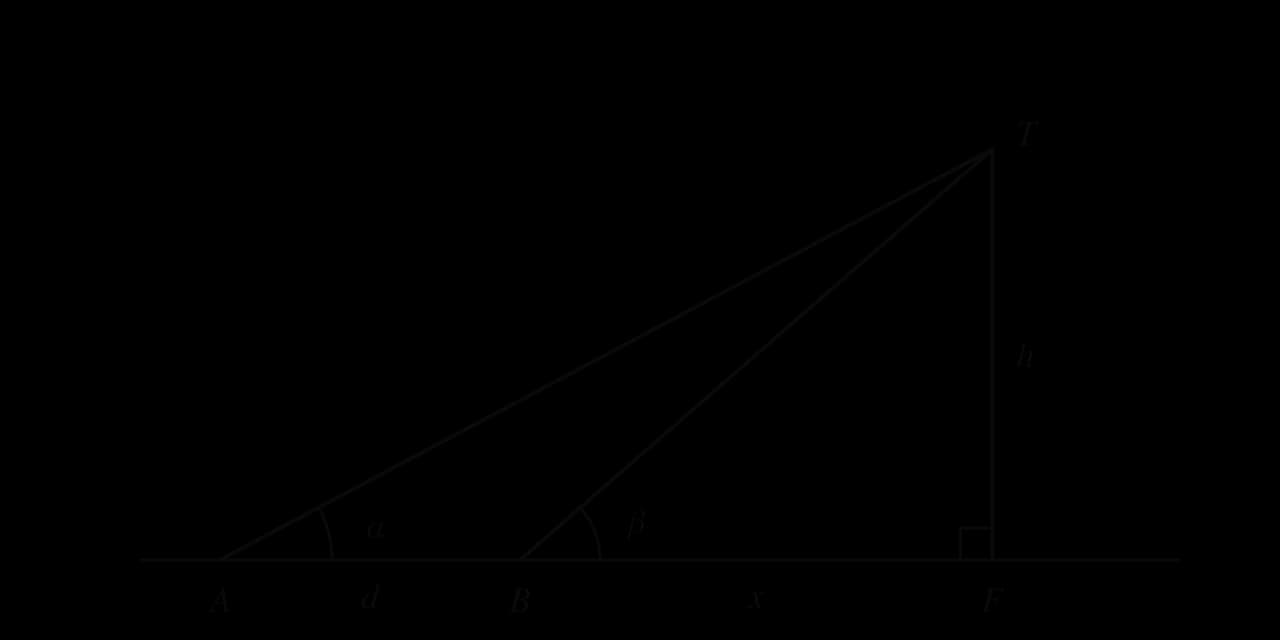
The method in the Eiffel Tower example needs the distance to the foot of the object. Often this distance is unknown: the foot of a mountain is inside the mountain, and the base of a tower may be behind a fence. Measuring two angles of elevation from two points a known distance apart, in line with the object, solves the problem.
The angle ATB at the top is β − α, because β is an exterior angle of triangle ABT.
There are two standard methods.
Method 1: the sine rule
In triangle ABT, the angle at B is 180°−β, so the angle at T is 180°−α−(180°−β)=β−α. Equivalently, β is an exterior angle of triangle ABT, so it equals the sum of the two interior opposite angles, α and AT^B. With side d and its opposite angle β−α known, the sine rule gives BT, and then h=BTsinβ in the right-angled triangle BFT.
Method 2: two equations
Each right-angled triangle gives an expression for h: h=xtanβ from triangle BFT, and h=(x+d)tanα from triangle AFT. Setting them equal gives one equation in x. This method suits non-calculator questions with exact values of tan.
Bearings
A bearing describes a direction on a map or chart. Bearings are used in navigation at sea and in the air, in orienteering and in surveying, because they give a direction without reference to any landmark.
A bearing always has three digits, so a direction 45° clockwise from north is written 045°. The four main compass directions are north 000°, east 090°, south 180° and west 270°; north-east is 045°, south-east 135°, south-west 225° and north-west 315°.
Reading "the bearing of B from A"
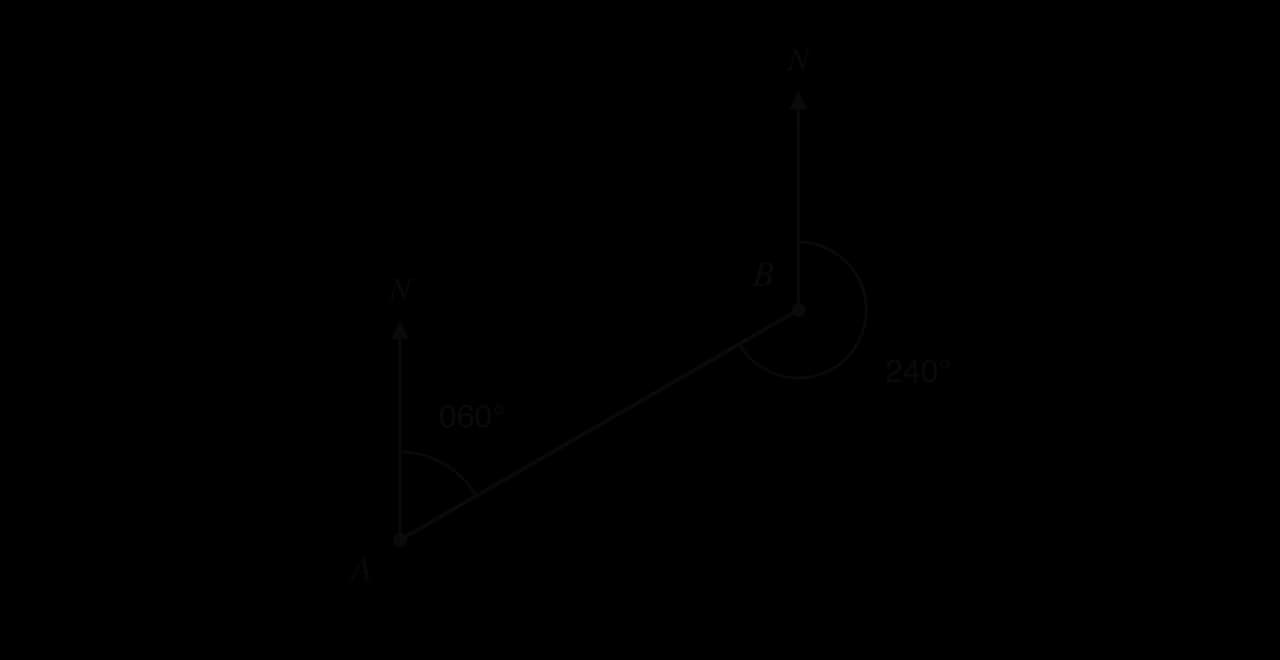
The phrase "the bearing of B from A" means: stand at A, face north, and turn clockwise until facing B. The point after "from" is where the angle is measured. Draw a north line at that point before measuring anything.
The bearing of B from A is 060°, and the bearing of A from B is 240°: the two bearings differ by exactly 180°.
Back bearings
The north lines at A and B are parallel. Going from A to B and then back from B to A means facing in exactly the opposite direction, which is a turn of 180°. So the bearing of A from B, the back bearing, is found by adding or subtracting 180°.
For example, if the bearing of a port from a ship is 305°, the bearing of the ship from the port is 305°−180°=125°.
Finding angles inside a triangle from bearings
Bearings give angles measured from north lines, while the sine and cosine rules need the angles inside a triangle. To convert, draw a north line at each turning point and use parallel-line facts: co-interior angles between two north lines add to 180°, and the back bearing at the new point gives the direction back to the previous point. The interior angle at a turning point is the difference between the back bearing and the new bearing (or 360° minus it, if that is the angle inside the triangle).
When the turn is not a right angle, the triangle is solved with the cosine rule for the distance and the sine rule for the angle.
Surveying and triangulation
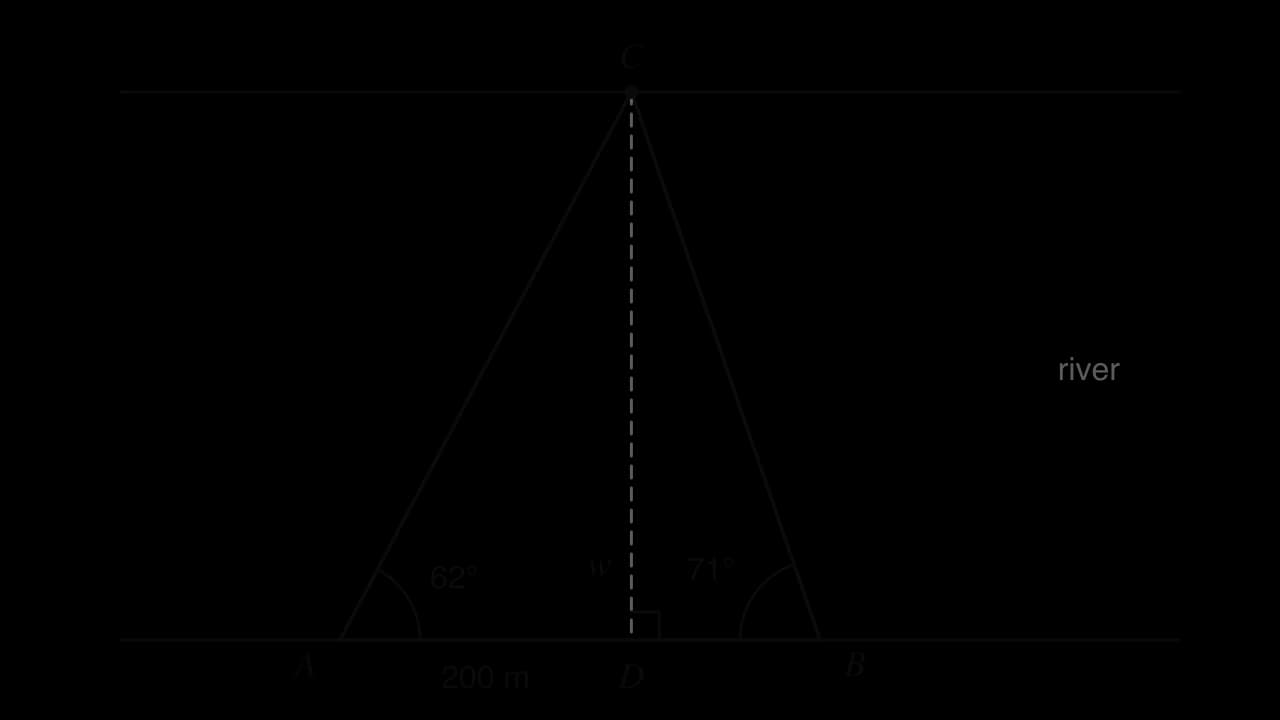
Distances across rivers, valleys and lakes cannot be measured with a tape. Surveyors measure a baseline on accessible ground instead, then measure the angles from each end of it to the distant point.
Triangulation fixes a point with only one measured length, because two angles and the side between them determine a triangle completely. A chain of triangles, each sharing a side with the next, can carry measurements across a whole country. The heights of Himalayan peaks, including Mount Everest, were first calculated in the nineteenth century by triangulation from survey stations on the plains of northern India, more than 150 km away.
The baseline AB and the two angles fix the triangle. The width of the river is the perpendicular distance w from C to the near bank.
The width could also be found from the area of the triangle: the area is 21×AB×AC×sinA, and also 21×AB×w, so w=ACsinA, the same calculation. Many surveying problems have more than one route to the answer, and a second method is a good check.
Problems in three dimensions
Three-dimensional problems combine everything above. The key facts are that a vertical line is perpendicular to every horizontal line through its foot, and that two lines on level ground meeting at a known angle (often given by bearings such as "due west" and "due south") lie in a horizontal plane. Each triangle needed is drawn separately, flat on the page, with its right angle marked.
A strategy for problems in three dimensions:
Draw a sketch of the whole situation, with horizontal ground drawn as a parallelogram (as if seen at an angle) and vertical lines drawn upright.
Identify each triangle that contains a right angle: usually one vertical side and one horizontal side.
Solve the triangles in a chain, carrying unrounded values from one to the next.
Use the sine or cosine rule for any triangle without a right angle, such as one lying on the ground or one tilted in space.
When the angle at the foot of a vertical object is not a right angle, the triangle on the ground needs the cosine rule, and an angle between two sloping lines needs it again in a tilted triangle.
Exam-style questions on applications of trigonometry
The next question is set without a calculator and uses the exact values tan30°=31, tan60°=3 and sin60°=23 (derived in 3.5).
Self-check
To do:
I can draw a clear, labelled diagram from a written description, with right angles marked and the unknown labelled.
To do:
I can use angles of elevation and depression, including the fact that they are equal as alternate angles.
To do:
I can allow for the height of an observer's eye above the ground.
To do:
I can find the height of an object whose foot cannot be reached, from two angles of elevation.
To do:
I can write bearings with three figures, find back bearings, and find the angle inside a triangle at a turning point.
To do:
I can solve navigation problems with Pythagoras's theorem, the sine rule and the cosine rule, and give the final direction as a bearing.
To do:
I can find an inaccessible distance by triangulation.
To do:
I can solve problems in three dimensions by finding the right-angled triangles and solving them in a chain.
m and
AB^C=104°
.
(a)
Find AC.
[3]3 marks
Markscheme (a)
attempt to use the cosine rule (M1)
AC2=852+1102−2(85)(110)cos104°(A1)
AC=154 (m) (154.431…)A1
(b)
Find BA^C.
[3]3 marks
Markscheme (b)
110sinBA^C=154.431…sin104°
(c)
It is also known that CD=70 m and AC^D=57°. Find AD.
[3]3 marks
(d)
Find the area of the field.
[4]4 marks
Markscheme (d)
area of triangle ABC=21(85)(110)sin104°=4536.03…
(e)
The farmer puts a fence around the boundary of the field. The fence costs $14.50 per metre. Find the cost of the fence, correct to the nearest dollar.
[2]2 marks
Markscheme (e)
perimeter =85+110+70+130.282…=395.282…(M1)
cost =$5732
Question 2 · AA-0009615 marks
The end wall of a house is in the shape of a triangle ABC on top of a rectangle. The horizontal base of the triangle is [AB], with AB=9.6 m. The two sloping edges of the roof are [AC] and [BC], with CA^B=35° and CB^A=50°.
Mira is flying a kite on level ground. She holds the end of the string 1.2 m above the ground. The string is straight, has length 85 m, and makes an angle of 52∘ with the horizontal.
(a)
Find the height of the kite above the ground.
[2]2 marks
(b)
The wind drops. The length of the string does not change, but it now makes an angle of 38∘ with the horizontal.
Find how far the kite has descended.
[2]2 marks
(c)
Find the horizontal distance between Mira and the point on the ground directly below the kite when the string makes an angle of 38∘ with the horizontal.
Moving closer makes the angle of elevation larger, as expected.
m. The side
BT
is opposite the angle at
A
,
28°
.
sin28°BT=sin13°50⇒BT=sin13°50sin28°=104.34… m
In the right-angled triangle BFT, h is opposite the 41° angle and BT is the hypotenuse.
h=104.34…×sin41°=68.459…≈68.5 m
Method 2. Let BF=x. Then h=xtan41°=(x+50)tan28°.
x(tan41°−tan28°)=50tan28°⇒x=78.753… m
h=78.753…×tan41°=68.459…≈68.5 m
Both methods give the same height.
is
130°
. The angle between them is
220°−130°=90°
, so angle
ABC
is a right angle.
(a) Use Pythagoras's theorem.
AC=122+92=225=15 km
(b) In the right-angled triangle, the angle at A satisfies
tan(BA^C)=129⇒BA^C=36.869…°
C is clockwise from the direction AB, so add this angle to the bearing of B.
Bearing of C from A=040°+36.869…°=076.869…°≈076.9°
is
190°
. The angle inside the triangle is
AB^C=250°−190°=60°
(a) Two sides and the included angle are known: cosine rule.
AC2=202+152−2×20×15×cos60°=400+225−300=325
AC=325=18.027…≈18.0 km
(b) Find angle BAC with the sine rule. It is opposite BC=15, which is not the longest side, so it is acute.
15sin(BA^C)=325sin60°⇒BA^C=46.102…°
The ship turned clockwise at B, so C is clockwise from the direction of B as seen from A.
Bearing of C from A=070°+46.102…°=116.10…°≈116.1°
(c) The return journey is the back bearing.
116.10…°+180°=296.10…°≈296.1°
It is opposite the baseline AB=200 m, so the sine rule can be used. AC is opposite the 71° angle.
sin71°AC=sin47°200⇒AC=sin47°200sin71°=258.56… m
The width w is the perpendicular distance CD. In the right-angled triangle ADC, AC is the hypotenuse and w is opposite the 62° angle.
w=258.56…×sin62°=228.30…≈228 m
(b) In the vertical triangle BFT, also with a right angle at F:
tanθ=8042.012…⇒θ=27.706…°≈27.7°
B is further from the mast than A, so its angle of elevation is smaller.
(c) West and south are perpendicular, so triangle AFB on the ground has a right angle at F.
AB=602+802=100 m
From A, the point B is 60 m east and 80 m south. The angle between south and AB is tan−1(8060)=36.869…°, measured from south towards east, which is anticlockwise from south.
Bearing of B from A=180°−36.869…°=143.13…°≈143.1°
(b) Triangle AFB lies on the ground with the included angle 75° at F: cosine rule.
AB2=1202+902−2×120×90×cos75°=16909.5…⇒AB=130.03…≈130 m
(c) Triangle ATB is tilted in space and has no right angle, but all three sides are now known: cosine rule.