Notes on 3.17 Vector equations of planes
A plane is the three-dimensional version of a straight line: the simplest possible surface, perfectly flat and extending without limit. Floors, walls, roof faces and solar panels are modelled as parts of planes, and in computer graphics curved objects are built from thousands of small flat pieces. Describing a plane with an equation makes it possible to calculate where lines meet it, how far points are from it and the angles it makes with other planes.
Describing a plane
A plane is fixed by a small amount of information, in the same way that a line is fixed by a point and a direction. There are two standard descriptions:
one point in the plane and two non-parallel directions lying in it;
one point in the plane and one direction perpendicular to it.
Three points that are not on the same line also fix a plane, because they give one point and two directions. This is why a three-legged stool never wobbles: the ends of its three legs always lie in one plane, while the ends of four legs may not.
Any three points are coplanar. Four points may or may not be, and two lines are coplanar exactly when they are parallel or intersecting, not skew (3.15). Planes are usually named with capital Greek letters such as (pi), or as , when there are several.
The vector equation of a plane
Suppose a plane contains the point , with position vector , and two non-parallel vectors and lie in it. Starting at , any point of the plane can be reached by moving some multiple of
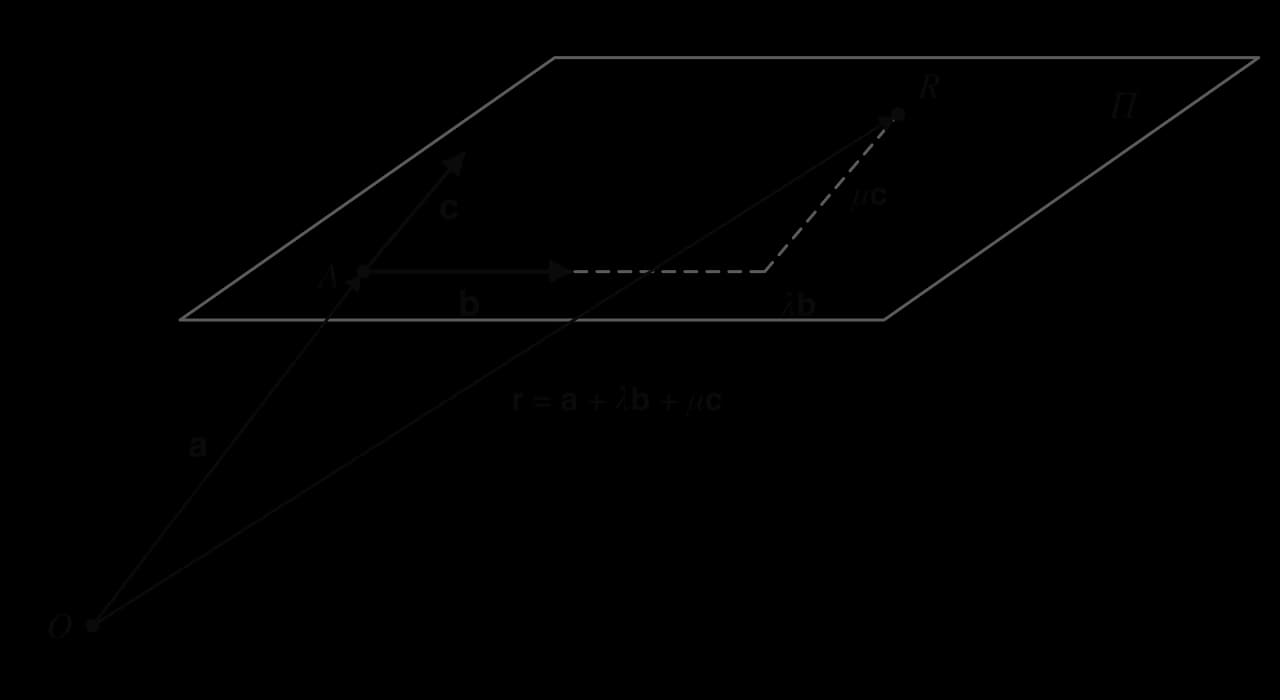
The vector equation of a plane is in the formula booklet. It has two parameters, where the equation of a line has one, because a plane is two-dimensional: it takes two independent numbers to say where a point is within it. Writing out the components gives the parametric equations of the plane, such as .
The two direction vectors must not be parallel. If were a multiple of , then would always point along , and the equation would describe only a line.
A plane through three points
For three non-collinear points , and , take
The method in this example works, but it needs two unknowns to be found for every point tested. The Cartesian equation, developed next, turns the test into a single substitution.
The normal vector and the scalar product form
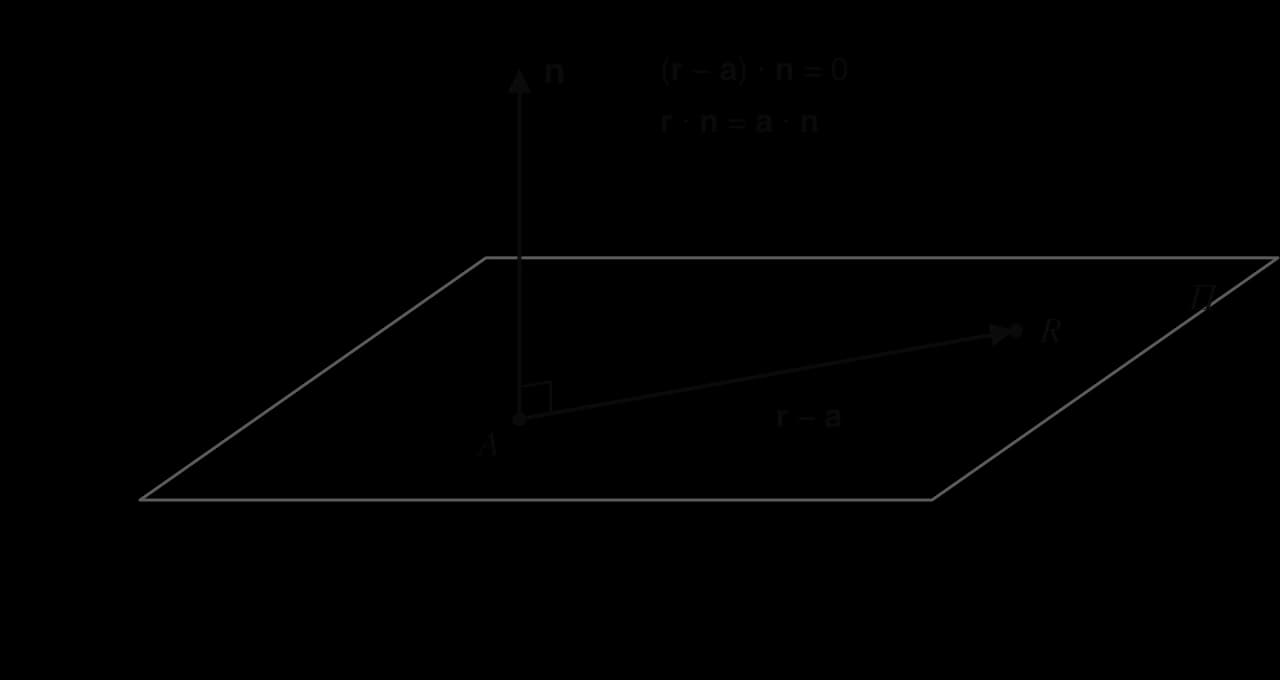
A normal vector to a plane is a vector perpendicular to it. Because a plane is flat, one direction is perpendicular to the whole plane at once: a vector normal to the plane is perpendicular to every line lying in it.
Deriving the equation
Let (position vector ) be a known point of the plane and (position vector ) any point. lies in the plane exactly when
The second form is in the formula booklet. Its right side, , is just a number.
The Cartesian equation
Writing
This is also in the formula booklet. It is the most useful form for calculation, and it can be read in both directions: the coefficients of , and are the components of a normal vector, and any equation of this form (with , , not all zero) is a plane with normal
Parallel planes and special planes
Parallel planes have parallel normal vectors. With the same normal, their Cartesian equations differ only in the constant on the right, for example and
When a variable is missing from the equation, the plane is parallel to that variable's axis, because the missing coordinate can take any value. The table lists the common cases.
Equation | Normal | Description |
|---|---|---|
The -plane (contains the - and |
Intercepts and sketching a plane
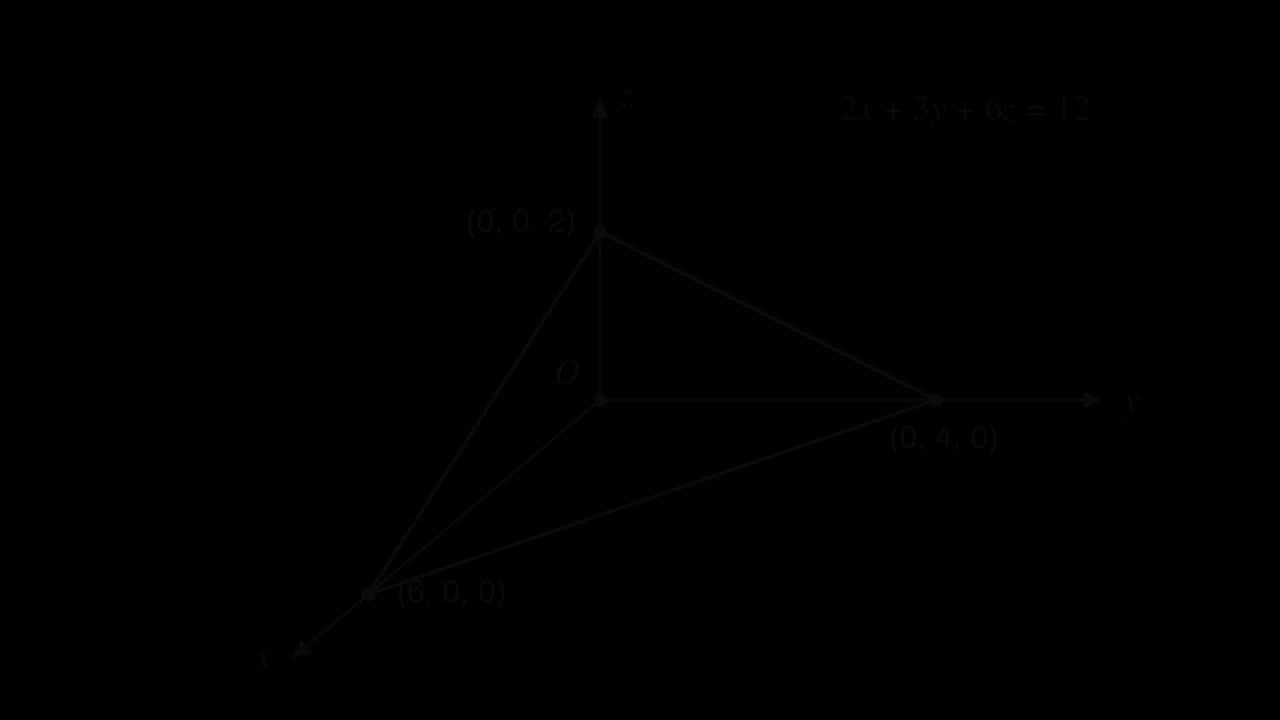
A plane that does not pass through the origin can be sketched from the points where it crosses the axes. For , setting two coordinates to zero at a time gives ,
Finding a normal with the vector product
When two non-parallel vectors and lie in a plane, the vector product is perpendicular to both, so it is a normal to the plane (3.16). This connects the vector equation to the Cartesian equation, and gives the standard method for a plane through three points.
To find the Cartesian equation of the plane through , and :
Find two directions in the plane, such as and
Converting between the forms
The three forms describe the same plane, and each is best for a different job. The vector form generates points; the Cartesian form tests points and is the easiest to combine with lines and other planes.
From | To | Method |
|---|---|---|
From Cartesian to vector form
Going from the Cartesian equation to a vector equation needs a point and two non-parallel directions perpendicular to . There are two common ways to find them.
Planes containing lines
A line with direction lying in a plane supplies a point and one direction. A second direction comes from another point or another line, and the normal is again a vector product.
Two intersecting lines also determine a plane: it contains both direction vectors, and the point of intersection (or any point of either line) gives .
If the two lines were skew, no plane would contain both. The vector product of the directions would still exist, but the points of the two lines would give different values of . This gives another test for skew lines.
Distance from a point to a plane
The distance from a point to a plane is the shortest distance, measured along the normal. The line through in the direction of meets the plane at the foot of the perpendicular , and the distance is

The method:
Write the line through along the normal: .
Substitute its parametric equations into the Cartesian equation of the plane and solve for .
Substitute to find
A shortcut formula
Carrying out the same steps for a general point and plane
For the example,
The distance between two parallel planes is the distance from any point of one to the other. For and
Exam-style questions on planes
Planes questions often build a chain: points give vectors, vectors give a normal, the normal gives an equation, and the equation is then used to test points or find distances.
The reflection in part (e) is a standard follow-on: the foot of the perpendicular is the midpoint of and its image, so doubling the parameter value gives the image directly.
Self-check
- To do:
I can write a vector equation of a plane from a point and two non-parallel directions, or from three points.
- To do:
I can explain why describes a plane, and convert it to