3.16 The vector product · IB Maths AA | Augment Education
3.16 The vector product
Calculate the vector product of two vectors, use its direction and magnitude, apply its properties, and find areas of parallelograms and triangles and vectors perpendicular to two given vectors.
IB Mathematics: Analysis and Approaches
Part of 3 Geometry and trigonometry
HL only
Key terms introduced here
Each is in the Maths AA glossary, with every other term in the subject.
The vector v×w perpendicular to both v and w, with magnitude ∣v∣∣w∣sinθ and direction given by the right-hand rule.
Notes on 3.16 The vector product
19 min readLast reviewed
The scalar product of two vectors is a number. The vector product combines two vectors in three dimensions to give a third vector, which is perpendicular to both of them and whose length measures the area they span. These two facts make it the standard tool for finding a direction at right angles to a flat surface, such as the normal to a plane, and for calculating areas of shapes in space. In physics the same product gives the turning effect (torque) of a force.
Defining the vector product
The vector product is defined only for vectors in three dimensions. It is written with a cross, v×w, and read "v cross w", so it is also called the cross product.
The vector product formula is in the formula booklet, but it is quicker to calculate with a layout than to substitute into it.
Calculating a vector product by hand
Each component of v×w is a "cross-multiplication" of two rows of the column vectors, leaving out one row each time:
First component: cover the first row, then multiply diagonally in the second and third rows: v2w3−v3w2
In each case the product going "down to the right" (v above, w below) comes first and the one going "up to the right" is subtracted. The pattern (2,3),(3,1),(1,2) of rows is cyclic, which is the easiest way to remember it.
Some textbooks write the same calculation as a determinant:
Every term cancels with another, so v×w is perpendicular to v. The same calculation with w shows it is perpendicular to w as well.
Magnitude and direction
A vector is fixed by its magnitude and its direction. For the vector product, both have a geometric meaning.
Magnitude
If θ is the angle between v and w (placed tail to tail, 0≤θ≤π), then
∣v×w∣=∣v∣∣w∣sinθ
This formula is in the formula booklet. Since 0≤θ≤π, sinθ≥0, so the right side is never negative. The magnitude is largest when the vectors are perpendicular (sinθ=1) and zero when they are parallel (sinθ=0
The result can be checked with the identity sin2θ+cos2θ=1, as the next example shows. It also means that the scalar and vector products together contain all the information about the angle: the scalar product gives cosθ, the vector product gives sinθ
Direction and the right-hand rule
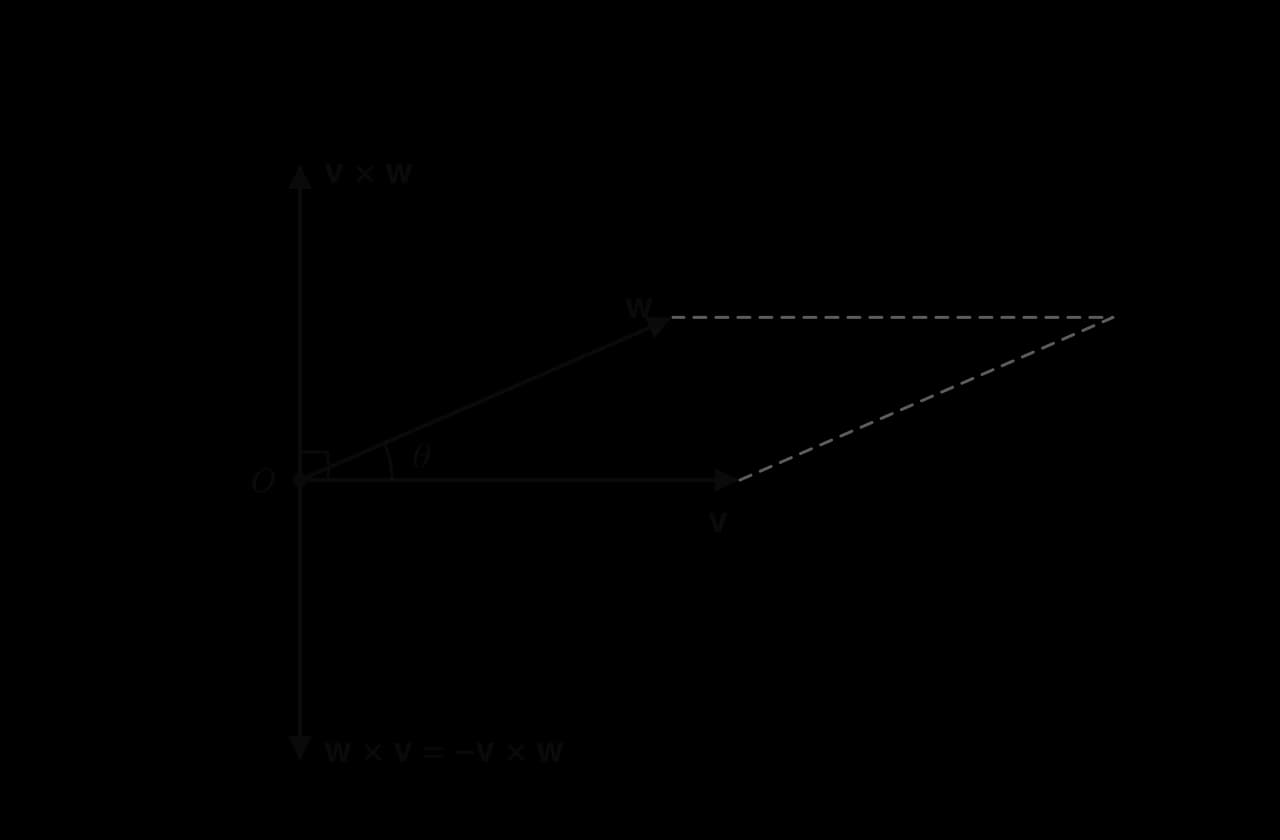
There are two directions perpendicular to both v and w, opposite to each other. The right-hand rule picks out the one that v×w points along.
An equivalent version: point the index finger along v and the middle finger along w; the thumb, held at right angles to both, points along v×w. The rule matches the component formula because the coordinate axes are set up as a right-handed system, with i×j=k
Turning from v towards w gives a product pointing up; turning from w towards v gives the same length pointing down. Both are perpendicular to the plane containing v and w.
Swapping the order reverses the turn, so the thumb points the other way. This is why the vector product depends on the order of the vectors, unlike the scalar product.
Products of the base vectors
The base vectors i, j and k are unit vectors at right angles to each other, so the product of two different ones has magnitude 1×1×sin90°=1
Going round the cycle in the direction of the arrows gives a positive result; going against the arrows gives a negative one.
These six results, with i×i=j×j=k×k=0, are enough to expand any vector product written in i,j,k
The magnitude formula and the scalar product can be combined to find sinθ and cosθ for the same pair of vectors, which shows what each product determines about an angle and what it leaves undecided.
Properties of the vector product
The vector product follows some, but not all, of the familiar rules of multiplication. Each property in the table can be checked from the component definition or from the geometric description.
Property
Statement
Anticommutative
w×v=−(v×w)
Distributive
u×(v+w)=u×v+u×w
Anticommutativity and a vector with itself
Swapping v and w in each component of the definition swaps the two terms of each subtraction, so every component changes sign: w×v=−(v×w)
Associativity fails
Brackets matter in a repeated vector product. With base vectors,
i×(i×j)=i×k=−j,but(i×i)×j=0×j=0
so the two bracketings give different answers.
Testing for parallel vectors
Two non-zero vectors are parallel exactly when the angle between them is 0 or π, which is exactly when sinθ=0. So v×w=0
Finding a vector perpendicular to two vectors
Because v×w is perpendicular to both v and w, the vector product is the direct way to find a direction at right angles to two given directions. This is how a normal vector to a plane is found from two directions in the plane (3.17), and how the direction of the common perpendicular of two skew lines is found (3.15). Any non-zero multiple of v×w
Areas of parallelograms and triangles
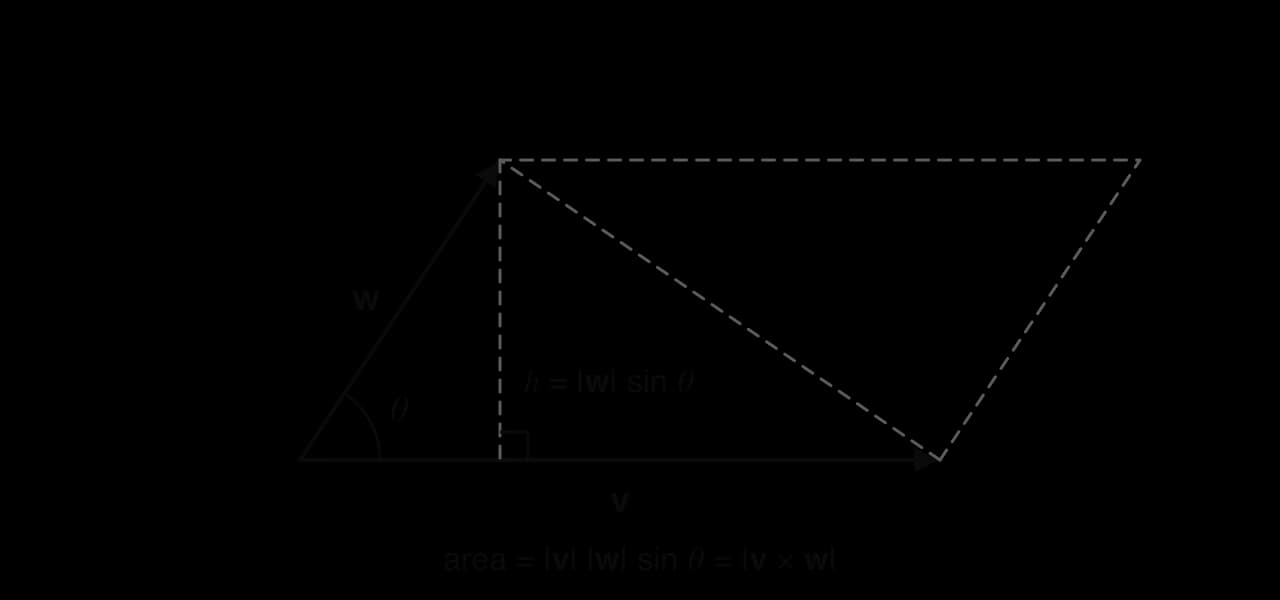
A parallelogram with adjacent sides v and w has base ∣v∣ and perpendicular height ∣w∣sinθ. Its area is base times height, ∣v∣∣w∣sinθ
The magnitude of the vector product is the parallelogram's base times its height. A diagonal cuts the parallelogram into two congruent triangles, each with half the area.
Area of parallelogram=∣v×w∣,Area of triangle=21∣v×w∣
The parallelogram formula is in the formula booklet. The triangle formula follows because a diagonal splits the parallelogram into two congruent triangles; it is the vector version of the familiar 21absinC.
For a triangle ABC, the two vectors must start from the same vertex: use AB and AC
When an area is given and a coordinate is unknown, the same formula leads to an equation for the unknown, usually a quadratic.
A modelling application: a shade sail
Shade sails are triangles of fabric stretched between three posts of different heights, so the sail is a tilted triangle in space. Its area decides how much fabric is needed.
A physics application: the moment of a force
In mechanics, a force F applied at a point with position vector r relative to a pivot has a turning effect, called its moment or torque, equal to r×F. Its magnitude ∣r∣∣F∣sinθ
Exam-style questions on the vector product
Questions on the vector product usually chain several skills: find two vectors, find their product, then use it for an area, a perpendicular vector or a plane.
The vector product formula and ∣v×w∣=∣v∣∣w∣sinθ are both in the formula booklet, along with the area of a parallelogram; the triangle formula is not, so write 21∣AB×AC∣
Self-check
To do:
I can calculate v×w from components without sign errors, and check it with scalar products.
To do:
I can state the magnitude ∣v∣∣w∣sinθ and use the right-hand rule to find the direction of a vector product.
To do:
I can work out products of i
Questions on 3.16
39 exam-style questions on this subtopic, written in the style of the IB papers. The first has its markscheme open. Counted on
Question 1 · AA-0026416 marks
The lines L1 and L2 have the following vector equations, where λ,μ∈R.
L1:r=2−11+λ110
L2:r=−343+μ012
(a)
Show that L1 and L2 are skew.
[4]4 marks
Markscheme (a)
110=k012
Question 2 · AA-0026617 marks
The line L1 has vector equation r=120+λ2−11
Question 3 · AA-0026715 marks
Three lines have the following vector equations, where λ,μ,ν∈R.
L1:r=6−3.54+λ1.2−11.5
Try a quick-fire question
One of 29 short multiple-choice questions on 3.16. Pick an answer to see why it's right or wrong.
What is the area of the parallelogram with adjacent sides 122 and 2−21?
From the formula booklet
The entries of the mathematics: analysis and approaches formula booklet that 3.16 uses. Each opens in the explained booklet.
The shadow of the sail directly below it, with the sun overhead, is the triangle with vertices (0,0), (6,0) and (2,5), of area 21×6×5=15
is the force times its perpendicular distance from the pivot, and its direction is the axis about which the force turns the object. This is why a spanner turns a bolt most easily when pushed at right angles to the handle, far from the bolt.
newtons is applied to a spanner at the point with position vector
r=0.30.10
metres relative to the centre of a bolt. Find the moment
r×F
and its magnitude.
Show the solution
r×F=(0.1)(−50)−(0)(0)(0)(0)−(0.3)(−50)(0.3)(0)−(0.1)(0)=−5150 N m
∣r×F∣=25+225=250=15.8 N m (3 s.f.)
Since F is perpendicular to r, this equals ∣r∣∣F∣=0.1×50=15.8
and
AC
. [2] (b) Find
AB×AC
. [2] (c) Hence find the exact area of triangle
ABC
. [2] (d) Find a unit vector perpendicular to the plane containing