Notes on 3.18 Intersections of lines and planes
Lines and planes in space meet in a small number of ways, and each way corresponds to a particular kind of solution of a set of linear equations. A laser beam hitting a screen, the shadow of a pole on sloping ground, the ridge where two roof faces meet and the corner where three walls meet are all intersections of lines and planes. The same calculations give the angles involved, such as the pitch of a roof or the angle at which a ray strikes a surface.
A line and a plane
A line and a plane in three dimensions are related in one of three ways. The direction vector of the line and the normal of the plane decide which.
Relationship | Condition | Points in common |
|---|---|---|
Line meets the plane at one point | Exactly one | |
Line lies in the plane |
If , the line is perpendicular to the normal, so it runs parallel to the plane: it either lies in it or stays a fixed distance away. Otherwise the line crosses the plane exactly once.
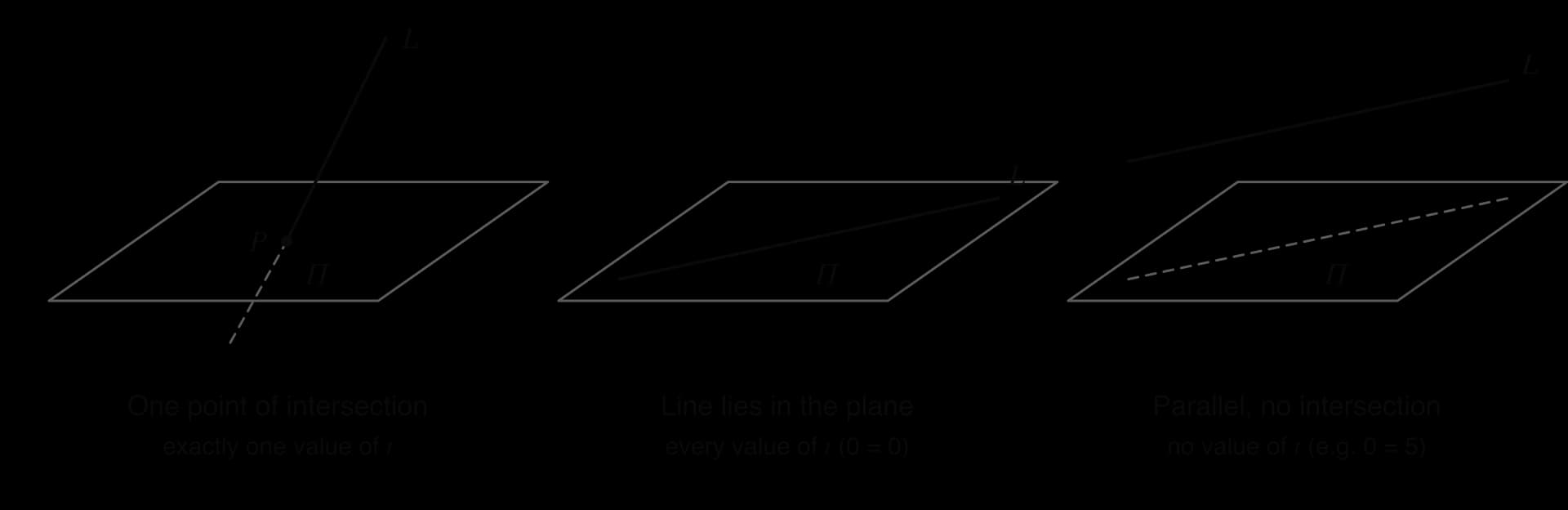
Finding the point of intersection
The quickest method uses the Cartesian equation of the plane and the parametric equations of the line:
Write the line as ,
If the plane is given in vector form, convert it to Cartesian form first (3.17). The linear equation in step 2 has the form , which is why the scalar product decides the case: if it is non-zero there is exactly one ; if it is zero the equation reads
Lines that lie in a plane or are parallel to it
When the coefficient of cancels, the outcome depends on the constant terms, so the remaining equation must be read carefully.
The same reasoning answers questions with an unknown constant. A line parallel to the plane can be moved into the plane by choosing its starting point correctly.
A modelling application: a shadow on sloping ground
Over short distances, the rays of sunlight are parallel straight lines, and a small area of ground is close to a plane. The shadow of a point is where the ray through it meets the ground.
The angle between a line and a plane
The angle between a line and a plane is the angle between the line and its projection onto the plane (its "shadow" when light shines along the normal). It is always between and .
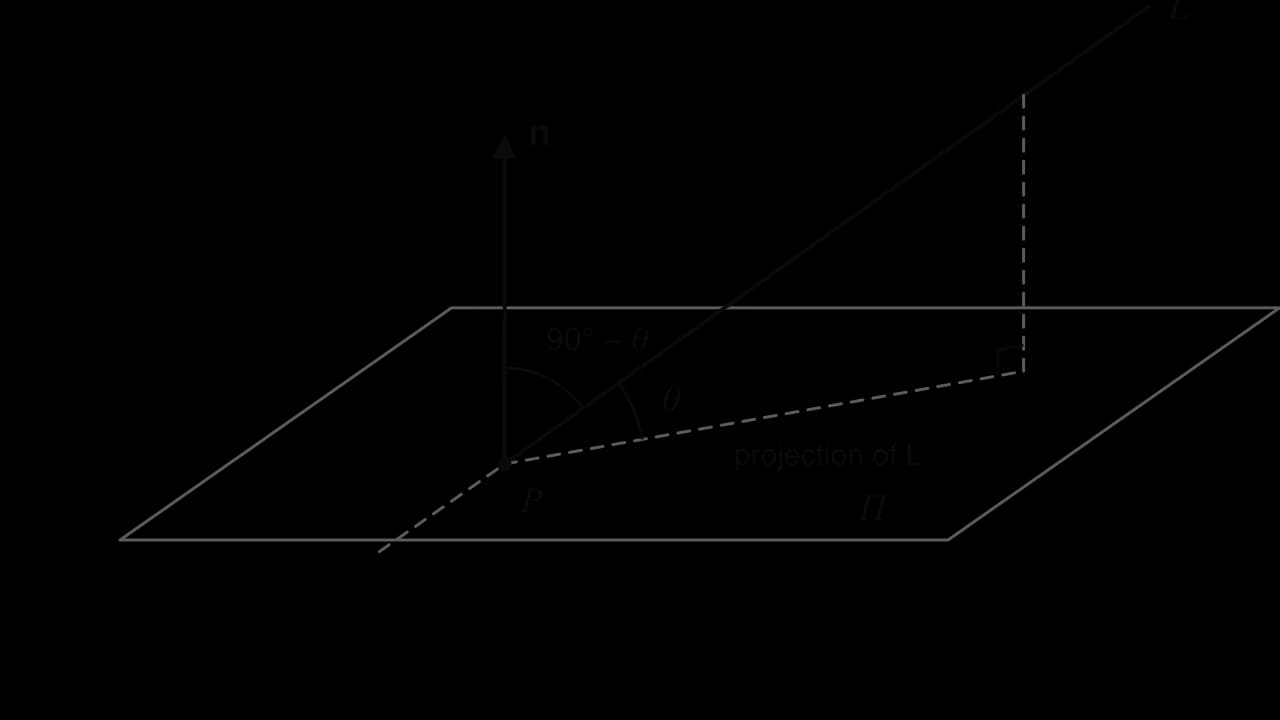
The scalar product gives the angle between the line's direction and the normal , which is . Since
The modulus makes positive, so is between and whichever way and
Two planes
Two planes are either parallel or they meet in a straight line. Their normals decide which:
If and are parallel, the planes are parallel. They are the same plane if one equation is a multiple of the other (for example
The direction follows from the vector product (3.16). The line lies in the first plane, so its direction is perpendicular to ; it also lies in the second plane, so its direction is perpendicular to . A vector perpendicular to both normals is
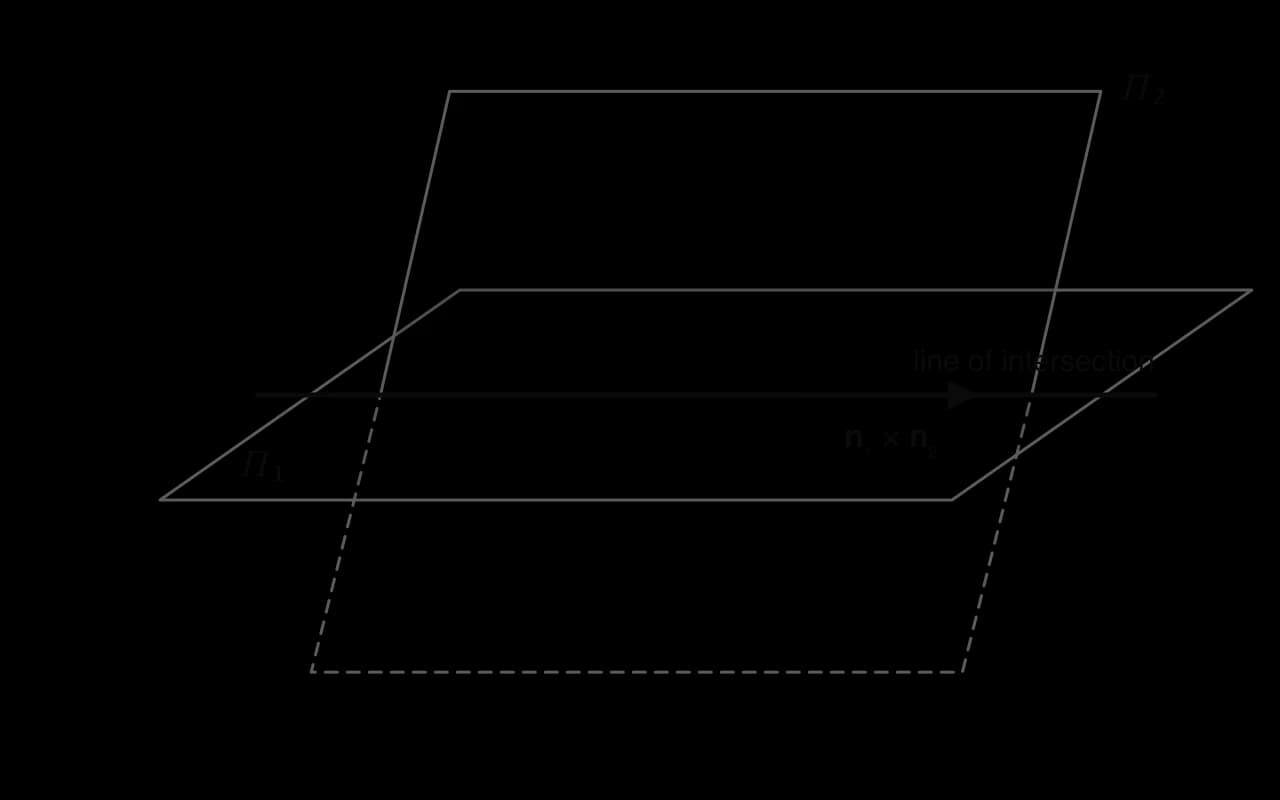
Finding the line of intersection
There are two standard methods. Both need one point on the line; the first finds the direction with the vector product, the second gets the direction automatically.
Method 1 (vector product and a point). Find . Then find one point on both planes: set one coordinate (often ) equal to and solve the two plane equations for the other two coordinates.
Method 2 (introduce a parameter). Set one variable equal to a parameter, for example , and solve the two equations for and in terms of . The result is the parametric form of the line.
The angle between two planes
The angle between two planes is measured in a plane perpendicular to their line of intersection, where both planes are seen edge-on as lines. Turning one plane onto the other turns its normal onto the other normal by the same amount, so the angle between the planes equals the angle between the normals (or its supplement).
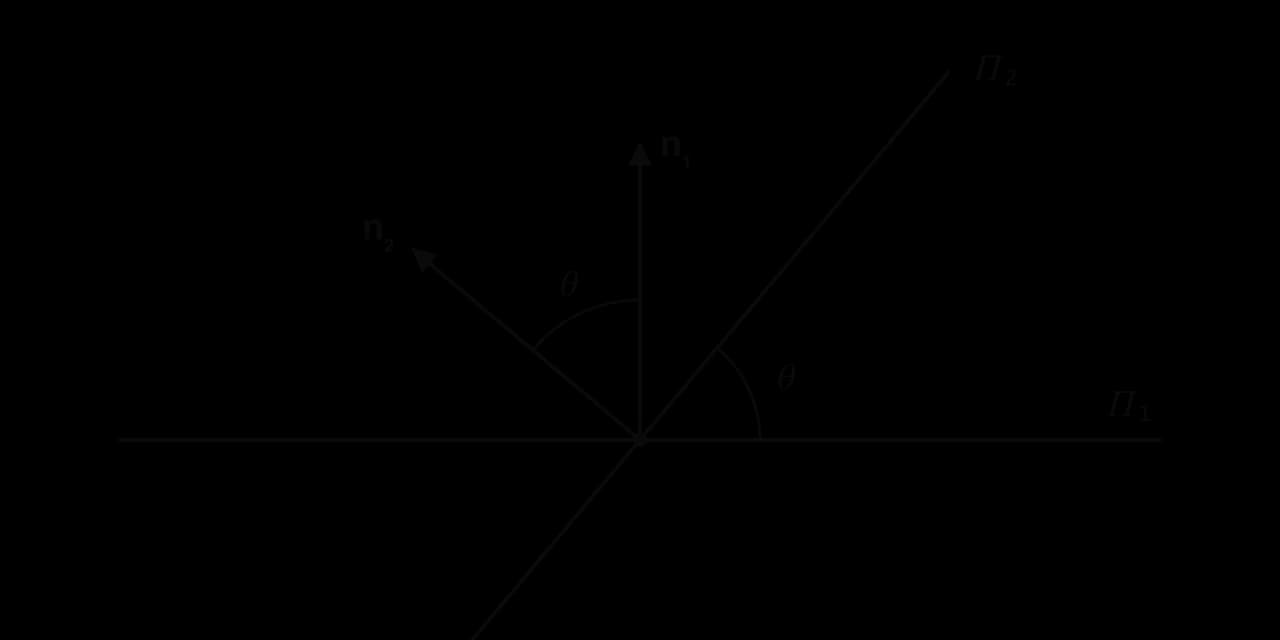
The modulus gives the acute angle. Two planes actually form two angles, and , and in a context the obtuse one is sometimes the one that matters.
In a roof, the line of intersection of two faces is the ridge, and the angle with a horizontal plane is the pitch. The angle inside the roof space is the obtuse angle between the faces, which shows why the context must decide which of the two angles is wanted.
Three planes
Three planes can meet at a single point, along a line, or not have any point in common at all. Each case matches a type of solution of the system of three linear equations formed by the three plane equations (1.16).
The possible arrangements
The table lists every arrangement. In the diagrams of the last four, the planes are drawn edge-on: each plane contains a direction pointing straight out of the page, so it is seen as a line.
Arrangement | Solutions of the system | Normals |
|---|---|---|
Meet at a single point | One (unique) solution | Not all parallel to one plane |
Sheaf: all contain one line | Infinitely many, one parameter | All perpendicular to the common line |
All three planes the same | Infinitely many, two parameters | All parallel; equations are multiples |
Triangular prism: meet in pairs in three parallel lines | No solution | All perpendicular to one direction; no two parallel |
Two parallel planes cut by the third | No solution | Exactly two parallel |
Three parallel planes (at least two distinct) | No solution | All parallel |
Two coincident planes cut by the third | Infinitely many: a line | Two parallel, from equations that are multiples |
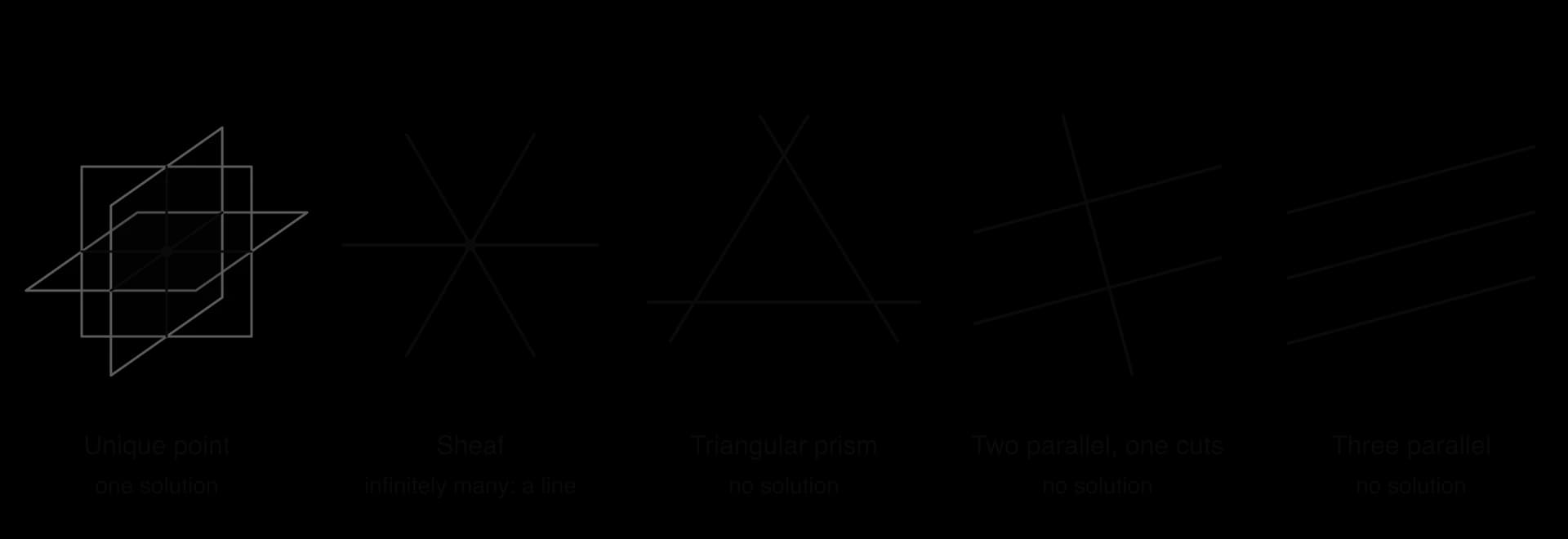
The sheaf and the triangular prism look alike in algebra: in both, elimination leaves an equation with all coefficients zero. In a sheaf the last equation is (consistent, infinitely many solutions); in a prism it is with (inconsistent, no solutions). In a prism each pair of planes still meets in a line, but the three lines are parallel and never meet.
Solving three equations
A system with a unique solution can be solved by elimination or directly with a graphic display calculator (GDC). When the GDC reports no unique solution, elimination by hand shows whether there are infinitely many solutions or none, and the normals then identify the arrangement.
Another way to see the result: and meet in the line
Parameters that give each case
Exam-style questions on intersections
These questions combine every result on lines and planes, and the parts often depend on each other. Each answer can be checked by substituting it back into the original equations.
When a question says "the system has infinitely many solutions" or "the planes meet in a line", the condition is that the third equation adds no new information. That gives two conditions (one from a point, one from the direction), which is why two unknowns such as and can be found.
Self-check
- To do:
I can find where a line meets a plane by substituting the line's parametric equations into the plane's Cartesian equation.
- To do:
I can tell from and a point whether a line meets a plane, lies in it or is parallel to it.
- To do:
I can calculate the angle between a line and a plane using sine, not cosine.
- To do:
I can decide whether two planes are parallel, coincident or meet in a line, and find the line of intersection by either method.
- To do:
I can find the acute (and, where relevant, obtuse) angle between two planes using their normals.
- To do:
I can solve three plane equations and interpret the result as a point, a sheaf, a triangular prism or parallel planes.
- To do:
I can find parameter values that make three planes meet at a point, in a line or not at all.