3.15 Coincident, parallel, intersecting and skew lines · IB Maths AA | Augment Education
3.15 Coincident, parallel, intersecting and skew lines
Decide whether two lines in 3D are coincident, parallel, intersecting or skew, find points of intersection, and find shortest distances from a point to a line and between two lines.
IB Mathematics: Analysis and Approaches
Part of 3 Geometry and trigonometry
HL only
Key terms introduced here
Each is in the Maths AA glossary, with every other term in the subject.
Find the value of a parameter for which two lines intersect.
Find the foot of the perpendicular from a point to a line and the shortest distance from the point to the line.
Calculate the shortest distance between two parallel lines.
Find the shortest distance between two skew lines, and the points on each line where it occurs.
Two straight lines in a plane either meet or are parallel. In three dimensions there is a fourth possibility: two lines can point in different directions and still never meet, like a road on a bridge and a railway passing underneath it at an angle. Deciding which of the four cases applies, and finding where lines meet or how close they come, is a basic task in navigation, engineering design and computer graphics.
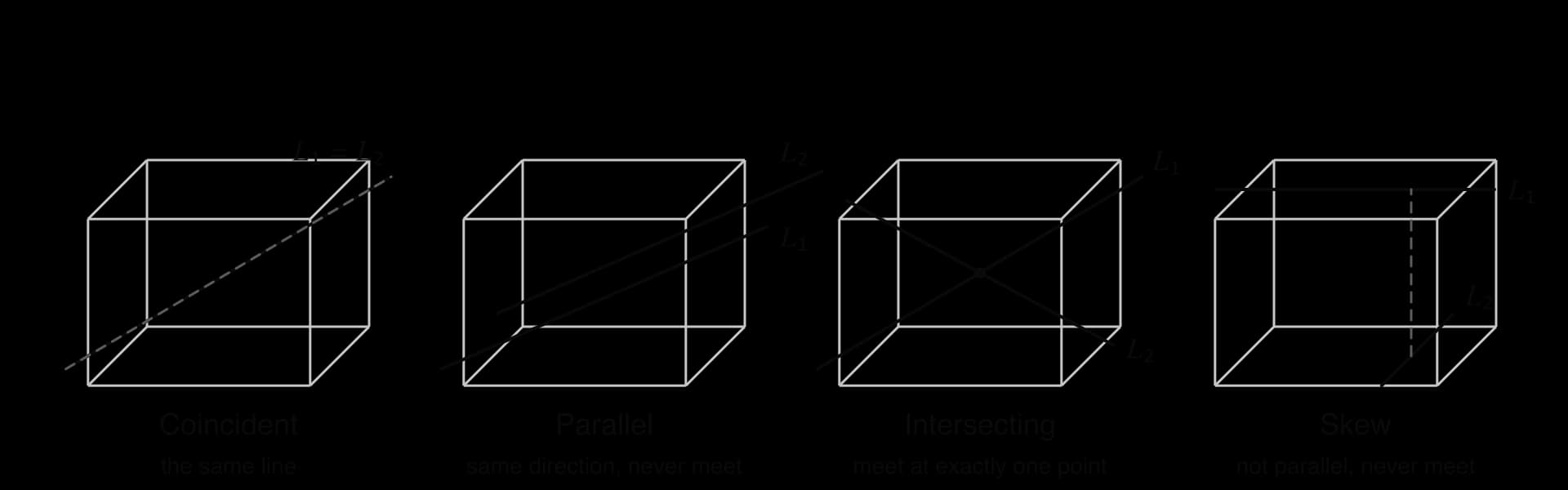
The four possible relationships between two lines
Every line has a direction vector, and any two lines can be compared using their direction vectors and the points they pass through. Two questions settle the relationship completely: are the directions the same, and do the lines share a point?
Coincident lines often look different on paper, because the same line can be written with any of its points as the starting point and any non-zero multiple of its direction vector. Skew lines can only exist in three dimensions. Two lines that are parallel or intersecting always lie in a common plane (they are coplanar), while two skew lines never do.
Only skew lines need three dimensions: the two lines lie in different parallel layers, so they pass each other without meeting.
The table summarises how each case is recognised from the vector equations r=a1+λb1 and r=a2+μb2.
Relationship
Direction vectors
Common points
Coincident
b2=kb1 for some scalar k
Every point
Parallel (distinct)
b2=kb1 for some scalar k
None
Intersecting
Not parallel
Exactly one
Skew
Not parallel
None
Lines in two dimensions
In a plane, two lines with non-parallel direction vectors always meet. So in two dimensions only three cases occur: coincident, parallel or intersecting. To find the intersection of r=(12)+λ(31) and r=(05)+μ(1−1), equate the two components:
1+3λ=μ,2+λ=5−μ
Substituting the first equation into the second gives 2+λ=4−3λ, so λ=21 and μ=25. The lines meet at (25,25). With two unknowns and two equations there is nothing left over to check, which is exactly why skew lines cannot occur in a plane.
Parallel and coincident lines
Two lines are parallel (or coincident) exactly when one direction vector is a scalar multiple of the other. The multiple can be negative or a fraction: −42−6=−22−13, so these two vectors give parallel lines even though they point in opposite senses.
To separate parallel from coincident, test whether one point of the first line lies on the second. If it does, the lines share a point and the same direction, so they are the same line. If it does not, they are distinct parallel lines and never meet.
Intersecting and skew lines
When the direction vectors are not parallel, the lines either intersect at one point or are skew. A point of intersection must lie on both lines, so there must be a value of λ and a value of μ that make the two position vectors equal:
a1+λb1=a2+μb2
Equating components
Writing this vector equation one component at a time gives three equations in only two unknowns, λ and μ. The method is:
Use a different parameter for each line (for example λ and μ).
Equate the x-, y- and z-components to get three equations.
Solve two of the equations simultaneously for λ and μ.
Substitute both values into the third equation. If it is satisfied, the lines intersect; substitute λ into L1 (or μ into L2) to find the point. If it is not satisfied, the lines do not meet, and since they are not parallel they are skew.
Three equations in two unknowns usually have no solution, which is why skew lines are the typical case in three dimensions. Two lines drawn at random in space are almost never in a common plane.
The decision process
The checks combine into a short decision process. Comparing direction vectors comes first, because it decides which of the two follow-up questions to ask.
Two questions decide every case. Parallel directions lead to a point test; non-parallel directions lead to solving for the two parameters.
The check in the third equation is the step that proves the lines meet. Without it, the two values found only make two of the three components agree, and the "point of intersection" could be two different points that happen to share an x- and a y-coordinate.
Lines given in Cartesian form
When a line is given in Cartesian form, convert it to vector form before equating components. The line lx−x0=my−y0=nz−z0 passes through (x0,y0,z0) with direction lmn. Setting each fraction equal to a parameter gives the parametric equations directly. For example,
3x−6=y−5=−2z+2becomesr=65−2+μ31−2
because y−5 is the same as 1y−5. The signs need care: z+2=z−(−2), so the z-coordinate of the point is −2.
Finding a parameter so that lines intersect
Some questions give one line with an unknown constant and ask for the value that makes the lines meet. The method is the same: solve the two equations that do not contain the unknown, then use the third equation to find it.
Paths that cross and objects that collide
In kinematics, r=a+tv gives the position of a moving object at time t (see 3.14). Two different questions can be asked about two such objects. Whether their paths cross is a question about the lines, so it uses a separate parameter for each line. Whether the objects collide asks whether they are at the same point at the same time, so it uses the same t in both equations. Paths can cross without a collision when the objects reach the crossing point at different times.
Shortest distance from a point to a line
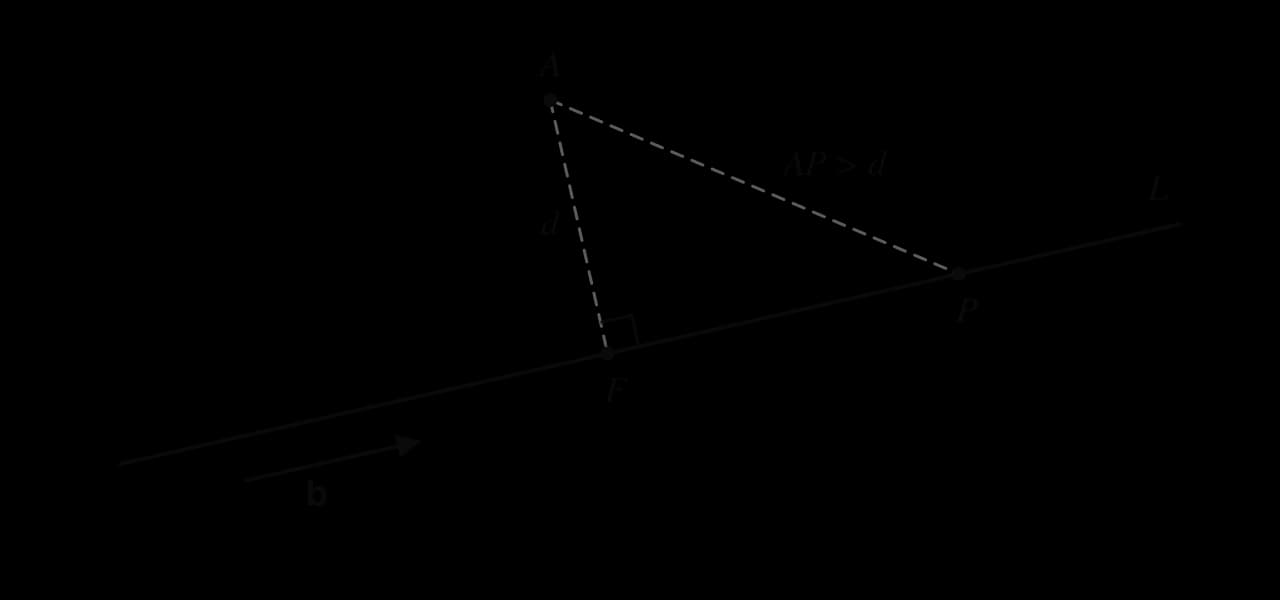
The distance from a point to a line means the shortest distance. Of all the segments joining a point A to points of a line L, the shortest one meets L at a right angle. Its end on the line is the foot of the perpendicular, usually labelled F.
The segment AF is shortest because, for any other point P on the line, triangle AFP has a right angle at F, so AP is its hypotenuse and is longer than AF.
Every other segment from A to the line is the hypotenuse of a right-angled triangle, so the perpendicular AF is the shortest.
Finding the foot of the perpendicular
The method uses the scalar product to express "perpendicular" as an equation (3.13):
Write a general point P on the line in terms of the parameter: OP=a+λb.
Find AP in terms of λ.
Set AP⋅b=0 and solve for λ. This value gives the foot F
The shortest distance is ∣AF∣.
The equation in step 3 is always linear in λ, so it has exactly one solution: there is only one foot of the perpendicular.
A formula using the vector product
Once the vector product is known (3.16), there is a quicker way to find the distance alone. If P0 is any point on the line and θ is the angle between P0A and b, then the distance is d=∣P0A∣sinθ. Since ∣P0A×b∣=∣P0A∣∣b∣sinθ,
d=∣b∣∣P0A×b∣
In the example, P0=(2,−1,0), P0A=35−1 and P0A×b=11−7−2, so d=6174=29, as before. This formula does not give the foot F, so use the scalar product method whenever the point itself is asked for.
Distance between parallel lines
Parallel lines stay the same distance apart everywhere. So the distance between them is the distance from any point on one line to the other line, found with the foot of the perpendicular.
Shortest distance between skew lines
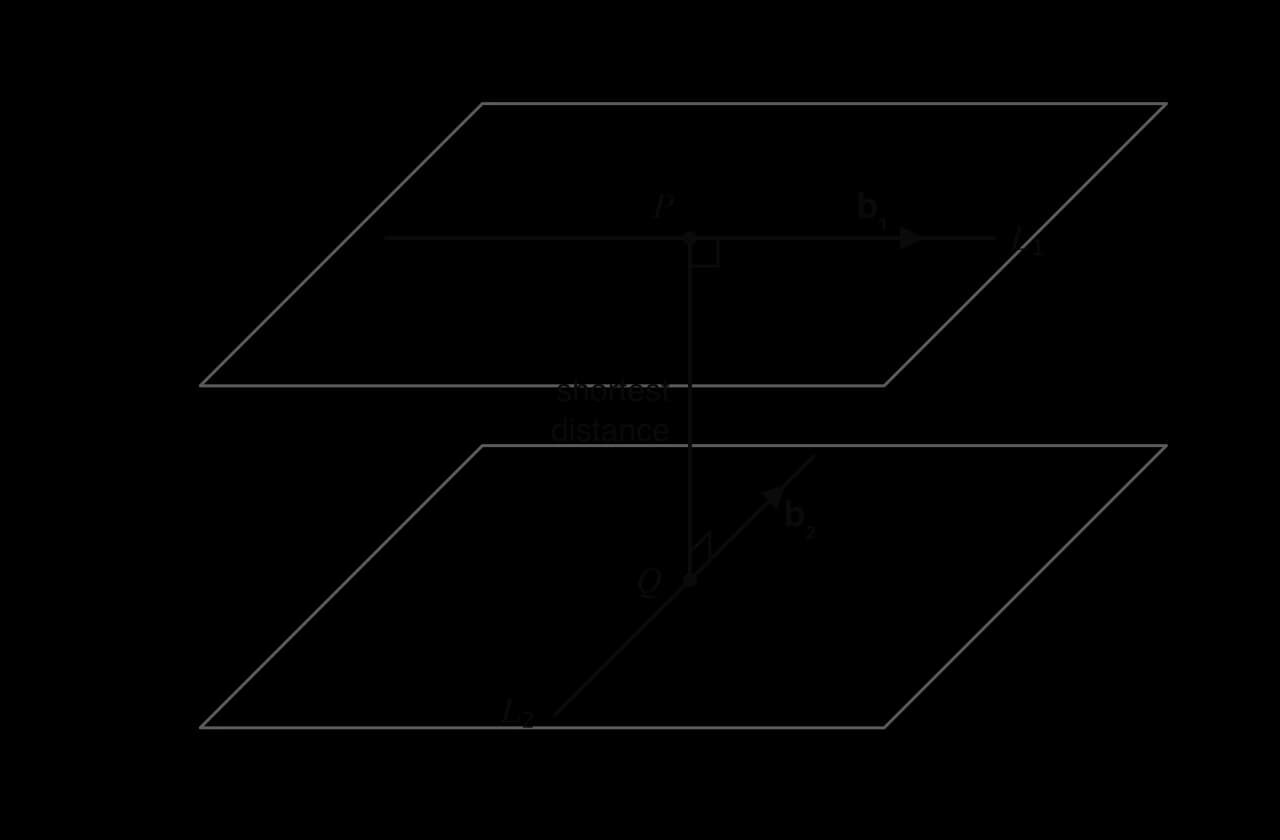
Two skew lines come closest at one pair of points, P on L1 and Q on L2. The segment PQ is perpendicular to both lines; it is called the common perpendicular. If PQ were not perpendicular to L1, sliding P a little along L1 would shorten it, and the same is true for L2.
Skew lines lie in two parallel planes. The common perpendicular PQ runs straight across the gap between the planes, at right angles to both lines.
Method 1: general points and two perpendicular conditions
This method finds the points P and Q as well as the distance.
Write general points P on L1 (parameter λ) and Q on L2 (parameter μ).
Find PQ in terms of λ and μ.
Set PQ⋅b1=0 and PQ⋅b2=0
Substitute to find P, Q and ∣PQ∣.
Method 2: projecting onto the common normal
A vector perpendicular to both lines is n=b1×b2 (3.16). The segment PQ is parallel to n. For any point A1 on L1 and any point A2 on L2, the length of PQ is the component of A1A2 in the direction of n:
d=∣n∣∣A1A2⋅n∣=∣b1×b2∣∣(a2−a1)⋅(b1×b2)∣
This works because moving A1 along L1 or A2 along L2 only adds multiples of b1 or b2, and both are perpendicular to n, so the dot product does not change. If d=0, the lines are coplanar, so they intersect (or are parallel, in which case n=0 and the formula cannot be used).
A modelling application
Engineers planning underground services check the clearance between straight pipes, cables and tunnels, which are usually skew. A calculator handles the arithmetic once the method is set up.
Exam-style questions on lines in three dimensions
The questions combine every skill on lines: classifying, intersecting, angles (3.14) and distances. They often move from a "show that" part to a part that uses its result.
The command term matters in the last part of questions like this. "Find the shortest distance" accepts either method; "find the points on each line that are closest" needs Method 1, because Method 2 gives only the length.
Self-check
To do:
I can test whether two direction vectors are parallel and decide between coincident and parallel lines by testing a point.
To do:
I can find the point where two lines intersect, solving two equations and checking the third.
To do:
I can prove that two lines are skew, stating both conditions.
To do:
I can convert a line from Cartesian form to vector form before comparing it with another line.
To do:
I can find an unknown constant that makes two lines intersect.
To do:
I can tell the difference between paths crossing and objects colliding.
To do:
I can find the foot of the perpendicular from a point to a line and the shortest distance to the line.
To do:
I can find the shortest distance between parallel lines and between skew lines.
Questions on 3.15
22 exam-style questions on this subtopic, written in the style of the IB papers. The first has its markscheme open. Counted on
Question 1 · AA-002446 marks
Two drones, A and B, are flying in straight lines with constant velocities. Relative to a fixed origin, their position vectors t seconds after they are launched are given by
rA=210+t321andrB=11−512+t04−3,
where distances are measured in metres and t≥0.
(a)
Show that the drones collide, and find the coordinates of the point of collision.
[4]4 marks
Markscheme (a)
attempt to equate components with the same value of tM1
2+3t=11⇒t=3A1
check in the other components: 1+2(3)=7=−5+4(3)
Question 2 · AA-002535 marks
The lines L1 and L2 have the following vector equations.
L1:r=1−23+λ21−1,λ∈R
Question 3 · AA-002547 marks
The line L1 has Cartesian equation
2x−1=3−y=4z+2.
Try a quick-fire question
One of 29 short multiple-choice questions on 3.15. Pick an answer to see why it's right or wrong.
Which expression gives the shortest distance from the point P to the line r=a+λb?
From the formula booklet
The entries of the mathematics: analysis and approaches formula booklet that 3.15 uses. Each opens in the explained booklet.
Now test whether the point (5,0,5) on L2 lies on L1. Each component gives a value of λ:
1+2λ=5⇒λ=2,2−λ=0⇒λ=2,−1+3λ=5⇒λ=2
All three components give the same value, λ=2, so (5,0,5) lies on L1. The lines have parallel directions and a common point, so they are coincident.
(b) 4−26=22−13, so L1 and L3 are parallel or coincident. Test the point (4,0,1) on L3:
1+2λ=4⇒λ=1.5,2−λ=0⇒λ=2
The values disagree, so no single value of λ gives (4,0,1). The point is not on L1, so L1 and L3 are parallel and distinct.
and
232
are not multiples of each other (the first components would need
k=2
, the second
k=1.5
), so the lines are not parallel.
Equate components:
xyz:1+λ=1+2μ:2λ=1+3μ:2−λ=−2+2μ
From the x-equation, λ=2μ. Substitute into the y-equation: 4μ=1+3μ, so μ=1 and λ=2.
Check in the z-equation: left side 2−2=0, right side −2+2(1)=0. Both sides are equal, so the lines intersect.
Substitute λ=2 into L1:
r=102+212−1=340
As a check, μ=1 in L2 gives (1+2,1+3,−2+2)=(3,4,0) as well. The point of intersection is (3,4,0).
is not a multiple of
12−1
, since the first components would need
k=1
but the second components would need
k=−21
.
No common point: equate components.
xyz:1+λ=μ:2λ=1−μ:2−λ=1+2μ
Substitute μ=1+λ from the x-equation into the y-equation: 2λ=1−(1+λ)=−λ, so 3λ=0, giving λ=0 and μ=1.
Check in the z-equation: left side 2−0=2, right side 1+2(1)=3. Since 2=3, there are no values of λ and μ satisfying all three equations, so the lines do not intersect.
The lines are neither parallel nor intersecting, so they are skew.
The x- and y-equations do not involve k, so solve them first. Subtracting the x-equation from the y-equation:
2λ−(1+λ)=(1+μ)−(4+μ)⇒λ−1=−3⇒λ=−2
Then μ=2λ−1=−5.
The lines intersect, so the z-equation must also hold: 2−(−2)=k+(−5), which gives k=9.
The point is λ=−2 on L1: (1−2,0−4,2+2)=(−1,−4,4). Check with μ=−5 on L4: (4−5,1−5,9−5)=(−1,−4,4).
The z-equation gives 0.4s=2, so s=5. Then the y-equation gives 10−2t=2, so t=4.
Check in the x-equation: left side −20+32=12, right side −3+15=12. The equation holds, so the paths cross. The crossing point is rA at t=4: (12,2,9).
(b) Aircraft A is at the crossing point when t=4 (12:04) and aircraft B when t=5 (12:05). They are never at the same place at the same time, so they do not collide.
(c) At t=4, rB=−3+12−18+167+1.6=9−28.6. The distance between the aircraft is
12−92−(−2)9−8.6=32+42+0.42=25.16=5.02 km (3 s.f.)
.
For the foot of the perpendicular, AP is perpendicular to the direction vector:
λ−3λ−52λ+1⋅112=(λ−3)+(λ−5)+2(2λ+1)=6λ−6=0
So λ=1, and the foot is F(3,0,2).
(b) With λ=1, AF=−2−43. As a check, −2−43⋅112=−2−4+6=0. The shortest distance is
∣AF∣=(−2)2+(−4)2+32=29≈5.39
. A general point on
L1
is
P(1+2λ,2−λ,−1+3λ)
, so
AP=2λ−32−λ3λ−2
Set AP⋅2−13=0:
2(2λ−3)−(2−λ)+3(3λ−2)=14λ−14=0⇒λ=1
The foot is F(3,1,2) and AF=−111. The distance between the lines is
∣AF∣=1+1+1=3≈1.73
and solve the two linear equations.
, so
PQ=μ−λ−11−μ−2λ−1+2μ+λ
Perpendicular to L1:
(μ−λ−1)+2(1−μ−2λ)−(−1+2μ+λ)=2−6λ−3μ=0
Perpendicular to L3:
(μ−λ−1)−(1−μ−2λ)+2(−1+2μ+λ)=−4+3λ+6μ=0
So 6λ+3μ=2 and 3λ+6μ=4. Doubling the second equation and subtracting the first gives 9μ=6, so μ=32, and then 6λ=2−2=0, so λ=0.
Substitute: P=(1,0,2) and Q=(32,31,37), so PQ=−313131.
∣PQ∣=91+91+91=33≈0.577
Check with Method 2: b1×b2=3−3−3, and a2−a1=−11−1, so
d=27∣−3−3+3∣=333=33
Both methods agree. Notice also that PQ is a multiple of b1×b2, as it must be.
The vector between the two given points is 3−1−2, and
3−1−2⋅2−5−17=6+5+34=45,∣n∣=4+25+289=318
So the shortest distance is
d=31845=2.52 m (3 s.f.)
Since 2.52>2, the plan meets the rule. In this model the pipe and duct are lines with no thickness; a real check would also subtract their radii from the distance between the centre lines.
. [3] The line
L3
has Cartesian equations
x=z−1,y=1
. (c) Show that
L1
and
L3
are skew. [4] (d) Find the shortest distance between
L1
and
L3
. [4]
The first gives μ=2λ. Substituting into the second: −2+λ=−7+6λ, so λ=1 and μ=2. Check the third: 3−1=2 and −2+4=2, which agree. The point is λ=1 on L1: (3,−1,2). Writing "the third equation is satisfied, so the lines intersect" earns the reasoning mark.
(b) Use the direction vectors, not the position vectors:
cosθ=614∣2(1)+1(3)+(−1)(2)∣=843=2213
With a GDC, this gives θ=70.9°.
(c) Write L3 in vector form. With z=t, x=t−1 and y=1, so L3:r=−110+t101. The directions 21−1 and 101 are not parallel, so the lines are not parallel. Equate components:
1+2λ=−1+t,−2+λ=1,3−λ=t
The second gives λ=3, then the third gives t=0. Check the first: 1+6=7 but −1+0=−1. The equations are inconsistent, so the lines do not meet, and since they are not parallel, they are skew.
(d) n=21−1×101=1×1−(−1)×0(−1)×1−2×12×0−1×1=1−3−1. With a3−a1=−23−3:
d=1+9+1∣−2−9+3∣=118=11811≈2.41
and
0+3=3=12−3(3)
, so the drones are at the same point at the same time
R1
(11,7,3)A1
Note: Award M0 for using different parameters for the two drones, unless it is then shown that both parameters are equal.
(b)
Find the speed of each drone.
[2]2 marks
Markscheme (b)
speed of A =9+4+1=14=3.74 m s−1(3.74165…)A1
speed of B =0+16+9=5 m s−1
L2:r=3−6−3+μ132,μ∈R
Show that L1 and L2 intersect, and find the coordinates of their point of intersection.