Notes on 3.14 Vector equations of lines
In two dimensions a straight line has an equation such as , built from its gradient. In three dimensions a single gradient cannot describe a direction, because a line can tilt in two independent ways. Vectors solve the problem: a line is fixed completely by one point on it and a vector giving its direction.
This description works the same way in two and three dimensions, and it has a natural reading as motion: start at a point and move steadily in a fixed direction. Straight-line paths of ships, aircraft, light rays and robot arms are all modelled in this way.
The vector equation of a line
A point and a direction
Let be a fixed point on a line, with position vector , and let be a non-zero vector parallel to the line. A point , with position vector , lies on the line exactly when the displacement

The vector equation of a line is a rule for producing points. Each real value of the parameter gives the position vector of one point: gives itself, positive values give points on one side of in the direction of , and negative values give points on the other side. The direction vector fixes which way the line points, and
The letter always stands for the position vector of a general point on the line. Writing the answer as "" is part of the equation; an expression such as
The line through two points
A line through two points and has direction
With this equation, gives , gives , and values of between 0 and 1 give the points of the line segment
One line, many equations
A line has infinitely many vector equations. Any point on the line can play the role of , and any non-zero multiple of is also a direction vector. The line through and in the last example could equally be written
To decide whether two equations describe the same line, check two things: the direction vectors must be parallel, and a point of one line must lie on the other.
Parametric and Cartesian forms
Parametric equations
Writing the vector equation one component at a time gives three ordinary equations. If the line passes through with direction vector
These are the parametric equations of the line. They are the most convenient form for substituting into other equations, for example to find where a line crosses a coordinate plane or another line.
Cartesian equations
Making the subject of each parametric equation and setting the results equal removes the parameter. When , and are all non-zero this gives the Cartesian equations of the line.
The Cartesian equations are really two equations (the first fraction equals the second, and the second equals the third), because a line in space needs two conditions to pin it down. The point can be read from the numerators and the direction from the denominators, but only once each numerator has the form , ,
If one component of the direction vector is zero, that coordinate never changes along the line. For the line through with direction
Form | Line through with direction |
|---|
Lines in two dimensions
Everything works in two dimensions with two components instead of three. The line
A direction vector with corresponds to a gradient of
Points on a line
Checking whether a point lies on a line
A point lies on a line if one value of the parameter produces it. Set the general point of the line equal to the given point, find from one component, then check that the same works in the remaining components. If any component fails, the point is not on the line.
Where a line crosses a coordinate plane
On the -plane every point has , on the -plane , and on the
The angle between two lines
The angle between two lines is defined as the angle between their direction vectors. It is found with the scalar product, exactly as for two vectors. Since a line has no preferred direction (both and are direction vectors of it), two lines make two angles, and , and the angle between the lines is taken to be the acute one.
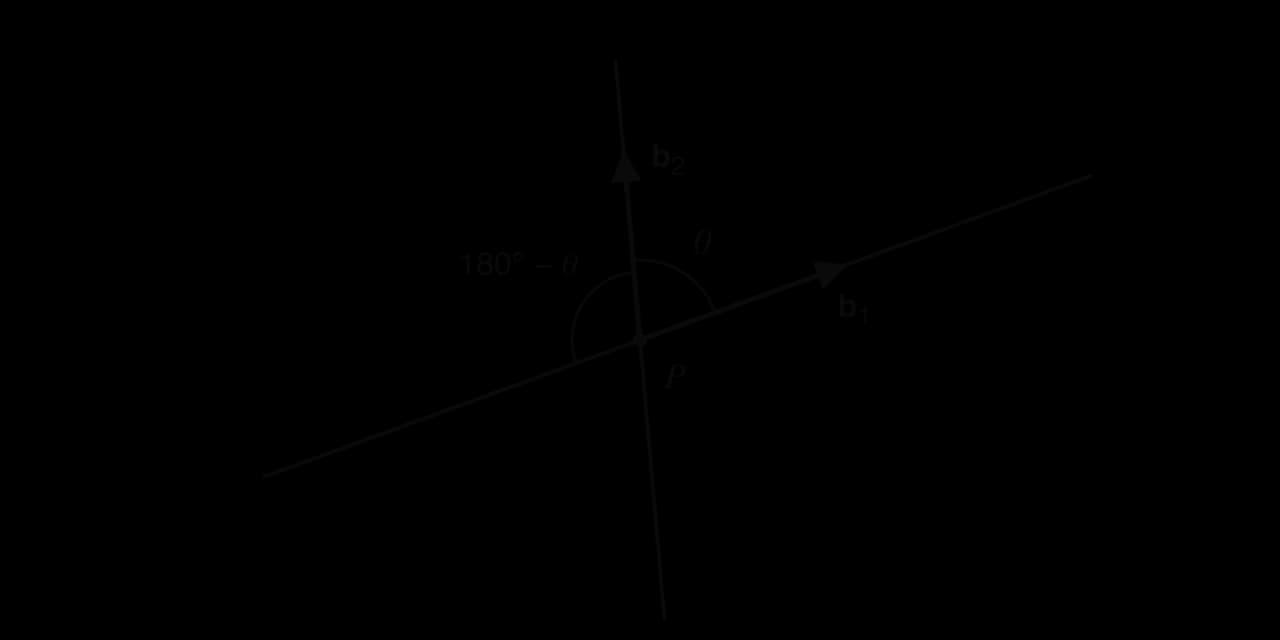
Taking the modulus of the scalar product makes the cosine non-negative, which always gives the acute angle (or a right angle):
The same formula applies whether or not the lines meet. Two lines in space can miss each other completely (skew lines, 3.15), but they still have directions, and so still have an angle between them.
Two lines are perpendicular when their direction vectors have a zero scalar product. For example, lines with directions
Lines as models of motion
Position, velocity and speed
An object moving with constant velocity travels in a straight line. If its position vector at time is , then after time it has moved , and its position vector is
This is the vector equation of a line with the time as the parameter. The direction vector is the velocity, and its magnitude is the speed. Units follow the situation: with positions in kilometres and time in hours, is in .
Unlike a general line, the parameter now has a physical meaning, so only some values make sense. Times before the motion began, or after it ends, are outside the model. The model also assumes the velocity never changes, which is a simplification: a real ship is pushed by currents and a real aircraft turns and climbs.
When two positions and the times at which they are reached are known, the velocity is the displacement divided by the time taken. For example, an object at at and at at
so its speed is and its position is
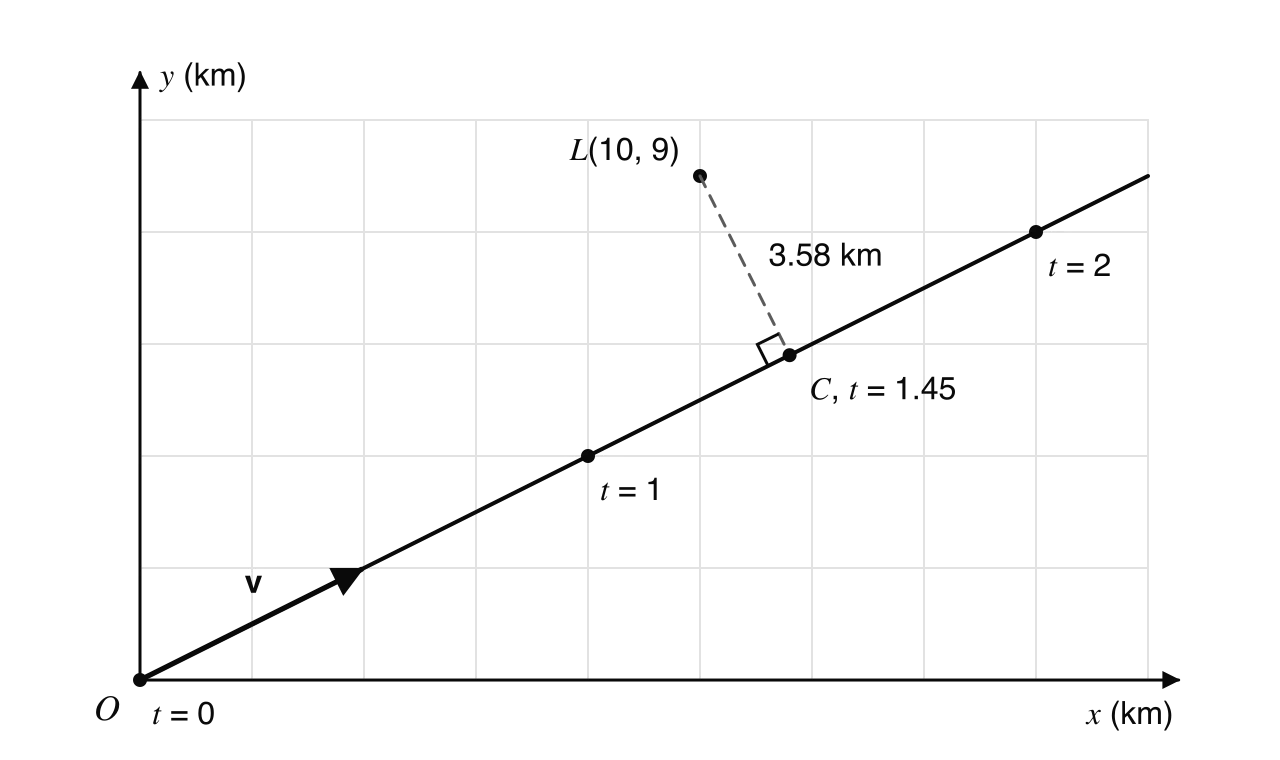
Closest approach to a fixed point
The distance between a moving object and a fixed point changes with time. It is smallest when the line from the fixed point to the object is perpendicular to the direction of motion, since a perpendicular is the shortest route from a point to a line. There are two equivalent ways to find this moment:
write the square of the distance as a quadratic in and find its minimum (by completing the square, or with a GDC or calculus);
use the scalar product: at closest approach, , where is the position vector of the fixed point.
Two moving objects
Two objects collide only if they are at the same place at the same time. Their paths may cross without a collision, because each object can pass through the crossing point at a different time. For this reason the two position vectors are compared using the same value of , which is different from finding where two lines meet (3.15), where each line has its own parameter.
Exam-style questions on lines
The second question models two aircraft. It is a calculator question, and the GDC is used to minimise a distance that would be slow to minimise by hand.
Self-check
- To do:
I can write a vector equation of a line through a point with a given direction, or through two points.
- To do:
I can explain why a line has many vector equations, and decide whether two equations represent the same line.
- To do:
I can convert between vector, parametric and Cartesian forms, including Cartesian equations with coefficients and minus signs.
- To do:
I can show whether a point lies on a line by checking every component with one value of the parameter.
- To do:
I can find the acute angle between two lines using only their direction vectors.
- To do:
I can find position, velocity and speed from .
- To do: