3.13 The scalar product · IB Maths AA | Augment Education
3.13 The scalar product
Calculate the scalar product of two vectors, use it to find angles, test for perpendicular and parallel vectors, and find the component of one vector along another.
IB Mathematics: Analysis and Approaches
Part of 3 Geometry and trigonometry
HL only
Key terms introduced here
Each is in the Maths AA glossary, with every other term in the subject.
The vector along w whose length is the scalar projection of v on w: ∣w∣2v⋅ww.
Notes on 3.13 The scalar product
24 min readLast reviewed
Adding two vectors gives another vector. The scalar product is a different way of combining two vectors, and its result is a single number. That number measures how far the two vectors point in the same direction: it is large and positive when they point roughly the same way, zero when they are at right angles, and negative when they point in roughly opposite directions.
This makes the scalar product the main tool for angles in three dimensions, where drawing an accurate diagram is difficult. It also appears in physics as the work done by a force, and later in the course it gives the equation of a plane.
The scalar product
The component form
The scalar product of two vectors is found by multiplying corresponding components and adding the results.
The dot between the vectors is part of the notation and must always be written: v⋅w is read "v dot w". The name "scalar product" comes from the fact that the answer is a scalar, not a vector.
The geometric form
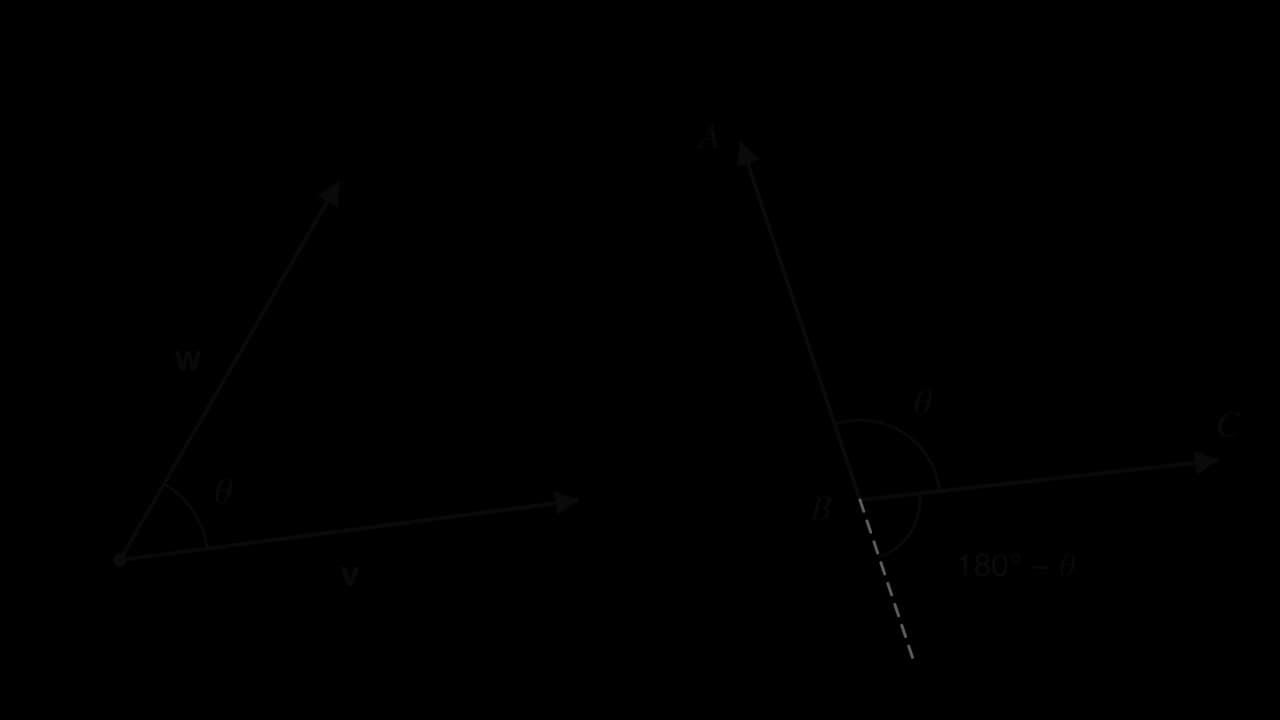
The scalar product can also be calculated from the lengths of the two vectors and the angle between them. The angle θ between two vectors is measured when they are drawn tail to tail, starting from the same point, and it always lies in the interval 0≤θ≤π (0° to 180°).
The angle between two vectors is measured with both pointing away from the same point. At the corner B of a triangle, that means using BA and BC; following AB and then BC measures the outside angle 180° − θ instead.
v⋅w=∣v∣∣w∣cosθ
Both forms always give the same number. The component form is used to calculate a scalar product, and the geometric form is used to interpret it, most often by rearranging it to find the angle.
Why the two forms agree
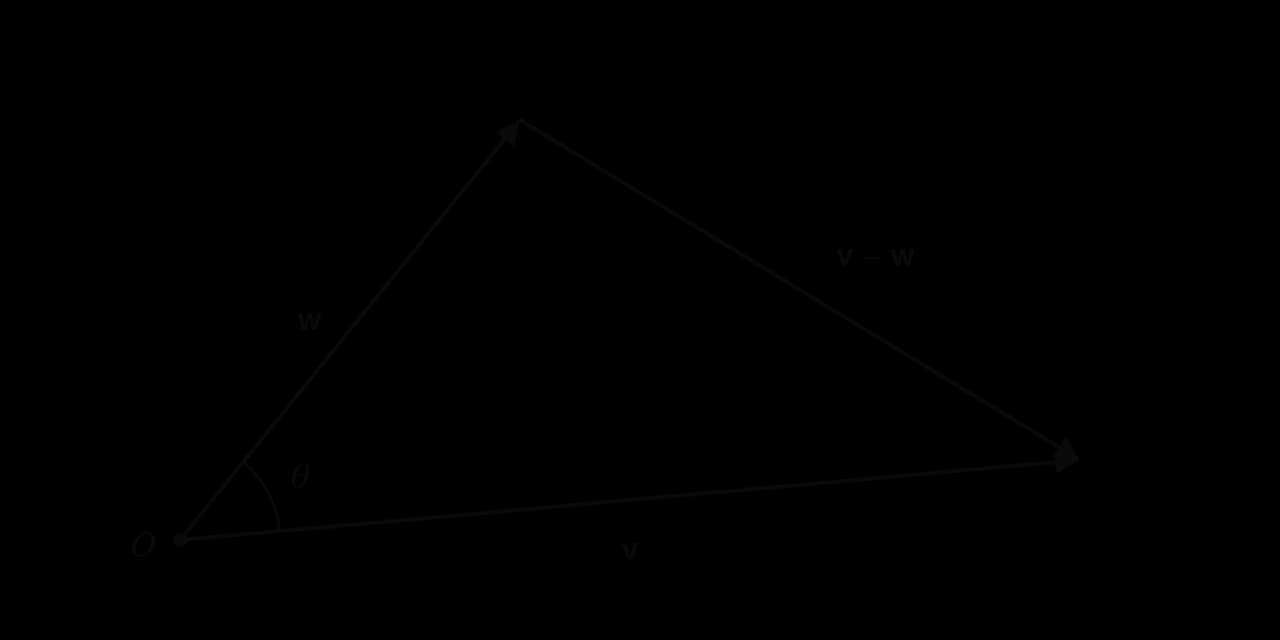
Draw v and w from the origin O. The third side of the triangle they form runs from the tip of w to the tip of v, so it represents v−w
The sides of this triangle have lengths |v|, |w| and |v − w|, with the angle θ between the first two, so the cosine rule applies.
The cosine rule (3.2) in this triangle gives
∣v−w∣2=∣v∣2+∣w∣2−2∣v∣∣w∣cosθ
The left-hand side can also be expanded from components:
Comparing the two expressions, the terms ∣v∣2+∣w∣2 match, so
v1w1+v2w2+v3w3=∣v∣∣w∣cosθ
This is a clear case of equivalence: one quantity has an algebraic description (components) and a geometric description (lengths and an angle), and moving between them is what makes the scalar product useful.
Properties of the scalar product
The scalar product follows most of the rules of ordinary multiplication, so expressions with dots can be expanded and simplified much like algebra.
Property
In symbols
Commutative
v⋅w=w⋅v
Distributive over addition
u⋅(v+w)=u⋅v+u⋅w
Each property follows from the component form. For example, v⋅v=v12+v22+v32
The property v⋅v=∣v∣2 is the key to questions that give magnitudes and scalar products but no components. The magnitude of a combination is found by squaring it as a scalar product and expanding.
The angle between two vectors
Finding the angle
Rearranging the geometric form gives the angle between two non-zero vectors directly from their components:
cosθ=∣v∣∣w∣v⋅w=∣v∣∣w∣v1w1+v2w2+v3w3
Since θ is between 0 and π, the inverse cosine gives exactly one angle. A negative cosine gives an obtuse angle, so no case analysis is needed.
The method has three steps: find the scalar product, find both magnitudes, then divide and take the inverse cosine.
What the sign of the scalar product shows
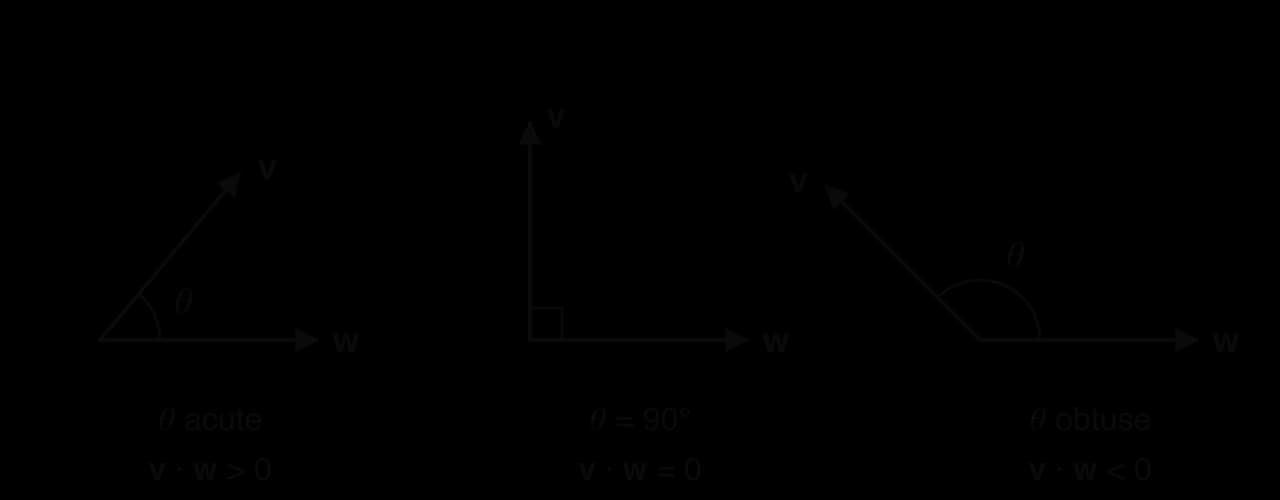
The magnitudes ∣v∣ and ∣w∣ are positive, so the sign of v⋅w is the sign of cosθ. This gives information about the angle before any calculation of θ
The sign of the scalar product shows the type of angle: positive for acute, zero for a right angle, negative for obtuse.
Exact angles
When the cosine is a value from the unit circle, such as 21 or −22
Angles with the coordinate axes
The angle between a vector and the positive x-axis is the angle between the vector and i. Since v⋅i=v1 and ∣i∣=1
Angles in triangles and solids
To find an angle in a triangle with known vertices, use the two vectors that start at the vertex where the angle is. For angle ABC, the vertex is B, so the vectors are BA and BC
Perpendicular vectors
The perpendicularity test
Two non-zero vectors are perpendicular when the angle between them is 90°. Since cos90°=0, the geometric form gives v⋅w=0. Conversely, if the scalar product of two non-zero vectors is zero, then cosθ=0
This is one of the most used facts in vector geometry. Perpendicular vectors are also called orthogonal. In two dimensions, (ab) is always perpendicular to (−ba)
A vector perpendicular to two others
In three dimensions, infinitely many directions are perpendicular to a single vector, but only one direction (up to multiples) is perpendicular to two non-parallel vectors. It can be found by writing the unknown vector as xyz
Parallel vectors and the scalar product
Parallel vectors are at an angle of 0 (same direction) or π (opposite directions), where cosθ=±1. The scalar product then reaches its largest possible size:
v and w parallel⟺∣v⋅w∣=∣v∣∣w∣
For any other angle ∣cosθ∣<1, so ∣v⋅w∣<∣v∣∣w∣.
For example, 2−46⋅−12−3=−2−8−18=−28
Proofs with the scalar product
Because a zero scalar product means a right angle, the scalar product turns geometric statements about perpendicular lines into algebra. The method is the same as for other vector proofs: choose a few vectors to describe the figure, write the vectors along the relevant lines in terms of them, and show that the scalar product is zero.
With the centre as origin, the ends of a diameter have position vectors a and −a, and every point of the circle is at the same distance from O.
The same few lines prove that the diagonals of a rhombus are perpendicular. In rhombus ABCD, let AB=a and AD=b
(a+b)⋅(a−b)=∣a∣2−∣b∣2=0
In a parallelogram that is not a rhombus, ∣a∣=∣b∣ and the diagonals are not perpendicular, so the proof also shows exactly when the result holds.
Projection: the component of one vector along another
Scalar and vector projection
Shining a light perpendicular to w casts a shadow of v onto the line of w. The length of that shadow is ∣v∣cosθ, from the right-angled triangle formed by v
The scalar projection of v onto w is the length of the shadow of v along w, |v| cos θ.
Dividing the scalar product by ∣w∣ gives exactly this length, because ∣w∣v⋅w=∣v∣cosθ
The scalar projection is the scalar product with the unit vector in the direction of w. The vector projection multiplies this length by the same unit vector. Projections give the foot of a perpendicular from a point to a line, which is the basis of the shortest-distance methods in 3.15.
Work done by a force
When a constant force F moves an object through a displacement s, only the part of the force along the direction of motion does any work. That part is the scalar projection of F onto s, and multiplying it by the distance ∣s∣ gives
W=∣F∣cosθ×∣s∣=F⋅s
With force in newtons and displacement in metres, the work is in joules (J). A force perpendicular to the motion does no work, which matches F⋅s=0.
Exam-style questions on the scalar product
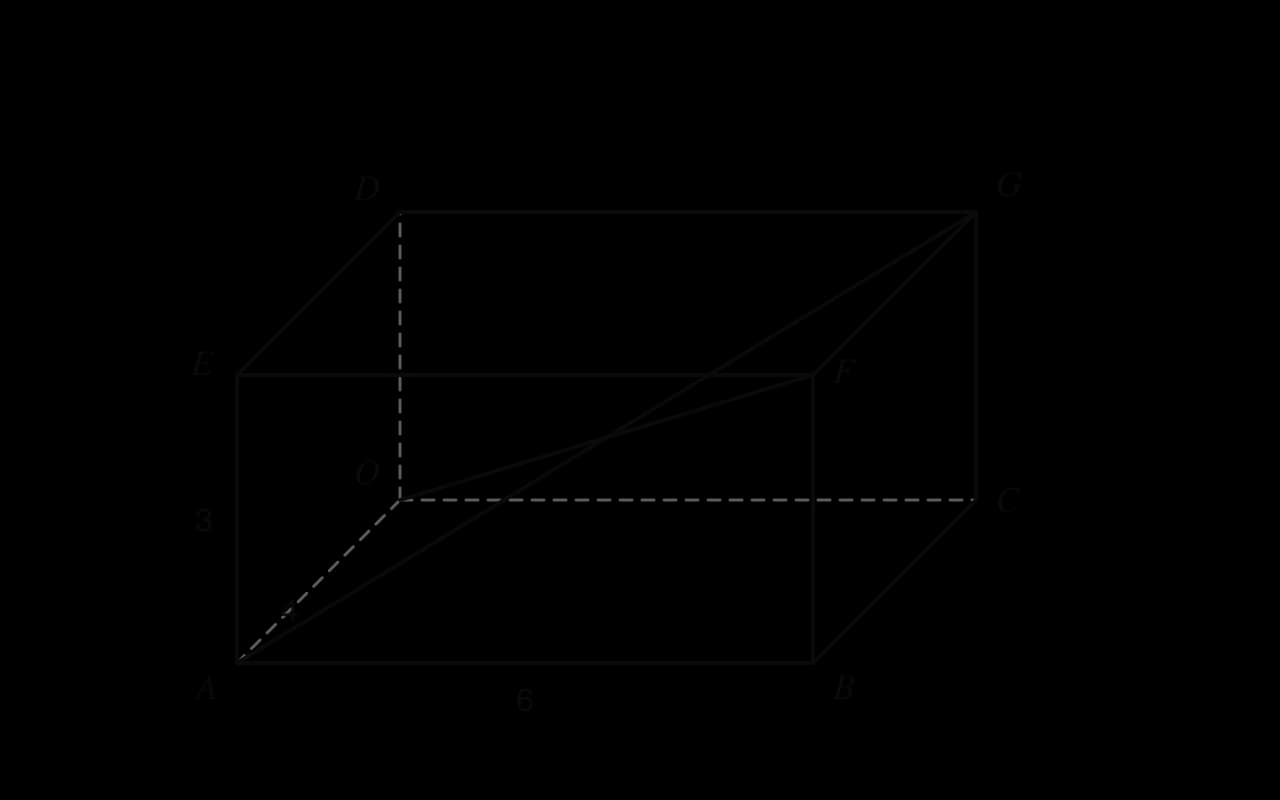
The second question is a calculator question about a solid. The vertices come from the dimensions of the cuboid, and the angles come from the vectors along its diagonals.
Self-check
To do:
I can calculate a scalar product from components and explain why the result is a number.
To do:
I can state the geometric form v⋅w=∣v∣∣w∣cosθ and explain why it agrees with the component form.
To do:
I can find the angle between two vectors, exactly or to 1 decimal place in degrees.
To do:
I can find an angle in a triangle using the two vectors that start at its vertex.
Questions on 3.13
66 exam-style questions on this subtopic, written in the style of the IB papers. The first has its markscheme open. Counted on
Question 1 · AA-0020918 marks
The points A(1,−2,0), B(3,1,6) and C(9,−1,9) are three vertices of a parallelogram ABCD, where D is diagonally opposite B.
(a)
Find AB and BC
Question 2 · AA-0021015 marks
ABCDEF is a regular hexagon with centre O. Let OA=a
Question 3 · AA-002174 marks
Consider the vectors a=2i−j+k and b=i+j+2k
Try a quick-fire question
One of 33 short multiple-choice questions on 3.13. Pick an answer to see why it's right or wrong.
For the cube OABCDEFG of side 2 in the diagram, what is the cosine of the angle between the diagonal OF and the edge OA?
From the formula booklet
The entries of the mathematics: analysis and approaches formula booklet that 3.13 uses. Each opens in the explained booklet.
(b) First write both vectors with all three components. v has no j term, so its second component is 0.
v⋅w=20−3⋅412=8+0−6=2
, stops halfway. The products of the components must be added, and the scalar product is the single number
−3
.
.
Scalars factor out
(kv)⋅w=k(v⋅w)=v⋅(kw)
A vector with itself
v⋅v=∣v∣2
Base vectors
i⋅i=j⋅j=k⋅k=1, i⋅j=j⋅k=k⋅i=0
, which is the square of the
magnitude
; geometrically, the angle between a vector and itself is
0
and
cos0=1
. The last row says that each base vector is a unit vector at right angles to the other two, and expanding
(v1i+v2j+v3k)⋅(w1i+w2j+w3k)
with these values gives the component formula again.
and
a⋅b=4
.
(a) Find (a+b)⋅(a−b).
(b) Find ∣a+2b∣.
Show the solution
(a) Expand like a product of brackets. The middle terms cancel because b⋅a=a⋅b.
(a+b)⋅(a−b)=a⋅a−a⋅b+b⋅a−b⋅b=∣a∣2−∣b∣2=9−25=−16
(b) Write the square of the magnitude as a scalar product, then expand.
∣a+2b∣2=(a+2b)⋅(a+2b)=∣a∣2+4a⋅b+4∣b∣2
=9+4×4+4×25=125
∣a+2b∣=125=55
does not mean
b=c
. It only means
a
is perpendicular to
b−c
.
and
w=304
, giving your answer in degrees.
Show the solution
Scalar product:
v⋅w=3+0−8=−5
Magnitudes:
∣v∣=1+4+4=3,∣w∣=9+0+16=5
Angle:
cosθ=3×5−5=−31⇒θ=109.471…°≈109.5°
The scalar product is negative, so the angle is obtuse, as expected.
.
, the angle can be given exactly. Answers in radians are expected in terms of
π
unless degrees are asked for.
and
0k1
is
3π
. Find the possible values of
k
.
Show the solution
(a) In columns, v=110 and w=011.
v⋅w=0+1+0=1,∣v∣=∣w∣=2
cosθ=2×21=21⇒θ=3π
(b) Use cos3π=21 in the angle formula.
2k2+10+0+1=21
Cross-multiply and square both sides.
2=2(k2+1)⇒4=2k2+2⇒k2=1⇒k=±1
Both values give a scalar product of 1 (positive, so the angle is acute), so both are valid.
, its cosine is simply
∣v∣v1
, and similarly for the other two axes.
-axes.
Show the solution
The magnitude is ∣v∣=4+1+4=3. Take the scalar product with each base vector in turn.
cosα=3v⋅i=32⇒α=48.189…°≈48.2°
cosβ=3v⋅j=−31⇒β=109.471…°≈109.5°
cosγ=3v⋅k=32⇒γ≈48.2°
The three cosines are the components of the unit vector 31v, so their squares add to 1: 94+91+94=1
.
.
Show the solution
The angle is at B, so use the vectors from B to the other two vertices.
BA=1−32−10−2=−21−2,BC=4−34−11−2=13−1
BA⋅BC=−2+3+2=3,∣BA∣=4+1+4=3,∣BC∣=1+9+1=11
cosAB^C=3113=111⇒AB^C=72.451…°≈72.5°
for angle
ABC
puts the vectors head to tail. Their scalar product gives the angle between the direction of
AB
continued and
BC
, which is
180°−AB^C
. With these points it would give
107.5°
instead of
72.5°
. Both vectors must point away from the vertex.
and
θ=90°
.
, since their scalar product is
−ab+ba=0
. The gradients of these two vectors are
ab
and
−ba
, whose product is
−1
, which is the rule for perpendicular lines from 2.1 seen from a new angle.
and
t42
are perpendicular.
(b) The points A(2,1,3), B(4,2,1) and C(3,1,4) are given. Show that triangle ABC has a right angle at A, and find its area.
Show the solution
(a) Set the scalar product equal to zero.
2t+4t−6=0⇒6t=6⇒t=1
(b) The angle is at A, so use AB and AC
AB=21−2,AC=101
AB⋅AC=2+0−2=0
Both vectors are non-zero and their scalar product is 0, so AB is perpendicular to AC and the triangle has a right angle at A.
For a right-angled triangle, the area is half the product of the two shorter sides.
∣AB∣=4+1+4=3,∣AC∣=1+0+1=2
Area=21×3×2=232
and solving the two equations given by the zero scalar products. The vector product in 3.16 does this in one step.
and
2−10
.
Show the solution
Let the vector be xyz. Its scalar product with each given vector is zero.
x+2y+3z=02x−y=0
Two equations in three unknowns give a family of solutions, as expected, since any multiple of the answer also works. The second equation gives y=2x. Substitute into the first.
x+4x+3z=0⇒z=−35x
Choose x=3 to avoid fractions: y=6 and z=−5. A suitable vector is 36−5
Check: 3+12−15=0 and 6−6+0=0.
, while the magnitudes are
56=214
and
14
, with product
28
. The size of the scalar product equals the product of the magnitudes, so the vectors are parallel, and the negative sign shows that they point in opposite directions. In practice, the quickest test for parallel vectors is usually to look for a scalar multiple, as in 3.12 (here the first vector is
−2
times the second), but the scalar product test fits naturally into questions that have already found
cosθ
.
and
OP=p
. Since
AB
is a diameter,
OB=−a
. Since
A
and
P
are both on the circle,
∣p∣=∣a∣
(both are radii).
The angle at P is between the vectors from P:
PA=a−p,PB=−a−p
Expand their scalar product.
PA⋅PB=(a−p)⋅(−a−p)=−a⋅a−a⋅p+p⋅a+p⋅p=∣p∣2−∣a∣2=0
Neither vector is zero, because P is different from A and B. A zero scalar product therefore means PA is perpendicular to PB, so angle APB=90°.
, with
∣a∣=∣b∣
because all sides are equal. The diagonals are
AC=a+b
and
DB=a−b
, and
. Look for a place to use them after expanding.
and the perpendicular dropped from its tip.
.
It is negative when the angle between the vectors is obtuse. The vector projection of v onto w is the vector of that length along w, ∣w∣2v⋅ww.
and
w=122
.
(a) Find the scalar projection of v onto w.
(b) Find the vector projection of v onto w.
Show the solution
(a) Find the scalar product and the magnitude of w, the vector being projected onto.
v⋅w=2+6+12=20,∣w∣=1+4+4=3
scalar projection=320
(b) Multiply the scalar projection by the unit vector 31w.
320×31122=920122
As a check, ∣v∣=7, so cosθ=2120 and ∣v∣cosθ=7×2120=320
to the point
(6,2,0)
, with distances in metres. Find the work done.
Show the solution
(a) The angle between the force and the displacement is 30°.
W=∣F∣∣s∣cosθ=80×15×cos30°=1039.23…≈1040 J
(b) The displacement is s=620
W=F⋅s=20×6+(−10)×2+5×0=120−20+0=100 J
The vertical part of the force, 5k, does no work because the crate moves horizontally.
(a) Find
AB
and
AC
. [2 marks]
(b) Show that cosBA^C=−96. [4 marks]
(c) Hence find the exact area of triangle ABC. [4 marks]
(d) The point D(p,1,0) is such that AD is perpendicular to AB. Find p. [3 marks]
Show the solution
(a)
AB=22−1,AC=1−12
(b) "Show that" needs every step, ending at the given value.
AB⋅AC=2−2−2=−2
∣AB∣=4+4+1=3,∣AC∣=1+1+4=6
cosBA^C=36−2=3×6−26=−96
(c) "Hence" means use the cosine from (b). Find the sine with sin2θ+cos2θ=1; the sine of an angle in a triangle is positive.