Notes on 3.12 Vectors
Many quantities are fully described by a single number: a mass of 3 kg, a time of 20 seconds, a temperature of 18 °C. Others also need a direction. A walker who moves 5 km has not been fully described until it is known whether the 5 km was north or south-east, and a force of 200 N acts very differently depending on which way it pushes. Vectors are the mathematical objects that carry both a size and a direction.
Vectors give a way of doing geometry with algebra. A point in space becomes a column of numbers, a movement from one point to another becomes a subtraction, and properties such as "these three points lie on a line" or "these two sides are parallel" become simple equations. The same ideas describe forces in physics, velocities in navigation and positions in computer graphics.
Vectors and scalars
What a vector is
A scalar has size only, while a vector has both size and direction. Distance and displacement show the difference clearly: a runner who completes one lap of a 400 m track has covered a distance of 400 m, but her displacement is zero because she finishes where she started.
Scalar | Related vector | Why the vector needs a direction |
|---|---|---|
Distance (5 km) | Displacement (5 km north-east) | It says where the object ends up |
Speed () | Velocity ( due east) | It says which way the object moves |
Mass (70 kg) | Weight (686 N downwards) | A force acts along a line, in one sense |
In pure mathematics a vector is most often a displacement: an instruction to move a certain distance in a certain direction. In print, a vector is written in bold type, . In handwriting bold is impossible, so a vector is underlined, , or given a small arrow,
Directed line segments
A vector is drawn as a directed line segment: a straight line with an arrowhead. The length of the line represents the magnitude of the vector and the arrowhead shows its direction. The vector represented by the segment from point to point is written ;
Two vectors are equal when they have the same magnitude and the same direction. Where they are drawn does not matter. Every arrow labelled in the diagram represents the same vector, because each one moves 3 units right and 2 units up.

The arrow pointing the opposite way has the same length as but the reverse direction. It is called the negative of and written . Reversing the order of the letters reverses a vector, so
This freedom to draw a vector anywhere is an example of equivalence: many different arrows represent one and the same vector, in the same way that , and
Components and column vectors
Base vectors in two dimensions
To calculate with vectors, each one is broken into movements along the axes. In two dimensions the base vectors are , a movement of one unit in the positive -direction, and , a movement of one unit in the positive -direction.
The vector from to in the diagram moves 4 units across and 3 units up, so it is the sum of four steps and three steps.
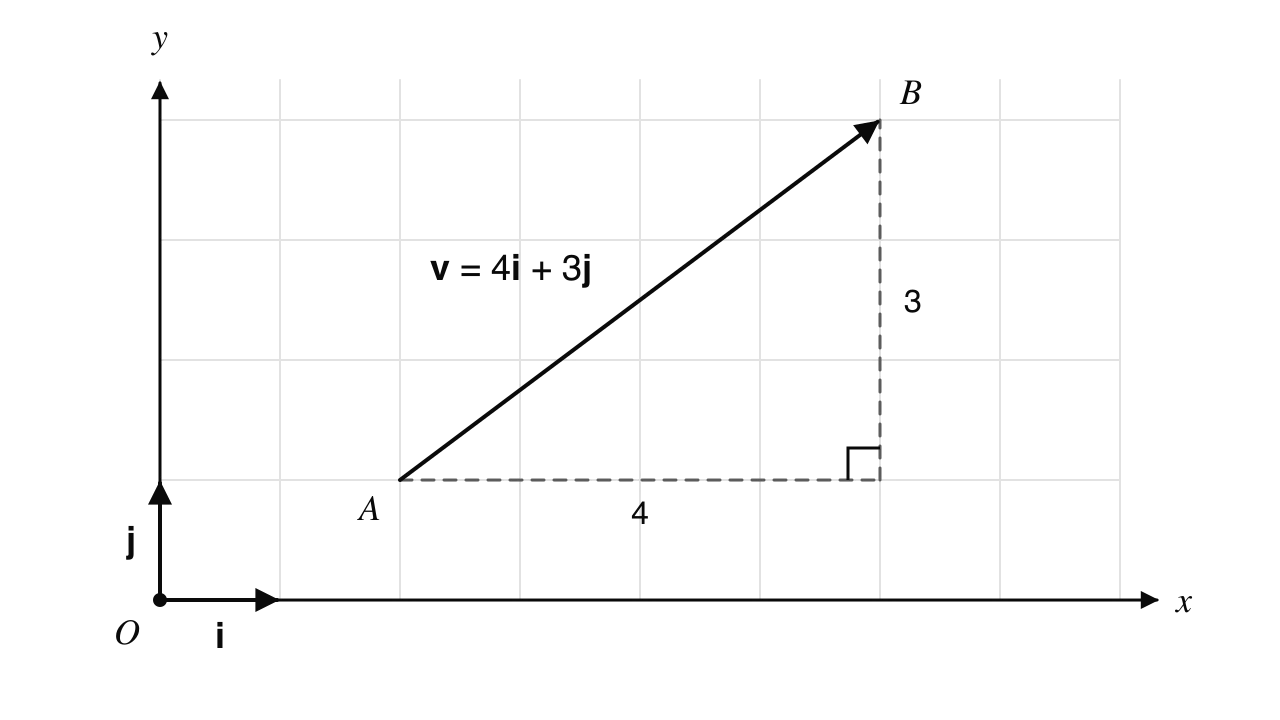
The vector can be written in two equivalent ways:
The numbers 4 and 3 are the components of . A component is negative when the movement is in the negative direction of an axis: means 2 units left and 5 units up.
Three dimensions
Points in space need three coordinates , measured along three mutually perpendicular axes. The axes are drawn as a right-handed system: if the fingers of the right hand curl from the positive -axis towards the positive -axis, the thumb points along the positive -axis. On paper the
The third base vector, , is one unit in the positive -direction. To reach the point from the origin, move 2 units along the -axis, 4 units parallel to the -axis and then 3 units up.
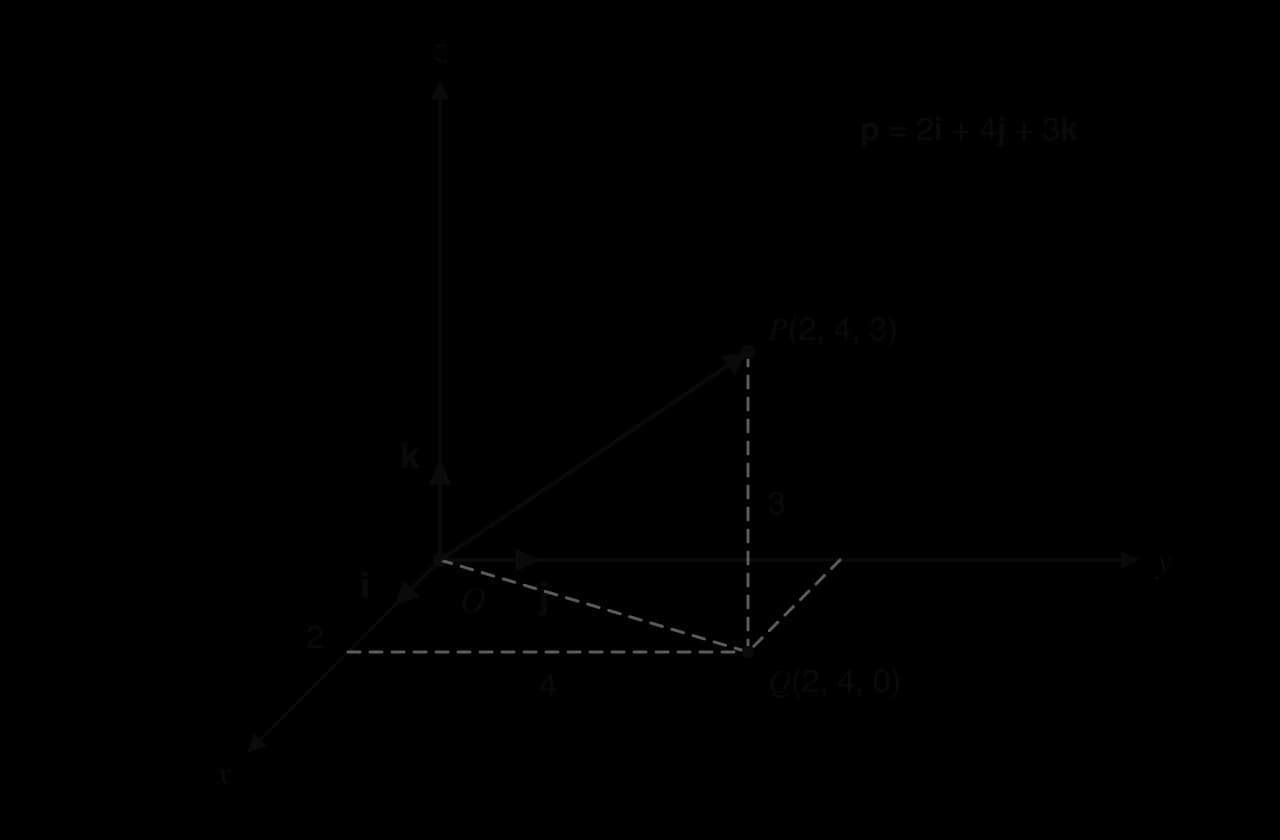
Column vectors and notation carry exactly the same information, and both are used freely. Column form is easier for calculations; the form fits more easily into a line of text. A missing base vector means a zero component:
Position vectors and displacement vectors
Position vectors
Once an origin is fixed, every point can be described by the vector from to . This is the position vector of , written
A point and its position vector contain the same numbers but are different objects. The point is a location; its position vector
Displacement vectors
The vector from one point to another point is a displacement vector. To get from to , one route is to go back from to the origin and then out from the origin to :
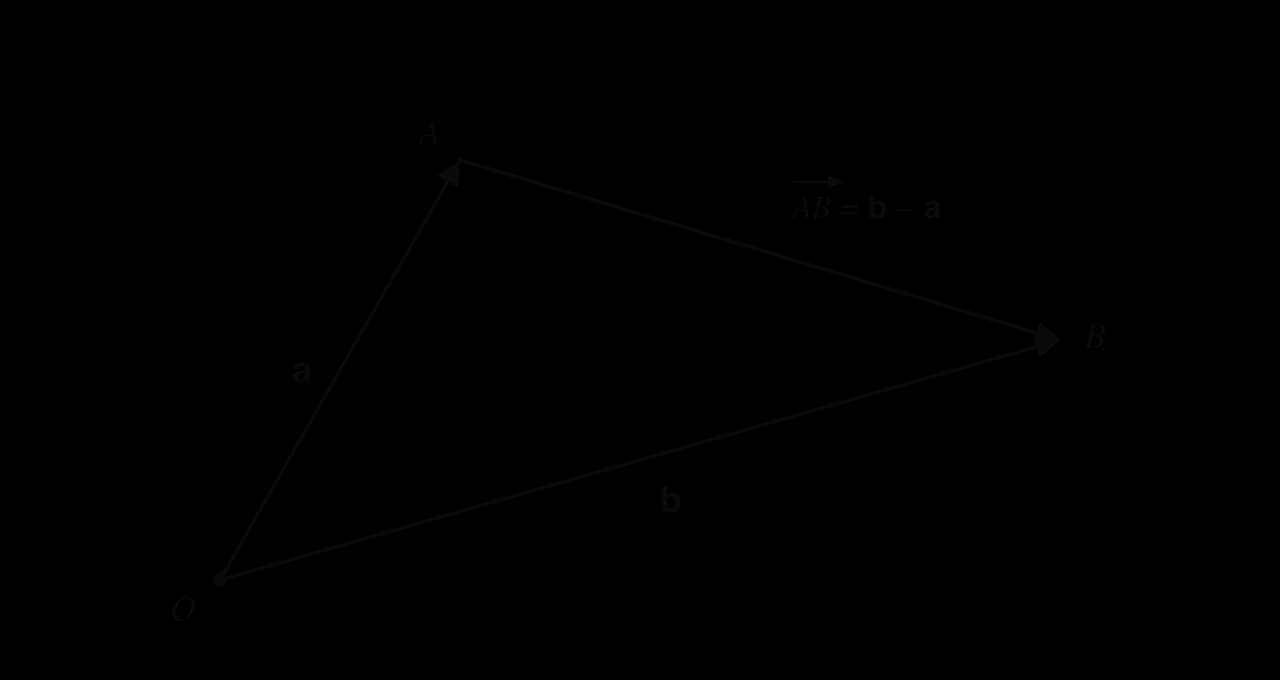
In words, "end minus start". The components of are the changes in , and
Adding and subtracting vectors
The triangle law
Two displacements made one after the other have the same effect as a single displacement. If is followed by , the arrows are placed head to tail, and the single arrow from the start of to the end of is the sum
Placing and tail to tail and completing the parallelogram gives the same result: the diagonal from the common tail is . This parallelogram law also shows that
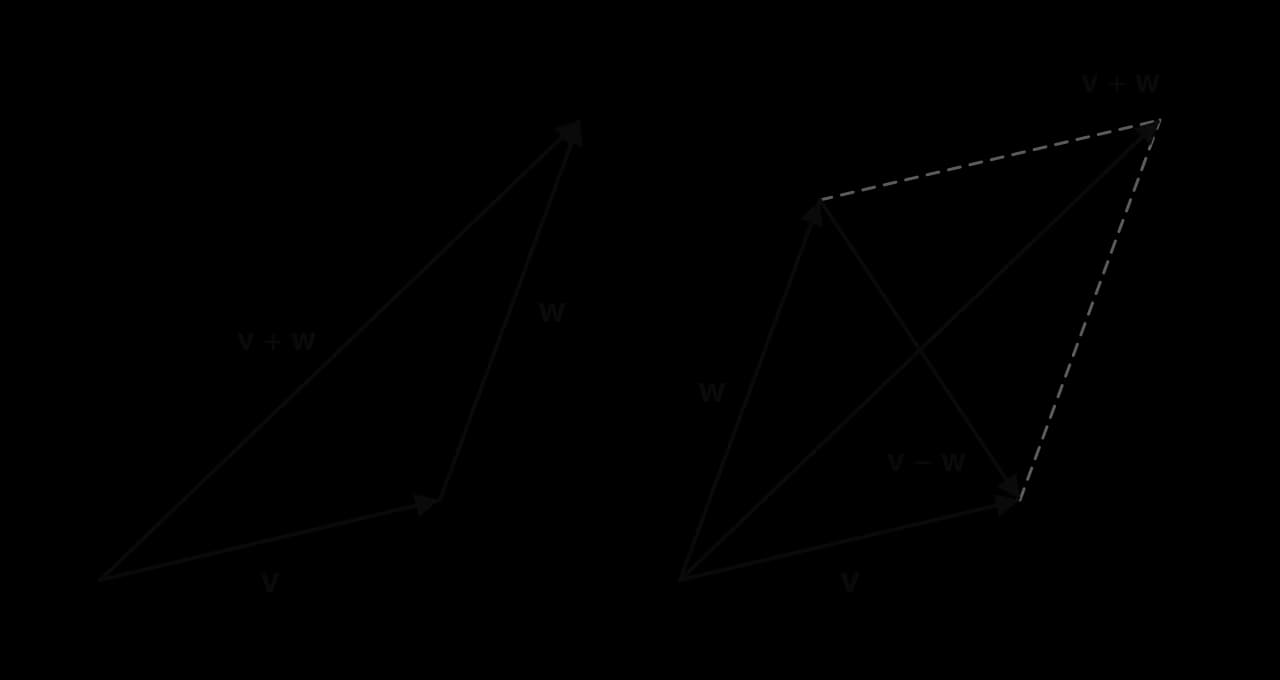
Algebraically, adding vectors means adding corresponding components, because the movements along each axis simply add up:
Any number of vectors can be added in the same way. A path gives
The zero vector and the negative of a vector
Moving from a point back to itself is a displacement of length zero. It is called the zero vector and written (in handwriting, ).
The negative is the vector that undoes , so . Its components are those of
Subtraction
Subtracting a vector means adding its negative:
In components, corresponding entries are subtracted. Geometrically, when and are drawn tail to tail, is the arrow from the head of to the head of
Multiplying a vector by a scalar
Scalar multiples
Multiplying a vector by a scalar multiplies every component by :
Geometrically, is times as long as . It points the same way as when

The usual rules of algebra hold for these operations, so vector expressions can be expanded, simplified and rearranged like ordinary algebraic expressions:
Rule | In symbols |
|---|---|
Addition is commutative | |
Addition is associative |
What has no meaning is adding a vector to a scalar. An expression such as is not defined, because a number has no direction to combine with.
Parallel vectors
Since multiplying by a scalar never turns a vector, two vectors that are scalar multiples of each other lie along parallel lines. The converse is also true: any two non-zero vectors in the same or opposite directions are scalar multiples of each other.
To test whether two vectors are parallel, look for a single value of that works for every component. If the first component gives one value of and the second gives another, the vectors are not parallel. For example,
Magnitude and unit vectors
The magnitude of a vector
The magnitude of a vector is its length, written or . In two dimensions, the components form the two shorter sides of a right-angled triangle and the vector is its hypotenuse, so Pythagoras' theorem gives
In three dimensions Pythagoras' theorem is used twice. For in the diagram of the axes, the point lies directly below
The distance between two points and is the magnitude of the displacement between them,
Scaling a vector scales its magnitude by the size of the scalar: . Adding vectors does not add magnitudes. In general
Unit vectors
A unit vector has magnitude 1. The base vectors , and are unit vectors, but there is a unit vector in every direction. Dividing a non-zero vector by its own magnitude keeps its direction and changes its length to 1.
Unit vectors separate the two pieces of information in a vector: the unit vector carries the direction and the magnitude carries the size. To build a vector with a given length in the direction of , multiply the unit vector by , giving
Displacement in context
In applications, vectors usually carry units, and the axes are given a meaning, such as east, north and vertically up. The magnitude of a displacement is then a straight-line distance, which is generally shorter than the distance actually travelled along a path.
Midpoints and dividing a line segment
The midpoint of a line segment
To reach the midpoint of , start at and go half of the way along
The position vector of the midpoint is the average of the position vectors of the end points, which matches the midpoint formula for coordinates. For and , the midpoint has position vector
Division in a given ratio
The same idea gives any point on the segment. If lies on with , then is
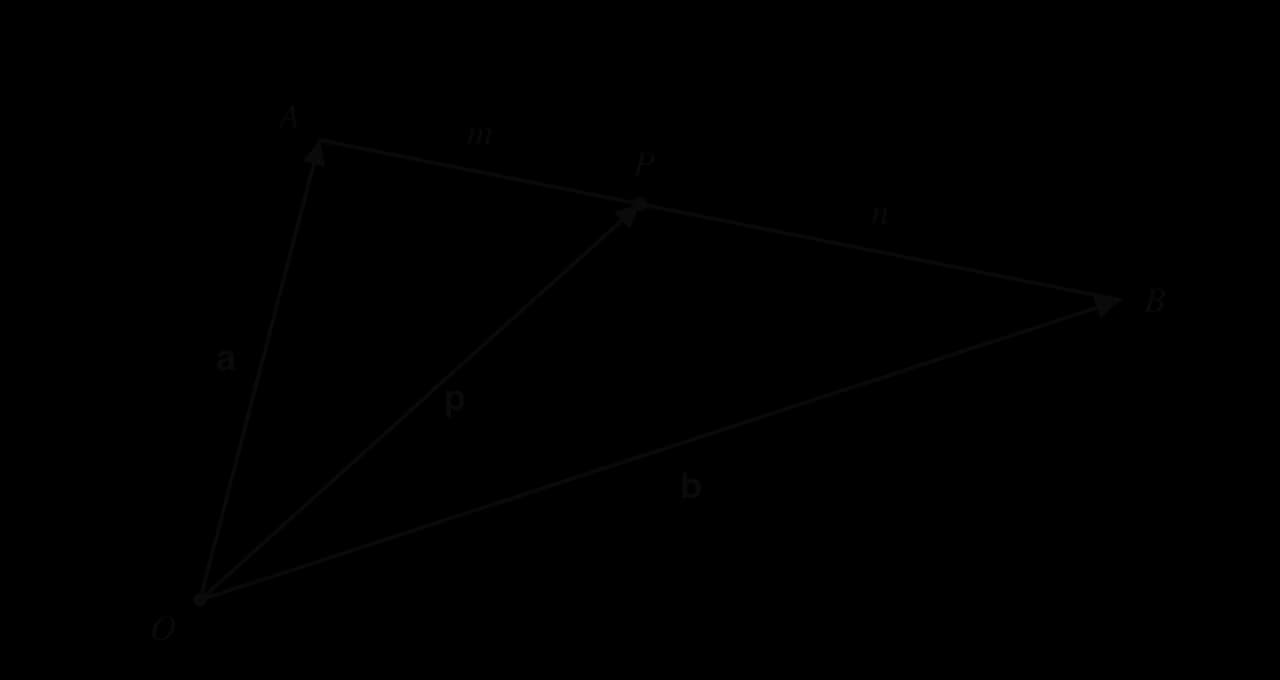
The second form weights each end point by the part of the ratio next to the other end, so the point closer to gives more weight to . The midpoint is the case .
Collinear points
Three or more points are collinear if one straight line passes through all of them. Vectors give a direct test. If is a multiple of
Parallel vectors alone are not enough: and
Parallelograms
A quadrilateral is a parallelogram exactly when one pair of opposite sides are equal as vectors:
The condition
A parallelogram is a rhombus if, in addition, two adjacent sides have equal length,
Proofs with vectors
Writing vectors in terms of two others
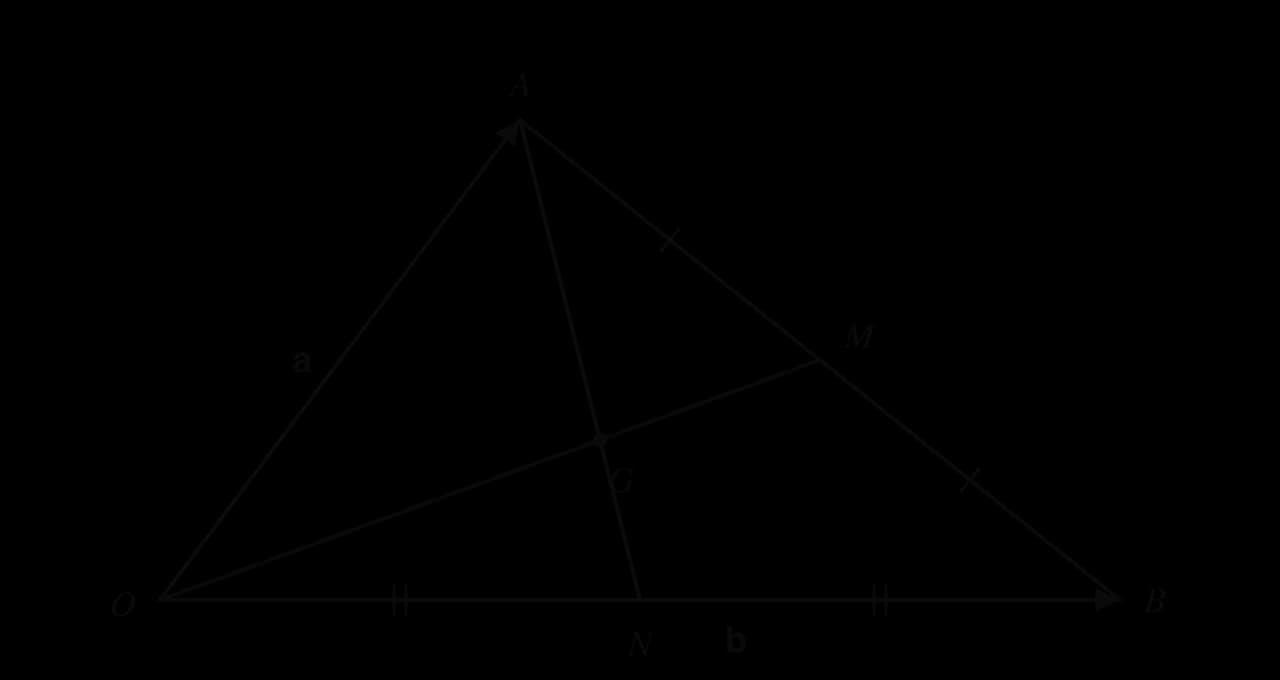
Geometric proofs with vectors usually start by choosing two non-parallel vectors, often called and , and writing every other vector in the figure in terms of them. In two dimensions, any vector can be written as in exactly one way, as long as and
Uniqueness gives the key step in many proofs, called comparing coefficients. Suppose . Then
Proving that lines are parallel
To prove two line segments parallel, show that the vector along one is a scalar multiple of the vector along the other. The scalar also gives the ratio of their lengths.
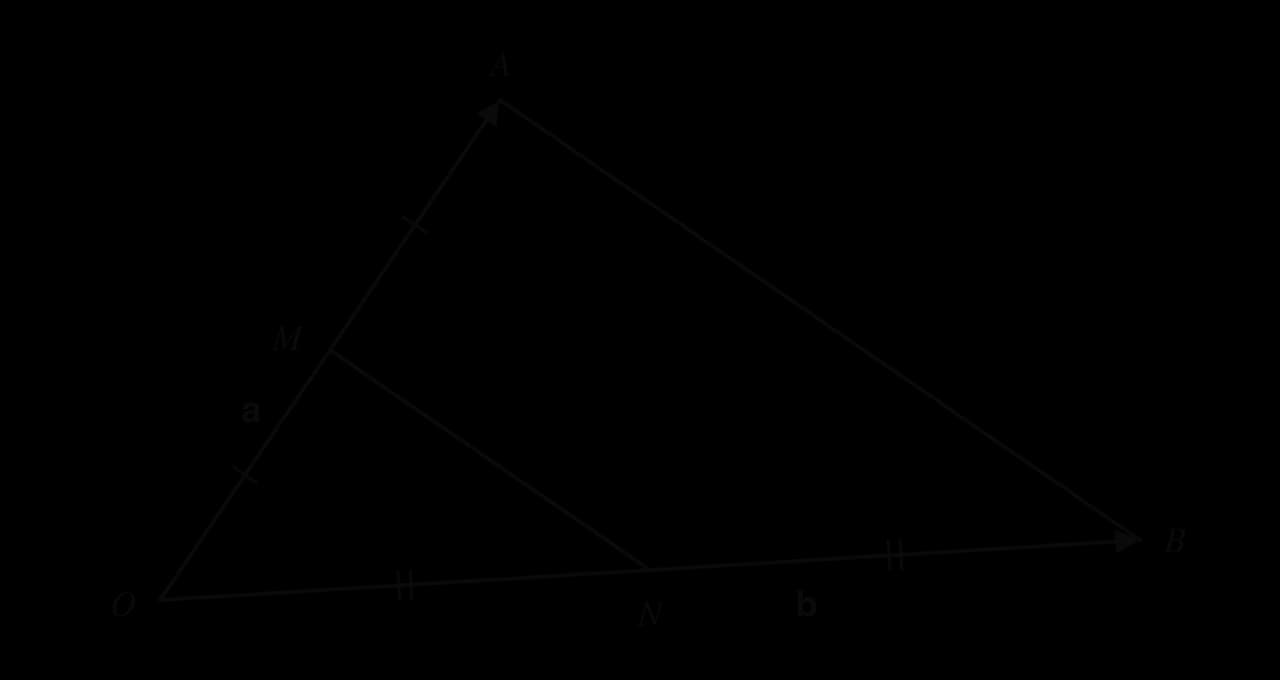
Proving that points coincide
To prove that two descriptions give the same point, find the position vector of each and show they are equal. A classic case is the diagonals of a parallelogram, which bisect each other.
The same approach works in reverse: if the diagonals of a quadrilateral have the same midpoint, the quadrilateral is a parallelogram. Many results about triangles and quadrilaterals that take several steps with congruent triangles take only a few lines with vectors.
Exam-style questions on vectors
The second question is a typical proof that uses two parameters and comparing coefficients. It is the vector proof that the medians of a triangle meet two thirds of the way along each one.
 YouTube
Self-check
- To do:
I can explain the difference between a vector and a scalar, and write vectors as arrows, column vectors and in terms of , and .
- To do:
I can find a displacement vector using