Augment Education
  • Blog
Log inStart free
augment

Augment Education

IB Diploma revision built around the syllabus.

contact@augment-education.com

Product

  • Features
  • Question bank
  • Quick fire
  • Worksheets
  • Flashcards
  • Notes
  • Subjects
  • What's new

Learn

  • IB guide
  • Booklets, explained
  • Blog
  • Free tools
  • Grade calculator
  • Subject checker

Company

  • About
  • Help
  • For parents
  • For teachers
  • Student stories
  • Comparisons

Augment Education is developed independently of the International Baccalaureate Organization and is not endorsed by it. “IB” and “International Baccalaureate” are its trademarks.

© 2026 Augment Education. All rights reserved.

PrivacyTerms
  1. Subjects
  2. Maths AA
  3. 3 Geometry and trigonometry
  4. 3.11 Symmetry of trigonometric graphs

3.11 Symmetry of trigonometric graphs

Use the symmetries of the unit circle and of the sine, cosine and tangent graphs to relate values at θ, −θ, π − θ, π + θ and π/2 − θ, simplify expressions and find every solution of an equation.

  • IB Mathematics: Analysis and Approaches
  • Part of 3 Geometry and trigonometry
  • HL only

Key terms introduced here

Each is in the Maths AA glossary, with every other term in the subject.

Complementary angles

Two angles whose sum is a right angle, π2\frac{\pi}{2}2π​ (or 90∘90^\circ90∘); the angles θ\thetaθ and π2−θ\frac{\pi}{2} - \theta2π​−θ.

Point symmetry

A graph has point symmetry about a point MMM if a rotation of 180∘180^\circ180∘ about MMM maps the graph onto itself; MMM is the centre of symmetry.

Notes on 3.11 Symmetry of trigonometric graphs

20 min readLast reviewed 14 Oct 2026

Learning objectives

  • Derive the relationships between sin⁡\sinsin, cos⁡\coscos and tan⁡\tantan at θ\thetaθ, −θ-\theta−θ, π−θ\pi - \thetaπ−θ, π+θ\pi + \thetaπ+θ and π2−θ\frac{\pi}{2} - \theta2π​−θ from the unit circle.

  • Describe each relationship as a symmetry of a graph: a line of symmetry, a centre of symmetry or a translation.

  • Determine whether a function built from circular functions is odd, even or neither.

  • Express a sine graph as a translation of a cosine graph, and the reverse.

  • Simplify trigonometric expressions and prove identities using the symmetry relationships.

  • Use symmetry to find every solution of a trigonometric equation from one known solution, including equations of the form sin⁡A=sin⁡B\sin A = \sin BsinA=sinB and cos⁡A=cos⁡B\cos A = \cos BcosA=cosB.

The graphs of sine, cosine and tangent are full of symmetry. The cosine curve is a mirror image of itself in the yyy-axis, the sine curve is unchanged by a half-turn about the origin, and each curve lands on itself after a translation by one period. Every one of these geometric facts is also an algebraic identity, such as cos⁡(−θ)=cos⁡θ\cos(-\theta) = \cos\thetacos(−θ)=cosθ or sin⁡(π−θ)=sin⁡θ\sin(\pi - \theta) = \sin\thetasin(π−θ)=sinθ, true for every angle θ\thetaθ.

These identities turn hard-looking expressions into simple ones, connect the sine and cosine functions to each other, and explain why the solutions of a trigonometric equation come in symmetric families. They are also the reason a single calculator value is enough to find every solution of an equation.

Scope: the symmetry relationships between the circular functions and the symmetries of their graphs, and their use in simplifying expressions and solving equations. Odd and even functions in general are in 2.14, exact values and related angles in 3.5, solving equations in 3.8, and the compound angle identities, which give a second proof of many results here, in 3.10.

Symmetry in the unit circle

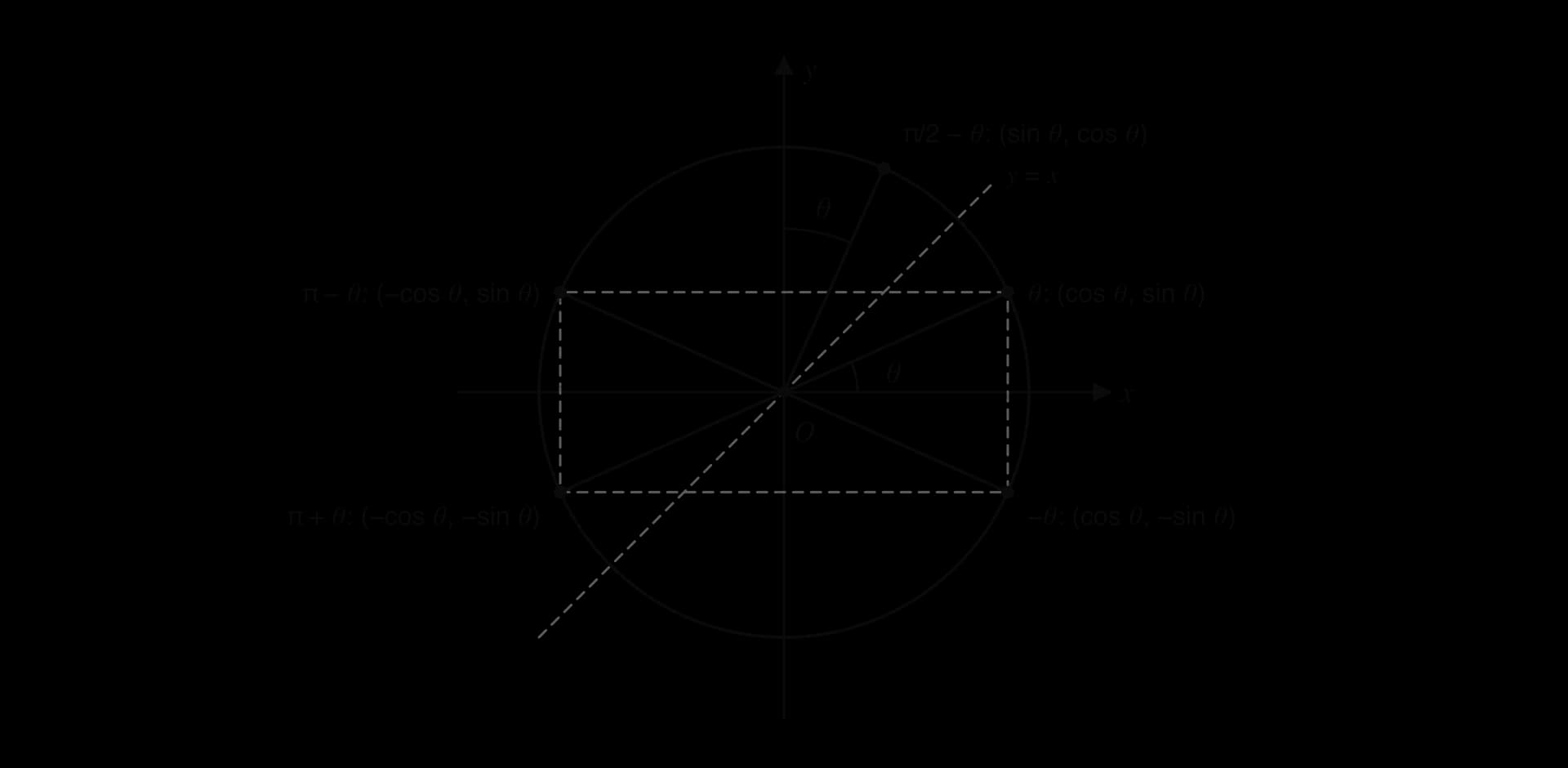
On the unit circle, the point at angle θ\thetaθ is P(cos⁡θ,sin⁡θ)P(\cos\theta, \sin\theta)P(cosθ,sinθ). Reflecting or rotating PPP in the axes and in the line y=xy = xy=x gives four more points whose angles are simple expressions in θ\thetaθ. Comparing their coordinates with those of PPP gives the symmetry relationships between the circular functions.

Unit circle with points at angles θ (cos θ, sin θ), π − θ (−cos θ, sin θ), π + θ (−cos θ, −sin θ), −θ (cos θ, −sin θ) at the corners of a dashed rectangle, and π/2 − θ (sin θ, cos θ), the reflection of θ in the dashed line y = x.
The four points at θ, π − θ, π + θ and −θ form a rectangle centred at O, so their coordinates differ only in sign. Reflecting in y = x swaps the two coordinates.

Transformation of PPP

New angle

New point

Relationship

Reflection in the xxx-axis

−θ-\theta−θ

(cos⁡θ,−sin⁡θ)(\cos\theta, -\sin\theta)(cosθ,−sinθ)

cos⁡(−θ)=cos⁡θ\cos(-\theta) = \cos\thetacos(−θ)=cosθ, sin⁡(−θ)=−sin⁡θ\sin(-\theta) = -\sin\thetasin(−θ)=−sinθ

Reflection in the yyy-axis

π−θ\pi - \thetaπ−θ

(−cos⁡θ,sin⁡θ)(-\cos\theta, \sin\theta)(−cosθ,sinθ)

sin⁡(π−θ)=sin⁡θ\sin(\pi - \theta) = \sin\thetasin(π−θ)=sinθ, cos⁡(π−θ)=−cos⁡θ\cos(\pi - \theta) = -\cos\thetacos(π−θ)=−cosθ

Rotation by π\piπ about OOO

π+θ\pi + \thetaπ+θ

(−cos⁡θ,−sin⁡θ)(-\cos\theta, -\sin\theta)(−cosθ,−sinθ)

sin⁡(π+θ)=−sin⁡θ\sin(\pi + \theta) = -\sin\thetasin(π+θ)=−sinθ, cos⁡(π+θ)=−cos⁡θ\cos(\pi + \theta) = -\cos\thetacos(π+θ)=−cosθ

Reflection in y=xy = xy=x

π2−θ\frac{\pi}{2} - \theta2π​−θ

(sin⁡θ,cos⁡θ)(\sin\theta, \cos\theta)(sinθ,cosθ)

cos⁡(π2−θ)=sin⁡θ\cos\left(\frac{\pi}{2} - \theta\right) = \sin\thetacos(2π​−θ)=sinθ, sin⁡(π2−θ)=cos⁡θ\sin\left(\frac{\pi}{2} - \theta\right) = \cos\thetasin(2π​−θ)=cosθ

Full turn

θ+2π\theta + 2\piθ+2π

(cos⁡θ,sin⁡θ)(\cos\theta, \sin\theta)(cosθ,sinθ)

sin⁡(θ+2π)=sin⁡θ\sin(\theta + 2\pi) = \sin\thetasin(θ+2π)=sinθ, cos⁡(θ+2π)=cos⁡θ\cos(\theta + 2\pi) = \cos\thetacos(θ+2π)=cosθ

The tangent relationships follow by dividing the sine by the cosine in each row:

tan⁡(−θ)=−tan⁡θtan⁡(π−θ)=−tan⁡θtan⁡(π+θ)=tan⁡θtan⁡(π2−θ)=1tan⁡θ\tan(-\theta) = -\tan\theta \qquad \tan(\pi - \theta) = -\tan\theta \qquad \tan(\pi + \theta) = \tan\theta \qquad \tan\left(\frac{\pi}{2} - \theta\right) = \frac{1}{\tan\theta}tan(−θ)=−tanθtan(π−θ)=−tanθtan(π+θ)=tanθtan(2π​−θ)=tanθ1​

Each holds wherever both sides are defined.

The figure is drawn with θ\thetaθ in the first quadrant, but the relationships hold for every angle. A reflection or rotation of the circle moves every point in the same way, whichever quadrant the point starts in, so the coordinates change in the same way too.

Tip

To recall a relationship quickly, test it with a familiar value. With θ=π6\theta = \frac{\pi}{6}θ=6π​: cos⁡(π−π6)=cos⁡5π6=−32=−cos⁡π6\cos\left(\pi - \frac{\pi}{6}\right) = \cos\frac{5\pi}{6} = -\frac{\sqrt{3}}{2} = -\cos\frac{\pi}{6}cos(π−6π​)=cos65π​=−23​​=−cos6π​, which confirms cos⁡(π−θ)=−cos⁡θ\cos(\pi - \theta) = -\cos\thetacos(π−θ)=−cosθ.

Negative angles: odd and even

Reflection in the xxx-axis changes the sign of the angle. The xxx-coordinate stays the same and the yyy-coordinate changes sign, so

cos⁡(−θ)=cos⁡θsin⁡(−θ)=−sin⁡θtan⁡(−θ)=−tan⁡θ\cos(-\theta) = \cos\theta \qquad \sin(-\theta) = -\sin\theta \qquad \tan(-\theta) = -\tan\thetacos(−θ)=cosθsin(−θ)=−sinθtan(−θ)=−tanθ

In the language of 2.14, cosine is an even function and sine and tangent are odd functions.

Line symmetry of the cosine graph

Because cos⁡(−x)=cos⁡x\cos(-x) = \cos xcos(−x)=cosx, the points (x,cos⁡x)(x, \cos x)(x,cosx) and (−x,cos⁡x)(-x, \cos x)(−x,cosx) are both on the graph of y=cos⁡xy = \cos xy=cosx. They are mirror images in the yyy-axis, so the whole graph is symmetrical about the yyy-axis.

−6−4−20246−1.5−1−0.500.511.5xy(θ, cos θ)(−θ, cos θ)(π, −1)(−π, −1)
  • y = cos x
The cosine graph is its own reflection in the y-axis: the points at θ and −θ are level with each other.

Point symmetry of the sine graph

Because sin⁡(−x)=−sin⁡x\sin(-x) = -\sin xsin(−x)=−sinx, the points (x,sin⁡x)(x, \sin x)(x,sinx) and (−x,−sin⁡x)(-x, -\sin x)(−x,−sinx) are both on the graph of y=sin⁡xy = \sin xy=sinx. The second is the image of the first after a rotation of 180∘180^\circ180∘ about the origin.

Definition

A graph has point symmetry about a point MMM if a rotation of 180∘180^\circ180∘ about MMM maps the graph onto itself. The point MMM is called the centre of symmetry. Point symmetry is also called rotational symmetry of order 2.

The graph of every odd function has point symmetry about the origin, and the graph of every even function has line symmetry in the yyy-axis. So the graphs of y=sin⁡xy = \sin xy=sinx and y=tan⁡xy = \tan xy=tanx have point symmetry about OOO, and the graph of y=cos⁡xy = \cos xy=cosx has line symmetry in the yyy-axis.

−6−4−20246−1.5−1−0.500.511.5xy(θ, sin θ)(−θ, −sin θ)O
  • y = sin x
A half-turn about the origin maps the sine graph onto itself: the points at θ and −θ are the same distance from O on opposite sides.

Worked example

Determine whether each function is odd, even or neither.

(a) f(x)=sin⁡xcos⁡xf(x) = \sin x\cos xf(x)=sinxcosx (b) g(x)=x2cos⁡3xg(x) = x^2\cos 3xg(x)=x2cos3x (c) h(x)=sin⁡x+cos⁡xh(x) = \sin x + \cos xh(x)=sinx+cosx

Show the solution

Replace xxx by −x-x−x and use sin⁡(−x)=−sin⁡x\sin(-x) = -\sin xsin(−x)=−sinx, cos⁡(−x)=cos⁡x\cos(-x) = \cos xcos(−x)=cosx.

(a) f(−x)=sin⁡(−x)cos⁡(−x)=(−sin⁡x)(cos⁡x)=−f(x)f(-x) = \sin(-x)\cos(-x) = (-\sin x)(\cos x) = -f(x)f(−x)=sin(−x)cos(−x)=(−sinx)(cosx)=−f(x), so fff is odd.

(b) g(−x)=(−x)2cos⁡(−3x)=x2cos⁡3x=g(x)g(-x) = (-x)^2\cos(-3x) = x^2\cos 3x = g(x)g(−x)=(−x)2cos(−3x)=x2cos3x=g(x), so ggg is even.

(c) h(−x)=−sin⁡x+cos⁡xh(-x) = -\sin x + \cos xh(−x)=−sinx+cosx. A single value shows that this is neither h(x)h(x)h(x) nor −h(x)-h(x)−h(x) in general: h(π4)=22+22=2h\left(\frac{\pi}{4}\right) = \frac{\sqrt{2}}{2} + \frac{\sqrt{2}}{2} = \sqrt{2}h(4π​)=22​​+22​​=2​, but h(−π4)=−22+22=0h\left(-\frac{\pi}{4}\right) = -\frac{\sqrt{2}}{2} + \frac{\sqrt{2}}{2} = 0h(−4π​)=−22​​+22​​=0, which is neither 2\sqrt{2}2​ nor −2-\sqrt{2}−2​. So hhh is neither odd nor even.

Common mistake

Concluding that a function is odd because f(−a)=−f(a)f(-a) = -f(a)f(−a)=−f(a) for one value aaa. The relationship must hold for every xxx in the domain. To show that a function is neither odd nor even, one counterexample for each is enough; to show that it is odd or even, use algebra that works for all xxx.

Supplementary angles: π − θ

Reflection in the yyy-axis turns the angle θ\thetaθ into π−θ\pi - \thetaπ−θ (in degrees, 180∘−θ180^\circ - \theta180∘−θ). The height of the point does not change, but its horizontal coordinate changes sign:

sin⁡(π−θ)=sin⁡θcos⁡(π−θ)=−cos⁡θtan⁡(π−θ)=−tan⁡θ\sin(\pi - \theta) = \sin\theta \qquad \cos(\pi - \theta) = -\cos\theta \qquad \tan(\pi - \theta) = -\tan\thetasin(π−θ)=sinθcos(π−θ)=−cosθtan(π−θ)=−tanθ

The first of these is behind the rule "the second solution of sin⁡x=k\sin x = ksinx=k is π−α\pi - \alphaπ−α" used in 3.8.

Lines of symmetry of the sine graph

Replacing θ\thetaθ by π2+t\frac{\pi}{2} + t2π​+t in sin⁡(π−θ)=sin⁡θ\sin(\pi - \theta) = \sin\thetasin(π−θ)=sinθ gives

sin⁡(π2−t)=sin⁡(π2+t)\sin\left(\frac{\pi}{2} - t\right) = \sin\left(\frac{\pi}{2} + t\right)sin(2π​−t)=sin(2π​+t)

The values of sin⁡x\sin xsinx at equal distances ttt either side of x=π2x = \frac{\pi}{2}x=2π​ are the same, so the sine graph is symmetrical about the vertical line x=π2x = \frac{\pi}{2}x=2π​, which passes through its maximum. Because the graph repeats every 2π2\pi2π and is also symmetrical about the line through its minimum, it has a line of symmetry through every turning point: x=π2+kπx = \frac{\pi}{2} + k\pix=2π​+kπ for every integer kkk.

−101234567−1.5−1−0.500.511.5xyx = π/2x = 3π/2x = π/2 − tx = π/2 + t(π, 0)
  • y = sin x
The sine graph is symmetrical about the vertical line through each maximum and minimum, and has point symmetry about each zero, such as (π, 0).

The same reasoning applied to the other graphs gives a full list of their symmetries.

Graph

Lines of symmetry

Centres of symmetry

y=sin⁡xy = \sin xy=sinx

x=π2+kπx = \frac{\pi}{2} + k\pix=2π​+kπ (through every maximum and minimum)

(kπ,0)(k\pi, 0)(kπ,0) (every zero)

y=cos⁡xy = \cos xy=cosx

x=kπx = k\pix=kπ (through every maximum and minimum)

(π2+kπ,0)\left(\frac{\pi}{2} + k\pi, 0\right)(2π​+kπ,0) (every zero)

y=tan⁡xy = \tan xy=tanx

none

(kπ2,0)\left(\frac{k\pi}{2}, 0\right)(2kπ​,0) (every zero and every point where an asymptote meets the xxx-axis)

The centres of symmetry of the sine graph come from sin⁡(π+t)=−sin⁡t\sin(\pi + t) = -\sin tsin(π+t)=−sint and sin⁡(π−t)=sin⁡t\sin(\pi - t) = \sin tsin(π−t)=sint: together they give sin⁡(π+t)=−sin⁡(π−t)\sin(\pi + t) = -\sin(\pi - t)sin(π+t)=−sin(π−t), so the values at equal distances either side of x=πx = \pix=π are equal in size and opposite in sign.

Half-turns and periods: π + θ

Rotating PPP through π\piπ about the origin turns θ\thetaθ into π+θ\pi + \thetaπ+θ and changes the sign of both coordinates:

sin⁡(π+θ)=−sin⁡θcos⁡(π+θ)=−cos⁡θtan⁡(π+θ)=−sin⁡θ−cos⁡θ=tan⁡θ\sin(\pi + \theta) = -\sin\theta \qquad \cos(\pi + \theta) = -\cos\theta \qquad \tan(\pi + \theta) = \frac{-\sin\theta}{-\cos\theta} = \tan\thetasin(π+θ)=−sinθcos(π+θ)=−cosθtan(π+θ)=−cosθ−sinθ​=tanθ

The last identity says that tan⁡\tantan has period π\piπ. The first two say that translating the graph of y=sin⁡xy = \sin xy=sinx or y=cos⁡xy = \cos xy=cosx by π\piπ to the left gives the same result as reflecting it in the xxx-axis.

Moving the sine or cosine graph half a period along the xxx-axis has the same effect as reflecting it in the xxx-axis: sin⁡(x+π)=−sin⁡x\sin(x + \pi) = -\sin xsin(x+π)=−sinx and cos⁡(x+π)=−cos⁡x\cos(x + \pi) = -\cos xcos(x+π)=−cosx for every xxx. A whole period, 2π2\pi2π, leaves the graphs unchanged. For tangent, a translation by π\piπ already leaves the graph unchanged.

Combining the relationships gives others. For example, sin⁡(θ−π)\sin(\theta - \pi)sin(θ−π) can be simplified by writing it as sin⁡(−(π−θ))\sin(-(\pi - \theta))sin(−(π−θ)):

sin⁡(θ−π)=−sin⁡(π−θ)=−sin⁡θ\sin(\theta - \pi) = -\sin(\pi - \theta) = -\sin\thetasin(θ−π)=−sin(π−θ)=−sinθ

using first that sine is odd and then the supplementary angle relationship. Alternatively, θ−π=(θ+π)−2π\theta - \pi = (\theta + \pi) - 2\piθ−π=(θ+π)−2π, so sin⁡(θ−π)=sin⁡(θ+π)=−sin⁡θ\sin(\theta - \pi) = \sin(\theta + \pi) = -\sin\thetasin(θ−π)=sin(θ+π)=−sinθ.

Complementary angles: π/2 − θ

Definition

Two angles are complementary if they add up to a right angle, π2\frac{\pi}{2}2π​ (or 90∘90^\circ90∘). The complement of θ\thetaθ is π2−θ\frac{\pi}{2} - \theta2π​−θ.

In a right-angled triangle, the two acute angles are complementary. The side opposite one of them is adjacent to the other, so the sine of each angle is the cosine of the other. The unit circle extends this to every angle: reflecting PPP in the line y=xy = xy=x swaps its coordinates and turns the angle θ\thetaθ into π2−θ\frac{\pi}{2} - \theta2π​−θ, so

sin⁡(π2−θ)=cos⁡θcos⁡(π2−θ)=sin⁡θtan⁡(π2−θ)=1tan⁡θ\sin\left(\frac{\pi}{2} - \theta\right) = \cos\theta \qquad \cos\left(\frac{\pi}{2} - \theta\right) = \sin\theta \qquad \tan\left(\frac{\pi}{2} - \theta\right) = \frac{1}{\tan\theta}sin(2π​−θ)=cosθcos(2π​−θ)=sinθtan(2π​−θ)=tanθ1​

The name cosine records this: the cosine of an angle is the sine of its complement. (The reciprocal 1tan⁡θ\frac{1}{\tan\theta}tanθ1​ is cot⁡θ\cot\thetacotθ, defined in 3.9.)

Worked example

Prove that sin⁡(π2+θ)=cos⁡θ\sin\left(\frac{\pi}{2} + \theta\right) = \cos\thetasin(2π​+θ)=cosθ and cos⁡(π2+θ)=−sin⁡θ\cos\left(\frac{\pi}{2} + \theta\right) = -\sin\thetacos(2π​+θ)=−sinθ for all θ\thetaθ.

Show the solution

Write π2+θ\frac{\pi}{2} + \theta2π​+θ as π2−(−θ)\frac{\pi}{2} - (-\theta)2π​−(−θ) and use the complementary angle relationships, then the odd and even properties:

sin⁡(π2+θ)=sin⁡(π2−(−θ))=cos⁡(−θ)=cos⁡θ\sin\left(\frac{\pi}{2} + \theta\right) = \sin\left(\frac{\pi}{2} - (-\theta)\right) = \cos(-\theta) = \cos\thetasin(2π​+θ)=sin(2π​−(−θ))=cos(−θ)=cosθ
cos⁡(π2+θ)=cos⁡(π2−(−θ))=sin⁡(−θ)=−sin⁡θ\cos\left(\frac{\pi}{2} + \theta\right) = \cos\left(\frac{\pi}{2} - (-\theta)\right) = \sin(-\theta) = -\sin\thetacos(2π​+θ)=cos(2π​−(−θ))=sin(−θ)=−sinθ

Each step uses an identity that holds for every angle, so both results hold for all θ\thetaθ.

Translating between sine and cosine graphs

Reading sin⁡(x+π2)=cos⁡x\sin\left(x + \frac{\pi}{2}\right) = \cos xsin(x+2π​)=cosx as a statement about graphs: translating the sine curve π2\frac{\pi}{2}2π​ to the left gives the cosine curve. In the same way cos⁡(x−π2)=cos⁡(π2−x)=sin⁡x\cos\left(x - \frac{\pi}{2}\right) = \cos\left(\frac{\pi}{2} - x\right) = \sin xcos(x−2π​)=cos(2π​−x)=sinx (cosine is even), so translating the cosine curve π2\frac{\pi}{2}2π​ to the right gives the sine curve. Any sinusoidal function can therefore be written using either sine or cosine.

−4−3−2−101234567−1.5−1−0.500.511.5xy(π/2, 1)(0, 1)(π, 0)(π/2, 0)
  • y = sin x
  • y = cos x = sin(x + π/2)
Each feature of the sine curve, such as the maximum at (π/2, 1), appears on the cosine curve π/2 further left, at (0, 1).

Relationship

Graph statement

cos⁡x=sin⁡(x+π2)\cos x = \sin\left(x + \frac{\pi}{2}\right)cosx=sin(x+2π​)

y=cos⁡xy = \cos xy=cosx is y=sin⁡xy = \sin xy=sinx translated π2\frac{\pi}{2}2π​ to the left

sin⁡x=cos⁡(x−π2)\sin x = \cos\left(x - \frac{\pi}{2}\right)sinx=cos(x−2π​)

y=sin⁡xy = \sin xy=sinx is y=cos⁡xy = \cos xy=cosx translated π2\frac{\pi}{2}2π​ to the right

−sin⁡x=cos⁡(x+π2)-\sin x = \cos\left(x + \frac{\pi}{2}\right)−sinx=cos(x+2π​)

y=−sin⁡xy = -\sin xy=−sinx is y=cos⁡xy = \cos xy=cosx translated π2\frac{\pi}{2}2π​ to the left

−cos⁡x=sin⁡(x−π2)-\cos x = \sin\left(x - \frac{\pi}{2}\right)−cosx=sin(x−2π​)

y=−cos⁡xy = -\cos xy=−cosx is y=sin⁡xy = \sin xy=sinx translated π2\frac{\pi}{2}2π​ to the right

These translations are not the only ones that work. Because the graphs are periodic, adding any multiple of 2π2\pi2π to the translation gives the same result; for example, y=cos⁡xy = \cos xy=cosx is also y=sin⁡xy = \sin xy=sinx translated 3π2\frac{3\pi}{2}23π​ to the right.

Worked example

(a) Find the smallest positive value of ppp for which the graph of y=cos⁡2xy = \cos 2xy=cos2x is the graph of y=sin⁡2xy = \sin 2xy=sin2x translated ppp units to the left.

(b) Hence write f(x)=4cos⁡(2x)−1f(x) = 4\cos\left(2x\right) - 1f(x)=4cos(2x)−1 in the form asin⁡(b(x+c))+da\sin(b(x + c)) + dasin(b(x+c))+d, where a>0a > 0a>0, b>0b > 0b>0 and 0<c<π0 < c < \pi0<c<π.

Show the solution

(a) Translating y=sin⁡2xy = \sin 2xy=sin2x by ppp to the left gives y=sin⁡(2(x+p))=sin⁡(2x+2p)y = \sin(2(x + p)) = \sin(2x + 2p)y=sin(2(x+p))=sin(2x+2p). This equals cos⁡2x=sin⁡(2x+π2)\cos 2x = \sin\left(2x + \frac{\pi}{2}\right)cos2x=sin(2x+2π​) for all xxx when 2p=π22p = \frac{\pi}{2}2p=2π​, that is p=π4p = \frac{\pi}{4}p=4π​.

The translation is π4\frac{\pi}{4}4π​, not π2\frac{\pi}{2}2π​: the horizontal stretch halves every horizontal distance, including the gap between the sine and cosine curves.

(b) From part (a), cos⁡2x=sin⁡(2(x+π4))\cos 2x = \sin\left(2\left(x + \frac{\pi}{4}\right)\right)cos2x=sin(2(x+4π​)), so

f(x)=4sin⁡(2(x+π4))−1f(x) = 4\sin\left(2\left(x + \frac{\pi}{4}\right)\right) - 1f(x)=4sin(2(x+4π​))−1

with a=4a = 4a=4, b=2b = 2b=2, c=π4c = \frac{\pi}{4}c=4π​ and d=−1d = -1d=−1, and 0<π4<π0 < \frac{\pi}{4} < \pi0<4π​<π.

Common mistake

Assuming the shift between sin⁡(bx)\sin(bx)sin(bx) and cos⁡(bx)\cos(bx)cos(bx) is always π2\frac{\pi}{2}2π​. It is a quarter of the period, 14×2πb=π2b\frac{1}{4} \times \frac{2\pi}{b} = \frac{\pi}{2b}41​×b2π​=2bπ​. For sin⁡3x\sin 3xsin3x and cos⁡3x\cos 3xcos3x the shift is π6\frac{\pi}{6}6π​.

Using symmetry to simplify expressions

The relationships reduce the circular function of any angle of the form ±θ+kπ2\pm\theta + \frac{k\pi}{2}±θ+2kπ​ to ±sin⁡θ\pm\sin\theta±sinθ, ±cos⁡θ\pm\cos\theta±cosθ or ±tan⁡θ\pm\tan\theta±tanθ (or its reciprocal). Two checks decide the result:

  1. Which function. Adding or subtracting π\piπ (or 2π2\pi2π) keeps the same function; adding or subtracting π2\frac{\pi}{2}2π​ (or 3π2\frac{3\pi}{2}23π​) swaps sine and cosine.

  2. Which sign. Imagine θ\thetaθ as a small positive acute angle, find the quadrant of the new angle, and use the sign of the original function in that quadrant.

For example, for cos⁡(3π2+θ)\cos\left(\frac{3\pi}{2} + \theta\right)cos(23π​+θ): the 3π2\frac{3\pi}{2}23π​ swaps cosine to sine; with θ\thetaθ small, 3π2+θ\frac{3\pi}{2} + \theta23π​+θ is in the fourth quadrant, where cosine is positive. So cos⁡(3π2+θ)=sin⁡θ\cos\left(\frac{3\pi}{2} + \theta\right) = \sin\thetacos(23π​+θ)=sinθ.

Tip

The quadrant check works because the relationship is an identity: if it holds for small positive θ\thetaθ it holds for all θ\thetaθ. Picking the sign from a small acute θ\thetaθ is a quick way to avoid sign errors, and substituting a value such as θ=π6\theta = \frac{\pi}{6}θ=6π​ is a quick way to check the result.

Worked example

Given that sin⁡α=0.6\sin\alpha = 0.6sinα=0.6 and 0<α<π20 < \alpha < \frac{\pi}{2}0<α<2π​, find the value of

(a) sin⁡(π−α)\sin(\pi - \alpha)sin(π−α) (b) cos⁡(π+α)\cos(\pi + \alpha)cos(π+α) (c) tan⁡(−α)\tan(-\alpha)tan(−α) (d) cos⁡(π2−α)\cos\left(\frac{\pi}{2} - \alpha\right)cos(2π​−α) (e) sin⁡(α+3π2)\sin\left(\alpha + \frac{3\pi}{2}\right)sin(α+23π​)

Show the solution

First find cos⁡α\cos\alphacosα and tan⁡α\tan\alphatanα. Since α\alphaα is acute, cos⁡α>0\cos\alpha > 0cosα>0:

cos⁡α=1−0.62=0.8tan⁡α=0.60.8=0.75\cos\alpha = \sqrt{1 - 0.6^2} = 0.8 \qquad \tan\alpha = \frac{0.6}{0.8} = 0.75cosα=1−0.62​=0.8tanα=0.80.6​=0.75

(a) sin⁡(π−α)=sin⁡α=0.6\sin(\pi - \alpha) = \sin\alpha = 0.6sin(π−α)=sinα=0.6.

(b) cos⁡(π+α)=−cos⁡α=−0.8\cos(\pi + \alpha) = -\cos\alpha = -0.8cos(π+α)=−cosα=−0.8.

(c) tan⁡(−α)=−tan⁡α=−0.75\tan(-\alpha) = -\tan\alpha = -0.75tan(−α)=−tanα=−0.75.

(d) cos⁡(π2−α)=sin⁡α=0.6\cos\left(\frac{\pi}{2} - \alpha\right) = \sin\alpha = 0.6cos(2π​−α)=sinα=0.6.

(e) Adding 3π2\frac{3\pi}{2}23π​ swaps sine to cosine. The angle α+3π2\alpha + \frac{3\pi}{2}α+23π​ is in the fourth quadrant, where sine is negative, so

sin⁡(α+3π2)=−cos⁡α=−0.8\sin\left(\alpha + \frac{3\pi}{2}\right) = -\cos\alpha = -0.8sin(α+23π​)=−cosα=−0.8

Check with the identities: sin⁡(α+3π2)=sin⁡((α+π2)+π)=−sin⁡(π2+α)=−cos⁡α\sin\left(\alpha + \frac{3\pi}{2}\right) = \sin\left(\left(\alpha + \frac{\pi}{2}\right) + \pi\right) = -\sin\left(\frac{\pi}{2} + \alpha\right) = -\cos\alphasin(α+23π​)=sin((α+2π​)+π)=−sin(2π​+α)=−cosα.

Expressions with several terms are simplified term by term, then collected.

Worked example

Simplify fully

(a) sin⁡(π−x)+cos⁡(π2+x)\sin(\pi - x) + \cos\left(\frac{\pi}{2} + x\right)sin(π−x)+cos(2π​+x)

(b) sin⁡(π+θ)cos⁡(−θ)cos⁡(π2−θ)\dfrac{\sin(\pi + \theta)\cos(-\theta)}{\cos\left(\frac{\pi}{2} - \theta\right)}cos(2π​−θ)sin(π+θ)cos(−θ)​, where sin⁡θ≠0\sin\theta \neq 0sinθ=0.

Show the solution

(a) sin⁡(π−x)=sin⁡x\sin(\pi - x) = \sin xsin(π−x)=sinx and cos⁡(π2+x)=−sin⁡x\cos\left(\frac{\pi}{2} + x\right) = -\sin xcos(2π​+x)=−sinx, so

sin⁡(π−x)+cos⁡(π2+x)=sin⁡x−sin⁡x=0\sin(\pi - x) + \cos\left(\frac{\pi}{2} + x\right) = \sin x - \sin x = 0sin(π−x)+cos(2π​+x)=sinx−sinx=0

(b) Replace each factor:

(−sin⁡θ)(cos⁡θ)sin⁡θ=−cos⁡θ\frac{(-\sin\theta)(\cos\theta)}{\sin\theta} = -\cos\thetasinθ(−sinθ)(cosθ)​=−cosθ

Cancelling sin⁡θ\sin\thetasinθ is allowed because sin⁡θ≠0\sin\theta \neq 0sinθ=0 is given.

Pairs of terms that are complementary or supplementary often cancel or combine, which is useful for sums with many terms.

Worked example

Find the exact value of cos⁡2(π12)+cos⁡2(5π12)\cos^2\left(\frac{\pi}{12}\right) + \cos^2\left(\frac{5\pi}{12}\right)cos2(12π​)+cos2(125π​).

Show the solution

The angles π12\frac{\pi}{12}12π​ and 5π12\frac{5\pi}{12}125π​ add up to 6π12=π2\frac{6\pi}{12} = \frac{\pi}{2}126π​=2π​, so they are complementary:

cos⁡(5π12)=cos⁡(π2−π12)=sin⁡(π12)\cos\left(\frac{5\pi}{12}\right) = \cos\left(\frac{\pi}{2} - \frac{\pi}{12}\right) = \sin\left(\frac{\pi}{12}\right)cos(125π​)=cos(2π​−12π​)=sin(12π​)

Therefore, by the Pythagorean identity,

cos⁡2(π12)+cos⁡2(5π12)=cos⁡2(π12)+sin⁡2(π12)=1\cos^2\left(\frac{\pi}{12}\right) + \cos^2\left(\frac{5\pi}{12}\right) = \cos^2\left(\frac{\pi}{12}\right) + \sin^2\left(\frac{\pi}{12}\right) = 1cos2(12π​)+cos2(125π​)=cos2(12π​)+sin2(12π​)=1

Neither value had to be found.

Using symmetry to find all solutions

Every solution of a trigonometric equation is related to every other by a symmetry of the graph. Once one solution is known, the lines of symmetry give a second, and the period gives the rest.

Symmetry of a transformed graph

For a transformed function such as f(x)=asin⁡(bx)+df(x) = a\sin(bx) + df(x)=asin(bx)+d, the lines of symmetry move with the graph. They pass through the maxima and minima, which for sin⁡(bx)\sin(bx)sin(bx) are at bx=π2+kπbx = \frac{\pi}{2} + k\pibx=2π​+kπ, that is x=π2b+kπbx = \frac{\pi}{2b} + \frac{k\pi}{b}x=2bπ​+bkπ​. If x1x_1x1​ is a solution of f(x)=kf(x) = kf(x)=k, its reflection in the nearest line of symmetry x=mx = mx=m is 2m−x12m - x_12m−x1​, which is also a solution.

Worked example

Given that x=0.2x = 0.2x=0.2 is a solution of 3sin⁡2x+1=k3\sin 2x + 1 = k3sin2x+1=k, find, without finding kkk, the other solution of this equation in the interval 0≤x≤π0 \le x \le \pi0≤x≤π.

Show the solution

The graph of y=3sin⁡2x+1y = 3\sin 2x + 1y=3sin2x+1 has period π\piπ and its first maximum where 2x=π22x = \frac{\pi}{2}2x=2π​, at x=π4x = \frac{\pi}{4}x=4π​. The line x=π4x = \frac{\pi}{4}x=4π​ is a line of symmetry, and x=0.2x = 0.2x=0.2 lies on the rising part just before it.

Reflecting 0.20.20.2 in x=π4x = \frac{\pi}{4}x=4π​:

x=2×π4−0.2=π2−0.2=1.37 (3 s.f.)x = 2 \times \frac{\pi}{4} - 0.2 = \frac{\pi}{2} - 0.2 = 1.37 \ (3 \text{ s.f.})x=2×4π​−0.2=2π​−0.2=1.37 (3 s.f.)

Adding the period π\piπ to either solution goes beyond π\piπ, so the other solution is x=1.37x = 1.37x=1.37.

(Check: 3sin⁡0.4+1=2.168…3\sin 0.4 + 1 = 2.168\ldots3sin0.4+1=2.168… and 3sin⁡(2×1.3708)+1=3sin⁡2.7416+1=2.168…3\sin(2 \times 1.3708) + 1 = 3\sin 2.7416 + 1 = 2.168\ldots3sin(2×1.3708)+1=3sin2.7416+1=2.168…)

Equations of the form sin A = sin B and cos A = cos B

The symmetry relationships also say exactly when two angles have the same sine or the same cosine. The angles BBB and π−B\pi - Bπ−B have the same sine, and so does any angle a whole number of turns away from either. Similarly, BBB and −B-B−B have the same cosine, and the tangent repeats every π\piπ:

sin⁡A=sin⁡B  ⟺  A=B+2kπ  or  A=π−B+2kπ\sin A = \sin B \iff A = B + 2k\pi \ \text{ or } \ A = \pi - B + 2k\pisinA=sinB⟺A=B+2kπ  or  A=π−B+2kπ
cos⁡A=cos⁡B  ⟺  A=B+2kπ  or  A=−B+2kπ\cos A = \cos B \iff A = B + 2k\pi \ \text{ or } \ A = -B + 2k\picosA=cosB⟺A=B+2kπ  or  A=−B+2kπ
tan⁡A=tan⁡B  ⟺  A=B+kπ\tan A = \tan B \iff A = B + k\pitanA=tanB⟺A=B+kπ

where k∈Zk \in \mathbb{Z}k∈Z. These give every solution of an equation in which the same function is applied to two different expressions.

Worked example

Solve sin⁡3x=sin⁡x\sin 3x = \sin xsin3x=sinx for 0≤x≤π0 \le x \le \pi0≤x≤π.

Show the solution

From sin⁡A=sin⁡B\sin A = \sin BsinA=sinB with A=3xA = 3xA=3x and B=xB = xB=x:

Case 1: 3x=x+2kπ3x = x + 2k\pi3x=x+2kπ, so 2x=2kπ2x = 2k\pi2x=2kπ and x=kπx = k\pix=kπ. In the interval: x=0x = 0x=0 or x=πx = \pix=π.

Case 2: 3x=π−x+2kπ3x = \pi - x + 2k\pi3x=π−x+2kπ, so 4x=π+2kπ4x = \pi + 2k\pi4x=π+2kπ and x=π4+kπ2x = \frac{\pi}{4} + \frac{k\pi}{2}x=4π​+2kπ​. In the interval: x=π4x = \frac{\pi}{4}x=4π​ or x=3π4x = \frac{3\pi}{4}x=43π​.

x=0, π4, 3π4, πx = 0, \ \frac{\pi}{4}, \ \frac{3\pi}{4}, \ \pix=0, 4π​, 43π​, π

Check x=3π4x = \frac{3\pi}{4}x=43π​: sin⁡9π4=sin⁡π4=22\sin\frac{9\pi}{4} = \sin\frac{\pi}{4} = \frac{\sqrt{2}}{2}sin49π​=sin4π​=22​​ and sin⁡3π4=22\sin\frac{3\pi}{4} = \frac{\sqrt{2}}{2}sin43π​=22​​.

When the two sides use different functions, a complementary angle relationship makes them the same function first.

Worked example

Solve cos⁡2x=sin⁡x\cos 2x = \sin xcos2x=sinx for 0≤x≤2π0 \le x \le 2\pi0≤x≤2π.

Show the solution

Write sin⁡x=cos⁡(π2−x)\sin x = \cos\left(\frac{\pi}{2} - x\right)sinx=cos(2π​−x), so the equation is cos⁡2x=cos⁡(π2−x)\cos 2x = \cos\left(\frac{\pi}{2} - x\right)cos2x=cos(2π​−x).

Case 1: 2x=π2−x+2kπ2x = \frac{\pi}{2} - x + 2k\pi2x=2π​−x+2kπ, so 3x=π2+2kπ3x = \frac{\pi}{2} + 2k\pi3x=2π​+2kπ and x=π6+2kπ3x = \frac{\pi}{6} + \frac{2k\pi}{3}x=6π​+32kπ​. In the interval: x=π6,5π6,3π2x = \frac{\pi}{6}, \frac{5\pi}{6}, \frac{3\pi}{2}x=6π​,65π​,23π​ (the next, 13π6\frac{13\pi}{6}613π​, is too large).

Case 2: 2x=−(π2−x)+2kπ2x = -\left(\frac{\pi}{2} - x\right) + 2k\pi2x=−(2π​−x)+2kπ, so x=−π2+2kπx = -\frac{\pi}{2} + 2k\pix=−2π​+2kπ. In the interval: x=3π2x = \frac{3\pi}{2}x=23π​, already found.

x=π6, 5π6, 3π2x = \frac{\pi}{6}, \ \frac{5\pi}{6}, \ \frac{3\pi}{2}x=6π​, 65π​, 23π​

The same answers come from writing cos⁡2x=1−2sin⁡2x\cos 2x = 1 - 2\sin^2 xcos2x=1−2sin2x and solving a quadratic in sin⁡x\sin xsinx (3.8). The two methods are equivalent; the symmetry method gives the general solution directly.

Common mistake

Cancelling the function, as in "sin⁡3x=sin⁡x\sin 3x = \sin xsin3x=sinx, so 3x=x3x = x3x=x". Equal sines do not mean equal angles: this loses every solution from the case A=π−BA = \pi - BA=π−B, and most of those from A=B+2kπA = B + 2k\piA=B+2kπ as well. Always write down both cases with 2kπ2k\pi2kπ.

Exam-style questions on symmetry of trigonometric graphs

Worked example

No calculator.

(a) Show that cos⁡(π2+θ)+sin⁡(π+θ)=−2sin⁡θ\cos\left(\frac{\pi}{2} + \theta\right) + \sin(\pi + \theta) = -2\sin\thetacos(2π​+θ)+sin(π+θ)=−2sinθ.

(b) Hence solve cos⁡(π2+θ)+sin⁡(π+θ)=1\cos\left(\frac{\pi}{2} + \theta\right) + \sin(\pi + \theta) = 1cos(2π​+θ)+sin(π+θ)=1 for 0≤θ≤2π0 \le \theta \le 2\pi0≤θ≤2π.

(c) The graph of y=cos⁡(x+π2)y = \cos\left(x + \frac{\pi}{2}\right)y=cos(x+2π​) can be obtained from the graph of y=sin⁡xy = \sin xy=sinx by a single transformation. Describe two different transformations that do this.

Show the solution

(a) cos⁡(π2+θ)=cos⁡(π2−(−θ))=sin⁡(−θ)=−sin⁡θ\cos\left(\frac{\pi}{2} + \theta\right) = \cos\left(\frac{\pi}{2} - (-\theta)\right) = \sin(-\theta) = -\sin\thetacos(2π​+θ)=cos(2π​−(−θ))=sin(−θ)=−sinθ, and sin⁡(π+θ)=−sin⁡θ\sin(\pi + \theta) = -\sin\thetasin(π+θ)=−sinθ (rotation by π\piπ on the unit circle). So

cos⁡(π2+θ)+sin⁡(π+θ)=−sin⁡θ−sin⁡θ=−2sin⁡θ\cos\left(\frac{\pi}{2} + \theta\right) + \sin(\pi + \theta) = -\sin\theta - \sin\theta = -2\sin\thetacos(2π​+θ)+sin(π+θ)=−sinθ−sinθ=−2sinθ

Each identity used is named, because the result is given.

(b) Using part (a), −2sin⁡θ=1-2\sin\theta = 1−2sinθ=1, so sin⁡θ=−12\sin\theta = -\frac{1}{2}sinθ=−21​. Sine is negative in the third and fourth quadrants and the related angle is π6\frac{\pi}{6}6π​:

θ=π+π6=7π6orθ=2π−π6=11π6\theta = \pi + \frac{\pi}{6} = \frac{7\pi}{6} \quad \text{or} \quad \theta = 2\pi - \frac{\pi}{6} = \frac{11\pi}{6}θ=π+6π​=67π​orθ=2π−6π​=611π​

(c) Since cos⁡(x+π2)=−sin⁡x\cos\left(x + \frac{\pi}{2}\right) = -\sin xcos(x+2π​)=−sinx, the graph is y=−sin⁡xy = -\sin xy=−sinx. It is obtained from y=sin⁡xy = \sin xy=sinx by a reflection in the xxx-axis, or by a translation of π\piπ units horizontally (left or right), because sin⁡(x±π)=−sin⁡x\sin(x \pm \pi) = -\sin xsin(x±π)=−sinx. (A rotation of 180∘180^\circ180∘ about the origin does not work: since sine is odd, it maps the sine curve onto itself.)

Exam tip

In "show that" questions with symmetry identities, state each relationship as you use it, such as "sin⁡(π+θ)=−sin⁡θ\sin(\pi + \theta) = -\sin\thetasin(π+θ)=−sinθ". Working from the left-hand side to the given right-hand side earns the marks; checking a single value of θ\thetaθ does not, because it proves nothing about other angles.

The second question combines symmetry with a known exact value.

Worked example

No calculator. It is given that cos⁡π5=1+54\cos\frac{\pi}{5} = \frac{1 + \sqrt{5}}{4}cos5π​=41+5​​.

(a) Find the exact values of cos⁡4π5\cos\frac{4\pi}{5}cos54π​, cos⁡6π5\cos\frac{6\pi}{5}cos56π​ and sin⁡3π10\sin\frac{3\pi}{10}sin103π​.

(b) Show that sin⁡(2π−θ)=−sin⁡θ\sin(2\pi - \theta) = -\sin\thetasin(2π−θ)=−sinθ for all θ\thetaθ.

(c) Hence find the value of ∑k=19sin⁡(kπ5)\displaystyle\sum_{k=1}^{9} \sin\left(\frac{k\pi}{5}\right)k=1∑9​sin(5kπ​).

Show the solution

(a) 4π5=π−π5\frac{4\pi}{5} = \pi - \frac{\pi}{5}54π​=π−5π​, so cos⁡4π5=−cos⁡π5=−1+54\cos\frac{4\pi}{5} = -\cos\frac{\pi}{5} = -\frac{1 + \sqrt{5}}{4}cos54π​=−cos5π​=−41+5​​.

6π5=π+π5\frac{6\pi}{5} = \pi + \frac{\pi}{5}56π​=π+5π​, so cos⁡6π5=−cos⁡π5=−1+54\cos\frac{6\pi}{5} = -\cos\frac{\pi}{5} = -\frac{1 + \sqrt{5}}{4}cos56π​=−cos5π​=−41+5​​.

3π10=π2−π5\frac{3\pi}{10} = \frac{\pi}{2} - \frac{\pi}{5}103π​=2π​−5π​, so sin⁡3π10=cos⁡π5=1+54\sin\frac{3\pi}{10} = \cos\frac{\pi}{5} = \frac{1 + \sqrt{5}}{4}sin103π​=cos5π​=41+5​​.

(b) Sine has period 2π2\pi2π and is odd, so sin⁡(2π−θ)=sin⁡(−θ)=−sin⁡θ\sin(2\pi - \theta) = \sin(-\theta) = -\sin\thetasin(2π−θ)=sin(−θ)=−sinθ.

(c) Pair the term with kkk with the term with 10−k10 - k10−k. Since (10−k)π5=2π−kπ5\frac{(10 - k)\pi}{5} = 2\pi - \frac{k\pi}{5}5(10−k)π​=2π−5kπ​, part (b) gives

sin⁡((10−k)π5)=−sin⁡(kπ5)\sin\left(\frac{(10 - k)\pi}{5}\right) = -\sin\left(\frac{k\pi}{5}\right)sin(5(10−k)π​)=−sin(5kπ​)

so the pairs k=1k = 1k=1 and 999, 222 and 888, 333 and 777, 444 and 666 each add up to 000. The remaining term is k=5k = 5k=5: sin⁡π=0\sin\pi = 0sinπ=0. So

∑k=19sin⁡(kπ5)=0\sum_{k=1}^{9} \sin\left(\frac{k\pi}{5}\right) = 0k=1∑9​sin(5kπ​)=0

This reflects the point symmetry of the sine graph about (π,0)(\pi, 0)(π,0).

Exam tip

When the angle in a question is a fraction of π\piπ that is not a standard exact value, such as 4π5\frac{4\pi}{5}54π​, look for a way to write it as π±θ\pi \pm \thetaπ±θ, 2π−θ2\pi - \theta2π−θ or π2±θ\frac{\pi}{2} \pm \theta2π​±θ, where θ\thetaθ is an angle with a known value. Questions that give one exact value and ask for several others are testing exactly this.

Self-check

  • To do:

    I can derive the relationships for −θ-\theta−θ, π−θ\pi - \thetaπ−θ, π+θ\pi + \thetaπ+θ and π2−θ\frac{\pi}{2} - \theta2π​−θ from reflections and rotations of the unit circle.

  • To do:

    I can explain that cosine is even and sine and tangent are odd, and what this means for their graphs.

  • To do:

    I can state the lines of symmetry and centres of symmetry of the sine, cosine and tangent graphs.

  • To do:

    I can write a sine graph as a translation of a cosine graph, and the reverse, including for sin⁡(bx)\sin(bx)sin(bx) and cos⁡(bx)\cos(bx)cos(bx).

  • To do:

    I can simplify expressions such as cos⁡(3π2+θ)\cos\left(\frac{3\pi}{2} + \theta\right)cos(23π​+θ) by deciding the function and the sign.

  • To do:

    I can use complementary and supplementary angles to evaluate sums and exact values.

  • To do:

    I can find a second solution of an equation by reflecting a known solution in a line of symmetry.

  • To do:

    I can solve equations of the form sin⁡A=sin⁡B\sin A = \sin BsinA=sinB and cos⁡A=cos⁡B\cos A = \cos BcosA=cosB by considering both cases.

Questions on 3.11

15 exam-style questions on this subtopic, written in the style of the IB papers. The first has its markscheme open. Counted on 20 October 2026

Question 1 · AA-001877 marks

It is given that sin⁡π9=p\sin\dfrac{\pi}{9} = psin9π​=p, where 0<p<10 < p < 10<p<1.

  1. (a)(i)

    Write down, in terms of ppp, the value of sin⁡8π9\sin\dfrac{8\pi}{9}sin98π​.

    [1]1 mark

    Markscheme (a)(i)

    sin⁡8π9=sin⁡(π−π9)=p\sin\dfrac{8\pi}{9} = \sin\left(\pi - \dfrac{\pi}{9}\right) = psin98π​=sin(π−9π​)=p A1

  2. (a)(ii)

    Write down, in terms of ppp, the value of sin⁡10π9\sin\dfrac{10\pi}{9}sin910π​.

    [1]1 mark

    Markscheme (a)(ii)

    sin⁡10π9=sin⁡(π+π9)=−p\sin\dfrac{10\pi}{9} = \sin\left(\pi + \dfrac{\pi}{9}\right) = -psin910π​=sin(π+9π​)=−p A1

  3. (b)

    Find, in terms of ppp, the value of cos⁡11π18\cos\dfrac{11\pi}{18}cos1811π​.

    [2]2 marks

    Markscheme (b)

    cos⁡11π18=cos⁡(π2+π9)\cos\dfrac{11\pi}{18} = \cos\left(\dfrac{\pi}{2} + \dfrac{\pi}{9}\right)cos1811π​=cos(2π​+9π​) (M1)

    =−sin⁡π9=−p= -\sin\dfrac{\pi}{9} = -p=−sin9π​=−p A1

    Note: Accept use of the compound angle identity for the (M1).

  4. (c)

    Find, in terms of ppp, the value of tan⁡17π9\tan\dfrac{17\pi}{9}tan917π​.

    [3]3 marks

    Markscheme (c)

    cos⁡π9=1−p2\cos\dfrac{\pi}{9} = \sqrt{1 - p^2}cos9π​=1−p2​ (positive since π9\dfrac{\pi}{9}9π​ is acute) (A1)

    tan⁡17π9=tan⁡(2π−π9)=−tan⁡π9\tan\dfrac{17\pi}{9} = \tan\left(2\pi - \dfrac{\pi}{9}\right) = -\tan\dfrac{\pi}{9}tan917π​=tan(2π−9π​)=−tan9π​ (M1)

    =−p1−p2= -\dfrac{p}{\sqrt{1 - p^2}}=−1−p2​p​ A1

    Note: Award (A1)(M1)A0 for p1−p2\dfrac{p}{\sqrt{1-p^2}}1−p2​p​.

Question 2 · AA-001887 marks

Let α\alphaα be the solution of the equation cos⁡x=0.35\cos x = 0.35cosx=0.35 for which 0<α<π20 < \alpha < \dfrac{\pi}{2}0<α<2π​.

  1. (a)

    Find the value of α\alphaα.

    [1]1 mark

  2. (b)

    Write down, in terms of α\alphaα, the four solutions of cos⁡x=0.35\cos x = 0.35cosx=0.35 for −2π≤x≤2π-2\pi \le x \le 2\pi−2π≤x≤2π.

    [2]2 marks

  3. (c)

    Hence solve the equation cos⁡x=−0.35\cos x = -0.35cosx=−0.35 for 0≤x≤2π0 \le x \le 2\pi0≤x≤2π.

    [2]2 marks

  4. (d)

    Hence solve the equation cos⁡2x=−0.35\cos 2x = -0.35cos2x=−0.35 for 0≤x≤π0 \le x \le \pi0≤x≤π.

    [2]2 marks

Answer it, then compare with the markscheme.Check this one with a free account
Question 3 · AA-001898 marks

A large observation wheel rotates at a constant speed. The height, hhh metres, of a capsule above the ground ttt minutes after it passes the lowest point of the wheel is modelled by

h(t)=20−18cos⁡(πt15),t≥0.h(t) = 20 - 18\cos\left(\frac{\pi t}{15}\right), \quad t \ge 0.h(t)=20−18cos(15πt​),t≥0.
  1. (a)

    Write down the time taken for the wheel to complete one rotation.

    [1]1 mark

  2. (b)

    The model can also be written in the form h(t)=18sin⁡(π15(t−q))+20h(t) = 18\sin\left(\dfrac{\pi}{15}(t - q)\right) + 20h(t)=18sin(15π​(t−q))+20, where q>0q > 0q>0. Find the smallest possible value of qqq.

    [3]3 marks

  3. (c)

    Find the first time at which the capsule is 30 metres above the ground.

    [2]2 marks

  4. (d)

    By using the symmetry of the graph of hhh, find the length of time, during each rotation, for which the capsule is more than 30 metres above the ground.
    [2]2 marks

Answer it, then compare with the markscheme.Check this one with a free account

Try a quick-fire question

One of 34 short multiple-choice questions on 3.11. Pick an answer to see why it's right or wrong.

The diagram shows y=sin⁡xy = \sin xy=sinx. Which line is a line of symmetry of the curve?

Graph of y = sin x for −π ≤ x ≤ 2π, with x-axis marks at −π, −π/2, π/2, π, 3π/2 and 2π and y-axis marks at −1 and 1.

On this page

  • Key terms
  • Notes
  • Questions
  • Quick fire

Published for 3.11

Exam-style questions
15
Notes pages
1
Quick-fire questions
34
Key terms
2
Counted on 20 October 2026Open it in Augment

More of IB Maths AA

  • 3.10 Compound angle identitiesBefore this in the Maths AA syllabus.
  • 3.12 VectorsAfter this in the Maths AA syllabus.
  • 3 Geometry and trigonometryThe whole topic, with all 18 of its subtopics.
  • IB Maths AAThe Maths AA syllabus, assessment and what Augment has for it.

Carry on with 3.11 in Augment

With a free account, Augment remembers where you stopped and what you have practiced.

Start freeOpen 3.11 in Augment