Derive and use the compound angle identities for sin, cos and tan and the double angle identity for tan to find exact values, prove identities, solve equations and write a cos θ + b sin θ as a single wave.
IB Mathematics: Analysis and Approaches
Part of 3 Geometry and trigonometry
HL only
Key terms introduced here
Each is in the Maths AA glossary, with every other term in the subject.
An identity that writes a trigonometric function of a sum or difference of two angles, such as sin(A+B), in terms of the sines, cosines or tangents of A and B separately.
A compound angle is an angle written as a sum or difference of two others, such as A+B or θ−3π. The compound angle identities give the sine, cosine and tangent of such an angle from the sines, cosines and tangents of the separate parts. They produce exact values for angles such as 15∘
The same identities explain why two waves of the same frequency always add up to a single wave of that frequency. A combination such as 3cosθ+4sinθ is one cosine wave with amplitude 5, shifted sideways. This fact is used wherever oscillations combine, from sound and alternating current to tides.
Why sin(A + B) is not sin A + sin B
A function f that satisfies f(A+B)=f(A)+f(B) for all inputs is called linear, and sine is not one. Taking A=B=4π
sin(4π+4π)=sin2π=1,sin4π+sin4π=22+22=2
Since 1=2, the sine of a sum is not the sum of the sines. The correct rule involves both sines and cosines of the two angles.
The compound angle identities
The six compound angle identities are usually written in three lines, with the upper sign of ± and ∓ going together and the lower signs going together.
Written out in full, the six identities are:
Sum
Difference
sin(A+B)=sinAcosB+cosAsinB
sin(A−B)=sinAcosB−cosAsinB
The sine identities keep the sign of the compound angle and mix the functions (sin cos, then cos sin). The cosine identities reverse the sign and keep the functions together (cos cos, then sin sin).
Deriving cos(A − B) with the distance formula
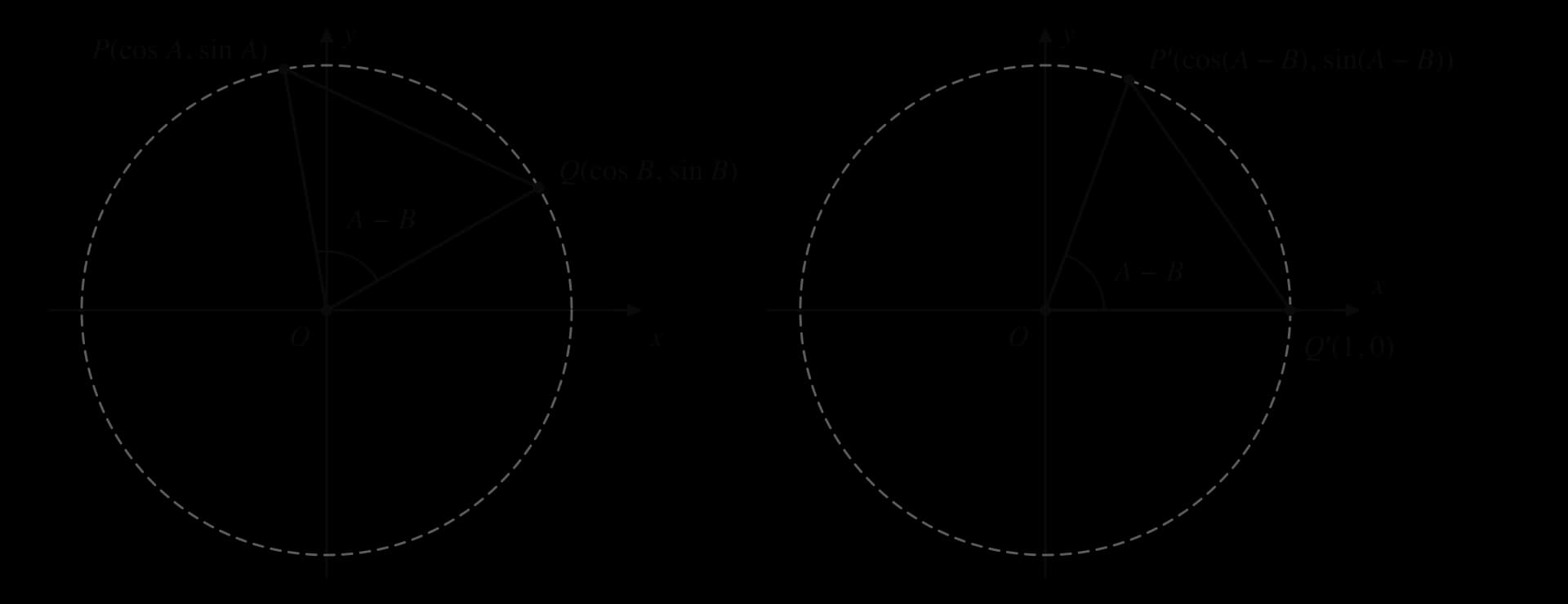
All six identities follow from one of them, cos(A−B)=cosAcosB+sinAsinB, which can be proved on the unit circle. Take the points P(cosA,sinA)
Rotating triangle OPQ about O does not change the length of the chord. Computing that length in both positions gives the identity for cos(A − B).
Setting the two expressions equal and cancelling gives
cos(A−B)=cosAcosB+sinAsinB
The argument uses only coordinates on the unit circle, so it holds for all angles A and B, not only acute ones. The cosine rule in triangle OPQ gives the same result for PQ2 when the triangle exists.
Deriving the other identities
The remaining identities follow from the first by replacing angles and using the symmetry of the graphs. Cosine is an even function and sine is an odd function, so cos(−B)=cosB and sin(−B)=−sinB.
Two complex numbers are equal only when their real parts are equal and their imaginary parts are equal. The real parts give cos(A+B) and the imaginary parts give sin(A+B). This is an example of equivalence between representations: the same fact about angles appears as a property of rotation in the plane and as a law of exponents.
Exact values from compound angles
Angles such as 15∘, 75∘ and 105∘ are sums or differences of 30∘
Some angles can be split in more than one way, for example 75∘=45∘+30∘ or 120∘−45∘
Using given ratios
When the ratios of A and B are given instead of the angles themselves, find the missing sine or cosine of each angle first, with the sign fixed by its quadrant, then substitute.
Recognising an identity in reverse
An expression that has the shape of the right-hand side of an identity can be collapsed into a single function. This is often the quickest route to an exact value.
Double angle identities
Deriving the double angle identities
Setting B=A in the sum identities gives the double angle identities. The ones for sine and cosine are studied in 3.6; here they appear as special cases.
sin2A=sin(A+A)=2sinAcosA
cos2A=cos(A+A)=cos2A−sin2A=2cos2A−1=1−2sin2A
The same substitution in the tangent identity gives a new result.
Triple angles and other multiples
Applying the identities twice gives the trigonometric functions of 3θ and other multiples in terms of θ. The method is to write the multiple as a sum, for example 3θ=2θ+θ, and expand.
Proving identities with compound angles
To prove an identity that contains a compound angle, expand it with the appropriate identity first. Then simplify, aiming at the form on the other side. The target suggests the route: if it contains only tan, divide by a product of cosines; if it contains only sin and cos of single angles, expand and collect like terms.
Results such as this one turn a sum of two sines into a product, which is useful in integration (5.16) and in physics, where two notes of slightly different frequencies produce beats.
When one of the angles is a standard angle, substitute its exact values as soon as the identity has been expanded.
Solving equations with compound angles
An equation that contains a compound angle with a known part, such as sin(x+6π), is usually solved by expanding, collecting the sinx terms and the cosx
The same method gives exact answers even when the tangent is not a familiar value, provided it matches a compound angle found earlier.
The tangent identity turns an equation in tan(x+constant) into an equation in tanx alone, often a quadratic.
Writing a cos θ + b sin θ as a single wave
The harmonic form R cos(θ − α)
The graph of y=3cosθ+4sinθ looks exactly like a cosine curve: it has the same period, 2π, but a larger amplitude and a horizontal shift. The compound angle identity explains why. For R>0,
This equals acosθ+bsinθ for all θ if the coefficients match:
Rcosα=a,Rsinα=b
Squaring and adding gives R2(cos2α+sin2α)=a2+b2
The harmonic form shows at once that acosθ+bsinθ has maximum value R, when θ=α, and minimum value −R
The values of Rcosα and Rsinα fix the quadrant of α, so check their signs before using arctan.
Combining waves
Any two oscillations of the same period combine into one oscillation of that period. If two sound waves of the same frequency reach a microphone, contributing pressures p1=acosωt and p2=bsinωt
Exam-style questions on compound angles
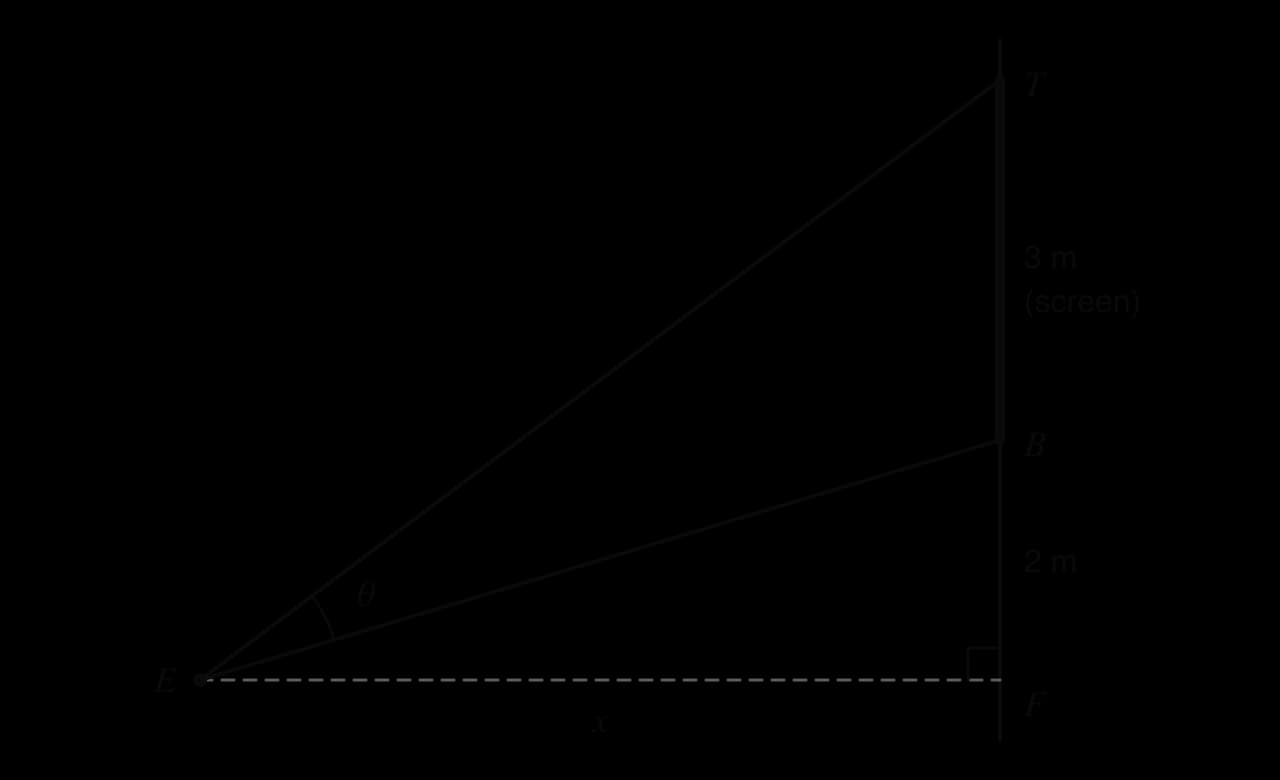
The screen BT and the angle θ it makes at the viewer's eye E, in the cinema question. Diagram not to scale.
Self-check
To do:
I can state the compound angle identities for sin(A±B), cos(A±B) and tan(A±B)
Questions on 3.10
36 exam-style questions on this subtopic, written in the style of the IB papers. The first has its markscheme open. Counted on
Question 1 · AA-001696 marks
Consider the angle 127π radians.
(a)
By writing 127π as 3π+4π, find the exact value of cos127π.
[3]3 marks
Markscheme (a)
cos127π=cos3πcos4π−sin3πsin4π
(b)
Find the exact value of tan127π, giving your answer in the form a+b3
Question 2 · AA-001706 marks
It is given that tanA=43, where 0<A<2π
Question 3 · AA-001716 marks
It is given that tan2θ=34, where 0<θ<4π
Try a quick-fire question
One of 33 short multiple-choice questions on 3.10. Pick an answer to see why it's right or wrong.
For 0≤x<2π, what is the solution of sinxcos6π+cosxsin6π=1?
From the formula booklet
The entries of the mathematics: analysis and approaches formula booklet that 3.10 uses. Each opens in the explained booklet.
If cosx=0, then sinx=±1 and the equation would read ±23=0
tanx=33=3
Tangent is positive in the first and third quadrants, so
x=3πorx=3π+π=34π
Check x=3π: sin2π=1
, giving exact answers.
Show the solution
Expand:
21cosx+23sinx=sinx⇒21cosx=(1−23)sinx
As before, cosx=0 gives no solution. Divide by cosx and multiply by 2:
tanx=2−31=(2−3)(2+3)2+3=2+3
From the exact values, tan15∘=2−3, and tan75∘=tan15∘1=2+3
x=125πorx=1217π
Check: cos(125π−124π)=cos12π
, giving answers to 3 significant figures.
Show the solution
Let t=tanθ. The left-hand side is 1−t1+t, valid when t=1:
1−t1+t=6t⇒1+t=6t−6t2⇒6t2−5t+1=0
Factorise: (3t−1)(2t−1)=0, so t=31
In 0≤θ≤π, tangent is positive only in the first quadrant, so each value gives one solution:
θ=arctan31=0.322θ=arctan21=0.464
Check θ=0.4636…: tan(0.4636…+0.7854…)=tan1.2490…=3.00 and 6×0.5=3
, and dividing gives
tanα=ab
.
When a>0 and b>0, α is acute and α=arctanab.
, when
θ=α+π
. Other versions such as
Rsin(θ+α)
or
Rcos(θ+α)
are found the same way: expand the chosen form and match coefficients.
and
0<α<2π
. (b) Write down the maximum value of
3cosθ+4sinθ
and find the smallest positive
θ
at which it occurs. (c) Solve
3cosθ+4sinθ=2
for
0≤θ<2π
.
Show the solution
(a) R=32+42=5. Then cosα=53 and sinα=54, both positive, so α is acute:
α=arctan34=0.92729…⇒3cosθ+4sinθ=5cos(θ−0.927)
(b) The maximum value is R=5, reached when cos(θ−α)=1, that is θ=α=0.927
(c) The equation becomes 5cos(θ−α)=2, so cos(θ−α)=0.4. With θ
θ−α=arccos0.4=1.15928…orθ−α=−1.15928…+2π=5.12391…
(−1.159 itself is outside the interval.) Adding α:
θ=2.09orθ=6.05
, the conditions are
Rcosα=−1
and
Rsinα=3
, so
α
is in the second quadrant and
α=32π
. The calculator value
arctan(−3)=−3π
is in the wrong quadrant.
, where
R>0
and
0<α<2π
. (b) Hence solve
sinθ−3cosθ=1
for
0≤θ<2π
. (c) State the minimum value of
sinθ−3cosθ
and the value of
θ
in
[0,2π)
at which it occurs.
Show the solution
(a) Expand the target form with the sine difference identity:
Rsin(θ−α)=Rsinθcosα−Rcosθsinα
Match coefficients with sinθ−3cosθ: Rcosα=1 and Rsinα=3. Then
R=1+3=2,tanα=3⇒α=3π
(α is acute because both Rcosα and Rsinα are positive.) So sinθ−3cosθ=2sin(θ−3π)
(b) 2sin(θ−3π)=1, so sin(θ−3π)=21
θ−3π=6πorθ−3π=65π⇒θ=2πorθ=67π
Check θ=67π: sin67π−3cos67π=−21+23=1
(c) The minimum value is −R=−2, when θ−3π=23π
, the total pressure is
Rcos(ωt−α)
with amplitude
R=a2+b2
. The amplitude of the combination is not
a+b
: the two waves peak at different times, so their peaks do not add. This is the mathematics behind the interference of waves, and it is a clear case of modelling with a single function that replaces two.
. (a) Show that the total pressure
p1+p2
can be written as
Rcos(2.5t−α)
, and find
R
and
α
. (b) Find the first time after
t=0
at which the total pressure is greatest.
Show the solution
(a) Let θ=2.5t. Matching 0.6cosθ+0.8sinθ with Rcosθcosα+Rsinθsinα gives Rcosα=0.6 and Rsinα=0.8, so
R=0.62+0.82=1=1,tanα=0.60.8=34⇒α=0.927
So p1+p2=cos(2.5t−0.927), with amplitude 1 Pa, less than
(b) The maximum occurs when 2.5t−0.927=0, so t=2.50.92729…=0.371
and
tan2θ
, together with the double angle identities for sine and cosine. It does not give the harmonic form, the exact values of standard angles or the signs in each quadrant. When a question says "use a compound angle identity" or "hence", an answer from a calculator alone earns no marks: write the identity with the values substituted.
. (a) Find the value of
tan(A+B)
. [2 marks] (b) Hence show that
arctan21+arctan31=4π
. [2 marks] (c) Find the exact value of
cos(A−B)
. [4 marks]
Show the solution
(a) Use the tangent sum identity (M1):
tan(A+B)=1−21⋅3121+31=6565=1(A1)
(b) A and B are acute, so 0<A+B<π (R1). The only angle in (0,π)
(c) From right-angled triangles with legs 1,2 and 1,3 (M1):
(a) Show that tanθ=x2+103x. [4 marks] (b) Find the value of x that makes θ as large as possible, and the maximum value of θ in degrees. [3 marks] (c) Find the range of distances for which θ≥20∘. [3 marks]
Show the solution
(a) Let F be the point on the wall level with the eye. Then ∠FET=arctanx5 and ∠FEB=arctanx2 (M1), so θ=∠FET−∠FEB. Using the tangent difference identity (M1):
tanθ=1+x5⋅x2x5−x2=1+x210x3(A1)
Multiply the numerator and the denominator by x2:
tanθ=x2+103x(A1, given answer)
(b) θ is acute and tan is increasing on (0,2π), so θ
θ=arctan0.47434…=25.4∘(A1)
(c) θ≥20∘ when x2+103x≥tan20∘
1.48≤x≤6.76 m(A1)
with the correct signs.
To do:
I can explain how cos(A−B) is derived from the distance between two points on the unit circle, and how the other identities follow.
To do:
I can find exact values such as sin75∘, cos127π and tan15∘.
To do:
I can find sin(A+B), cos(A−B) and tan(A+B) from given ratios, choosing signs from the quadrants.
To do:
I can derive and use tan2θ=1−tan2θ2tanθ.
To do:
I can prove identities that involve compound and double angles.
To do:
I can solve equations with compound angles without losing solutions by dividing.
To do:
I can write acosθ+bsinθ as Rcos(θ−α) and use it to find maximum values and solve equations.