3.9 Reciprocal and inverse trigonometric functions · IB Maths AA | Augment Education
3.9 Reciprocal and inverse trigonometric functions
Use sec, cosec and cot and their Pythagorean identities, sketch their graphs, and work with arcsin, arccos and arctan, their domains, ranges, exact values and compositions.
IB Mathematics: Analysis and Approaches
Part of 3 Geometry and trigonometry
HL only
Key terms introduced here
Each is in the Maths AA glossary, with every other term in the subject.
The functions arcsinx, arccosx and arctanx, which return the angle with a given sine, cosine or tangent. Each is the inverse of sine, cosine or tangent restricted to a domain on which it is one-to-one.
The functions secθ=cosθ1, cosecθ=sinθ1 and cotθ=sinθcosθ, each defined for every angle at which its denominator is not zero.
Notes on 3.9 Reciprocal and inverse trigonometric functions
29 min readLast reviewed
The three basic circular functions, sine, cosine and tangent, have reciprocals called secant, cosecant and cotangent. They add no new information, since each is one divided by a familiar function, but they make many identities, equations and integrals much shorter to write. The derivative of tanx, for example, is sec2x, and the identity 1+tan2θ=sec2θ
The inverse trigonometric functions answer the opposite question: given the value of a sine, cosine or tangent, which angle produced it? They appear whenever an angle has to be found from lengths, such as the angle of a ramp from its rise and run or the angle at which a camera must point to follow a moving object. Because sine, cosine and tangent repeat their values, each inverse has to be defined with care so that it gives exactly one angle.
The reciprocal trigonometric functions
Definitions
Each reciprocal trigonometric function is one divided by one of the three basic functions. They are written sec (secant), cosec (cosecant, written csc on many calculators and in some books) and cot (cotangent).
The last form of cotθ, sinθcosθ, is the safer one to use. It also defines cotθ
Where each function is undefined
A reciprocal is undefined wherever the function in its denominator is zero. On the unit circle, cosθ=0 at the top and bottom of the circle and sinθ=0 at the left and right.
Function
Undefined when
Undefined at (k∈Z)
secθ=cosθ1
A geometric picture on the unit circle
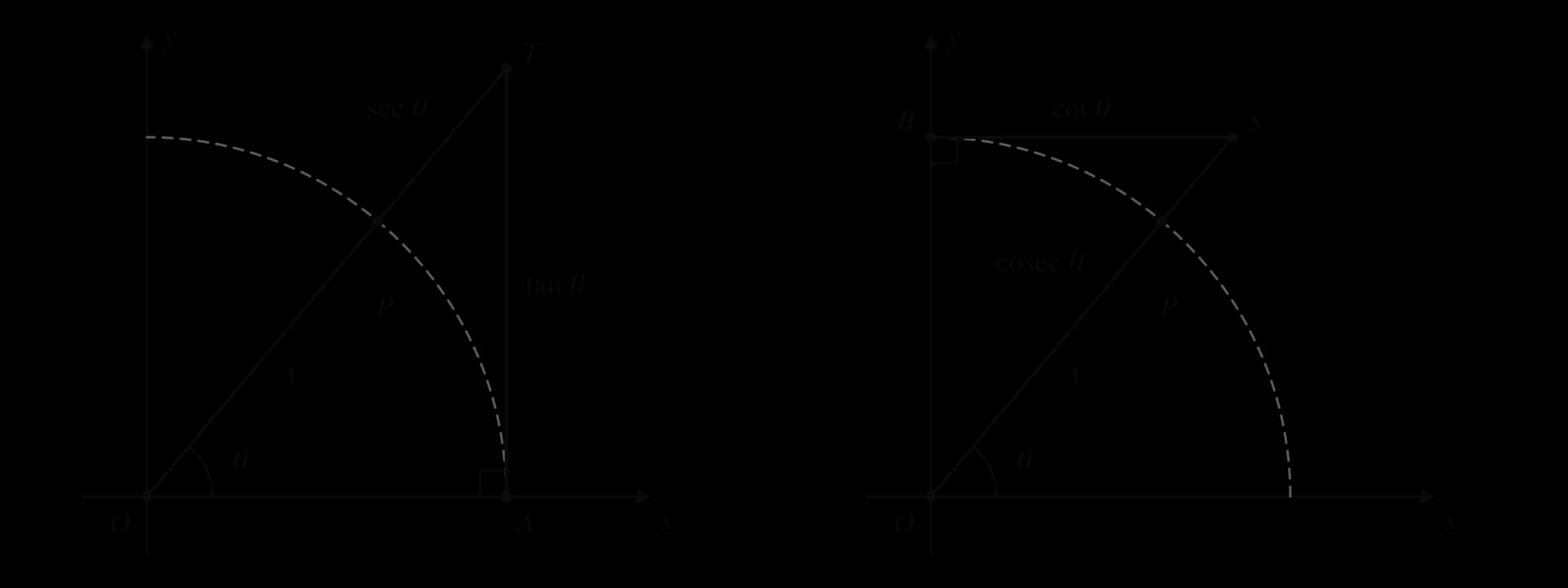
The names secant and tangent come from lines drawn on the unit circle. Take a point P on the unit circle at angle θ and extend the radius OP until it meets the tangent to the circle at A(1,0). In the right-angled triangle OAT, the side OA
Sec θ and tan θ are lengths along the tangent at (1, 0); cosec θ and cot θ are lengths along the tangent at (0, 1). OT and OS are always at least 1, the radius.
The picture explains two facts about sizes. Since OT is the hypotenuse of a triangle with a side of length 1, ∣secθ∣≥1 for every θ, and in the same way ∣cosecθ∣≥1
Exact values
Exact values of sec, cosec and cot come straight from the exact values of sin, cos and tan. Find the basic value first, including its sign from the quadrant, then take the reciprocal and rationalise the denominator if needed.
θ
0
6π
4π
Graphs of the reciprocal functions
Each reciprocal graph can be sketched from the graph of the function it comes from, using the ideas of reciprocal graphs from 2.8:
where the original function is 0, the reciprocal has a vertical asymptote;
where the original function is 1 or −1, the reciprocal has the same value, so the two graphs touch;
where the original function is small and positive, the reciprocal is large and positive (and the same for negative values);
the reciprocal has the same sign as the original function everywhere, and the same period.
The graph of y = sec x
The graph of y=secx is built from the graph of y=cosx. Where cosx has a maximum of 1, secx
The key features of y=secx are:
domain: x∈R, x=2π+kπ
The graph of y = cosec x
The graph of y=cosecx is built from y=sinx in the same way. Its asymptotes are at the zeros of sinx, x=kπ
Since sinx=cos(x−2π), the graph of y=cosecx
The graph of y = cot x
The graph of y=cotx has asymptotes where sinx=0, at x=kπ, and crosses the x-axis where cosx=0
The graph of y=cotx is decreasing on every branch. It has period π (like tanx), domain x=kπ
The table collects the features of all three reciprocal graphs.
Feature
y=secx
y=cosecx
y=cotx
Pythagorean identities with reciprocal functions
Deriving the identities
The Pythagorean identity cos2θ+sin2θ=1 from 3.6 has two companions. Dividing every term by cos2θ
cos2θcos2θ+cos2θsin2θ=cos2θ1⇒1+tan2θ=sec2θ
Dividing instead by sin2θ (whenever sinθ=0) gives
sin2θcos2θ+sin2θsin2θ=sin2θ1⇒1+cot2θ=cosec2θ
The pairing is easy to remember: tan goes with sec and cot goes with cosec. In the unit circle picture, 1+tan2θ=sec2θ
Finding one ratio from another
When the value of one trigonometric ratio and the quadrant of the angle are known, the identities give every other ratio. The identity gives the size; the quadrant gives the sign.
Proving identities
To prove an identity, start from one side (usually the more complicated one) and transform it step by step into the other side. A reliable strategy with reciprocal functions is to write everything in terms of sin and cos, combine fractions over a common denominator, and then use a Pythagorean identity.
Some identities are proved more neatly by using the new Pythagorean identities directly instead of converting to sin and cos. Both routes are valid; choose whichever keeps the algebra shorter.
Solving equations with the Pythagorean identities
An equation that mixes tanθ and secθ, or cotθ and cosecθ, can usually be turned into a quadratic in one function by replacing a squared term. The method is the one from 3.8 for sin and cos
When the quadratic does not factorise into standard angles, a graphic display calculator (GDC) finds the principal angle and the CAST diagram or the graph's symmetry gives the rest.
Inverse trigonometric functions
Why the domain must be restricted
A function has an inverse function only if it is one-to-one: each output comes from exactly one input. The sine function is not one-to-one, since sin6π=sin65π=sin613π=21
To define an inverse, each function is first given a restricted domain: an interval on which it is one-to-one and still takes every one of its values exactly once. The standard choices are
sinx on −2π≤x≤2π
Each interval contains the acute angles 0 to 2π, so the inverse gives the familiar acute angle whenever the value is positive.
The inverse trigonometric functions therefore return an angle, in radians unless degrees are stated. The principal value is the one a calculator gives: for example, arcsin21=6π, although 65π
Domains and ranges
The domain of each inverse is the range of the restricted original function, and the range of each inverse is the restricted domain.
Function
Domain
Range (principal values)
y=arcsinx
−1≤x≤1
−2π≤y≤2π
The graphs of the inverse functions
The graph of an inverse function is the reflection of the original graph in the line y=x. Reflecting the restricted part of y=sinx gives the graph of y=arcsinx: an increasing curve from (−1,−2π)
The graph of y=arccosx is the reflection of y=cosx for 0≤x≤π. It decreases from (−1,π)
The graph of y=arctanx is the reflection of y=tanx for −2π<x<2π
Both arcsin and arctan are odd functions, so arcsin(−x)=−arcsinx and arctan(−x)=−arctanx
Exact values of inverse functions
To find an exact value such as arccos(−22), ask which angle in the principal range has the given value. The related angle comes from the standard exact values; the range of the function decides the quadrant.
Composing a function with its inverse
For any function and its inverse, f(f−1(x))=x for every x in the domain of f−1, and f−1(f(x))=x
Composition
Equals x when
Example where it does not
sin(arcsinx)
−1≤x≤1 (undefined otherwise)
sin(arcsin2)
Simplifying expressions such as sin(arccos x)
An expression such as sin(arccosx) asks for the sine of the angle whose cosine is x. Give the angle a name, θ=arccosx, so that cosθ=x with 0≤θ≤π
sinθ=±1−cos2θ=±1−x2
Because θ is between 0 and π, sinθ≥0, so the positive root is correct:
sin(arccosx)=1−x2,−1≤x≤1
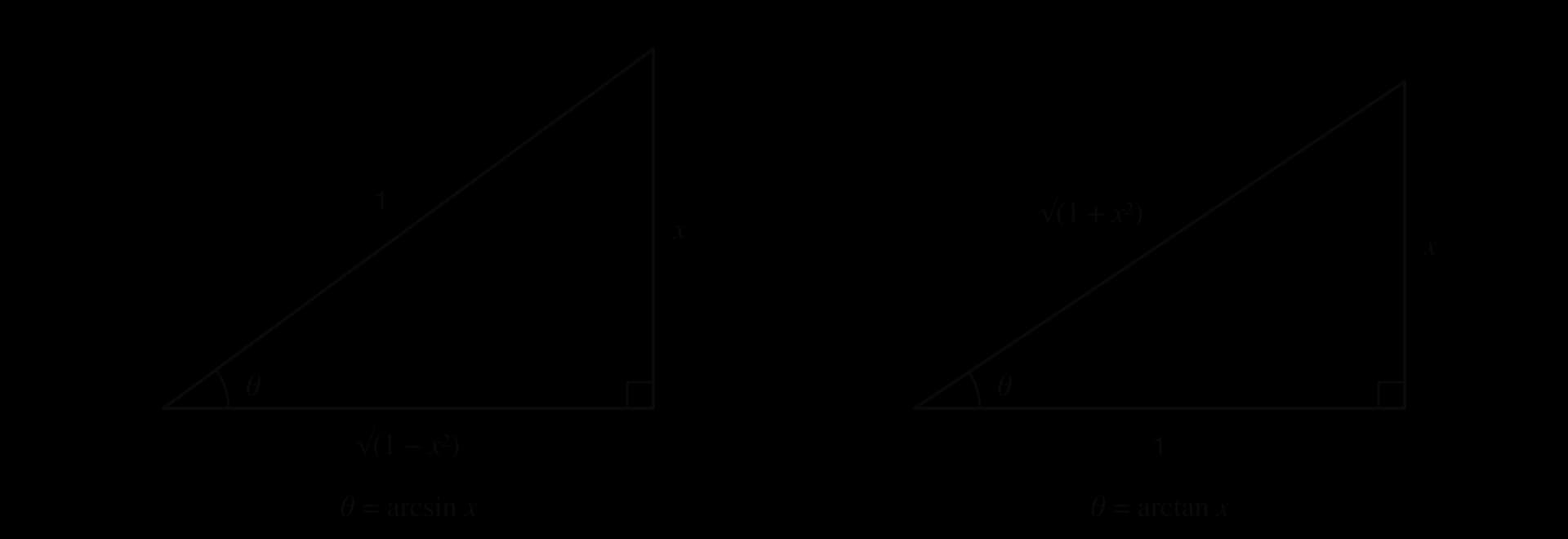
A right-angled triangle gives the same results quickly when x>0. For θ=arcsinx, label the hypotenuse 1 and the opposite side x; Pythagoras' theorem gives the adjacent side 1−x2
Choose the sides so that the ratio matches the inverse function: sin θ = x/1 on the left, tan θ = x/1 on the right. Every other ratio of θ can then be read off the triangle.
These hold for negative x as well, because cos is positive throughout the ranges of arcsin and arctan, and sin, tan keep the sign of x
The identity arcsin x + arccos x = π/2
In a right-angled triangle the two acute angles add up to 2π, and the sine of one is the cosine of the other. This suggests that arcsinx and arccosx always add to 2π
Solving equations and transforming inverse functions
An equation in which the unknown sits inside an inverse function is solved by applying the original function to both sides. Before that, check that the value on the other side lies in the range of the inverse function; if it does not, there is no solution.
Transformations from 2.11 apply to inverse trigonometric graphs in the usual way. For y=aarccos(bx+c)+d, the domain comes from solving −1≤bx+c≤1
Modelling with inverse trigonometric functions
Whenever an angle depends on two lengths, an inverse trigonometric function expresses it. An angle of elevation, the angle of a slope or the direction of a camera can each be written as θ=arctanadjacentopposite. The model then shows how the angle changes as one of the lengths changes, which is a relationship that the triangle on its own does not show.
When one of the lengths in the model changes over time, the angle becomes a function of time. The horizontal asymptotes of y=arctanx then have a physical meaning: the angle approaches ±2π but can never reach it while the other length stays fixed. The rate at which such an angle changes is found with the derivative of arctanx
Exam-style questions on reciprocal and inverse functions
Self-check
To do:
I can define secθ, cosecθ and cotθ and find their exact values for standard angles in any quadrant.
To do:
I can sketch y=secx
Questions on 3.9
39 exam-style questions on this subtopic, written in the style of the IB papers. The first has its markscheme open. Counted on
Question 1 · AA-001758 marks
This question concerns sums of inverse tangent functions.
(a)
Find the exact value of arctan2+arctan3.
[4]4 marks
Markscheme (a)
let α=arctan2 and β=arctan3; tan(α+β)=1−2×32+3M1
=−1A1
α,β∈]4π,2π[
arctan2+arctan3=43πA1
Note: Award M1A1R0A0 for −4π. Award the R1 for any valid argument that places α+β in the second quadrant.
(b)
Solve the equation arctanx+arctan2x=4π.
[4]4 marks
Markscheme (b)
taking tan of both sides: 1−2x2x+2x=1
Question 2 · AA-001767 marks
The line L1 has equation y=1.5x+2 and the line L2
Question 3 · AA-0018216 marks
Let Sn=r=1∑narctan(r22)
Try a quick-fire question
One of 40 short multiple-choice questions on 3.9. Pick an answer to see why it's right or wrong.
Which expression equals 1+tan2θ wherever both are defined?
From the formula booklet
The entries of the mathematics: analysis and approaches formula booklet that 3.9 uses. Each opens in the explained booklet.
(b) 67π is in the third quadrant, where sine is negative. Its related angle is 6π, so sin67π=−21
cosec67π=−211=−2
(c) 32π is in the second quadrant, with related angle 3π. There cos32π=−21
cot32π=23−21=−31=−33
(d) cosπ=−1, so secπ=−11=−1
means the inverse function
arccosθ
, an angle, not the reciprocal
cosθ1
. For powers,
cos2θ
means
(cosθ)2
, but the index
−1
is reserved for the inverse function. Write the reciprocal as
secθ
or
(cosθ)−1
.
has a local minimum of
1
; where
cosx
has a minimum of
−1
,
secx
has a local maximum of
−1
. The asymptotes are at the zeros of
cosx
,
x=2π+kπ
.
y = sec x
y = cos x
The U-shaped branches of y = sec x touch y = cos x where cos x = ±1 and run up or down to an asymptote wherever cos x = 0. No part of the secant graph lies strictly between y = −1 and y = 1.
; range:
y≤−1
or
y≥1
;
period 2π, the same as cosx;
local minima at (2kπ,1) and local maxima at ((2k+1)π,−1);
symmetric in the y-axis, because cos(−x)=cosx: it is an even function.
, and its branches turn at
(2π,1)
and
(23π,−1)
, where
sinx=±1
.
y = cosec x
y = sin x
y = cosec x has the same shape as y = sec x, translated π/2 to the right. Its asymptotes are where sin x = 0.
is the graph of
y=secx
translated by
2π
to the right. It has domain
x=kπ
, range
y≤−1
or
y≥1
, and period
2π
. Because
sin(−x)=−sinx
, cosecant is an
odd function
: its graph has rotational symmetry of order 2 about the origin.
, at
x=2π+kπ
. These are exactly the places where
tanx
has asymptotes, which is why the two graphs fit together.
,
k∈Z
, and range
R
.
y = cot x
y = tan x
y = cot x falls on every branch while y = tan x rises. Each crosses the x-axis where the other has an asymptote, and the two meet where tan x = cot x = ±1.
Vertical asymptotes
x=2π+kπ
x=kπ
x=kπ
Range
y≤−1 or y≥1
y≤−1 or y≥1
R
Period
2π
2π
π
Symmetry
even
odd
odd
Zeros
none
none
x=2π+kπ
, so the period halves from
2π
to
π
.
Asymptotes occur where sin2x=0, so 2x=kπ and x=2kπ. In the interval 0<x<π there is one, at x=2π; the ends x=0 and x=π are also asymptotes of the curve, although they are not in the domain.
Turning points occur where sin2x=±1:
2x=2π⇒x=4π,y=12x=23π⇒x=43π,y=−1
So there is a local minimum at (4π,1) and a local maximum at (43π,−1).
y = cosec 2x
One full period of y = cosec 2x: an upward branch on 0 < x < π/2 and a downward branch on π/2 < x < π.
(allowed whenever
cosθ=0
) gives
They are often used rearranged, as tan2θ=sec2θ−1 and cot2θ=cosec2θ−1.
is Pythagoras' theorem in triangle
OAT
, with legs
1
and
tanθ
and hypotenuse
secθ
.
, find the exact values of
secθ
,
cosecθ
and
cotθ
.
Show the solution
First, cotθ=tanθ1=−21.
Use 1+tan2θ=sec2θ:
sec2θ=1+(−2)2=5⇒secθ=±5
In the second quadrant cosθ<0, so secθ<0 and secθ=−5
: substitute, factorise, solve each factor, then reject impossible values.
Replace
tan2θ
with
sec2θ−1
so that only
secθ
appears:
2(sec2θ−1)=3secθ⇒2sec2θ−3secθ−2=0
Factorise as a quadratic in secθ:
(2secθ+1)(secθ−2)=0⇒secθ=−21 or secθ=2
Since ∣secθ∣≥1 for all θ, secθ=−21 has no solutions.
secθ=2 means cosθ=21. Cosine is positive in the first and fourth quadrants, so
θ=3πorθ=2π−3π=35π
Check θ=3π: 2tan23π=2×3=6 and 3sec3π=3×2=6.
, giving answers to 3 significant figures.
Show the solution
Replace cosec2x with 1+cot2x:
3(1+cot2x)−5cotx−5=0⇒3cot2x−5cotx−2=0
Factorise:
(3cotx+1)(cotx−2)=0⇒cotx=−31 or cotx=2
Convert to tan, since calculators have no cot key: tanx=−3 or tanx=21
tanx=21: the principal value is x=0.46364…. Tangent has period π
tanx=−3: the calculator gives −1.24904…, which is outside the interval. Adding π gives 1.89254… and adding 2π
The values x=0,π,2π, where cotx and cosecx are undefined, are not solutions. The solutions are
x=0.464,1.89,3.61,5.03
, and infinitely many other angles share the same sine. A horizontal line
y=21
crosses the graph of
y=sinx
infinitely many times.
(increasing from
−1
to
1
);
cosx on 0≤x≤π (decreasing from 1 to −1);
tanx on −2π<x<2π (increasing through every real value).
;
y=arccosx means cosy=x and 0≤y≤π;
y=arctanx means tany=x and −2π<y<2π.
The angle returned is called the principal value. The functions are also written sin−1x, cos−1x and tan−1x.
also has a sine of
21
.
y=arccosx
−1≤x≤1
0≤y≤π
y=arctanx
x∈R
−2π<y<2π
, not
−3π
. Only
arcsin
and
arctan
return negative angles.
to
(1,2π)
, passing through the origin.
y = arcsin x
y = sin x, −π/2 ≤ x ≤ π/2
y = x
y = arcsin x is the reflection of the restricted sine curve in y = x. Its domain is −1 ≤ x ≤ 1 and its range is −π/2 ≤ y ≤ π/2.
to
(1,0)
and crosses the
y
-axis at
(0,2π)
. It lies entirely on or above the
x
-axis, because every principal value of
arccos
is between
0
and
π
.
y = arccos x
y = cos x, 0 ≤ x ≤ π
y = x
y = arccos x decreases from (−1, π) to (1, 0) and is symmetric about the point (0, π/2).
(a) The graph ends at (1,0), so arccos1=0.
(b) It crosses the y-axis at (0,2π), so arccos0=2π.
(c) It starts at (−1,π), so arccos(−1)=π.
The graph has rotational symmetry of order 2 about (0,2π): the point at −x is as far above 2π as the point at x is below it. This is the identity arccos(−x)=π−arccosx.
. The vertical asymptotes
x=±2π
of the tangent graph become
horizontal asymptotes
y=±2π
, so the curve flattens out but never reaches them. Its domain is all of
R
, which makes
arctan
the most widely used of the three in modelling.
y = arctan x
y = arctan x is defined for every real x and approaches the horizontal asymptotes y = ±π/2 without reaching them.
. Their graphs pass through the origin with rotational symmetry about it. The function
arccos
is neither odd nor even.
(c)
arctan(−31)
(d)
arcsin(−1)
Show the solution
(a) The angle in [−2π,2π] with sine 23 is 3π, so arcsin23=3π.
(b) The related angle is 4π, since cos4π=22
arccos(−22)=π−4π=43π
(c) The related angle is 6π, since tan6π=31
arctan(−31)=−6π
(d) sin(−2π)=−1 and −2π
for every
x
in the domain of
f
. For the trigonometric functions the second statement only applies to the restricted domain, which leads to results that can look surprising.
is undefined
arcsin(sinx)
−2π≤x≤2π
arcsin(sin65π)=6π
arccos(cosx)
0≤x≤π
arccos(cos34π)=32π
arctan(tanx)
−2π<x<2π
arctan(tan43π)=−4π
(c)
arctan(tan43π)
(d)
sin(arcsin0.3)
Show the solution
Work from the inside out: evaluate the inner function, then apply the inverse and keep its range in mind.
(a) sin65π=21, and the angle in [−2π,2π] with sine 21 is 6π. So arcsin(sin65π)=6π, not 65π.
(b) cos34π=−21, and the angle in [0,π]
(c) tan43π=−1, and the angle in (−2π,2π)
(d) 0.3 is in the domain of arcsin, so sin(arcsin0.3)=0.3 exactly. No evaluation is needed.
. The output of
arcsin
is always between
−2π
and
2π
, so an answer of
65π
is impossible. Check that every answer lies in the principal range.
. Then find
sinθ
with the Pythagorean identity or a right-angled triangle:
. For
θ=arctanx
, label the opposite side
x
and the adjacent side
1
, so the hypotenuse is
1+x2
.
. A triangle can only show positive lengths, so whenever the inner value is negative, decide the sign from the quadrant of the angle.
(c)
cos(2arcsin31)
Show the solution
(a) Let θ=arccos(−53). Then cosθ=−53 and, since the range of arccos is [0,π] and the cosine is negative, θ is in the second quadrant. There sinθ>0:
sinθ=1−259=54⇒tanθ=−5354=−34
(b) Let θ=arctan2, so tanθ=2 and 0<θ<2π
sec2θ=1+4=5⇒secθ=5
taking the positive root because θ is acute.
(c) Let θ=arcsin31, so sinθ=31
cos2θ=1−2(31)2=1−92=97
, and the result holds for negative
x
as well.
. Hence find the exact value of
arccos22+arcsin22
without evaluating either term, and solve
arcsinx=2arccosx
.
Show the solution
Let θ=arcsinx, so sinθ=x and −2π≤θ≤2π. Then
cos(2π−θ)=sinθ=x
From the range of θ, 0≤2π−θ≤π, which is the range of arccos
arccosx=2π−θ=2π−arcsinx⇒arcsinx+arccosx=2π
Hence arccos22+arcsin22=2π
For the equation, write arcsinx=2π−arccosx:
2π−arccosx=2arccosx⇒arccosx=6π⇒x=cos6π=23
Check: arcsin23=3π
(c)
arctanx=2
Show the solution
(a) Divide by 2: arcsin(x−1)=6π, which is in the range of arcsin. Take the sine of both sides:
x−1=sin6π=21⇒x=23
(b) 32π is in [0,π], so a solution exists:
2x=cos32π=−21⇒x=−41
(c) The range of arctan is −2π<y<2π
, and the range comes from scaling and translating
[0,π]
.
and state its domain.
Show the solution
(a) The input of arccos must satisfy −1≤x−2≤1, so the domain is 1≤x≤3. The values of arccos(x−2) run from 0 to π, so the range of f is 0≤f(x)≤3π.
(b) Write y=3arccos(x−2) and swap the roles of x and y (rearrange for x, then rename):
3y=arccos(x−2)⇒x−2=cos3y⇒x=2+cos3y
So f−1(x)=2+cos3x, with domain 0≤x≤3π
, so
θ=arctan121=0.08314… rad=4.76…∘≈4.8∘
(b) A slope of 1:12 needs a run of 12×0.45=5.4 m. With a run of 7.2 m,
θ=arctan7.20.45=arctan0.0625=3.576…∘≈3.6∘
which is within the limit.
Source for the 1:12 limit: 2010 ADA Standards for Accessible Design, section 405.2 (USA).
in 5.15.
. (a) Find
θ
when
h=1200
, in degrees to 1 decimal place. (b) Find the height of the rocket when the angle of elevation is
80∘
. (c) Describe what happens to
θ
as
h
becomes very large, and interpret this in context.
does not. In a "show that" with a square root, justify the sign of the root by stating the range of the angle, as in part (d); this reasoning mark is often lost.
,
y=cosecx
and
y=cotx
with their asymptotes, turning points and periods.
To do:
I can derive 1+tan2θ=sec2θ and 1+cot2θ=cosec2θ from sin2θ+cos2θ=1.
To do:
I can use these identities to find one ratio from another, prove identities and solve equations, rejecting impossible values.
To do:
I can state the domain and range of arcsinx, arccosx and arctanx and sketch their graphs.
To do:
I can find exact values of inverse trigonometric functions and of compositions such as arccos(cos34π).
To do:
I can simplify expressions such as sin(arccosx) and tan(arccos(−53)) with the correct sign.
To do:
I can solve equations involving inverse trigonometric functions and use arctan to model an angle that depends on two lengths.
(since
2,3>1
), so
2π<α+β<π
R1
M1
2x2+3x−1=0A1
x=4−3±17A1
for x<0 both arctanx and arctan2x are negative, so their sum cannot be 4π; hence x=4−3+17 only R1
Note: Award the R1 only if 4−3−17 is rejected with a valid reason (it gives a sum of −43π).
has equation
y=−0.4x+1
.
The lines L1 and L2 make angles α and β respectively with the positive x-axis, measured anticlockwise.
(a)
By considering tan(β−α), find the acute angle between L1 and L2. Give your answer in degrees.
[3]3 marks
(b)
The line L3 passes through the point (0,2) and makes an acute angle of 40° with L1
and the value is negative, so the angle is in the fourth quadrant, measured clockwise:
is in the range of
arcsin
, so
arcsin(−1)=−2π
.
with cosine
−21
is
32π
. So the answer is
32π
.
with tangent
−1
is
−4π
.
. Using
1+tan2θ=sec2θ
,
. The
double angle identity
cos2θ=1−2sin2θ
uses
sinθ
directly:
. So
2π−θ
is the principal value whose cosine is
x
:
directly.
and
2arccos23=2×6π=3π
.
, approximately
−1.571<y<1.571
. Since
2>2π
, the equation has no solution. Taking
x=tan2≈−2.19
would be wrong:
arctan(−2.19)≈−1.14
, not
2
.
(the range of
f
).
m.
, the horizontal asymptote of
y=arctanx
. The angle of elevation approaches
90∘
but never reaches it: the observer looks closer and closer to straight up, but the rocket is never directly overhead. Equal increases in height also change
θ
by less and less as the rocket climbs.
and
x=π−6π=65π
(A1).
sinx=−1
gives
x=23π
(A1).
. Check
x=23π
:
cot23π=0
and
cosec23π=−1
, so
0+1−1=0
.
(A1), since the inner expression takes every value from