Notes on R2.1 Indigenous societies in the Americas (circa 750–1500)
Indigenous societies in the Americas before 1500 developed without contact with Afro-Eurasia, yet they built cities, empires, writing and calendar systems, road networks and farming methods that fed millions of people. Understanding how they were organised, and what strained them, is the starting point for any study of the encounters that followed 1492.
Peoples, places and evidence
The societies of the study
The Americas between 750 and 1500 were home to many millions of people: modern estimates for 1492 range from under 10 million to over 100 million, with about 50 million a common middle figure. Most lived in two regions of dense population: Mesoamerica, which stretched from central Mexico to Honduras and El Salvador, and the Andes of western South America. These two regions had cities, states and intensive agriculture. Elsewhere, from the eastern woodlands of North America to the forests of Paraguay and the valleys of central Chile, most people lived in villages and governed themselves through kin groups and councils.
Six societies are the main examples. Three were states with rulers, capitals and taxes:
The Maya of southern Mexico, Guatemala and Belize, who were never one state but a world of rival city-states. Their southern cities were at their height around 750 and largely abandoned by 950; the north (Yucatán) went on to produce new centres at Chichén Itzá and Mayapán.
The Mexica of Tenochtitlan, leaders of the Triple Alliance that from 1428 built the Aztec Empire in central and southern Mexico.
The Inca, whose state, Tawantinsuyu, grew from about the 1430s to stretch some 4,000 km along the Andes from southern Colombia to central Chile.
Three were not states, but organised large populations without kings:
The Haudenosaunee ("people of the longhouse"), called the Iroquois by the French, five nations of farming villages in what is now New York State, joined in the League of Peace.
The Mapuche of central and southern Chile, farmers, herders and fishers organised in independent lineages.
The Guaraní of the forests of Paraguay, southern Brazil and north-east Argentina, village farmers who moved their settlements every few years.
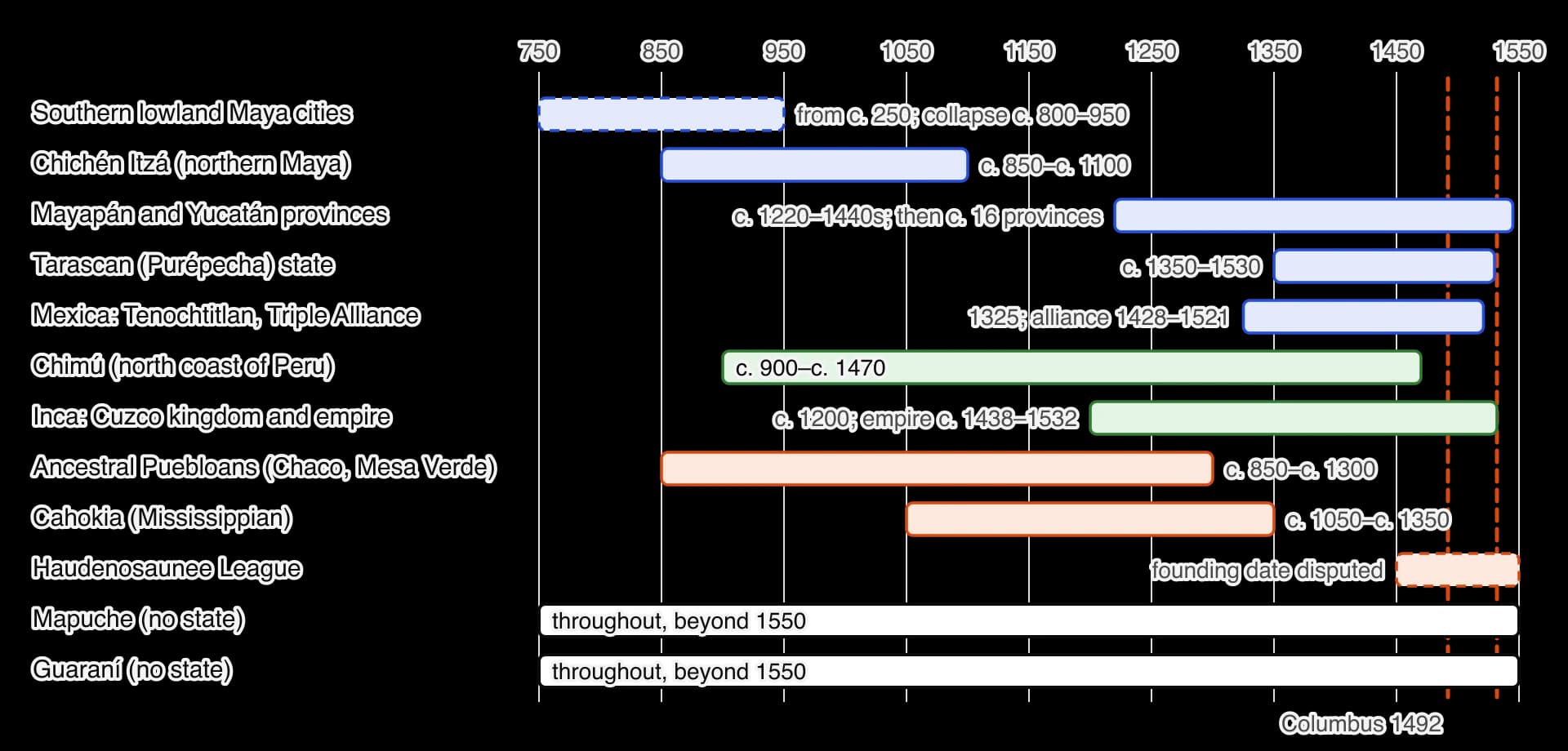
The chart of lifespans shows that these societies did not all exist at once. The southern Maya cities had faded before the Mexica and Inca rose; the Mexica and Inca empires were young, both less than a century old in 1519 and 1532. Other societies, such as Cahokia on the Mississippi and the Ancestral Puebloans of the south-west of the modern USA, rose and declined within the period and are useful for comparison.
Names and terms
Many familiar names for these peoples were given by outsiders. "Aztec" is a label popularised by scholars in the eighteenth and nineteenth centuries; the people of Tenochtitlan called themselves the Mexica. "Inca" was strictly the title of the ruler and the name of the royal lineages of Cuzco; their subjects were many different peoples, and the state was Tawantinsuyu, "the four parts together". "Iroquois" probably came from a name used by the Haudenosaunee's enemies, and the Spanish called the Mapuche "Araucanians". Modern historians prefer the names peoples used for themselves, while recognising the older names that appear in many books.
The problem of evidence
Only the Maya, and to a lesser extent the peoples of central Mexico, kept written records before 1500, and most of these were destroyed. Four Maya books survive, and only about a dozen pre-conquest books from central Mexico and Oaxaca. Andean peoples recorded numbers, and perhaps more, on knotted cords (khipus) that nobody can now fully read. The Haudenosaunee, Mapuche and Guaraní kept their histories in memory, speech and ceremony. Historians therefore build their picture from five kinds of evidence, each with its own perspective.
Kind of evidence | Examples | What it can show | Limits |
|---|---|---|---|
Pre-conquest writing and art | Maya inscriptions on stelae, lintels and pottery (c. 250–900); the Dresden Codex | The words of rulers and priests at the time: dates, wars, alliances, rituals | Royal propaganda; silent about commoners; mostly Classic period |
Records kept by Indigenous methods | Khipus; Codex Mendoza tribute lists copied from older records; wampum belts | Counts of people and tribute; agreements between peoples | Khipus largely undeciphered; copies made for Spanish officials |
Post-conquest histories by Indigenous and mestizo writers | Guaman Poma (1615); Garcilaso de la Vega (1609); Nahuatl annals; the Popol Vuh (written down c. 1550s) | Memories and traditions of Indigenous elites in their own languages or voices | Written a generation or more after conquest; each defends a family, city or argument |
Spanish chronicles and friars' studies | Cieza de León (1553); Diego de Landa (c. 1566); Sahagún's Florentine Codex (1577) | Eyewitness descriptions; interviews with elders | Written by conquerors and missionaries with their own purposes; outsiders' categories |
Archaeology and science | Excavated cities and storehouses; LiDAR surveys; lake and cave sediments; radiocarbon dating | Settlement, population, diet, climate and dates independent of any writer | Shows what was built and eaten, rarely what people thought |
The sources are also uneven between societies. There is far more on the Mexica and Inca, the empires the Spanish conquered and administered, than on the Mapuche or Guaraní, whose pre-1500 history is known mainly through archaeology and through descriptions written after 1540. For the Haudenosaunee, the main written account of the League's constitution was recorded from oral tradition only in the late nineteenth and early twentieth centuries.
Establishment and maintenance of political authority
Every society in the study had to answer the same questions: who could command others, why people should obey, and how a ruler at the centre could control communities at a distance without modern communications. The answers ranged from the god-like kings of the Maya and Inca to the councils of the Haudenosaunee, where no one could give orders at all. A common thread runs through the states, however. No ruler governed every village directly. Power always passed through local leaders, and the relationship between central rulers and local leaders is the key to how these societies held together, and to how they came apart.
The Maya: holy lords and overkings
A Classic Maya city-state was ruled by a king who bore the title k'uhul ajaw, "holy lord". The king was a political leader and also a sacred figure who stood between his people and the gods. He performed rituals of bloodletting, dedicated temples and set up carved stone monuments, stelae, that recorded his birth, accession, wars and ceremonies in hieroglyphic text, dated precisely in the Long Count calendar. These monuments were royal propaganda, proclaiming divine favour and descent from founding ancestors.
Descent mattered above all. At Copán in Honduras, the sixteenth king, Yax Pasaj, dedicated a square stone altar in 776 (Altar Q) carved with all sixteen rulers of his dynasty seated in a row, the founder K'inich Yax K'uk' Mo' handing him the sceptre of office. The altar asserted continuity at a time when Copán's nobles were growing more powerful. Yax Pasaj was the last king to rule Copán effectively: a monument for a successor, begun in 822, was left unfinished.
Some kings were more than local rulers. From the sixth to the eighth century two "superstates" competed for dominance: Tikal in northern Guatemala and the Kaanul ("snake") dynasty based at Calakmul in southern Mexico. Each built a network of allied and subordinate kingdoms. Inscriptions record a lesser king as the y-ajaw, "the vassal of", an overking. Tikal's victory over Calakmul in 695 weakened the Kaanul network, and by the later eighth century the lowlands had broken into many small, competing kingdoms. Maya overlordship was a web of personal ties between dynasties, which made it flexible but unstable: a defeat could unravel a whole network.
In the north, after the southern collapse, Maya government changed shape. Chichén Itzá's successor as the leading city of Yucatán, Mayapán (c. 1220–1440s), was governed by a council of noble lineages, the multepal ("joint rule"), whose heads lived in the walled city and drew tribute from their home districts. According to Diego de Landa, writing in the 1560s from Maya informants, the dominant Cocom lineage became tyrannical and was overthrown by a revolt of other lords led by the Xiu, and the city was destroyed in the 1440s. Yucatán then split into some sixteen to eighteen independent provinces. Some were ruled by a single lord (halach uinic, "true man") over town lords; others were loose groupings of towns.
The Mexica: great speakers and subject kings, 1469–1519
The formation of the Triple Alliance in 1428, the reforms of Itzcoatl and Tlacaelel and the reign of Moctezuma I (1440–1469) are a focused study of their own. That study explains the basic units of Mexica politics: the altepetl or city-state, its ruler, the tlatoani, and the huey tlatoani ("great speaker") of Tenochtitlan, chosen by a council of nobles from the royal family. The half-century after 1469 shows how this system worked once the empire was large, and how its rulers tried to strengthen it.
The imperial bargain
The Aztec Empire was a hegemonic empire. Conquered altepetl kept their own rulers, temples and laws. In return they paid tribute on a fixed schedule, supplied soldiers and labour, and did not rebel. The Codex Mendoza, painted about 1541 from older records, lists 38 tributary provinces, each with its quotas of cloth, food, warriors' costumes, feathers, cacao or gold. Tribute was collected by Mexica stewards, the calpixque, posted in the main town of each province. Garrisons were placed only in some frontier and rebellious areas.
For local rulers the bargain had real benefits. They kept their titles and lands and their authority over their own people. Many married women of the Mexica royal family, received gifts of fine cloth and insignia, and could call on the alliance's armies against local rivals. For the centre, the bargain was cheap: a few officials could draw wealth from hundreds of towns without governing them.
Hernán Cortés, who spent the winter of 1519–1520 in Tenochtitlan, described how Moctezuma II bound these rulers to him.
All the principle chiefs of these provinces, especially those in the vicinity of the capital, reside, as I have already stated, the greater part of the year in that great city, and all or most of them have their oldest sons in the service of Moctezuma. There are fortified places in all the provinces, garrisoned with his own men, where are also stationed his governors and collectors of the rents and tribute, rendered him by every province; and an account is kept of what each is obliged to pay, as they have characters and figures made on paper that are used for this purpose.
Hernán Cortés, Second Letter to Charles V, 30 October 1520 (trans. in O. J. Thatcher, ed., The Library of Original Sources, 1907). Cortés wrote to persuade the emperor that he had found a rich and well-ordered kingdom worth conquering, and that he was its rightful master, so he had reasons to stress Moctezuma's power. Archaeology and the tribute lists suggest that garrisons and governors were far less common than he implies. His account is most useful for control at the centre: subject lords kept at court and their sons held in the ruler's service, a form of honourable hostage-taking.
Strengthening the centre
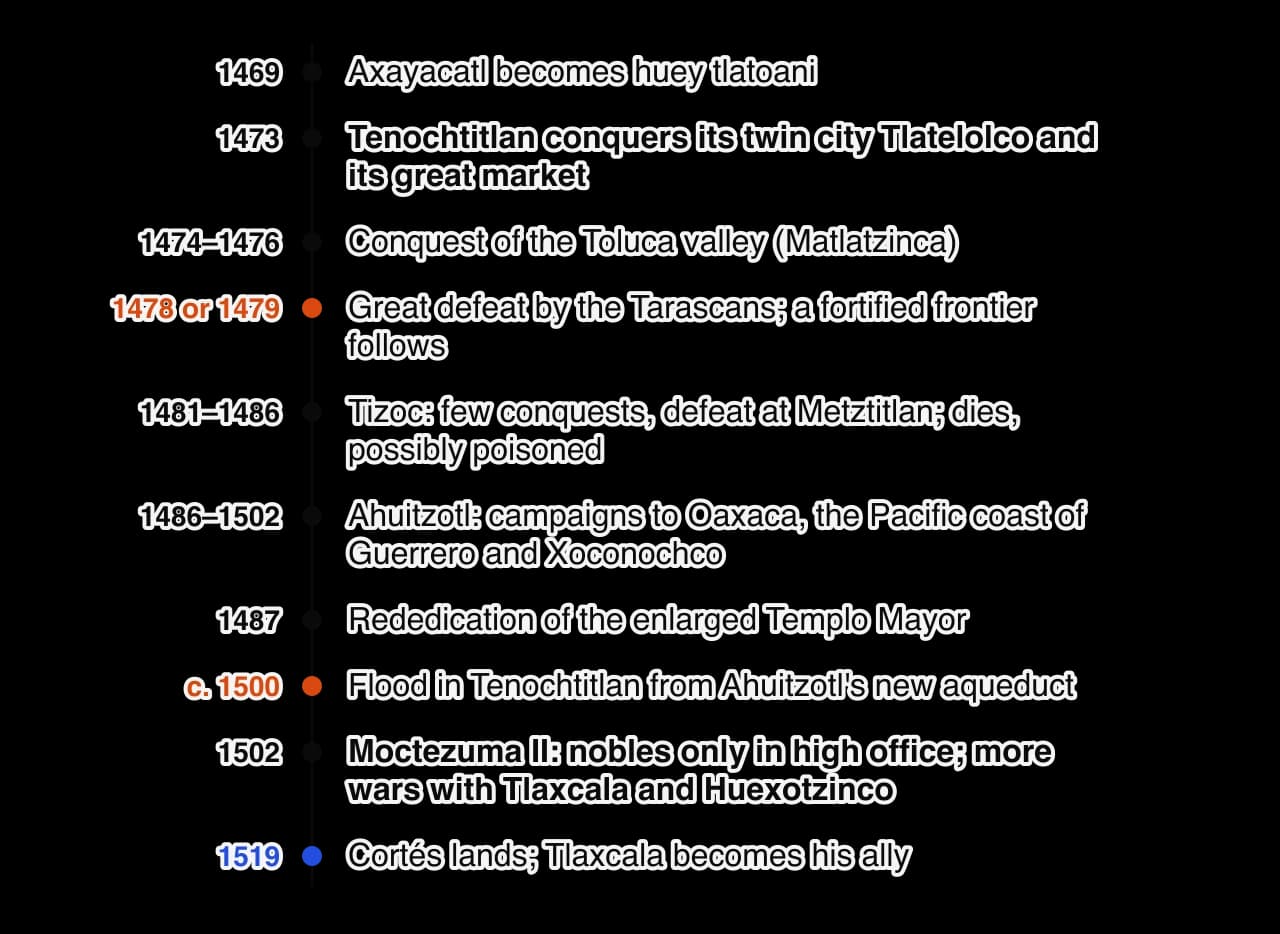
The rulers after 1469 tightened Tenochtitlan's grip in several ways. In 1473 Axayacatl conquered Tlatelolco, the twin city on the same island and home of the greatest market of the region, killed its ruler Moquihuix, and placed it under military governors instead of a tlatoani. Tenochtitlan also came to dominate its allies, increasingly influencing the choice of rulers in Texcoco itself.
Moctezuma II (r. 1502–1520) went furthest. According to the friar Diego Durán, whose history drew on a Mexica chronicle, he dismissed officials of commoner origin who had served his predecessor Ahuitzotl and allowed only nobles to hold high office or serve in the palace. Historians debate whether this was an attempt to build a more centralised state or simply the self-glorification of a ruler; either way it narrowed the routes by which ambitious commoners could rise, and it relied on the loyalty of a smaller noble elite.
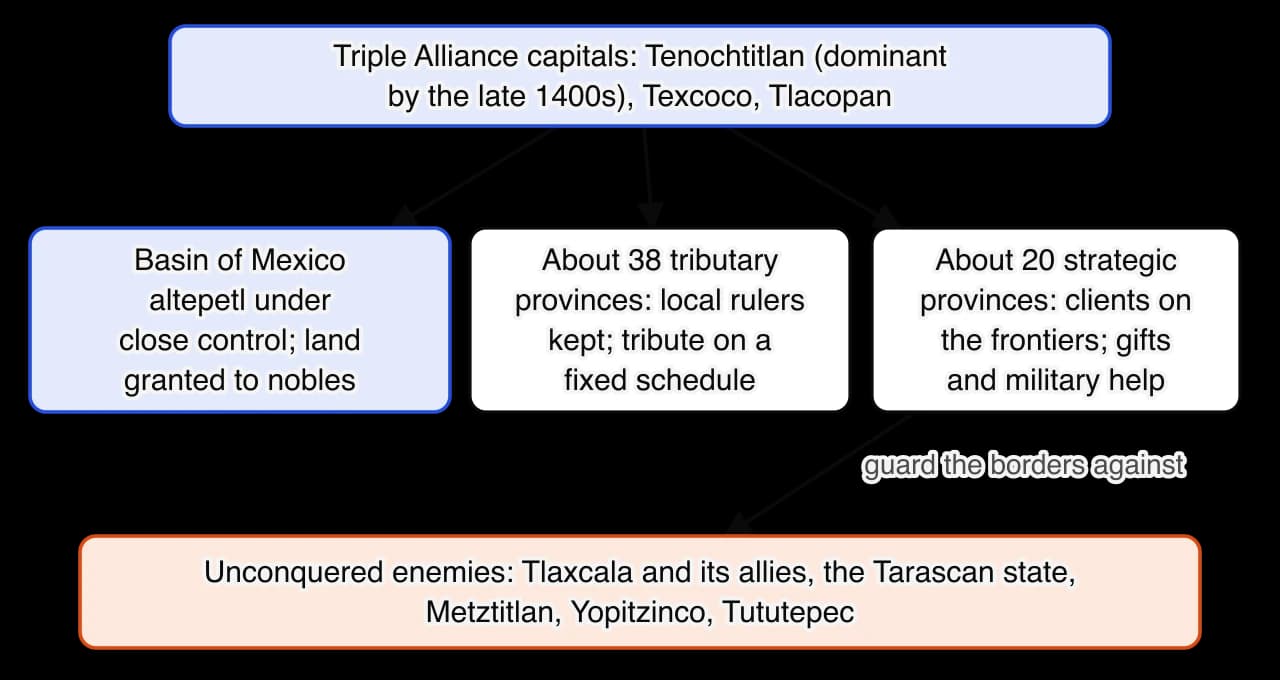
The diagram of the empire's zones shows why the bargain was fragile. Large parts of the empire paid tribute only because the alliance looked unbeatable. When a huey tlatoani died, subject towns often stopped paying and had to be reconquered; each new ruler's first campaign, often against rebels, also supplied captives for his coronation.
The Inca: the son of the Sun and the kurakas
The Inca state was far more centralised than the Aztec Empire. At its head was the Sapa Inca, regarded as the son of the Sun god Inti and a sacred being whose body, clothing and even leftovers were treated with reverence. His principal wife, the Coya, was usually his full sister, which set the ruling family apart from all others. Around him stood the royal lineages of Cuzco, the panaqas, each descended from an earlier ruler.
The panaqas show how religion and politics were fused. When a Sapa Inca died, his mummified body was kept in his palace, served by his lineage, consulted as an oracle and carried to festivals. Under the custom of split inheritance, his palaces, estates and servants stayed with his mummy and his lineage. The new ruler inherited the office and the state, but not his father's private wealth, so he had to acquire new lands and labour of his own. The archaeologists Geoffrey Conrad and Arthur Demarest argued in Religion and Empire (1984) that this custom was a powerful motor of Inca expansion. The lineages were also political factions whose rivalries shaped every succession.
Governing the provinces
Tawantinsuyu was divided into four quarters (suyu), each under an apu, usually a close relative of the ruler. The quarters were divided into about 80 provinces, each with an Inca governor based at a new provincial centre, such as Huánuco Pampa in the central highlands. Below the governors, the state used local lords, the kurakas, to run the population.
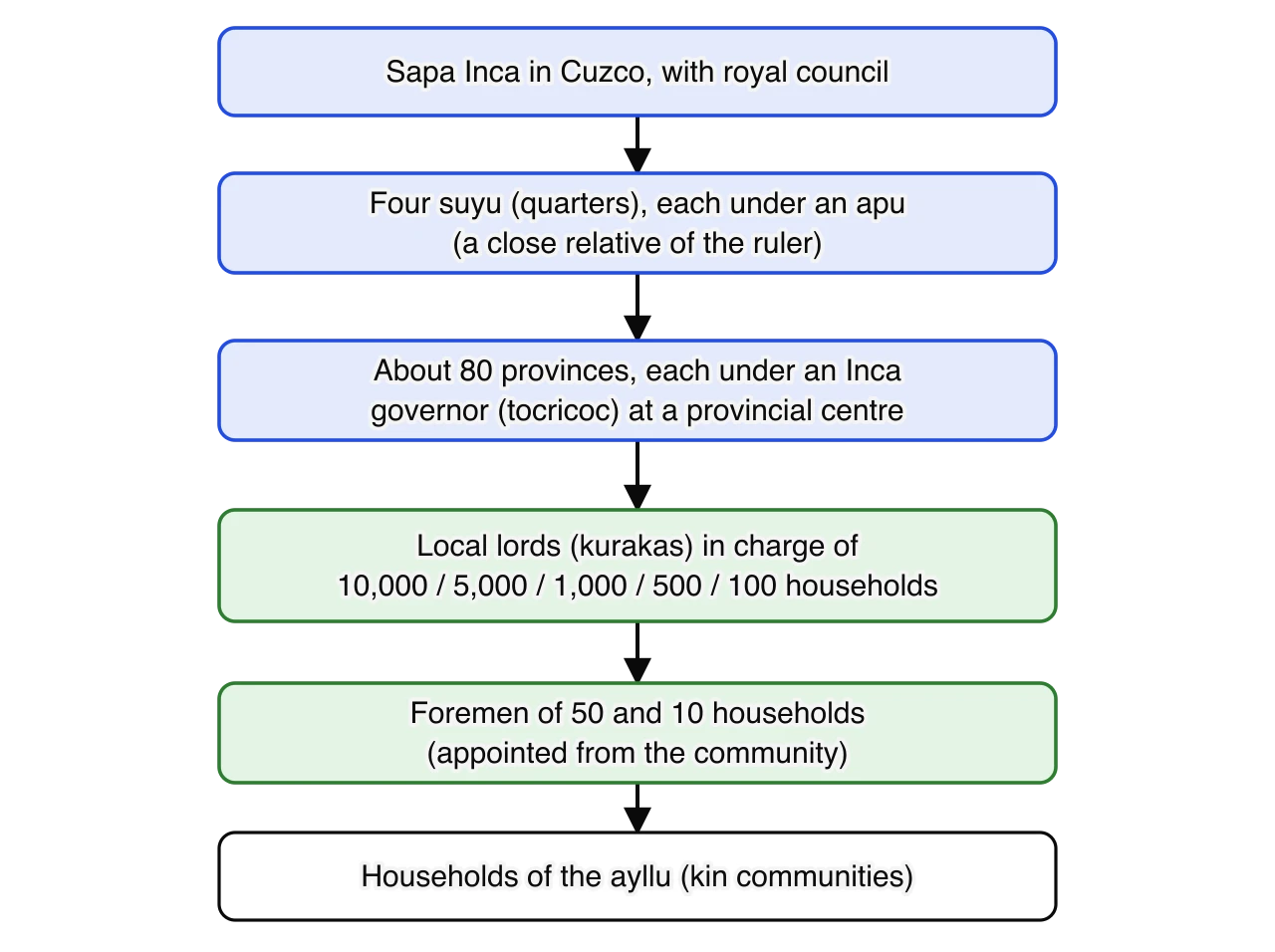
Spanish and mestizo writers described the population as organised in units of ten, as the diagram of Inca administration shows. The Inca Garcilaso de la Vega, son of a Spanish captain and an Inca noblewoman, described it in his history of 1609.
As the fundamental principle of their government, the Yncas ordained a law by which it seemed to them that they would prevent all the evils that might have a tendency to arise in their empire. They ordered that, in all the towns of their dominions, both large and small, the inhabitants should be registered by decades of ten, and that one of these should be selected as a decurión, to have charge over the other nine.
Inca Garcilaso de la Vega, Royal Commentaries of the Incas, Book II, chapter 11, 1609 (trans. Clements Markham, Hakluyt Society, 1869). Garcilaso left Peru at the age of twenty and wrote in Spain half a century later, partly to present his mother's people as a civilised nation comparable to ancient Rome; his use of the Roman word "decurion" shows this purpose. Archaeologists and historians accept that the Incas counted households in decimal units for labour service, but think the system was applied unevenly and that Garcilaso idealised its order.
The records of this system were kept on khipus, cords with knotted strings whose colours, positions and types of knot recorded numbers and categories. Specialists, the khipukamayuq, kept the accounts at every level.
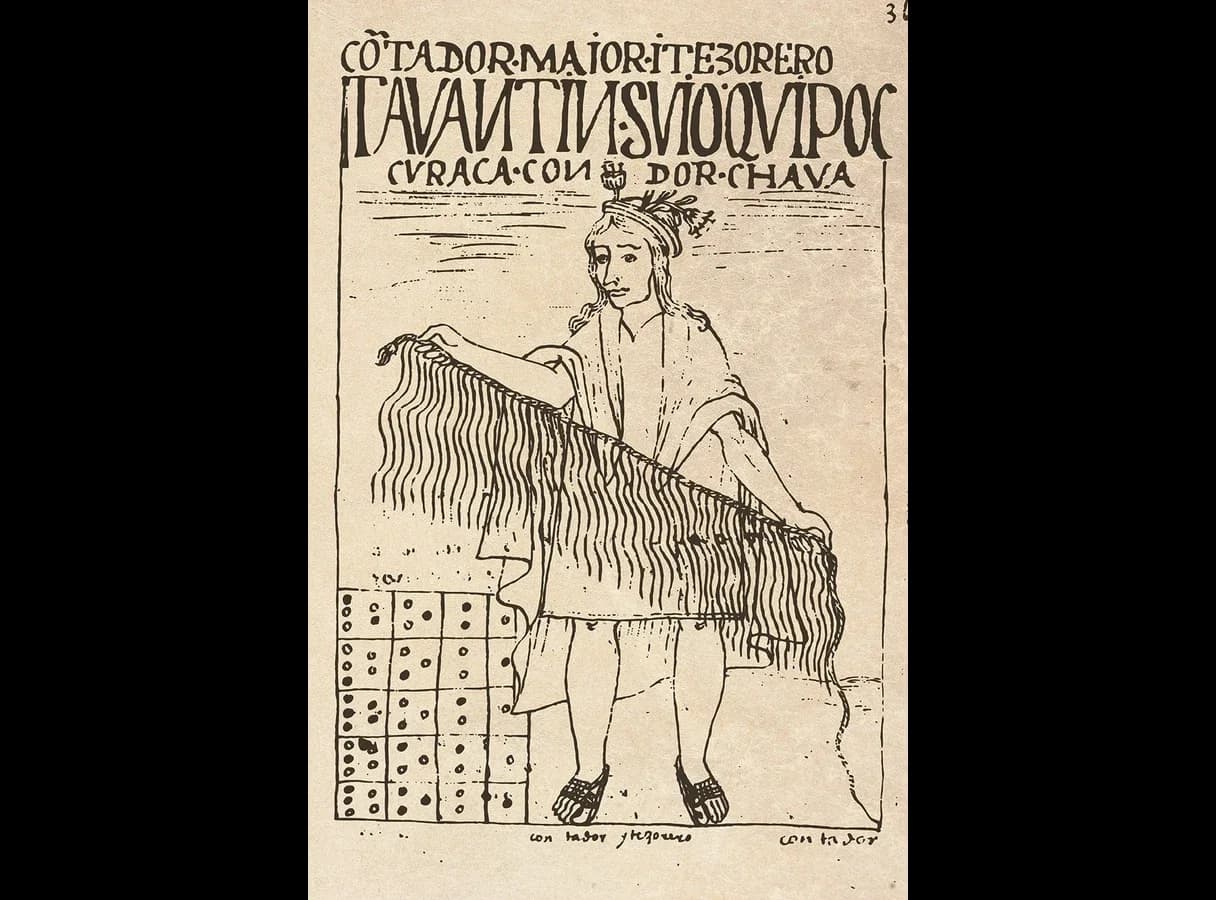
The bargain with the kurakas
Kurakas kept their positions and much of their status. The larger ones received gifts of fine cloth, wives from the Sapa Inca, servants and lands; some were given the status of "Incas by privilege". In return they organised their people's labour service, kept order and passed on the state's demands. The Incas also took securities for their loyalty. The sons of kurakas were brought to Cuzco to be educated in Inca ways, and the sacred objects (huacas) of conquered peoples were taken to Cuzco, where they were honoured but also held as hostages.
Behind the gifts lay the threat of force. Rebels were punished harshly, and whole communities could be moved. Under the policy of mitma (mitmaqkuna, "people moved out"), the state resettled families from loyal regions into newly conquered or rebellious ones, and moved troublesome peoples to safe regions far from home. Huayna Capac emptied much of the fertile Cochabamba valley in modern Bolivia of its original inhabitants and brought in thousands of workers from across the empire to grow maize for the state. Resettlement broke up local loyalties and put reliable subjects where they were needed.
Communications held the system together. The road network, the Qhapaq Ñan, ran for roughly 30,000 to 40,000 km through mountains, deserts and forests, with rest houses (tambos) and storehouses about a day's walk apart. Relay runners, the chaskis, carried messages and khipus between stations; modern estimates suggest that a message could travel more than 200 km in a day.
 YouTube
Legitimising power: religion and warfare
Religion and warfare were the two great sources of legitimacy for rulers across the Americas, and they were closely linked. Victory showed that the gods favoured a ruler, and offerings, including captives, kept the cosmos in order. The table compares how the three states joined the two.
Society | Religious basis of authority | Role of warfare |
|---|---|---|
Maya (Classic) | The king as k'uhul ajaw, descended from deified ancestors; royal bloodletting and temple dedications | Capture of rival kings and nobles, recorded on monuments and sometimes followed by their sacrifice; victories proved divine favour |
Mexica | The huey tlatoani as servant of Huitzilopochtli and Tlaloc; temple building and great sacrifices at the Templo Mayor | Each new ruler fought a coronation war to take captives; warriors' rank came from captives taken; expansion presented as a divine mission |
Inca | The Sapa Inca as son of the Sun; the cult of royal mummies; the state shrine of the Coricancha in Cuzco | Conquest presented as spreading the order of the Sun; victories celebrated in Cuzco with captured idols and enemies' weapons |
In the non-state societies, authority rested more on persuasion and kinship. A Haudenosaunee sachem or a Guaraní chief led because he was respected, generous and a good speaker, and could be replaced if he failed. Religion still mattered: Guaraní shamans (karaí) could outweigh chiefs in influence.
Administration, codes of conduct and law
None of these societies had a written law code in the European sense, but all had clear rules, enforced by officials, councils or kin. Mexica and Texcocan law, associated with Nezahualcoyotl of Texcoco and the sumptuary laws of Moctezuma I, set out punishments for theft, adultery and drunkenness and fixed what each rank could wear. Judges sat in courts in Tenochtitlan and Texcoco, with appeals to higher courts and to the ruler. Moral codes were taught through the huehuetlatolli, formal "speeches of the elders" on duty and modesty, and in schools: noble boys trained for office and the priesthood in the calmecac, commoner boys for war in the telpochcalli of their calpulli.
Inca law was severe. Spanish accounts describe death for rebellion, for entering the houses of the chosen women and for serious theft from the state, with lesser punishments such as stoning or public shaming for other offences. Kurakas judged minor cases and Inca officials serious ones.
Among the Haudenosaunee the basic rules of political life were set out in the Great Law of Peace, the Gayanashagowa, recited at council and passed down orally. It fixed the number of sachems from each nation, the procedure of the council and the duties of leaders, and it gave women the power to remove a chief who failed his people.
Alliances among different communities
Alliances were as important as conquest. The Triple Alliance itself began as a partnership of three cities. Its great enemy Tlaxcala was a confederation of four altepetl (Tepeticpac, Ocotelulco, Tizatlan and Quiahuiztlan), whose rulers decided matters of war and peace together. Shifting alliances with Huexotzinco and Cholula helped it survive decades of war with the Mexica.
The Haudenosaunee League of Peace
The most famous alliance in North America was the League of the Haudenosaunee, which joined five nations: the Mohawk, Oneida, Onondaga, Cayuga and Seneca. Haudenosaunee tradition tells that the League was created after a time of blood feuds by the Peacemaker (Deganawidah), a Huron-born prophet, and his follower Hiawatha, an Onondaga or Mohawk leader, who persuaded the nations to accept the Great Law and won over the fierce Onondaga chief Tadodaho. The date of the founding is disputed, from the twelfth century to the sixteenth.
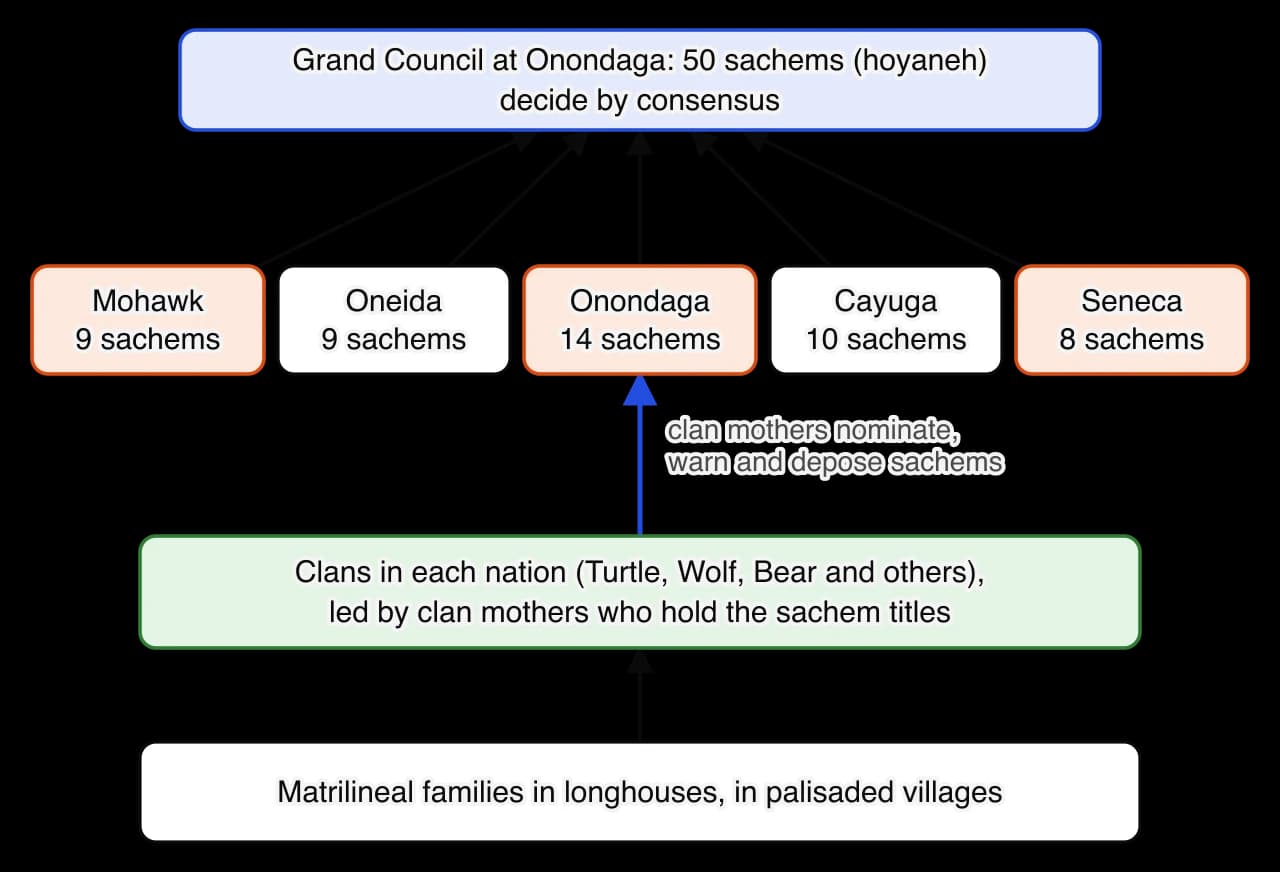
The Grand Council met at Onondaga, the central nation, whose chiefs were the "firekeepers". The council worked by consensus: matters passed between the elder and younger brother nations and back until all agreed, so no nation could be outvoted. The League settled disputes by ritual and gifts, above all through the Condolence ceremony, in which the council mourned dead chiefs and raised up their successors. It was not a single government: each nation kept its own council and could make war on outsiders. The written Great Law records the power of the people, above all the women, to correct their chiefs.
If at any time it shall be manifest that a Confederate Lord has not in mind the welfare of the people or disobeys the rules of this Great Law, the men or the women of the Confederacy, or both jointly, shall come to the Council and upbraid the erring Lord through his War Chief. If the complaint of the people through the War Chief is not heeded the first time it shall be uttered again and then if no attention is given a third complaint and warning shall be given.
Article 19 of the Great Law, in Arthur C. Parker (ed.), The Constitution of the Five Nations, or the Iroquois Book of the Great Law, 1916. The text was compiled around 1900 from versions dictated by Haudenosaunee leaders, notably Seth Newhouse, and set out in numbered articles like a European constitution: a late record of a long oral tradition, shaped for outside readers. It is strong evidence of how the Haudenosaunee themselves understood their government and less certain evidence of how it worked before 1500.
 YouTube
Alliances without states: the Mapuche
The Mapuche show how a people without a state could act together. The basic unit was the lof, a patrilineal kin group under a lonko (head). Several lof shared a religious centre (rewe), and groups of rewe could join in larger alliances for ceremonies and war. In war, assemblies chose a war leader, the toki, whose authority lasted only for the campaign. This structure, known from Spanish sources after 1540, let the Mapuche gather large forces quickly and disperse again, leaving no centre to capture.
Society | Centre | Local leaders | What locals gained | What the centre gained | Weak points |
|---|---|---|---|---|---|
Maya overkingdoms | Overking (Tikal, Calakmul) | Vassal kings (y-ajaw) | Protection, prestige, marriage ties | Tribute, allies in war | Networks collapsed after a defeat |
Aztec Empire | Huey tlatoani of Tenochtitlan | Tlatoque of subject altepetl | Kept titles and lands; gifts; royal marriages; military help | Tribute and labour at low cost | Loyalty only while the alliance looked strong; revolts at each succession |
Inca Empire | Sapa Inca and Inca governors | Kurakas | Status, cloth, wives, land; "Incas by privilege" | Labour service, soldiers, order | Rested on royal prestige; split by a disputed succession |
Haudenosaunee League | Grand Council (no single ruler) | Sachems chosen by clan mothers | Peace among the nations; a voice in council | Joint decisions; security | Each nation could act alone; consensus slow |
Establishment and maintenance of economic structures
Every economy in the study rested on farming, above all of maize, which had spread from Mexico to the Great Lakes and Chile. What differed was who controlled land and labour, and how goods moved. Three features set the Americas apart from Afro-Eurasia: there were no large draught animals except the llama in the Andes, no iron tools, and no wheeled transport. Everything that travelled overland went on human backs or, in the Andes, on llamas, which made bulk food expensive to move and shaped every economic system.
Extent and limits of sedentary organisation
Most people in the Americas in 1500 were farmers, but not all farmers were fully settled. The degree of sedentism depended on the crops, the soil and the climate, and it shaped the size and power of political units.
Way of life | Examples, c. 750–1500 | How people made a living | Political organisation |
|---|---|---|---|
Non-sedentary (mobile) | Peoples of the Great Plains and Great Basin of North America; Patagonia; parts of the Gran Chaco | Hunting, fishing, gathering; seasonal moves | Bands of related families; leaders by consent |
Semi-sedentary | Haudenosaunee; Guaraní; most Mapuche | Farming with villages moved every 10–20 years (Haudenosaunee) or every few years (Guaraní); also hunting, fishing, herding | Villages, clans and lineages; confederations or temporary alliances |
Sedentary with towns and chiefdoms | Cahokia and other Mississippian centres; Ancestral Puebloans; Taíno of the Caribbean | Intensive maize farming; trade; storage | Chiefdoms under hereditary leaders; mound or great-house centres |
Sedentary with cities and states | Maya; Mexica and their neighbours; Inca and Chimú | Intensive farming with raised fields, terraces and irrigation; tribute; markets (Mesoamerica) or state storehouses (Andes) | City-states and empires with kings, nobles and officials |
The categories were not fixed. Even in the Maya lowlands, most farmers practised swidden agriculture, clearing a plot of forest by cutting and burning, planting maize, beans and squash together in a field called a milpa, and leaving it to recover after a few years. Permanent cities stood among shifting fields. The Haudenosaunee lived in permanent-looking palisaded villages of several hundred to two thousand people, but moved them every one or two decades as the soil and the nearby firewood were used up.
Sedentary life had limits. Without draught animals or wheels, a city could feed itself only from nearby fields or by water, which is why the largest cities stood beside lakes (Tenochtitlan) or among dense intensive fields (the Maya). Societies on poorer land stayed smaller and more mobile, which gave them flexibility but made states harder to build.
Landholding
In none of these societies did land belong to individuals as private property in the modern sense. It was held by kin groups, by rulers or by the gods, and people gained the right to farm it through membership of a community.
Mesoamerica
Among the Mexica and their neighbours, most land belonged to the calpulli, a ward or kin-based community. Its leaders allocated plots to member households, who could farm them as long as they used them; a family that left its land uncultivated for two years could lose it. Alongside calpulli land there were lands attached to offices and institutions: palace lands (tecpantlalli) that supported the ruler's household, temple lands, and lands whose produce fed the army (milchimalli). After 1428 conquered land was also granted to nobles as private estates worked by dependent tenants, which created a growing class of landless labourers.
The Andes
In the Inca state all land belonged in principle to the ruler. In each province it was divided into three parts: land for the state, land for the Sun and other gods, and land left to the community, the ayllu. The ayllu redistributed its land among households according to their size, and households farmed it for themselves. The state and religious lands were farmed by the community's labour, and their harvests went into storehouses. Rulers also held private royal estates, such as Machu Picchu.
Non-state societies
Among the Haudenosaunee, land was held by the clans and worked by the women, who controlled the fields and the stored harvest. Mapuche and Guaraní land was likewise held by lineages and villages; no outside ruler took a share.
Agricultural production and irrigation control
Region | Main crops | Key techniques | Who controlled them |
|---|---|---|---|
Maya lowlands | Maize, beans, squash, chilli, cacao, cotton | Milpa swidden; raised and drained fields in wetlands; terraces on hillsides; large reservoirs for the dry season at cities such as Tikal | Households and lineages; reservoirs built and managed by city rulers |
Basin of Mexico | Maize, beans, squash, amaranth, chilli | Chinampas (raised fields in shallow lakes); dikes and canals; terraces | Calpulli and nobles; the great hydraulic works by the Triple Alliance rulers |
Andes | Potatoes, quinoa, maize, beans; llamas and alpacas | Terraces (andenes); irrigation canals; freeze-drying of potatoes (chuño); fields at many altitudes | Ayllu for local works; the Inca state for large terraces and canals |
North coast of Peru (Chimú) | Maize, beans, cotton, squash | Long irrigation canals linking river valleys across the desert | The Chimú state, then the Inca after c. 1470 |
North-eastern woodlands (Haudenosaunee) | Maize, beans, squash ("Three Sisters") | Mounded fields; crops planted together | Women of the clans |
Paraguay and southern Brazil (Guaraní) | Manioc, maize, sweet potatoes, beans | Swidden in forest clearings; hunting and fishing | Extended families within the village |
The chinampa fields of the Basin of Mexico, and the dike and aqueducts that protected them, are studied in depth in the focused study of the Aztec Empire. The Andes show a different response to a harder environment. Inca farmers worked fields from the warm valleys below 2,500 metres, where maize grew, to the high grasslands above 4,000 metres, where only potatoes, quinoa and herds survived. Terraces turned steep slopes into irrigated fields. Freeze-drying potatoes into chuño in the cold nights of the dry season produced food that kept for years.
Control of irrigation was a source of power. On the desert coast of Peru, where no crops grew without canals, the Chimú state built canals that ran for tens of kilometres between valleys. When the Incas conquered Chimú around 1470 they took over these works. In the Maya lowlands, large reservoirs in the centre of cities such as Tikal gave rulers control of drinking water in the dry season, one of the bases of their authority, and made them vulnerable when droughts emptied the reservoirs.
The role of tribute
Tribute, the regular payment of goods or labour by subjects to rulers, was the main way states in the Americas paid for their rulers, nobles, temples and armies. The form of tribute differed sharply between Mesoamerica and the Andes.
Tribute in goods: the Aztec Empire
The tribute lists of the Codex Mendoza show the Aztec Empire's provinces paying goods on fixed schedules, some every eighty days, some twice a year, some once a year. The commonest item was cotton cloth, paid in standard lengths called mantas, followed by warriors' costumes and shields, maize, beans and other foodstuffs, and from the warm lands cacao, feathers, jade, gold, rubber and copal incense. Each province paid in what it produced, so tribute brought to the Basin of Mexico the goods of every climate in the empire. Subject towns also owed labour for building projects and soldiers for campaigns.
Tribute also had political functions. The ruler redistributed much of it as gifts to nobles, warriors and allies, binding them to him, and payment was a public sign of submission, which is why rebellion began by stopping it.
Tribute in labour: the Inca
The Inca state demanded labour rather than goods. Under the mit'a, every household owed turns of work: farming the state and Sun lands, herding state llamas, weaving cloth, building roads and terraces, carrying loads and serving in the army. Households kept the produce of their own land; what the state took was their time. This was tribute in a society without money.
Aztec Empire | Inca Empire | |
|---|---|---|
Main form of tribute | Goods: cloth, food, costumes, luxury goods | Labour: turns of work (mit'a) |
How it was recorded | Painted tribute lists (later copied in the Codex Mendoza) | Khipus kept by khipukamayuq |
Who collected it | Mexica stewards (calpixque) in subject towns | Kurakas organised labour; Inca officials supervised |
Where it went | The three capitals; redistributed to nobles, warriors, allies | State and religious storehouses; redistributed to army, officials, workers |
Effect on subjects | Heavy demands on cloth-producing households; resentment | Large demands on time; feasts and stores returned part of it |
Among the Maya, rulers also received tribute, but the evidence is scattered. Classic painted pottery shows cloth and cacao laid before kings. In Yucatán at the time of contact, towns paid their lords in cotton cloth, maize, turkeys, honey and wax.
Reciprocity, trade networks and the role of marketplaces
Reciprocity and redistribution in the Andes
The Andean economy rested on reciprocity. Within an ayllu, households helped one another with farming and building under the principle of ayni, labour given and later returned in kind; work for the whole community, such as cleaning canals, was done together as mink'a. The Inca state presented its own demands in the same language. When people worked the state's fields, the state fed them and provided maize beer (chicha) and music, as a host feeds guests, so that labour service appeared as an exchange of generosity, not a tax. The historian John Murra described this as an economy of reciprocity and redistribution, in which goods moved by obligation and command, not through markets.
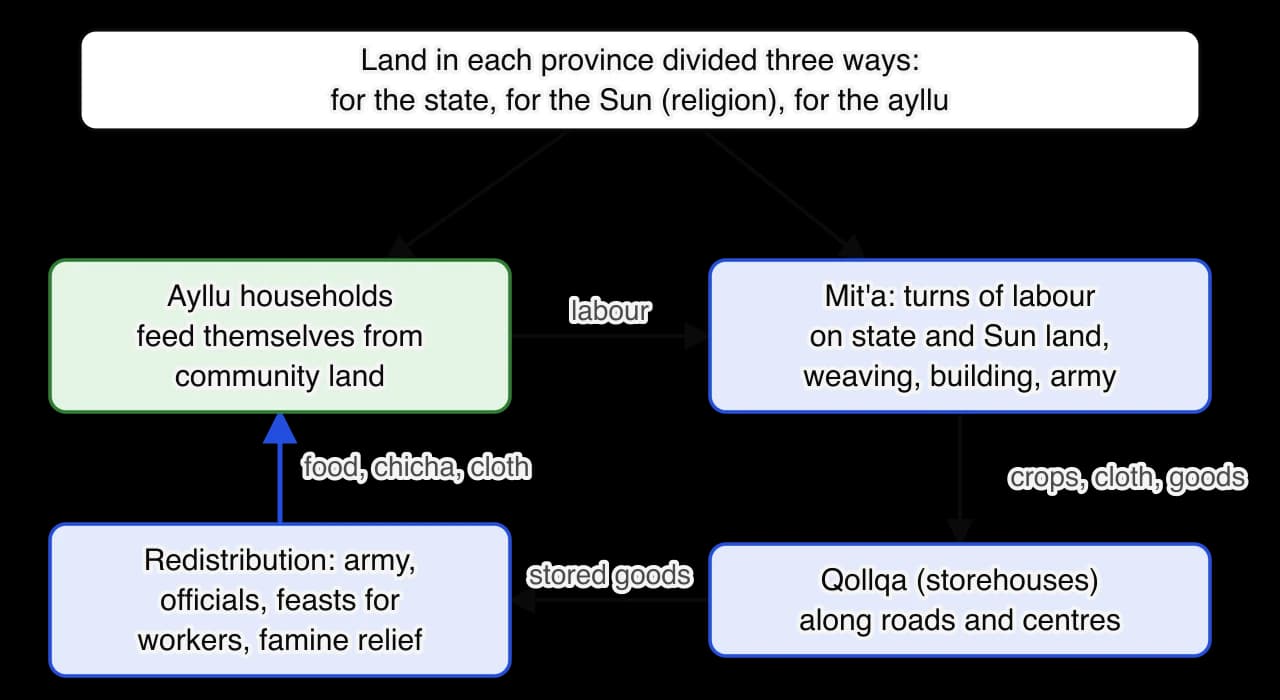
The economy diagram shows the role of the storehouses, the qollqa. Rows of small stone buildings on dry, windy hillsides kept dried potatoes, maize, quinoa, dried meat, cloth, weapons and tools. The scale of storage is shown by the number of storehouses recorded by archaeologists.
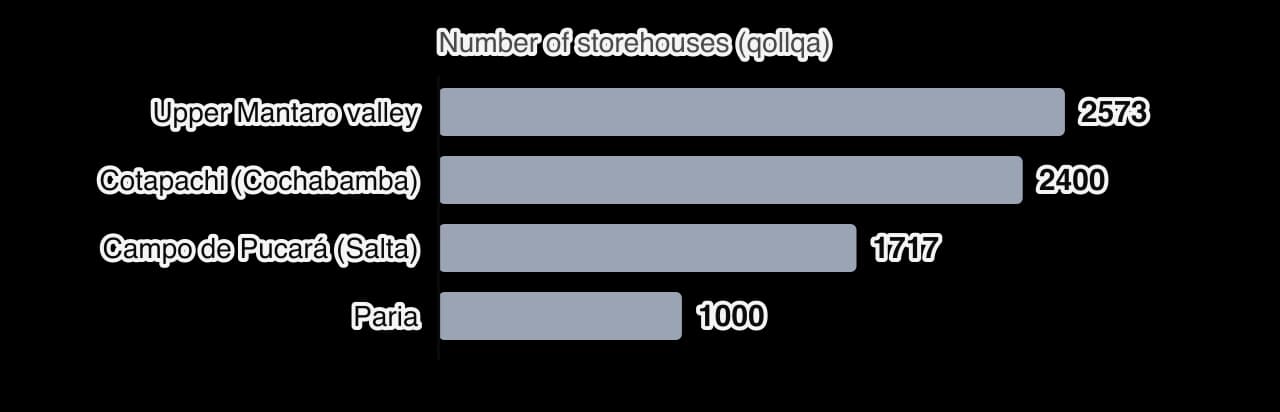
The Spanish soldier Pedro de Cieza de León, who travelled through the Andes between 1547 and 1550, saw many storehouses still standing.
In some parts of this book I have alluded to the great power of the Kings Yncas of Peru, and to their surpassing valour, and how, along a distance of more than one thousand two hundred leagues of coast which was under their rule, they appointed their delegates and governors, and formed many deposits full of all things necessary for their troops. In some of these depots there were lances, in others darts, and in others sandals, and so on with other arms and articles of clothing which these people use, besides stores of food.
Pedro de Cieza de León, Chronicle of Peru, Part 1, chapter 44, 1553 (trans. Clements Markham, Hakluyt Society, 1864). Cieza arrived after the conquest and the civil wars among the Spanish, when many stores had already been looted, so he relied on what he saw of the remaining buildings and on what Andean lords told him. His emphasis on supplies for troops is supported by archaeology and shows how closely the storage system was tied to military power.
Markets were not absent from the Andes. Barter took place at local gatherings, and on the coast the merchants of the Chincha valley traded along the Pacific shore by raft. But in the Inca heartland the great flows of goods passed through the state, not through markets, and there was no general currency.
Markets and merchants in Mesoamerica
Mesoamerica had a commercial economy alongside tribute. Every town of any size held a regular market, often every five days, and the largest, at Tlatelolco, drew tens of thousands of people. Cacao beans served as small change and standard lengths of cotton cloth (quachtli) as larger units of value, so prices could be set and goods exchanged far beyond barter. Long-distance merchants, the pochteca, carried luxury goods to the frontiers and beyond. The archaeologist Michael E. Smith has argued that markets and household production made the Aztec economy far more commercial than older accounts, focused on tribute, suggested.
The Maya were great traders by sea. Large dugout canoes carried salt, cotton cloth, cacao, obsidian, jade and copper around the coast of Yucatán, linking ports from the Gulf of Mexico to Honduras. On his fourth voyage in 1502, Christopher Columbus met such a canoe near the Bay Islands of Honduras, loaded with cotton cloth, copper goods and cacao beans and paddled by some two dozen men.
Societies without markets still traded over long distances: Cahokia drew copper from the Great Lakes and shells from the Gulf of Mexico, and Haudenosaunee villages exchanged goods with neighbours through gift-giving and diplomacy.
Establishment and maintenance of social organisation
In all these societies the basic building block of social organisation was the kin group, larger than the household, which held land, organised work and worship, and gave people their identity. On top of these kin groups the states built hierarchies of rank; the non-state societies kept authority within the kin groups themselves.
Social hierarchies
The three states had steep hierarchies, with a hereditary nobility exempt from labour tribute at the top and commoners who farmed, paid tribute and fought below. The Mexica social groups, and the route upwards through capturing prisoners, are set out in the focused study of the Aztec Empire; the table compares the three states.
Level | Maya (Classic) | Mexica | Inca |
|---|---|---|---|
Ruler | K'uhul ajaw (holy lord) | Huey tlatoani | Sapa Inca, with the Coya |
High nobility | Royal family; regional lords (sajal); scribes and priests | Pipiltin: royal lineage, office-holders, priests | Royal lineages of Cuzco (panaqas); "Incas by privilege" |
Local elites | Lesser nobles of towns and lineages | Rulers of subject altepetl; calpulli heads | Kurakas |
Specialists | Painters, carvers, scribes, traders | Pochteca merchants; featherworkers, goldsmiths | Weavers, metalworkers, khipukamayuq, aqllakuna |
Commoners | Farming families | Macehualtin in calpulli | Hatun runa in ayllu |
Dependent and unfree | Slaves from war and debt | Mayeque (tenants); tlacotin (slaves) | Yanakuna (hereditary retainers) |
Rank in the Inca state
Inca society was divided first between the Incas and everyone else. The royal Incas of Cuzco, recognisable by the large ear spools that led the Spanish to call them orejones ("big ears"), filled the highest offices. Below them came the "Incas by privilege" from around Cuzco, then the kurakas, ranked by the households they controlled. Most people were hatun runa, adult married men and their households in the ayllu, who owed mit'a labour.
Two groups stood outside the ayllu system and were directly dependent on the state or nobility. The yanakuna were men and their families removed from their communities to serve the ruler, nobles or temples permanently; some rose high, but they had lost the protection of their ayllu. The aqllakuna ("chosen women") were girls selected from the provinces and housed in special enclosures (aqllawasi) in provincial centres, where they wove the finest cloth and brewed chicha for state ceremonies. Some served the Sun as priestesses, some were given by the ruler as wives to nobles and loyal kurakas, and a few were sacrificed.
Social mobility was limited in the Andes. A commoner could not become an Inca, and the descendants of a kuraka inherited his office. In Mexica society, by contrast, a commoner could rise through success in war, at least until Moctezuma II reserved high offices for nobles.
Gender roles
Descriptions of gender roles come mostly from men, and mostly from Spaniards who expected women to be subordinate. Taken together, the evidence shows complementary roles in which women held real power in some areas, alongside clear inequalities.
Mesoamerica
Among the Mexica, women were responsible for the household, cooking and above all weaving, which produced the cloth that families paid in tribute and sold in markets. The Codex Mendoza shows girls being taught to spin and weave by their mothers from the age of four. Women also worked as market traders, healers, midwives and priestesses, could own property, bring cases before judges and seek divorce. In Mexica thought childbirth was a woman's battle: a woman who died giving birth was honoured like a warrior killed in war and was believed to accompany the sun across the sky. Politically, though, women were excluded from office, and royal women mattered above all as links in marriage alliances between dynasties.
Maya inscriptions show that royal women could hold great power. Lady Six Sky, a princess from Dos Pilas, came to the city of Naranjo in 682 to restore its ruling dynasty and governed in the name of her young son, carrying out war and rituals in her own right. At Yaxchilan, carved lintels of the early eighth century show Lady K'abal Xook, a wife of the king, performing the bloodletting rituals that called up royal ancestors. These were exceptional royal women.
The Andes
Andean societies followed a principle of parallel descent: women inherited rights and property from their mothers, men from their fathers. Men and women were complementary halves of a household: men ploughed and fought, women planted and wove. Cloth was the most valued good in the Andes, given as gifts, offered to the gods and burned in sacrifice, and the finest cloth (qompi) was made by aqllakuna and specialist men.
The Coya, the principal wife of the Sapa Inca, had her own lands, servants and religious duties, centred on the cult of the Moon. Royal women of the panaqas played a large part in choosing a successor. The state also used women and girls as political resources: aqllakuna were given as wives to bind kurakas to the ruler, and some girls were offered in capacocha, the sacrifice of children on mountain summits in times of crisis or at great state ceremonies. The frozen bodies of three children found near the summit of Llullaillaco in Argentina in 1999, dated to around 1500, are the best-known evidence.
The Haudenosaunee
Women held more political power among the Haudenosaunee than in any other society of the study. Descent and clan membership passed through women, and the households of a longhouse were usually led by the senior woman of the lineage. Women owned and farmed the fields and controlled the food stores. The clan mothers chose the sachems from among the men of their lineage, could warn and remove them, and decided whether war captives should be adopted. The Great Law states the principle directly.
The lineal descent of the people of the Five Nations shall run in the female line. Women shall be considered the progenitors of the Nation. They shall own the land and the soil. Men and women shall follow the status of the mother.
Article 44 of the Great Law, in Arthur C. Parker (ed.), The Constitution of the Five Nations, 1916. As with the other articles, this text was recorded more than three centuries after the period, in a form shaped for outside readers. Its account of women's rights is supported by seventeenth-century French Jesuit and Dutch descriptions of Haudenosaunee life, which shows that the principle long predates the written version.
Among the Mapuche and Guaraní, women did most of the farming, cooking and weaving, while men cleared land, hunted and fought; leading men had several wives, which increased their household's labour and influence. Mapuche women also served as machi, healers and religious specialists.
Family structure and kinship
Society | Kin group | Descent | What the kin group did |
|---|---|---|---|
Mexica | Calpulli (ward or kin community) | Mainly through the father, with links through both parents | Held and allocated land; ran a temple and a school (telpochcalli); sent men to war as a unit; paid tribute |
Inca | Ayllu (community claiming a common ancestor) | Parallel: women through women, men through men | Held and redistributed land; organised reciprocal labour (ayni, mink'a); worshipped its ancestors and huacas |
Maya | Patrilineal lineages within towns | Through the father; names also passed through the mother | Held land and orchards; noble lineages provided rulers and council members (Mayapán) |
Haudenosaunee | Matrilineal clans and lineages in longhouses | Through the mother | Held fields; chose sachems; adopted captives; regulated marriage (no marriage within the clan) |
Mapuche | Lof (patrilineal lineage group) | Through the father | Held land and pastures; acted together in ceremonies, feasts and war |
Guaraní | Extended family in a large communal house | Mainly through the father | Farmed and hunted together; several houses formed a village under a chief |
The ayllu deserves particular attention because it survived the Incas, the Spanish and the republics that followed, and still exists in the Andes. Its members claimed a common ancestor, often a mummy or sacred place, and usually married within it. The Inca state did not create the ayllu; it used it, by counting ayllu households for labour service and by presenting the state as a great ayllu with the Sapa Inca as its head.
A Haudenosaunee longhouse was a long building of poles and elm bark, from about 20 to over 60 metres long, with a central corridor of hearths each shared by two families. All the families of a longhouse belonged to one matrilineage. When a man married, he moved into his wife's longhouse, and his children belonged to her clan.
Organisation of tribes and clans
In the non-state societies, clans and tribes did the work that officials did in the states. Each Haudenosaunee nation was divided into clans named after animals, such as Turtle, Wolf and Bear (the Mohawk and Oneida had these three; the Seneca had eight). Clan membership crossed national boundaries, so a Wolf clan Mohawk regarded a Wolf clan Seneca as a relative. This web of kinship across the five nations helped hold the League together.
Mapuche society was built from lineage groups (lof) that were independent in everyday matters and joined in larger groupings for religious ceremonies and war. Guaraní villages of several large family houses chose a chief for his generosity, oratory and success in war. In both, leaders were obeyed only while they kept their kin's support.
Construction of identities
The Mexica told a story of themselves as a chosen people, led from Aztlan by their god Huitzilopochtli to found Tenochtitlan where an eagle perched on a cactus. The identity of other Nahua peoples remained local: a Tlaxcalan or a Chalcan identified with his own altepetl and its patron god, and Mexica rule did not change that. When Cortés arrived, many of these peoples saw the Mexica as foreign overlords.
The Incas tried harder to create a shared identity among their subjects, while keeping them distinct. They spread Quechua (runa simi, "the people's language") as the language of government, made local lords learn it, and carried the cult of the Sun to every province. At the same time they ordered each people to keep its own distinctive dress and headgear, so that a person's origin could be seen at a glance. Inca identity itself rested on an origin story in which the first Inca, Manco Capac, emerged from Lake Titicaca or a cave near Cuzco as a child of the Sun.
Maya identity was rooted in the city and its dynasty. Classic kings used emblem glyphs that named their kingdom, and inscriptions recorded the gods and ancestors of each city. Yet a shared calendar and writing system gave the Maya a wider identity without political unity. Among the Haudenosaunee, the League itself became a source of identity: the five nations described their confederacy as one great longhouse stretching across their lands, with the Mohawk keepers of its eastern door and the Seneca of its western door.
Impact of warfare on Indigenous societies
War was part of life in almost every society in the study, from the raids of Haudenosaunee villages to the campaigns of Inca armies tens of thousands strong. Its impact depended on what it was fought for: land and tribute, captives, prestige or revenge.
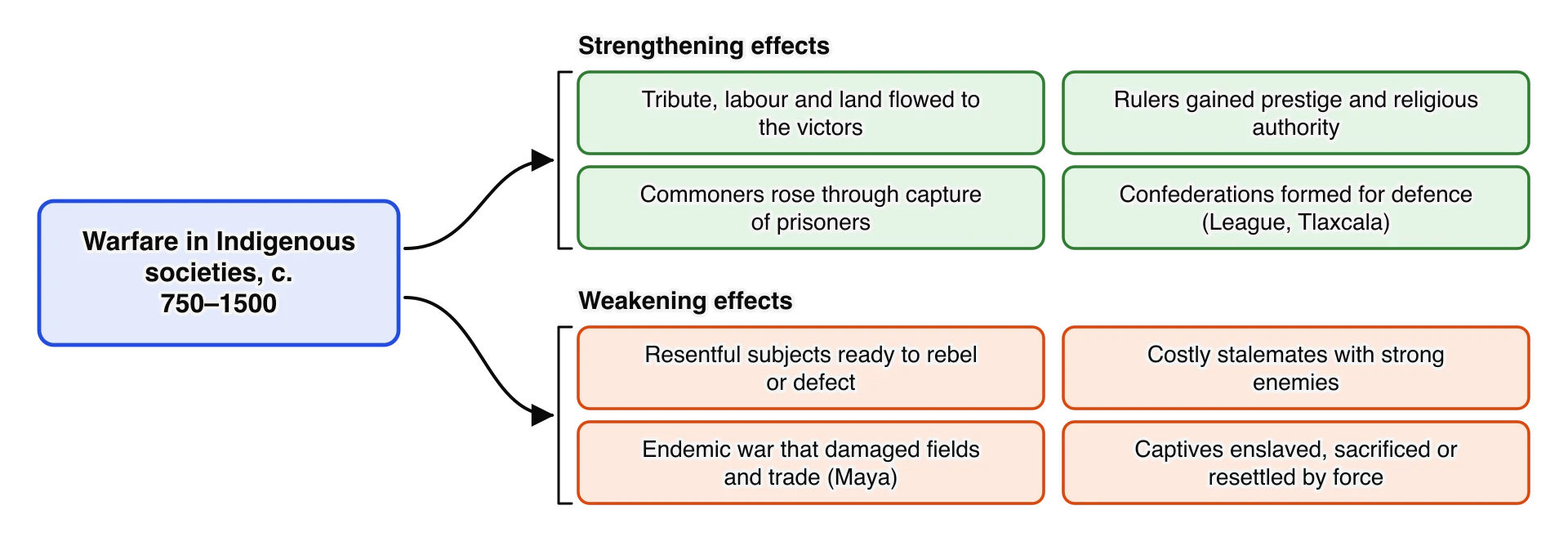
Expansion and conquest
The Inca: from kingdom to empire
Until the early fifteenth century the Incas were one small kingdom among many in the southern highlands of Peru. According to Inca tradition, recorded by Spanish chroniclers, the Chanka, a powerful confederation to the west, attacked Cuzco around 1438. The old ruler fled, but his son Cusi Yupanqui defended the city, defeated the Chanka, took the throne and the name Pachacuti ("he who turns the world around"). This story, told by the victors, makes Pachacuti a founding hero; radiocarbon dates from Inca sites suggest that expansion had begun some decades earlier, so the tradition may compress a longer process into one great victory.
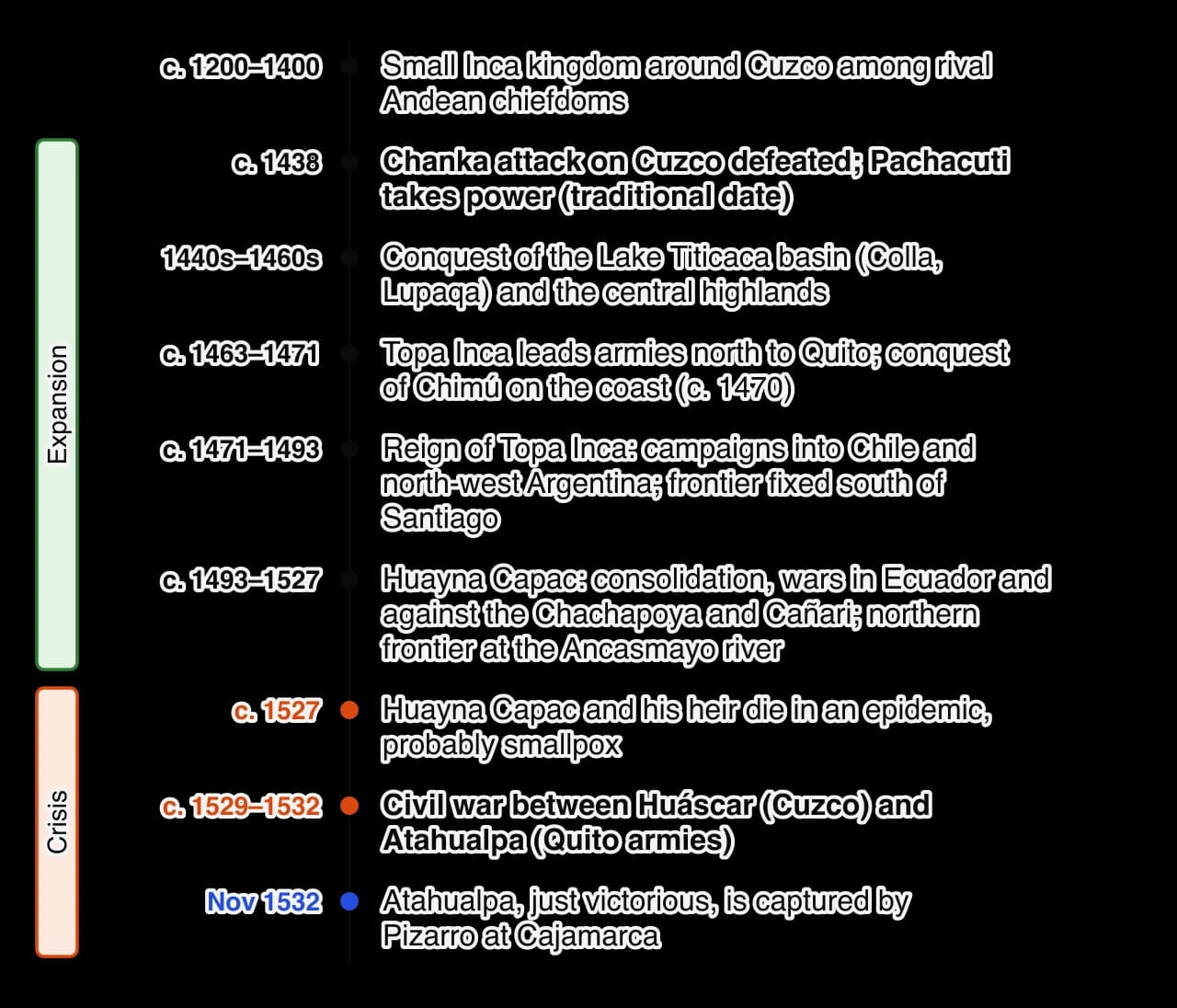
Under Pachacuti, his son Topa Inca and his grandson Huayna Capac, Inca armies conquered the Lake Titicaca basin, the central highlands, the coastal kingdom of Chimú, the highlands of Ecuador and large parts of modern Bolivia, Chile and Argentina. By about 1525 the empire stretched some 4,000 km and held perhaps 10 million people, though estimates range from about 6 million to more than 12 million.
The Incas preferred to conquer without fighting. Envoys offered a local lord gifts of cloth and the promise of keeping his position if he submitted, and the scale of the Inca army made the alternative clear. Many lords accepted. Those who resisted were besieged and defeated, and peoples who rebelled after submitting, such as the Cañari of Ecuador and the Chachapoya of northern Peru, were punished by the killing of leaders and the deportation of large parts of their populations.
Limits to conquest
Conquest had limits that were set as much by geography and the nature of the enemy as by military strength. The Incas never conquered the Amazonian lowlands, where forest peoples without central authority used the terrain against armies built for the highlands. In central Chile they advanced to around the Maipo and Cachapoal rivers south of modern Santiago. Garcilaso de la Vega recorded a three-day battle against the peoples south of the Maule River, after which the Inca commanders chose to fortify the frontier instead of advancing. Historians debate the date and even the place of this battle, but archaeology confirms that Inca control stopped well north of the Mapuche heartland.
The Mexica met similar limits. In 1478 or 1479 Axayacatl invaded the Tarascan (Purépecha) state of Michoacán to the west, a centralised kingdom with its capital at Tzintzuntzan. The Mexica army was routed; Nahua sources speak of very heavy losses. Afterwards both states fortified their frontier, and the Mexica never attacked the Tarascans again. Tlaxcala, Metztitlan and other enemies also survived, so that by 1519 the empire's map was full of unconquered enclaves.
Endemic war among the Maya
Maya war in the eighth century was fought between rival dynasties for prestige, tribute and control of trade routes, not to build an empire. The most serious wars, marked in inscriptions by a "star war" glyph, ended with the sacking of a city. In the Petexbatun region of Guatemala, war in the second half of the eighth century became so intense that the people of the capital Dos Pilas built walls through their own ceremonial centre before abandoning it in the 760s, and the nearby citadel of Aguateca was burned and abandoned around 810. Archaeologists such as Arthur Demarest see this cycle of war as one cause of the wider Classic collapse.
Wealth accumulation, including looting and pillaging
For the Mexica, the main reward of conquest was a permanent flow of tribute, assessed on each newly conquered town. Victorious armies also looted conquered cities and took captives, and successful warriors were rewarded by the ruler with cloth, insignia and sometimes land. This helps explain why expansion continued long after the basin was secure.
The Incas took wealth in a different form: land, labour and skilled people. When they conquered Chimú, they carried off its treasure of gold and silver, its ruler and many of its metalworkers to Cuzco, where Chimú craftsmen worked for the Inca court. Conquered lands were divided into state, Sun and community fields, and conquered peoples' labour went to the state.
Among the Classic Maya, war brought tribute from defeated cities and prestige to the victorious king; captured kings were displayed on monuments, sometimes for years. In the non-state societies, war aimed at captives and honour more than wealth.
Military organisation and warfare tactics
Society | Organisation | Weapons and tactics |
|---|---|---|
Mexica | Units raised by calpulli and subject towns under noble commanders; elite warrior orders; rank by captives taken | Obsidian-edged wooden swords (macuahuitl), spear-throwers (atlatl), slings and bows; quilted cotton armour; battles aimed at capture; campaigns timed for the dry season after harvest |
Inca | Armies of conscripts serving their mit'a, under Inca generals and kurakas; garrisons of resettled loyal peoples; fortresses on frontiers | Slings, star-headed maces, spears, bolas; massed infantry; supply from storehouses along the roads; offers of peace before attack; sieges of hill forts |
Classic Maya | Armies led by kings and nobles, drawn from their followers | Spears, atlatls, shields; raids to capture nobles; destruction of rival centres in major wars; walls and palisades in the late eighth century |
Haudenosaunee | Volunteer war parties of a few dozen men under a war leader; no standing army | Bows, war clubs, wooden armour; ambush and surprise raids; captives taken home |
Mapuche | Warriors from allied lineages under a temporary war leader (toki) | Clubs, spears, bows; ambush, mobility; dispersal into the forest when outmatched |
The Inca army was the best supplied of the period. Because storehouses lay a day's march apart along the roads, an army of tens of thousands could move through the mountains without living off the land, and so without turning the population against it. The Mexica, by contrast, had to demand food from towns along the route of a campaign, and an army could rarely operate for long more than a few days' march from the basin. These differences in logistics help explain why the Inca built a territorial empire and the Mexica a hegemonic one.
Subjugation and enslavement of other Indigenous peoples
Victory meant subjugation for the defeated, in forms that ranged from paying tribute to losing freedom or life. Mexica captives were mostly destined for sacrifice, a practice examined in the focused study of the Aztec Empire; the large-scale sacrifices at the rededication of the Templo Mayor in 1487 under Ahuitzotl were the most famous, though the numbers given in later sources are much disputed. Slaves (tlacotin) in Mexica society were mostly people who had sold themselves or been sold for debt or crime, rather than war captives; some captives were sold as slaves in markets.
The Incas subjugated whole peoples through resettlement. Communities that resisted could be moved hundreds of kilometres from their homeland and replaced with loyal settlers, and some rebellious men were turned into yanakuna, permanent servants of the state. Among the Maya, captured nobles were humiliated or sacrificed, and captured commoners could become slaves, who were also traded along the coast.
In the north-eastern woodlands, the Haudenosaunee fought what historians call mourning wars. When a person died, his or her relatives might call for a raid to take captives who would "replace" the dead. Captives were brought back to the village, where the clan mothers decided their fate: some were adopted into families and took the place of the dead, while others were tortured and killed in public ceremonies. The historian Daniel Richter links this culture of war to grief, kinship and the need to keep village populations stable. Among the coastal Tupí, relatives of the Guaraní, captives were held for months and then killed and eaten in a ritual, as the German gunner Hans Staden described from his own captivity in the 1550s; whether the inland Guaraní did the same before 1500 is less clear.
Role of culture in maintaining Indigenous societies
Language and records allowed rulers to govern and communities to remember; religion justified the social order; the arts displayed power and identity; and knowledge of the natural world made farming possible. Rulers used all four deliberately, but culture also belonged to ordinary people and outlasted the states.
Language and the recording of knowledge
Maya writing
The Maya had the only fully developed writing system of the pre-contact Americas, able to record any sentence of the spoken language. It was logosyllabic: some signs stood for whole words and others for syllables, so a word could be written in several ways. Scribes of high rank wrote on stone, pottery and folding books of bark paper, recording the reigns of kings, the planets and the calendar.
Most Maya books were destroyed after the Spanish conquest. The Franciscan friar Diego de Landa, who ran the campaign against Maya religion in Yucatán, held a great burning of books and religious images at Maní in 1562. A few years later, defending himself in Spain against charges of excessive cruelty, he described Maya writing and its fate.
These people also used certain characters or letters, with which they wrote in their books their ancient matters and their sciences; and with these, and with figures, and some signs in the figures, they understood their matters, made them understood and taught them. We found a great number of books in these letters of theirs, and because they contained nothing in which there was not superstition and falsehoods of the devil, we burned them all, which they felt deeply and which gave them pain.
Diego de Landa, Relación de las cosas de Yucatán (Account of the Things of Yucatán), c. 1566, section 41 (translated here from the Spanish manuscript). Landa wrote as a missionary justifying his actions, so he presents the burning as a duty, yet he also records the grief of the Maya and preserved much of what is known about their calendar. The same text included his "alphabet" of Maya signs, which he had misunderstood as letters; in 1952 the Soviet scholar Yuri Knorozov used it to show that the signs were largely syllables, the key step in decipherment.
The decipherment of Maya writing, from Knorozov's work and Tatiana Proskouriakoff's demonstration in 1960 that monuments recorded the lives of real rulers, transformed Maya history. Earlier scholars had imagined peaceful priest-astronomers; the inscriptions showed dynasties at war.
Nahuatl, Quechua and other languages
In central Mexico, painted books combined pictures, place signs, names and numbers. Nahuatl was the common language of the Aztec Empire's rulers and traders, and Nahuatl oral literature, including poems attributed to Nezahualcoyotl of Texcoco, survived to be written down in the Latin alphabet after 1521.
The Incas spread Quechua as the language of administration, which helped bind a multilingual empire. They had no writing in the European sense, but the khipu recorded census data, tribute and storehouse contents with great precision. Whether khipus could also record narratives, such as histories or messages, is debated; the anthropologist Gary Urton has argued that their structure could encode more than numbers.
Oral tradition and wampum
Societies without writing kept knowledge in memory and performance. The Haudenosaunee Great Law was recited at council meetings by speakers trained to remember it, and its articles were linked to strings and belts of wampum, purple and white shell beads arranged in patterns. A wampum belt was a record of an agreement and a means of remembering it: the Hiawatha belt, with its five linked symbols, represents the union of the five nations. Oral tradition was maintained by specialists and tested in public, though it changed over time.
Religion
All these societies were polytheistic, worshipping many gods and sacred beings, and in all of them religion was woven into politics, farming and family life.
Society | Main beliefs | How religion supported society |
|---|---|---|
Maya | Gods of rain (Chaak), maize, sun and the underworld; deified royal ancestors; humans made from maize (the Popol Vuh, written down in the 1550s) | Kings performed rituals for rain and fertility; temples and ballcourts at the heart of cities; calendars governed ceremonies |
Mexica | Huitzilopochtli (sun and war), Tlaloc (rain), Quetzalcoatl and many others; the present world as the Fifth Sun | Sacrifice repaid the debt to the gods; festivals filled the 365-day year; temples symbolised the state |
Inca | Inti (Sun), Viracocha (creator), Pachamama (Earth Mother), mountain spirits (apus); huacas: sacred places, stones and objects; royal mummies | Cult of the Sun linked every province to Cuzco; huacas taken to Cuzco; offerings to mountains and the earth for good harvests |
Haudenosaunee | Creator and Sky Woman; spirits in all living things; the Peacemaker's message | Thanksgiving speeches to the natural world; the Condolence ceremony renewed the League; medicine societies healed |
Guaraní | Creator and culture heroes; the search for a "Land without Evil" | Shamans led ceremonies and could lead whole villages on religious migrations |
In Cuzco, the Inca organised the sacred landscape itself. From the Coricancha, the temple of the Sun, imaginary lines called ceques radiated out across the valley, linking more than 300 huacas: springs, rocks, hills and shrines, each cared for by a particular kin group. Across the empire, the Incas honoured local huacas as well as the Sun, adding conquered peoples' gods to their own rather than suppressing them.
The Guaraní idea of a "Land without Evil" (yvy marane'ỹ), a paradise on earth that could be reached by dancing, fasting and journeying, is known from accounts of mass migrations after the Spanish arrival. Some anthropologists, such as Hélène Clastres (1975), saw it as an ancient religious tradition that helped explain earlier Tupí-Guaraní migrations; others argue that it grew stronger as a response to colonial crisis.
The arts
Maya painters and sculptors produced carved stelae and lintels, painted pottery with scenes from court and myth, and murals such as those at Bonampak (c. 790), which show a royal court, a battle and the presentation of captives in brilliant colour.
Mexica sculptors carved monumental stone works such as the great disc of the moon goddess Coyolxauhqui, found at the foot of the Templo Mayor in 1978, and the Sun Stone (carved c. 1502–1521).
Inca builders fitted stone blocks so closely without mortar that their walls in Cuzco have survived earthquakes that destroyed Spanish buildings. Textiles were the highest art: tunics woven with geometric designs (tocapu) marked rank and identity.
Haudenosaunee craftspeople made carved wooden masks, decorated pottery and wampum; much of their art was in perishable materials that rarely survive.
Art also maintained social order. Fine cloth, feathered costumes and gold ornaments were badges of rank that ordinary people were forbidden to wear. The great buildings of Cuzco, Tenochtitlan and the Maya cities displayed rulers' power to subjects and visitors alike.
Relationship with the natural world
Farming calendars, astronomy and religion were one body of knowledge that told people when to plant, harvest and hold festivals.
Mesoamerican peoples used two interlocking calendars: a 260-day ritual count and a 365-day solar year, which together repeated every 52 years. The Maya added the Long Count, which counted days from a starting point equivalent to 3114 BCE and allowed them to date events precisely over thousands of years. Their mathematics used a positional system with a symbol for zero, one of only a few cultures in history to develop the concept independently.
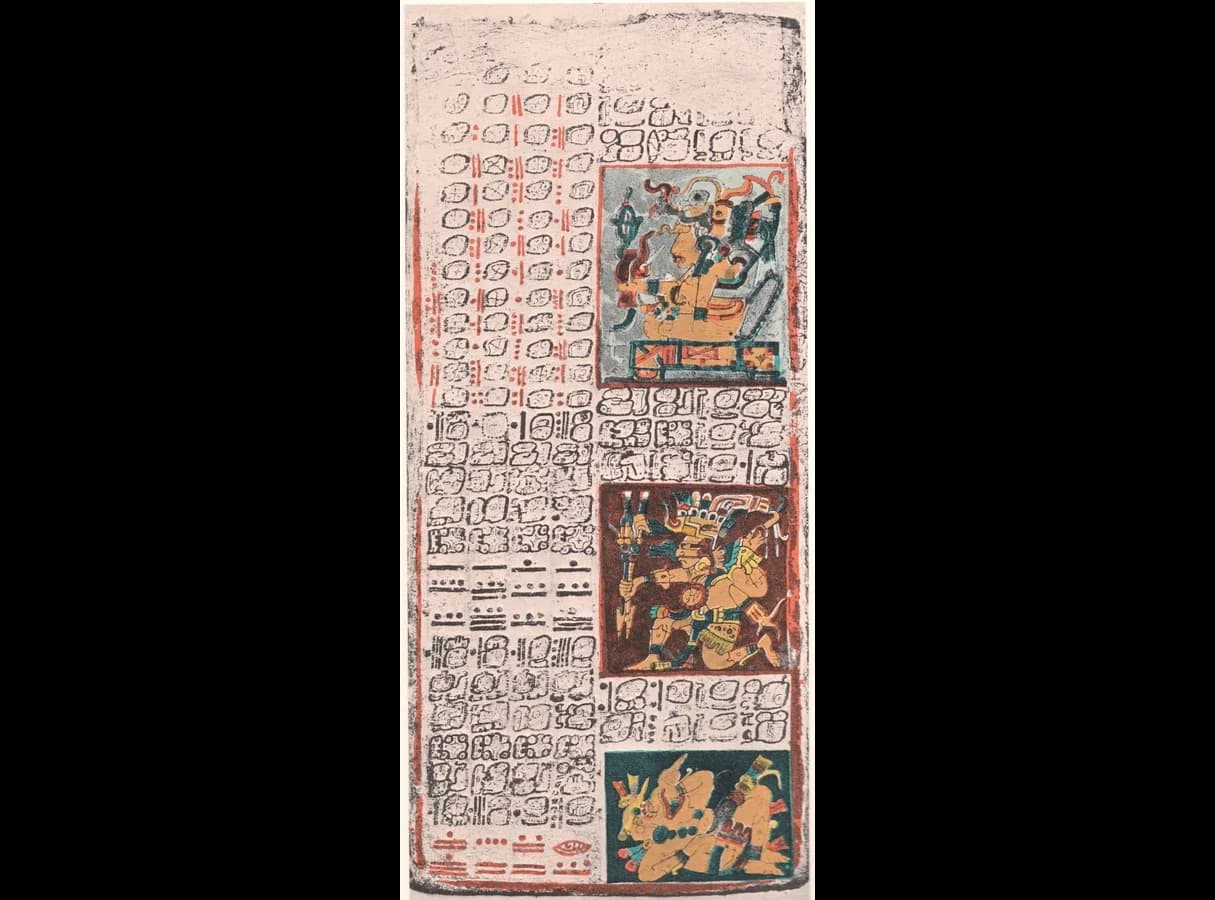
Maya astronomers, as the Venus table of the Dresden Codex shows, tracked the movements of the planet Venus with an error of only a few hours over centuries, and predicted eclipses. These calculations served religion and politics: some Classic period wars appear to have been timed to the appearance of Venus. In the Andes, the Incas used pillars on the hills around Cuzco to mark the sun's position at planting and harvest, and the Pleiades, called Qollqa, were watched to predict the coming rains.
The natural world was also sacred. For Andean peoples, mountains were powerful beings (apus) who controlled water and weather and received offerings; the earth, Pachamama, was given chicha and coca before planting. The Haudenosaunee opened gatherings with a Thanksgiving Address that thanked the earth, waters, plants, animals, winds and sun in turn. Respect for the natural world did not mean leaving it untouched. Indigenous peoples reshaped their landscapes with terraces, canals, raised fields and controlled burning of forests, a point stressed by Charles Mann in 1491 (2005). Where those changes went too far, as in the Maya lowlands, they contributed to crisis.
Challenges faced by Indigenous societies
The societies of the study faced four kinds of challenge: threats from other Indigenous peoples, environmental change, social pressures such as overpopulation, and weaknesses in their own political organisation. These challenges rarely came alone. The most serious crises came when several struck a society at the same time, as in the Maya lowlands in the ninth century.
Threats from other Indigenous societies
Every state in the study had dangerous neighbours. The Incas began their rise by surviving the Chanka attack on Cuzco; later the Mapuche and the forest peoples of the Amazon held their frontiers. The Mexica faced the Tarascans to the west, who defeated them in 1478 or 1479, and the Tlaxcalan confederation to the east, which they fought for decades without conquering. Tlaxcala, encircled and cut off from trade in salt and cotton, survived, and its hatred of the Mexica made it Cortés's most important ally in 1519. Among the Maya, the rivalry of Tikal and Calakmul shaped the whole lowlands for two centuries.
In the north-east, the Haudenosaunee League was itself a response to external and internal threat: its tradition begins with an age of feuds among the five nations. Its members remained at war with neighbours such as the Wendat (Huron) confederacy north of Lake Ontario.
Environmental factors
Environmental challenges could be sudden, such as a frost, flood or volcanic eruption, or slow, such as a long drought or soil exhaustion. The famine of One Rabbit in central Mexico in 1450–1454 and the Mexica response to it are studied in the focused study of the Aztec Empire. Other societies faced similar pressures. In the Andes, El Niño events brought floods to the desert coast and drought to the highlands; Inca storage was in part a response to this uncertainty. In the south-west of the modern USA, a great drought between 1276 and 1299 (dated by tree rings) coincided with the abandonment of the Ancestral Puebloan cliff dwellings of Mesa Verde. Cahokia, the largest town north of Mexico, with perhaps 10,000 to 20,000 people at its height around 1050–1200, declined from about 1200 and was largely abandoned by 1350, through some combination of drought, flooding, soil and wood depletion and political conflict.
Case study: the Classic Maya collapse, c. 800–950
The most dramatic crisis of the period was the collapse of the Classic Maya cities of the southern lowlands. In the eighth century this region of northern Guatemala, Belize and southern Mexico held dozens of kingdoms and several million people; LiDAR surveys, which map the ground beneath the forest from aircraft, have found far denser settlement than older estimates allowed. Within about 150 years most of its great cities had stopped building, their kings had disappeared and much of the population had died or moved away.
The evidence of collapse
The clearest evidence comes from the inscriptions. The number of dated monuments peaked around 790 and then fell sharply. One city after another set up its last dated stela: Copán in the 820s, Tikal in 869, and the last Long Count date of all, at Toniná, in 909. The decline was not simultaneous: the western cities along the Usumacinta river and the Petexbatun region collapsed first, from the late eighth century, and some cities in Belize and the north continued for longer.
Explanations
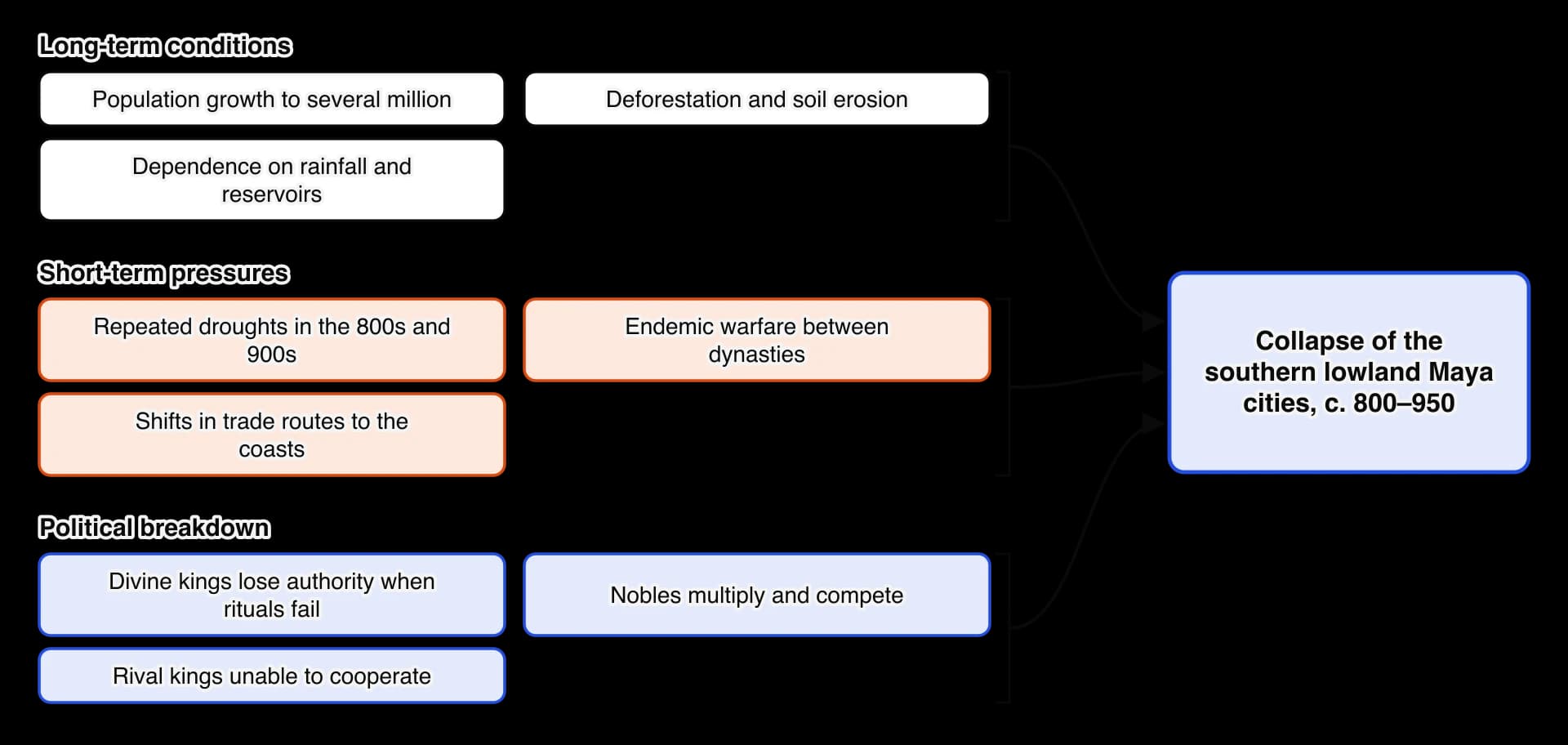
No single explanation is accepted. Four main factors are weighed.
Drought. Sediment cores from lakes and from the sea floor off Venezuela, and stalagmites from caves in Belize, record repeated droughts in the ninth and tenth centuries. Gerald Haug and colleagues (2003) linked severe droughts around 810, 860 and 910 to waves of abandonment, and Douglas Kennett and colleagues (2012) matched a cave record from Belize with the decline in monument building.
Overpopulation and environmental damage. Dense populations had cleared much of the forest for fields and fuel, including wood to burn lime for plaster. Soil erosion reduced harvests. Jared Diamond, in Collapse (2005), presented the Maya as a society that exceeded the capacity of its environment.
Warfare. The endemic war of the eighth century, visible in Petexbatun, disrupted farming and trade and consumed resources. Arthur Demarest has emphasised war and competition between dynasties.
Political and ideological breakdown. The authority of the k'uhul ajaw rested on his ability to secure rain, harvests and victory through ritual. When droughts and wars persisted, faith in divine kingship weakened; at the same time, growing numbers of nobles competed for resources. The system of rule, not only the population, collapsed.
Most scholars now combine these factors. Drought was the trigger in many places, but it struck a landscape already crowded and degraded, and a political system based on rival divine kings could not cooperate to respond. The northern cities, with different political structures and access to coastal trade, adapted and continued: Chichén Itzá flourished in the very centuries when the south declined.
The Maya case shows the four kinds of challenge interacting: drought worked through dense population, endemic war and rival kings who could not cooperate. Which mattered most depends on whether the trigger or the underlying vulnerability is in question.
Social factors, including overpopulation
Population growth increased the strain on land in several societies. In the Basin of Mexico, the population of perhaps one million or more by 1500 depended on chinampas, on imports of tribute food and on the stability of the lake system; floods and frosts could cause hunger quickly. In the Andes, the Inca state's demands for labour and the resettlement of communities placed heavy burdens on the ayllu. Social divisions, such as the growing landless class in central Mexico and the many yanakuna and resettled people in the Andes, weakened the bonds between rulers and ruled.
Political factors, including weaknesses of political organisation
Succession and the Inca civil war
The greatest political weakness of the Inca state was succession. There was no fixed rule that the eldest son inherited; the ruler named a successor from among his sons by the Coya, but the choice had to be accepted by the royal lineages and the gods, and disputes were common. Around 1527 Huayna Capac died in Ecuador, probably of smallpox, which had spread through Indigenous trade networks ahead of the Spanish. His chosen heir died in the same epidemic. Two of his sons claimed the throne: Huáscar in Cuzco, backed by the royal lineages there, and Atahualpa, who commanded the veteran armies in the north.
The civil war that followed (c. 1529–1532) was fought across the empire. Atahualpa's generals defeated and captured Huáscar near Cuzco in 1532 and carried out bloody reprisals against his family and supporters. Peoples who had backed Huáscar, or who resented Inca rule, such as the Cañari, were punished. Atahualpa was travelling south to take the throne when he met Francisco Pizarro's small Spanish force at Cajamarca in November 1532 and was captured. The war had divided the Inca elite and left many subject peoples ready to welcome anyone who opposed the new ruler. The reasons for the Spanish victory are part of the history of colonialism after 1492. The crisis of succession itself came from within: it was built into an Inca system that had no fixed rule of inheritance.
Weak integration in the Aztec Empire
The Aztec Empire's political weakness was the other side of its strength. Indirect rule was cheap, but it left subject rulers with their own armies and identities and gave them little reason for loyalty beyond fear and profit. When Cortés arrived in 1519, Tlaxcala, the Totonacs of the Gulf coast and, eventually, a faction in Texcoco joined him; the alliance that had built the empire came apart along the lines of its own construction.
Fragmentation in the Maya world and the limits of confederation
The Maya were never united, and their political fragmentation left them unable to act together against drought or war in the ninth century. In Yucatán, the collapse of Mayapán in the 1440s, after a revolt against the Cocom lineage, produced sixteen to eighteen independent provinces that fought one another. Confederations also had limits. The Haudenosaunee League depended on consensus, so decisions were slow, and each nation could act on its own, as later events showed. Yet decentralisation could also be a strength: the Mapuche, without a centre, could not be conquered at a single stroke.
Perspectives and debates
Whose voices? Contemporary and early colonial perspectives
Because most written sources date from after the conquests, the first debate is about the sources themselves. Spanish conquerors and chroniclers such as Cortés and Cieza de León admired what they found but described it in European terms and often to justify conquest. Missionaries such as Landa and Sahagún recorded a great deal in order to uproot Indigenous religion. Indigenous and mestizo nobles wrote to defend their peoples and families, and disagreed with one another: Garcilaso de la Vega presented the Incas as wise lawgivers comparable to the Romans, while Guaman Poma, from a provincial lineage the Incas had conquered, praised Andean government but was more critical of the Incas themselves, so Indigenous writers did not share a single perspective.
Missing from most of these sources are commoners, women, slaves and the peoples conquered by the Mexica and Inca. Archaeology of houses, fields, graves and diets is the main way historians recover their experience.
Historians' interpretations
Debate | Historian and work | Argument | Evidence stressed |
|---|---|---|---|
Nature of the Inca economy | Louis Baudin, L'Empire socialiste des Inka (1928) | The Inca state was a planned "socialist" economy that guaranteed welfare for all | Spanish descriptions of storehouses, land division and care for the old and sick |
Nature of the Inca economy | John V. Murra, The Economic Organization of the Inka State (1956, published 1980); "the vertical archipelago" (1972) | An economy of reciprocity and redistribution rooted in the ayllu; communities controlled resources at different altitudes | Colonial inspection records (visitas) of Andean communities; kinship obligations |
Nature of the Inca economy | Terence D'Altroy and Timothy Earle (1985); D'Altroy, The Incas (2002) | The state financed itself through "staple finance": labour produced food and cloth stored and spent by the state | Excavated storehouses and provincial centres; khipu accounts |
Drivers of Inca expansion | Geoffrey Conrad and Arthur Demarest, Religion and Empire (1984) | Split inheritance forced each new ruler to conquer new lands, and royal ideology drove expansion | The cult of royal mummies; the rapid expansion after c. 1438 |
The Classic Maya collapse | Jared Diamond, Collapse (2005) | Overpopulation and environmental damage made the Maya vulnerable; drought finished them | Deforestation, erosion, population estimates |
The Classic Maya collapse | Arthur Demarest, Ancient Maya (2004) | Political competition and endemic war among elites were central; the collapse varied from region to region |
These debates turn on what evidence is trusted. Baudin relied on idealised Spanish and mestizo descriptions; Murra and D'Altroy used colonial administrative records and archaeology. Diamond stressed environmental damage, while critics of his book, such as the contributors to Questioning Collapse (2010), edited by Patricia McAnany and Norman Yoffee, objected that it underrated the political choices and continuity of the Maya. The scientific evidence for drought has strengthened since 2000, but it tells historians when rainfall fell, not why one city survived and another did not.
The founding of the Haudenosaunee League
The date of the League's founding shows how different kinds of evidence can point in different directions. Oral tradition gives no calendar date but describes a solar eclipse during the Peacemaker's mission. The scholars Barbara Mann and Jerry Fields (1997) matched this to an eclipse visible in the Seneca homeland in 1142. Many archaeologists, including Dean Snow in The Iroquois (1994), date the League to about 1450–1525, when villages became larger, more fortified and more similar in style, suggesting new forms of cooperation. Others place it later still. The question cannot yet be settled, and an answer should present it as contested.
Comparing Indigenous societies
Any one society is easier to understand when it is set beside the others, which show what was typical and what was distinctive about it. The table summarises the main features of the six societies: their political authority, economy, social organisation, warfare, culture and main challenges.
Maya | Mexica | Inca | Haudenosaunee | Mapuche | Guaraní | |
|---|---|---|---|---|---|---|
Political authority | Divine kings of city-states; later councils (Mayapán) and provinces | Huey tlatoani; hegemonic empire of subject altepetl | Sapa Inca; territorial empire with governors and kurakas | League of five nations; council of 50 sachems | Independent lineages; war leaders chosen in crises | Village chiefs and shamans |
Economy | Milpa and intensive fields; tribute; coastal trade; cacao money | Chinampas; tribute in goods; markets and pochteca | Terraces and irrigation; mit'a labour; storehouses; few markets | Three Sisters farmed by women; hunting; gift exchange | Farming, herding, fishing | Swidden farming of manioc and maize; hunting |
Social organisation | Kings, nobles, scribes, commoners, slaves | Pipiltin and macehualtin; calpulli; warrior ranks | Incas, kurakas, hatun runa, yanakuna, aqllakuna; ayllu | Matrilineal clans; clan mothers | Patrilineal lof | Extended families in communal houses |
Warfare | Dynastic wars for captives and tribute | Wars of conquest; flower wars; captives for sacrifice | Wars of conquest; resettlement of rebels | Mourning wars for captives | Defensive alliances; resisted Inca | Raids; captives |
Culture |
The comparison shows a broad pattern. The larger and more centralised a society, the more it could achieve in building, storage and war, but the more it depended on a single ruler and on the loyalty of conquered peoples. Smaller and decentralised societies achieved less on a grand scale but proved resilient, a contrast that became important after 1500.
Applying the ideas in exam questions
Question 1: rulers and local leaders
Question 2: religion and authority
Question 3: the impact of warfare
Question 4: women and power
Self-check
- To do:
I can name the main Indigenous societies of the Americas between c. 750 and 1500 and place them in time and space.
- To do:
I can explain why most written evidence dates from after the conquests and how this affects what historians know.
- To do:
I can describe how Maya kings, the Mexica huey tlatoani and the Sapa Inca established and maintained their authority.
- To do:
I can explain the relationship between central rulers and local leaders in the Aztec and Inca empires, and judge how far it was mutually beneficial.
- To do:
I can explain how religion and warfare legitimised power, and describe law and codes of conduct in at least two societies.
- To do:
I can explain how the Haudenosaunee League, Tlaxcala and the Mapuche organised alliances among communities.
- To do:
I can distinguish sedentary, semi-sedentary and non-sedentary ways of life and explain the limits of sedentary organisation.
- To do:
I can compare landholding, farming and irrigation in Mesoamerica, the Andes and the north-eastern woodlands.
- To do:
I can explain the role of tribute in goods (Mexica) and in labour (Inca), and the roles of reciprocity, redistribution, trade and markets.
- To do:
I can describe the social hierarchies of the three states and the kin groups (calpulli, ayllu, clans, lof) of all six societies.
- To do:
I can analyse gender roles, including the power of Haudenosaunee clan mothers and Andean parallel descent.