FS1 Climate and innovation
How two societies before 1500, the Norse in the North Atlantic and the Aztecs in the Basin of Mexico, met the limits of their environment with new ways of living, and how this focused study is studied and examined.
- IB History
- SL and HL
What FS1 covers
From the subject guide: what you need to know and be able to do.
Focused study: two paired examples, assessed through sources in paper 1.
2 subtopics in Climate and innovation
Each one has its own page once something is published for it.
- FS1.1Norse exploration (circa 982–1020)notes
- FS1.2The Aztec Empire (circa 1428–1469)notes
An overview of FS1 Climate and innovation
Climate and innovation is a focused study of how societies respond to the limits and opportunities of their environment. Its two examples are the Norse voyages and settlements in Greenland and North America (c. 982–1020) and the first four decades of the Aztec Empire in the Basin of Mexico (c. 1428–1469). In both, people under pressure from land, water and weather found new ways to farm, build, travel and organise.
Two examples, three questions
The two examples are studied through the same three key questions. The diagram of the focused study shows how they fit together: each question is asked of the Norse and of the Aztecs, so that the answers can be compared.
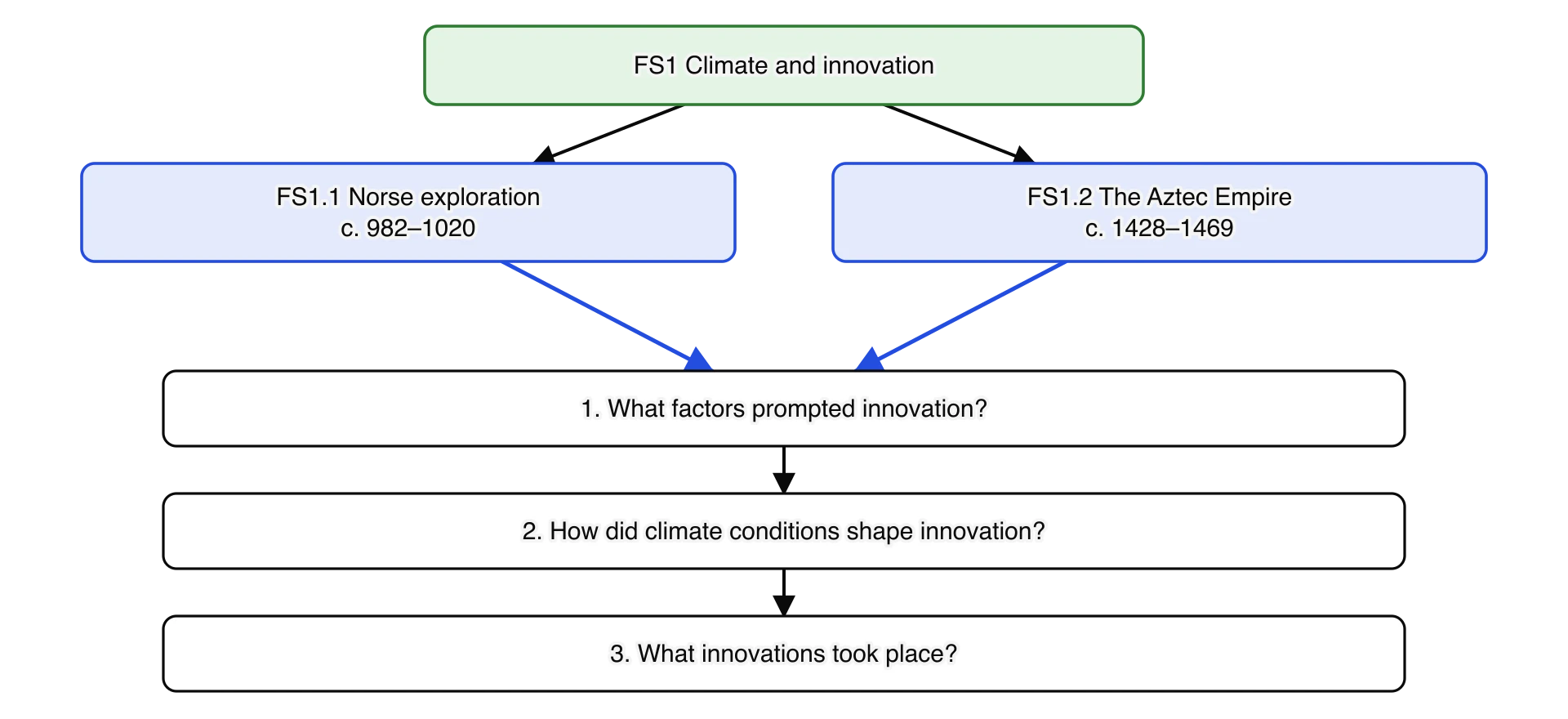
The table of the key questions summarises what each example covers under each question. The details, with the sources and the debates between historians, are on the two example pages.
Key question | FS1.1 Norse exploration (c. 982–1020) | FS1.2 The Aztec Empire (c. 1428–1469) |
|---|---|---|
What factors prompted innovation? | Shortage of good land in Iceland after about 930; the ocean-going knarr and navigation without instruments; the leadership of Erik the Red and his son Leif Erikson | The Triple Alliance of Tenochtitlan, Texcoco and Tlacopan (1428) and its tribute empire; the reforms of Itzcoatl and Tlacaelel, including the Flower Wars; the rule of Moctezuma I (1440–1469) |
How did climate conditions shape innovation? | The Medieval Warm Period, with warmer summers and less sea ice; new sea routes west; the very different environments of Greenland and Vinland | A high, closed lake basin of salt and fresh water with frost and floods; the importance of water resources; the floods of 1449 and the frost, drought and famine of One Rabbit (1450–1454) |
What innovations took place? | Farming colonies in south-west Greenland; the site at L'Anse aux Meadows in Newfoundland, where wood was cut in 1021; new ways of getting food; relations with the Indigenous peoples the Norse called skrælingjar | Tenochtitlan as a planned island city of causeways and canals; chinampas, the raised fields of the fresh-water lakes; the dike and aqueduct; expansion into Totonacapan on the Gulf coast |
Big ideas that run through the focused study
The central question of the study is how far the environment caused innovation. In both examples climate created the problems and opened some opportunities: warmer North Atlantic summers made Greenland farming practical, and frost and drought in the 1450s threatened the Mexica with famine. But climate on its own explains little. Pressure on land in Iceland explains why people were willing to leave, ships and seamanship explain how they could, and the political power, tribute and labour of the Triple Alliance explain why the Mexica could build dikes and aqueducts on a large scale. Weighing environmental, economic, political and individual factors against each other is the core skill of the study.
Innovation in both societies meant adaptation more than invention. The Norse moved Icelandic pastoral farming to Greenland and came to rely more on seals and caribou; the Mexica extended older methods of lake farming and water control to feed a fast-growing city. Both examples also show the limits of innovation: Vinland was abandoned within a few years, partly because of hostility with its Indigenous inhabitants, while the expansion into the better-watered lands of the Gulf coast is often linked to the famine of the 1450s.
Sources are the third big idea. Almost nothing was written down at the time. The Norse voyages are known from Icelandic sagas written about two centuries later, and the Aztec Empire mainly from codices and chronicles made after the Spanish conquest of 1521, many of them shaped by Tenochtitlan's own version of its past. Historians test these accounts against archaeology, tree rings, ice cores and other evidence of past climate. Asking who made a source, when and why, and what it can and cannot show, is therefore part of studying the events themselves.
The four historical concepts all apply. Cause and consequence asks what drove innovation; continuity and change asks how much the settlers and the Mexica changed their way of life; perspectives asks how the Norse, the Indigenous peoples they met, the Mexica and the peoples they conquered saw events; and significance asks how much a short-lived settlement in Newfoundland, nearly five hundred years before Columbus, really matters.
How the focused study is studied and examined
Every student, at SL and HL, takes one focused study out of five options: Climate and innovation, Independence and identity, Political and economic transitions, Conflict and displacement, and Protest and change. Each option has two examples, and both must be studied in full, in about 50 teaching hours.
The focused study is assessed by Paper 1 (1 hour 15 minutes, 24 marks; 30 per cent of the SL grade and 20 per cent of the HL grade). SL and HL students sit the same paper. Each session the paper sets material on only one of the two examples, which is why both have to be known well. Students receive an inquiry question in the form "To what extent …?", three primary or secondary sources (A, B and C), and three questions that are the same every session: how the content of Sources A and B can be used to answer the inquiry question (6 marks), how the context of Source C influences how it can be used (6 marks), and how the perspectives in all three sources can be used (12 marks).
Carry on with FS1 in Augment
With a free account, Augment remembers where you stopped and what you have practiced.