Explain overtourism and carrying capacity, apply Doxey’s irridex, evaluate site management and ecotourism using Rwanda’s gorilla tourism, and examine future tourism and the politics of international sport participation.
Each is in the Geography glossary, with every other term in the subject.
Tourism that is owned and managed by a local community, which decides how visitors are received and keeps most of the income.
A population that has spread from its original homeland to other countries while keeping cultural, emotional or family links with it.
A model (1975) suggesting that residents' attitudes to tourists pass through four stages, euphoria, apathy, annoyance and antagonism, as visitor numbers grow.
The level of visitor use a site can sustain before damage to its ecosystems, such as erosion, coral loss or wildlife disturbance, becomes unacceptable or irreversible.
The level of tourism beyond which it displaces other economic activities or raises costs for residents, such as housing, to the point that the local economy is harmed.
Responsible travel to natural areas that conserves the environment, sustains the well-being of local people and involves education about the environment; one form of sustainable tourism.
The level of use or stress beyond which an environment's condition changes sharply, so that damage accelerates or can no longer be reversed naturally.
Explain the environmental, social and economic consequences of unsustainable tourism growth in urban and rural hotspots.
Distinguish between physical, ecological, perceptual, social and economic carrying capacity, and explain the idea of an environmental threshold.
Draw and annotate Doxey’s irridex, and evaluate it as a model of residents’ attitudes to tourism.
Evaluate management options that increase the resilience of tourism sites, using named urban and rural examples.
Explain the concept of sustainable tourism and the growth of ecotourism, and evaluate how sustainable ecotourism is in practice.
Evaluate sustainable tourism in one low-income country, using gorilla tourism in Rwanda.
Examine how social media, international security and diaspora growth are likely to influence future international tourism.
Discuss the growing importance of political and cultural influences on international sport participation, including international agreements, changing gender roles and the Paralympic Games.
Tourism has grown so fast that some of the world’s most visited places now struggle to cope. Residents of Venice, Barcelona and Mallorca have protested against crowds and rising rents, and authorities in Thailand and the Philippines have closed famous beaches to let them recover. Managing tourism for the future means deciding how many visitors a place can take, who pays, and who is allowed to take part.
The key concept of possibility is central: tourism and sport could follow several futures, from continued growth to strict limits, and those futures depend on decisions made now. Power decides which future is chosen, because residents, governments, tourism companies, visitors and international sporting bodies want different things. Participation in international sport raises the same question of power at a global scale: who sets the rules, and who is included.
73 exam-style questions on this subtopic, written in the style of the IB papers. The first has its markscheme open. Counted on
Examine the relative importance of personality and affluence in influencing the types of tourism that people choose.
10 marks
Marks should be allocated according to the markbands.
Personality refers to an individual's attitudes and preferences, such as willingness to take risks, curiosity and desire for familiarity. Plog's model (1970s) classifies tourists along a continuum from psychocentric ("dependable": preferring familiar, safe, organized destinations) through mid-centric to allocentric ("venturer": preferring novel, remote, independent travel). Affluence refers to disposable income and wealth. Types of tourism may be described by cost, duration, destination and purpose.
Possible applied themes (AO2) demonstrating knowledge and understanding (AO1):
Affluence sets limits on cost, distance and frequency: lower-income households take fewer, shorter, mostly domestic trips; affluent people take frequent short breaks and long-haul or luxury holidays (eg safari lodges in Botswana, Antarctic cruises).
Affluence also shapes destination choice through the price of flights, accommodation and visas; exchange rates make some destinations cheaper for some nationalities.
Personality shapes the kind of trip within the affordable range: psychocentric tourists choose package holidays to familiar resorts (eg British tourists to Spanish coastal resorts such as Benidorm), often returning to the same place; allocentric tourists choose independent or adventure travel (eg trekking in Nepal, adventure sports in Queenstown, New Zealand, where commercial bungee jumping began in 1988).
Risk-taking and sensation-seeking personalities are linked to adventure tourism and extreme environments; others prefer cultural, heritage or wellness tourism.
Personality can outweigh affluence: low-budget backpackers may travel to more remote places than wealthy tourists who choose luxury resorts.
With a free account, Augment remembers where you stopped and what you have practiced.
A place that attracts large numbers of visitors because of its attractions and facilities; managers may develop honeypots deliberately to concentrate visitors where damage can be controlled.
The global governing body of the Paralympic movement, founded in 1989 and based in Bonn, which organises the Paralympic Games and sets classification rules.
Travel to see places, landscapes or species that are disappearing or changing, such as glaciers, coral reefs or polar wildlife, before they are lost.
A management approach that defines how much change in a site's environmental and social conditions is acceptable, monitors indicators of those conditions and acts when a limit is approached.
A situation in which the number of visitors to a destination is so high that it damages the quality of life of residents, the experience of visitors or the environment.
The main international multi-sport event for athletes with physical, visual or intellectual impairments, held after the Olympic Games in the same host city.
The level of crowding that visitors will tolerate before their experience of a site is spoiled; also called psychological carrying capacity.
The maximum number of visitors a site can physically hold at one time, limited by its space and facilities, such as seats, beds or beach area.
Travel by members of a diaspora to the places their ancestors came from, to explore their family history, heritage and identity.
The ability of a tourism site to absorb visitor pressure and recover from damage while keeping the qualities that attract visitors.
The level of tourism that residents of a destination can accept before their quality of life and their attitudes to visitors deteriorate.
Tourism that takes full account of its current and future economic, social and environmental impacts, meeting the needs of visitors, the industry, the environment and host communities.
A charge on visitors, usually per night of accommodation or on entry to a place, collected by a government to fund public services, conservation or the management of tourism.
The transformation of a place, especially a city neighbourhood, so that its housing, shops and services serve visitors rather than residents, often displacing local people.
Official advice issued by a government to its citizens about the safety of travelling to another country or region, ranging from general caution to advice against all travel.
The methods used by site managers to control the number, timing, distribution and behaviour of visitors in order to protect a site and the experience it offers.
An international body, founded in 1999, that promotes and coordinates the fight against doping in sport and maintains the World Anti-Doping Code.
A tourism hotspot attracts a very high concentration of visitors relative to its size or resident population. Growth brings income and jobs, but when it continues beyond what a place can absorb, its costs rise faster than its benefits. These consequences can be grouped as environmental, social and economic.
Erosion and trampling: footpaths widen and scar hillsides, and vegetation, dunes and soils are worn away.
Water and energy demand: hotels, pools and golf courses use far more water per person than residents, which matters in dry regions such as the Mediterranean and small islands.
Waste and sewage: litter, plastic and untreated sewage pollute beaches, lagoons and coral reefs.
Wildlife disturbance and habitat loss: boats, vehicles and crowds disturb animals; resorts, roads and marinas replace mangroves, wetlands and forests.
Carbon emissions: long-haul flights make tourism a significant source of greenhouse gases, an impact that falls outside the destination itself.
Overtourism describes a situation in which the number of visitors to a place is so high that it reduces the quality of life of residents or the quality of the experience for visitors, or both. The term became widely used from about 2017, as protests against tourism spread in European cities.
Overtourism changes the character of places. Touristification is the process by which a neighbourhood is transformed to serve visitors rather than residents: apartments become short-term holiday lets, bakeries and hardware shops are replaced by souvenir shops and cafés, and rents rise until long-term residents move out. The historic centre of Venice has had fewer than 50,000 residents since 2022, while the city receives an estimated 22–30 million visitors a year, and in 2017 up to 60,000 tourists a day.
Residents have responded with protest. In 2024 between 20,000 and 50,000 people marched in the Canary Islands in April, about 3,000 protested in Barcelona in July, where some sprayed tourists with water pistols, and estimates of a march in Palma de Mallorca in July ranged from 12,000 to 50,000. Their complaints were mainly about housing: by 2024 about 1,000 residents of Mallorca were living in their vehicles. Spain received 94 million international tourists in 2024, almost twice its population of 48 million.
Sources: Wikipedia, "Tourism in Venice" and "2024 anti-tourism protests in Spain", 2026.
Growth can also harm local economies. Rising land, housing and food prices hurt residents who do not work in tourism; other industries, such as farming and fishing, lose land, water and workers to tourism; and a place that depends on one industry becomes vulnerable to any fall in demand. Public spending on rubbish collection, policing and transport for visitors can exceed the taxes visitors pay, especially when most of them are day-trippers who spend little.
Urban hotspots | Rural hotspots | |
|---|---|---|
Examples | Venice, Barcelona, Amsterdam, Hallstatt (a small town), Kyoto | Maya Bay (Thailand), Boracay (Philippines), Everest base camp (Nepal), the Lake District (England) |
Main pressures | Crowding of streets and transport; short-term lets; loss of shops and residents; cruise ship day-trippers | Erosion, sewage and waste; coral and habitat damage; disturbance of wildlife |
Who is most affected | Residents of historic centres | Ecosystems and small local communities |
Typical responses | Fees and taxes, limits on short-term lets, group size limits, cruise restrictions | Closures for restoration, quotas and permits, footpath repair, zoning |
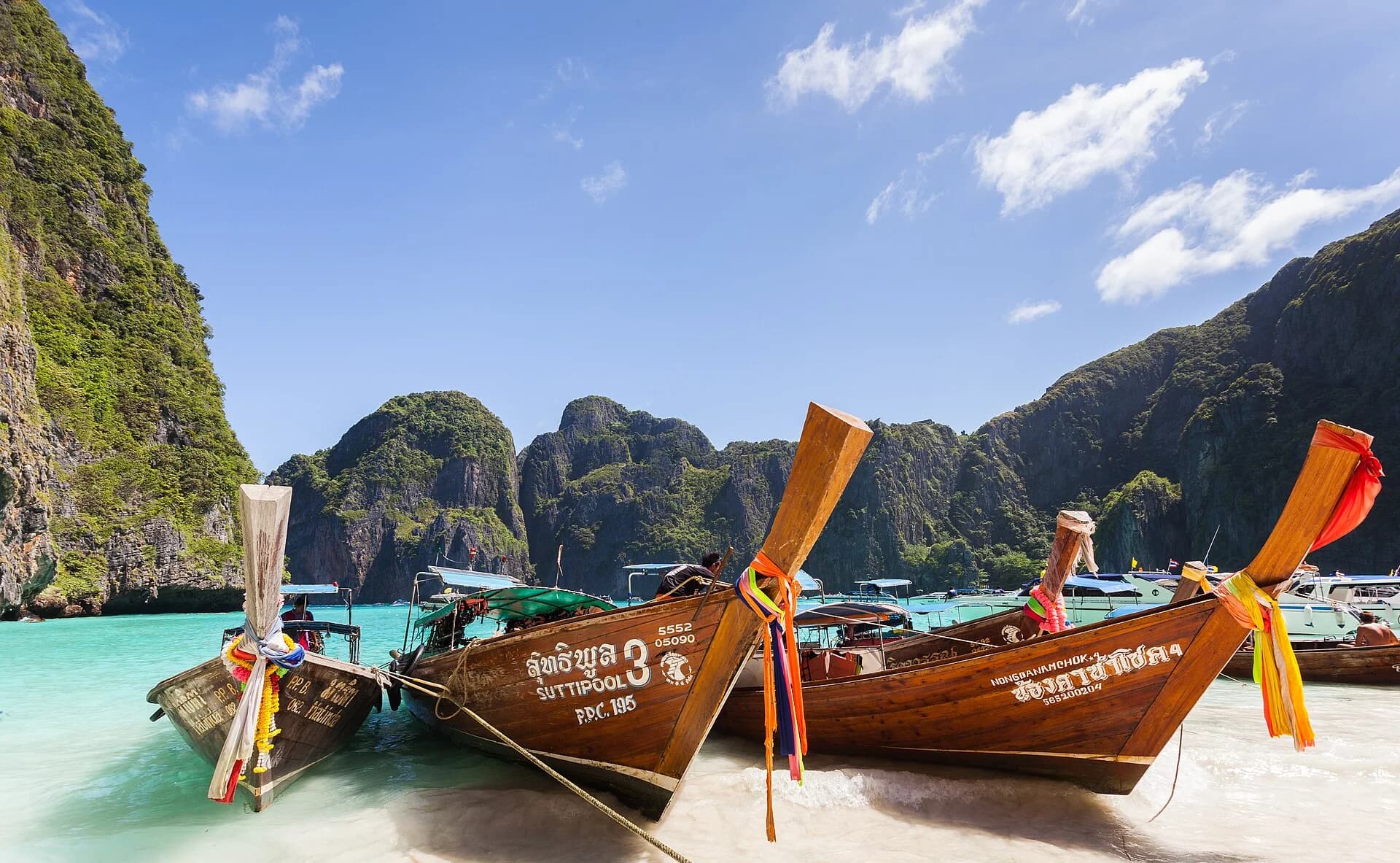
Maya Bay, a cove on the island of Ko Phi Phi Le in southern Thailand, shows the rural extreme. After it appeared in the film The Beach (2000), it received about 5,000 visitors and around 200 boats a day, and about 80% of the coral around the bay was damaged. The Thai authorities closed it in 2018, first for four months and then indefinitely, while more than 15,000 corals were propagated; blacktip reef sharks returned to the bay later that year. It reopened in early 2022 with no boats allowed in the bay, no swimming and a one-hour limit on each visit.
Boracay in the Philippines shows a similar response to sewage pollution. In 2018 President Rodrigo Duterte called the island a "cesspool" because its obsolete sewage system was discharging into the sea, and it was closed to tourists for six months, from 26 April to 26 October 2018. Buildings were demolished to create a 30-metre buffer from the waterline, and beach vendors and bonfires were cleared. The island received 2.16 million tourist arrivals in 2025, so the closure restored the site without ending its popularity.
Sources: Wikipedia, "Maya Bay" and "Boracay", 2026.
Carrying capacity is the maximum use that a place or system can sustain without unacceptable damage. In tourism it is the number of visitors a site can receive before its environment, its residents or the experience it offers start to suffer. Carrying capacity is not one number: it depends on what is being protected, so geographers distinguish five types.
Physical carrying capacity is the simplest. It is the maximum number of people a site can physically hold at one time, set by space and facilities: the seats in a stadium, the area of a beach or the number of beds in a resort.
Ecological carrying capacity (also called environmental carrying capacity) is the level of use a site can sustain before damage to its ecosystems, such as erosion, coral loss or wildlife disturbance, becomes unacceptable or irreversible. It is usually much lower than the physical capacity: Maya Bay could hold thousands of people on its sand, but its reef could not survive 200 boats a day.
Perceptual carrying capacity (also called psychological carrying capacity) is the level of crowding visitors will tolerate before their enjoyment falls. It varies with the visitor: a festival-goer expects crowds, while a hiker in a wilderness area may feel a site is spoiled when a few other groups are in view.
Social carrying capacity is the level of tourism residents will tolerate before their quality of life and their attitudes to visitors deteriorate. The protests in Barcelona and Mallorca show social carrying capacity being exceeded even where the physical and ecological capacity of the city might still be higher.
Economic carrying capacity is the point at which tourism begins to displace other economic activities or to raise costs for residents so much that the local economy suffers, for example when housing becomes unaffordable for workers or farmland is lost to resorts.
Type | What is protected | How it is measured or judged | Example of it being exceeded |
|---|---|---|---|
Physical | Space and facilities | Area per visitor, beds, seats, parking spaces | Crowd crushes at events; queues near the summit of Everest in 2019 |
Ecological | Ecosystems, soils, wildlife | Ecological surveys: footpath width, coral cover, wildlife behaviour | About 80% of the coral at Maya Bay damaged by 2018 |
Perceptual | The visitor’s experience | Visitor surveys of satisfaction and crowding | Visitors avoiding Venice or Hallstatt at peak times |
Social | Residents’ quality of life | Resident surveys, protests, complaints | Anti-tourism protests in Barcelona, Mallorca and the Canary Islands, 2024 |
Economic | The local economy and cost of living | House prices and rents, share of housing in short-term lets | Residents of Mallorca living in vehicles because of housing costs, 2024 |
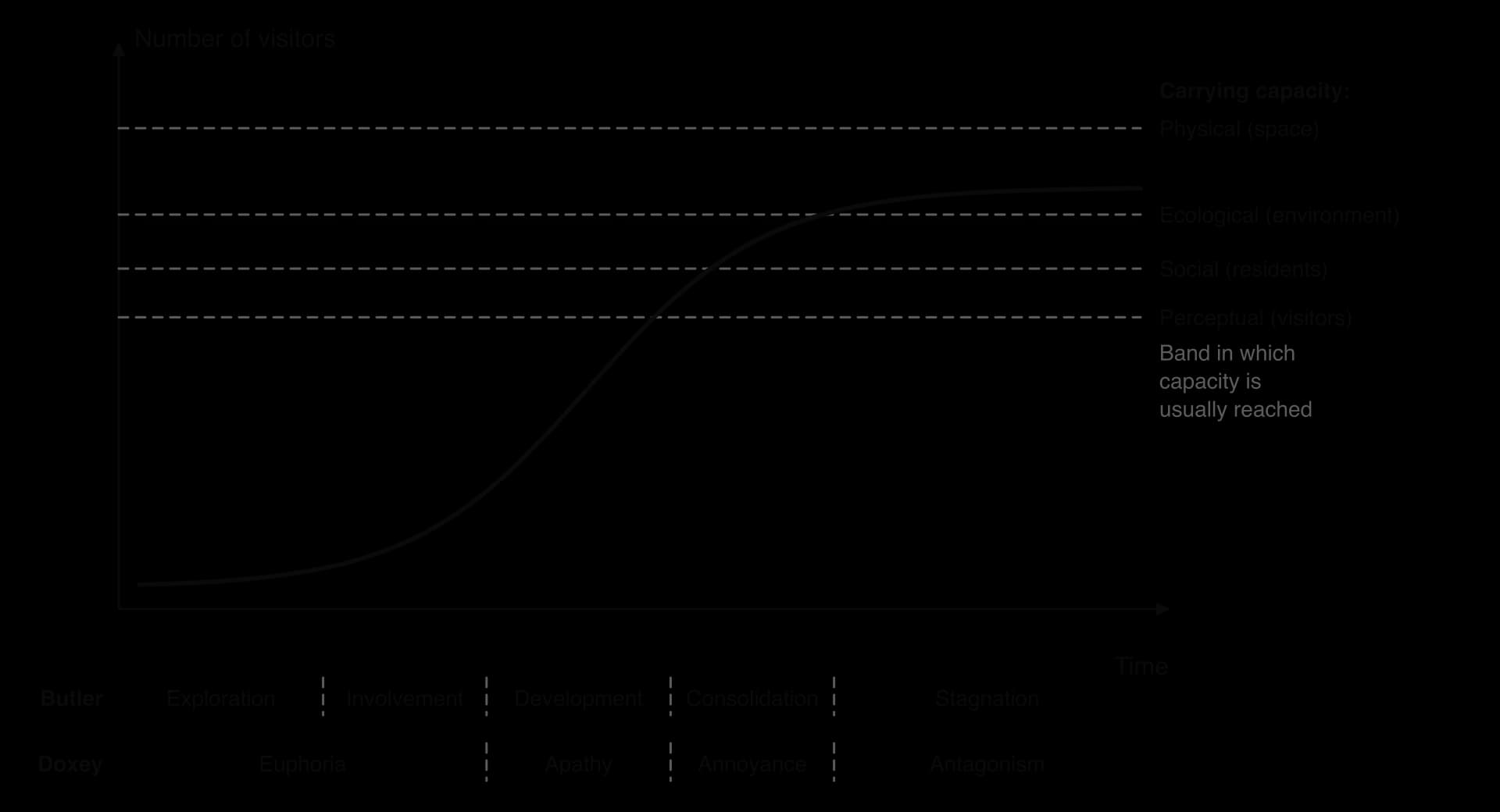
The figure combines carrying capacity with Butler’s model, which describes how a destination grows through exploration, involvement, development and consolidation to stagnation. Butler placed stagnation where the destination reaches its carrying capacity; showing capacity as a band, rather than a line, recognises that the five types are reached at different visitor numbers.
An environmental threshold is the level of use or stress beyond which an environment’s condition changes sharply, so that damage accelerates or becomes irreversible. Below the threshold, a footpath or reef recovers between seasons; above it, erosion gullies form, soil is lost faster than it forms, or a reef dies and turns to rubble. Thresholds explain why small increases in visitor numbers can sometimes cause large changes in a site.
The idea of a threshold is the key difference between ecological carrying capacity and gradual wear. A site managed below its threshold can absorb tourism indefinitely; a site pushed past it may need closure and expensive restoration, as at Maya Bay, or may never recover.
Carrying capacity is useful because it gives managers a target, supports quotas and permits, and makes clear that growth has limits. Its weaknesses are serious. It is not a single, fixed number: it changes with the season, with management (a surfaced path carries more walkers than a muddy one), and with who is asked, since a tour operator, a resident and an ecologist will give different answers. It can also suggest that damage starts only at a precise number, when in reality impacts increase gradually and depend on how visitors behave.
Many park managers therefore use limits of acceptable change (LAC) instead. Rather than asking "how many visitors?", LAC asks "how much change in the condition of the site is acceptable?", sets measurable indicators (path width, litter, wildlife sightings, visitor satisfaction), monitors them and acts when a limit is approached. LAC was developed in the 1980s for wilderness areas managed by the US Forest Service.
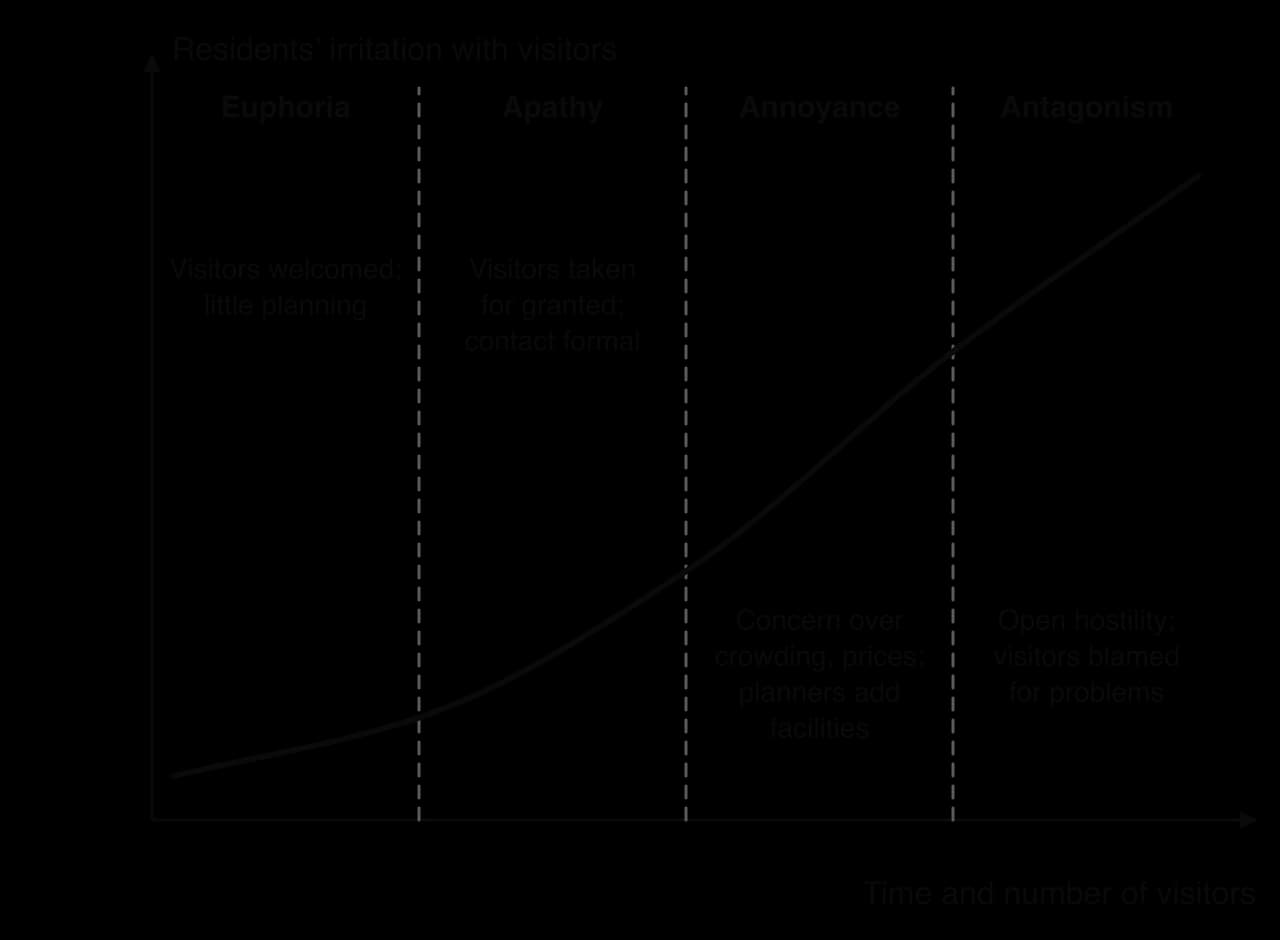
In 1975 the tourism researcher George Doxey proposed Doxey’s irridex (index of tourist irritation), a model of how residents’ attitudes to visitors change as tourism grows. It suggests that irritation rises through four stages as visitor numbers increase and the costs of tourism become more visible to residents.
Stage | Residents’ attitude | Typical situation |
|---|---|---|
Euphoria | Visitors are welcomed with enthusiasm; they bring money and interest | Early growth, few visitors, little planning or control |
Apathy | Visitors are taken for granted; contact becomes commercial and formal | Tourism is an established industry; marketing becomes the main concern of planners |
Annoyance (irritation) | Residents worry about crowding, prices, noise and the loss of local shops and housing | Visitor numbers approach saturation; planners add infrastructure rather than limit growth |
Antagonism | Irritation is openly expressed; visitors are blamed for social and economic problems | Protests, graffiti and campaigns against tourism; marketing tries to repair the image |
The irridex links closely to Butler’s model and to social carrying capacity. Euphoria matches the exploration and involvement stages, apathy the development stage, annoyance consolidation, and antagonism stagnation, when social carrying capacity has been passed. The protests of 2024 in Barcelona, where some residents sprayed visitors with water pistols, and the marches against mass tourism there in 2025, are typical of the antagonism stage.
Strengths | Limitations |
|---|---|
Simple and easy to apply: residents’ statements and protests can be matched to a stage | Assumes the community is homogeneous; in reality residents who earn from tourism may stay positive while others become hostile |
Highlights residents’ perspective, often ignored in growth-focused planning | Assumes change in one direction only; attitudes can improve when tourism is managed well or when it falls |
Links to Butler and social carrying capacity, so it helps to predict tension | Does not explain why some communities tolerate very high numbers (for example where tourism is the main employer) |
Suitable for fieldwork: questionnaires with a rating scale can place residents on the irridex | Based on case studies of the 1970s; social media and short-term lets have changed how quickly irritation spreads |
The model is most useful as a warning signal rather than a prediction. Where surveys show residents moving from apathy to annoyance, managers can act before antagonism sets in, for example by limiting short-term lets or spreading visitors more widely.
Site resilience is the ability of a tourism site to absorb visitor pressure and recover from damage without losing the qualities that attract visitors. It applies the core idea of resilience, the capacity of a system to absorb, recover from and adapt to stress, to a single site. Managers increase site resilience in two ways: by reducing the pressure on the site, and by making the site more able to withstand it.
The set of methods used to control the number, timing, distribution and behaviour of visitors is called visitor management. It ranges from simple signs and footpaths to quotas, prices and closures.
Permits, quotas and timed tickets keep numbers below a chosen capacity. Machu Picchu in Peru limited entry to the citadel to 2,500 visitors a day in 2011; in 2024 the daily limit was raised to 4,500, with up to 5,600 at peak times. Bhutan has limited its tourism since it first opened to visitors in 1974. Quotas protect a site directly but are unpopular with businesses that lose income, and they raise the question of how the scarce places are allocated.
Charging visitors raises money for management and can reduce demand. A tourist tax is a charge on visitors, usually per night of accommodation or on entry, collected by a government for public services, conservation or managing tourism.
Bhutan’s "high value, low impact" policy charges a Sustainable Development Fee: US$200 per night for all nationalities when the country reopened in September 2022, reduced to US$100 from September 2023 to win back visitors, while visitors from India pay a much smaller fee. Venice introduced a €5 access fee for day-trippers on peak days from 25 April 2024; in 2025 it applied on 54 days, rising to €10 for visitors who did not book at least four days ahead.
Prices work only if they are high enough to change behaviour. In Venice more visitors came on fee days in 2024 than had been expected, so the fee raised money but did not noticeably reduce crowds. Pricing is also unequal: it excludes people on low incomes first, so a site can become a place for the wealthy only.
Zoning divides an area into parts with different permitted uses, such as strict protection, quiet recreation and intensive visitor facilities. A honeypot site is a place that attracts large numbers of visitors because of its attractions and facilities. Managers can use honeypots deliberately: by providing car parks, toilets, cafés and short, surfaced walks at a few sites, they concentrate most visitors where the land can cope and keep quieter areas protected.
Engineering can make a site physically more resistant. Paths are surfaced, stone-pitched or laid with boardwalks; drainage stops water running down them; fences and signs keep people off fragile ground. In the Lake District in England, the Fix the Fells partnership, founded in 2001 by the National Park Authority, the National Trust and other bodies, repairs and maintains 344 upland paths covering about 660 km, using staff and more than 100 volunteer "lengthsmen", and spent almost £10 million in its first two decades. Hardening protects the surrounding vegetation but changes the character of a wild landscape and needs permanent funding.
Spreading visitors reduces peaks. Tourist boards promote lesser-known regions and off-season travel; timed entry slots spread visitors through the day; and transport links can be routed to quieter places. The Austrian village of Hallstatt, with about 740 residents and up to 10,000–30,000 visitors on busy days, allocated time slots to tour coaches from 2020 and capped arrivals at 54 coaches a day, about half the previous number.
Cities increasingly regulate the source of the pressure. In June 2024 the mayor of Barcelona, Jaume Collboni, announced that the city would end short-term tourist rentals by 2028, to return the apartments to the housing market. Venice has barred cruise ships of over 25,000 tonnes from the Giudecca Canal, which passes the historic centre, since August 2021, and from June 2024 it limited tour groups to 25 people and banned loudspeakers.
 YouTube
The most extreme option is to close a site completely, as at Maya Bay (2018–2022) and Boracay (2018). Closure allows ecosystems and infrastructure to recover, but local boat operators, hotel workers and vendors lose their incomes, and the reopened site may need permanent limits to stop the damage returning. Education and codes of conduct, such as rules on not touching coral or keeping a set distance from wildlife, are the cheapest option, but they depend on visitors choosing to follow them.
Sources: Wikipedia, "Machu Picchu", "Tourism in Bhutan", "Tourism in Venice", "Fix the Fells", "Hallstatt" and "2024 anti-tourism protests in Spain", 2026.
Option | Example | Strengths | Limitations |
|---|---|---|---|
Quotas, permits, timed tickets | Machu Picchu (2,500 a day in 2011; 4,500 in 2024) | Direct control of numbers; predictable | Limits are negotiated and often raised; excluded visitors go elsewhere |
Pricing and tourist taxes | Bhutan’s fee (US$100 a night from 2023); Venice day fee (from 2024) | Raises money for management; targets low-spending day-trippers | Excludes people on low incomes; may not reduce numbers |
Zoning and honeypots | National park car parks and short walks | Protects most of the area at low cost | Honeypots themselves are damaged and crowded |
Site hardening | Fix the Fells, Lake District (344 paths) | Increases physical and ecological capacity | Expensive; makes landscapes less natural |
Dispersal | Hallstatt coach slots (54 a day) | Reduces peaks without cutting total income | Spreads impacts to new places |
Regulating short-term lets and cruises | Barcelona (end by 2028); Venice cruise ban (2021) | Tackles housing and social pressures at source | Opposed by property owners, platforms and cruise lines; legal challenges |
Closure and restoration | Maya Bay (2018–22); Boracay (2018) | Allows recovery of damaged ecosystems | Loss of local income; temporary unless followed by limits |
No single option is enough. The most resilient sites combine several: Maya Bay reopened with a boat ban, a time limit and no swimming, rather than relying on closure alone. Management is most effective where one authority controls access, such as an island, a national park or a heritage site with a gate, and hardest in open cities, where visitors cannot easily be counted or stopped. The choice also involves power and equity: quotas and prices protect residents and ecosystems but shift the cost to visitors, especially those with less money, while doing nothing often shifts the cost to residents.
Sustainability means meeting the needs of the present without compromising the ability of future generations to meet their own needs. Sustainable tourism applies this to tourism. UN Tourism (formerly the UNWTO) defines it as tourism that takes full account of its current and future economic, social and environmental impacts, addressing the needs of visitors, the industry, the environment and host communities. It is a goal for all tourism, not a type of holiday.
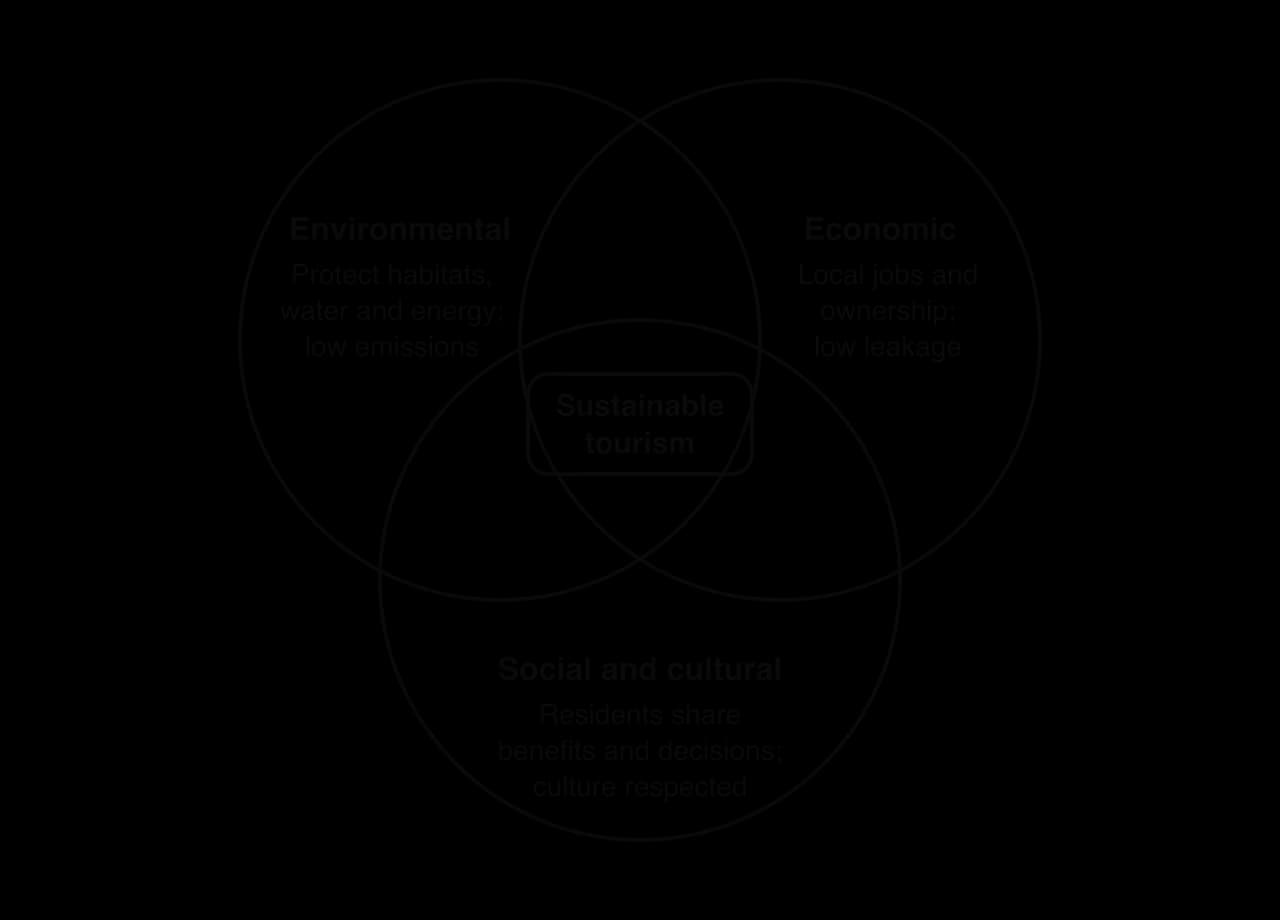
Sustainable tourism is linked to the Sustainable Development Goals (SDGs) adopted by the United Nations in 2015. Tourism is named in three targets: SDG 8 (decent work and economic growth, through tourism that creates jobs and promotes local culture), SDG 12 (responsible consumption and production, through tools to monitor sustainable tourism) and SDG 14 (life below water, through the sustainable use of marine resources, including tourism, by small island states and LDCs).
Ecotourism is one form of sustainable tourism. The International Ecotourism Society describes it as responsible travel to natural areas that conserves the environment, sustains the well-being of local people and involves interpretation and education. It is usually small in scale, based on nature and wildlife, and designed so that its income pays for conservation.
Small scale and low impact: small lodges built with local materials, renewable energy, limits on group size.
Local benefit: local ownership or employment, and a share of revenue for communities.
Conservation funding: entry fees and permits pay for rangers, research and habitat protection.
Education: guides interpret the environment and culture for visitors.
Community-based tourism (CBT) is tourism that is owned and managed by local communities, so that they decide how visitors are received and keep most of the income. Homestays, village tours and community-run lodges are examples. CBT often overlaps with ecotourism but can also be cultural, for example in rural villages in Thailand or the Andes.
Growing environmental awareness and concern about the impacts of mass tourism.
Demand for authentic, experience-based holidays, especially among higher-income travellers.
The need of national parks and conservation organisations for income, and of governments in LICs and MICs for foreign exchange.
Promotion by national tourism boards and certification schemes that make "green" holidays easier to find.
Costa Rica, an upper-middle-income country in Central America, is the best-known national example. It built a reputation for ecotourism based on rainforests, cloud forests and wildlife, and on a large share of its land in protected areas. International arrivals grew from 1.28 million in 2000 to 3.37 million in 2019.
Sources: UN Tourism, via World Bank, World Development Indicators, 2026.
Greenwashing: some businesses use labels such as "eco" or "green" without real environmental or social practices. Greenwashing misleads visitors and undermines genuine operators.
Long-haul flights: most ecotourists fly long distances to reach their destinations, so the carbon emissions of the trip can outweigh its local benefits.
Success can bring mass visitation: as in Costa Rica, a reputation for ecotourism attracts growing numbers, larger hotels and more roads, which can push sites past their carrying capacity.
Exclusion and leakage: high prices may exclude local and domestic visitors, and foreign-owned lodges may send profits abroad.
Certification: independent schemes can help visitors identify genuine operators, but they cost money for small businesses and vary in quality.
Ecotourism is most sustainable where it remains small, locally controlled and tied to conservation through fees and revenue sharing. It is least sustainable where the label is used for marketing alone or where the destination grows into mass tourism. Its biggest unresolved problem is the carbon cost of reaching it, which no local management can remove.
Rwanda is a small, landlocked country in East Africa with about 14.6 million people in 2025 and one of the highest population densities in Africa, about 587 people per km² in 2023. It is a low-income country, with a gross national income per capita of US$1,150 in 2025 (Atlas method), below the World Bank’s low-income threshold of US$1,175 in the classification published in July 2026. Since the genocide against the Tutsi in 1994, the government has made tourism, and especially gorilla tourism, a central part of its development strategy.
Gorilla tourism takes place in Volcanoes National Park in the north-west, a park of about 160 km² of montane rainforest, bamboo and alpine vegetation on the slopes of five of the eight Virunga volcanoes. It borders Virunga National Park in the Democratic Republic of the Congo (DRC) and Mgahinga Gorilla National Park in Uganda, and it lies about two hours by road from Kigali’s international airport. Established in 1925, it was the first national park created in Africa.
Mountain gorillas live only in two areas: the Virunga volcanoes shared by Rwanda, Uganda and the DRC, and Uganda’s Bwindi Impenetrable National Park. Their numbers in the Virungas fell to a low of 254 in a 1981 census, after decades of hunting and habitat loss: between 1969 and 1973, 1,050 ha of the park were cleared to grow pyrethrum, a crop used for insecticide. The American primatologist Dian Fossey, who founded the Karisoke Research Centre in the park in 1967, campaigned against poaching until she was murdered there in 1985. War in the early 1990s stopped tourism entirely from 1992 until 1999.
Rwanda chose to sell gorilla tourism as an exclusive, high-priced product. Visitors trek in small groups with guides and trackers to spend a limited time with one habituated gorilla family, keeping at least 7 m away. In May 2017 the Rwanda Development Board (RDB) doubled the price of a gorilla permit from US$750 to US$1,500, among the highest prices for any wildlife experience in the world. The aim is to earn the most income from the fewest visitors, keeping numbers within the ecological carrying capacity of the gorillas and their habitat.
At the same time the government raised the share of park revenue given to communities around Rwanda’s national parks from 5% to 10%. RDB reported in 2022 that over Rwf 7.9 billion had been spent on 880 community projects since the revenue-sharing scheme began in 2005, including health centres, clean water supplies, markets and housing for teachers. Each year the Kwita Izina ceremony names the gorillas born in the park: 354 baby gorillas had been named by 2022, and the event is used to promote conservation and the country’s image.
Gorilla tourism sits inside a wider national strategy. The "Visit Rwanda" brand sponsors Arsenal, Bayern Munich and the LA Clippers, and officials credit the deals with an 8% rise in visitor numbers. Rwanda also markets Nyungwe Forest (chimpanzees and a canopy walkway), Akagera National Park (savanna wildlife) and Lake Kivu, and it has built the Kigali Convention Centre to attract conferences, so that visitors who come for the gorillas stay longer and spend more elsewhere.
 YouTube
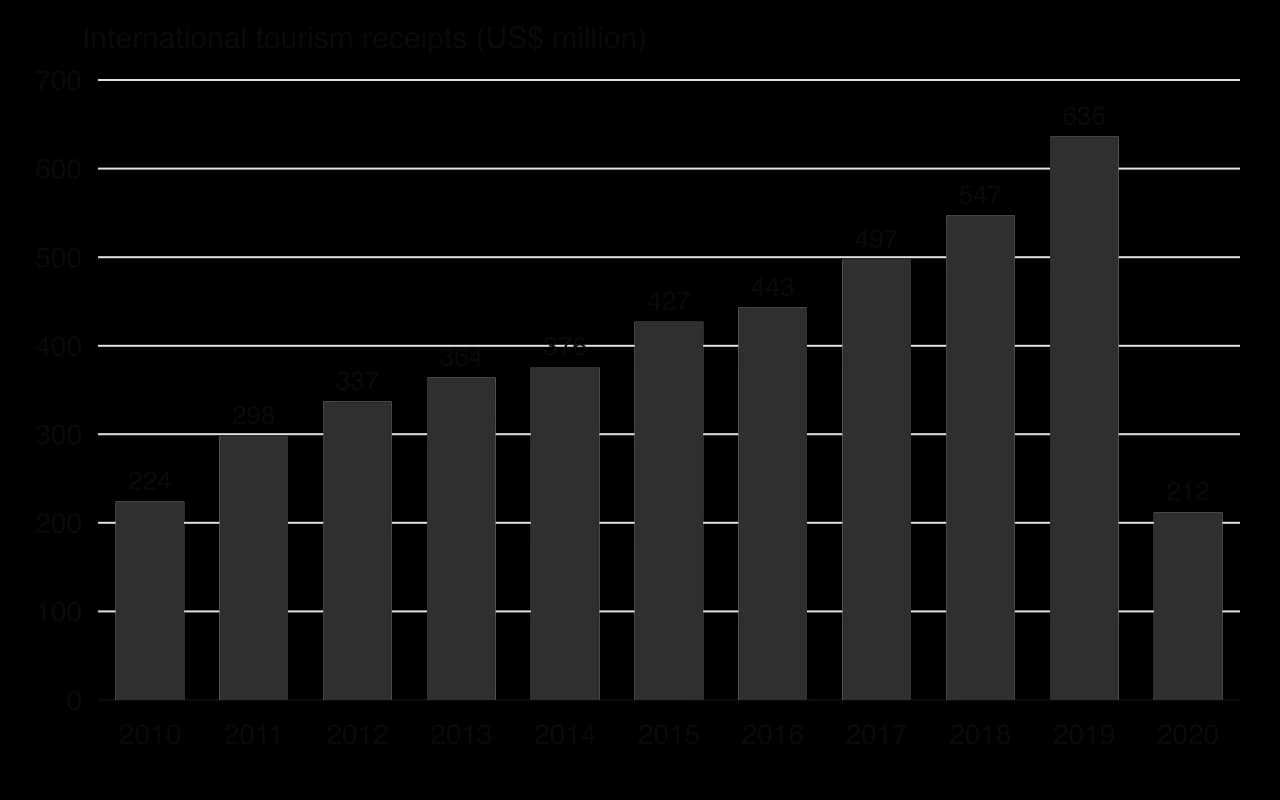
Economic. International tourism receipts almost tripled, from US$224 million in 2010 to US$636 million in 2019, when they made up 28.2% of the country’s export earnings; arrivals rose from 0.67 million in 2010 to 1.71 million in 2018. Tourism became Rwanda’s largest source of foreign exchange. The COVID-19 pandemic cut receipts by two-thirds in 2020, to US$212 million, which showed the risk of dependence on international visitors.
Environmental. The mountain gorilla population has recovered. The Virunga population was counted at 480 in 2010, and the total population of the species (Virungas and Bwindi) was estimated at about 1,063 in 2019; in 2018 the IUCN moved the mountain gorilla from critically endangered to endangered. Tourism income pays for rangers, anti-poaching patrols and veterinary care, and revenue sharing gives neighbouring farmers a reason to protect the park rather than clear it. In 2022 Rwanda announced plans to enlarge the park from about 13,000 ha to 23,000 ha, with a 6,260 ha buffer zone for agroforestry, at a cost of about US$255 million.
Social. Revenue sharing has paid for clinics, water and markets in districts around the park, and tourism employs guides, trackers, porters and lodge staff. Cultural villages near the park show visitors traditional dance, crafts and farming, a form of community-based tourism that keeps income in local hands.
Exclusivity and equity: at US$1,500, one permit costs about 1.3 times Rwanda’s GNI per capita for a whole year, so almost no Rwandans can visit their own national symbol at the full price.
Leakage: many visitors arrive on international airlines, book through foreign tour operators and stay in luxury lodges, several of them run by international companies, so much of their spending outside the permit leaves the country.
Dependence: one species in one park is the core of the product; a disease outbreak, conflict across the border in the DRC or another pandemic could close it. Respiratory infections, which gorillas can catch from people, cause about 20% of sudden gorilla deaths.
Land pressure: in one of Africa’s most densely populated countries, enlarging the park means moving farming households, and crop raiding by park animals costs farmers money that revenue sharing only partly compensates.
Marketing costs: critics have questioned why a low-income country should spend on sponsoring wealthy European football clubs, while the government argues that the deals raise the country’s profile and bring in visitors.
Pillar | Evidence that it is sustainable | Evidence of limits |
|---|---|---|
Environmental | Gorilla numbers recovering; park expansion planned; low visitor numbers within carrying capacity | Disease risk from contact with people; habitat surrounded by dense farmland |
Economic | Receipts almost tripled 2010–2019; tourism the largest earner of foreign exchange; high value per visitor | 67% fall in receipts in 2020; leakage to foreign airlines, operators and lodges |
Social | 10% of park revenue shared; 880 community projects; jobs for guides and porters | Most Rwandans cannot afford permits; households displaced by park expansion; uneven benefit between villages |
Gorilla tourism in Rwanda meets most tests of sustainable tourism. It has funded the recovery of an endangered species, earned foreign exchange for a low-income country and shared part of its income with the communities that bear the costs of living beside the park. Its high-price, low-volume model deliberately keeps use within ecological carrying capacity.
The main limits are equity and dependence: the product is designed for wealthy foreign visitors, much of their total spending leaks abroad, and a single shock can stop it, as in 2020. Its long-term sustainability depends on spreading visitors to other parks and products, and on continuing to give local people a real share of the benefits.
Key concept | How the case shows it |
|---|---|
Possibility | A species close to extinction in 1981 is recovering because tourism made it more valuable alive; the planned park expansion is a choice about the future |
Power | The national government and RDB set prices and rules; communities receive a share but do not decide them; foreign visitors’ ability to pay decides who participates |
Sustainability | Income pays for conservation, but dependence on one product and on long-haul visitors limits the economic and environmental sustainability of the model |
Sources: World Bank, World Development Indicators, 2026; The New Times, "RDB announces new gorilla permit tariffs", 7 May 2017; KT Press, "Kwita Izina 2022", August 2022; Wikipedia, "Volcanoes National Park", "Tourism in Rwanda" and "Mountain gorilla", 2026.
Explain how a high permit price can support both conservation and development in Rwanda.
Evaluate the revenue-sharing scheme from the perspective of farming households living beside the park.
To what extent is gorilla tourism in Rwanda an example of ecotourism rather than simply sustainable tourism?
International tourism recovered from the COVID-19 pandemic to about 1.4 billion arrivals in 2024, but its future pattern will depend on several factors that are changing quickly. Three are especially important: social media, international security and the growth of diasporas.
Social media platforms such as Instagram, TikTok and YouTube, and review sites such as Tripadvisor, have changed how people choose destinations. A single viral image can make a place famous overnight, and peer reviews have replaced guidebooks for many travellers. National tourism boards now pay influencers to promote destinations, and businesses depend on their online ratings.
The effects can be extreme in small places. Hallstatt, a lakeside village in the Austrian Alps with about 740 residents, became widely known in East Asia after a South Korean television series in 2006 and images shared as "the most Instagrammable town in the world"; in 2013 rumours that it had inspired the film Frozen increased day visits further.
Hallstatt receives an estimated 10,000 to nearly 30,000 visitors on busy days, most on coach tours that stop briefly for photographs, and in 2012 a full-scale replica of the village was built in Huizhou, China. In 2023 residents blocked the road tunnel used by coaches in protest, and the mayor promised to cut coach numbers further.
Social media also drives last-chance tourism: travel to see places, landscapes or species that are disappearing or changing, such as melting glaciers, bleaching coral reefs or polar wildlife, before it is too late. Last-chance tourism can fund conservation and raise awareness, but the visitors’ flights add to the climate change that threatens the places they come to see.
Sources: Wikipedia, "Hallstatt", 2026.
Tourists avoid places they believe are dangerous, so terrorism, conflict, crime and disease can empty a destination quickly. Governments influence these decisions through a travel advisory: official advice to their citizens about the safety of travelling to another country, ranging from general caution to advice against all travel. Advisories also affect insurance, because many policies are invalid where a government advises against travel, and tour operators often cancel holidays to the countries concerned.
Tunisia shows the effect of security shocks on a tourism-dependent economy. After gunmen killed 22 people, most of them foreign visitors, at the Bardo National Museum in Tunis in March 2015, a gunman killed 38 people, 30 of them British, at a beach hotel at Port El Kantaoui near Sousse on 26 June 2015. On 8 July the UK government changed its advice to "advise against all but essential travel", about 3,000 British tourists were flown home, and major tour operators, including TUI, cancelled holidays to Tunisia for the rest of the season.
In Sri Lanka, suicide bombings of churches and luxury hotels on Easter Sunday, 21 April 2019, killed 269 people, including at least 45 foreign nationals. Arrivals fell from 2.52 million in 2018 to 2.03 million in 2019, ending a decade of growth.
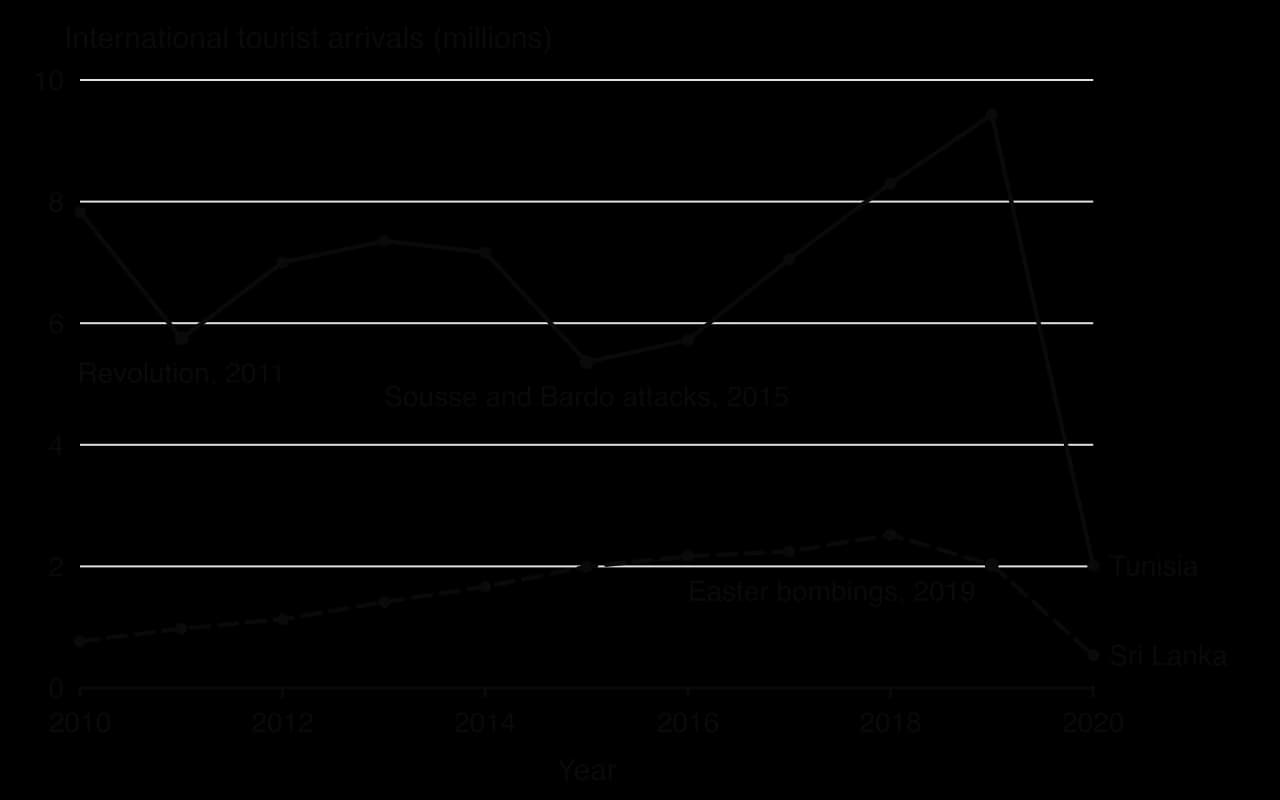
The graph shows that security shocks cause sharp but often temporary falls. Tunisia’s arrivals fell from 7.16 million in 2014 to 5.36 million in 2015, but recovered to 7.05 million by 2017 and reached a record 9.43 million in 2019. Recovery depends on how long advisories last, on new security measures and on marketing, and destinations that depend on one source market recover most slowly. The pandemic was a security shock of a different kind: health security closed borders worldwide in 2020, far more deeply than any terrorist attack.
Sources: Wikipedia, "2015 Sousse attacks" and "2019 Sri Lanka Easter bombings", 2026; UN Tourism, via World Bank, World Development Indicators, 2026.
A diaspora is a population that has spread from its original homeland to other countries while keeping cultural, emotional or family links with it. International migration has created large diasporas, such as people of Indian, Chinese, Mexican, Filipino and Nigerian origin around the world, and they generate a growing flow of visiting friends and relatives tourism (VFR) back to their countries of origin.
Diasporas also create roots tourism: travel by people to the places their ancestors came from, to explore their family history and identity. Ghana’s Year of Return in 2019, launched by President Nana Akufo-Addo in Washington in 2018, invited people of African descent, especially African Americans, to visit Ghana 400 years after the first enslaved Africans were recorded arriving in Virginia in 1619. International arrivals rose by 18% and spending per tourist rose from US$1,862 in 2017 to US$2,589. Later, some Ghanaians complained that wealthy returnees had raised prices beyond the reach of local people.
Diaspora flows are a stable market because they depend on family ties rather than fashion: VFR travellers tend to return after crises sooner than other tourists. They also support new air routes, because airlines can rely on year-round demand between, for example, cities in the United Kingdom and India or the Gulf and South Asia.
Sources: Wikipedia, "Year of Return, Ghana 2019", 2026.
Rising incomes in Asia: the new global middle class, especially in China and India, will provide most of the growth in international travel.
Ageing populations: more retired people in HICs, with time and savings, travel off-season and favour cruises and health tourism.
Low-cost airlines and visa policy: cheaper flights and easier visas, such as electronic visas and visa-free agreements, open new destinations.
Climate change: less reliable snow threatens lower ski resorts, and summer heat waves in the Mediterranean may shift visitors to spring, autumn or cooler regions.
Carbon pricing: taxes on aviation fuel or flights would raise the cost of long-haul travel and could favour shorter trips and rail.
Who takes part in international sport is not decided by ability alone. Governments, international federations and agreements decide which countries and athletes may compete, and cultural change decides which groups are encouraged or excluded. These influences have become more important as international sport has grown in political and commercial value.
The Gleneagles Agreement of 1977 is the classic example of politics shaping participation. Meeting at Gleneagles in Scotland, the heads of government of the Commonwealth agreed unanimously to discourage sporting contact and competition with South Africa, as part of the international campaign against apartheid. The sports most affected, cricket and rugby union, were dominated by Commonwealth countries, so the boycott isolated South African sport. After apartheid began to be dismantled, South Africa returned to international competition, taking part in the 1992 Barcelona Olympics, its first Games since 1960.
The World Anti-Doping Agency (WADA), founded in Lausanne in November 1999 and based in Montreal since 2002, sets common rules against doping through the World Anti-Doping Code, first applied before the 2004 Athens Olympics and accepted by more than 650 sports organisations. In 2016 the McLaren Report, commissioned by WADA, found that more than 1,000 Russian athletes in over 30 sports had been involved in or benefited from state-sponsored doping between 2011 and 2015. As a result, Russian athletes competed under neutral names and flags at several Olympic Games.
Other agreements and rulings also shape participation:
Sanctions: after Russia’s invasion of Ukraine in 2022, most international federations excluded teams from Russia and Belarus, and only individual athletes approved as neutrals could compete at the Paris 2024 Olympics.
The Bosman ruling (1995): the European Court of Justice ruled that footballers in the European Union could move freely to a new club when their contracts ended, and limits on the number of players from other EU countries were removed, which made European leagues much more international.
The Olympic Charter: it forbids discrimination of any kind, giving athletes and campaigners a basis to challenge exclusion.
Refugee athletes: the IOC created a Refugee Olympic Team for athletes who cannot represent their home countries. It had 10 athletes at Rio 2016, 29 at Tokyo 2020 and 37 at Paris 2024, where the boxer Cindy Ngamba won its first medal, a bronze.
Eligibility rules for women’s categories are a live and contested debate. Some sporting bodies and athletes argue that rules based on sex are needed to keep competition fair; others, including many human rights organisations, argue that such rules exclude transgender and intersex women and can involve intrusive testing.
In March 2026 the IOC adopted a policy that, from the Los Angeles 2028 Games, limits women’s events at the Olympics to athletes who test negative in a one-time screening for the SRY gene, a marker of male sex development; athletes who are not eligible may compete in men’s, mixed or open categories. The IOC presents the policy as protecting fairness and safety, World Athletics has supported it, and critics argue that genetic screening is intrusive and excludes transgender and some intersex women. Other federations have adopted different rules, and the debate continues.
Sources: Wikipedia, "Gleneagles Agreement", "World Anti-Doping Agency", "Refugee Olympic Team" and "Participation of women in the Olympics", 2026.
Changing ideas about the roles of women have greatly increased their participation in international sport. Women were 13% of athletes at the 1964 Olympics, 23% in 1984 and about 44% at London 2012, the first Games at which every national Olympic committee sent female athletes: Saudi Arabia, Qatar and Brunei included women for the first time. For Paris 2024 the IOC allocated equal numbers of athlete places to women and men, and described them as the first Games with full gender parity on the field of play. Of the 11,215 athletes registered in Paris, 5,503 (49.1%) were women.
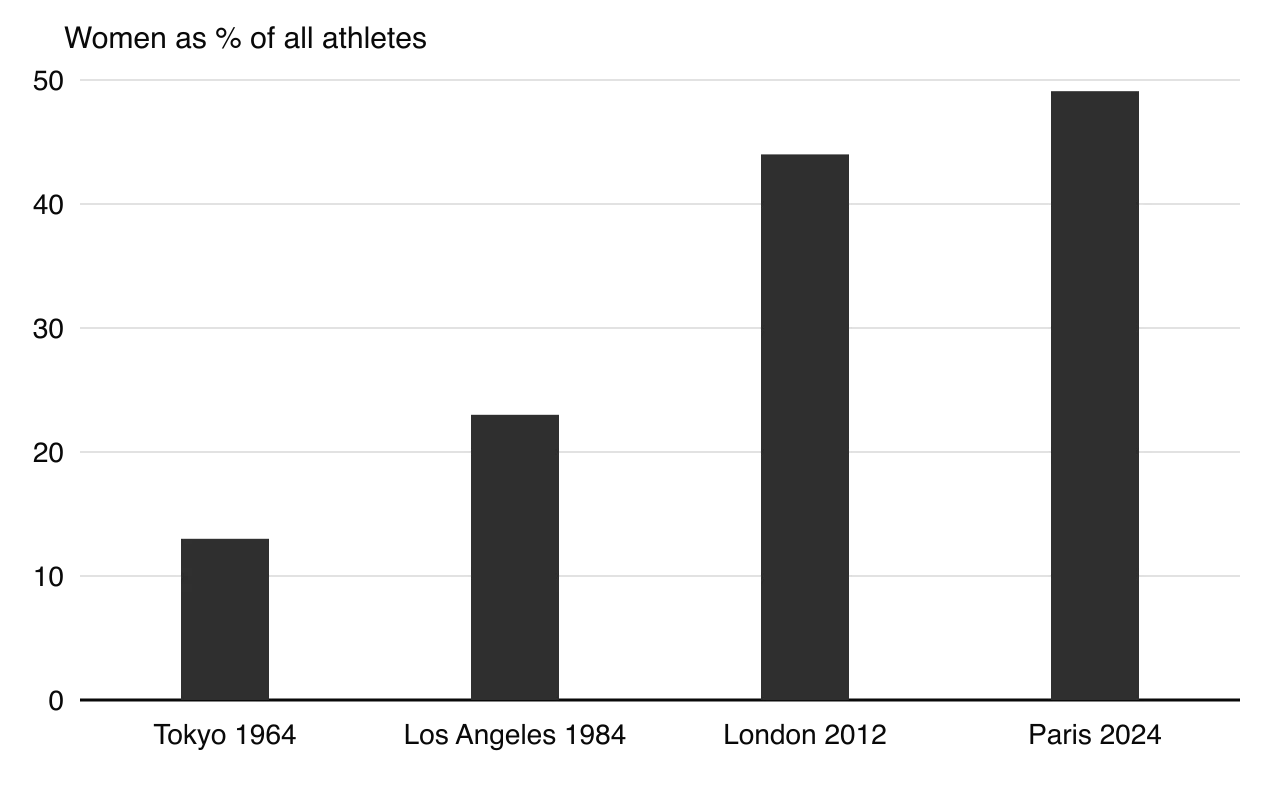
Women’s professional sport has grown fastest in football. The 2023 FIFA Women’s World Cup in Australia and New Zealand was the first with 32 teams, drew a total attendance of 1,978,274, an average of about 30,900 per match, and offered prize money of US$110 million, US$80 million more than in 2019. Growing broadcasting deals and professional leagues have followed.
Barriers remain. Men’s prize money and pay are still far higher in most sports; women’s sport receives a much smaller share of media coverage; and some governments restrict women’s participation for political or religious reasons. In Afghanistan, the Taliban government that returned to power in 2021 has banned women from playing sport, and Afghan women athletes who compete abroad do so in exile.
The Paralympic Games are the main international multi-sport event for athletes with impairments, held immediately after the Olympic Games in the same host city, a practice since Seoul 1988 that an agreement between the IOC and the IPC made binding in 2001. The name now refers to the Greek para, "beside" or "alongside", for Games held in parallel with the Olympics.
The movement began in 1948, when the neurologist Ludwig Guttmann organised a sports competition at Stoke Mandeville Hospital in England for British Second World War veterans with spinal cord injuries, on the same day as the opening of the London Olympics. The first Paralympic Games, in Rome in 1960, had about 400 athletes from 23 countries. The International Paralympic Committee (IPC), the global governing body, was founded in 1989 and is based in Bonn, Germany. Athletes are grouped by a classification system based on how an impairment affects performance in each sport, across ten eligible impairment types.
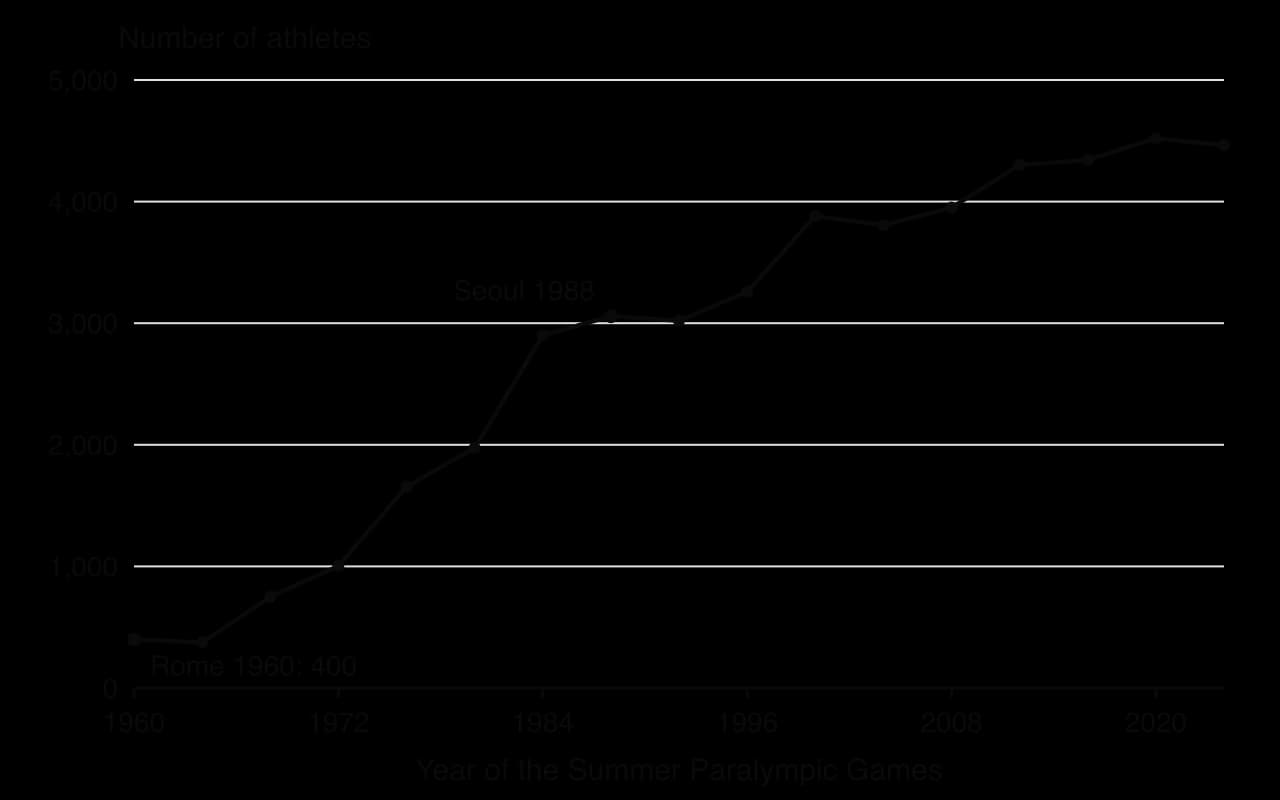
The Games have become a major media event. London 2012 was a turning point: the British broadcaster Channel 4 took the television rights and gave the Games prime-time coverage, and in 2024 all 22 Paralympic sports were televised for the first time, with Channel 4’s coverage reaching 20 million people. Paris 2024 had 549 medal events in 22 sports and sold 2.5 million tickets, a Paralympic record.
The Paralympics have changed how disability is seen in many countries, presenting para athletes as elite competitors rather than objects of sympathy. Their effect on everyday participation is weaker. Disabled people in most countries remain less likely to take part in sport than non-disabled people, because of inaccessible facilities, transport and cost, and the media attention given to elite athletes does not by itself remove these barriers. Participation at the Games also reflects wealth: athletes from HICs and large emerging economies have far better access to specialist equipment, coaching and classification, so these countries win most of the medals.
Sources: Wikipedia, "Paralympic Games", "Summer Paralympic Games" and "2024 Summer Paralympics", 2026.
Influence | Example | Effect on participation |
|---|---|---|
International agreement | Gleneagles Agreement (1977) | Excluded apartheid South Africa from Commonwealth sport until its readmission in the early 1990s |
Anti-doping rules | WADA Code (2004); McLaren Report (2016) | Restricted Russian participation to neutral athletes |
Sanctions | Exclusion of Russia and Belarus after 2022 | National teams barred; only approved neutral individuals at Paris 2024 |
Legal ruling | Bosman ruling (1995) | Free movement of EU footballers; more international leagues |
Changing gender roles | Equal Olympic quotas, Paris 2024; Women’s World Cup 2023 | Women’s participation at parity at the Olympics; professional growth |
Political restriction | Taliban ban in Afghanistan (from 2021) | Afghan women excluded from sport at home |
Paralympic movement | IPC; 4,463 athletes from 170 nations, Paris 2024 | Para athletes competing at the elite level worldwide |
Questions on managing tourism and sport for the future appear in Paper 1 as a 10-mark structured question on a stimulus, often visitor numbers against carrying capacity, a graph of arrivals before and after a shock, or a survey of residents’ attitudes, and a choice of 10-mark extended questions on managing hotspots, sustainable tourism, future tourism or participation in international sport.
The table shows international tourist arrivals in Tunisia, 2013–2019.
Year | 2013 | 2014 | 2015 | 2016 | 2017 | 2018 | 2019 |
|---|---|---|---|---|---|---|---|
Arrivals (millions) | 7.35 | 7.16 | 5.36 | 5.72 | 7.05 | 8.30 | 9.43 |
Sources: UN Tourism, via World Bank, World Development Indicators, 2026.
Unsustainable growth in tourism hotspots causes environmental damage (erosion, sewage, coral loss), social problems (overtourism, touristification, protests) and economic costs (rising prices, dependence).
Carrying capacity has five types, physical, ecological, perceptual, social and economic, reached at different visitor numbers; beyond an environmental threshold, damage accelerates or becomes irreversible. Limits of acceptable change is an alternative approach.
Doxey’s irridex describes residents’ attitudes moving from euphoria to apathy, annoyance and antagonism as tourism grows; it links to Butler’s model but assumes a uniform community.
Management to increase site resilience includes quotas, pricing and tourist taxes, zoning and honeypots, site hardening, dispersal, regulating short-term lets and cruises, and closure; it is most effective where access can be controlled.
Sustainable tourism balances economic, social and environmental impacts; ecotourism is one form of it, with risks of greenwashing, long-haul emissions and growth into mass tourism.
Rwanda’s high-price gorilla tourism has funded conservation, foreign exchange and community projects, but it is exclusive, exposed to shocks and partly leaks abroad.
Future international tourism will be shaped by social media, international security (Tunisia 2015, Sri Lanka 2019), diaspora growth and roots tourism, and by incomes, ageing, climate change and carbon pricing.
International sport participation is shaped by agreements and rules (Gleneagles, WADA, sanctions), changing gender roles (parity at Paris 2024) and the growth of the Paralympics.
I can explain the environmental, social and economic consequences of overtourism in an urban and a rural hotspot.
I can distinguish the five types of carrying capacity and explain what an environmental threshold is.
I can draw Doxey’s irridex and evaluate it as a model.
I can evaluate at least four management strategies with named examples and evidence of their results.
I can explain sustainable tourism and ecotourism, and evaluate how sustainable ecotourism is.
I can evaluate gorilla tourism in Rwanda as sustainable tourism in a low-income country.
I can examine how social media, security and diasporas influence future tourism, with data.
I can discuss political and cultural influences on international sport participation, including the Paralympics.
Affluence can outweigh personality: an allocentric person on a low income may have no opportunity to travel internationally.
Plog's model also links personality types to stages of destination growth, as mass psychocentric tourists follow earlier allocentric visitors.
Good answers may be well structured (AO4) and may additionally offer a critical evaluation (AO3) which argues that affluence determines whether and how far people travel, while personality influences what kind of tourism they choose, so their relative importance depends on the decision being examined. Another approach might be to consider other factors (life-cycle stage, gender, culture, place of residence) or to critique Plog's model (based on US travellers in the 1970s; personalities change over time and with travel experience). Perspectives from people in societies at different stages of development might also be considered.
For 5–6 marks, expect some weakly-evidenced outlining of the influence of personality and/or affluence.
For 7–8 marks, expect a structured account which includes:
either well-evidenced explanation of the influence of both personality and affluence on types of tourism, using examples of tourism types and destinations
or a discursive conclusion (or ongoing evaluation) grounded in geographical concepts and/or perspectives.
For 9–10 marks, expect both of these traits.
NB. Maximum [6] if only personality or only affluence is considered.
Marks | Level descriptor |
|---|---|
0 | The response does not reach a standard described by the descriptors below. |
1–2 | Too brief, lists unconnected information, not focused on the question and lacks structure. Knowledge is very general, with large gaps or errors; examples or case studies are missing or only listed. No analysis; terminology is missing or used incorrectly. |
3–4 | Too general, lacks detail, not focused on the question and largely unstructured. Outlines examples, statistics and facts, both relevant and irrelevant, with links to the question only listed. Basic terminology is used, with errors or inconsistently. No critical evaluation of evidence; any conclusion is irrelevant. |
5–6 | Partially addresses the question, with a narrow argument, an unsubstantiated conclusion and limited evaluation. Describes relevant supporting evidence (examples, case studies) and outlines links to the question. The argument repeats one point or covers only part of the question. Other perspectives, or strengths and weaknesses of evidence, are listed. |
7–8 | Addresses the whole question; the analysis is evaluated and the conclusion is relevant but lacks balance. Relevant evidence is described correctly and covers all the main points. The argument is clear but one-sided or unbalanced. Complex terminology is used correctly but not consistently. Other perspectives, or strengths and weaknesses of evidence, are described. |
9–10 | In-depth and specific to the question (topic and command term). Correct, relevant examples, statistics and detail are integrated and their link to the question explained. The argument is balanced, explaining complexity, exceptions and comparisons. Evaluation of evidence and perspectives is well developed, and the conclusion is balanced and aligned with the evidence. Logically structured and easy to follow. |
To what extent are differences in participation in sport between social groups narrowing over time?
10 marks
Examine why outstanding physical attractions are rarely enough on their own to turn a rural area into a tourism hotspot.
10 marks