E Leisure, tourism and sport
See how the four parts of the option fit together, from who has leisure time to managing overtourism, with the case studies, key concepts, SL/HL arrangement and Paper 1 questions in one place.
- IB Geography
- SL and HL
What E covers
From the subject guide: what you need to know and be able to do.
Option: changing leisure patterns, and tourism and sport from the local to the international scale.
4 subtopics in Leisure, tourism and sport
Each one has its own page once something is published for it.
- E.1Changing leisure patterns64 questions · notes
- E.2Tourism and sport at the local and national scale72 questions · notes
- E.3Tourism and sport at the international scale85 questions · notes
- E.4Managing tourism and sport for the future73 questions · notes
An overview of E Leisure, tourism and sport
The leisure, tourism and sport option studies how people use their free time and how places become sites of leisure, from a neighbourhood park to a World Cup host city. Tourism is one of the largest flows of people and money in the world, about 1.4 billion international arrivals in 2024, so its growth changes economies, landscapes and communities in both the places tourists come from and the places they visit.
Questions that frame the option
Each subtopic answers one broad geographic question. The first asks how human development gives rise to leisure activities. The second asks how physical and human factors turn particular places into sites of leisure. The third asks why some countries have far more power than others to take part in global tourism and sport. The fourth asks what futures are possible for managing tourism and sport, and for deciding who takes part, at different scales.
Behind these inquiries lie real questions about real places:
Why did outbound trips from China fall by 87% in 2020, a year in which Chinese incomes kept rising?
How does a dairy farm in Somerset become a temporary city of more than 200,000 people for five days, and who bears the costs?
Why did Qatar, a state of under three million people, win the right to host the 2022 FIFA World Cup, and was it worth the cost to the migrant workers who built it?
Can a gorilla permit costing US$1,500 pay for both conservation and development in a low-income country such as Rwanda?
Why have residents of Barcelona and Mallorca protested against the visitors on whom their economies depend?
What the option covers
Subtopic | Main question | Case study and detailed examples |
|---|---|---|
E.1 Changing leisure patterns | How does development change the time, money and choices people have for leisure, and who takes part? | Case study: China, from Golden Weeks to the world’s largest outbound market. Detailed examples: participation in the UK (Sport England’s Active Lives survey); Malawi and India as contrasts |
E.2 Tourism and sport at the local and national scale | Why do some places become hotspots and sites of leisure, and how far do they draw their users from? | Case study: Glastonbury Festival at Worthy Farm, Somerset. Detailed example: the Bundesliga, Germany. Short examples: Cancún, Atlantic City, the Lake District, the Maha Kumbh Mela 2025 |
E.3 Tourism and sport at the international scale | Which countries gain from global tourism and sport, and on whose terms? | Case study: Qatar and the 2022 FIFA World Cup. Detailed examples: niche tourism in New Zealand, Nepal, Croatia and Peru; TUI and Marriott; the Maldives, Fiji and The Gambia; London 2012 and Brazil 2014 |
E.4 Managing tourism and sport for the future | How can hotspots stay within their limits, and what will shape future tourism and sport participation? | Case study: gorilla tourism in Rwanda. Detailed examples: Venice, Barcelona, Maya Bay, Boracay, Hallstatt; Tunisia and Sri Lanka after attacks; Ghana’s Year of Return; the Gleneagles Agreement and the Paralympic Games |
How the subtopics connect
The four subtopics form a sequence of scale and time, from who has leisure time and money to how growth can be managed so that places and participation last. Development creates demand for leisure; that demand settles in particular places with the right primary and secondary resources; successful places and countries then compete for visitors, investment and events in a global market; and growth eventually meets the limits of a place, raising questions of management and of who is allowed to take part.
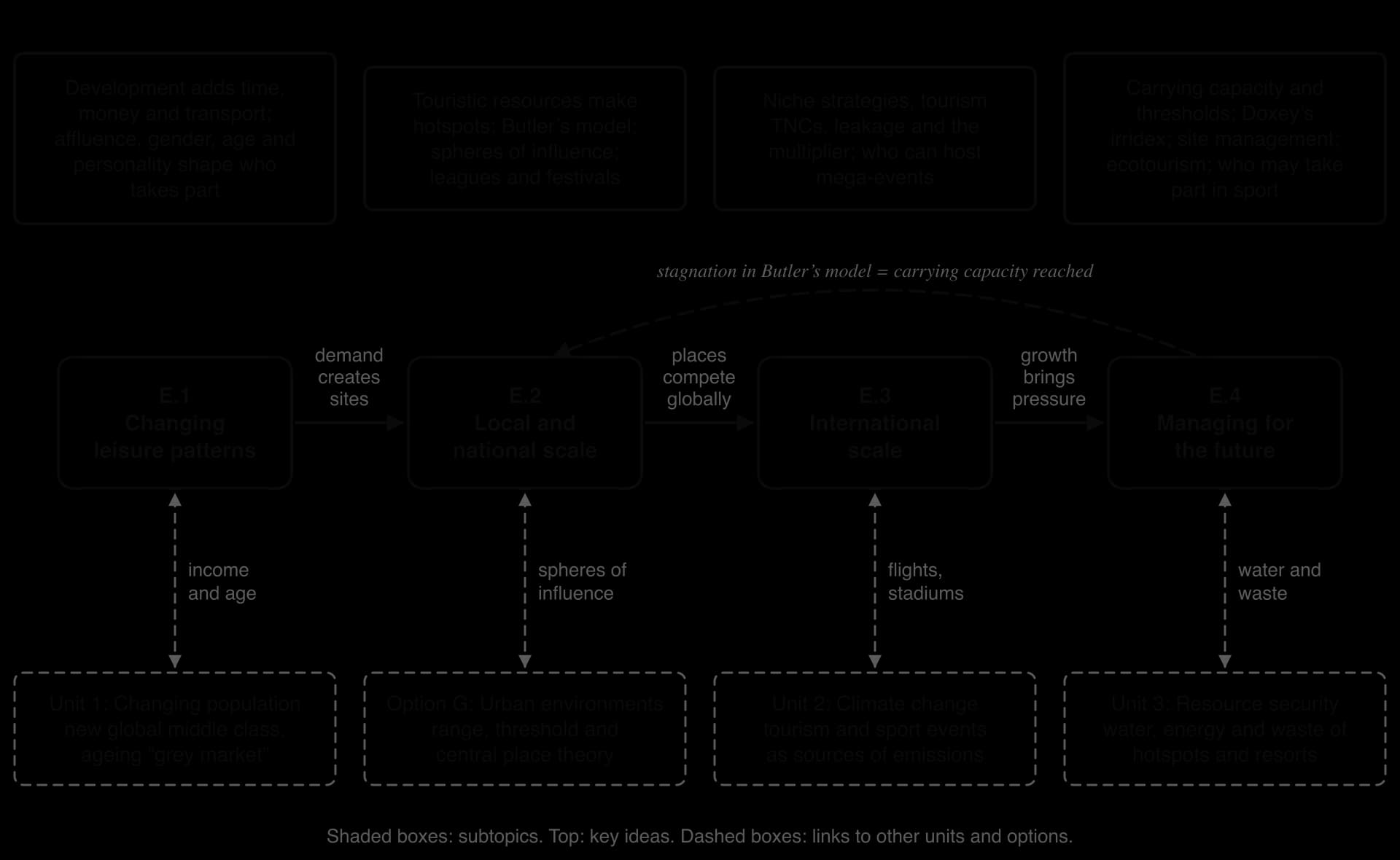
The concept map shows one important loop. Butler’s tourism area life cycle, taught at the national scale, ends in stagnation when a resort reaches its carrying capacity, which is the starting point for managing hotspots. Plog’s psychographic model links the first two subtopics in the same way: allocentric travellers “discover” a place in Butler’s exploration stage and psychocentric ones arrive at stagnation.
The dashed links show where the option meets the rest of the course. The growth of the new global middle class and of ageing populations drives demand. The sphere of influence of a park or stadium uses the same ideas of range and threshold as central place theory in urban geography. Long-haul flights and mega-events add to global emissions, and resorts in dry places compete with residents for water and generate large volumes of waste.
Key concepts in leisure, tourism and sport
All four key concepts run through the option, with three further concepts specific to it.
Concept | How it appears in the option |
|---|---|
Place | Primary touristic resources such as Rwanda’s mountain gorillas or Machu Picchu are unique to their place; a tourism hotspot depends on its site, accessibility and image. |
Process | Industrialisation, paid holidays and cheap flights create leisure time; cumulative causation makes hotspots grow; leakage and the multiplier effect determine how much tourist spending a place keeps. |
Power | Governments decide who may travel (China, 2020–2023); transnational corporations (TNCs) control flights, hotels and booking; the IOC and FIFA choose hosts; residents usually have least say. |
Possibility | Futures range from continued growth to quotas, tourist taxes and closures; ecotourism and sustainable tourism are proposed paths, but long-haul flights limit both. |
Consumption | Tourists pay to experience scenery, heritage and atmosphere, the consumption of landscapes, which can degrade what they come to see. |
Carrying capacity and threshold | Physical, ecological, perceptual, social and economic limits are reached at different visitor numbers; beyond an environmental threshold, as at Maya Bay’s reef, damage accelerates. |
Sustainability | Long-term management of touristic resources: Rwanda’s high-price, low-volume permits, Glastonbury’s fallow years, Venice’s limits on large cruise ships. |
Scale and spatial interactions organise the option. A park draws users from a few streets, a stadium from a region and a national park from the world, and distance decay weakens every flow with distance. Perspectives matter in every evaluation, because visitors and residents judge the same crowds, rents and noise differently, and residents’ attitudes can turn from welcome to hostility as visitor numbers grow, as Doxey’s irridex describes.
How SL and HL differ
Every Geography student studies options: SL students choose two of the seven and HL students choose three. Leisure, tourism and sport has the same content at both levels, its pages are identical for SL and HL readers, and both levels answer the same Paper 1 question on it. Nothing in the option is HL only.
HL students who take the option meet some of its ideas again in the HL extension, for example soft power and TNCs in global interactions, but the option itself does not change.
Assessment
The option is examined in Paper 1. Each option has one structured question built on a stimulus (10 marks) and one extended answer chosen from two (10 marks), marked with the same markband as Paper 2’s essays. The stimulus is often a graph of arrivals over time, a table of participation or tourism receipts, a desire-line map, a survey of residents’ attitudes or a photograph of a resort or festival site.
The structured question typically has four parts: (a)(i) and (a)(ii), one mark each, read a value or fact from the stimulus; (b), two marks, asks for an outline of one cause or effect; and (c), three marks plus three, asks for two developed explanations (for example, “Explain two reasons why a national park has a larger sphere of influence than a city stadium”).
Of the two extended questions, one is usually on a process or model, such as the usefulness of Butler’s model and the other on management, such as the costs and benefits of hosting a mega-event or the sustainability of tourism in a hotspot. Changing leisure patterns, local sites and management also suit fieldwork for the internal assessment: sphere of influence surveys, footpath erosion counts and Doxey surveys of residents.
Carry on with E in Augment
With a free account, Augment remembers where you stopped and what you have practiced.