Define leisure, recreation, tourism and sport, explain how leisure grows with development, classify activities, and analyse how income and personal factors shape participation, with China and the UK as examples.
Each is in the Geography glossary, with every other term in the subject.
Describes a tourist who seeks new, unfamiliar and adventurous destinations and travels independently, often before a place becomes popular (Plog's 'venturer').
Time free from paid work, study, sleep, personal care and household or caring obligations, which a person can choose how to spend.
The income a household has available to spend or save after paying income taxes and social security contributions.
Tourism by residents of a country to places within the same country but outside their usual environment.
A model of the stages a person passes through, from young single adult through partnership and parenthood to the empty nest and retirement, each with typical patterns of income, time and leisure.
Tourism that involves crossing an international border, either by residents travelling abroad (outbound tourism) or by non-residents visiting a country (inbound tourism).
The arrival of an overnight visitor in a country other than their country of residence; arrivals count trips rather than individual people.
The discretionary time left after work, study, sleep, personal care and obligations such as housework and caring, and the activities people freely choose to do in that time.
Define leisure, recreation, tourism and sport, and distinguish between them using real activities.
Explain why the amount of leisure time grew in industrialised societies, and how its purpose has changed.
Compare leisure in low-income, middle-income and high-income societies.
Classify touristic activities by cost, duration and destination, and sporting activities by cost, popularity and site.
Describe and explain the relationship between economic development and participation in tourism and sport, using real data.
Examine recent changes in participation for societies at contrasting stages of development, including China and the UK.
Explain how affluence, gender, stage in the life cycle, personality and place of residence affect personal participation.
Evaluate Plog’s psychographic model as a way of explaining tourist behaviour.
Leisure is the time people have free from work and other obligations, and the activities they choose to do in it. How much leisure people have, and what they do with it, varies enormously between places and over time, and it changes as societies develop: a farmer in rural Malawi, a factory worker in Shenzhen and a retired teacher in Manchester have very different amounts of free time and money, and use them in very different ways.
Changing leisure patterns are a result of human development processes: industrialisation, rising incomes, labour laws and new transport technology. The outcomes differ by place, because culture, climate, government policy and wealth shape what people can do. Questions of power run through the topic too, since governments decide how many paid holidays workers get and who may travel abroad, and gender norms decide whose free time is protected.
64 exam-style questions on this subtopic, written in the style of the IB papers. The first has its markscheme open. Counted on
Examine reasons why the amount of leisure time has grown in some societies but not in others.
10 marks
Marks should be allocated according to the markbands.
Leisure time is discretionary time: the time left after paid work, education, unpaid domestic work and physiological needs such as sleeping and eating. The question asks why leisure time has increased in some societies and why it has stayed the same (or fallen) in others, so it invites contrasts between places, groups and periods. Accept societies defined at any scale (national, regional, urban or rural, or social groups within a country).
Possible applied themes (AO2) demonstrating knowledge and understanding (AO1):
Shorter working weeks and legal limits on working hours in many high-income countries: in the UK the typical week fell from around 60 hours in the mid-19th century to under 40 hours by the late 20th century; France introduced a 35-hour week in 2000; the EU Working Time Directive set a 48-hour maximum and at least four weeks of paid annual leave.
Paid holidays and public holidays: the UK Bank Holidays Act (1871) and later statutory paid leave (now 28 days including bank holidays); China's "Golden Week" holidays from 1999 and the five-day working week from 1995 created blocks of free time for a growing urban workforce.
Labour-saving technology in the home (washing machines, microwaves) reduces unpaid domestic work, mainly in more affluent households.
Longer life expectancy and earlier or longer retirement give older people in high-income societies many years of leisure time.
Leisure time has not grown, or has fallen, for some: long-hours work cultures in Japan and South Korea (the term karoshi, death from overwork; South Korea cut the legal maximum week from 68 to 52 hours only in 2018); the gig economy and multiple jobs; the "double burden" of paid and unpaid work for many women.
With a free account, Augment remembers where you stopped and what you have practiced.
A tourist destination far from the visitor's home, usually reached by a flight of more than about six hours, often in another continent.
An airline that offers low fares by cutting costs, for example through one aircraft type, secondary airports, quick turnarounds, online booking and charges for extras.
Tourism in which large numbers of people visit the same destinations, usually on standardised and relatively cheap products such as package holidays, often at the same times of year.
Business tourism for meetings, incentives (reward trips for employees), conferences and exhibitions or events.
A visitor who stays at least one night in collective or private accommodation in the place visited; UN Tourism calls overnight visitors tourists.
A holiday sold at a single price that combines at least transport and accommodation, often with transfers, meals and excursions, usually organised by a tour operator.
The percentage of a population, or of a group within it, that takes part in a particular activity over a stated period.
A model (1974) that classifies tourists by personality on a scale from psychocentric (familiar, safe, organised travel) to allocentric (new, unfamiliar, independent travel), with most people mid-centric.
Describes a tourist who prefers familiar, safe and well-developed destinations, organised travel and familiar food and surroundings (Plog's 'dependable').
An activity undertaken voluntarily in leisure time for enjoyment, relaxation or refreshment, usually at or near home or in the local area.
A visitor who does not stay overnight in the place visited, such as a day-tripper or a cruise passenger on a shore visit; also called an excursionist.
A tourist destination relatively close to the visitor's home, usually reached by a flight of up to about three hours or by land, often in the same world region.
A sport whose events attract large audiences who watch in person or through broadcasting, as well as or rather than taking part.
A physical activity governed by rules or customs, often competitive, undertaken for enjoyment, health or as a profession, by participants or watched by spectators.
A lack of enough discretionary time for rest and leisure, because of long or irregular hours of paid work, commuting, and unpaid domestic and caring work.
The activities of people travelling to and staying in places outside their usual environment for not more than one consecutive year, for leisure, business or other purposes (UN Tourism definition).
Travel whose main purpose is to visit family or friends, who often provide the accommodation; abbreviated to VFR tourism.
Four terms describe how people use their free time. They overlap, and geographers use them precisely, because the same activity can count as one, two or three of them depending on where it happens and why.
A day can be divided into time that is committed and time that is free. Committed time includes paid work and study, sleep and personal care (eating, washing), and obligations such as housework, shopping for necessities and caring for children or older relatives. Whatever remains is discretionary time: time a person can choose how to use. Leisure is this residual time and the activities chosen in it.
Discretionary time is the amount of free time itself, measured in hours; leisure also includes what people choose to do with those hours.
Leisure needs money as well as time. Disposable income is the income a household has left after taxes; the part not needed for essentials such as housing, food and fuel can be spent on leisure. A person may have plenty of free time but little money (an unemployed young adult), or plenty of money but little free time (a senior lawyer working 70 hours a week). Participation in most commercial leisure needs both.
Recreation is any activity done in leisure time for enjoyment, relaxation or refreshment, such as reading, gardening, walking the dog or meeting friends. Most recreation takes place in or near the home and the local area.
Tourism involves travel. UN Tourism (formerly the UNWTO), the United Nations agency for tourism, defines it as the activities of people travelling to and staying in places outside their usual environment for not more than one consecutive year, for leisure, business or other purposes. The usual environment is the area where a person lives, works, studies and does their regular shopping.
UN Tourism divides visitors into two groups. An overnight visitor (a tourist) stays at least one night in the place visited. A same-day visitor (an excursionist) returns home on the same day; a passenger who spends a day ashore from a cruise ship is a same-day visitor in each port.
The distinction matters for local economies, because overnight visitors spend money on accommodation and evening meals, while same-day visitors spend much less per head.
Sport is a physical activity with rules, often competitive, done for enjoyment, fitness or as a profession. Sport can be done (participation) or watched, either in person or through television and streaming.
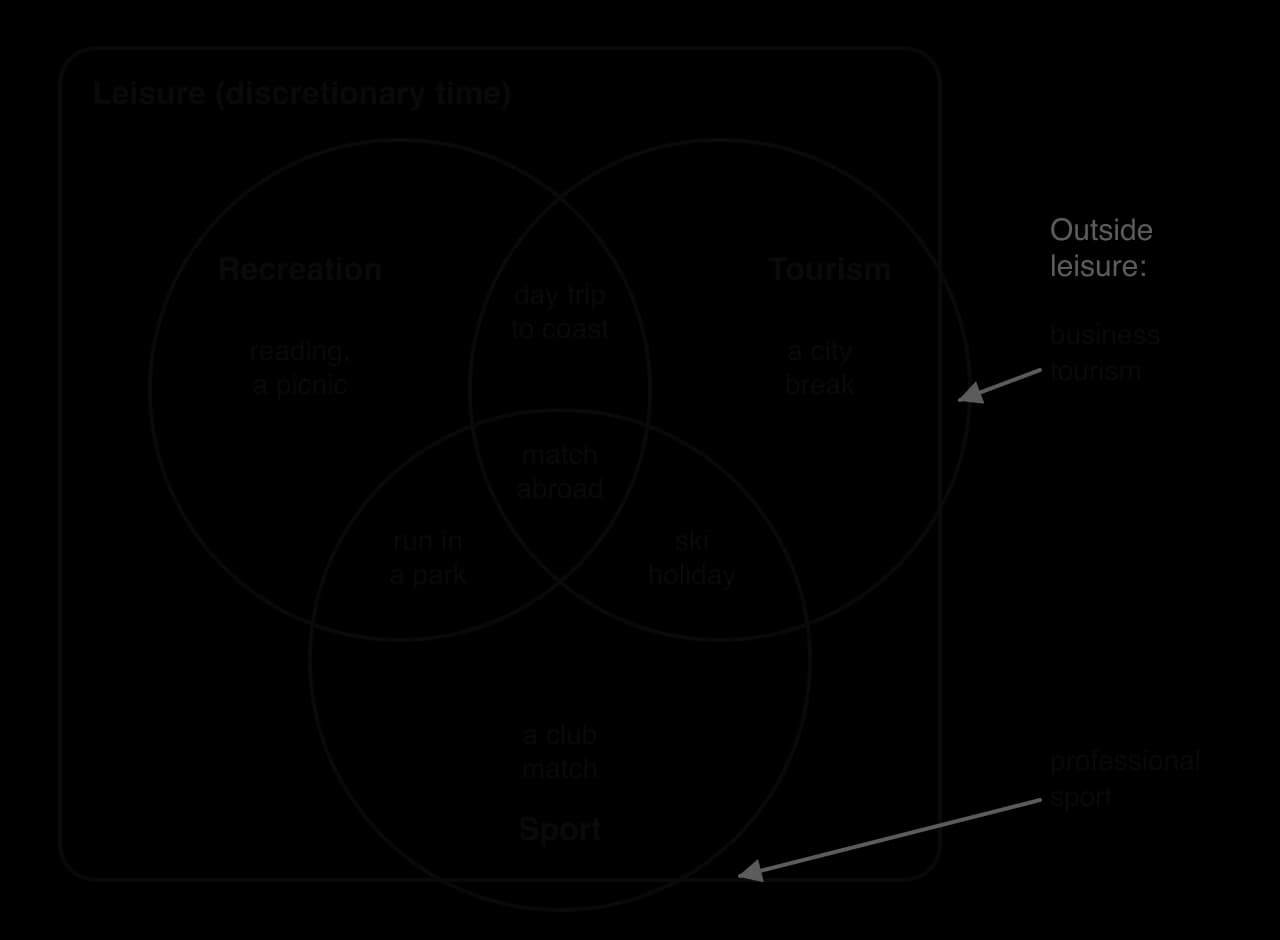
The Venn diagram shows how the terms fit together. A run in a local park is recreation and sport, but not tourism, because the runner stays in their usual environment. A ski holiday in the Alps is tourism and sport. A day trip to the coast is recreation and tourism (a same-day visit). Watching a football match abroad combines all three.
Two parts of the diagram lie outside leisure. Business tourism, such as travel to a conference, is tourism under the UN Tourism definition but is part of the traveller’s work. Professional sport is work for the players, though it is leisure for the spectators who watch it.
Activity | Leisure? | Recreation? | Tourism? | Sport? |
|---|---|---|---|---|
Reading a novel at home | Yes | Yes | No | No |
A weekly five-a-side football game in the home town | Yes | Yes | No | Yes |
A family day trip to a theme park 150 km away | Yes | Yes | Yes (same-day visitor) | No |
A week’s trekking holiday in Nepal | Yes | Yes | Yes (overnight visitor) | Yes (hiking) |
An engineer flying to a trade fair in Frankfurt | No (work) | No | Yes (business tourism) | No |
For most of history, most people had little discretionary time. In farming societies, work followed the seasons and daylight, and rest came on religious days: the English word holiday comes from "holy day". The growth of leisure as a large, regular block of free time is a product of industrialisation and the changes that followed it.
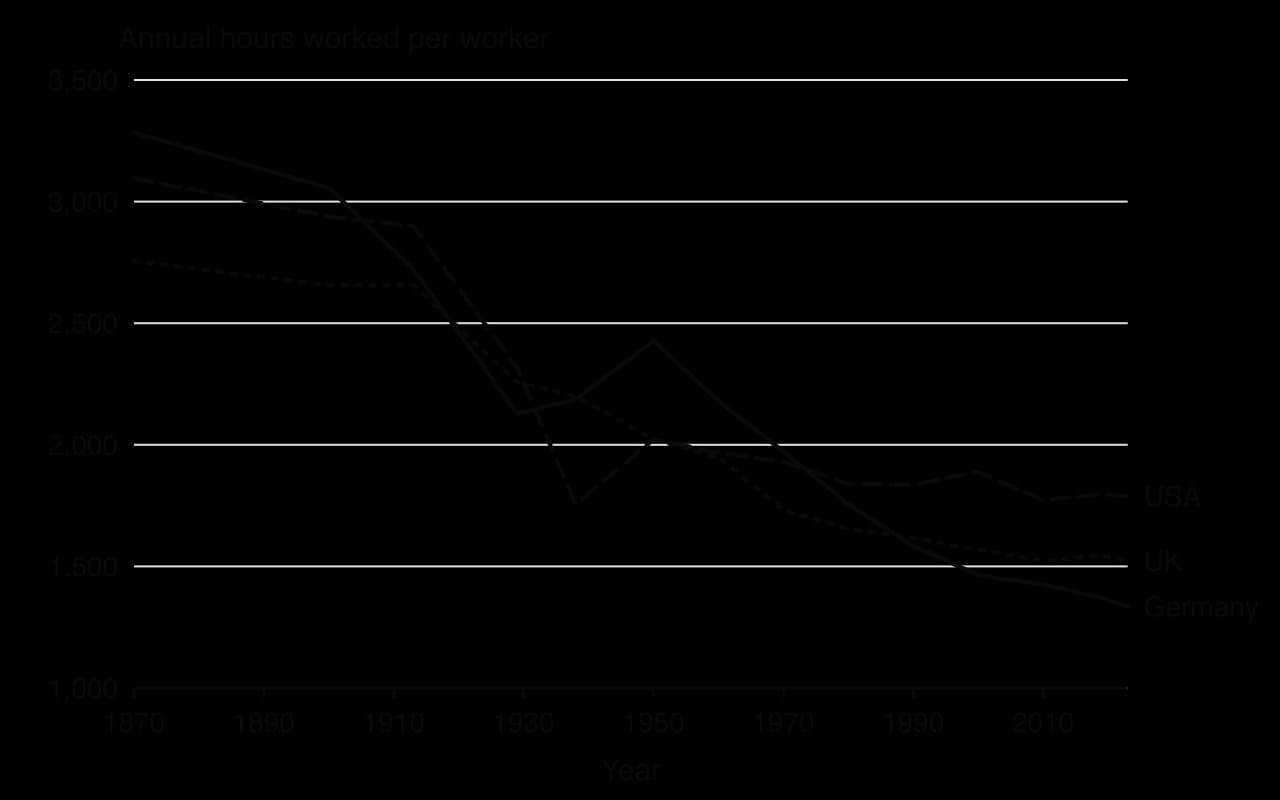
In the factories of 19th-century Britain, Germany and the USA, work moved out of the home and into fixed shifts measured by the clock. At first hours were extremely long: in 1870 workers averaged more than 2,700 hours a year in the UK and more than 3,000 in Germany and the USA, roughly 55–60 hours a week. The factory system also created a clear boundary between work time and free time, which made leisure something that could be counted and fought for.
Workers organised in trade unions to demand shorter hours, and governments passed laws to limit them. In the UK, the Factories Act 1847 limited women and young people to ten hours a day in textile mills, and the Bank Holidays Act 1871 created public holidays.
Henry Ford introduced a five-day, 40-hour week in his car factories in 1926, and the USA’s Fair Labor Standards Act of 1938 set a standard working week of 44 hours, falling to 40 hours by 1940, with extra pay for overtime. In France, the Matignon Agreements of June 1936 led to the first two weeks of paid holiday for workers, and parliament adopted a 40-hour week in the same month.
The long-run fall in working hours is clear in the data. Annual hours per worker in Germany fell from about 3,300 in 1870 to about 1,300 in 2023, a fall of about 60%.
Paid annual leave gave workers blocks of free time long enough for a holiday away from home. The European Union’s Working Time Directive (first adopted in 1993) requires at least four weeks of paid annual leave in every member state; the UK’s statutory minimum is 5.6 weeks, including public holidays, and France has given workers five weeks of paid leave since 1982.
China introduced paid annual leave of 5, 10 or 15 days, rising with years of service, in regulations that took effect on 1 January 2008. The USA is an exception among high-income countries: federal law does not require employers to give any paid holiday, so leave depends on employers and contracts.
Labour-saving domestic technology such as washing machines and refrigerators cut the hours needed for housework, freeing time, especially for women. Rising life expectancy and state pensions created a long period of retirement: retirement in high-income countries can now last for decades, much of it spent as leisure time. Above all, rising real incomes raised disposable income, so households could afford to spend more on leisure once essentials were paid for.
Each new transport technology widened the range of leisure travel. Railways brought the seaside within reach of factory workers: Thomas Cook’s first organised excursion, on 5 July 1841, took passengers by train from Leicester to Loughborough and back for one shilling, meal included.
Jet aircraft from the late 1950s cut flight times and costs, and tour operators began selling the package holiday, combining flights, transfers and accommodation for one price. After the European Union completed the liberalisation of its air transport market in 1997, any EU airline could fly between any two EU airports, and low-cost airlines such as Ryanair and easyJet grew rapidly with low fares, secondary airports and online booking. Cheap flights helped to create the short "city break".
Low-cost airlines later allowed travellers to assemble their own trips online, competing with the package model.
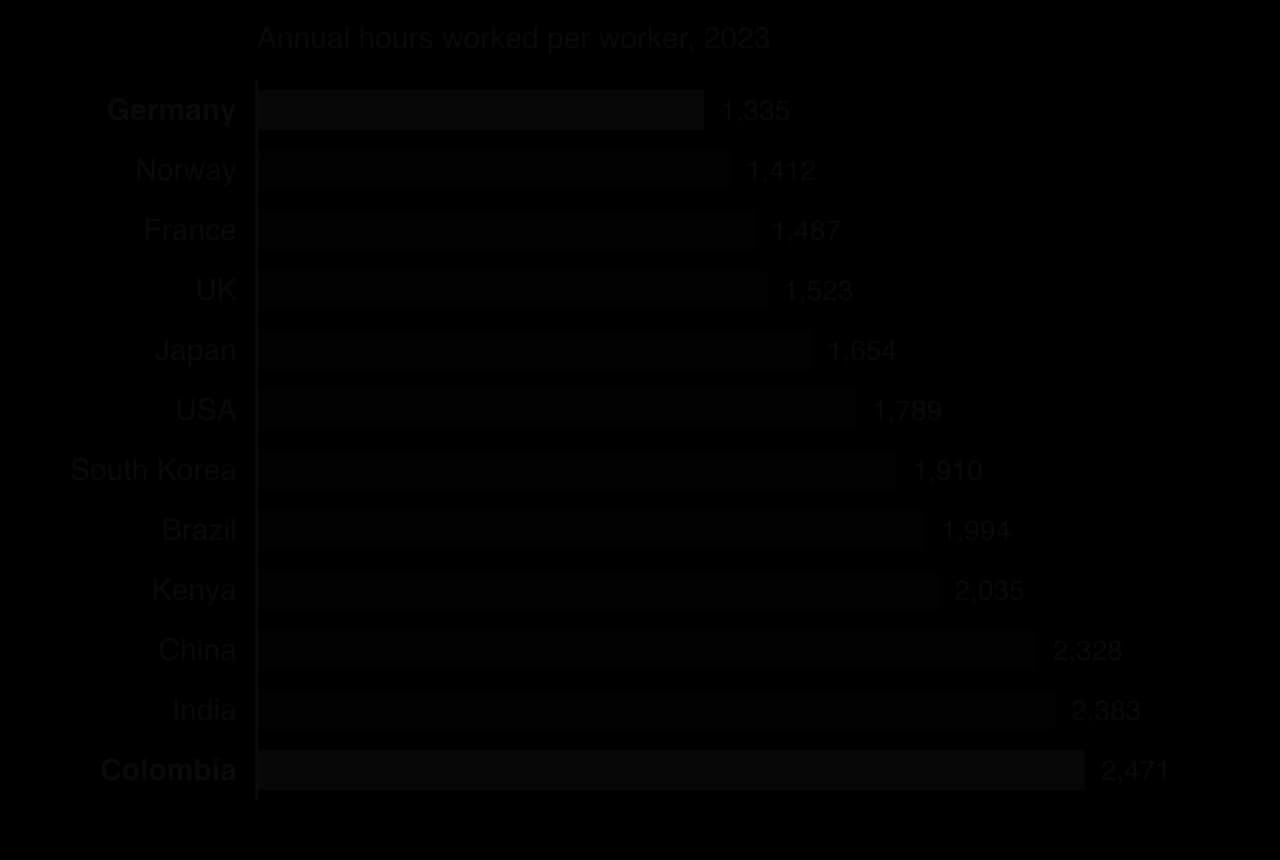
Large differences remain. In 2023, workers in Germany averaged about 1,335 hours a year, while workers in Colombia averaged about 2,470, roughly 85% more. Workers in China and India worked well over 2,300 hours. Shorter hours generally go with strong labour laws and paid leave, but the USA and South Korea are high-income countries with long hours.
People have always used free time for rest, worship and socialising. What has changed is the range of purposes leisure serves, and the share of it that is bought and sold.
In pre-industrial Europe, free time was tied to the religious calendar: saints’ days, festivals and pilgrimages. In industrial Britain, leisure became a way to recover from long hours in factories. Railway companies and resort developers built seaside towns such as Blackpool, Brighton and Scarborough, where workers spent a week each year, often during the "wakes weeks" when whole mill towns closed at once.
In the late 20th century, leisure in high-income countries became a major part of consumption: people spend money on leisure to express their identity, status and values. The clothes people wear for a sport, the destinations they choose and the festivals they attend signal who they are. Leisure is also used for health and wellbeing (gyms, yoga, parkrun, spa breaks) and self-development (learning a language, a cookery holiday).
The idea of an experience economy, proposed by Joseph Pine and James Gilmore in the late 1990s, describes the shift from buying goods and services to paying for memorable experiences, such as a cookery class in Bangkok or a stadium tour at Camp Nou. The sociologist Robert Stebbins described serious leisure: the committed pursuit of an amateur activity, such as marathon running or birdwatching, developed like a career.
Since the 2000s, much leisure time in all income groups has moved onto screens: streaming video and music, social media, online gaming and e-sports. Digital leisure is cheap once a device and an internet connection are available, can be done at home at any time, and connects people across the world. It has replaced some physical activity, especially among young people, although fitness apps and online running clubs also encourage exercise.
Main purpose of leisure | When it became widespread | Examples |
|---|---|---|
Rest and religious observance | Pre-industrial societies | Saints’ days, festivals, pilgrimages |
Recovery from industrial work | 19th and early 20th centuries | Wakes weeks, when Lancashire mill towns closed and workers went to Blackpool |
Consumption, identity and status | Late 20th century | Branded sportswear, fashionable destinations, festivals |
Health, wellbeing and self-development | Late 20th century to today | Gyms, yoga, parkrun, language and cookery holidays |
Experiences and digital leisure | Since the 2000s | Stadium tours, streaming, online gaming, e-sports |
More leisure time on average does not mean everyone has more. Time poverty describes people who lack enough discretionary time because of long or irregular working hours, long commutes and unpaid work in the home.
Time poverty is unequal by gender. Women everywhere do most of the world’s unpaid care work, such as cooking, cleaning and caring for children and older relatives: the International Labour Organization estimated in 2018 that women perform about three-quarters of all hours of unpaid care work. Women in paid employment therefore often have a "second shift" at home and less leisure time than men in the same households.
Sources: International Labour Organization, Care Work and Care Jobs for the Future of Decent Work, 2018.
The amount and type of leisure depend strongly on a society’s stage of development. Income classes (low-income countries (LICs), middle-income countries (MICs) and high-income countries (HICs)) are a useful starting point, but every country also contains wide differences between rich and poor, urban and rural, men and women.
In LICs, much of the population works in subsistence farming or the informal sector, with long and irregular hours and no paid holidays. Much of the remaining time goes on unpaid work that richer households pay to avoid, such as collecting water and fuelwood or walking long distances to markets and clinics, and this work falls mostly on women and girls. Leisure is therefore mostly local, free or cheap and social: visiting relatives, music and dance, religious festivals, conversation, street football and watching televised matches in a café or community hall.
International tourism is out of reach for most people. In 2019 there were about 6 international departures for every 1,000 people in Malawi, compared with about 1,200 in Germany.
As incomes rise in MICs, a large urban middle class gains paid holidays, savings, cars and smartphones. The first result is usually a boom in domestic tourism: trips within the country to beaches, mountains, heritage sites and big cities. China created week-long national holidays from 1999 to encourage domestic travel, and its domestic trips reached about 6 billion in 2019. India’s domestic tourist visits rose from 677 million in 2021 to about 2.5 billion in 2023 (provisional), much of it pilgrimage and visits to relatives. International tourism, first to nearby countries and then further away, follows later as incomes rise further.
International tourism can be seen from either end of the journey: the same trip is outbound for the country of origin and inbound for the destination.
The growth of this group links to the core idea of the new global middle class: hundreds of millions of people in emerging economies, especially in Asia, whose incomes now allow discretionary spending.
In HICs, most workers have paid holidays and enough disposable income for regular commercial leisure. Leisure is diverse: weekend city breaks, long-haul holidays, cruises, gym memberships, festivals and specialised hobbies. An ageing population has created a large "grey market" of healthy, affluent retired people who travel off-peak and for long periods.
Feature | Low-income societies | Middle-income societies | High-income societies |
|---|---|---|---|
Discretionary time | Limited by long hours of farm and informal work and unpaid tasks | Growing for urban workers with formal jobs and paid holidays | Generally high, but with time poverty for some groups |
Typical leisure | Socialising, music, religious festivals, informal sport | Shopping, eating out, domestic trips, mass holidays at peak times | Diverse and commercial: city breaks, long-haul travel, gyms, niche hobbies |
Tourism | Mostly inbound visitors from richer countries | Mass domestic tourism, then outbound tourism to nearby countries | High outbound tourism, short-haul and long-haul |
Classifying activities helps geographers compare them and explain why they attract different people to different places. Tourism is commonly classified by cost, duration and destination; sport by cost, popularity and site.
By cost, tourism ranges from budget travel (backpacking, hostels, camping, overland buses) through mid-range package holidays to luxury travel (five-star resorts, private guides, first-class flights). By duration, it ranges from the day trip (a same-day visit) and the short break of one to three nights, through the one- or two-week holiday, to extended stays such as a gap year, a seasonal stay by retired people in a warmer climate, or "digital nomads" who work remotely while travelling for months.
By destination, trips are domestic or international, and international trips are short-haul or long-haul. A short-haul destination is relatively close to the origin, typically a flight of up to about three hours (London to Barcelona). A long-haul destination is far away, typically more than about six hours’ flight and often in another continent (London to Bangkok).
Long-haul trips cost more in money, time and carbon emissions, so they are taken less often and usually last longer.
Basis | Categories | Example |
|---|---|---|
Cost | Budget (backpacking, hostels, camping); mid-range (package holiday); luxury | A backpacker in South-east Asia; a two-week package in Mallorca; a safari lodge in Botswana |
Duration | Day trip; short break (1–3 nights); holiday (1–2 weeks); extended stay (gap year, winter-sun stay, digital nomad) | A day trip from London to Brighton; a weekend city break in Prague; a gap year in Australia |
Destination | Domestic or international; short-haul or long-haul; urban, coastal, rural or wilderness | A Golden Week trip within China; London to Barcelona (short-haul); London to Bangkok (long-haul) |
Purpose | Leisure and holidays; VFR; business and MICE; religious; health | Visiting family in India from the UK; a conference in Singapore; the Hajj |
Most real trips combine several categories: a retired couple on a two-week luxury cruise in the Caribbean are on a long-haul, luxury leisure trip of holiday length.
UN Tourism also classifies trips by their main purpose. Leisure and holidays are the largest group, but two other purposes are important.
Visiting friends and relatives (VFR) tourism: trips made mainly to see family or friends, often staying with them. VFR flows are large between migrants’ home and host countries, such as between the UK and India or the USA and Mexico.
MICE tourism: business tourism for meetings, incentives (trips given to employees as rewards), conferences and exhibitions. Cities such as Singapore and Dubai build convention centres to attract it, because business visitors spend more per day than most leisure tourists.
Other purposes: religious pilgrimage (the Hajj to Mecca), health and medical treatment, education and shopping.
VFR visitors spend less on accommodation than other tourists, but they are less affected by fashion and price, so VFR flows are among the most stable in tourism.
Mass tourism is the movement of large numbers of people to the same popular destinations, usually on standardised, low-cost products such as package holidays to Mediterranean beach resorts. Its opposite is niche tourism, in which specialised products are sold to a small segment of the market with particular interests, such as birdwatching, mountaineering or visiting film locations. Niche types and national strategies built on them are part of the international scale of tourism.
Sports differ in cost because of equipment, membership, coaching, travel and access to facilities. Running, football and basketball need little more than shoes and a ball, so they are popular among people on low incomes. Golf, skiing, sailing, equestrian sports and motor sport need expensive equipment, specialist sites and often club membership, so participants are mostly affluent.
Sports differ in popularity, which can be measured as participation (people who play), spectating (people who attend in person) and viewing (people who watch on screen). Football has the widest global reach. Other sports are regional: cricket in South Asia, the UK and Australia; baseball in the USA, Japan and the Dominican Republic; ice hockey in Canada and northern Europe. A spectator sport is one that attracts large paying or viewing audiences, such as football, American football or Formula 1.
Sports also differ by site. Formal, purpose-built sites include stadiums, swimming pools, gyms and golf courses. Informal sites include streets, beaches, parks and school playgrounds. Natural sites include mountains for climbing and skiing, rivers for kayaking and the sea for surfing.
Sport | Cost | Popularity | Site |
|---|---|---|---|
Football | Low (a ball and space) | Global: the most-played and most-watched sport | Formal (stadiums) and informal (streets, beaches) |
Running | Low (shoes) | Very high participation, growing through events such as parkrun | Informal (roads, parks) and natural (trails) |
Golf | High (equipment, club fees) | Mainly HICs and affluent groups | Formal, purpose-built courses on large areas of land |
Skiing | High (equipment, lift pass, travel) | Regional: Alps, Rockies, Japan; growing in China | Natural mountain sites with built lifts |
Where an activity’s costs have three parts that add to 100% (for example equipment, entry fees and travel), a triangular graph can classify activities by plotting each as one point: running falls near the equipment corner, golf near the entry-fee corner, and skiing near the centre, because travel to mountain resorts is a large part of its cost.
Participation in tourism and organised sport rises with economic development, but the relationship is neither simple nor fixed. A participation rate is the share of a population that takes part in an activity over a given period, such as the percentage of adults who took a holiday abroad last year or who play sport at least once a week.
An international tourist arrival is recorded each time an overnight visitor enters a country. Arrivals count trips, not people: a business traveller who visits France four times a year counts as four arrivals. Global arrivals grew from about 25 million in 1950 to 278 million in 1980 and about 1.4 billion in 2018.
Arrivals reached about 1.46 billion in 2019. In 2020, COVID-19 border closures caused the deepest collapse in the history of the data: arrivals fell by about 74%, about one billion fewer than in 2019, compared with a fall of 4% in the 2009 financial crisis. Recovery took four years. Arrivals were still 69% below the 2019 level in 2021, passed 960 million in 2022, and reached about 1.3 billion in 2023, 1.4 billion in 2024 (almost the 2019 level) and an estimated 1.52 billion in 2025.
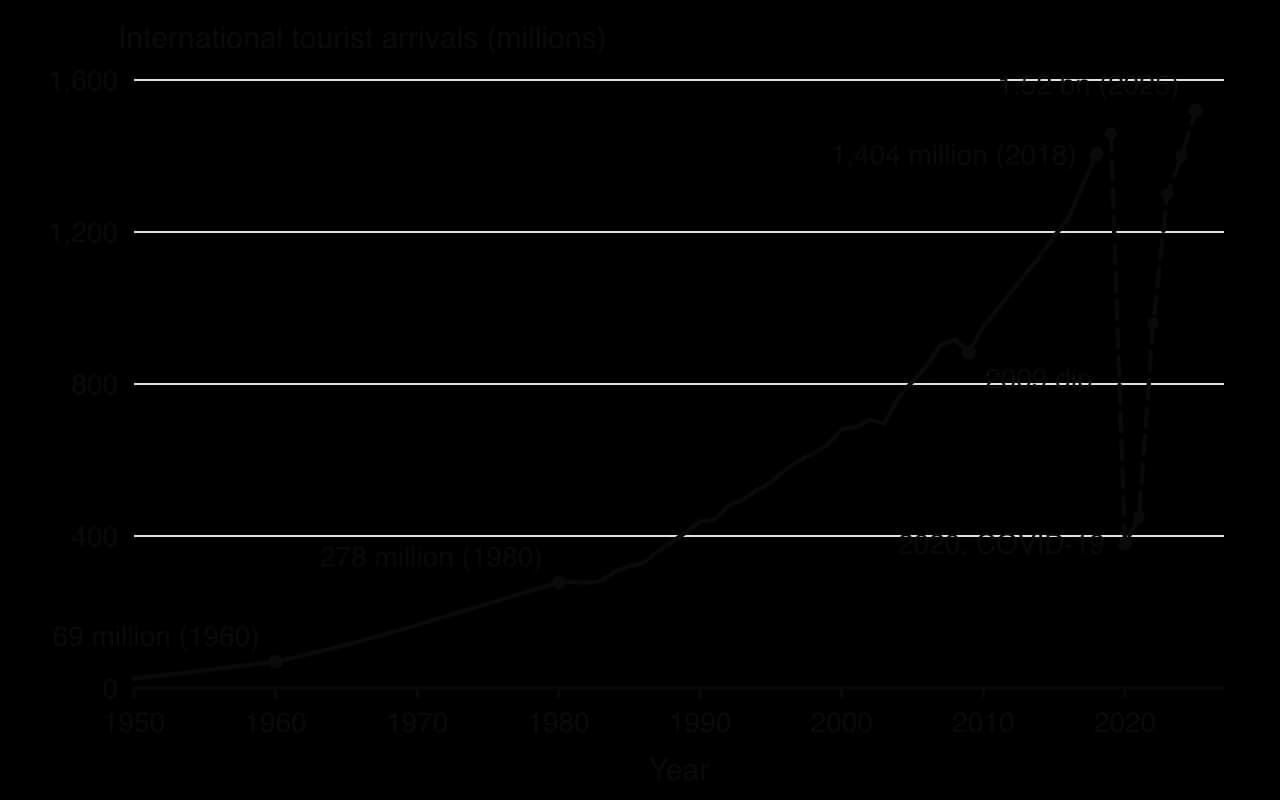
The line graph shows exponential rather than steady growth. The rise speeds up after about 1985, as Asian economies grew, jet travel became cheaper and more countries opened to tourism. Europe still receives about half of all international arrivals, far more than any other region.
Sources: UN Tourism, World Tourism Barometer, January 2021, January 2023, January 2024 and January 2025; UNWTO (2019) via Our World in Data.
At the national scale, the number of international trips per person rises with income. The scatter graph plots GDP per capita against international departures per 1,000 people for 23 countries in 2019. Departures are very low below about US$10,000 per person (Malawi 6, India 19 per 1,000) and rise steeply among high-income countries (Germany 1,191, Sweden 1,751). The relationship is positive but curved: plotted against income on a logarithmic scale, departures stay near zero across the poorer half of the range and then climb rapidly.
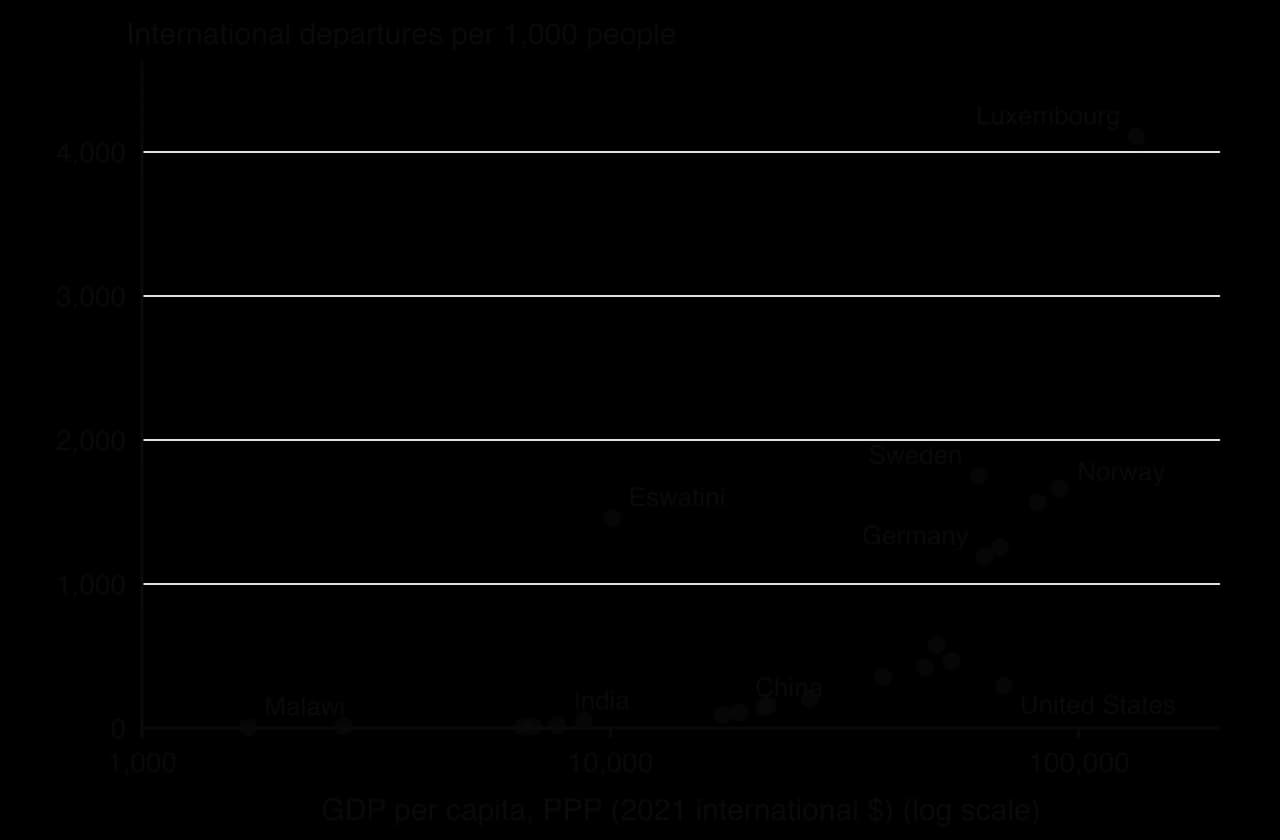
Three reasons explain the positive relationship. Higher incomes give more disposable income for travel. Richer countries usually have more paid leave and more formal jobs. And richer populations are more likely to own passports, cars and credit cards and to live near international airports. At the household scale, the share of the budget spent on leisure rises with income, because essentials take a smaller share.
The anomalies on the scatter graph show that income is only one factor.
Geography and size. Luxembourg (4,109 departures per 1,000) is a small, rich country where many trips to neighbouring France, Germany and Belgium are short. Eswatini (1,459 per 1,000) is small and almost surrounded by South Africa, so frequent short cross-border trips count as international. The USA (295 per 1,000) is so large and varied that most of its residents’ holidays are domestic.
Government policy. States can open or close international travel. China allowed outbound group tours only to approved destinations for many years and closed its borders to most leisure travel from 2020 to early 2023. North Korea does not allow ordinary citizens to travel abroad for leisure.
Culture. Attitudes to holidays, the religious calendar and family obligations shape when and where people travel. Religious travel such as the Hajj or Hindu pilgrimages produces large flows that are not closely tied to income.
Sport as low-cost leisure. Some sports, especially football and running, are cheap enough to be popular at every income level, so sport participation varies less with income than international travel does.
Within any society, some people take part in sport and tourism far more than others. Five personal factors explain most of the difference: affluence, gender, stage in the life cycle, personality and place of residence. They act together, so two people in the same country can have very different leisure lives.
Affluence means wealth and income. More affluent people have more disposable income, are more likely to have paid holidays and flexible working hours, and are more likely to own a car and a passport. They can pay for the costs that act as barriers to others: club memberships, equipment, coaching, flights and accommodation. The gap appears even in activities that seem cheap: in England in 2024–25, 73.2% of the most affluent adults were active for at least 150 minutes a week, against 53.8% of the least affluent.
Affluence affects the type of participation as well as the amount. Low-cost sports such as football, running and walking are spread across income groups, while golf, skiing, sailing and equestrian sport are dominated by high-income households because of equipment, club fees and travel. In tourism, affluent households take more trips, travel further (long-haul rather than short-haul) and stay in more expensive accommodation, while low-income households are more likely to take day trips, stay with relatives or not travel at all. Affluence also buys time: people who can pay for childcare, cleaning or a shorter commute have more discretionary time as well as more money.
Men and women differ in participation in most countries. In England in 2024–25, 67.3% of men were active for at least 150 minutes a week, against 62.2% of women. Several reasons explain the gap.
Time: women do most unpaid domestic and caring work, so they have less discretionary time, especially when children are young.
Safety: fear of harassment or violence discourages some women from running alone, travelling alone or using parks after dark.
Cultural and religious norms: expectations about dress, mixed-sex sport and women’s presence in public spaces limit participation in some societies; facilities with women-only sessions can remove some barriers.
Provision and media: men’s sport has historically received more facilities, sponsorship and broadcast coverage, which shapes who plays and watches.
These barriers are changing. Saudi Arabia allowed women to attend football matches as spectators for the first time in January 2018, and its football federation launched a women’s Premier League in 2022. In many HICs, women’s football has grown rapidly in participation and spectating. In tourism, women travelling alone are now a fast-growing market, and some tour operators design trips specifically for them.
Sources: Wikipedia, "Women’s football in Saudi Arabia", citing BBC News (12 January 2018).
The family life cycle is a sequence of stages that many people pass through: young single adult, couple without children, family with young children, family with teenagers, "empty nest" (children have left home) and retirement. Each stage changes a person’s free time, disposable income and responsibilities, and so their leisure.
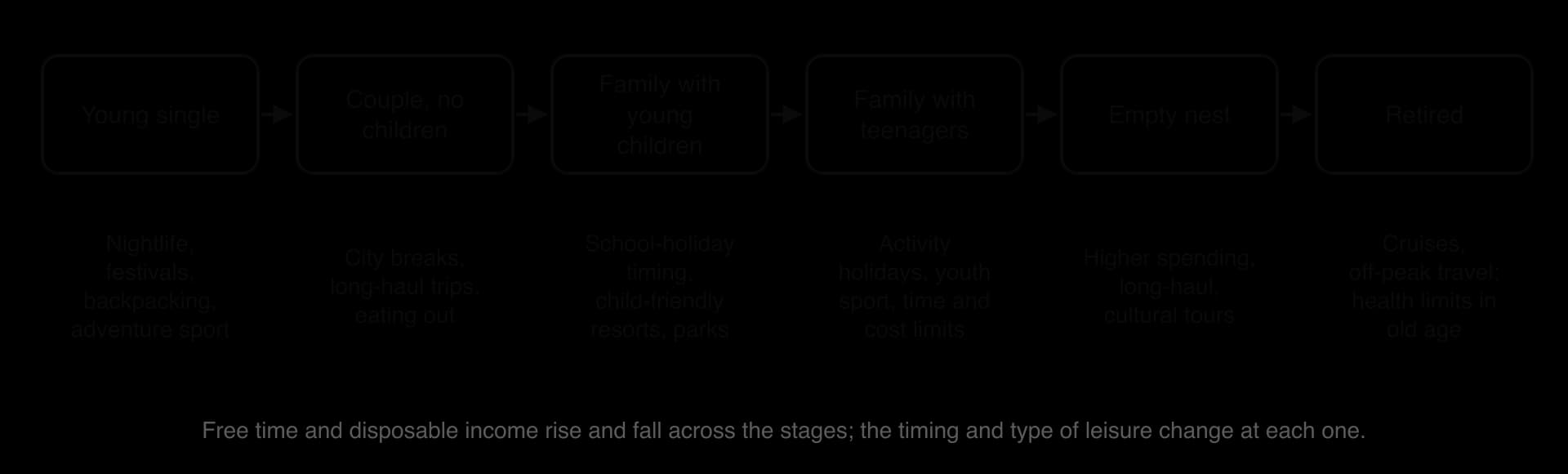
Young single adults often have low incomes but few ties, so they favour nightlife, festivals, backpacking and adventure sport. Families with young children must travel in school holidays, when prices are highest, and choose child-friendly resorts, campsites and theme parks. Empty nesters often have the most disposable income and flexibility, so they take long-haul trips and cultural tours. Retired people can travel off-peak and for longer, which makes them the main market for cruises and winter-sun holidays, until health limits travel in old age.
Sport participation generally falls with age and changes in type, from team sports and contact sports in youth towards walking, swimming, cycling, golf and fitness classes later in life.
People differ in how adventurous they are. In 1974 the American travel researcher Stanley Plog proposed Plog’s psychographic model, which classifies travellers by personality along a scale from psychocentric to allocentric. Plog suggested that personality types are distributed roughly like a normal (bell-shaped) curve: most people are mid-centric, with fewer at each extreme.
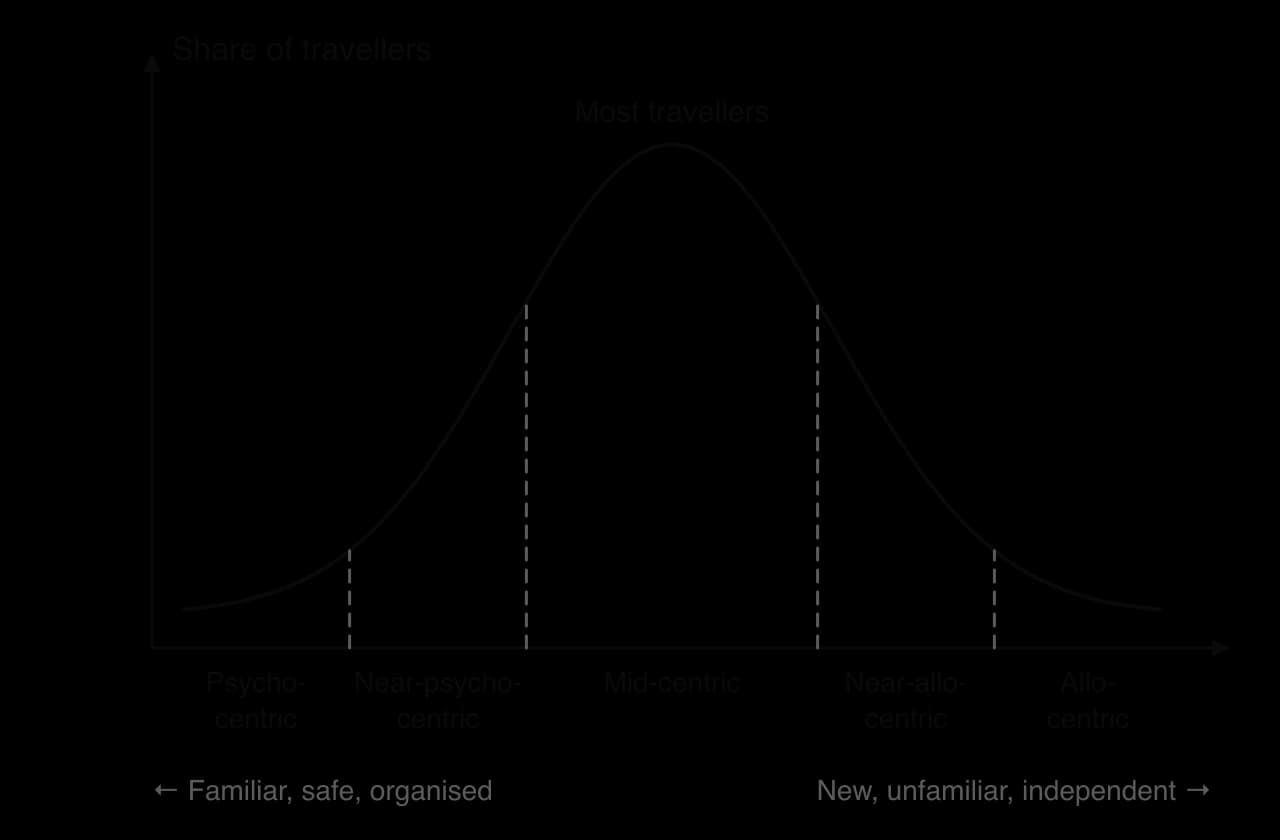
An allocentric traveller (Plog later used the word "venturer") seeks novelty, travels independently, and visits unfamiliar places before they become popular: a trek in a remote part of Bhutan, or a stay in a village with no tourist facilities. A psychocentric traveller (later "dependable") prefers familiar food and language, safe and well-known destinations and organised packages, often returning to the same resort each year.
At the other end of the scale are travellers who value security above novelty.
Plog linked personality to the growth of destinations. Allocentrics "discover" a place; as facilities develop, mid-centrics follow; as it becomes crowded and familiar, allocentrics move on and psychocentrics arrive. This links the model directly to Butler’s model of how resorts grow and change.
 YouTube
Strengths | Limitations |
|---|---|
Simple and visual, so it is easy to apply to real tourists and destinations | Personality is hard to measure; the original research surveyed US airline passengers in the 1970s, so it may not apply to other cultures or eras |
Explains why different people choose different destinations, beyond income alone | People change type by trip and over their lives: the same person may backpack at 20 and book a cruise at 70 |
Links demand to the life cycle of destinations, which helps tourism planners predict change | Ignores constraints: a person may want allocentric travel but lack the money, time, passport or visa |
Plog’s model is most useful as a way of describing the motives that shape choices, not as a reliable classification of individuals. Its main weakness is that it treats travel as a matter of personal preference, when affluence, gender and life-cycle stage often decide what is possible.
Where a person lives shapes their access to leisure. Urban residents usually have more facilities within reach (gyms, pools, stadiums, cinemas) and better access to airports, while rural residents may need to travel long distances, especially without a car. Access falls with distance from a facility, a pattern known as distance decay.
The physical setting matters too. People living near mountains are more likely to ski or climb, as in Norway and Switzerland; people living on coasts are more likely to surf, sail or swim in the sea, as in Australia. Local sporting traditions are tied to place: hurling in Ireland, sumo in Japan, and distance running in the highlands of Kenya’s Rift Valley, where towns such as Iten host running camps that require little more than roads, altitude and a running tradition.
The five factors rarely act alone. An affluent retired woman in a large city may travel long-haul several times a year, while a young man on a low income in a remote rural area may have little leisure beyond informal football and television. Disability is a further factor: physical access to venues and transport, the cost of adapted equipment and attitudes in sport all affect participation.
The UK is a high-income country with a long history of mass leisure. Its pattern of participation has changed in two main ways since the 1970s. First, the traditional week at a British seaside resort has declined, as cheaper package holidays and later low-cost flights took holidaymakers to Spain, Greece and Türkiye instead. UK residents made about 57 million trips abroad in 2000 and about 93 million in 2019, more than one for every person in the country. Second, COVID-19 travel restrictions cut trips abroad to about 24 million in 2020 and encouraged "staycations": holidays taken within the UK.
Sport participation is measured by Sport England’s Active Lives survey, which asks a large sample of adults about their activity. In November 2024–25, 64.6% of adults in England (30.9 million people) were active for at least 150 minutes a week, an increase of 859,000 people on the previous year, led by fitness activities and running. The bar chart shows the gaps by affluence, gender, age, disability and ethnicity that the personal factors predict.
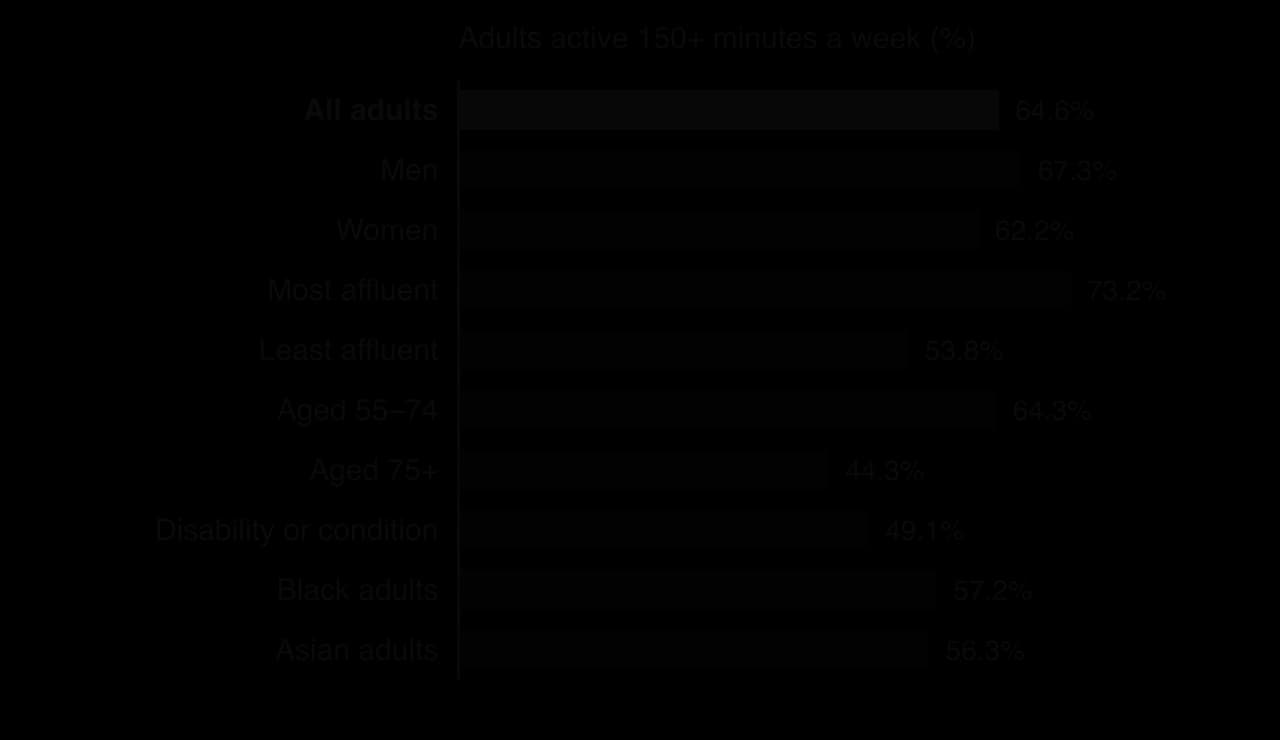
The data show that, even in a rich country, participation is unequal. Black and Asian adults (57.2% and 56.3% active) and the least affluent take part less than average, which policy-makers link to cost, access to facilities, time and cultural barriers. Free, local, low-cost activities such as walking and parkrun, a free weekly timed 5 km run founded in Bushy Park, London, in 2004, have been among the fastest ways of widening participation.
Sources: UN Tourism via World Bank, World Development Indicators (2026); Sport England, Active Lives Adult Survey, November 2024–25 (2026).
China is an upper-middle-income country and the world’s second most populous. Within one generation its people have moved from very limited leisure travel to mass domestic tourism and the largest outbound tourism market in the world. China shows how economic development, government policy and a growing urban middle class together change leisure patterns, and how quickly those patterns can be reversed by a shock.
Economic reforms from 1978 brought rapid industrialisation and urbanisation. China’s gross national income (GNI) per capita (Atlas method) rose from US$950 in 2000 to US$13,660 in 2024, a more than fourteen-fold increase. Hundreds of millions of people moved into urban jobs with regular wages, and a new middle class gained savings, cars and smartphones. Working hours remain long by international standards (about 2,330 hours per worker in 2023), so free time is concentrated into public holidays.
Leisure in China was shaped directly by government policy. In 1999 the government extended the National Day holiday (1 October) into a week, and in 2000 it formalised three week-long "Golden Weeks" (Spring Festival, May Day and National Day) by moving weekend days to create seven or eight consecutive days off. The aim was to expand domestic tourism and consumer spending, and the number of National Day travellers rose from an estimated 28 million in 1999 to 705 million in 2017.
Paid annual leave of 5 to 15 days followed in 2008, when the May Day week was cut and shorter holidays for traditional festivals such as Qingming and the Dragon Boat Festival were added.
Holiday | 2000–2007 | From 2008 |
|---|---|---|
Spring Festival (Chinese New Year) | Golden Week (about 7 days, with weekend days moved) | Golden Week kept |
May Day (1 May) | Golden Week | Cut to a short break |
National Day (1 October) | Golden Week | Golden Week kept |
Qingming, Dragon Boat and Mid-Autumn festivals | Not public holidays | One-day public holidays, usually joined to a weekend |
Paid annual leave | No national entitlement in force | 5, 10 or 15 days, rising with years of service |
Concentrating holidays in a few weeks produced extreme peaks of crowding at popular sites such as the Great Wall. The Spring Festival also produces the world’s largest annual movement of people, as migrant workers travel home to visit relatives: a form of VFR travel that dominates China’s transport system for several weeks each year.
 YouTube
Domestic tourism grew to about 6.01 billion trips in 2019, more than four trips per person. Outbound travel grew even faster, from about 10.5 million departures in 2000 to 154.6 million in 2019, helped by rising incomes, easier passports and visas, and more flights. Since 2012, Chinese tourists have been the world’s biggest spenders on international tourism; in 2016 they accounted for about 21% of global tourism spending (US$261 billion). Even so, only about 7% of Chinese citizens held a passport in 2018, so international travel remained concentrated among the affluent urban population.
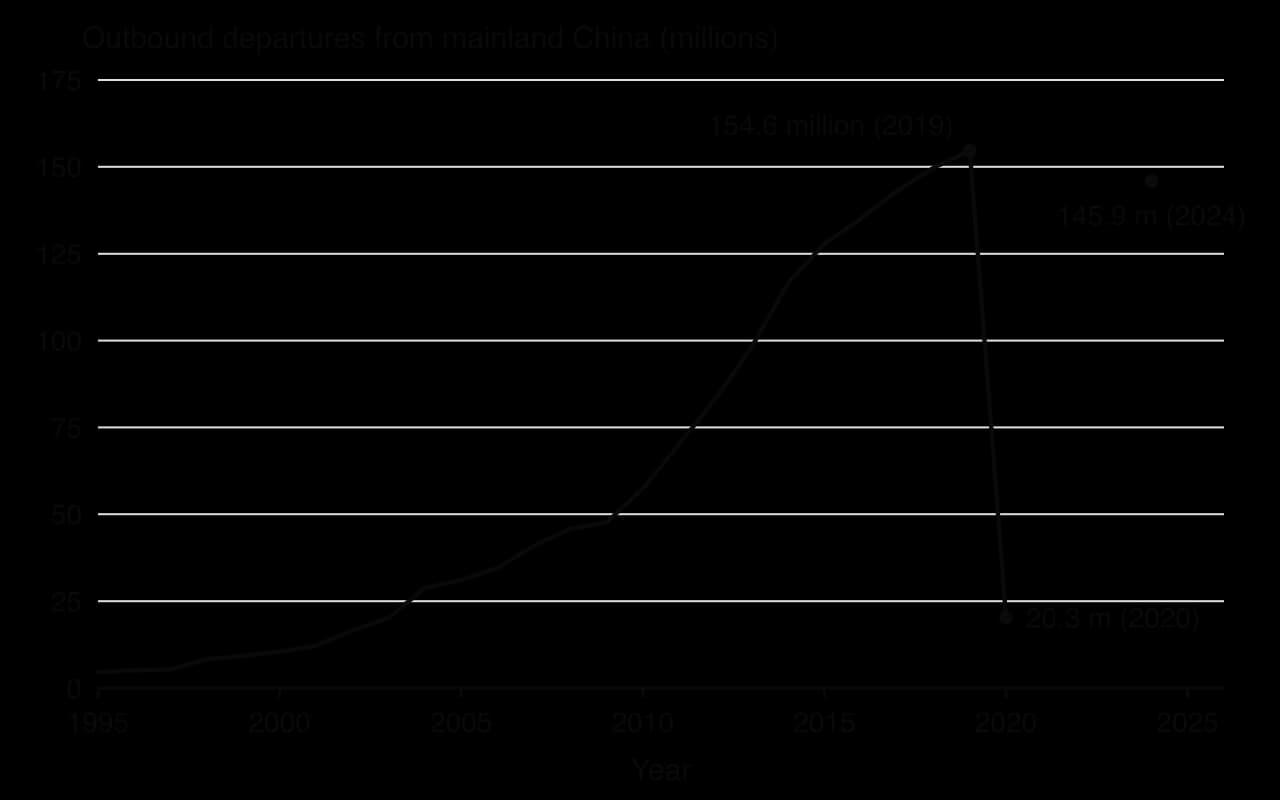
COVID-19 reversed the growth almost overnight. Outbound departures fell from 154.6 million in 2019 to 20.3 million in 2020, a fall of 87%, and China kept strict border controls until early 2023. By 2024, recovery was strong: domestic trips reached 5.62 billion, 14.8% more than in 2023, and outbound visits reached 145.89 million. Of these, 97.12 million were to Hong Kong, Macao and Taiwan, which shows that much "outbound" travel is short-haul to nearby destinations.
The government has also promoted sport participation, partly to improve health and partly to build national prestige. When Beijing won the right to host the 2022 Winter Olympics in 2015, the state set a target of engaging 300 million people in "ice and snow" sports. In January 2022, the National Bureau of Statistics reported that more than 346 million people had taken part in winter sports since 2015, based on a survey of 40,100 respondents.
Group | Effects of the growth of leisure |
|---|---|
Urban middle class | Paid leave, rising income and easier travel bring domestic and international holidays, winter sports and city breaks |
Rural residents and migrant workers | Few paid holidays and lower incomes; much travel is VFR at Spring Festival rather than tourism for pleasure |
Destination communities | Jobs and income in places such as Guilin and Zhangjiajie, but crowding at peak weeks |
The state | Uses holidays to boost consumption and regulates who travels where, from outbound group tours to border closures |
Foreign destinations | Thailand, Japan and European cities depend heavily on Chinese visitors and are exposed when Chinese travel stops |
The case of China shows the key concepts at work. Process: rising incomes, urbanisation and paid leave turned leisure from a privilege into a mass activity in about two decades. Power: the state decided when people could travel, where they could go and, from 2020, whether they could leave at all. Place: patterns differ sharply between rich coastal cities and the rural interior. Possibility: with the middle class still growing, China’s tourists are likely to shape world tourism for decades, but the 2020 collapse shows how quickly that future can change.
Sources: World Bank, World Development Indicators (2026), with tourism data from UN Tourism; National Bureau of Statistics of China, Statistical Communiqués for 2019 (2020) and 2024 (2025); Wikipedia, "Golden Week (China)" and "Tourism in China" (2026); Xinhua and China Daily reports of the NBS survey (January 2022).
Explain why China’s government created week-long holidays rather than giving workers more individual paid leave.
To what extent was the growth of leisure in China a result of rising incomes rather than state policy?
Suggest why most of China’s outbound visits in 2024 were to Hong Kong, Macao and Taiwan.
Questions on changing leisure patterns appear in Paper 1 as a structured question on a stimulus (10 marks) and a choice of extended-response questions (10 marks). Stimuli are often a graph of arrivals over time, a table of participation rates or a scatter graph.
The table shows international departures per 1,000 people and GDP per capita for six countries in 2019.
Country | Income group | GDP per capita, PPP (2021 international $) | International departures per 1,000 people |
|---|---|---|---|
Malawi | Low income | 1,687 | 6 |
India | Lower-middle income | 7,702 | 19 |
China | Upper-middle income | 18,821 | 109 |
Mexico | Upper-middle income | 21,704 | 158 |
United States | High income | 69,121 | 295 |
Germany | High income | 62,950 | 1,191 |
Sources: UN Tourism (2025) and World Bank and others (2026), via Our World in Data.
Extended questions on changing leisure patterns usually ask how far economic development explains participation, or how personal factors interact. A strong answer uses real data, named societies at contrasting stages of development, and a conclusion that weighs the factors.
Leisure is discretionary time and the activities chosen in it; recreation, tourism and sport overlap within it, but only tourism requires travel outside the usual environment.
Leisure time grew in industrial societies through labour laws, paid holidays, labour-saving technology, longer lives, rising incomes and new transport; annual hours per worker in Germany fell by about 60% from 1870 to 2023.
The purpose of leisure has shifted from rest and religious festivals towards consumption, identity, health, experiences and digital activities; time poverty affects many workers and especially women.
Leisure in LICs is mostly local and low-cost; MICs develop mass domestic tourism; HICs have diverse, commercial leisure and an ageing market.
Tourism can be classified by cost, duration, destination and purpose (VFR, MICE); sport by cost, popularity and site.
Participation in tourism rises strongly with income, but geography, government policy, culture and the low cost of some sports make the relationship complex.
Affluence, gender, life-cycle stage, personality (Plog’s model) and place of residence all shape personal participation, and they interact.
China’s outbound departures grew from 10.5 million (2000) to 154.6 million (2019), collapsed in 2020 and recovered by 2024, showing the roles of income, state policy and shocks.
I can define leisure, recreation, tourism and sport, and classify real activities using them.
I can explain, step by step, why leisure time grew in industrialised societies.
I can describe how the purpose of leisure has changed, including digital leisure and time poverty.
I can compare leisure in low-, middle- and high-income societies with named examples.
I can classify tourism by cost, duration, destination and purpose, and sport by cost, popularity and site.
I can describe the relationship between development and participation from a scatter graph, including anomalies.
I can explain how five personal factors affect participation, with data from England.
I can evaluate Plog’s psychographic model.
I can use China as a case study of changing participation, with figures and dates.
In low-income rural societies, much time is spent on subsistence farming, collecting water and fuel, and household tasks, so free time is limited and often blended with work (eg children playing while herding livestock); seasonal agricultural calendars give more free time at some times of year.
Informal-sector workers in rapidly growing cities (eg street traders in Lagos or Dhaka) often have no paid holidays or legal limits on hours.
Good answers may be well structured (AO4) and may additionally offer a critical evaluation (AO3) which recognizes that growth in leisure time depends on the power of workers and governments (labour laws, trade unions) as well as on economic development. Another approach might be to argue that differences within societies (by gender, occupation, age or formality of employment) may be as large as those between societies, or that "more leisure time" does not always mean more time free of work, as smartphones blur the boundary between work and leisure. Answers may also consider change over time: leisure time may grow at one stage of development and then stall.
For 5–6 marks, expect some weakly-evidenced outlining of reasons why leisure time has grown and/or not grown.
For 7–8 marks, expect a structured account which includes:
either well-evidenced explanation of reasons for both growth and lack of growth in leisure time, with located examples
or a discursive conclusion (or ongoing evaluation) grounded in geographical concepts and/or perspectives, such as places, power or change over time.
For 9–10 marks, expect both of these traits.
NB. Maximum [6] if only societies where leisure time has grown are considered.
Marks | Level descriptor |
|---|---|
0 | The response does not reach a standard described by the descriptors below. |
1–2 | Too brief, lists unconnected information, not focused on the question and lacks structure. Knowledge is very general, with large gaps or errors; examples or case studies are missing or only listed. No analysis; terminology is missing or used incorrectly. |
3–4 | Too general, lacks detail, not focused on the question and largely unstructured. Outlines examples, statistics and facts, both relevant and irrelevant, with links to the question only listed. Basic terminology is used, with errors or inconsistently. No critical evaluation of evidence; any conclusion is irrelevant. |
5–6 | Partially addresses the question, with a narrow argument, an unsubstantiated conclusion and limited evaluation. Describes relevant supporting evidence (examples, case studies) and outlines links to the question. The argument repeats one point or covers only part of the question. Other perspectives, or strengths and weaknesses of evidence, are listed. |
7–8 | Addresses the whole question; the analysis is evaluated and the conclusion is relevant but lacks balance. Relevant evidence is described correctly and covers all the main points. The argument is clear but one-sided or unbalanced. Complex terminology is used correctly but not consistently. Other perspectives, or strengths and weaknesses of evidence, are described. |
9–10 | In-depth and specific to the question (topic and command term). Correct, relevant examples, statistics and detail are integrated and their link to the question explained. The argument is balanced, explaining complexity, exceptions and comparisons. Evaluation of evidence and perspectives is well developed, and the conclusion is balanced and aligned with the evidence. Logically structured and easy to follow. |
Examine how and why the purpose of leisure has changed in two or more societies at contrasting stages of development.
10 marks
To what extent has technological change been the main cause of changing leisure patterns in recent decades?
10 marks