Notes on 5.3 Local responses to global interactions
Learning objectives
Describe the range of local responses to global interactions, from acceptance and adaptation to resistance.
Distinguish between anti-globalisation and alter-globalisation movements, and explain how campaigns against TNCs gain influence.
Evaluate local sourcing of food and goods as a response to globalised production.
Explain the causes and forms of anti-immigration movements, and examine their effects on migration policy.
Explain how government and militia controls restrict personal freedoms to participate in global interactions.
Analyse the use of protectionism and resource nationalism, and evaluate their costs and benefits for different stakeholders.
Explain how civil society uses social media and campaigns for internet freedom to promote international-mindedness.
Examine how acceptance of, and resistance to, global interactions take different forms at different scales.
Compare two places where restricted freedoms have been challenged: Nigeria and Iran.
Introduction
Local communities, citizens’ groups, businesses and governments shape how global interactions affect their places. They decide whether to welcome a foreign factory, buy food grown nearby, vote for tighter borders, block a social media platform or campaign for the right to use it. The responses range from enthusiastic acceptance to outright rejection, and they help to explain why globalisation advances quickly in some places and slowly, or not at all, in others.
Power is the central concept. A village in Kerala, a national government and a global coalition of digital rights groups all try to shape global interactions, but their ability to do so differs enormously. Scale matters too, because the same issue, such as migration or online freedom, is contested in local streets, in national parliaments and in international campaigns at the same time. The topic draws on transnational corporations and civil society from the core, and on cultural imperialism and glocalisation, which are ways of adapting to global culture.
Accepting, adapting and resisting global interactions
Every place is exposed to global flows of goods, investment, people, information and ideas, but places respond to them differently. Geographers often describe the responses as a spectrum. At one end, a place accepts or adopts global interactions: it invites foreign investment, joins trade agreements and welcomes migrant workers. In the middle, a place adapts them to local values and needs. At the other end, it resists or rejects them.
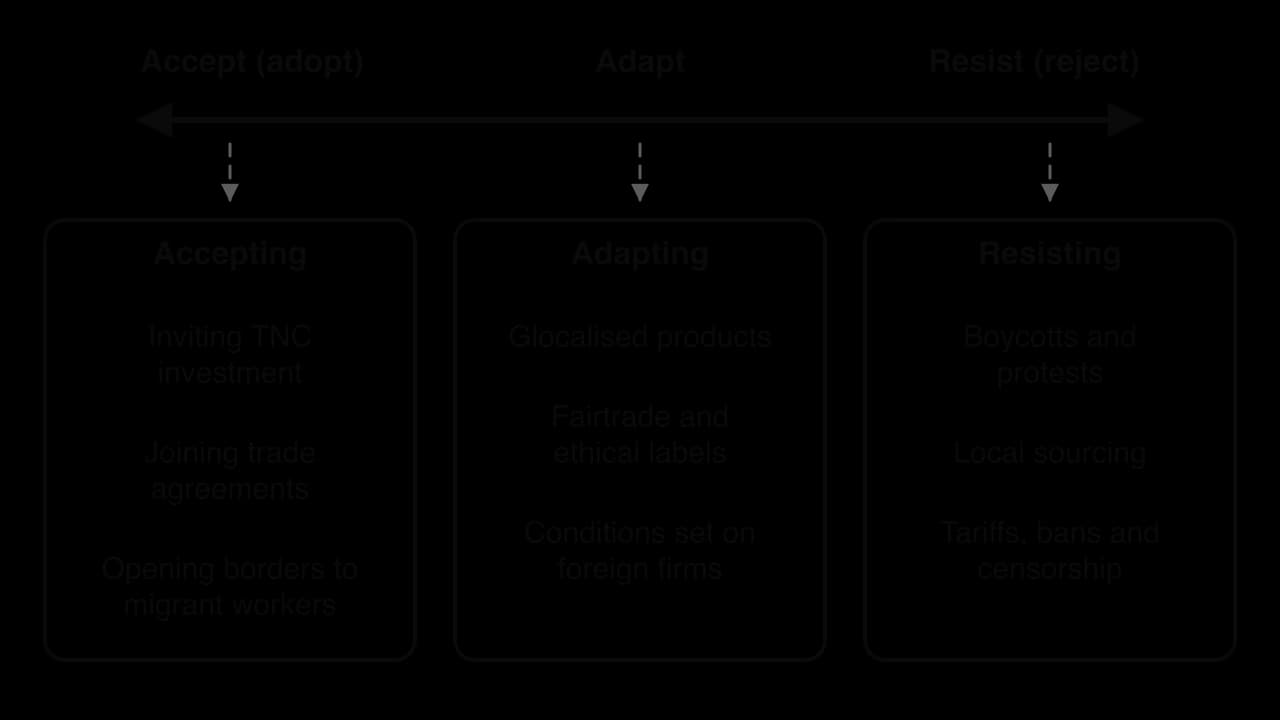
Adaptation is the most common response. A TNC may change its products for local tastes, a government may let a foreign firm in on condition that it hires local staff, and consumers may buy imported goods only if they carry an ethical label such as Fairtrade. These compromises show that local actors are not powerless: they can set terms. The Nigerian government’s conditions for allowing Twitter back into the country in 2022, including local registration and tax, are an example of adaptation by bargaining.
Resistance itself takes many forms. It can be peaceful or violent, legal or illegal, organised by citizens from below or imposed by governments from above. A consumer boycott, which is a refusal to buy from a company or country as a form of protest, is resistance by citizens. A tariff on imported steel is resistance by a state. An internet shutdown is a state restricting its own citizens’ participation in global interactions, and the use of virtual private networks to get around it is citizens resisting that restriction.
The actors with the most power to accept or resist are not always the obvious ones. National governments set trade and migration rules, but TNCs decide where to invest, international organisations such as the World Trade Organization set rules that limit what governments may do, and well-organised local groups can force a TNC or a government to change course.
Resisting globalised production
Globalised production means that goods are designed in one country, made from parts produced in several others and sold worldwide, usually by TNCs organised through long supply chains. Its critics argue that it moves jobs to places with low wages and weak labour laws, harms the environment, and puts the profits of distant shareholders before the needs of local communities. Their responses range from mass protest to changes in what people buy.
Anti-globalisation and alter-globalisation movements
The anti-globalisation movement is a loose network of groups, including trade unions, environmental organisations, farmers’ movements, students and anarchists, that oppose the spread of free trade, the power of TNCs and the policies of international economic institutions. It has no single leader or programme. What unites it is the view that economic globalisation, as it has developed since the 1980s, benefits corporations and wealthy countries at the expense of workers, the poor and the environment.
The movement became internationally visible at the WTO Ministerial Conference in Seattle, USA, which opened on 30 November 1999. At least 40,000 protesters blocked streets around the conference centre. Police used tear gas and pepper spray, more than 500 people were jailed in a single day, and the National Guard was called in. The conference ended on 3 December without agreement on a new round of trade negotiations, partly because of the protests and partly because of disagreements between rich and poor member states.
Many campaigners reject the label “anti-globalisation”, because they are not against international links as such. The term alter-globalisation (from the French altermondialisme) describes movements that support global co-operation and the exchange of ideas but want a different kind of globalisation: one that protects workers’ rights, the environment and the poorest countries. The World Social Forum, first held in Porto Alegre, Brazil, in 2001 as an alternative to the World Economic Forum in Davos, used the slogan “Another world is possible”.
Campaigns against transnational corporations
Campaigns against particular TNCs are often more effective than protests against globalisation in general, because a company has a brand to protect and can be named, shamed and boycotted. Campaigners use research reports, media coverage, consumer boycotts, shareholder pressure and legal action. Three examples show the range.
Nike and sweatshops in the 1990s
Nike designs its shoes and clothing in the USA but has them made by subcontractors in Asia. In 1991 a report by the activist Jeff Ballinger described low pay and poor conditions in Nike’s supplier factories in Indonesia, where one worker was found to earn as little as 14 cents an hour, below the national minimum wage. In 1996 Life magazine published a photograph of a 12-year-old boy in Pakistan sewing a Nike football. Student groups, unions and NGOs in North America and Europe organised protests and boycotts, and the label sweatshop became attached to the brand.
The campaign changed Nike’s behaviour. The company raised the minimum age of its factory workers, joined monitoring schemes and, in 2005, became one of the first in its industry to publish the names and locations of its supplier factories. Critics argue that conditions in many supplier factories remain poor, but the case shows that the reputations of global brands give distant consumers a source of power over working conditions in other countries. The collapse of the Rana Plaza factory building in Bangladesh in 2013 renewed the same critique of fast fashion two decades later.
Coca-Cola in Plachimada, Kerala
Hindustan Coca-Cola Beverages, a subsidiary of The Coca-Cola Company, opened a bottling plant in the village of Plachimada in Palakkad district, Kerala, India, in 2000. Villagers, most of them Adivasi (Indigenous) people, soon reported that their wells were running dry and that the water left was contaminated, and that waste from the plant was being given to farmers as fertiliser. On 22 April 2002 they began a protest by blockading the factory entrance, and the protest continued for years with support from environmental groups, political parties and activists elsewhere in India and abroad.
The local panchayat (village council) revoked the plant’s licence on 3 April 2003, and after continued protest and court cases the factory closed in March 2004. A government committee later estimated the damage at about ₹216 crore (about US$30 million), though compensation has not been paid.
In 2017 the company told India’s Supreme Court that it did not intend to restart production at the site. Plachimada shows a local community, with the help of a local government and national allies, rejecting a TNC on grounds of water rights. The company contested the licence decision through the courts for more than a decade, which shows that a local victory can take years to secure against a well-resourced firm.
Consumer boycotts
Boycotts turn individual shopping choices into collective pressure. They have been used against companies over labour rights, environmental damage, animal welfare and the countries in which they operate. Consumer boycotts aimed at a whole country, such as those called against apartheid South Africa from the 1960s or the boycott, divestment and sanctions campaigns aimed at Israel since 2005, are political campaigns as well as economic ones, and each is supported and opposed by different groups for different reasons.
The effectiveness of boycotts is debated. They are most likely to change a company’s behaviour when the brand is well known, the demand is clear and achievable, alternatives are easy to buy and the media take up the story. Many boycotts have little measurable effect on sales, but they can damage a brand’s reputation, which matters to companies that sell to young, wealthy consumers.
Local sourcing of food and goods
A quieter form of resistance to globalised production is to buy goods produced nearby. Local sourcing means obtaining food and other goods from producers in the same local area or region, rather than through global supply chains. Supporters argue that it keeps money in the local economy, supports small farmers and businesses, keeps traditional products alive, reduces transport and gives consumers more trust in how their food is produced.
Form of local sourcing | How it works | Example |
|---|---|---|
Farmers’ markets | Producers sell directly to customers at regular local markets, so they keep a larger share of the price | Common in the USA, the UK, France and Australia; many towns hold weekly markets |
Community-supported agriculture (CSA) | Households pay a farm in advance for a share of its harvest, sharing the farmer’s risk | Spread from Japan (teikei) and Europe to North America from the 1980s |
Slow Food | An international movement promoting traditional, regional food and small producers | Founded in Italy in 1986 in protest at a McDonald’s opening near the Spanish Steps in Rome; over 100,000 members in more than 150 countries |
Locavore and “buy local” campaigns | Consumers choose food grown within a set distance; councils and businesses promote local shops | Local food labels, independent shop campaigns, public procurement rules for school meals |
Local currencies | A currency that can be spent only with local businesses, so money circulates in the area | The Bristol Pound, UK (2012–2021) |
Slow Food shows how local sourcing can become a global movement. Its forerunner, Arcigola, was founded by Carlo Petrini in 1986 to resist the opening of a McDonald’s restaurant near the Spanish Steps in Rome, and its international manifesto was signed in Paris in 1989 by delegates from 15 countries. The movement now has more than 1,300 local groups worldwide. It describes globalisation as a process from which small producers must be both protected and included, which is closer to alter-globalisation than to simple rejection.
The Bristol Pound shows both the appeal and the limits of local currencies. It was launched on 19 September 2012 to encourage people to spend with independent businesses in Bristol and to help those businesses buy from each other. By 2015 about £1 million had been issued and more than 800 businesses accepted it.
Use declined after about 2017, the digital scheme closed in August 2020, the paper notes were withdrawn in September 2020, and the last date for exchanging notes passed in December 2021. Its supporters cited the local multiplier effect, the idea that money re-spent locally generates more local income than money spent at national chains, most of which leaves the area.
Evaluating local sourcing
Local sourcing is often promoted as better for the environment because it reduces food miles, the distance food travels from where it is produced to where it is eaten. The idea is intuitive, but food miles are only one part of the environmental impact of food. A life-cycle approach counts the emissions from every stage: farming, processing, packaging, transport, retail, cooking and waste. On that measure, how food is produced usually matters more than how far it travels.
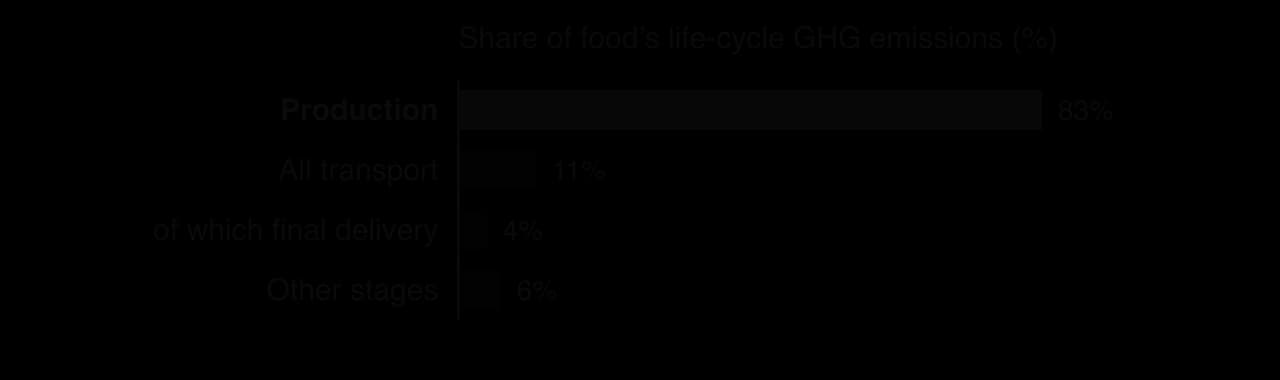
The chart shows that the stage local sourcing changes most, final delivery, contributes only about 4% of the emissions of food eaten in US households. The same study found that shifting less than one day a week’s worth of calories from red meat and dairy to chicken, fish, eggs or vegetables would cut more emissions than buying all food locally. Tomatoes grown in heated greenhouses in northern Europe, or lamb raised on feed in a cold climate, can therefore have a larger carbon footprint than the same food grown in a warmer place and shipped a long way.
The method of counting every stage is called life-cycle assessment, and it is also used to judge the environmental risks of other global flows of goods.
Strengths of local sourcing | Limitations of local sourcing |
|---|---|
Keeps more spending in the local economy and supports small producers | Local food is often more expensive, so it is easier for wealthier households to choose |
Shorter supply chains can be more resilient to global shocks such as the COVID-19 disruptions of 2020 | Local supply is seasonal and limited by climate; few places can grow everything they eat |
Builds trust between producers and consumers and preserves traditional foods | Fewer food miles do not always mean lower emissions; production methods matter more |
Can reduce packaging and refrigerated transport for some products | Buying local in rich countries can reduce export income for farmers in LICs, such as Kenyan growers of vegetables and flowers for Europe |
Local sourcing is therefore most effective as an economic and social strategy, strengthening local businesses and communities, and less reliable as an environmental one unless it is combined with lower-impact production. It also raises a question of equity: if consumers in high-income countries stop buying imported food, farmers in lower-income countries who depend on those markets lose income. In practice, local sourcing complements global supply chains rather than replacing them, which is why it is best seen as adaptation at the margins rather than outright rejection of globalised production.
The rise of anti-immigration movements
International migration is one of the most visible global interactions, because migrants bring new languages, religions and customs into neighbourhoods, schools and workplaces. In many high-income countries, especially in Europe and North America, support has grown since the 2000s for parties and movements that want to reduce immigration sharply. An anti-immigration movement is resistance to one specific global flow: the movement of people.
Many of these movements are described as forms of populism, a style of politics that presents society as divided between “ordinary people” and a corrupt or out-of-touch “elite”, and that claims to speak for the people against that elite. Populism can be found on the political left and the right; anti-immigration populism usually presents national elites, international organisations such as the European Union and migrants themselves as threats to the nation. Some anti-immigration campaigning expresses xenophobia, fear or hatred of people from other countries, although supporters of reduced immigration often reject that description and frame their case in economic or cultural terms.
Xenophobia is different from disagreement about how many migrants a country should admit. It is hostility to people because of where they or their families come from, and it can lead to discrimination, harassment and violence.
Why anti-immigration movements have grown
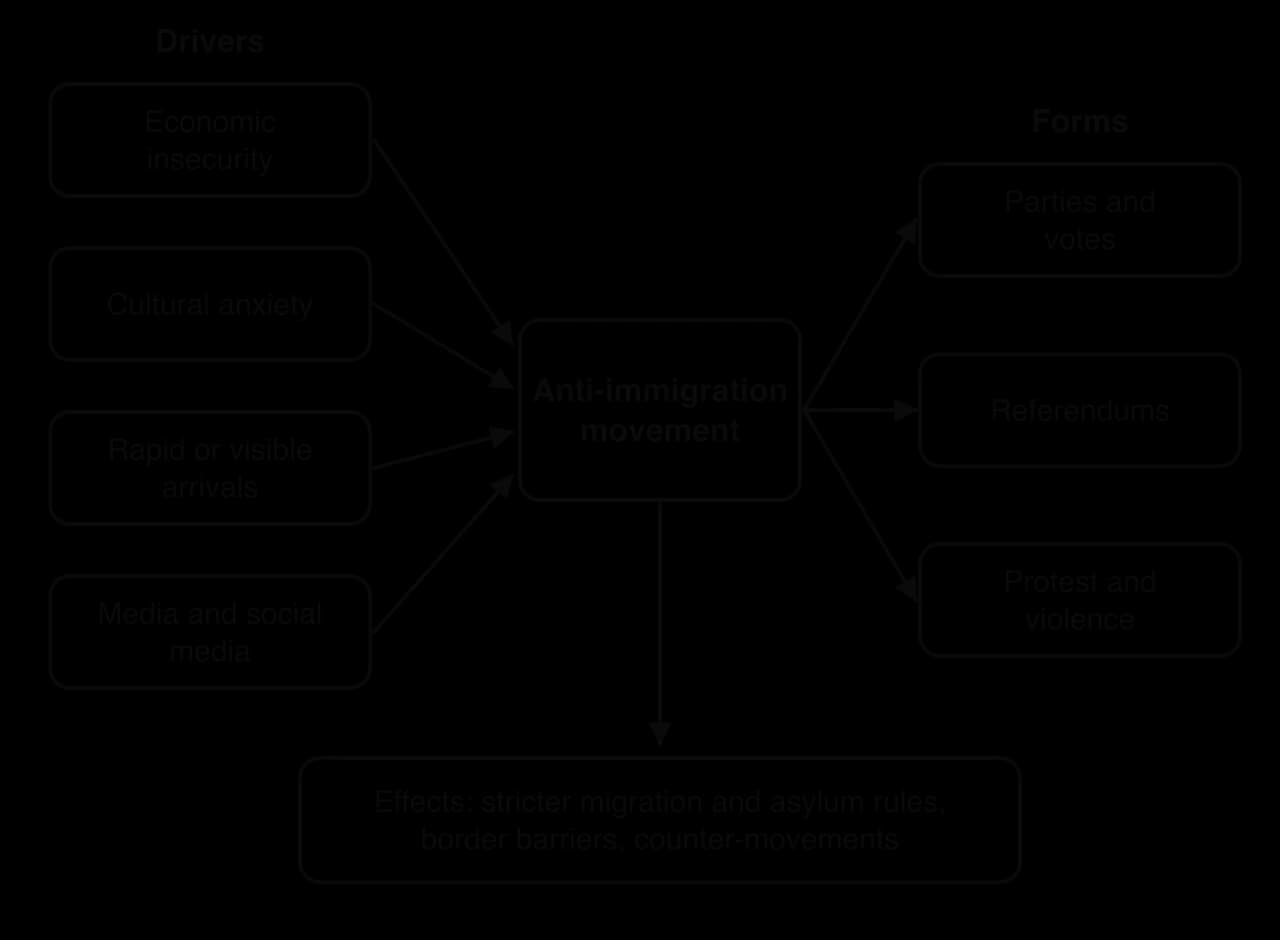
Researchers point to several drivers, which usually work together rather than alone. Their relative importance varies between countries and is still debated.
Economic insecurity. Deindustrialisation, the offshoring of manufacturing jobs and the financial crisis of 2008 left some regions with high unemployment and low wages. Some workers blame competition from migrants for lower pay or difficulty finding housing, even where economists find the overall effect of immigration on wages to be small.
Cultural anxiety. Rapid changes in the ethnic, religious or linguistic make-up of a place can make some long-standing residents feel that their way of life or national identity is under threat. This links to the debates about cultural diversity and cultural hybridity in changing identities and cultures.
Rapid or visible arrivals. Sudden increases in the number of refugees and asylum seekers, such as the arrival of more than one million people in the European Union in 2015, make migration a highly visible issue, even in places that receive few migrants.
Media and social media. News coverage that focuses on crime or crisis, and social media platforms that spread false claims quickly and group like-minded users together, can amplify fear and help movements to organise.
Forms of anti-immigration movement
Anti-immigration movements take three main forms. They contest elections as political parties, they win referendums on national sovereignty and borders, and they organise protests, a small minority of which turn violent. Governments that respond to them also build physical border barriers.
Form | Example | Key facts |
|---|---|---|
Party (France) | Rassemblement National (National Rally) | With its allies, led the first round of the 2024 National Assembly election with 33.2% of the vote; it won 142 seats in the second round, behind two other blocs |
Party (Germany) | Alternative für Deutschland (AfD) | Won 20.8% in the February 2025 federal election, doubling its share and coming second; other parties refused to govern with it |
Party (Sweden) | Sweden Democrats | Became the second-largest party in 2022 with just over 20% of the vote and supported the new government without joining it |
Party (UK) | Reform UK | Won 14.3% of the vote but only 5 of 650 seats in the July 2024 general election, under first-past-the-post voting |
Referendum (UK) | The Brexit vote, 23 June 2016 | 51.9% voted to leave the European Union; control of immigration was a central argument of the Leave campaign |
Border barrier (Hungary) | Fence on the borders with Serbia and Croatia, built from mid-2015 | Irregular entries fell sharply after it was completed; the government said Hungarians should decide who they live with |
Protest and violence (UK) | Riots of 30 July–5 August 2024 | Followed false online claims about the attacker in the Southport stabbings; hotels housing asylum seekers were attacked; 1,840 arrests by July 2025 |
Sources: Wikipedia articles on the 2024 French legislative, 2025 German federal, 2022 Swedish general and 2024 UK general elections, the 2016 EU referendum, the Hungarian border barrier and the 2024 UK riots, citing national electoral bodies and police figures, accessed 2026.
The UK riots of 2024 show how fast online claims can turn into street violence. On 29 July 2024 three young girls were killed in a knife attack at a dance class in Southport. False claims spread on social media that the attacker was a Muslim asylum seeker; he was in fact born in the UK. Protests outside a mosque in Southport the next day turned violent, and disorder spread to other English towns and to Belfast over the following week, with attacks on police, mosques, immigrant-owned businesses and hotels housing asylum seekers.
The response showed the strength of counter-movements. From 6 August the unrest died down, and on 7 August large anti-racist rallies across the country far outnumbered anti-immigration protesters. The courts dealt quickly with those charged, and the government and police pressed social media companies over the spread of false claims. Counter-movements, such as refugee welcome groups, anti-racist campaigns and migrant community organisations, are themselves civil society actors in the debate about migration.
Effects on migration policy
Anti-immigration movements influence policy even when they do not hold power, because mainstream parties change their own positions to win back voters. The effects include stricter asylum rules, fewer visas for some categories of migrant, more spending on border enforcement, agreements with transit countries to stop people leaving, and in some cases physical barriers. The United Kingdom’s vote to leave the European Union ended free movement of EU citizens to the UK from the start of 2021 and replaced it with a points-based immigration system that applies to EU and non-EU migrants alike.
The effects are uneven. Immigration to the UK reached record levels in the years after Brexit, mainly from outside the EU, which shows that national policy responds to labour shortages and to the needs of employers, universities and health services as well as to public opinion. Government rules on migration, such as visas and points systems, are part of the political influences on global interactions, while the movements that press for those rules belong to local responses.
Stakeholder | Typical position on immigration | Source of power |
|---|---|---|
Anti-immigration parties and voters | Reduce numbers sharply, restore national control of borders | Votes, referendums, media attention, pressure on mainstream parties |
Employers in agriculture, care, construction and health | Keep access to migrant workers to fill labour shortages | Lobbying, economic importance, warnings of shortages |
Migrants and diaspora communities | Secure legal status, family reunion and protection from discrimination | Community organisations, votes once naturalised, remittances to home countries |
Refugee and human rights NGOs | Protect the right to asylum under international law | Legal challenges, campaigns, international conventions |
National governments | Balance public opinion, the economy and legal obligations | Law-making, border control, international agreements |
Geopolitical constraints on personal freedoms
Participation in global interactions depends on personal freedoms: the freedom to communicate, to travel, to read foreign media, to join organisations and to trade. Many governments, and some armed groups that control territory, restrict these freedoms. They usually justify the restrictions by national security, public order, protection from foreign influence or religious and moral values. Critics see them as ways to keep power and to prevent citizens from organising or learning what others think.
Internet censorship and shutdowns
The internet is the main channel through which individuals take part in global interactions, so it is the main target of government control. Censorship is the suppression or control of speech, media and information that a government or other authority considers harmful, offensive or threatening. Online, it includes blocking foreign websites and apps, removing posts, slowing (throttling) connections and punishing users.
China operates the most extensive system, known informally as the Great Firewall. Many foreign platforms, such as Google, Facebook, YouTube and X, are blocked, and domestic substitutes such as WeChat, Weibo and Baidu must censor content. Unauthorised use of virtual private networks (VPNs) can be punished with fines.
Russia restricted Facebook and X (then Twitter) from late February 2022, after its full-scale invasion of Ukraine, and the bans were nearly total by 4 March. YouTube was heavily slowed by 2024, and from 2025 the authorities restricted calls on foreign messaging apps such as WhatsApp and Telegram while promoting a state-backed alternative.
Iran blocks many foreign platforms and has repeatedly cut access during protests, most severely in 2019, 2022 and January 2026.
India has imposed more shutdowns than any other democracy, most of them ordered by state governments. Jammu and Kashmir had the longest recorded shutdown, of 552 days: a complete communications blackout began on 4 August 2019, when its special constitutional status was revoked, slow 2G access to approved websites returned on 25 January 2020, and high-speed internet only in February 2021.
An internet shutdown is the most extreme form of control: the intentional disruption of internet or mobile data access for a population or area. Shutdowns are often imposed during protests and elections, during national school tests to stop cheating, or in conflict zones. They have large economic costs, because online banking, trade, transport and government services stop working. Iran’s communications minister estimated that the shutdown imposed during protests in January 2026 cost the economy about US$35.7 million a day.
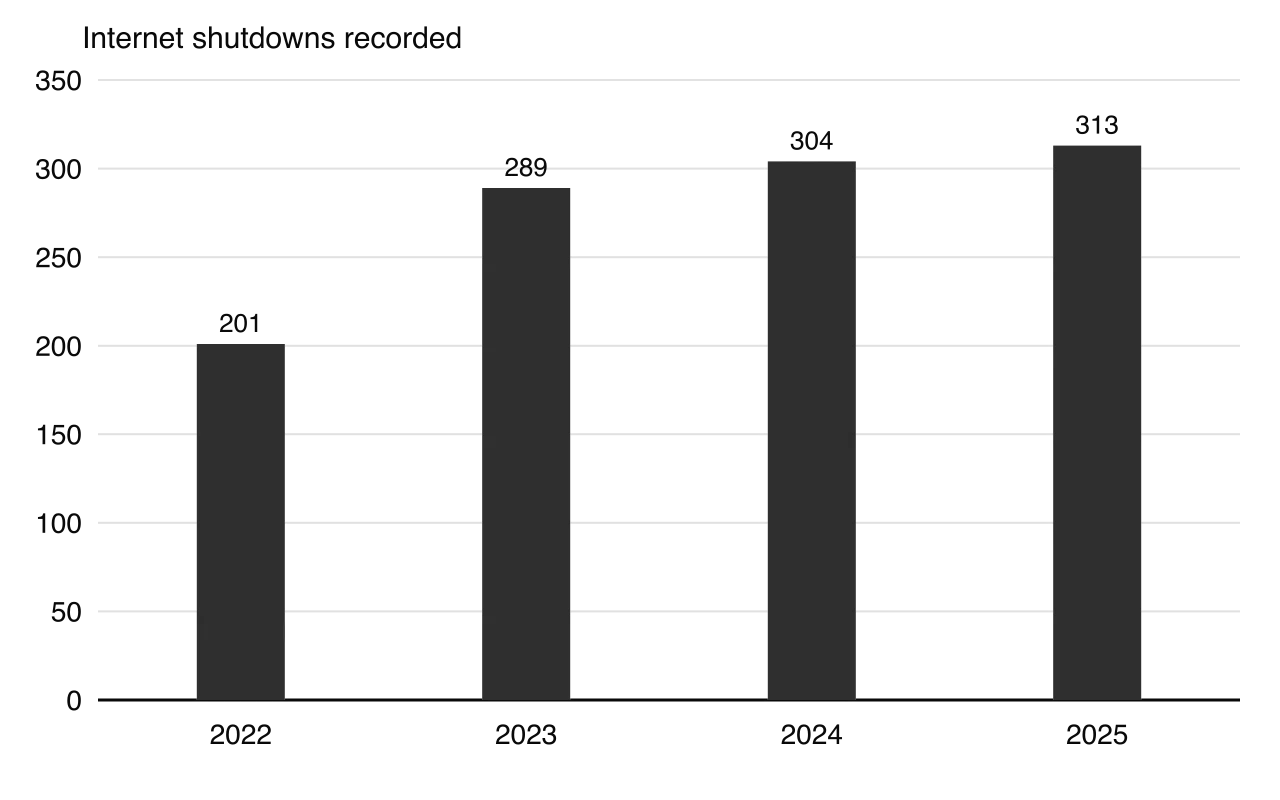
The chart shows a rising trend: from 201 shutdowns recorded in 2022 to 289 in 2023, 304 in 2024 and 313 in 2025, a rise of about 56% in three years. Access Now notes that its counts are likely to be underestimates, because some shutdowns in remote areas or tightly controlled countries go unreported. The Asia-Pacific region accounted for 195 of the shutdowns in 2025, about three-fifths of the total; Myanmar (at least 95) and India (65) recorded the most.
 YouTube
Travel restrictions, media control and limits on NGOs
Other controls limit people’s physical and organisational participation in global interactions. Travel and exit restrictions prevent citizens from leaving: North Korea requires state permission for any foreign travel and punishes unauthorised departure, so very few of its citizens take part in international migration, tourism or study. Some governments ban critics from travelling abroad, or confiscate passports.
Media control includes state ownership of broadcasters, licensing of journalists and the jamming or blocking of foreign news services. Restrictions on NGOs and foreign funding limit the ability of civil society to connect with international partners. Russia’s “foreign agent” law of 2012 requires organisations that receive funding from abroad and engage in loosely defined political activity to register and label their publications, and it has been extended to individuals and media. Governments that pass such laws argue that they protect national sovereignty, the authority of a state to govern its territory and make its own decisions without outside interference; NGOs argue that the laws are designed to silence criticism.
Militia controls
Where armed groups control territory, they can restrict freedoms as tightly as a state. Since retaking control of Afghanistan in August 2021, the Taliban have banned most girls from secondary school (from September 2021), banned women from universities and from working for NGOs (both from December 2022), and restricted women’s travel and employment. These rules cut women off from education, paid work and the international organisations that employed many of them, and some NGOs had to stop their work in the country.
In north-east Nigeria, Boko Haram, whose name is commonly translated as “Western education is forbidden”, has attacked schools, most notoriously abducting 276 schoolgirls from Chibok in 2014. In Somalia, the militant group Al-Shabaab ordered telecommunications companies to cut mobile internet services in areas it controlled in 2014, and has punished people for watching foreign films. Militia controls show that restrictions on participation do not come only from governments, and that they can be enforced by violence where the state is weak.
Measuring freedom
Restrictions on freedom are hard to measure, because they are often informal and hidden. The most widely used measures come from Freedom House, a US-based NGO. Its annual Freedom in the World report, published since 1973, scores political rights and civil liberties in 195 countries and 15 territories. Its Freedom on the Net report scores internet freedom out of 100, using three groups of indicators: obstacles to access (for example shutdowns and infrastructure), limits on content (blocking and censorship) and violations of user rights (surveillance, arrests and attacks on users).

The scores show a clear pattern. High-income democracies such as Iceland, the UK and the USA score highest, while countries with one-party or military rule, such as China and Myanmar, score lowest. Large lower-middle-income democracies, including India, Nigeria and Kenya, fall in the middle: they have competitive elections and active online debate, but also shutdowns, arrests of online critics and laws that limit speech.
National trade restrictions
Governments also restrict global interactions by controlling trade. Since the Second World War, most states have lowered barriers to trade through agreements and the rules of the World Trade Organization. Trade restrictions push in the opposite direction: they protect particular industries, jobs or resources from foreign competition or foreign ownership, often in the name of national security or economic independence.
Protectionism and its tools
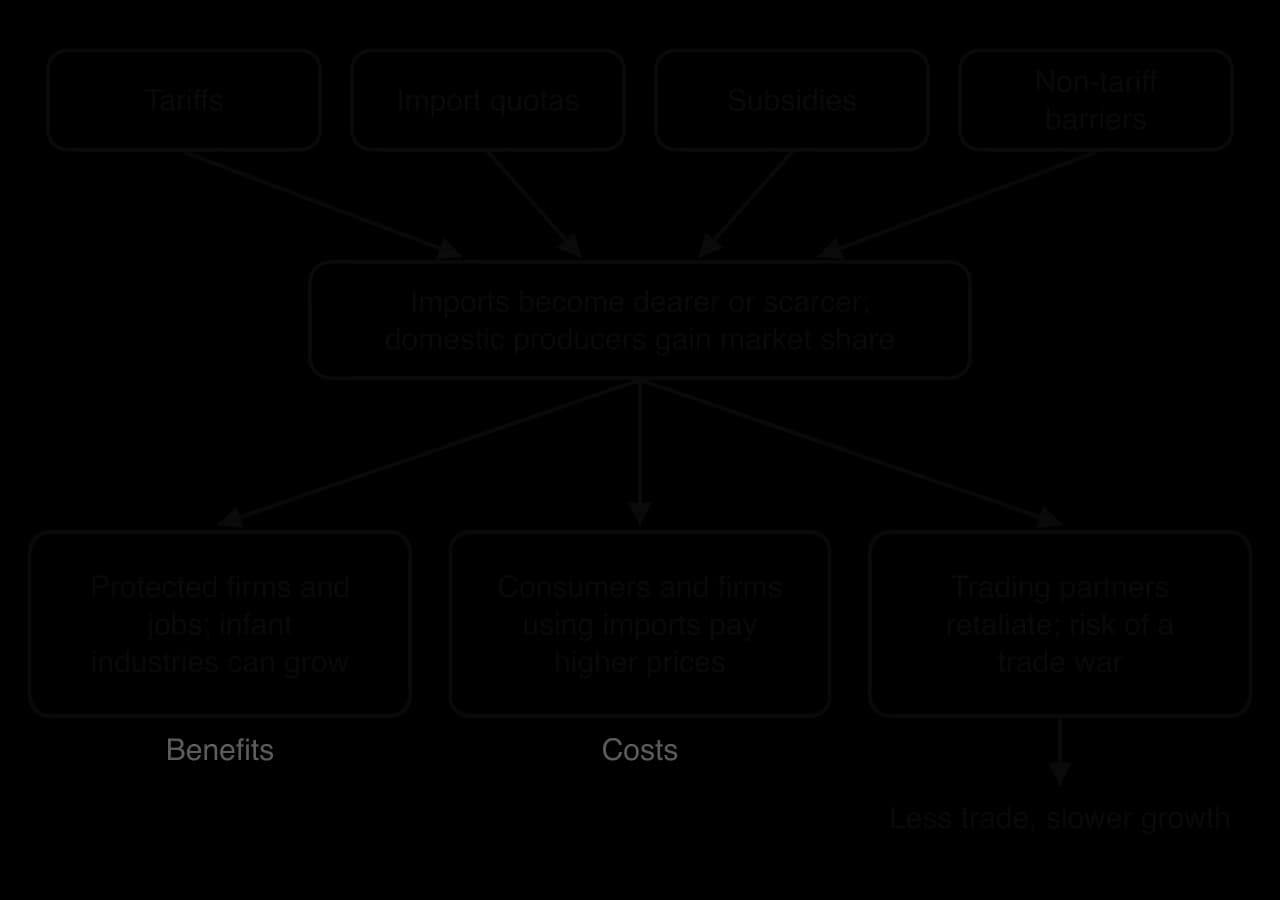
Protectionism is the policy of protecting a country’s producers from foreign competition by restricting imports. Its supporters argue that it saves jobs, protects new “infant” industries until they can compete, keeps strategic industries such as steel, food and computer chips in national hands, and responds to unfair practices by other countries, such as state subsidies. Its critics argue that it raises prices, invites retaliation and makes the protected industries less efficient.
Tool | How it works | Example |
|---|---|---|
Tariff | A tax on imported goods, usually a percentage of their value, which makes them dearer than domestic goods | US tariffs of 25% on steel and 10% on aluminium from March 2018 |
Import quota | A legal limit on the quantity or value of a good that may be imported in a period | Limits on imports of sugar or textiles; the EU’s quotas on steel imports from 2018 |
Subsidy | Government payments or tax breaks to domestic producers, so they can sell more cheaply at home and abroad | Farm subsidies in the EU and the USA; support for battery and chip factories |
Non-tariff barrier | Rules other than taxes that make importing harder: product standards, licences, slow customs checks, “buy national” rules for government purchases | Food safety rules that bar certain imports; local-content requirements |
Import substitution | A long-term strategy of replacing imports with domestic production behind high barriers | Many Latin American and South Asian economies from the 1950s to the 1980s |
An import quota limits quantity directly, so it gives the government more certain control over the volume of imports than a tariff, but it raises no tax revenue and can create shortages.
Non-tariff barriers are often harder to see and to challenge, because a product standard may protect consumers as well as producers. A ban on imported food treated with a particular pesticide, for example, may be justified on health grounds but also shelters domestic farmers.
Import substitution industrialisation was the main development strategy of countries such as India and Brazil for several decades after independence or the Second World War. It built up domestic industries, but many of them remained inefficient, which is one reason why most of these countries opened their economies from the 1980s and 1990s.
Tariffs and trade wars since 2018
From 2018 the United States raised tariffs sharply. In March 2018 it imposed tariffs of 25% on steel and 10% on aluminium from most countries, and from mid-2018 it imposed tariffs on hundreds of billions of dollars of imports from China, which retaliated with tariffs on US goods, especially farm products. A trade war is a conflict in which countries raise tariffs or other barriers against each other in successive rounds of retaliation.
On 2 April 2025, which the US president called “Liberation Day”, the USA announced a 10% tariff on imports from nearly all countries, from 5 April, with higher rates for many major trading partners. Most of the higher rates were paused for 90 days a week later, after falls in share and bond prices, but tariffs on China rose to 145% and China’s tariffs on US goods to 125% before the two sides agreed to reduce them.
The average effective US tariff rate rose from 2.5% in January 2025 to an estimated 27% in April 2025, the highest in more than a century. On 20 February 2026 the US Supreme Court ruled that the International Emergency Economic Powers Act, the emergency law used for many of these tariffs, does not allow the president to impose tariffs. Collection of those tariffs stopped within days and refunds to importers began in April 2026. Tariffs imposed under other trade laws, such as those on steel and aluminium, remained, and the administration introduced new ones under different laws; the average effective rate was estimated at 12.1% on 21 July 2026.
The European Union has also used trade defence. After an investigation found that Chinese makers of battery electric vehicles benefited from unfair government subsidies, the European Commission imposed additional countervailing duties on imports of these cars from China in late 2024. China, the EU and the USA each describe their own measures as defensive responses to the unfair practices of others, which is why trade disputes escalate so easily.
Resource nationalism
Some trade restrictions concern natural resources rather than manufactured goods. Resource nationalism is the assertion by a state of greater control over the natural resources in its territory, through higher taxes and royalties, state ownership, export bans or rules requiring processing at home. One of its tools is nationalisation, the transfer of privately owned companies or assets into state ownership. Resource nationalism is a form of resistance to global interactions in which the state, rather than civil society, limits the power of foreign investors.
Country and resource | Action | Aim and effect |
|---|---|---|
Bolivia: natural gas | President Evo Morales decreed on 1 May 2006 that the state would take “total and absolute control” of hydrocarbons | Followed years of protest against foreign control of gas; raised state revenue and renegotiated contracts with foreign firms |
Indonesia: nickel | Banned exports of nickel ore from January 2020 (after an earlier ban in 2014–2017) | To force processing at home and enter the battery supply chain; smelters such as those at the Morowali Industrial Park expanded, and Indonesia produced about 1.6 million of the world’s 3.3 million tonnes of nickel in 2022 |
Venezuela: oil | In 2007 the government required foreign companies in the Orinoco Belt heavy-oil projects to give the state oil company PDVSA majority control; ExxonMobil and ConocoPhillips refused and their assets were expropriated | Increased state control and revenue while oil prices were high, but underinvestment and mismanagement, followed by US sanctions from 2017, cut PDVSA’s output from about 3.4 million barrels a day in 1998 to about 800,000 in the 2020s |
Mexico: lithium | A law of April 2022 barred private companies from lithium concessions; a decree of February 2023 declared the reserves national property | To keep the value of a battery mineral in national hands; foreign investors such as China’s Ganfeng Lithium were affected |
China: rare earths | Export restrictions on several rare earth elements from April 2025 and wider controls announced in October 2025, partly suspended for a year after a US–China deal on 30 October 2025 | China dominates the refining of these minerals, so controls give it bargaining power in trade disputes and alarm importers |
Sources: Wikipedia articles on the Bolivian gas war, Nickel mining in Indonesia, PDVSA, the López Obrador presidency, Ganfeng Lithium and the Rare earths trade dispute, citing government decrees and official statistics, accessed 2026.
Indonesia’s nickel ban shows how resource nationalism can change a country’s place in global supply chains. By refusing to export raw ore, Indonesia persuaded mainly Chinese investors to build smelters on its islands, so more of the value of the metal is created inside the country. The policy has created tens of thousands of jobs (about 43,000 at Morowali alone), but nickel mining and processing became a leading cause of deforestation in Indonesia by 2024, and the EU challenged the ban at the WTO as a breach of trade rules.
Evaluating trade restrictions
Stakeholder | Possible gains | Possible losses |
|---|---|---|
Workers and firms in protected industries | Jobs and sales are protected; new industries (batteries, smelting) can develop | Less pressure to innovate; dependence on continued protection |
Consumers | Some gain jobs or wages in protected industries | Higher prices and less choice |
Firms that use imported inputs | Few | Higher costs for steel, parts and minerals, making their own products less competitive |
Exporters | Few | Lost markets when trading partners retaliate (US soybean farmers after 2018) |
Governments | Tariff revenue; bargaining power; control of strategic resources | Strained diplomatic relations; legal challenges at the WTO and in national courts |
Foreign investors | Some invest to get inside the barrier (smelters in Indonesia) | Loss of assets or contracts through nationalisation; less certainty |
Trade restrictions are most effective when they are targeted, temporary and backed by a plan to make the protected industry competitive, as with some infant industries, and least effective when they are broad and permanent, which raises costs for the whole economy. Resource nationalism can increase a country’s share of the value of its minerals, but it can also deter the investment needed to extract them. In the long term, both protectionism and resource nationalism reduce the interdependence that globalisation creates; whether that is a gain (more sovereignty and security) or a loss (less trade and growth) depends on the stakeholder and on the place.
Civil society, international-mindedness and internet freedom
Civil society is the range of groups and organisations that are separate from governments and businesses: NGOs, charities, trade unions, faith groups, community associations and informal networks of citizens. It resists some global interactions, but it also widens participation in others, by connecting people across borders and by challenging the controls that governments and militias place on them.
International-mindedness
International-mindedness is an openness to other cultures, perspectives and global issues, together with a sense of responsibility towards people in other places. Civil society promotes it through exchange programmes, international volunteering, education about global issues, solidarity campaigns and the sharing of news and culture across borders. It is the opposite of the xenophobia found in some anti-immigration movements, and a counterweight to the narrowing of identities that can accompany globalisation.
Social media activism and citizen journalism
Social media have made it far cheaper and faster for citizens to organise. Social media activism is the use of social media platforms to raise awareness, mobilise supporters and put pressure on governments, companies or other institutions. Its tools include hashtag campaigns, online petitions, crowdfunding, the live-streaming of protests and the co-ordination of boycotts. Governments and international organisations use the same platforms to speak directly to the public in other countries, a practice known as digital diplomacy, and civil society groups answer them in public, so debates that were once held between diplomats now take place in front of a global audience.
#MeToo spread virally from October 2017, when the actor Alyssa Milano encouraged women to use the phrase to show how common sexual harassment and assault are, after allegations against the film producer Harvey Weinstein. The movement was taken up in many countries, sometimes under local names, and led to new workplace rules and laws.
#BlackLivesMatter began as a hashtag in the USA in 2013 and became a global movement in 2020, when the murder of George Floyd by a police officer in Minneapolis led to protests against racism and police violence in many countries.
#EndSARS in Nigeria in October 2020 used Twitter to organise protests against police brutality, with 48 million tweets in ten days.
Citizen journalism is the collection and sharing of news by members of the public rather than professional journalists, usually with smartphones and social media. It allows events to be reported from places that professional media cannot reach, or where the media are controlled. In Iran in 2022, an Instagram account run from inside and outside the country to share videos of protests had more than 450,000 followers by October. Citizen journalism also has risks: footage can be unverified or misleading, and those who film may be identified and punished.
Critics of online campaigns also point to slacktivism: supporting a cause with a click, a like or a profile picture, which costs little and may change little.
Campaigning for internet freedom
Internet freedom is the ability of people to access, use and publish on the internet without censorship, shutdowns, unlawful surveillance or punishment for what they say online. It is treated by many civil society organisations as an extension of the rights to freedom of expression and information in the Universal Declaration of Human Rights (1948).
Access Now, founded in 2009 after the disputed Iranian presidential election of that year, campaigns against shutdowns, censorship and surveillance. In 2016 it launched the #KeepItOn campaign with a coalition of about 70 organisations, which now records every shutdown it can verify and lobbies governments and telecommunications companies to keep networks running.
The Electronic Frontier Foundation (EFF), founded in the USA in 1990, defends online civil liberties through lawsuits, technology and campaigns, and supports encryption.
Circumvention tools let users get around censorship: virtual private networks (VPNs) route traffic through servers in other countries, and the Tor network hides who is visiting which website. VPN downloads rise sharply whenever a platform is blocked, as in Nigeria in 2021.
Satellite internet, such as Starlink, can bypass national networks altogether. During Iran’s blackout of January 2026 it was one of the few ways to get online, and the authorities responded by seizing satellite dishes.
The limits of online activism
Online tools have limits. Governments monitor social media to identify and arrest activists, so the same platforms that help protesters to organise also expose them to surveillance. Social media spread misinformation as fast as accurate news, as the UK riots of 2024 showed. Online support may not turn into action (slacktivism), and campaigns that trend for a few days can fade before they achieve change. Access to the tools is also unequal: in 2024 only 41% of Nigeria’s population used the internet, compared with 71% of the world’s population, so online activism mostly reaches those who are already connected.
Sources: ITU, Individuals using the Internet, via World Bank World Development Indicators, 2024.
Challenging restricted freedoms in Iran, 2022–2023
On 16 September 2022, Mahsa (Jina) Amini, a 22-year-old Kurdish Iranian woman, died in the custody of Iran’s morality police, who had detained her for allegedly breaking the rules on wearing the hijab. Protests began at her funeral and spread to cities and universities across the country, led largely by women and young people under the slogan “Woman, Life, Freedom”. The government blocked specific services and repeatedly shut down internet and mobile networks from 19 September, and blocked Instagram and WhatsApp, which had been allowed and widely used; the monitoring group NetBlocks called them the most severe restrictions since 2019.
The crackdown was severe. Iran Human Rights counted at least 551 people killed, including at least 68 minors, by 15 September 2023, and the rights group HRANA counted 19,262 arrests by 6 January 2023; by spring 2023 seven people had been executed in connection with the protests.
The Supreme Leader, Ali Khamenei, described the unrest as “riots” organised by foreign enemies, and the government reported dozens of members of the security forces killed. The USA, the EU and others imposed sanctions on the morality police and security officials, and in early 2024 a UN fact-finding mission found that the state had committed crimes against humanity; the government rejected the mission and its findings. Protests had largely subsided by spring 2023, and a stricter “Hijab and Chastity” bill passed parliament in September 2023.
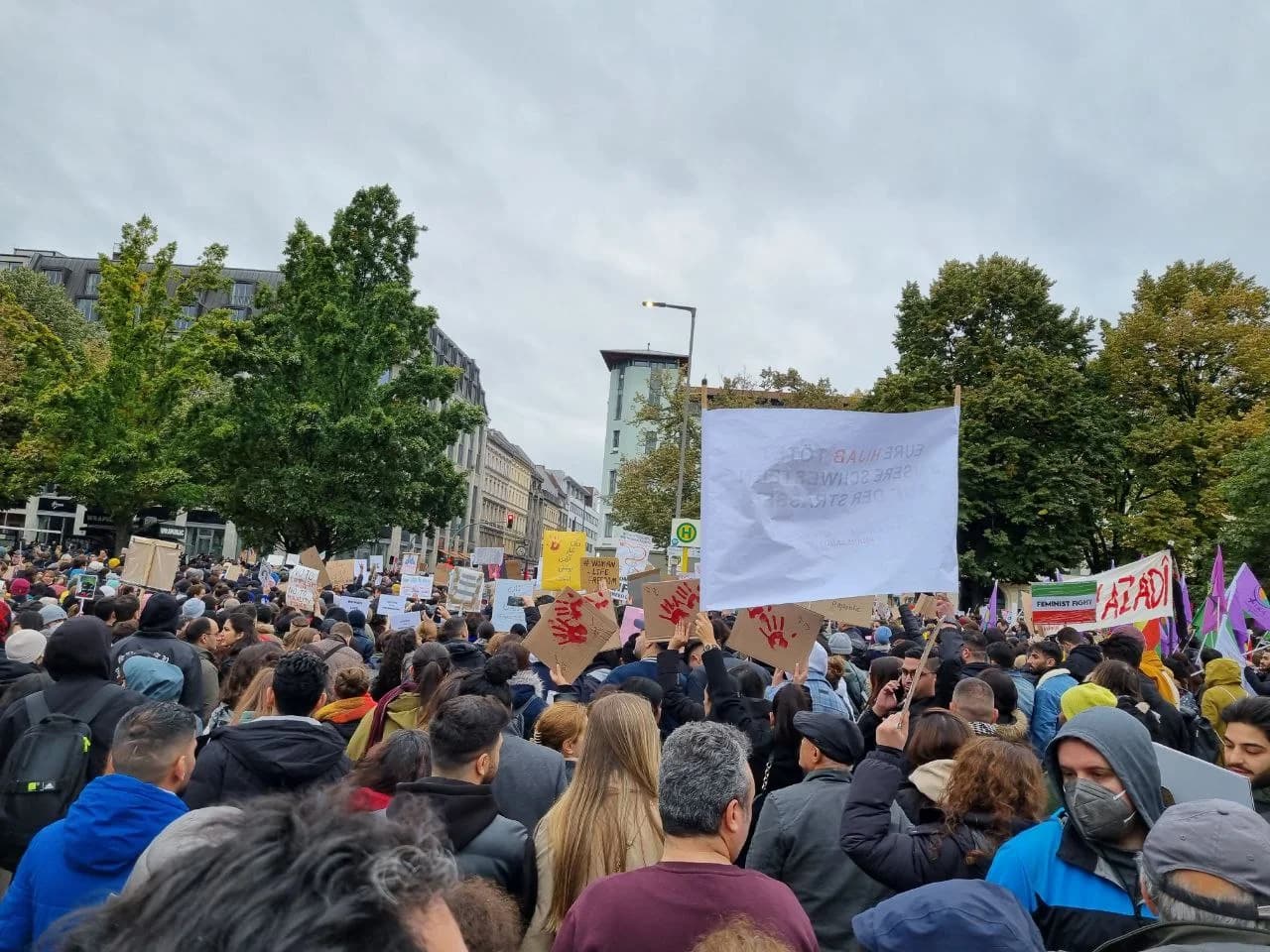
Iran shows both the power and the limits of civil society. Citizens used VPNs, citizen journalism and the diaspora to keep the world informed, international solidarity marches took place in many cities, and the protests changed how many Iranians and outsiders saw the state. However, the government kept control through force and shutdowns, and its internet freedom score remained among the lowest in the world (13 out of 100 in 2025). When protests returned in January 2026, the authorities imposed a nationwide blackout again.
Sources: Wikipedia, Mahsa Amini protests and 2026 Internet blackout in Iran (citing Iran Human Rights, HRANA, NetBlocks and the UN Fact-Finding Mission), accessed 2026; Freedom House, Freedom on the Net 2025.
Acceptance and resistance at different scales
Acceptance of and resistance to global interactions take different forms at different scales, and the scales interact. At the local scale, resistance is often direct and specific: villagers blockade a factory, residents shop at a farmers’ market, or neighbours protest against a hotel housing asylum seekers. At the national scale, it takes the form of laws and votes: tariffs, resource nationalisation, referendums, internet shutdowns and NGO laws. At the global scale, it is organised through networks: the anti-globalisation movement, international NGOs and campaigns such as #KeepItOn.
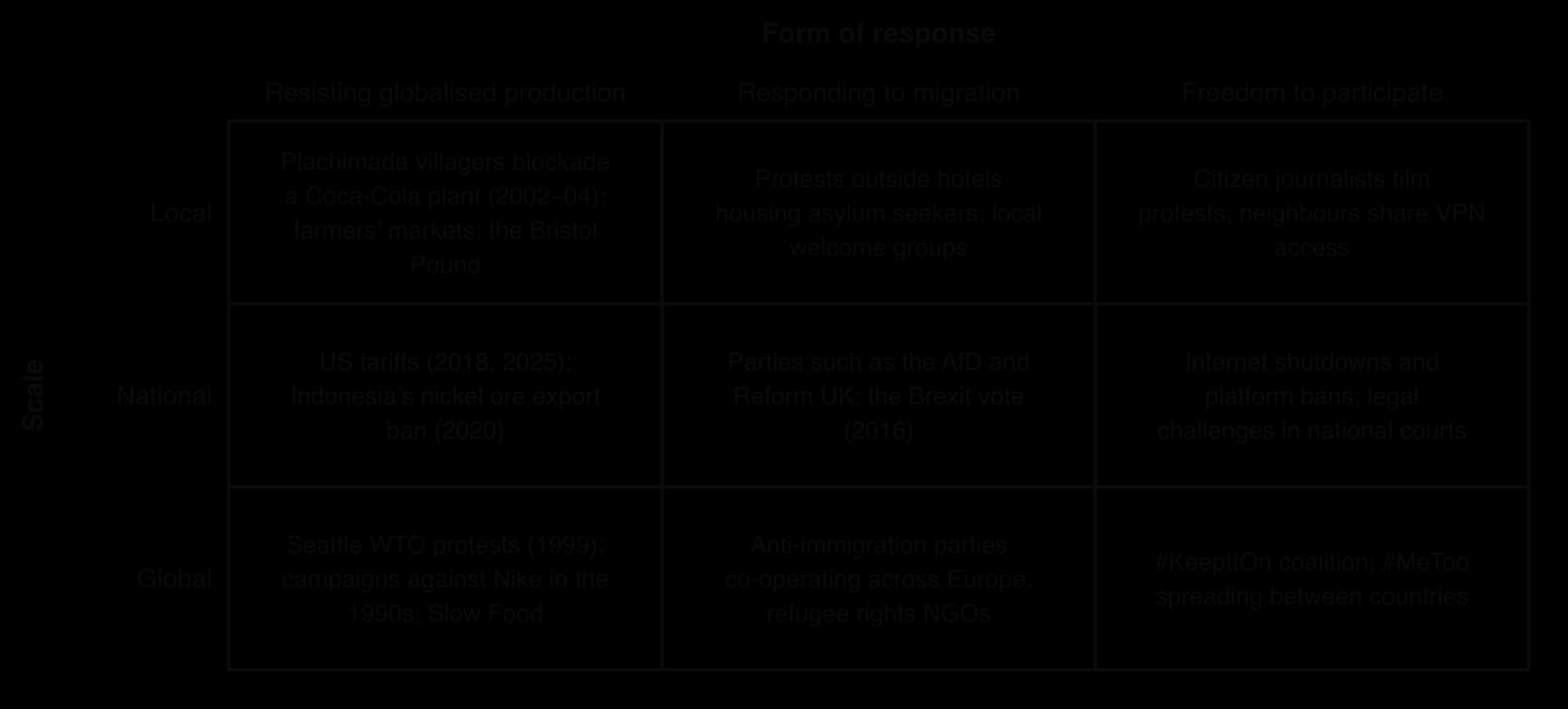
Power shifts between scales in both directions. National governments are usually the most powerful actors, because they make laws and control borders and networks. Local actors gain power when they connect to national and global allies, as in Plachimada, and global campaigns gain power when they are rooted in local grievances, as in #EndSARS. Global institutions such as the WTO can also limit what national governments may do, which is one reason why anti-globalisation movements target them.
The direction of resistance also varies with the place. In high-income democracies, the most visible resistance is to the effects of globalisation, such as job losses, immigration and the power of TNCs. In states with tight controls on freedom, much civil society activity is a demand for more participation in global interactions: access to foreign platforms, news and contacts. Acceptance and resistance therefore depend on who holds power, what they gain or lose from global interactions and how far citizens are free to express their views.
Case study: Nigeria’s Twitter ban, 2021–2022
The place and its context
Nigeria, in West Africa, is the most populous country in Africa, with about 232.7 million people in 2024, and one of its largest economies. It has a young, fast-growing online population: 41% of Nigerians used the internet in 2024, up from 32% in 2020, and the social media platform Twitter (now X) was widely used by journalists, businesses, politicians and activists. The country is a federal democracy, but it faces several security crises, including an Islamist insurgency in the north-east and a separatist movement in the south-east that seeks an independent state of Biafra.
Twitter had already shown its power in Nigerian politics. In October 2020 the #EndSARS protests against police brutality, named after the Special Anti-Robbery Squad, were organised largely on the platform, with 48 million tweets in ten days. The government had floated plans to regulate social media on several occasions, and some ministers saw Twitter as a channel for misinformation and for opposition to the state.
The process: from a deleted tweet to a nationwide ban
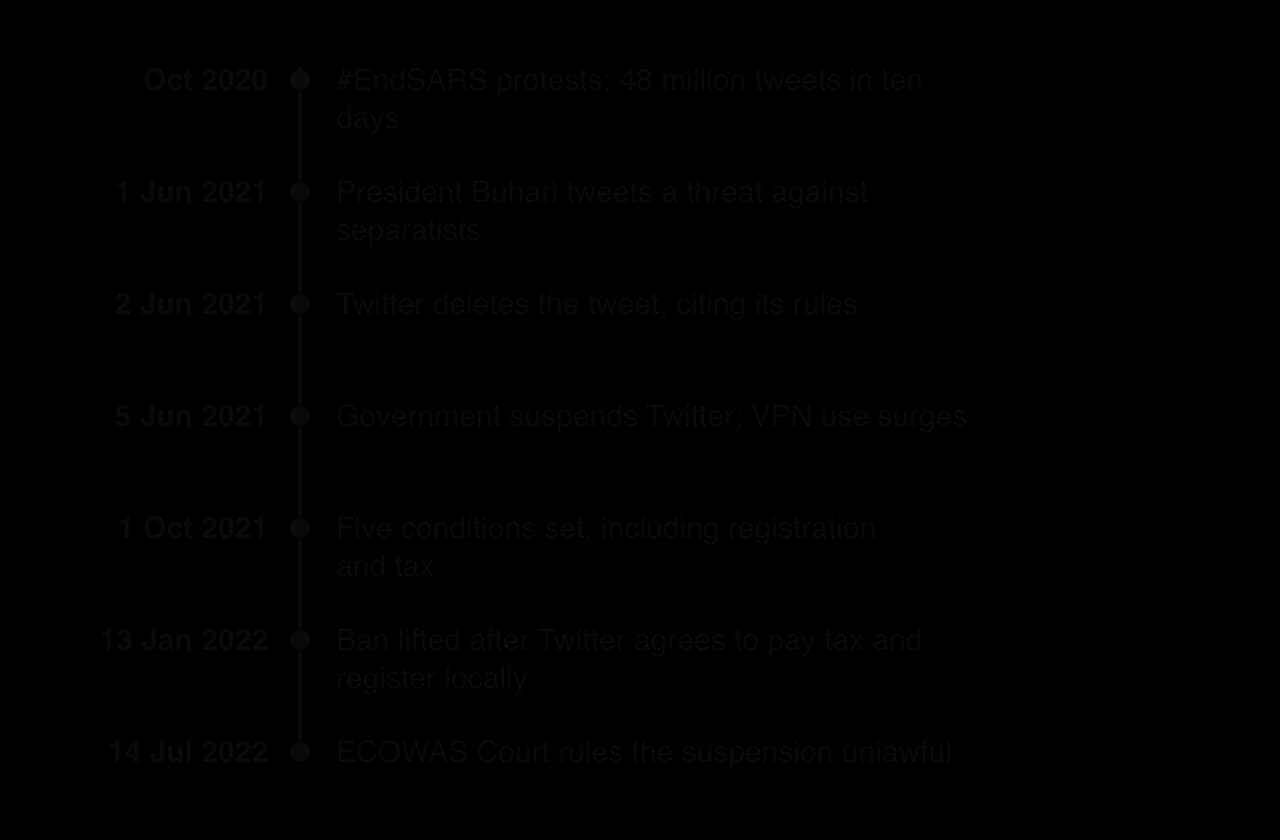
On 1 June 2021 President Muhammadu Buhari posted a tweet threatening a crackdown on regional separatists “in the language they understand”, which critics read as a reference to the civil war of 1967–1970. Twitter deleted the tweet the next day, saying that it broke its rules. On 4 June the information minister, Lai Mohammed, announced that Twitter’s operations in Nigeria were suspended, and telecommunications companies blocked access from 5 June. The government said that the decision was based on a “litany of problems”, including misinformation and fake news on the platform with “real world violent consequences”, not only the deleted tweet.
The ban was enforced through national networks. The broadcasting regulator told radio and television stations to stop using Twitter, and the justice minister at first threatened to prosecute citizens who got round the ban, although he later denied it.
Talks between the government and the company began in July 2021. On 1 October the president set five conditions for lifting the ban: respect for national security and cohesion; registration, physical presence and representation in Nigeria; fair taxation; dispute resolution; and local content. On 12 January 2022 the government announced that Twitter had agreed to pay “applicable tax” and to set up a legal entity in Nigeria, and access returned on 13 January.
Impacts on different groups
Group | Impact | Response |
|---|---|---|
Nigerian users and activists | Lost easy access to a key platform for news, debate and organising | Switched to VPNs; traffic to the VPN provider ExpressVPN rose by more than 200% |
Businesses and online traders | Lost a channel for marketing and customer service; one estimate put the cost to the economy at over ₦6 billion within three days | Moved to other platforms or used VPNs |
Journalists and broadcasters | Told by the regulator to stop using Twitter as a source or channel | Some continued through VPNs; press groups condemned the order |
Twitter (a TNC) | Lost access to a large and growing market | Called the ban “deeply concerning”, then negotiated and accepted conditions |
Civil society organisations | Saw the ban as a threat to freedom of expression | SERAP and the Nigerian Bar Association prepared legal challenges; SERAP took the case to the ECOWAS Court |
Foreign governments | Saw a restriction on democratic rights | The UK, Canada and Sweden, and the USA and the EU jointly, condemned the ban |
Stakeholders’ positions
The Nigerian government argued that it was defending national security and the country’s “corporate existence” against a foreign company that applied its rules unfairly, deleting the president’s tweet while, in its view, allowing incitement by others. It presented the ban as an assertion of sovereignty over a foreign platform and its conditions as normal regulation of a business operating in Nigeria. Some foreign politicians supported this view: the former US president Donald Trump, who had himself been suspended from Twitter, praised the ban.
Twitter argued that it applied its rules to all users, including world leaders, and that open access to the platform was a matter of freedom of expression. Civil society organisations such as SERAP (the Socio-Economic Rights and Accountability Project) and Amnesty International argued that the ban breached the rights of millions of Nigerians to free expression and information. Many users saw it as a response to the role of Twitter in the #EndSARS protests rather than to one deleted tweet.
Responses and how well they worked
Citizens’ responses limited the ban’s effect but did not end it. VPNs allowed many urban, educated users to continue posting, so the ban was porous, but less connected users and businesses lost access.
The legal challenge took longer. In a judgment published on 14 July 2022, the Court of Justice of the Economic Community of West African States (ECOWAS), in a case brought by SERAP and 176 Nigerians, ruled that the suspension was unlawful because it breached the rights to freedom of expression, access to information and the media under the African Charter on Human and Peoples’ Rights and the International Covenant on Civil and Political Rights. It ordered the government not to repeat the ban.
The ban ended through bargaining between a state and a TNC, after the court case had begun but before the judgment. The government gained some of its aims, including a promise of local registration and tax, while Twitter regained access to the market. The court ruling then added a regional legal check on what the government may do. Nigeria’s internet freedom score of 59 out of 100 in 2025 (“Partly Free”) reflects this mixed record: online debate is active and the ban was reversed, but arrests of online critics and pressure on journalists continue.
What the case shows
Key concept | How the case shows it |
|---|---|
Power | A national government used its control of telecommunications networks to cut citizens off from a global platform, and used access to its market to bargain with a TNC; citizens and courts used VPNs and regional law to push back |
Place | Nigeria’s large young population and the political role of Twitter after #EndSARS made the platform both valuable and threatening to the state |
Scale | A national ban affected a global company, was condemned by foreign governments and was judged by a regional court, while its effects were felt by individual users and traders |
Possibility | The outcome, a negotiated return and a court ruling against repetition, shows that restrictions can be reversed, but also that the threat of a ban gives governments bargaining power over platforms |
Compared with Iran, Nigeria shows a different balance of power. In Nigeria, a democratic state with independent courts and an active civil society, a ban on one platform was challenged and reversed within months. In Iran, a state that controls the courts and the security forces kept many restrictions in place despite mass protest. In both countries, citizens used the same tools (VPNs, citizen journalism, international allies) to challenge restricted freedoms, but the outcome depended on the institutions within which they acted.
To what extent was the Nigerian government’s ban on Twitter an act of resistance to globalisation?
Explain why VPNs reduced the impact of the ban more for some groups than for others.
Suggest why the government and Twitter both had reasons to negotiate rather than continue the ban.
Sources: Wikipedia, 2021 Nigerian Twitter ban (citing Reuters, BBC, Premium Times and the Federal Government of Nigeria), accessed 2026; Ripples Nigeria, “ECOWAS Court declares Twitter ban unlawful”, 14 July 2022; Freedom House, Freedom on the Net 2025; UN Population Division and ITU via World Bank World Development Indicators, 2024.
Exam practice
Paper 3 sets one question on each of the three HL extension units, and you answer one of them. Each question has a part (a) worth 12 marks and a part (b) worth 16 marks, and both are marked with markbands rather than point by point.
Strong answers on local responses to global interactions use a small number of well-known cases in detail rather than many cases in passing, and they say which actor holds power in each one: a community, a TNC, a government, a militia or an international network.
Part (a): an analysis question
Part (b): a discussion question
A short data question for practice
Summary
Places respond to global interactions along a spectrum from acceptance through adaptation to resistance, and the same place may accept one flow while resisting another.
The anti-globalisation movement opposes economic globalisation; alter-globalisation movements seek a fairer form of it. Seattle 1999 made both visible.
Campaigns against TNCs (Nike in the 1990s, Coca-Cola in Plachimada) gain power from brands, media attention and local–global alliances.
Local sourcing supports local economies but is a weak environmental strategy on its own: production, not transport, causes most of food’s emissions.
Anti-immigration movements grow from economic insecurity, cultural anxiety, visible arrivals and social media, and act through parties, referendums and protest; counter-movements oppose them.
Governments restrict participation through censorship, internet shutdowns (313 in 2025), exit controls and NGO laws; militias such as the Taliban restrict it by force.
Protectionism (tariffs, quotas, subsidies, non-tariff barriers) and resource nationalism (Bolivia, Indonesia, Mexico, China) create winners and losers and can lead to trade wars.
Civil society widens participation through social media activism, citizen journalism and campaigns for internet freedom, but faces surveillance, misinformation and the digital divide.
Nigeria’s Twitter ban (2021–2022) and Iran’s protests (2022–2023) show restricted freedoms being challenged, with outcomes shaped by each state’s institutions and power.
Self-check
- To do:
I can describe the spectrum of responses to global interactions, with an example of acceptance, adaptation and resistance.
- To do:
I can distinguish anti-globalisation from alter-globalisation and explain why some campaigns against TNCs succeed.
- To do:
I can evaluate local sourcing, using evidence on food miles and life-cycle emissions.
- To do:
I can explain the causes, forms and policy effects of anti-immigration movements, with named and dated examples.
- To do:
I can explain how governments and militias restrict personal freedoms to participate in global interactions.
- To do:
I can analyse protectionism and resource nationalism and evaluate who gains and who loses from them.
- To do:
I can explain how civil society uses social media and campaigns for internet freedom, and the limits of these tools.
- To do:
I can examine how acceptance and resistance take different forms at local, national and global scales.
- To do:
I can compare the challenges to restricted freedoms in Nigeria and Iran.