5 Human development and diversity
See how the three parts of the unit fit together, from measuring and supporting human development to changing cultures and local responses, with the case studies, core links and Paper 3 demands.
- IB Geography
- HL only
What 5 covers
From the subject guide: what you need to know and be able to do.
HL extension: development opportunities, changing cultures and identities, and local responses to globalisation.
3 subtopics in Human development and diversity
Each one has its own page once something is published for it.
- 5.1Development opportunities176 questions · notes
- 5.2Changing identities and cultures118 questions · notes
- 5.3Local responses to global interactions155 questions · notes
An overview of 5 Human development and diversity
Human development and diversity studies how global interactions change people’s lives, cultures and identities, and how places and people respond to them. It asks who gains from development and global culture, who is left out, and how far local communities, governments and civil society can accept, adapt or resist the flows that reach them. Global interaction is a two-way process here: K-pop and Bollywood reach world audiences, and diasporas carry culture back to their homelands as well as into their new ones.
Questions that frame the unit
The unit follows three lines of geographical inquiry. The first asks how the processes of human development can be supported, and how well indices measure them. The second asks how global interactions bring cultural influences and changes to places, and whether the variety of the world’s cultures is widening or narrowing. The third asks how much power local places and actors have to resist or accept change, and how that power varies from place to place.
These inquiries lead to real questions that geographers try to answer with evidence:
Why did women hold 63.8% of the seats in Rwanda’s Chamber of Deputies after the 2024 election, when its constitution reserves 30%, yet Rwanda’s Gender Inequality Index is almost the same as India’s?
Why did Leicester’s ethnic diversity index rise from 0.43 in 1991 to 0.64 in 2021, while about a third of the world’s languages are classed as endangered?
How did villagers in Plachimada, Kerala, force a Coca-Cola bottling plant to close in 2004?
Why did Nigeria block Twitter for 222 days in 2021–2022, and why did the ECOWAS Court rule the ban unlawful?
Why does McDonald’s sell no beef burgers in India, and does that make global culture more alike or less?
What the unit covers
The unit has three subtopics, which move from development and its measurement, to cultural change, to the local responses that decide how far global interactions reach.
Subtopic | Main question | Case study and detailed examples |
|---|---|---|
5.1 Development opportunities | How is human development measured, and how can it be supported through empowerment, affirmative action and social entrepreneurship? | Case study: Rwanda, women’s representation and the development gap. Detailed examples: India’s reservations, Brazil’s Law of Quotas. Examples: the SDG indicators and the 2026 progress report, the HDI, IHDI, MPI and GII, Nunavut and the Sámi parliaments, the Grameen Bank and the Andhra Pradesh crisis of 2010, Fairtrade, the UN Global Compact, Rana Plaza and the Accord |
5.2 Changing identities and cultures | How do global interactions change cultures, identities and cultural landscapes, and is diversity widening or narrowing? | Case study: the Indian diaspora (35.4 million in 2024), from the Gulf to Leicester and Trinidad. Examples: Leicester’s diversity index, Welsh and Māori revitalisation, Hallyu, Bollywood and Nollywood, McDonald’s in India, France’s “cultural exception”, Brick Lane, Little India in Singapore |
5.3 Local responses to global interactions | How do communities, civil society and governments resist or accept global interactions, and who has the power to do so? | Case study: Nigeria’s Twitter ban, 2021–2022. Detailed example: Iran’s “Woman, Life, Freedom” protests, 2022–2023. Examples: Seattle 1999, Nike and sweatshops, Plachimada, Slow Food, the Bristol Pound, the UK riots of 2024, internet shutdowns in Jammu and Kashmir, the Taliban’s bans, US tariffs and the Supreme Court ruling of February 2026, Indonesia’s nickel ore ban |
Several places and ideas reappear from different angles. India appears through its reservations in the first subtopic, its diaspora in the second and the Plachimada campaign in the third; Kerala is both a region transformed by Gulf remittances and the state where villagers turned away Coca-Cola. Nigeria is the home of Nollywood, a reverse cultural flow, and of the Twitter ban, a government restricting a global flow. Fairtrade is an alternative trading network in the first subtopic and an ethical label through which consumers adapt global trade in the third.
How the subtopics connect
The concept map shows the main links. The first subtopic treats human development as a widening of people’s capabilities and choices, measured by indices such as the Gender Inequality Index and supported by affirmative action, microfinance, Fairtrade and corporate social responsibility. Development brings more contact with the rest of the world, through trade, migration, media and tourism, and the second subtopic examines what that contact does to cultures and identities. The third shows that change is accepted, adapted or resisted, and the dashed loop shows that these responses in turn decide who gains from development.
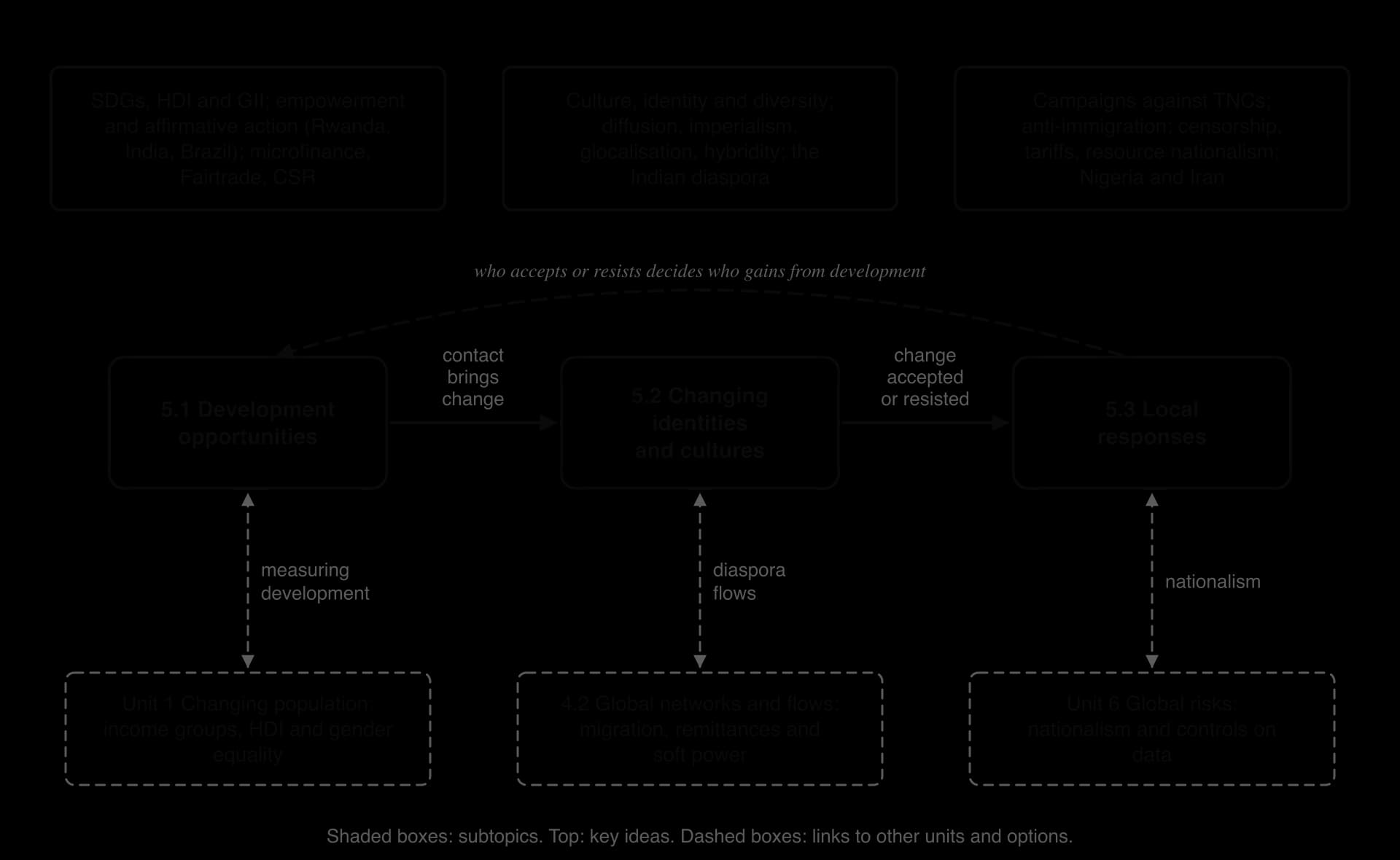
The adopt, adapt or resist framing runs through all three subtopics. A global product can be adopted unchanged, as smartphones are; adapted to local tastes and beliefs through glocalisation; or resisted, as France does with its quota for French-language songs on the radio and as governments do when they block foreign platforms. The same place can do all three with different flows at the same time.
Key concepts in Human development and diversity
Equity, diversity, identity, power and perspectives run through the unit, alongside the key concepts of place, process and possibility.
Concept | How it appears in the unit |
|---|---|
Equity | Development gaps between and within countries; quotas and reserved places for women, Dalits, Adivasi and Black and Indigenous Brazilians; who captures the premium in a Fairtrade chain. |
Diversity | Cultural diversity measured by languages and diversity indices, narrowed by homogenisation and widened by migration, revitalisation and cultural hybridity. |
Identity | Multiple, changing identities of migrants and their children; diasporas that keep ties across borders; the contested identities of Leicester and Fiji. |
Power | Brands exposed to boycotts, states that block platforms, militias that close schools, and citizens who use VPNs and courts to challenge restrictions. |
Place | Rwanda’s parliament and its rural villages; Belgrave Road in Leicester; Plachimada, a village that turned away a TNC. |
Process | The diffusion of cultural traits through migration, media and trade; glocalisation of branded products; the spread of microfinance through international networks. |
Possibility | Whether quotas stay temporary or become permanent, as India’s reservations have; whether endangered languages are revitalised, as Welsh and Māori have been, or lost. |
Perspectives | Supporters and critics of quotas, of cultural imperialism arguments and of protectionism, and governments and NGOs that disagree about what freedom means. |
The unit builds directly on the core. From the unit on population it takes development, the Human Development Index, the income groups and gender equality, and asks how far they can be changed by deliberate action. From resource stewardship it takes the Sustainable Development Goals as criteria for measuring development. From the unit on climate change it takes transnational corporations, globalisation, civil society and CSR, and studies their effects on cultures and their limits as tools of development.
From power, places and networks it takes migration flows, remittances, soft power and the shrinking world. The options add further links: ethnic enclaves and gentrification in Urban environments, and local sourcing and Fairtrade food in Food and health.
How SL and HL differ
Human development and diversity is one of the three HL extension units, studied only by HL students and examined in Paper 3. SL students do not study it. Its emphasis on whether global interactions are adopted, adapted or resisted is the clearest expression of the HL extension’s view that global interaction is two-way, complex and neither inevitable nor universal.
The unit builds on the SL and HL core rather than repeating it. Development and the HDI, gender equality, the SDGs, migration, globalisation, TNCs, civil society and CSR are core concepts that the unit reuses, adding the validity of development indices, empowerment, social entrepreneurship, cultural change and resistance. Paper 3 questions on the unit expect this core knowledge, and the options, to be brought into the answer.
Assessment
The unit is examined in Paper 3, which sets one question on each HL extension unit; candidates answer one of the three. Each question has two parts on the same unit: part (a), worth 12 marks, asks candidates to analyse, explain or examine, and part (b), worth 16 marks, gives a quoted statement to discuss or to judge how far they agree with.
Part (a) rewards detailed, structured analysis of two or more mechanisms across a range of places or outcomes, and needs no synthesis or evaluation. Part (b) reaches the top band only with both a synthesis of well-evidenced themes from across the HL extension and the core and a critical evaluation that weighs perspectives and the certainty of the evidence.
Questions on the unit tend to ask how diasporas influence cultural diversity, how social entrepreneurship supports development or how governments restrict participation in global interactions. Typical part (b) statements claim that global interactions make cultures more alike, that affirmative action is the most effective way to close the development gap, or that local resistance can do little to slow globalisation. The measurement of diversity and development, with diversity indices, development diamonds and scatter graphs of indices, is a frequent source of evidence.
Carry on with 5 in Augment
With a free account, Augment remembers where you stopped and what you have practiced.