HL.a Environmental law
Explain how environmental law works at local, national and international scales, evaluate treaties, courts and rights of nature, and apply the legal lens to issues across the whole course.
- IB Environmental Systems and Societies
- Part of HL HL lenses
- HL only
Key terms introduced here
Each is in the ESS glossary, with every other term in the subject.
- ASEAN Agreement on Transboundary Haze Pollution
A legally binding agreement signed in 2002 by the members of the Association of Southeast Asian Nations to prevent and monitor land and forest fires and cooperate on the resulting smoke haze.
- Basel Convention
An international treaty, in force since 1992, that controls the movement of hazardous wastes between countries, especially from richer to poorer countries, and since 2019 covers plastic waste.
- Bilateral agreement
A legally binding agreement between two states, often used to manage a shared river, lake, border region or migratory population.
- Climate litigation
Legal action in national or international courts to force governments or companies to reduce greenhouse gas emissions, adapt to climate change or pay for climate-related harm.
- Common but differentiated responsibilities
The principle that all states share responsibility for protecting the global environment, but that richer states, which have caused more damage and have more resources, should take on greater obligations.
- Convention
A broad international agreement, legally binding on the states that ratify it, which sets out general goals and a framework for cooperation on an issue, such as the UNFCCC.
- Environmental constitutionalism
The inclusion of environmental rights and duties in a country's constitution, such as a right to a healthy environment or rights for nature, so that they rank above ordinary laws.
- Environmental law
The body of rules governing how people use and affect natural resources and the environment, covering resources, pollution, biodiversity and development, with the aim of improving social and ecological sustainability.
- Illegal, unreported and unregulated fishing
Fishing that breaks national or international rules, is not reported or is misreported to the authorities, or takes place where no management rules apply, undermining the management of fish stocks.
- International Court of Justice
The principal court of the United Nations, in The Hague, which settles legal disputes between states and gives advisory opinions on questions of international law, including environmental law.
- International environmental law
The body of treaties, customary rules and court decisions between states that governs transboundary pollution, shared resources and global environmental problems, binding states that consent to it.
- International Tribunal for the Law of the Sea
An international court in Hamburg with 21 judges, created by the UN Convention on the Law of the Sea, which settles disputes over fishing, marine pollution and maritime boundaries and gives advisory opinions.
- Law
A rule that governs human behaviour, made and enforced by a social or governmental authority, so that breaking it can bring a penalty such as a fine, an order to repair damage or prison.
- Legal personhood
The status of being recognised by law as able to hold rights and duties and to sue or be sued, given to companies and increasingly to natural entities such as rivers and forests.
- Lobbying
The attempt by individuals, companies or interest groups to influence the decisions of lawmakers and governments in favour of their own interests, through meetings, donations, campaigns or funded research.
- Protocol
A later international agreement attached to a convention that adds specific, often quantified, commitments and becomes legally binding only on the states that ratify it, such as the Kyoto Protocol.
- Ramsar Convention
An international treaty signed in Ramsar, Iran, in 1971 for the conservation and sustainable use of wetlands, under which parties list wetlands of international importance.
- Ratification
The formal approval of an international agreement by a state, usually through its parliament, after which the state is legally bound by the agreement.
- Rights of Nature
A legal approach that recognises ecosystems, species or natural features such as rivers as holders of rights, for example to exist, regenerate and be restored, enforceable by guardians on their behalf.
- Signatory
A state that has signed an international agreement, showing its intention to be bound and agreeing not to undermine it, but which is not legally bound until it ratifies.
- Transboundary pollution
Pollution released in one country that is carried by air, water or other means across borders, causing harm in other countries, such as smoke haze, acid deposition or river pollution.
Notes on HL.a Environmental law
Learning objectives
Define law and environmental law, and outline the four main areas that environmental law covers.
Explain how environmental law can support environmental justice and why lobbying makes it hard to pass.
Explain why the success of environmental law depends on enforcement, institutions, public acceptance and funding.
Describe environmental constitutionalism, using a national constitution that has helped to address an environmental issue.
Distinguish between local, national and international environmental law, with an example at each scale.
Explain why international law is needed for transboundary pollution and shared resources, using the ASEAN haze agreement and action on illegal fishing.
Distinguish between conventions and protocols, and evaluate the relative success of the Montreal Protocol, the Kyoto Protocol and the Paris Agreement.
Outline how international agreements create institutions such as the CITES Secretariat and work with bodies such as the IUCN.
Discuss the role of international courts and tribunals, and the difficulty of setting compensation and damages.
Evaluate legal personhood for natural entities, linking it to Indigenous worldviews, value systems and rights-based ethics.
Evaluate legal and economic strategies, separately and together, for keeping resource use sustainable.
Apply the legal lens to issues from every topic of the course.
Introduction
Environmental law is the set of rules that societies make to control how people use and affect the natural world, from a town’s rules on waste collection to treaties signed by almost every country on Earth. It matters because many environmental problems arise where individual choices add up to collective harm, and law is one of the main tools a society has for changing what people and companies are allowed to do.
The legal lens connects to the three foundation ideas of the course. Every law expresses a perspective: what a society values enough to protect, and whose interests count. Laws act on systems by limiting inputs (pollutants), regulating outputs (harvests) and protecting storages (forests, fish stocks, the ozone layer). Most environmental law also aims at sustainability, keeping the use of natural systems within limits that allow them to last.
What a law is
A law is a rule that governs how people behave and that is made and enforced by a social or governmental authority. The key word is enforced. A rule of etiquette or a company’s voluntary pledge may influence behaviour, but breaking it brings no penalty from the state. Breaking a law can lead to a fine, the loss of a licence, an order to repair damage or, for serious offences, prison.
Where laws come from
Laws are made in several ways, and environmental protection draws on all of them. Most countries have more than one source of law operating at the same time.
Source of law | Who makes it | Environmental example |
|---|---|---|
Legislation (statutes, acts) | A parliament or other elected body | The UK Clean Air Act 1956, passed after London’s Great Smog of 1952, which created smoke control areas |
Regulations | Government agencies, using powers given by legislation | Air-quality standards for six common pollutants set by the US Environmental Protection Agency under the Clean Air Act |
Constitution | A founding document, changed only by special procedures | Ecuador’s constitution of 2008, which gives nature its own rights |
Case law | Judges, whose rulings guide later cases | The Dutch Supreme Court’s Urgenda ruling (2019), which ordered the state to cut emissions |
Customary and Indigenous law | Communities, through long-standing practice | Māori tikanga (customary practice) on caring for rivers and fisheries, now recognised in some New Zealand statutes |
International law | States, through treaties they agree to be bound by | The Montreal Protocol (1987) on ozone-depleting substances |
Sources: UK Clean Air Act 1956; US Clean Air Act (EPA); Constitution of Ecuador (2008); Supreme Court of the Netherlands (2019).
Law also differs from voluntary action in who it binds. A voluntary scheme, such as a company’s net-zero pledge, binds only those who choose to join, while a law applies to everyone within its scope, including those who would prefer not to comply. That is why law is often used where voluntary action has failed to solve a problem shared by many people.
Environmental law and what it covers
Environmental law is the part of law that deals with how human beings use and affect natural resources and the environment, with the aim of improving social and ecological sustainability. It is not one single law but a large and growing body of rules, made at every scale from a village to the United Nations.
Environmental law covers four broad areas. Many laws touch more than one area, and a single issue such as a new mine may involve all four at once.
Area | What the laws control | Examples |
|---|---|---|
Management of natural resources | How much may be taken, by whom, when and where | Fishing quotas and closed seasons; forestry licences; mining permits; water abstraction licences |
Management of pollution | What may be released into air, water and soil, and in what amounts | Emission limits for power stations; bans on dumping waste; vehicle exhaust standards; limits on nitrate in drinking water |
Protection of biodiversity | Which species and habitats are protected and how | Bans on hunting endangered species; protected areas; controls on trade in wildlife; rules on invasive species |
Construction and development | Whether and how projects may go ahead | An environmental impact assessment (EIA) before a dam, road or mine is approved; planning permission; building standards |
The tools that environmental laws use vary as much as the issues. Some set standards (no more than a fixed concentration of a pollutant), some ban an activity outright (dumping at sea), some require a permit before an activity can start, and some assign liability, so that whoever causes damage must pay to repair it. Newer laws give rights, either to people (a right to a healthy environment) or to nature itself.
 YouTube
Law, environmental justice and lobbying
Protecting the common good
Many environmental problems follow the pattern of the tragedy of the commons. Each user of a shared resource, such as a fishery, an aquifer or the atmosphere, gains the full benefit of taking a little more, while the cost of overuse is shared by everyone. The result is overexploitation and degradation that serve the short-term interests of a minority at the expense of the long-term common good.
Law can change this pattern by setting limits that apply to everyone, so that no single user gains by breaking them. It can also protect groups who would otherwise carry the costs of others’ activities. Where an economic system rewards harm, for example by making it cheaper to dump waste than to treat it, law can require more ethical behaviour by making the harmful option illegal or expensive.
Law as a tool for environmental justice
Environmental justice is the fair treatment of all people with respect to environmental benefits and burdens. Polluting industries, waste sites and resource extraction have often been placed near poor communities, Indigenous peoples and ethnic minorities, who have the least power to resist them. Law can address this in three ways: by giving affected people the right to take a polluter to court, by requiring that communities are consulted before projects go ahead, and by setting the same standards for everyone regardless of where they live.
Courts have become an important place for this. In 2009, Shell settled a case brought in New York by relatives of Ken Saro-Wiwa and other Ogoni activists executed in Nigeria on 10 November 1995, paying US$15.5 million without admitting liability. In the Netherlands in 2021, a district court ordered Shell to cut its global carbon emissions by 45% by 2030 compared with 2019, a ruling overturned on appeal on 12 November 2024. The two cases show both the reach of law across borders and how uncertain the outcome of litigation can be.
Sources: Wikipedia, Ken Saro-Wiwa; Milieudefensie v Royal Dutch Shell (2026).
Why environmental laws are hard to pass
Environmental laws impose costs on those whose activities they restrict, and some of these are among the most economically powerful organisations in a society. Lobbying is the attempt to influence lawmakers in favour of a particular interest, through meetings, campaign donations, advertising, funded research and the threat of moving jobs elsewhere. Lobbying is legal and every interest group does it, including environmental organisations, but the resources available to large industries are usually far greater.
The American Clean Energy and Security Act of 2009 shows how lobbying and politics can stop a law. The bill would have set up a national cap-and-trade scheme for greenhouse gas emissions. It passed the House of Representatives on 26 June 2009 by 219 votes to 212, but with no prospect of overcoming a threatened filibuster, it was never brought to a vote in the Senate. Fossil-fuel interests lobbied heavily against it, alongside opposition from members of Congress representing coal and oil states.
Lobbying also operates at the international level. At COP30 in Belém, Brazil, in November 2025, a coalition of campaign groups counted about 1,600 participants linked to the oil, gas and coal industries, about one in every 25 people attending. Oil-producing countries blocked binding language on phasing out fossil fuels, and the conference president announced two voluntary roadmaps outside the formal negotiations.
Sources: Wikipedia, American Clean Energy and Security Act (2026); 2025 United Nations Climate Change Conference (2026).
Making environmental law work
Environmental law is built into each country’s existing legal framework: its constitution, its courts, its government departments and its traditions. The same law can therefore work well in one country and fail in another. Its success depends on three conditions beyond the words of the law itself.
Effective enforcement through strong institutions. Agencies must have the power and staff to inspect, monitor and prosecute, and courts must be independent and able to impose meaningful penalties. Where officials can be bribed, or where courts are slow and overloaded, laws are ignored.
General acceptance by society. People comply most when they see a law as fair and legitimate. A law that clashes with people’s livelihoods or culture, without offering alternatives, is often resisted.
Adequate funding. Monitoring air quality, patrolling protected areas and cleaning up contaminated land all cost money, which poorer governments may not have.
Plastic bag bans in two countries show how much these conditions matter. Bangladesh became the first country to ban lightweight plastic bags in 2002, after littered bags blocked drains during floods, but enforcement was weak and bags remained widespread; in 2024 the government announced that legal action would begin in supermarkets from 1 October and in all markets from 1 November. Kenya banned the use, manufacture and import of plastic carrier bags in 2017 after earlier attempts in 2007 and 2011 had failed under pressure from manufacturers, and about 67% of consumers surveyed supported the 2017 ban.
Sources: Wikipedia, Phase-out of lightweight plastic bags (2026).
Even strong legal systems can be defied by their own governments. In 2017 Poland began large-scale logging in the Białowieża Forest, one of the last remaining parts of the primeval lowland forest of Europe, felling about 190,000 m³ of wood. The government continued despite pleas from UNESCO and an interim order from the Court of Justice of the European Union to stop, and on 17 April 2018 the Court ruled that Poland had broken EU law.
Sources: Wikipedia, Białowieża Forest (2026).
Environmental constitutionalism
A constitution is a country’s highest law. It sets out how the state is governed and the basic rights of citizens, and ordinary laws that conflict with it can be struck down by the courts. Because it is hard to change, a right written into a constitution is more secure than one in an ordinary statute, which a new government can repeal with a simple majority.
Environmental constitutionalism is the introduction of environmental rights and obligations into a constitution. These may take the form of a right of citizens to a clean or healthy environment, a duty on the state to protect nature or future generations, or rights held by nature itself. The idea grew from the Stockholm Declaration of 1972. More than 150 states now recognise a right to a healthy environment in some form, in their constitutions, laws or court rulings or through regional treaties, and the UN General Assembly recognised it as a human right in July 2022. Courts increasingly use such provisions to decide climate cases.
Ecuador: a constitution that gives nature rights
Ecuador’s constitution, approved by referendum on 28 September 2008 with 65% of the vote, was the first in the world to recognise the rights of nature. It draws on the Andean Indigenous idea of Pachamama, which joins the physical and spiritual aspects of the natural world. Article 71 gives nature the right to “integral respect for its existence” and to the maintenance and regeneration of its life cycles, and allows any person or community to ask the authorities to enforce these rights. Article 72 gives nature a right to restoration, and Article 73 requires the state to prevent the extinction of species and the destruction of ecosystems.
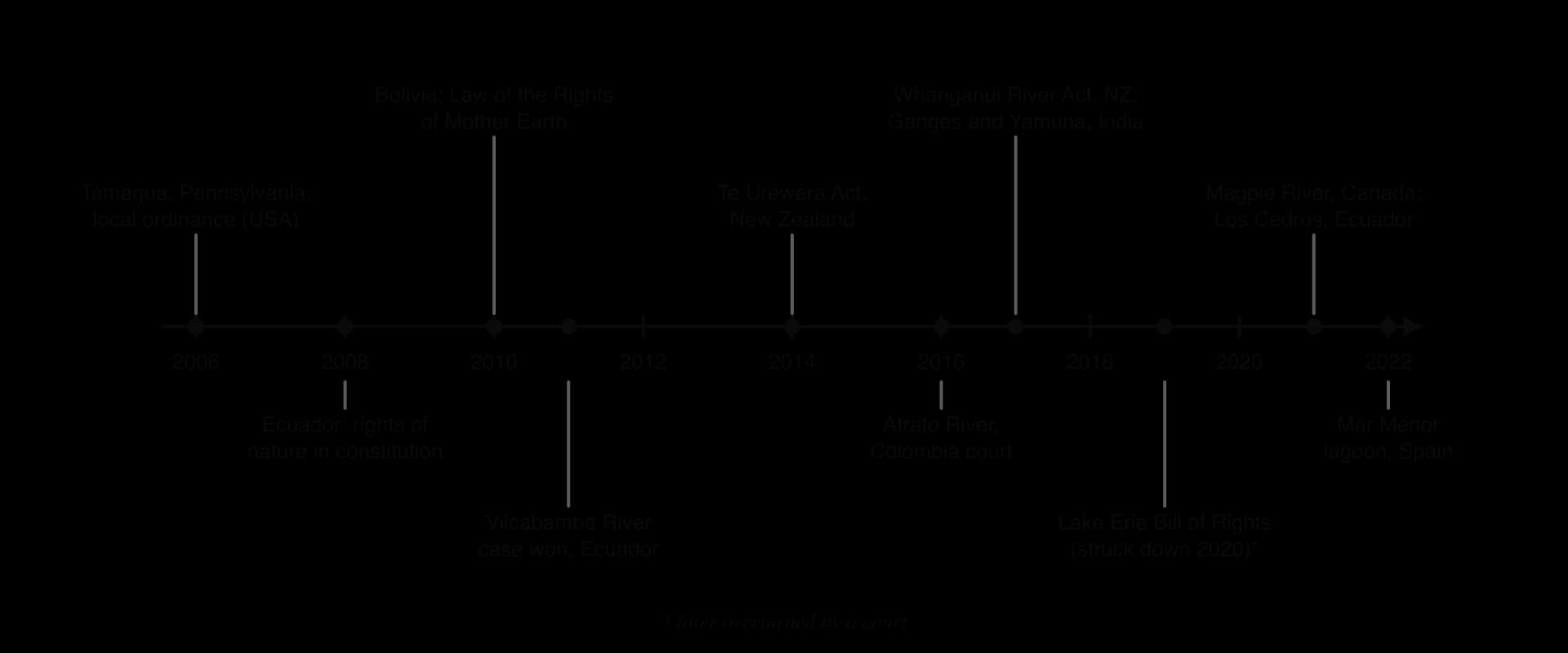
The provisions have been used successfully in court. In 2011 a provincial court in Loja ruled in favour of the Vilcabamba River, which a road project had narrowed by dumping debris into it, and ordered the area to be restored; the court placed the burden of proving no harm on the government. In 2021 the Constitutional Court ruled that mining permits for copper and gold in the Los Cedros protected cloud forest would harm its biodiversity, violated the rights of nature and were unconstitutional.
Sources: Wikipedia, Rights of nature in Ecuador; Environmental personhood; Right to a healthy environment (2026).
Constitutions and climate change
Constitutional rights are increasingly applied to climate change. In March 2021 Germany’s Federal Constitutional Court ruled that the country’s climate law placed too much of the burden of cutting emissions on later years, threatening the freedoms of young people and future generations. The government responded by raising its 2030 target to a cut of at least 65% below 1990 levels and bringing the date for climate neutrality forward to 2045. In 2023 a district court in the US state of Montana ruled that a state law preventing agencies from considering greenhouse gas emissions breached the state constitution’s right to a “clean and healthful environment”.
Sources: Wikipedia, Neubauer v Germany; Climate change in Germany; Juliana v. United States (Held v. Montana) (2026).
Environmental constitutionalism has limits. A right written in general terms must still be interpreted by judges, who may hesitate to tell governments how to run economic policy. Rulings can also be slow to enforce: the local government was slow to carry out the repairs ordered in the Vilcabamba case, and crude oil, much of it from the Amazon, remains Ecuador’s largest export.
Local, national and international law
Environmental laws are made at three scales. Local laws are made by city or regional councils and usually deal with local services such as waste collection, recycling and land use. National laws are made by a country’s parliament or government and apply across the whole country, for example air- and water-quality standards. International laws are agreements between states, used for issues that cross borders or affect the whole planet, such as fisheries, trade in endangered species and climate change.
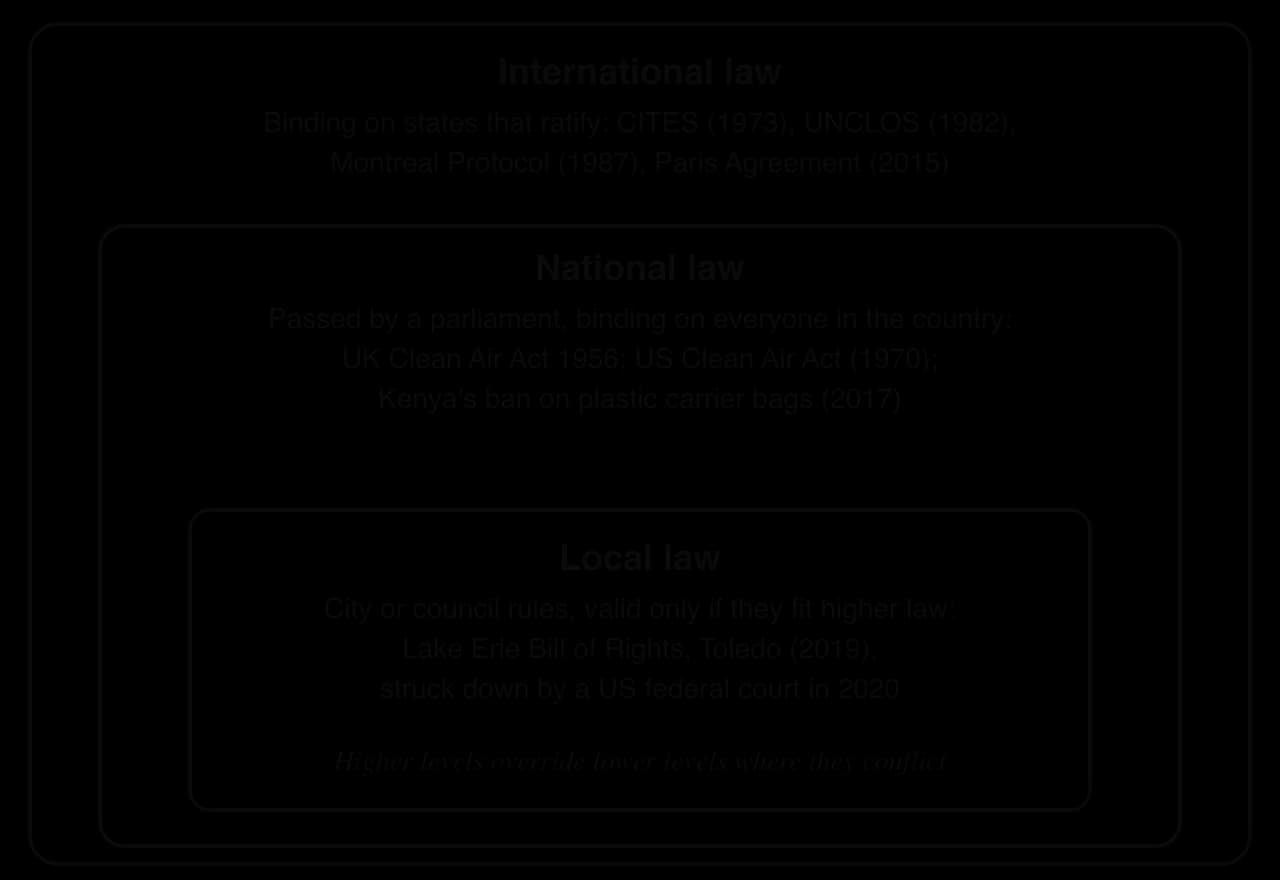
Laws made at national or international level take priority over those made locally. The Lake Erie Bill of Rights shows what happens when they clash. Voters in Toledo, Ohio, passed it on 26 February 2019 after toxic algal blooms had made the city’s tap water unsafe; it declared that Lake Erie had a right to “flourish”. A farmer challenged it the next day, and on 27 February 2020 a US federal judge struck it down as unconstitutionally vague and beyond the powers of a city government in Ohio.
Sources: Wikipedia, Environmental personhood (2026).
Scale | Example | What it does | Strengths and limits |
|---|---|---|---|
Local | San Francisco plastic bag ordinance (2007) | Limited plastic carrier bags in large shops; extended to all retail stores in 2012 and restaurants in 2013, with a 10-cent charge for paper bags | Quick to pass and enforce in one city; covers only that city, though California later banned retail plastic bags statewide from 1 January 2026 |
Local | Lake Erie Bill of Rights, Toledo (2019) | Gave a lake legal rights and let residents sue on its behalf | Responsive to local concerns, but overruled by higher law within a year |
National | UK Clean Air Act 1956 | Created smoke control areas and moved homes towards smokeless fuels after the Great Smog of 1952, which is thought to have caused about 12,000 deaths | Enforceable across a whole country, but cannot control pollution arriving from abroad |
National | US Clean Air Act (1970 amendments) | Required national air-quality standards for the most harmful pollutants | Strong agency (EPA) and courts; subject to political change |
International | CITES (in force 1975) | Controls international trade in listed endangered species through permits | Almost every country is a party, but it relies on national enforcement and covers trade only |
Sources: Wikipedia, Plastic bag bans in the United States; Clean Air Act 1956; Clean Air Act (United States); CITES (2026).
Two countries that share a river, a lake or a border region often make a bilateral agreement, a treaty between just the two of them. Argentina and Uruguay agreed the Statute of the River Uruguay in 1975, which requires each to inform the other of any project that might affect the river. Bilateral agreements can be more detailed and quicker to make than global ones, but they depend on good relations between the two countries.
International law for transboundary issues
Air, water, migratory animals and pollutants do not stop at borders. Transboundary pollution is pollution that originates in one country but causes harm in another, such as acid deposition, smoke haze, river pollution or radioactive fallout. Shared resources, such as a fish stock that migrates between the waters of several countries or swims into the high seas, raise the same problem. A single country cannot solve it with national law, because the source lies outside its control.
International environmental law provides the framework for dealing with these issues. It rests on the agreement of states, which are sovereign: no world government can force a country to accept a treaty. Once a state has ratified an agreement, however, it is bound by it under international law, and other states can hold it to account through diplomacy, dispute procedures or courts.
The ASEAN Agreement on Transboundary Haze Pollution
Every dry season, fires used to clear land for oil palm and pulpwood plantations, and to burn drained peatland, send smoke haze from Sumatra and Kalimantan in Indonesia across Malaysia, Singapore and neighbouring countries. The member states of the Association of Southeast Asian Nations signed the ASEAN Agreement on Transboundary Haze Pollution in 2002. It commits them to prevent and monitor fires and to cooperate when haze occurs.
Indonesia, the main source of the haze, did not ratify the agreement until 16 September 2014, the last member to do so. The 2015 haze, worsened by El Niño drought, affected more than 28 million people in Indonesia alone, closed schools in three countries and was estimated by the Indonesian government to cost up to US$35 billion. Critics argue that the agreement is vague, lacks enforcement mechanisms and is weakened by the ASEAN principle of non-interference in members’ internal affairs. In response, Singapore passed its own Transboundary Haze Pollution Act in 2014, which allows it to penalise companies anywhere whose fires cause haze in Singapore.
Sources: Wikipedia, ASEAN Agreement on Transboundary Haze Pollution; 2015 Southeast Asian haze (2026).
Illegal, unreported and unregulated fishing
Illegal, unreported and unregulated fishing (IUU fishing) includes fishing without a licence, catching more than a quota allows, misreporting catches and fishing in areas or seasons where no rules apply. It undermines the management of fish stocks, because scientists and managers do not know how many fish are really being taken, and it harms the coastal communities of low-income countries whose waters are fished illegally by foreign fleets.
The FAO International Plan of Action to Prevent, Deter and Eliminate IUU Fishing (2001) is a voluntary framework that sets out what flag states, coastal states and port states should do. It was followed by the binding Agreement on Port State Measures, which entered into force on 5 June 2016. Under it, ports can refuse entry or landing to vessels suspected of illegal fishing, so that illegally caught fish cannot easily reach the market. Closing ports is effective because a fishing vessel at sea is hard to police, but it must eventually come to port to unload its catch.
Sources: Wikipedia, Agreement on Port State Measures (2026).
Conventions, protocols and how agreements are made
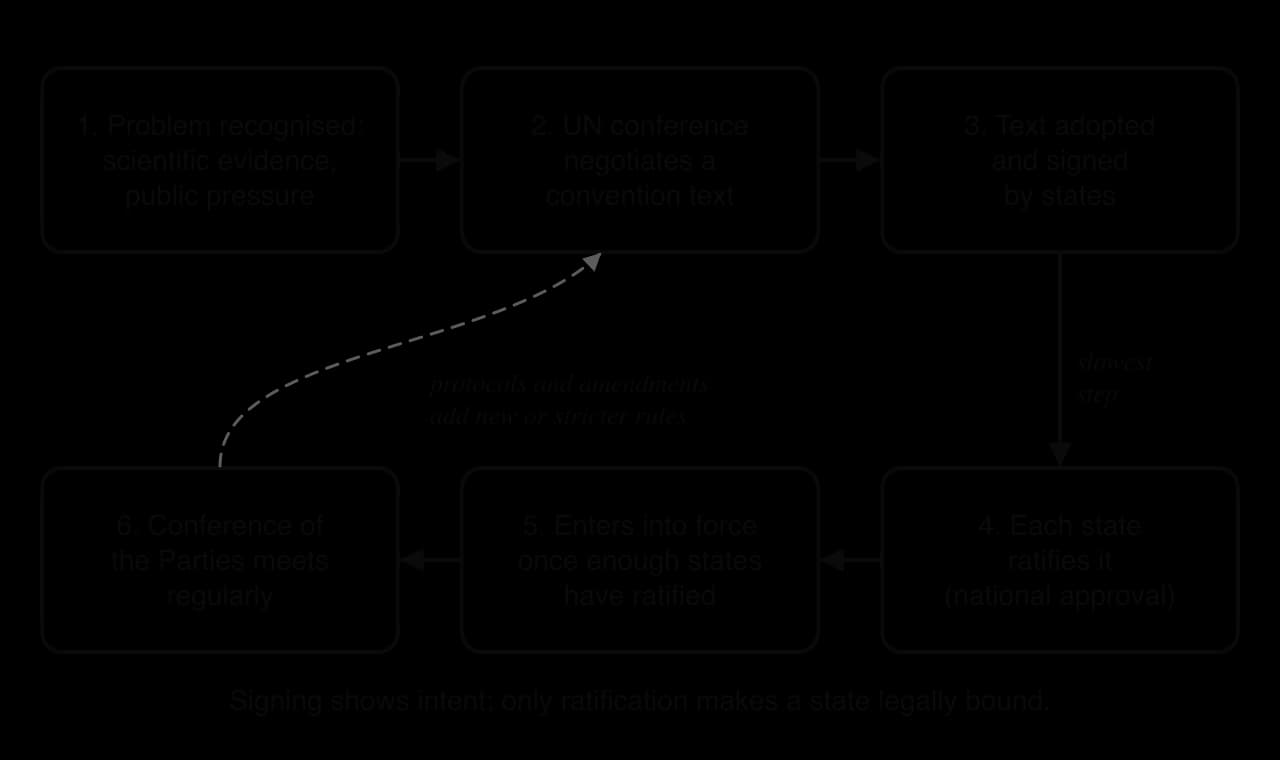
Most international environmental law is made through the United Nations. A conference of states negotiates a text; once states have agreed it, they sign it and then ratify it. Two kinds of agreement are central. A convention is a broad, legally binding agreement that sets out general aims and principles and creates a framework, such as the United Nations Framework Convention on Climate Change (UNFCCC) of 1992. A protocol is a later agreement attached to a convention that adds specific, often quantified, commitments; it becomes legally binding only for the states that ratify it.
Signing and ratifying are different steps. A signatory has signed the text, showing its intention to be bound and agreeing not to undermine the treaty’s purpose. Ratification is the formal act, usually approved by a national parliament, by which a state agrees to be legally bound. A treaty enters into force only when a set number of states have ratified it, sometimes with an extra condition, such as the share of global emissions they represent.
Why agreements are slow and difficult
International agreements are hard to reach and slow to take effect. Several challenges recur in almost every negotiation.
Challenge | What it means | Example |
|---|---|---|
Complexity | Many issues, sectors and countries are linked | Climate change touches energy, farming, forests, transport and trade at once |
Rapidly evolving science | Targets set today may soon look too weak or too strong | The Montreal Protocol was tightened in 1990, 1992 and later years as evidence of ozone loss grew |
Pressure from stakeholders at home | Governments answer to industries, workers and voters | The US Senate never ratified Kyoto |
Differentiated responsibilities | Disputes over who caused the problem and who should act first | Kyoto set targets only for developed countries |
Finance | Low-income countries ask high-income countries to pay for action and adaptation | COP30 agreed to triple adaptation finance by 2035 without settling who pays |
Geopolitical conflict | Rivalries and wars block cooperation | Changes of US government led to withdrawals from the Paris Agreement in 2020 and 2026 |
Economic impact | Fear of lost jobs and competitiveness | Industries warn that unilateral carbon limits move production abroad |
Sources: Wikipedia, Kyoto Protocol; Paris Agreement; 2025 United Nations Climate Change Conference (2026).
The principle of common but differentiated responsibilities lies at the centre of many of these disputes. Under it, all countries share responsibility for protecting the global environment, but those that have contributed most to a problem, and that have the most wealth and technology, should do more and help others. Developing countries argue that high-income countries industrialised with fossil fuels for two centuries; high-income countries point out that most of today’s emissions growth comes from emerging economies. How the principle is applied shapes the design of every climate agreement.
Montreal, Kyoto and Paris compared
Three agreements are often compared to understand what makes international environmental law succeed. The Montreal Protocol (1987) phases out ozone-depleting substances under the Vienna Convention of 1985. The Kyoto Protocol (1997) set binding emission cuts under the UNFCCC. The Paris Agreement (2015), also under the UNFCCC, replaced Kyoto’s approach with pledges made by each country.
Feature | Montreal Protocol (1987) | Kyoto Protocol (1997) | Paris Agreement (2015) |
|---|---|---|---|
In force | 1 January 1989 | 16 February 2005 | 4 November 2016 |
Who has binding targets | Every party, with developing countries given later deadlines | Only developed (Annex I) countries | No binding targets: each country sets its own nationally determined contribution (NDC) |
Participation | 198 parties: the first treaty ratified by every UN member state | 192 parties in 2020; the USA never ratified and Canada withdrew in 2012 | Ratified by every UNFCCC member except Iran, Libya and Yemen; the USA’s second withdrawal took effect on 27 January 2026 |
Help for developing countries | Multilateral Fund pays for the switch to substitutes | Clean Development Mechanism: investment in emission-cutting projects | Climate finance goals; adaptation and loss and damage funds |
Later developments | Amendments speed up phase-outs; Kigali Amendment (2016) phases down HFCs | Doha Amendment extended targets to 2020 for 37 parties | Five-yearly NDC updates; first global stocktake (2023); COP30 (2025) agreed no fossil-fuel phase-out roadmap |
Outcome | Concentrations of most important CFCs have levelled off or fallen; the ozone layer is projected to recover to 1980 levels by about 2066 over Antarctica | The 36 countries fully participating in the first period (2008–2012) complied, but global CO₂ emissions rose from about 32 to 35 billion tonnes a year over the same period | Current policies point to about 2.6 °C of warming by 2100, and full delivery of pledges to about 2.2 °C, far above the 1.5 °C goal |
Sources: Wikipedia, Montreal Protocol; Kyoto Protocol; Paris Agreement; 2025 United Nations Climate Change Conference (2026); Our World in Data (2025); Climate Action Tracker (November 2025).
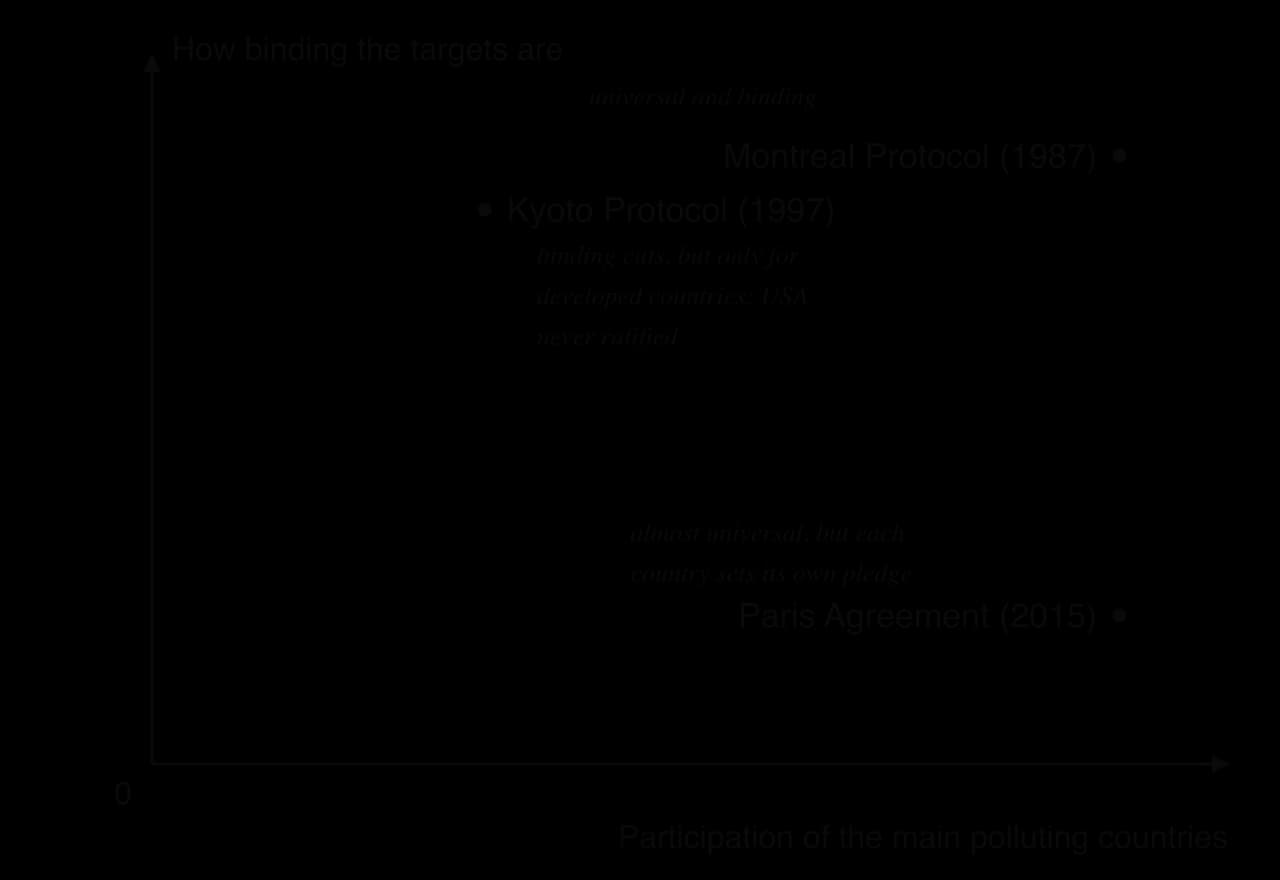
Montreal succeeded for reasons that were hard to repeat for climate change. Only a small number of chemicals and companies were involved, substitutes became available, the damage was dramatic and quick to explain (the ozone hole was discovered in 1985), and the Multilateral Fund paid developing countries the extra costs of switching. Climate change involves the whole energy system of every economy, and the costs of cutting emissions fall on today’s voters while many of the benefits come later and elsewhere.
Kyoto’s legally binding targets were its strength and its weakness. Binding cuts for developed countries reflected differentiated responsibilities, but without targets for fast-growing economies such as China and India, and without the United States, it covered a shrinking share of global emissions. Paris took the opposite approach: by letting each country set its own target, it brought in almost every country, and its “ratchet” requires a new, more ambitious NDC every five years. Its weakness is that nothing forces a country to set a strong target or to meet it.
Institutions created by international agreements
Agreements do not run themselves. Many create permanent institutions to collect information, check compliance, fund action and organise meetings of the parties, and many rely on existing organisations for scientific advice. These institutions often become as important as the treaty text, because they keep the agreement working between negotiations.
CITES and its Secretariat
CITES, the Convention on International Trade in Endangered Species of Wild Fauna and Flora, was agreed in Washington, DC, on 3 March 1973 and entered into force on 1 July 1975. Species are listed in three appendices. Commercial trade in wild specimens of Appendix I species, those threatened with extinction, is banned, while trade in Appendix II species is allowed with export permits. Each party must pass its own national legislation to put CITES into effect.
The convention is run by a Secretariat, overseen by a Secretary-General, with Standing, Animals and Plants Committees. Although CITES has no court, its practice has given the Secretariat and Standing Committee ways to respond to countries that break the rules: suspending cooperation, and recommending that all parties suspend CITES-related trade with the offending country until it takes corrective action. The most common failing is not submitting annual reports. Critics note that CITES deals only with trade, not with habitat loss, the largest cause of biodiversity decline.
Sources: Wikipedia, CITES (2026).
The IUCN
The International Union for Conservation of Nature (IUCN) was founded on 5 October 1948 in Fontainebleau, France. It is unusual because its members include both governments and non-governmental organisations: over 1,400 of them from more than 170 countries, with about 16,000 volunteer scientists working in its commissions. It does not make law, but it supports the making and implementation of law. CITES itself grew out of a resolution adopted at an IUCN meeting in 1963, the IUCN Red List is used to decide which species need protection, and the IUCN advises on World Heritage natural sites and has observer status at the United Nations.
Sources: Wikipedia, International Union for Conservation of Nature; CITES (2026).
Institution | Created by or linked to | What it does |
|---|---|---|
CITES Secretariat and Standing Committee | CITES (1973) | Manages the appendices, checks permits and reports, can recommend trade suspensions |
Multilateral Fund | Montreal Protocol (fund paying out since 1991) | Pays developing countries the extra costs of phasing out ozone-depleting substances |
UNFCCC Secretariat and Conference of the Parties | UNFCCC (1992) | Registers national pledges, receives reports, hosts annual COP meetings |
Ramsar list of wetlands | Ramsar Convention (1971) | Lists wetlands of international importance: 2,531 sites covering over 2.6 million km² in February 2025 |
IUCN | Independent (1948); advises CITES, World Heritage and others | Red List of threatened species, scientific advice, standards for protected areas |
Sources: Wikipedia, Montreal Protocol; Ramsar Convention; IUCN (2026).
International courts and tribunals
Courts decide what the law means in a particular dispute, and their rulings shape how agreements are understood afterwards. International environmental law has been tested in several kinds of court. Some settle disputes between states; some give advisory opinions, which explain the law without deciding a dispute; and some protect individuals’ human rights against their own governments.
The International Court of Justice
The International Court of Justice (ICJ), in The Hague, is the main court of the United Nations. It settles disputes between states that accept its jurisdiction and gives advisory opinions when asked by UN bodies. Three cases show the range of its environmental work.
Pulp Mills on the River Uruguay (Argentina v. Uruguay), 2010. Argentina claimed that a large pulp mill built at Fray Bentos in Uruguay broke the 1975 river statute. The court found that Uruguay had breached its duty under the statute to notify and consult Argentina, but that the mill had not been shown to pollute the river, so closing it was not justified. The judgment is also the first in which an international court held that an environmental impact assessment, carried out before a project starts, is a requirement of general international law where an industrial activity risks significant harm across a border.
Whaling in the Antarctic (Australia v. Japan), 31 March 2014. By 12 votes to 4, the court ruled that Japan’s JARPA II programme, which had killed about 3,600 minke whales, was not for purposes of scientific research and ordered Japan to revoke its permits. Japan cancelled its 2014 Antarctic hunt but began a new programme, then withdrew from the International Whaling Commission and resumed commercial whaling in its own waters from 1 July 2019.
Obligations of States in respect of Climate Change, 23 July 2025. After a campaign led by Vanuatu, the UN General Assembly asked for this advisory opinion on 29 March 2023. The court was unanimous that states have binding obligations under the climate treaties and general international law to protect the climate system, treated 1.5 °C as the agreed primary temperature goal, and found that failure to act, including through fossil fuel production, licences or subsidies, may be an internationally wrongful act that can require states to stop and to make full reparation.
Sources: Wikipedia, Pulp Mills on the River Uruguay; Whaling in the Antarctic case (2026); ASIL Insights, Pulp Mills (2010); DLA Piper, ICJ climate change advisory opinion (2025).
The whaling case shows both the power and the limits of the court. Japan complied with the ruling for its original programme, but it responded by redesigning its hunt and then leaving the international body that regulated it. An advisory opinion is weaker still: it is not binding, although it is an authoritative statement of what binding treaties and customary law require, and it is likely to be cited in national courts and future negotiations.
The International Tribunal for the Law of the Sea
The International Tribunal for the Law of the Sea (ITLOS), based in Hamburg, has 21 judges and was created by the United Nations Convention on the Law of the Sea (UNCLOS), adopted in 1982 and in force since 16 November 1994. It hears disputes about fishing, marine pollution and maritime boundaries.
In December 2022 the Commission of Small Island States on Climate Change and International Law asked it whether states have obligations under UNCLOS to deal with climate change. Its unanimous advisory opinion of 21 May 2024 found that human greenhouse gas emissions into the atmosphere are pollution of the marine environment under the convention. States must therefore take all necessary measures to prevent, reduce and control that pollution, judged against the best available science and the 1.5 °C temperature goal.
Sources: Wikipedia, International Tribunal for the Law of the Sea; ITLOS, Case No. 31 and Press Release 350 (2024).
The Court of Justice of the European Union and human rights courts
Regional courts can be more powerful than global ones because their members have agreed in advance to accept their rulings. The Court of Justice of the European Union (formerly the European Court of Justice) enforces EU environmental law on member states, as in its 2018 ruling against Poland over logging in the Białowieża Forest.
The European Court of Human Rights ruled on 9 April 2024, in KlimaSeniorinnen v. Switzerland, that Switzerland had violated the human rights of a group of older women by failing to act on climate change “in good time and in an appropriate and consistent manner”. It was the first time an international court found that a state’s inaction on climate change violated human rights; the Swiss parliament responded in June 2024 by recommending that the government reject the ruling.
Sources: Wikipedia, Verein KlimaSeniorinnen Schweiz v. Switzerland (2026).
Climate cases in national courts
Climate litigation, the use of courts to force governments or companies to act on climate change, has grown quickly: a UN count recorded 884 cases in 24 countries in 2017, and the total had reached 2,180 by December 2022, about two-thirds of them in the United States. Results vary greatly between legal systems.
Case | Court and date | Outcome | What it shows |
|---|---|---|---|
Urgenda v. the Netherlands | Supreme Court of the Netherlands, 20 December 2019 | State ordered to cut emissions at least 25% below 1990 levels by 2020; the Hemweg coal plant closed in 2020, four years early | Courts can treat inadequate climate action as a breach of human rights |
Juliana v. United States | Filed 2015 by 21 young people; dismissed for lack of standing; Supreme Court declined to hear it in March 2025 | Dismissed without a ruling on the facts | Courts may refuse to decide climate policy, leaving it to elected governments |
Milieudefensie v. Shell | District court of The Hague 2021; appeal court 12 November 2024 | 45% cut by 2030 ordered, then overturned on appeal | Companies may have a duty to limit emissions, but courts hesitate to set a specific figure |
KlimaSeniorinnen v. Switzerland | European Court of Human Rights, 9 April 2024 | Switzerland found in breach of the European Convention on Human Rights | Regional human-rights courts can hold states to account |
Sources: Wikipedia, Climate change litigation; Urgenda Foundation v State of the Netherlands; Juliana v. United States; Milieudefensie v Royal Dutch Shell; Verein KlimaSeniorinnen Schweiz v. Switzerland (2026).
The difficulty of compensation and damages
When a court finds that a law has been broken, it must decide what the wrongdoer should pay. Setting appropriate compensation and damages for environmental harm is one of the hardest problems in environmental law. Many of the losses have no market price: a lost species, a polluted sacred site, or ill health that appears years later. The victims may be poor and far from the courts where the company is based, and proving that a particular harm was caused by a particular action can be difficult.
The 1984 gas leak at the Union Carbide pesticide plant in Bhopal, India, exposed over 500,000 people to methyl isocyanate. The Indian government claimed US$3.3 billion, but in February 1989 the company agreed an out-of-court settlement of US$470 million, which India’s Supreme Court upheld in 1991.
A government affidavit in 2006 put the number of injuries at about 558,125, so the settlement is widely judged to have been far too small. By contrast, after the Deepwater Horizon oil spill in the Gulf of Mexico in 2010, BP pleaded guilty to criminal charges and agreed to pay US$4.5 billion in fines and other payments in 2012, and in 2016 a US court approved a further settlement of US$20.8 billion, the largest environmental damage settlement in US history.
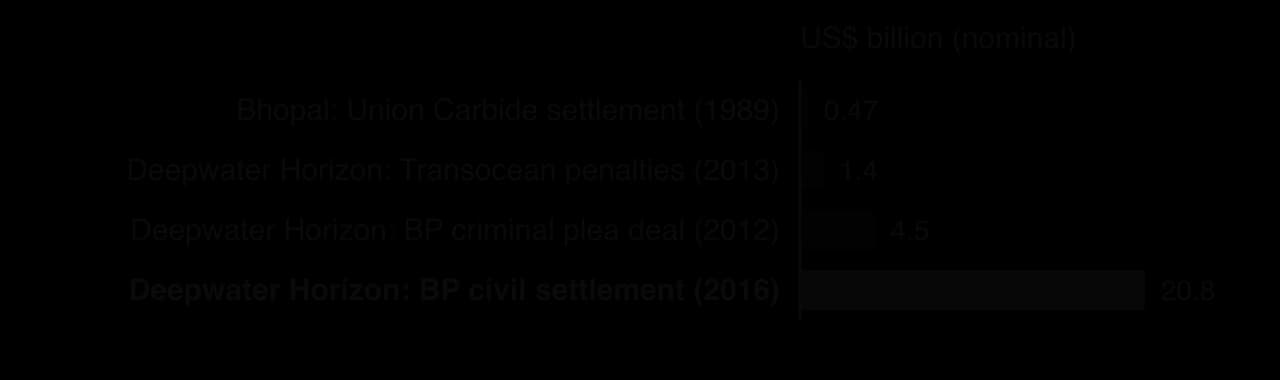
The contrast reflects differences in legal systems, in the wealth and political power of the places affected, and in when the disasters happened. It raises questions of environmental justice: should the value of a life or a livelihood depend on the country where the harm occurs? Climate change adds a further difficulty. The ICJ’s 2025 opinion found that causation does not have to be proved for a state to be responsible for a breach, but that reparation requires a “sufficiently direct and certain causal nexus” between the breach and the harm, which is hard to show for the effects of global emissions.
Legal personhood for natural entities
A legal person is anything the law treats as able to hold rights and duties, to own property, to make contracts, and to sue and be sued in court. Human beings are legal persons, but so are companies, charities and governments; this is called corporate personhood. Legal personhood is a legal tool, not a claim that the entity is a human being or has a mind.
In 1972 the American law professor Christopher Stone asked, in the essay “Should Trees Have Standing?”, whether natural objects should have “standing”, the right to bring a case in court. In the same year the US Supreme Court ruled in Sierra Club v. Morton that an environmental group could not sue to stop a ski resort in the Mineral King Valley because its members had not shown they would be harmed. Justice William Douglas, in dissent, argued that natural features should be able to sue in their own name, represented by people with a meaningful relationship to them, and cited Stone’s essay.
Since then, more and more laws have granted legal personhood, or rights, to natural entities. By June 2021 at least 53 initiatives in 12 countries used the idea of a “person” in their legal text. Because a river or forest cannot speak in court, each law appoints guardians who act on its behalf.
Sources: Wikipedia, Environmental personhood; Rights of nature; Sierra Club v. Morton (2026).
Links to Indigenous knowledge, value systems and ethics
Legal personhood for nature connects law to three other parts of the course. First, many Indigenous knowledge systems do not separate people from nature: a river may be an ancestor, a relative or a living being. Legal personhood gives these relationships a form that state law can recognise, which is why many of the best-known examples, in New Zealand, Colombia and Canada, were created with or by Indigenous peoples. Second, personhood reflects different environmental value systems. An ecocentric reading sees it as recognising the intrinsic value of nature; an anthropocentric reading sees it as a practical way to protect resources that people depend on.
Third, legal personhood is an application of rights-based ethics. Rights-based (deontological) ethics judges actions by whether they respect the rights of others. Giving a river rights means that some actions, such as polluting it beyond a certain point, are wrong because they violate those rights, not only because they produce bad results for people. This makes nature’s protection less dependent on calculations of costs and benefits.
 YouTube
Arguments for and against
Arguments for | Arguments against |
|---|---|
Nature can be defended in court even when no human has been harmed | Who speaks for the river? Guardians may disagree about its interests |
Recognises Indigenous relationships with land and water and supports reconciliation | A legal person can also be sued: is a river liable for flood damage? |
Moves protection beyond ownership and short-term economic use | Lawsuits are expensive, so rights may be hard to use in practice |
Provides a long-term, legally secure framework that is hard to repeal | Many laws cover only part of an ecosystem (for example, only a short stretch of the Ganges lies in Uttarakhand state) |
Encourages cooperation between government, Indigenous peoples and users | Farmers, industries and river communities may see the rights as limits on their own rights and livelihoods |
Sources: Wikipedia, Environmental personhood (2026).
Legal and economic strategies together
Law and economics are two different strategies for keeping the use of resources sustainable, and each has a characteristic weakness. Economic tools, such as taxes, tradeable permits and payments for ecosystem services, work by changing prices, but economics struggles to put a value on ecosystem services and on their degradation, especially services with no market. Legal tools, such as bans, standards and protected areas, work by setting rules, but law struggles to get all stakeholders to agree and to enforce the rules once agreed.
Legal strategies | Economic strategies | |
|---|---|---|
How they work | Rules, standards, bans and rights backed by penalties | Prices, taxes, subsidies and markets that change incentives |
Examples | Emission limits; CITES trade bans; protected areas; rights of nature | Carbon taxes; emissions trading; payments for ecosystem services |
Strengths | Clear limits; can protect what has no price; can protect the rights of the vulnerable | Flexible; lets those who can cut pollution cheaply do so first; raises revenue |
Weaknesses | Hard to agree; costly to enforce; can be rigid | Hard to value non-market services; prices may be set too low; can let the rich pay to pollute |
The two are often most successful when combined. A fine for illegal dumping or for an oil spill is a legal penalty that works through money: it makes breaking the law more expensive than obeying it, applying the polluter-pays principle. After the Exxon Valdez spill in Alaska in 1989, the United States passed the Oil Pollution Act of 1990, which set up a liability system for oil spills. When the Deepwater Horizon rig exploded in 2010, BP was designated the lead “responsible party” under that Act and had to coordinate and pay for the response, before paying the criminal fines and civil settlement shown in the chart of payments.
Sources: Wikipedia, Exxon Valdez oil spill; Deepwater Horizon oil spill; European Union Emissions Trading System (2026).
Emissions trading is another combined tool. A law sets a cap on total emissions and requires companies to hold permits; the market then sets the price of the permits. The European Union’s Emissions Trading System, which Switzerland also links to, depends on both the legal cap and the market price. If the cap is set too loosely, the price falls and the scheme does little: in the first phase (2005–2007) more permits were issued than were needed to cover actual emissions, and the price fell to €0.10 a tonne by September 2007.
Case study: the Whanganui River as a legal person
Context
The Whanganui River, 290 km long, is the third-longest river in Aotearoa New Zealand. It rises on the northern slopes of Mount Tongariro in the centre of the North Island and flows through steep, forested hill country to the sea at the city of Whanganui. For the Whanganui iwi (Māori tribes), the river is an ancestor and a taonga (treasure), not a resource to be owned. The Crown has formally acknowledged that there are 143 known marae (community meeting places) along its length, and that it has been a home, a highway, a food basket and a fishery for the iwi and hapū (sub-tribes) of the river.
The iwi expressed this relationship in the saying “Ko au te awa, ko te awa ko au”, which the 2017 Act translates as “I am the River and the River is me”. The river is seen as an indivisible living whole, from the mountains to the sea, so harm to the river is harm to the people.
The issue: 140 years of legal conflict
From 1840, when the Treaty of Waitangi was signed, the colonial and later national government (the Crown) took control of the river through a series of laws that ignored the iwi’s relationship with it. The Wanganui River Trust Act 1891 allowed the river to be cleared for steamboats, which destroyed eel weirs and other traditional fishing structures. The Coal-mines Act Amendment Act 1903 declared that the beds of all navigable rivers had “always been vested in the Crown”. Gravel was extracted from the riverbed without compensation, and the Tongariro Power Scheme diverted water from the river’s headwaters to generate hydroelectricity, which the Crown has acknowledged was done without consulting the iwi.
The iwi resisted through law and protest. They first petitioned Parliament in the 1870s; their claim to the riverbed went through a succession of courts and a Royal Commission between 1938 and 1962; the Waitangi Tribunal heard their claims in the 1990s; and in 1995 they occupied Moutoa Gardens in the city of Whanganui. The dispute is described as the longest-running legal case in the history of New Zealand.
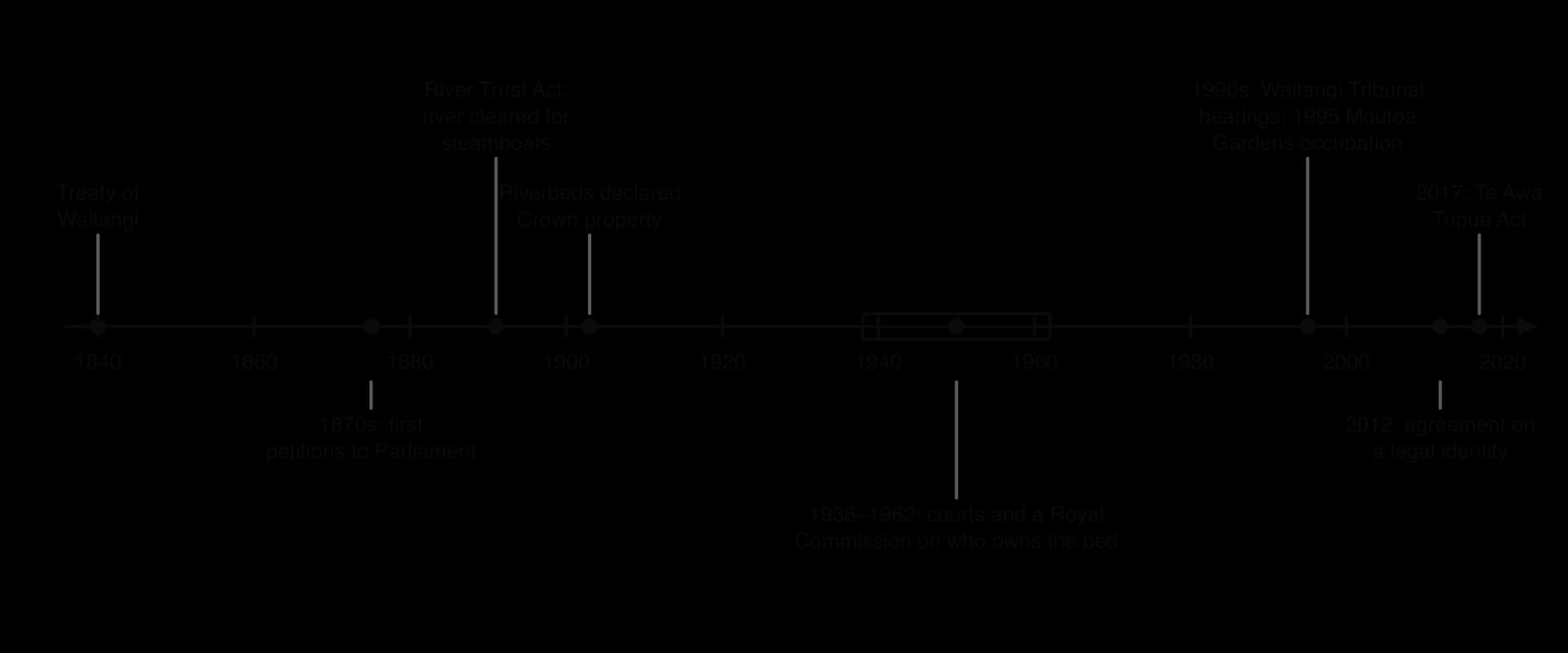
One reason the conflict lasted so long was a mismatch between two worldviews. English law could only frame the claim as a dispute about title to the riverbed, a piece of property. The iwi saw the river as an indivisible whole that could not be divided into bed, banks and water, and that no one could own. The Crown acknowledged in 2017 that the earlier litigation had been “required to be framed in terms of English law as a claim for a title to the riverbed, rather than to the River as an indivisible whole”.
The settlement: Te Awa Tupua
On 30 August 2012 the Crown and the iwi agreed that the river would have its own legal identity. The deed of settlement was signed on 5 August 2014, and the Te Awa Tupua (Whanganui River Claims Settlement) Act 2017 was passed on 15 March 2017 and received royal assent on 20 March 2017. Section 12 recognises Te Awa Tupua as “an indivisible and living whole, comprising the Whanganui River from the mountains to the sea, incorporating all its physical and metaphysical elements”, and section 14 declares that it “is a legal person and has all the rights, powers, duties, and liabilities of a legal person”.
Te Awa Tupua is a legal person and has all the rights, powers, duties, and liabilities of a legal person.
— Te Awa Tupua (Whanganui River Claims Settlement) Act 2017, section 14(1)
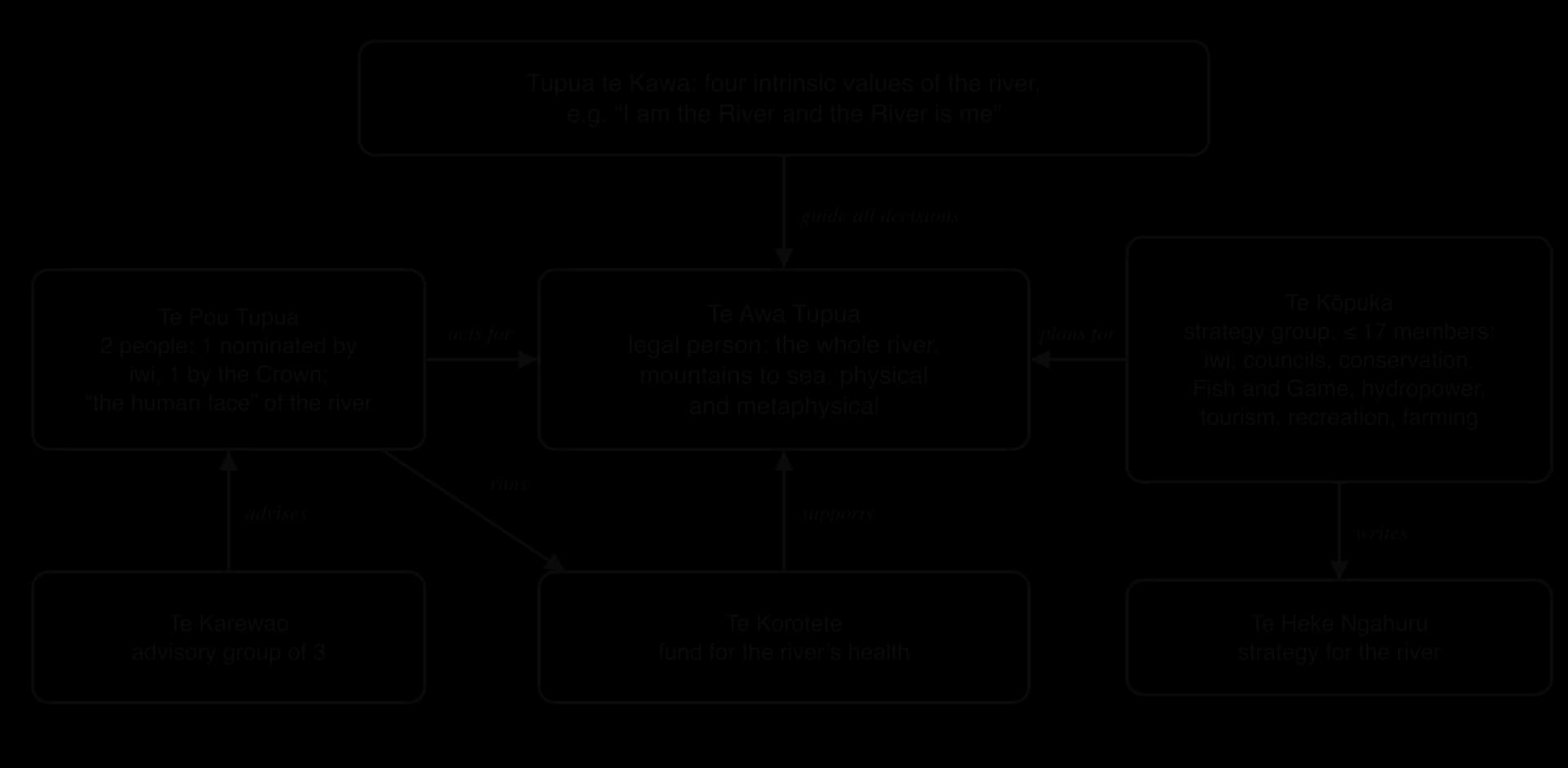
The Act sets up a structure of people and bodies to act for the river. Te Pou Tupua, two people, one nominated by the iwi and one by the Crown, is “the human face of Te Awa Tupua” and acts in its name.
Tupua te Kawa, four values that express the river’s essence, must be considered by decision-makers. Te Kōpuka, a strategy group of up to 17 members, brings together iwi, local councils, the Department of Conservation, Fish and Game, the hydropower company Genesis Energy, and people representing environmental, tourism, recreational and farming interests. It writes a strategy for the river, Te Heke Ngahuru, and a fund, Te Korotete, supports the river’s health.
Data: who sits on Te Kōpuka
Appointed by or representing | Members |
|---|---|
Trustees of the iwi settlement | 1 |
Iwi with interests in the Whanganui River | up to 5 |
Relevant local authorities (councils) | up to 4 |
Director-General of Conservation | 1 |
New Zealand Fish and Game Council | 1 |
Genesis Energy (operator of the Tongariro Power Scheme) | 1 |
Environmental and conservation interests | 1 |
Tourism interests | 1 |
Recreational interests | 1 |
Primary industries (farming, forestry) | 1 |
Total | up to 17 |
Sources: Te Awa Tupua (Whanganui River Claims Settlement) Act 2017, section 32.
The membership shows that personhood did not remove other users from the river. Section 16 of the Act states that nothing in it limits existing private property rights in the river or creates, transfers or affects rights to water, fish or other wildlife. Decision-makers acting under the laws listed in the Act must have regard to the river’s status and values and must state how they have done so.
Evaluation
Perspective | View of the settlement |
|---|---|
Whanganui iwi | Recognition of a relationship, not ownership. The lead negotiator said the iwi considered the river an ancestor and that treating it as a living whole was “the correct way to approach it… instead of the traditional model for the last 100 years of treating it from a perspective of ownership and management”. |
The Crown | A way to settle a long-standing grievance and breach of the Treaty of Waitangi. The minister responsible said legal personhood was “no stranger than family trusts, or companies, or incorporated societies”. |
Hydropower, farming and other users | Existing property and water rights are kept, but their activities must now be weighed against the river’s values, and they have a seat on Te Kōpuka. |
Legal scholars and critics | The Act does not by itself set pollution limits or restore flows; it depends on how decision-makers, councils and courts apply it, and on funding. A river with legal personhood can, in principle, also be held liable. |
Ecocentric and anthropocentric readings | Ecocentrists see the river’s intrinsic value recognised in law; anthropocentrists may see a practical and cultural settlement that improves management for people. |
Sources: Wikipedia, Whanganui River; Environmental personhood (2026); Te Awa Tupua Act 2017, sections 15–16 and 69.
Measured against the aims of environmental law, the settlement is strongest as a tool of environmental justice and reconciliation: it ended the longest legal dispute in the country’s history and gave an Indigenous worldview legal force.
Its effect on the river’s ecological health is harder to judge, because the Act changed who speaks for the river and how decisions must be made rather than imposing new environmental standards. It also built on existing legal frameworks: it is a Treaty of Waitangi settlement, using the same legal form as a company or trust, which helps to explain why it has lasted where the Lake Erie Bill of Rights, a local measure that conflicted with higher law, did not.
What it shows
The Whanganui case shows that legal personhood can be built into an existing legal system, that it is closely linked to Indigenous worldviews which do not separate people from nature, and that it can address environmental justice by recognising long-ignored relationships. It also shows the limits of law: personhood creates a voice for the river, but its practical effect depends on enforcement, funding, and the agreement of everyone who uses the river. Other countries have cited it: Colombia’s Constitutional Court referred to it in its 2016 ruling on the Atrato River, and the Uttarakhand High Court in India referred to it in 2017.
Sources: Te Awa Tupua (Whanganui River Claims Settlement) Act 2017; Wikipedia, Whanganui River; Environmental personhood; Te Urewera (2026).
The legal lens across the course
The legal lens can be applied to almost every topic. The table gives short applications for understandings that carry a legal link, with the law or legal idea that applies and the point it makes. Each subtopic page teaches the content itself; the legal angle adds who sets the rules, how they are enforced and whose rights are protected.
Topic | Issue | Legal angle |
|---|---|---|
1 Foundation | Perspectives and the history of the environmental movement; sustainability; environmental justice | Laws record a society’s values at the time they were made: the UK Clean Air Act 1956 followed the Great Smog, and the Minamata Convention on Mercury (adopted 10 October 2013, in force 16 August 2017) followed decades of mercury poisoning in Japan. The Sustainable Development Goals are not legally binding, which is one of their limitations. |
2 Ecology | Human impacts on the carbon and nitrogen cycles | Carbon removal and fertiliser rules are set nationally, while the climate treaties set the global frame; the Stockholm Convention (in force 17 May 2004) restricts persistent organic pollutants but allows DDT for malaria control. |
3 Biodiversity | Threats to species and habitats; conservation strategies; Indigenous land management | CITES (trade), the Convention on Biological Diversity and national endangered-species and protected-area laws; legal rights of Indigenous peoples over their land; rights of nature for rivers and forests. Wildlife laws are only as strong as their enforcement against poaching and illegal trade. |
4 Water | Water access and transboundary rivers; fisheries; pollution | Rights to water and sanitation; bilateral treaties such as the River Uruguay statute; UNCLOS and its 370 km exclusive economic zones; the High Seas Treaty (adopted 19 June 2023, in force 17 January 2026); port state measures against IUU fishing; water-quality standards and fines for discharges. |
5 Land | Land rights; agriculture and methane | Secure land tenure for small farmers and Indigenous peoples; national laws on fertiliser, pesticides and soil conservation. |
6 Atmosphere and climate | Climate action; geoengineering; ozone | UNFCCC, Kyoto and Paris; climate litigation (Urgenda, KlimaSeniorinnen); the ICJ advisory opinion (2025); the Montreal Protocol and Kigali Amendment; the lack of any binding international rules on solar geoengineering. |
7 Natural resources | Resource management; EIA; waste | Licences, quotas and EIAs required by law before a mine or dam is approved; the Basel Convention controls exports of hazardous waste, and plastic waste amendments agreed in May 2019 are binding on 186 states. |
8 Population and urban systems | Population policies; environmental migration; urban green space | Human rights law limits coercive population policies; the legal status of people displaced by climate change is unresolved; city planning law sets zoning, green space and air-quality rules. |
Sources: Wikipedia, Minamata Convention on Mercury; Stockholm Convention; High Seas Treaty; Basel Convention (2026).
Exam practice
The HL lenses do not have a paper of their own. They appear in Paper 1, where an HL case study may ask how a law or agreement affects the place described, in Paper 2 Section A, as short-answer items on legal content, and above all in Paper 2 Section B. The markbands for the final 9-mark part of each essay reward “HL lenses content” at the higher bands, so an HL answer that brings in a named law, treaty or court case, explained and evaluated, is more likely to reach 7–9 marks.
How to bring the legal lens into an essay
Identify the scale. Is the issue local, national or transboundary? This decides which kind of law can address it.
Name the law or agreement precisely. “The Montreal Protocol (1987)”, not “an ozone treaty”.
Explain the mechanism. What does the law require, ban or allow, and how is it enforced (penalties, trade suspensions, courts)?
Evaluate with evidence. Use participation, compliance and outcomes; consider lobbying, funding and differentiated responsibilities.
Link to another lens. Law combined with economics (fines, permits) or with ethics (rights of nature, intergenerational duties) shows the linked, cross-topic thinking the top band describes.
Reach a judgement. State how far the law solves the problem, and what else is needed.
Paper 2 Section A-style questions
A second item tests the conditions for law to work, so it rewards a pair of reasons for each half.
An “explain” item needs a reason for each point, not just a list of features of personhood.
Paper 1-style data question
Resource (hypothetical data, invented for practice). Lake Kesar is shared by two countries, X and Y. In 2010 they signed a bilateral agreement limiting phosphate discharges into the lake. Country X ratified it in 2011; Country Y ratified it in 2018.
Year | Phosphate input from X (tonnes yr⁻¹) | Phosphate input from Y (tonnes yr⁻¹) | Summer algal bloom area (km²) |
|---|---|---|---|
2008 | 120 | 150 | 64 |
2012 | 85 | 155 | 58 |
2016 | 70 | 160 | 55 |
2020 | 65 | 110 | 38 |
Paper 2 Section B-style essay
Summary
A law is a rule governing behaviour that is made and enforced by a social or governmental authority; environmental law governs how people use and affect natural resources, aiming at social and ecological sustainability.
Environmental law covers natural resources, pollution, biodiversity and development (including EIAs), using standards, bans, permits, liability and rights.
Law can protect the common good and support environmental justice, but lobbying by powerful interests makes environmental laws hard to pass.
Laws succeed only with strong institutions and enforcement, public acceptance and adequate funding, so the same law can work in one country and fail in another.
Environmental constitutionalism puts environmental rights and duties into constitutions; Ecuador’s 2008 constitution gives nature rights that courts have enforced (Vilcabamba 2011, Los Cedros 2021).
Laws operate at local, national and international scales; higher levels override lower ones, and transboundary issues need international or bilateral law (ASEAN haze agreement, port state measures against IUU fishing).
Conventions set frameworks; protocols add specific commitments; both bind only states that ratify them. Montreal succeeded more than Kyoto, and Paris traded binding targets for near-universal participation.
Agreements create institutions such as the CITES Secretariat and work with bodies such as the IUCN.
International courts and tribunals (ICJ, ITLOS, the EU court, human-rights courts) increasingly shape environmental law, but setting fair compensation and damages remains difficult.
Legal personhood for rivers and forests, such as the Whanganui River in 2017, links law to Indigenous worldviews, ecocentric values and rights-based ethics.
Law and economics each have weaknesses; combined tools such as fines for spills and dumping, and emissions trading under a legal cap, are often the most effective.
Self-check
- To do:
I can define law and environmental law and give an example of each of the four areas environmental law covers.
- To do:
I can explain how law supports environmental justice and how lobbying can block environmental laws.
- To do:
I can explain why enforcement, institutions, acceptance and funding decide whether a law works.
- To do:
I can describe environmental constitutionalism using Ecuador’s constitution as an example.
- To do:
I can give an example of an environmental law at the local, national and international scale.
- To do:
I can explain why transboundary pollution and shared resources need international law, using the ASEAN haze agreement or IUU fishing.
- To do:
I can distinguish a convention from a protocol and evaluate the Montreal Protocol, Kyoto Protocol and Paris Agreement.
- To do:
I can outline the role of institutions such as CITES and the IUCN.
- To do:
I can discuss what international courts have done and why compensation for environmental harm is hard to set.
- To do:
I can evaluate legal personhood for nature, using the Whanganui River.
- To do:
I can compare legal and economic strategies and explain why combining them often works best.
- To do:
I can apply the legal lens to an issue from any topic in an extended answer.
Flashcards for HL.a
The official deck for this part of the syllabus.
HL.a Environmental law · front
What is a law?
HL.a Environmental law · front
What feature distinguishes a law from a rule of etiquette or a voluntary pledge?
- HL.a Environmental law179 cards
Carry on with HL.a in Augment
With a free account, Augment remembers where you stopped and what you have practiced.