HL HL lenses
How environmental law, environmental economics and environmental ethics give HL students three extra ways to analyse any issue in the course, and how they fit together.
- IB Environmental Systems and Societies
- HL only
What HL covers
From the subject guide: what you need to know and be able to do.
Three lenses applied across the HL course: law, economics and ethics.
3 subtopics in HL lenses
Each one has its own page once something is published for it.
- HL.aEnvironmental lawnotes
- HL.bEnvironmental economicsnotes
- HL.cEnvironmental ethicsnotes
An overview of HL HL lenses
The HL lenses are three ways of looking at environmental issues through other disciplines: law, economics and ethics. Each lens is taught as a short unit of its own, and then applied back to the issues met in every topic, from fisheries and forests to cities and the climate.
The lenses, environmental law, environmental economics and environmental ethics, build on the science of the course. Ecology can show that a fish stock is collapsing and predict what will happen if fishing continues; it cannot say who should be allowed to fish, how the fishery should be paid for, or whether the fish matter for their own sake. Those questions belong to law, economics and ethics, and most real environmental decisions depend on all three.
Questions the lenses ask
Who makes the rules about using the environment, at what scale, and how are they enforced?
Why do international agreements succeed or fail, and what can courts do when governments or companies break the rules?
Why do free markets often fail, leading to overuse and pollution, and how can prices, taxes and payments change behaviour?
Can nature be given a money value, and what is lost when it is?
Is endless economic growth compatible with a finite planet, or are decoupling and degrowth needed?
What is right and wrong in how humans treat nature, and who or what deserves moral consideration, including future generations?
How do different ethical frameworks reach different answers to the same environmental decision?
The three lenses
Lens | What it covers | Extended example |
|---|---|---|
HL.a Environmental law | What laws are; the areas environmental law covers; justice and lobbying; enforcement; environmental constitutionalism; local, national and international law; transboundary pollution and illegal fishing; conventions and protocols (Montreal, Kyoto and Paris compared); institutions such as CITES and the IUCN; international courts and climate cases; compensation and damages; legal personhood for nature; law and economics combined. | The Whanganui River in Aotearoa New Zealand, recognised as a legal person in 2017. |
HL.b Environmental economics | What economics studies; environmental and ecological economics; market failure and externalities; the polluter-pays principle and its tools; greenwashing; property rights and the tragedy of the commons; valuing nature (use and non-use values, willingness to pay); valuing ecosystem services; economic growth and the environmental Kuznets curve; decoupling, degrowth and zero growth; the circular economy and doughnut economics. | Costa Rica’s payments for ecosystem services. |
HL.c Environmental ethics | What ethics and environmental ethics are; beliefs about humans and nature; instrumental and intrinsic value; moral standing, Leopold’s land ethic and future generations; virtue, consequentialist and rights-based ethics; the appeal to nature fallacy; environmental and social justice movements. | Predator Free 2050 in Aotearoa New Zealand. |
How the lenses fit together
Each lens asks a different question about the same issue, and the answers depend on each other. A law often uses an economic tool: a fine for an oil spill or a cap on emissions with tradeable permits is both a legal rule and a price. An economic valuation rests on ethical choices about what to count, such as whether a species with no market use has any intrinsic value, and how much weight to give to people not yet born. Ethical ideas, in turn, become law: the belief that rivers can have moral standing has led several countries to give them legal personhood.
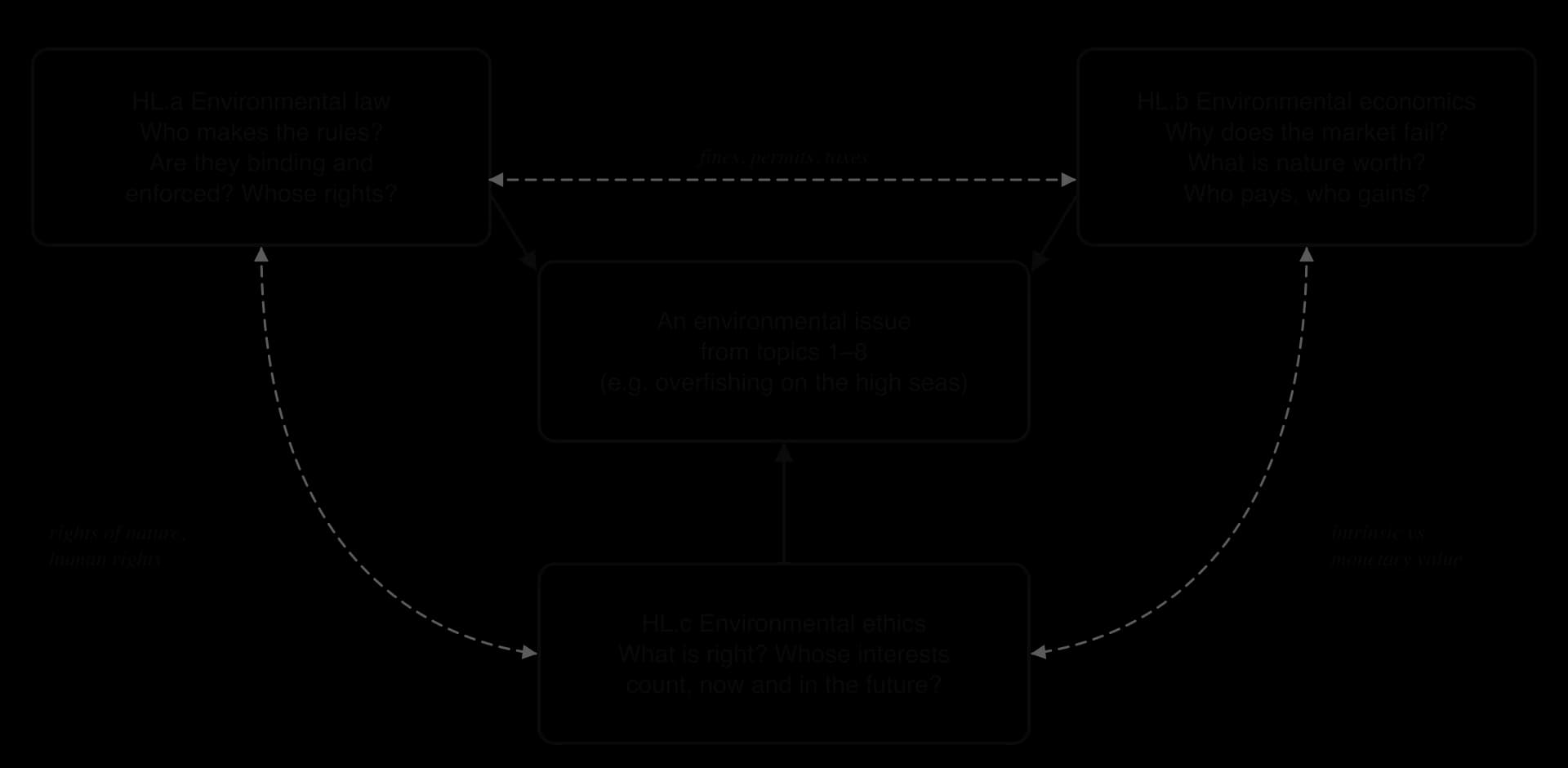
Overfishing on the high seas shows how the three combine. In law, fishing beyond national waters was long open to all; the High Seas Treaty, in force since 17 January 2026, allows marine protected areas there for the first time, while port state measures target illegal fishing.
In economics, open access is a classic tragedy of the commons: each fleet gains from catching more while the cost of a collapsing stock is shared, and subsidies keep fleets fishing even when stocks are low. In ethics, the questions are whether fish and marine ecosystems have value of their own, and what duty present fishers have to future generations who will need the same stocks.
 YouTube
Links to perspectives, systems and sustainability
Perspectives
The lenses give depth to the environmental value systems met in the Foundation topic. Ecocentric, anthropocentric and technocentric perspectives each lead to preferences in all three lenses: an ecocentric view may favour rights of nature in law, ecological economics and degrowth, and an ethics that gives moral standing to whole ecosystems; a technocentric view may favour market tools, green growth and consequentialist cost–benefit reasoning. The ethics lens explains the beliefs behind these perspectives; the law and economics lenses show how they turn into rules and prices.
Systems
Laws and economic instruments act on systems by changing inputs, outputs and storages: a fishing quota limits an output, a carbon tax reduces an input to the atmosphere, a protected area safeguards a storage. Ecological economics treats the economy itself as a subsystem of the biosphere, drawing in energy and materials and returning waste and heat. Feedback appears too: a weak law that is ignored can make a problem worse, while a successful agreement such as the Montreal Protocol can move a system back from a tipping point.
Sustainability
All three lenses are about how to make sustainability happen. Law sets enforceable limits, economics sets the incentives and measures what is being used up, and ethics explains why it matters and to whom, including future generations. Ideas taught with sustainability, such as environmental justice, the doughnut model, the circular economy and the SDGs, are developed further through the lenses.
How SL and HL differ
SL and HL students study the same common content in topics 1–8, the same Foundation topic and the same internal assessment. HL students study additional HL-only understandings in most subtopics, shown in the notes as sections headed “(HL only)”, and the three HL lenses, which are HL-only units of their own. Only Foundation (1.1–1.3) and 7.3 Solid waste have no HL-only sections.
The lenses are not confined to their own pages. In the syllabus, many understandings in topics 1–8 are linked to HL.a, HL.b or HL.c, showing where HL students are expected to bring a lens in. A link does not make the understanding itself HL-only; it marks a place where a legal, economic or ethical angle deepens the analysis. Each lens page includes short applications drawn from all eight topics, and the HL-only sections of the topic pages name the laws, tools and frameworks that apply.
Lens | Typical applications in topics 1–8 |
|---|---|
Law | CITES and protected areas (biodiversity); UNCLOS, EEZs and the High Seas Treaty (fisheries); transboundary water treaties; the Paris Agreement and climate litigation; EIAs before resource projects; the Basel Convention on waste trade |
Economics | Valuing ecosystem services; the tragedy of the commons in fisheries and the atmosphere; carbon taxes and emissions trading; water pricing; green GDP; the circular economy and the doughnut in cities and resource use |
Ethics | Intrinsic value of species; whaling and Indigenous hunting; climate and environmental justice; duties to future generations; animal welfare in farming; rights in population policy |
Assessment
The HL lenses do not have a paper of their own. They are assessed through Paper 1 and Paper 2. In Paper 1, the unseen case study may include material on a law, an economic policy or a dispute between stakeholders, with questions asking HL students to analyse or evaluate it. Paper 2 Section A can include short-answer items on lens content, such as distinguishing a convention from a protocol, explaining market failure or defining moral standing.
The lenses matter most in Paper 2 Section B. The final 9-mark part of each essay is marked with markbands, and at HL the bands refer to knowledge of “ESS issues, concepts and HL lenses content”. An HL answer reaches the top band more easily when it brings in a named law or court case, an economic instrument or valuation, or an ethical framework, explains how it applies, and uses it to weigh arguments and reach a judgement. Using two lenses together, such as a law that works through an economic penalty, shows the linked, cross-topic thinking the top band describes.
Flashcards for HL
The official decks for this part of the syllabus.
- HL.a Environmental law179 cards
- HL.b Environmental economics240 cards
- HL.c Environmental ethics131 cards
Carry on with HL in Augment
With a free account, Augment remembers where you stopped and what you have practiced.