1 Introduction
What the Digital Society course is, how it links concepts, content and contexts through inquiry, and how its five topics and the inquiry project fit together for SL and HL students.
- IB Digital Society
- SL and HL
What 1 covers
From the subject guide: what you need to know and be able to do.
What “digital society” means, and why it is a contested idea.
1 subtopics in Introduction
Each one has its own page once something is published for it.
- 1.1What is digital society?notes
An overview of 1 Introduction
What the course studies
Digital Society studies how digital systems shape the lives of people and communities, and how people shape those systems in return. Smartphones, social media platforms, online banking, recommendation feeds, voice assistants and delivery robots are all digital systems, and each changes how people work, learn, communicate, govern and look after their health.
Digital Society belongs to the individuals and societies group of the Diploma Programme. It is not a computer science course. Students learn enough about how technologies work to understand their effects, but the main questions are social, economic, political and ethical: who benefits from a digital system, who is harmed or left out, and what should happen next. The course shares methods with sociology, geography, economics, global politics, philosophy and media studies.
Concepts, content and contexts
The course is built on three connected elements, often called the 3 Cs. Concepts such as power, identity and change are lenses that give insight into a real-world example. Content covers the technologies themselves, such as data, algorithms and artificial intelligence, and informs an inquiry with accurate detail about how they work. Contexts such as health, the economy and politics situate an inquiry in the area of life where the effects are felt.
These elements come together through inquiry: a sustained process of asking an open question, exploring sources, investigating the impacts and implications of a digital system for people and communities, and then reflecting on and sharing the findings. An inquiry into TikTok's "For You" feed, for example, might combine content on algorithms (how the app chooses which videos to show), the concept of identity (how teenagers present themselves to an unseen audience) and the social context (friendships and peer groups).
How the course is organised
The course has five topics and a practical inquiry project, as the structure diagram shows.
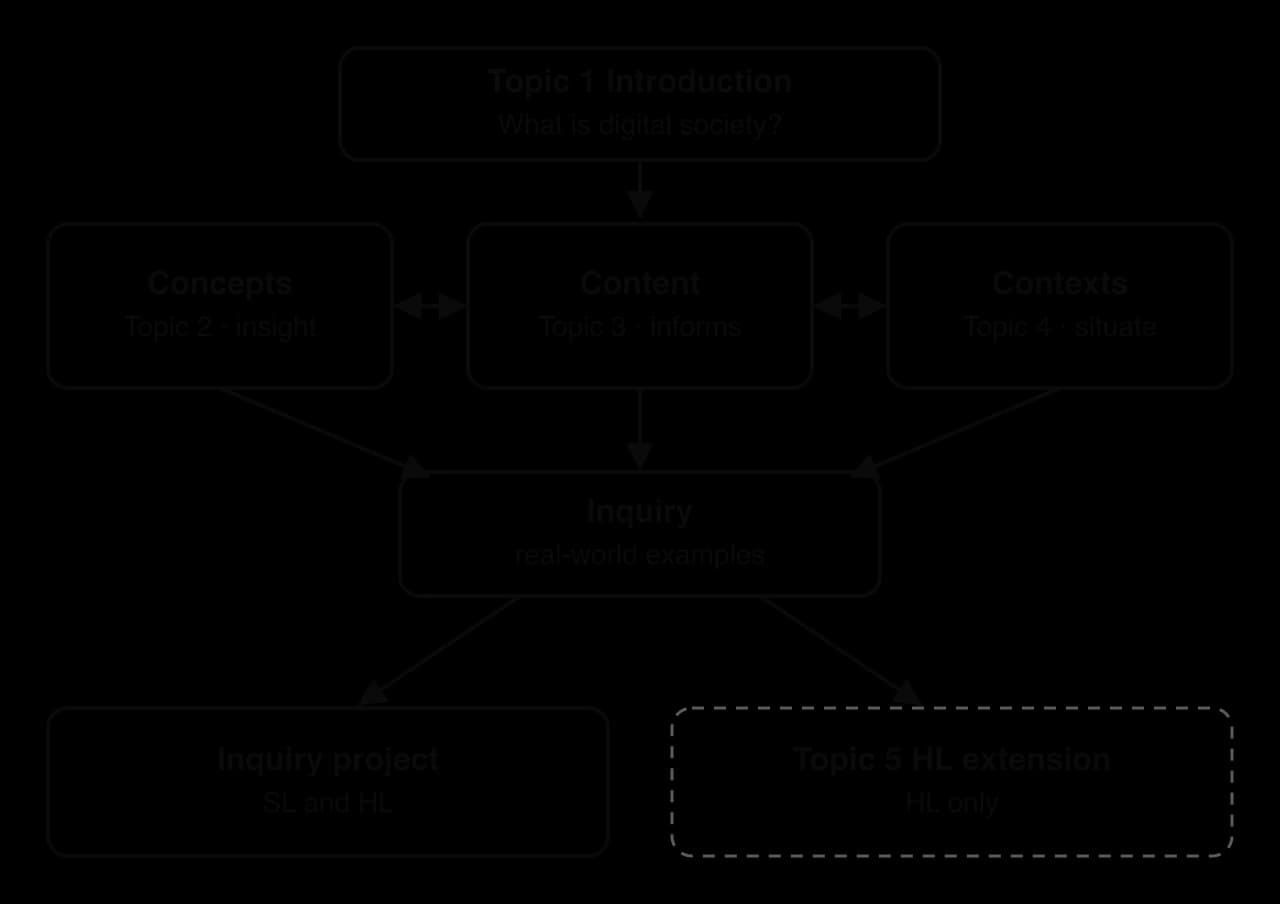
Part | What it covers |
|---|---|
Topic 1 Introduction | What digital society means, its history, digital divides, binary data, digitization and digitalization, and the course framework |
Topic 2 Concepts | Seven lenses: change, expression, identity, power, space, systems, and values and ethics |
Topic 3 Content | Seven areas of technology: data, algorithms, computers, networks and the internet, media, artificial intelligence, and robots and autonomous technologies |
Topic 4 Contexts | Seven areas of life: cultural, economic, environmental, health, human knowledge, political and social |
Topic 5 HL extension | Three global challenges (global well-being, governance and human rights, sustainable development) and the digital interventions that respond to them |
Inquiry project | An independent inquiry into the impacts and implications of a digital system for people and communities |
Topic 1 has a single subtopic, 1.1 What is digital society?, which introduces the ideas and vocabulary used everywhere else in the course. It explains why "digital society" is a contested term, why access to digital systems is uneven, and how analogue processes and objects are turned into digital forms. Later topics return to it often, since every inquiry starts from the same questions about what is digital, for whom and with what effects.
Carry on with 1 in Augment
With a free account, Augment remembers where you stopped and what you have practiced.