
Define values and ethics, distinguish personal, shared, collective and professional values, apply five ethical frameworks to digital dilemmas, and use values and ethics as a lens to evaluate digital systems.
Each is in the Digital Society glossary, with every other term in the subject.
A written set of principles and standards of conduct adopted by a profession or organisation to guide its members' decisions, such as the ACM Code of Ethics and Professional Conduct for computing professionals.
A family of ethical frameworks that judge an action only by its results, so the right action is the one with the best overall consequences. Utilitarianism is the best-known form.
A user interface design that deliberately manipulates or deceives users into choices that benefit the company rather than themselves, such as agreeing to data collection or a subscription that is hard to cancel.
An ethical framework, associated with Immanuel Kant, that judges actions by whether they respect moral duties and rules, such as honesty or respect for persons, rather than by their consequences.
The branch of ethics that examines the moral questions raised by the design, use and governance of digital systems, such as privacy, fairness, accountability and the treatment of users.
A systematic approach to deciding what is right, based on a central principle such as maximising good outcomes, following duties or respecting rights, which can be applied to new situations.
The systematic study of what is right and wrong, good and bad, and of the reasons for those judgements; also, a set of principles that guides the conduct of a person, group or profession.
Define values, ethics and morality, and distinguish ethics from law.
Outline how ethics, philosophy, world religions, law and public policy each study values and ethics in digital society.
Explain how values and ethics guide individual and group decisions, and discuss whether AI systems and robots can or should have ethics.
Distinguish between personal, shared, collective and professional values, including the hacker ethic.
Describe consequentialism, deontology, virtue ethics, rights-based ethics and the ethics of care, and apply each to a digital dilemma.
Explain how values are expressed through frameworks, codes, rules, policies and laws.
Analyse how values shape the design of digital systems, including value-sensitive design, privacy by design and dark patterns.
Evaluate a digital system through the concept of values and ethics, using at least two ethical frameworks.
Values and ethics are the ideas people use to decide what is right, fair, just, legal and proper, and to guide what they do. Every digital system carries choices of this kind, from the default privacy settings on a phone to the rules a self-driving car follows when an accident cannot be avoided.
Values and ethics is the seventh of the course's concepts. It works as a lens on every technology in the content topics, especially data, algorithms, artificial intelligence and robots, and on every context, from health to politics. It connects closely to the concept of power, because those who design and govern digital systems decide whose values the systems carry.
With a free account, Augment remembers where you stopped and what you have practiced.
An ethical framework, developed by thinkers such as Carol Gilligan and Nel Noddings, that places relationships and responsibility for others, especially vulnerable or dependent people, at the centre of moral decisions.
A set of shared values associated with early computer hacker culture, described by Steven Levy in 1984, including free access to computers and information, distrust of central authority, and judging people by their skill rather than their status.
A being that can understand right and wrong, choose how to act and be held responsible for its choices; adult humans are moral agents, while current robots and AI systems are not.
The view that moral judgements are true or false only relative to a particular culture, community or person, so that no single set of values applies to everyone. It contrasts with moral universalism, which holds that some principles apply to all people.
The beliefs and practices about right and wrong that a person or community actually holds. Ethics is the systematic study of these beliefs and the reasons behind them.
An approach in which the protection of personal data is built into a digital system from the start and set as the default, rather than added afterwards or left for users to switch on; required in the EU by Article 25 of the GDPR.
The difficulty of deciding who is morally or legally responsible when an autonomous system causes harm, because no single human directly chose the harmful action.
An ethical framework that judges actions by whether they respect the rights every person holds, such as privacy or free expression, which may not be overridden simply to benefit others.
A thought experiment in which a person must choose whether to divert a runaway vehicle so that it kills fewer people, used to test intuitions about consequences, duties and the difference between causing and allowing harm; often applied to autonomous vehicles.
A consequentialist framework, associated with Jeremy Bentham and John Stuart Mill, holding that the right action is the one that produces the greatest total well-being for everyone affected, with each person's well-being counting equally.
An approach to designing technology, developed by Batya Friedman and colleagues, that identifies the human values at stake and the direct and indirect stakeholders from the start, and builds support for those values into the system through conceptual, empirical and technical investigations.
Beliefs held by a person or group about what is important, desirable or worth protecting, such as privacy, safety, equality or freedom, which guide their choices and judgements. Values can be personal, shared by a group, collective across a society, or professional.
An ethical framework, going back to Aristotle, that focuses on the character of the person acting, holding that the right action is what a person of good character, with virtues such as honesty and compassion, would do.
Scope: this concept covers what values and ethics are, how they guide human action, the different levels at which values are held, how they are expressed through frameworks, codes, rules, policies and laws, and how they shape ideas, objects, practices, systems and spaces. The named ethical theories are widely used illustrations of ethical frameworks rather than a required list.
Privacy, freedom of expression, safety, fairness, honesty, efficiency, convenience and profit are all values that recur in debates about technology. Values tell a person or group what matters; they do not by themselves say what to do when two values conflict.
Most disagreements about digital systems are conflicts between values that are each reasonable on their own. End-to-end encryption in messaging apps protects privacy but makes police investigations harder, setting privacy against public safety. A feed that keeps users scrolling serves engagement and profit but may work against users' well-being.
In everyday speech "ethics" and "morality" usually mean the same thing, but in academic work it helps to keep them apart. Morality is the beliefs and practices about right and wrong that a person or community actually holds. Ethics is the systematic study of those beliefs: it asks why something is right or wrong, tests the reasons, and builds principles that can be applied to new cases.
The second meaning is the one used in phrases such as "medical ethics" or "a company's AI ethics". Digital ethics applies ethical study to data, algorithms, platforms, AI and robots, and to the people and communities they affect.
A judgement about an action can concern morality, fairness, justice, legality or social custom. These overlap, but an action can pass one test and fail another.
Distinction | Question it asks | Digital example |
|---|---|---|
Right and wrong | Is it morally acceptable? | Sharing a friend's private photo without asking |
Fair and unfair | Are people treated evenly, without prejudice? | A hiring algorithm that scores equally qualified women lower |
Just and unjust | Are benefits and burdens shared as they should be across society? | Who bears the cost when automation removes jobs in one region |
Legal and illegal | Does it break a law? | Collecting children's data for advertising |
Proper and improper | Does it follow accepted social norms? | Joining a video call for work from bed |
Fairness usually describes how individuals are treated in a particular decision. Justice is broader: it concerns how a whole society shares out rights, resources and opportunities. A face-matching system that misidentifies darker-skinned faces more often is unfair to each person it misidentifies, and unjust if it leads to more wrongful police stops in some communities than others.
Laws are rules made and enforced by a state. Many laws express ethical values (data protection laws protect privacy, for example), but ethics and law are not the same. Laws change more slowly than technology and differ from country to country, and some legal actions are widely seen as unethical. Most everyday actions sit where the two overlap, as the diagram shows, and most public debate concerns actions outside that overlap.
The "legal but unethical" region often shrinks over time, because public concern about a practice leads to new laws, as happened with manipulative interface design in the 2020s. The "ethical but illegal" region is more disputed. Whistleblowers who break secrecy laws to expose wrongdoing are judged very differently by different people and states.
People and cultures do not always agree on values, which raises the question of whether any values apply to everyone. Moral universalism holds that at least some principles, such as the equal dignity of all people, apply regardless of culture; moral relativism denies this.
The debate matters because a global platform must either apply one set of rules everywhere or adapt them country by country. Attitudes to privacy differ, for example: Germany, with its history of state surveillance, gives privacy great weight, and in 2010 nearly a quarter of a million German households asked Google to blur their homes in Street View.
The question "Can there be a universal system of digital ethics?" has two kinds of answer. One is that convergence is already happening. In 2021 all 193 member states of UNESCO adopted the Recommendation on the Ethics of Artificial Intelligence, the first global agreement of its kind, built on values such as human rights and dignity, diversity and inclusiveness. A review of 84 sets of AI ethics guidelines found that the same few principles appear again and again, as the chart shows.
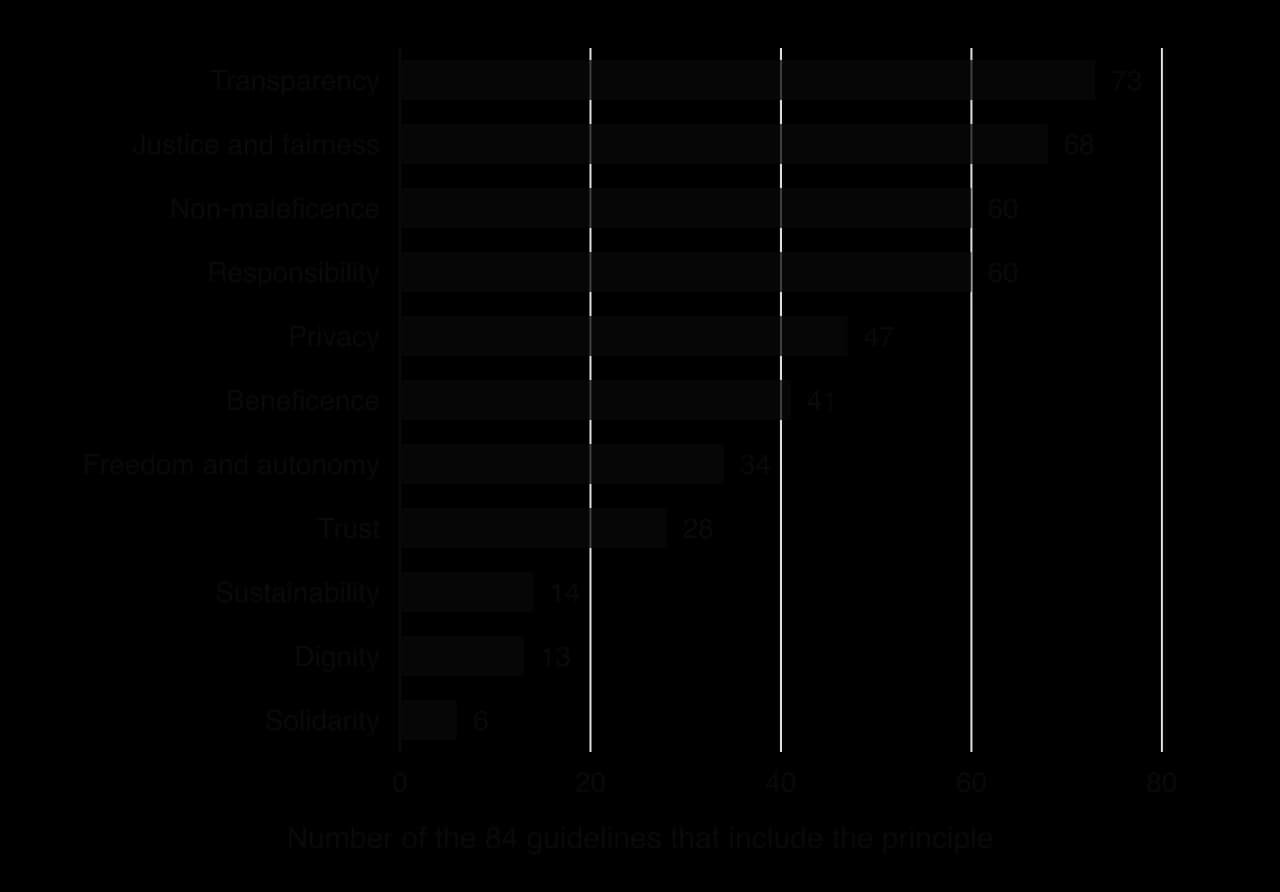
The other answer is that agreement on words hides disagreement on meaning. The same review found that guidelines interpret "fairness" very differently, and that more than a third came from the USA and the UK alone, while African and South American countries were absent except through international bodies. The southern African idea of Ubuntu ("a person is a person through other persons") puts community at the centre, and AI ethics built on it would stress solidarity more than individual rights. A universal digital ethics may be possible at the level of broad principles, while their application stays local.
Several disciplines study values and ethics in digital society, and each asks a different kind of question about the same digital system.
Discipline | How practitioners approach values and ethics | Digital example |
|---|---|---|
Ethics and philosophy | Analyse arguments, define concepts precisely, build and test theories of right action | Debating whether an AI system can be a moral agent |
World religions | Draw on sacred texts, traditions and ideas such as human dignity, compassion or stewardship | The Rome Call for AI Ethics (2020) |
Law | Interpret and apply binding rights and duties; decide responsibility and liability | Court cases about who is liable when an automated system causes harm |
Public policy | Design government action that balances values across a population | Rules on children's online safety; the EU AI Act |
Religious traditions bring long-standing values to new technology. The Rome Call, first signed in February 2020 by the Pontifical Academy for Life, Microsoft, IBM and the UN Food and Agriculture Organization, sets out six principles for AI, including transparency and inclusion; Jewish and Islamic leaders signed it in 2023 and leaders of Asian religions in 2024.
Lawyers turn values into enforceable rights and duties, and policymakers choose between competing values for a whole society: the EU AI Act, in force from 2024, sorts AI systems by risk and bans a few uses outright, such as social scoring.
An individual's values shape everyday digital choices, such as whether to post a photo of someone else or use a generative AI tool for homework. Groups decide through debate, votes or the rules of their organisation, and group action can change what an organisation does.
In 2018 several thousand Google employees protested against Project Maven, a contract to analyse US military drone footage with AI. Google did not renew it and published AI principles that ruled out work on weapons. In 2025 it removed that commitment, which shows that an organisation's stated values can change with its leaders and political context.
Artificial intelligence systems increasingly take decisions with ethical consequences, such as which job applicants to shortlist or which posts to remove. There are two broad ways to give them ethical behaviour.
Approach | How it works | Strengths | Limitations |
|---|---|---|---|
Top-down (rules) | Designers write explicit rules, such as "never recommend self-harm content" | Predictable and easy to inspect | Rules cannot foresee every situation and can conflict |
Bottom-up (learning) | The system learns acceptable behaviour from examples, such as human ratings of answers | Handles new situations | Copies the values and biases in its training data; hard to inspect |
Developers of large language models combine both: they train models on human ratings of helpful and harmless answers, and some also give the model a written list of principles. These methods can make a chatbot refuse clearly harmful requests, but they cannot settle whose values it should follow when reasonable people disagree, for example about politics or religion.
A robot can follow rules, but whether it "has" ethics depends on what that means. The philosopher James Moor proposed in 2006 that machines can be ethical in four increasingly demanding senses.
Type of agent | Meaning | Example |
|---|---|---|
Ethical-impact agent | Its use has ethical consequences | Robot camel jockeys replacing child jockeys |
Implicit ethical agent | Safe behaviour is built into its design | An industrial robot that stops when a person comes near |
Explicit ethical agent | It reasons with ethical rules to choose an action | A self-driving car weighing outcomes in an emergency |
Full ethical agent | It makes and justifies ethical judgements and is responsible for them | No existing machine |
Today's robots and AI systems are at most explicit ethical agents. They do not understand why an action is right or feel concern for others, so most ethicists agree that they are not moral agents.
Whether robots should have ethics is a different question. As robots become more autonomous, some decisions with moral weight must be made by the machine in real time, which creates a responsibility gap: when an autonomous vehicle causes harm, it can be unclear whether the manufacturer, programmer, operator or owner is to blame. When an Uber test vehicle in self-driving mode killed a pedestrian in Arizona in 2018, Uber was not charged; the safety driver later pleaded guilty to endangerment, so responsibility fell on the human closest to the machine.
The strongest form of the debate concerns lethal autonomous weapon systems, which can select and attack targets without a human decision. Campaigners argue that a machine, which cannot be held responsible, should never decide to take a life; in December 2023 the UN General Assembly passed its first resolution on such weapons. Supporters reply that machines do not panic or seek revenge.
Values are held at different levels, from a single person to a whole society, as the nested diagram shows. The levels often support each other but can also conflict: an engineer's personal values may clash with her employer's policy, or a community's shared values with the law.
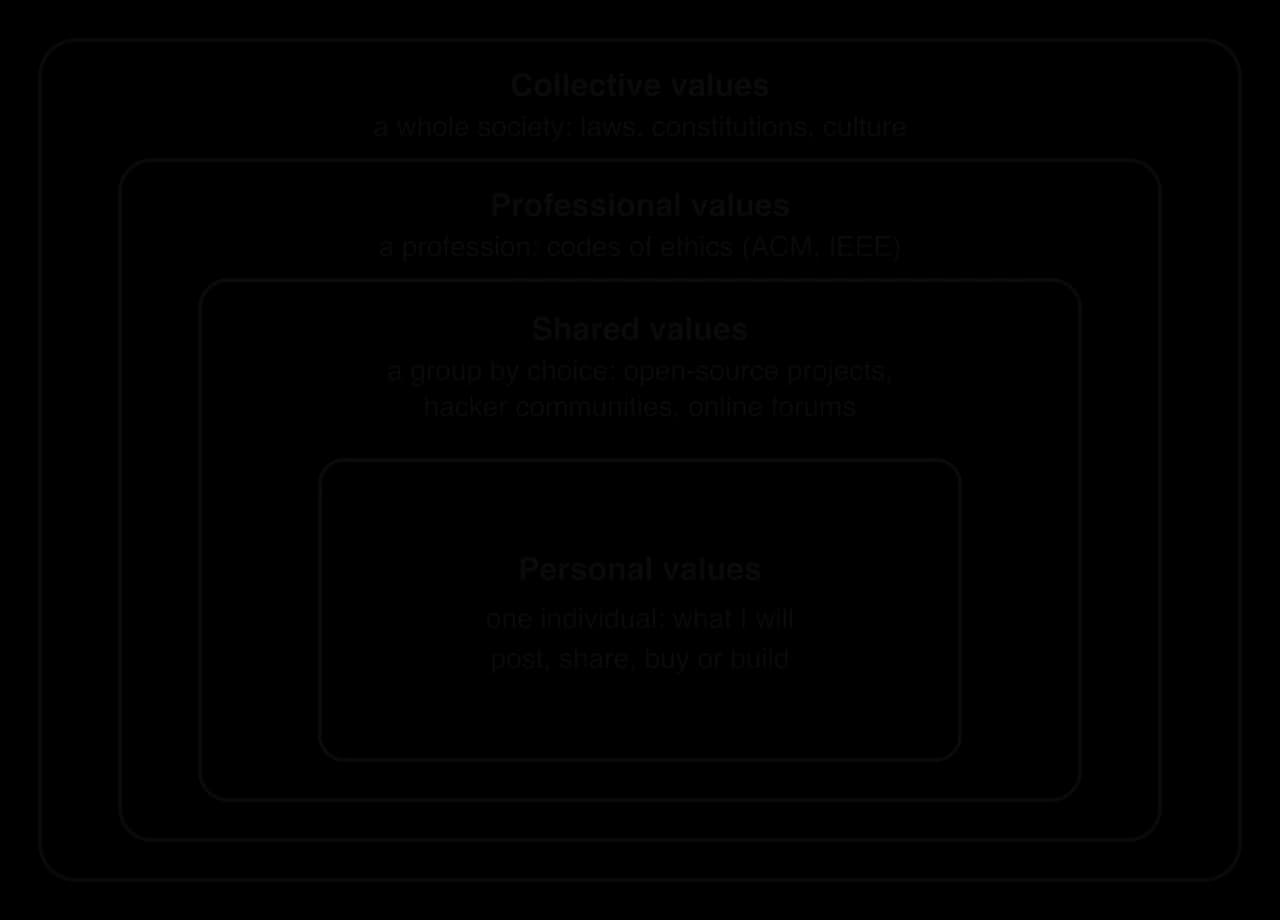
Personal values belong to one individual and come from family, religion, education and experience. They explain why two users of the same platform can act in opposite ways, for example in what they share or report.
Shared values are held in common by a group that people join by choice, such as an online forum, a fan community or an open-source software project. The Free Software Foundation's "four freedoms" (to run, study, change and share software) are shared values of this kind, and Wikipedia editors share a commitment to a neutral point of view.
Collective values belong to a whole society or culture and are expressed through its laws, institutions and customs. Strong data protection in European law reflects collective values about privacy and dignity. Collective values change slowly but do change, as attitudes to children's social media use have in many countries.
Professional values belong to the members of a profession and are usually written down in a code of ethics. The Association for Computing Machinery (ACM), the largest society of computing professionals, updated its Code of Ethics and Professional Conduct in 2018. Its first principles ask members to contribute to human well-being, avoid harm, be honest, be fair and not discriminate, and respect privacy.
A code's weakness is enforcement: a doctor who breaks medical ethics can lose the right to practise, but most software developers need no licence, so breaking the ACM code rarely has formal consequences.
Hacking is often linked with crime, but the word first described skilful, playful programming. In his 1984 book Hackers, the journalist Steven Levy described a hacker ethic shared by early programmers at MIT and in California: access to computers should be unlimited, all information should be free, authority should be mistrusted, hackers should be judged by their hacking rather than by degrees or position, and computers can create art and change lives for the better.
Germany's Chaos Computer Club, one of the largest hacker associations, later added principles such as "don't litter other people's data" and "make public data available, protect private data". Whether hackers share an ethical code today depends on which hackers are meant:
White-hat hackers test systems with permission so flaws can be fixed, often through paid bug bounty programmes such as "Hack the Pentagon" (2016).
Grey-hat hackers break in without permission but without intent to harm, often to expose a flaw.
Black-hat hackers break in for gain or to cause damage, for example with ransomware.
Hacktivists, such as the collective Anonymous, use hacking for political causes.
Hackers share some values, especially the value placed on skill and access to information, but not a single ethical code. The same technical skill can serve protection or harm, and what separates these groups is consent, intent and respect for others' data.
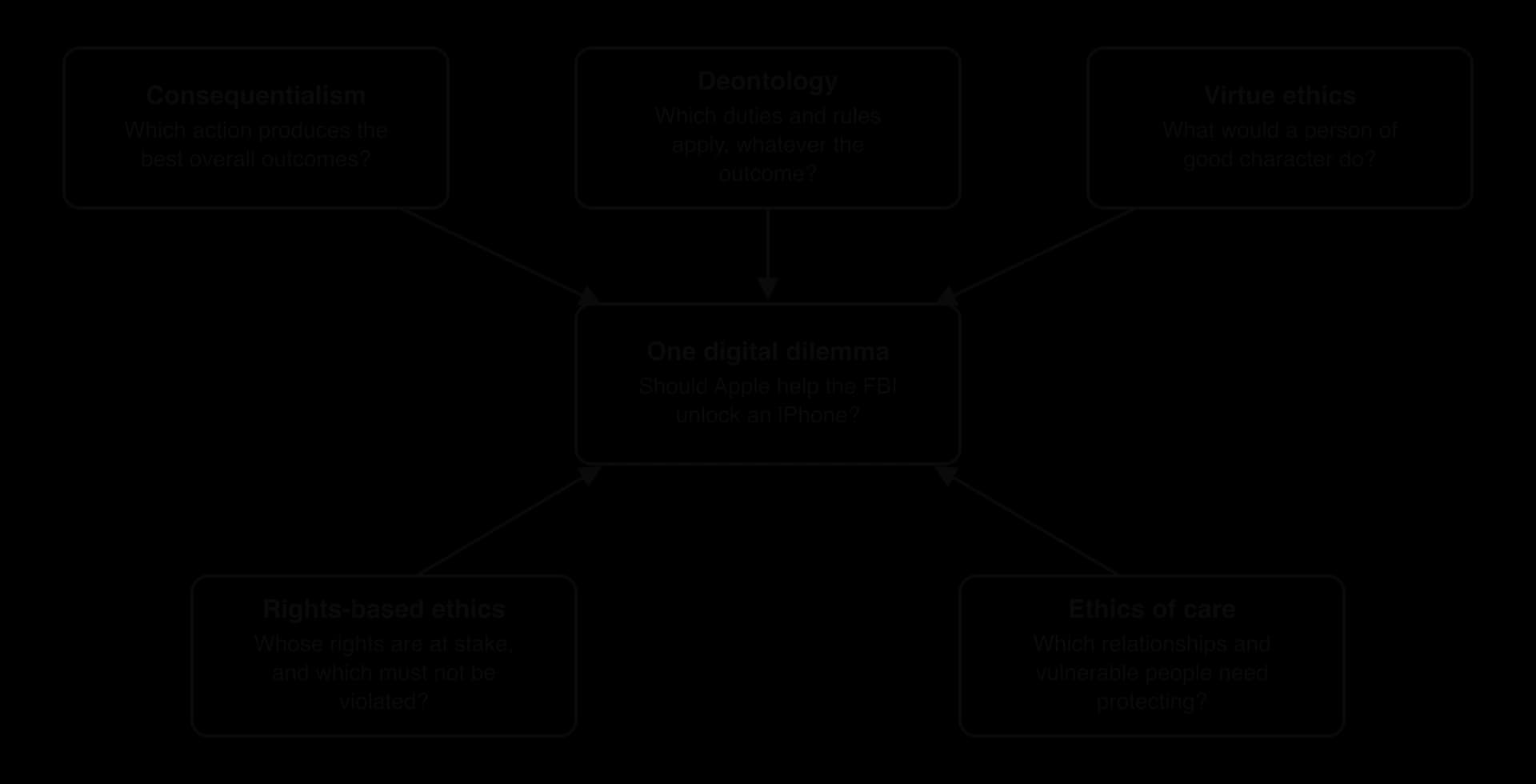
An ethical framework is a structured way of reasoning about what to do. Each framework treats a different feature of an action as the one that matters most: its results, the duties involved, the character it shows, the rights it affects or the relationships it touches. Using several on the same issue shows which values are at stake and why people disagree.
Consequentialism judges an action only by its results: the right action has the best overall consequences. Its best-known form, utilitarianism, was developed by Jeremy Bentham and John Stuart Mill in the 18th and 19th centuries.
Utilitarian reasoning matches cost–benefit analysis, so it is common in technology policy: approving a contact-tracing app in a pandemic weighs lives saved against millions of users' privacy. It counts everyone's interests equally, but it can justify serious harm to a minority, and consequences are hard to predict for technologies with unintended consequences. Rule utilitarians reply that people should follow the rules that produce the best results when everyone keeps them, such as respecting privacy, which protects individuals in most cases.
 YouTube
In deontology (from the Greek word for duty), some actions, such as lying or using a person merely as a tool, are wrong even if they produce good results. The 18th-century German philosopher Immanuel Kant set out the categorical imperative, two of whose formulations are best known: act only on a rule that you could want everyone to follow, and treat people always as ends in themselves, never merely as means.
Deontology explains objections to deceptive design even when it causes little measurable harm: tricking users treats them as means to a company's goal. It protects individuals from being sacrificed for the majority and explains why promises and honesty matter. Critics find it rigid (Kant held that lying is wrong even to save someone), and duties can conflict, such as keeping users' secrets and preventing harm.
Virtue ethics asks "what kind of person should I be?" rather than "which action is right?". It goes back to the Greek philosopher Aristotle, who held that virtues are built through practice and guided by practical wisdom, the ability to judge what a particular situation requires. Similar ideas appear in the Confucian tradition.
Virtue ethics suits professional life, because it treats ethics as a matter of habits as well as single choices: an engineer who discovers that a product misleads users might ask what an honest and courageous engineer would do. Its weakness is that it gives imprecise guidance in hard cases, and cultures may disagree about which traits are virtues.
Rights-based ethics is closely related to deontology, since each right a person holds sets duties that others owe them. It draws on the 17th-century philosopher John Locke's idea of natural rights and is expressed in the Universal Declaration of Human Rights of 1948, which lists rights such as life, liberty, free expression and, in Article 12, privacy.
Rights-based reasoning dominates technology law, because rights can be written into constitutions and enforced in courts; the GDPR, for example, gives people rights to access, correct and delete data about them. Its weakness is that rights often conflict (one person's free expression against another's privacy), and the framework does not always say which should win.
The ethics of care was developed from the 1980s by the psychologist Carol Gilligan and the philosopher Nel Noddings, among others, who argued that morality grows out of relationships rather than abstract rules.
The ethics of care asks how a design affects children, older people, people with disabilities, survivors of abuse or content moderators who view harmful material all day. Its strength is that it brings dependence and unequal power into view, which frameworks built around independent, equal individuals can overlook. Its weakness is that it can favour people close to us over distant strangers, and gives limited guidance for policies affecting millions.
A real case shows what happens when different frameworks are applied to the same issue. In December 2015 two attackers killed 14 people in San Bernardino, California. In February 2016 a US court ordered Apple to write software to bypass the security of an iPhone used by one of them. Apple refused, arguing that such a tool would weaken the security of every iPhone, and the FBI withdrew the case in March 2016 after an outside firm unlocked the phone. The diagram places this dilemma at the centre, with the question each framework asks around it.
The trolley problem is a thought experiment introduced by the philosopher Philippa Foot in 1967 and developed by Judith Jarvis Thomson. A runaway tram will kill five people unless a bystander pulls a lever to divert it onto a side track, where it will kill one. Most people say pulling the lever is acceptable. Yet most say it is wrong to stop the tram by pushing a large person off a footbridge into its path, though the numbers are the same.
Simple utilitarian reasoning treats the two versions alike, since five lives outweigh one in both. A common deontological explanation of the difference is that pushing someone uses them as a means to save the others, while the person on the side track is harmed as a side effect. The problem gained new importance with autonomous vehicles, whose software might in rare cases have to "choose" whom to put at risk.
To guide action consistently, abstract values must be expressed in more specific forms, which differ in who makes them and how they are enforced. The diagram arranges them as steps.
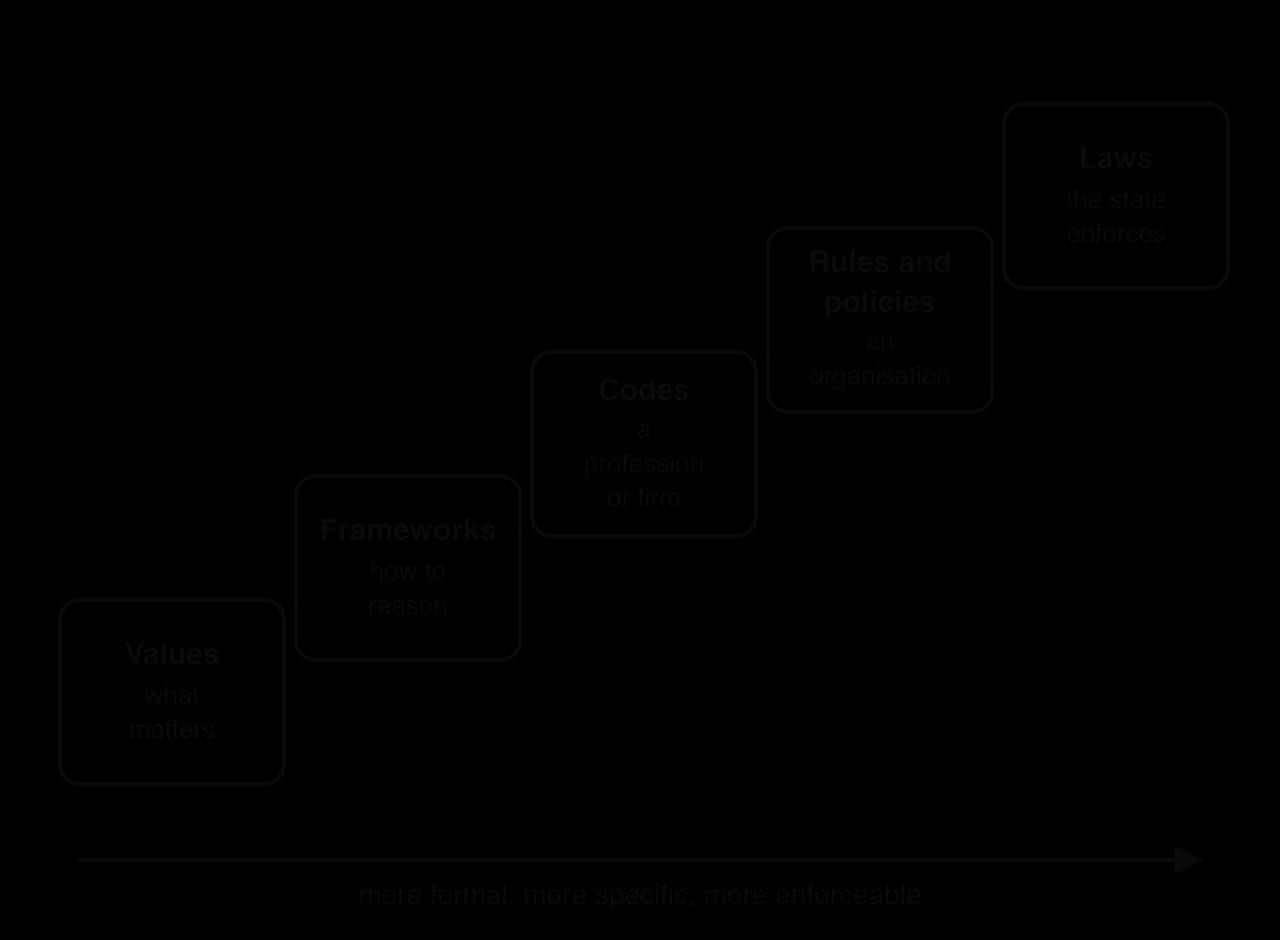
Form | Made by | Enforced by | Digital example |
|---|---|---|---|
Ethical framework | Philosophers, traditions | Not enforced; a way of reasoning | Cost–benefit analysis of a contact-tracing app |
Code of ethics | A profession or organisation | Reputation, membership, sometimes licensing | ACM Code of Ethics |
Rules | An organisation or community | Removal, suspension | Platform community guidelines |
Policies | An organisation or government | Management, audits | A company's AI principles; a school's acceptable use policy |
Laws | A state or group of states | Courts, regulators, fines | GDPR (2018); Digital Services Act (2022); AI Act (2024) |
Codes and company policies can respond quickly and set standards higher than the law, but they depend on goodwill and are easy to change, as Google's revision of its AI principles showed. Laws carry penalties but take years to pass. The balance between self-regulation by companies and regulation by governments is a central debate about values in digital society.
A common claim is that technology is neutral and only its use is good or bad. In a 1980 essay, "Do Artifacts Have Politics?", the political theorist Langdon Winner argued instead that technologies embody social and political choices. An app that encrypts messages by default carries the value of privacy; one that shares location by default favours data collection. Values shape digital society in five ways:
Ideas: concepts such as "open source" or "the right to be forgotten" grew out of particular values.
Objects: a modular, repairable phone embodies sustainability, while a sealed device puts thinness first.
Practices: two-factor authentication or asking before tagging a friend express values about security and respect.
Systems: platforms encode values in their algorithms, for example ranking content by engagement or by reliability.
Spaces: moderated forums, children's apps and encrypted chat groups are shaped by the values of those who build and govern them.
Value-sensitive design (VSD), developed by Batya Friedman and colleagues at the University of Washington from the 1990s, accounts for human values throughout the design process rather than adding ethics after a product is built. It uses three linked kinds of investigation, shown in the diagram and repeated as the design develops.

VSD separates direct stakeholders, who use the system, from indirect stakeholders, who are affected without using it. Passers-by filmed by a smart doorbell camera are indirect stakeholders whose privacy designers must consider even though they never chose the product.
Privacy by design applies the same thinking to one value. Ann Cavoukian, the Information and Privacy Commissioner of Ontario, Canada, set it out as seven principles, including privacy as the default setting. The EU's GDPR turned the idea into law in 2018: Article 25 requires "data protection by design and by default".
The opposite of value-sensitive design is the dark pattern, a term coined by the designer Harry Brignull in 2010 for interfaces that push users into choices they would not otherwise make: a bright "Accept all" button beside a hidden "Reject" option, or a cancellation process spread over many screens.
In January 2022 the French data protection authority (CNIL) fined Google €150 million and Facebook €60 million because their websites let users accept cookies with one click but needed several to refuse them. In the USA, the Federal Trade Commission accused Amazon of manipulative designs that enrolled customers in Prime and made cancellation hard; in September 2025 Amazon agreed to pay $2.5 billion to settle, without admitting wrongdoing. The EU's Digital Services Act now prohibits manipulative interfaces on online platforms. Through a deontological lens, dark patterns treat users as means to a company's goals; through a utilitarian lens, the harm is measurable in unwanted subscriptions and data given without real consent.
Designers make decisions for millions of people, and there are strong reasons to say they have obligations to users:
Power: through the concept of power, designers set the choices users can make, and greater power brings greater responsibility.
Professional values: the ACM code's duties to avoid harm and respect privacy apply to design decisions.
Vulnerability: some users, such as children, cannot easily protect themselves from persuasive technology.
Regret from inside the industry: Aza Raskin, who designed infinite scroll in 2006, later regretted how it was used to keep people scrolling and co-founded the Center for Humane Technology.
Counter-claims also deserve weight. Designers work for employers who set growth targets and may have little power to refuse, and adult users can leave a platform, so responsibility is arguably shared. A balanced judgement is that designers have real obligations but can only meet them fully when companies and laws support them.
The concept applies to every content topic and context. Each row pairs a technology with a context and names the values in conflict.
Content | Context | Real-world example | Values in conflict |
|---|---|---|---|
3.1 Data | 4.4 Health | Period-tracking apps after the US Supreme Court's 2022 Dobbs ruling, when users feared their data could be used in prosecutions | Health benefits against privacy and safety |
3.2 Algorithms | 4.2 Economic | Automated hiring and credit-scoring tools | Efficiency against fairness |
3.4 Networks | 4.6 Political | Government internet shutdowns during protests and elections | Public order against free expression |
3.5 Media | 4.1 Cultural | Generative AI trained on artists' work without permission | Innovation against creators' rights |
3.6 Artificial intelligence | 4.5 Human knowledge | Students using chatbots for coursework | Access to help against honesty in learning |
3.7 Robots | 4.7 Social | Care robots for older people in Japan | Independence against human contact and dignity |
To analyse a digital system through the concept of values and ethics, work through these steps.
Identify the stakeholders directly and indirectly affected, including those without a voice in the design.
Identify the values at stake for each group, and where they conflict.
Apply at least two ethical frameworks, stating what each recommends and why.
Check the codes, rules, policies and laws that already apply, and whether they match the ethical conclusions.
Reach a judgement that weighs the frameworks, states the conditions under which it holds, and suggests what should change.
In rare cases a self-driving car might face an unavoidable crash and have to "choose" between harming its passengers and harming pedestrians. In 2016 Jean-François Bonnefon, Azim Shariff and Iyad Rahwan showed a social dilemma in the journal Science: most people approved of cars that would sacrifice their passenger to save more pedestrians, but preferred to buy a car that would protect its own passengers.
To find out what people around the world believe such cars should do, Rahwan's group at the MIT Media Lab launched the Moral Machine website in June 2016. The results, published in Nature in 2018, came from about 40 million decisions made in ten languages by millions of people in 233 countries and territories.
The Moral Machine presents users with versions of the trolley problem adapted to self-driving cars. In each scenario a car's brakes fail, and the user decides whether it should stay on course or swerve, each option killing a different group of passengers or pedestrians, as in the simplified scenario in the diagram.
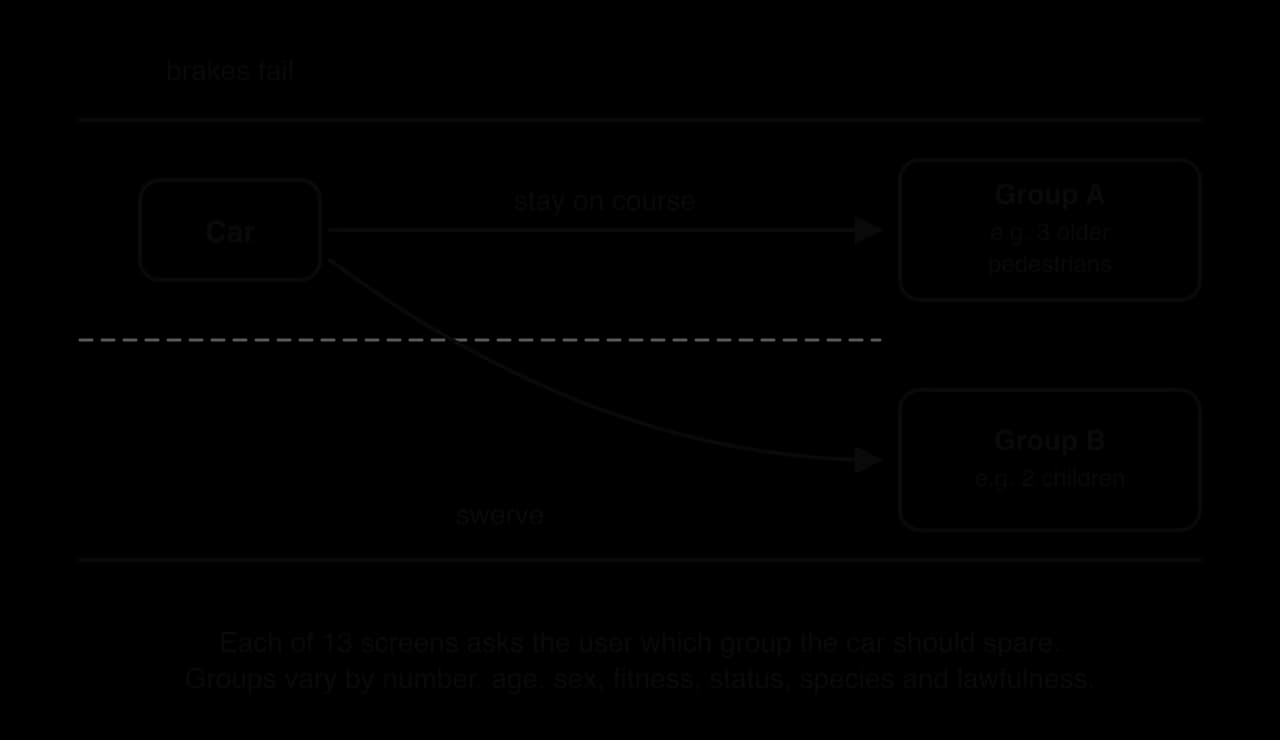
A session contains 13 scenarios. The researchers analysed nine factors: sparing humans or pets, staying on course or swerving, passengers or pedestrians, more or fewer lives, men or women, the young or the old, lawful or jaywalking pedestrians, the fit or the less fit, and higher or lower social status. An optional survey recorded users' age, gender, education, religion and politics, and the site recorded their country.
 YouTube
Three preferences were shared across almost all countries: sparing humans over animals, more lives over fewer, and the young over the old. Beyond these, preferences varied between cultures, and the researchers grouped the 130 countries with enough respondents into three clusters.
Cluster | Main countries | Distinctive preferences |
|---|---|---|
Western | North America and many European countries of Christian tradition | Stronger preference for the car not intervening |
Eastern | East Asian countries and countries of Islamic tradition | Much weaker preference for sparing the young; more weight on sparing lawful pedestrians |
Southern | Central and South America, plus France and countries with French influence | Stronger preference for sparing women, the young, the fit and higher status; weaker preference for humans over pets |
Preferences also tracked institutions and economics. Respondents from countries with stronger rule of law gave more weight to sparing pedestrians who cross legally, and those from countries with higher economic inequality were more likely to spare characters of higher status.
For car manufacturers and software developers, the experiment showed that there is no single global answer to how a car should behave in a dilemma.
For policymakers, the findings conflicted with existing rules. In 2017 Germany's Ethics Commission on Automated and Connected Driving published 20 guidelines, one of which prohibits any distinction between people by personal features such as age or gender in unavoidable accidents. Yet sparing the young was one of the strongest global preferences. The authors argued that public preferences should inform rules without dictating them.
For people and communities who ranked low, such as older and homeless people, software that followed majority preferences would build discrimination into the machine, against groups least able to influence its design. For the public, the experiment involved millions in ethical reasoning about a technology still in development.
Through the concept of values and ethics, the data show the frameworks at work. Saving more lives is utilitarian; the Western preference for not intervening matches the deontological idea that causing harm is worse than allowing it; the German rule is rights-based, since equal dignity forbids ranking lives by personal features. The results also bear on universal digital ethics: some values are close to universal, while their ranking varies by culture.
Through the concept of power, the key question is who decides. Majority votes on a website reflect who chose to take part, and the power to turn preferences into code lies with a few car and software companies, while the people most at risk have little voice. Through the concept of identity, the experiment turned age, sex, fitness and status, the same features that anti-discrimination law protects, into variables to be weighed.
The Moral Machine gathered data at an unprecedented scale, made it public, and showed that culture and institutions shape moral preferences in measurable ways. Its limitations are also important:
Sample: participants chose to take part online, so they did not represent any country's population; those who completed the survey were mostly young, male and university-educated.
Forced choice: in 2020 the psychologists Yochanan Bigman and Kurt Gray argued in Nature that when people may also choose to treat both groups equally, most do, so the format may exaggerate preferences for unequal treatment. The original authors replied that framing affects any such survey.
Realism: real autonomous vehicles work with uncertain sensor data and rarely face clear trolley-style choices.
Descriptive, not normative: the experiment measures what people prefer, not what is right. A majority preference to spare people of higher status does not make it ethical to do so.
A balanced judgement is that the Moral Machine is valuable evidence of how values vary between cultures and a strong tool for public engagement, but not a direct guide for programming vehicles. Its main lesson is that ethical choices in digital systems cannot be avoided, and that public preferences must be weighed against principles, such as equal dignity, that protect groups who might otherwise lose out.
The second question uses a short written source.
I can define values, ethics and morality, and distinguish ethics from law.
I can distinguish right and wrong, fair and unfair, just and unjust, legal and illegal, and proper and improper, with digital examples.
I can discuss whether a universal system of digital ethics is possible, using evidence.
I can outline how philosophy, world religions, law and public policy approach values in digital society.
I can explain how values guide the decisions of individuals and groups, with a real example.
I can discuss whether values can be programmed into AI and whether robots have or should have ethics.
I can distinguish personal, shared, collective and professional values, with a digital example of each.
I can discuss whether hackers share values or an ethical code.
I can describe five ethical frameworks, with a strength and a weakness of each.
I can apply several frameworks to one digital dilemma and explain why they may disagree.
I can explain how values are expressed through frameworks, codes, rules, policies and laws.
I can analyse how values shape digital systems, using value-sensitive design, privacy by design and dark patterns.
I can evaluate the Moral Machine experiment and a digital system of my choice through two frameworks.