Notes on 5.8 Research and development
Learning objectives
Define research and development (R&D), invention and innovation.
Calculate R&D intensity and explain why it differs between industries.
Evaluate the importance of research and development for a business.
Explain the importance of developing goods and services that address customers’ unmet needs, including latent needs.
Distinguish between adaptive creativity and innovative creativity.
Explain how patents, copyright and trademarks protect intellectual property, and the limits of that protection.
Distinguish between incremental and disruptive innovation, with real examples.
Introduction
Research and development (R&D) is the work a business does to discover new knowledge and turn it into new or improved products and processes. Pharmaceutical companies spend years developing new medicines, car makers develop electric vehicles and batteries, and software firms build new features and services. R&D is expensive and risky, but for many businesses it is the main source of future sales and of an advantage over competitors.
R&D is closely linked to the key concept of creativity, since it is the organised search for new ideas and new ways of using them. It is a response to change in technology and consumer needs, and it often causes change in whole industries. It raises questions of ethics, for example about testing medicines on people and setting prices for life-saving drugs, and much current R&D aims at sustainability, such as cleaner energy, lighter materials and products that can be recycled.
What research and development is
Research and development combines two activities. Research produces new knowledge: scientists, engineers or designers investigate how something works or what might be possible. Development turns that knowledge into something a business can sell or use: a product design, a prototype, a new recipe, a software feature or a better production process.
R&D is not limited to laboratories and high-technology firms. A food manufacturer that develops a lower-sugar recipe, a bank that designs a new mobile app and a clothing retailer that tests a fabric made from recycled bottles are all carrying out R&D. Much R&D aims at processes rather than products: finding ways to make the same product faster, cheaper, more safely or with less waste.
Stages of the R&D process
R&D usually moves through a series of stages, from general research to a finished product. Many ideas enter the process, but most are dropped along the way, because they do not work, cost too much or would not sell.
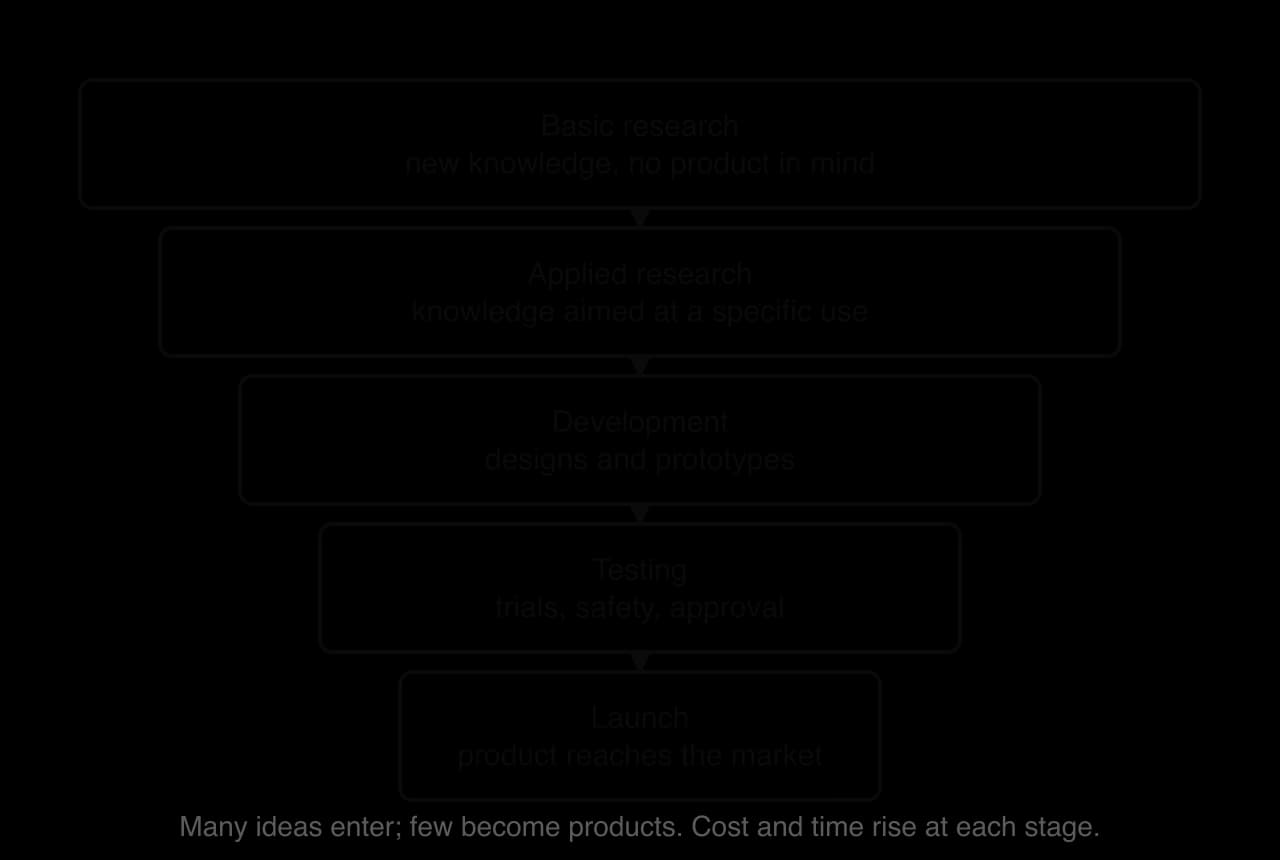
The funnel shows the main stages. Basic research investigates without a particular product in mind, for example studying how a hormone controls appetite. Applied research aims the knowledge at a specific use, such as a medicine that copies that hormone. Development turns the idea into designs and prototypes; testing checks that the product works, is safe and meets regulations; and launch takes it to the market. In medicines, the testing stage alone can take many years, because clinical trials must show that a drug is safe and effective before regulators approve it.
Most businesses do mainly applied research and development, because basic research is costly and its commercial value is uncertain. Basic research is done mostly by universities, government laboratories and the largest companies, and businesses often use its results through partnerships and licences.
Invention and innovation
Two words are central to R&D and are often confused. An invention is a new idea, device or process that did not exist before. An innovation is the successful introduction of a new or improved idea into the market or into the way a business works. An invention becomes an innovation only when it is developed into something people use and are willing to pay for.
Innovation can involve a new product, a new process, a new way of marketing or a new business model. It is judged by its success in use, not by how original the idea is.
The difference matters because an invention earns no revenue until it is developed into a product that customers buy. An engineer at Kodak, Steven Sasson, built the first battery-powered handheld digital camera prototype in 1975. Kodak later sold digital cameras, but they earned low margins against cheaper Asian rivals, while sales of its highly profitable photographic film fell; Kodak filed for bankruptcy protection in January 2012. Successful innovation needs a way of earning a profit from an idea and a willingness to change the business around it.
Sources: Wikipedia, “Kodak” (citing company history and court filings), 1975–2013.
How much businesses spend on R&D
Spending on R&D varies enormously between businesses and industries. To compare businesses of different sizes, analysts express R&D spending as a percentage of sales revenue. This measure is called R&D intensity.
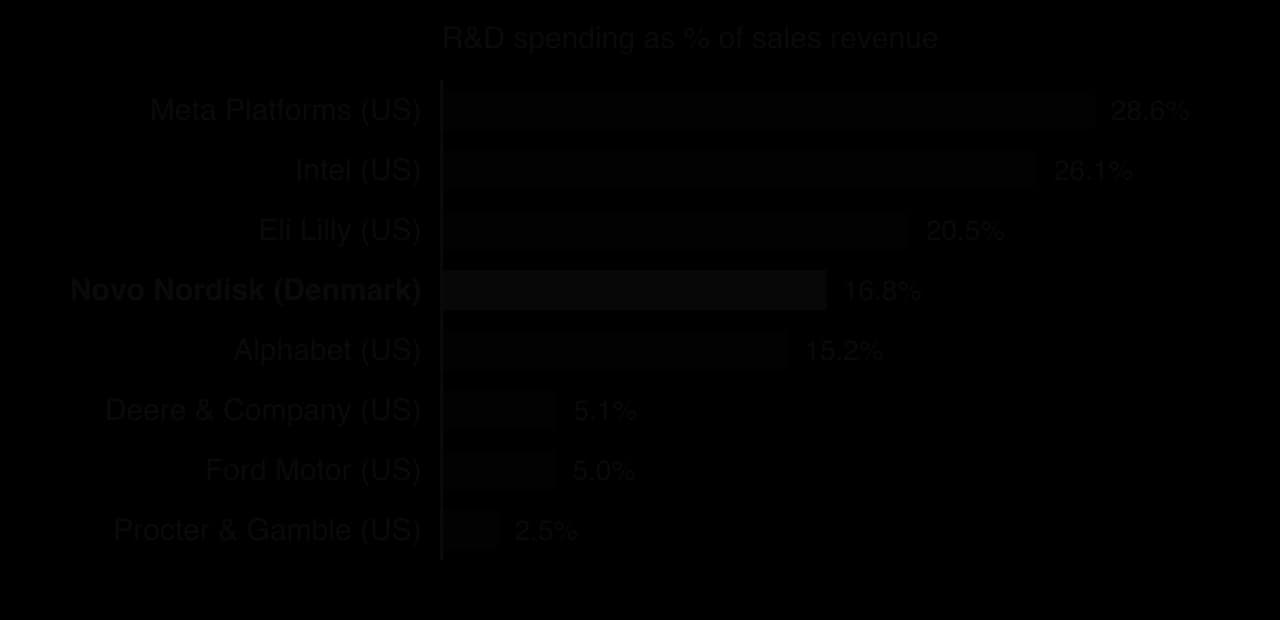
The chart compares the R&D intensity of eight large companies. Technology and pharmaceutical firms such as Meta, Intel, Eli Lilly, Novo Nordisk and Alphabet spend between about 15% and 29% of their revenue on R&D. Ford and the agricultural machinery maker Deere spend about 5%, and Procter & Gamble, which makes household goods, about 2.5%.
The differences reflect the nature of each industry. Where products are based on science or software, change quickly and can be protected by patents, the rewards for R&D are large, so firms must invest heavily to keep up. Where products change slowly and competition depends more on brands, distribution and cost, R&D intensity is lower, although the amounts spent by large firms are still large in money terms.
Why R&D is important for a business
R&D is an investment: the business spends money now in the hope of higher sales, lower costs or a stronger position in the future. Its importance comes from several connected benefits.
New products to replace those in decline
Every product follows a product life cycle: sales grow, reach maturity and eventually decline as tastes change, competitors imitate it or technology moves on. A business that sells only one or two products will see its total sales fall unless it has new products ready. R&D provides this flow of new products, often called a pipeline.
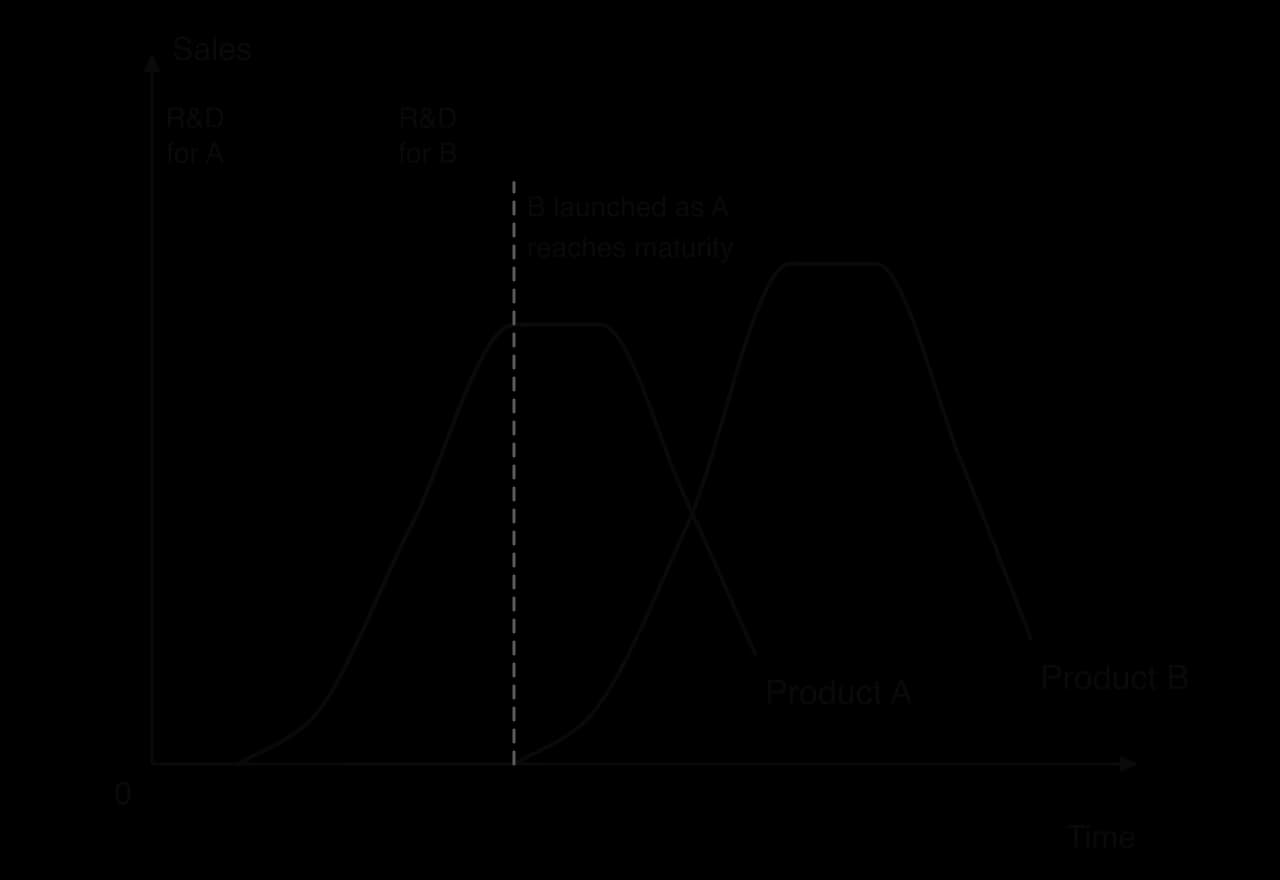
The diagram shows two product life cycles. The shaded areas are the periods of R&D before each launch. Because R&D takes years, work on product B has to start while product A is still in its growth stage. If the business waited until A’s sales started to fall, there would be a gap of several years with falling revenue. R&D can also support extension strategies for existing products, such as new features, versions or uses that lengthen the maturity stage.
Competitive advantage and higher prices
New or better products give a business something its rivals do not have, a unique selling point or a basis for product differentiation. While competitors catch up, the business can often charge a premium price, earn higher profit margins and win market share. In industries where products can be patented, the advantage can last for many years. This link between R&D and competitive advantage is why R&D intensity is highest in industries where products are hardest to copy.
Lower costs through process innovation
R&D into processes can make production cheaper, faster, safer and less wasteful. New machinery, automation, better materials and improved methods raise productivity and lower costs per unit. This can allow lower prices, higher margins or both, and often reduces energy use and waste, which supports environmental sustainability.
Growth, reputation and access to new markets
Successful R&D helps a business grow, both by selling more to existing customers and by entering new markets. A reputation for innovation strengthens the brand, attracts talented employees who want to work on new ideas, and makes investors more willing to provide finance. R&D can also help a business meet new regulations, such as limits on emissions, before its competitors do.
Costs and risks of R&D
R&D also has serious drawbacks, which explain why many businesses spend little on it.
High cost. Laboratories, specialist staff, equipment, prototypes and testing are expensive. The money spent has an opportunity cost: it could have been used for marketing, expansion or paying dividends.
Long time lags. It can take years before R&D produces anything to sell, so the business needs enough finance and patience to wait. Shareholders who want short-term profits may object.
Uncertain results. Most projects fail. Ideas may not work, may cost too much to produce, may be beaten by a rival’s product or may simply not be wanted by customers.
Imitation. Competitors may copy a successful product quickly, especially where it cannot be protected by a patent, so the business that paid for the R&D may not earn the rewards.
Dependence on a few successes. When one product is very successful, a business can become dependent on it, and its sales may fall sharply when the product’s patent expires or a better product appears.
Ethical questions. Some R&D raises ethical concerns, such as animal testing, the risks to people taking part in clinical trials, the collection of personal data and the prices charged for products that people need.
R&D strategies
Businesses choose different approaches to R&D, depending on their resources and the market.
Strategy | What it means | Advantages | Disadvantages |
|---|---|---|---|
Leader (offensive) | Aim to be first to market with new technology | Premium prices, strong brand, patents, chance to set industry standards | Highest cost and risk; others learn from the leader’s mistakes |
Follower (defensive) | Let others go first, then improve on their products quickly | Lower risk; can learn from the leader and from customer feedback | Smaller share of early profits; may face patents |
Imitator | Copy proven products at lower cost once patents allow | Very low R&D cost; can compete on price | Low margins; no reputation for innovation |
Buy or license | Acquire firms or license technology developed by others | Faster access to ideas; spreads risk | Expensive; depends on others’ R&D |
Open innovation and partnerships | Work with universities, suppliers, start-ups or even competitors | Shares costs and expertise; access to more ideas | Must share rewards and control; risk of losing ideas |
Being first brings a first-mover advantage: the first business in a new market can build brand recognition, sign up customers and suppliers, gain economies of scale and protect its position with patents before rivals arrive. The advantage is not guaranteed. Later entrants can learn from the pioneer’s mistakes, use cheaper technology and target customers the pioneer has already educated about the product.
Evaluation: how important is R&D for a business?
R&D is essential for some businesses and much less important for others. Its importance depends on several factors.
The industry. In pharmaceuticals, electronics, software and car making, products change quickly and competitors invest heavily, so a business that stops investing in R&D will soon fall behind. In industries such as basic foods, cleaning or retail, products change slowly and other factors matter more.
The length of product life cycles. The shorter the life cycle, the more often new products are needed and the more important R&D becomes.
The strength of intellectual property protection. Where patents are strong and enforced, the business that invests in R&D can earn the rewards; where copying is easy, the case for R&D is weaker.
Finance and size. R&D needs money and patience. Large, profitable businesses can fund many projects and accept that most will fail; small businesses may only afford one or two, so each failure matters more.
Objectives and stakeholders. Shareholders who want short-term profits may resist R&D spending; owners with long-term objectives, or with a mission to solve a social problem, are more willing to invest.
Culture and people. R&D succeeds only when employees are encouraged to share ideas and are allowed to fail, which depends on the organisational culture and on managers’ attitude to risk.
On balance, R&D is most important where competition is based on new technology and where the business can protect and profit from what it develops. Even in other industries, some R&D, especially into processes and into what customers need, is usually necessary for long-term survival. For most businesses, the judgment concerns how much to invest in R&D, in which projects, and how to make sure that the spending leads to products and processes that create value.
Meeting customers’ unmet needs
Products succeed when they meet a need that customers have. Many needs are already met by existing products, so the greatest opportunities usually lie in unmet needs: needs that no current product satisfies, or satisfies well. Some of these needs are known to customers, who are frustrated by the products available. Others are latent: customers are not yet aware of them, and recognise them only when a new product shows what is possible.
A latent need is a special kind of unmet need, one the customer has not yet recognised.
Latent needs are hard to find through ordinary market research, because customers cannot describe a need they do not know they have. Asking people in a survey what they want usually produces requests for small improvements to existing products. Businesses therefore use methods such as observation of how people actually live and work, in-depth interviews and testing early prototypes with users, and they analyse the problems and workarounds customers create for themselves.
Adaptive and innovative creativity
Businesses can respond to customers’ needs with two kinds of creativity. Adaptive creativity improves or adapts what already exists, usually to meet needs customers already know they have. Innovative creativity produces something genuinely new, often meeting latent needs that customers had not expressed.
Innovative creativity, by contrast, starts from new knowledge or a new way of seeing a problem.
Adaptive creativity | Innovative creativity | |
|---|---|---|
Starting point | An existing product or idea | A new idea, often from new knowledge |
Needs addressed | Known needs that customers can describe | Latent needs customers cannot yet describe |
Risk | Lower: customers already want the product type | Higher: no proven market |
Typical result | Incremental innovation | New product categories; sometimes disruptive innovation |
Example | A razor with more blades, a phone with a better camera | A mobile phone service for sending money without a bank account |
The table shows that the two kinds of creativity carry different levels of risk and reward. Adaptive creativity is safer and suits most businesses most of the time. Innovative creativity is riskier but can create entirely new markets, in which the first business to meet the need can gain a large advantage.
M-Pesa, launched by Safaricom and Vodafone in Kenya in 2007, shows how a latent need can be found. The service was first designed so that customers of a microfinance institution could receive and repay small loans through mobile phone airtime agents. Customers used it in other ways, above all to send money to their families, so the service was refocused on transfers and payments. By December 2011 it had about 17 million subscribers in Kenya, meeting a need for safe, cheap money transfers among people without bank accounts that traditional banks had not served.
Sources: Wikipedia, “M-Pesa” (citing Communications Commission of Kenya, 2012; Hughes and Lonie, 2010).
Why addressing unmet needs is important
Developing products that meet unmet needs matters for several reasons. Customers with an unmet need have no satisfactory alternative, so the business faces little competition at first and can often charge higher prices. The first business to meet the need may gain a first-mover advantage and strong brand loyalty. Products that solve real problems tend to spread by word of mouth, which lowers marketing costs. And meeting unmet needs in areas such as health, finance or clean energy can create social value as well as profit, which supports a business’s corporate social responsibility and reputation.
The approach also has risks. Latent needs are uncertain, so a business may spend heavily on a product that customers turn out not to want. Customers may need to be educated about a new kind of product, which takes time and money. If the product succeeds, competitors will try to copy it, so the business needs to protect its ideas and keep improving.
Protecting intellectual property
R&D produces ideas, designs, inventions, software, brand names and creative works. These are valuable, but they are easy to copy once others have seen them. Intellectual property (IP) is the legal term for these creations of the mind, and intellectual property rights give their owners the exclusive right to use them for a period of time. Without such rights, competitors could copy a new product without paying for the R&D behind it, and few businesses would invest in R&D at all.
The three main forms of protection are patents, copyright and trademarks. Each is recorded on the statement of financial position as an intangible asset when it has been bought, and each protects a different kind of creation.
Patent | Copyright | Trademark | |
|---|---|---|---|
What it protects | An invention: a new product, process or technical solution | Original creative works: writing, music, films, software code, art, photographs | Signs that identify a brand: names, logos, slogans, sometimes colours, sounds or shapes |
How it is obtained | By application to a patent office; must be new, inventive and capable of industrial use | Automatically when the work is created; no registration needed in most countries | By registration with a trademark office (some rights also arise from use) |
How long it lasts | Usually 20 years from the date of filing, if renewal fees are paid | Usually the author’s life plus 50 or 70 years, depending on the country | Usually 10 years, renewable indefinitely while the mark is used |
What the owner must give up | Full public disclosure of how the invention works | Nothing | Nothing, but the mark must be used |
Example | Gillette’s Mach3 razor (1998) was protected by 35 patents | Disney’s 1928 film Steamboat Willie entered the US public domain on 1 January 2024 | The ® symbol shows a registered trademark |
Sources: Wikipedia, “Patent”, “Trademark” and “Steamboat Willie” (citing the TRIPS Agreement and US law); Wikipedia, “Gillette” (citing The New York Times, 1998).
Patents
A patent gives the owner the exclusive right to make, use and sell an invention for a limited period, usually 20 years from the date the application was filed. In return, the inventor must publish a full description of how the invention works. When the patent ends, anyone can use the invention. This bargain encourages R&D, because the inventor can earn a return, while making sure that the knowledge eventually becomes available to everyone.
Patents are territorial: a patent granted in one country protects the invention only in that country. A business that wants protection in many markets must apply, and pay, in each one or through international systems. Renewal fees must usually be paid every year to keep a patent in force; if a fee is not paid, the protection ends early. Novo Nordisk’s Canadian patent on the chemical structure of semaglutide, the active ingredient of Ozempic, lapsed in 2020 after a maintenance fee was not paid, so generic manufacturers could enter the Canadian market once the period of data protection there ended in January 2026.
Sources: Wikipedia, “Semaglutide” (citing Canadian Intellectual Property Office records and press reports).
Copyright
Copyright protects original creative works, such as books, music, films, photographs, software code and website content. It arises automatically when the work is created, so there is no need to register it in most countries, and it usually lasts for the life of the author plus 50 or 70 years, depending on the country. Copyright protects the expression of an idea, not the idea itself: another business may write its own software that does the same job, as long as it does not copy the code.
Copyright is central to businesses in music, film, publishing, games and software. It eventually ends, however. Disney’s 1928 cartoon Steamboat Willie, an early Mickey Mouse cartoon with synchronised sound, entered the public domain in the United States on 1 January 2024, so anyone may now use that early version of the character. Later versions of Mickey Mouse are still protected, and Disney can still rely on trademarks for the character as a brand.
Trademarks
A trademark protects the signs that tell customers which business a product comes from: brand names, logos, slogans, and in some cases colours, sounds or shapes. Registration usually lasts 10 years and can be renewed indefinitely, as long as the mark continues to be used. The symbol ® shows a registered trademark, and ™ is used for a mark that has not been registered.
Because trademarks can last for ever, they protect a business’s brand long after its patents and copyrights have expired. A trademark can be lost, however, if it is not used or if it becomes the ordinary name for a type of product. “Escalator” was once a trademark but became the general word for a moving staircase, so it lost its protection.
Trade secrets
Some businesses choose not to patent an invention at all, because a patent requires full disclosure and ends after about 20 years. Instead they keep the information secret, protected by confidentiality agreements with employees and partners. A trade secret can last indefinitely, but only as long as it stays secret: if a competitor discovers it independently or works it out from the product, there is no protection.
Benefits and limitations of intellectual property protection
Benefits for the business | Limitations |
|---|---|
A period without direct copies, which allows premium prices and a return on R&D | Applying for and renewing patents and trademarks in many countries is expensive |
An intangible asset that can be sold or licensed to earn royalties | Enforcing rights through the courts is slow and costly, especially abroad, where courts and laws differ |
Reassurance for investors and lenders, who can see that ideas are protected | Patents require full disclosure, which can help competitors to design around the invention |
A stronger brand, protected from imitations, through trademarks | Protection ends: sales can fall sharply when a key patent expires (the “patent cliff”) |
Encouragement for employees and partners to innovate | Small businesses may lack the money to defend their rights against large firms |
The table shows that intellectual property rights are valuable but not absolute. Competitors may develop different products that meet the same need without breaking any patent, and in some countries copies are sold despite the law. Businesses that depend on IP therefore also rely on speed, brand loyalty and continuing R&D.
Innovation: incremental and disruptive
Innovations differ greatly in how much they change a product or a market. Most are small improvements to existing products. A few are so different that they change how an industry works and which businesses lead it. The two extremes are called incremental and disruptive innovation.
Incremental innovation
Incremental innovation is a series of small, step-by-step improvements to existing products, services or processes. Each step makes the product a little better, cheaper or more convenient, but does not change what it is or who buys it. Most R&D in most businesses produces incremental innovation.
Gillette’s razors show incremental innovation over decades. The Trac II, announced in 1971, was described as the first two-blade razor; the Sensor (1990) added blades mounted on springs; the Mach3 (1998) added a third blade after five years of development; and the Fusion (2006) had five blades. Each product kept existing customers buying Gillette and allowed higher prices, but none changed the basic idea of a razor with replaceable blades.
Sources: Wikipedia, “Gillette” (citing McKibben, 1998, and The New York Times, 1998).
Incremental innovation has clear advantages. It is less risky and cheaper than radical change, it uses the business’s existing knowledge and production, and existing customers understand and accept it. It can extend the maturity stage of the product life cycle. Its main drawback is that it can leave the business focused on improving today’s products while a completely different approach develops elsewhere.
Disruptive innovation
The idea of disruptive innovation comes from Clayton Christensen of Harvard Business School, who introduced it with Joseph Bower in a 1995 article and developed it in his 1997 book The Innovator’s Dilemma. A disruptive innovation is a new product or business model that starts by serving customers whom existing firms ignore, usually because it is simpler, cheaper or more convenient but performs worse on the measures that established customers value. It improves over time until it is good enough for most customers, and then takes the market from the established firms.
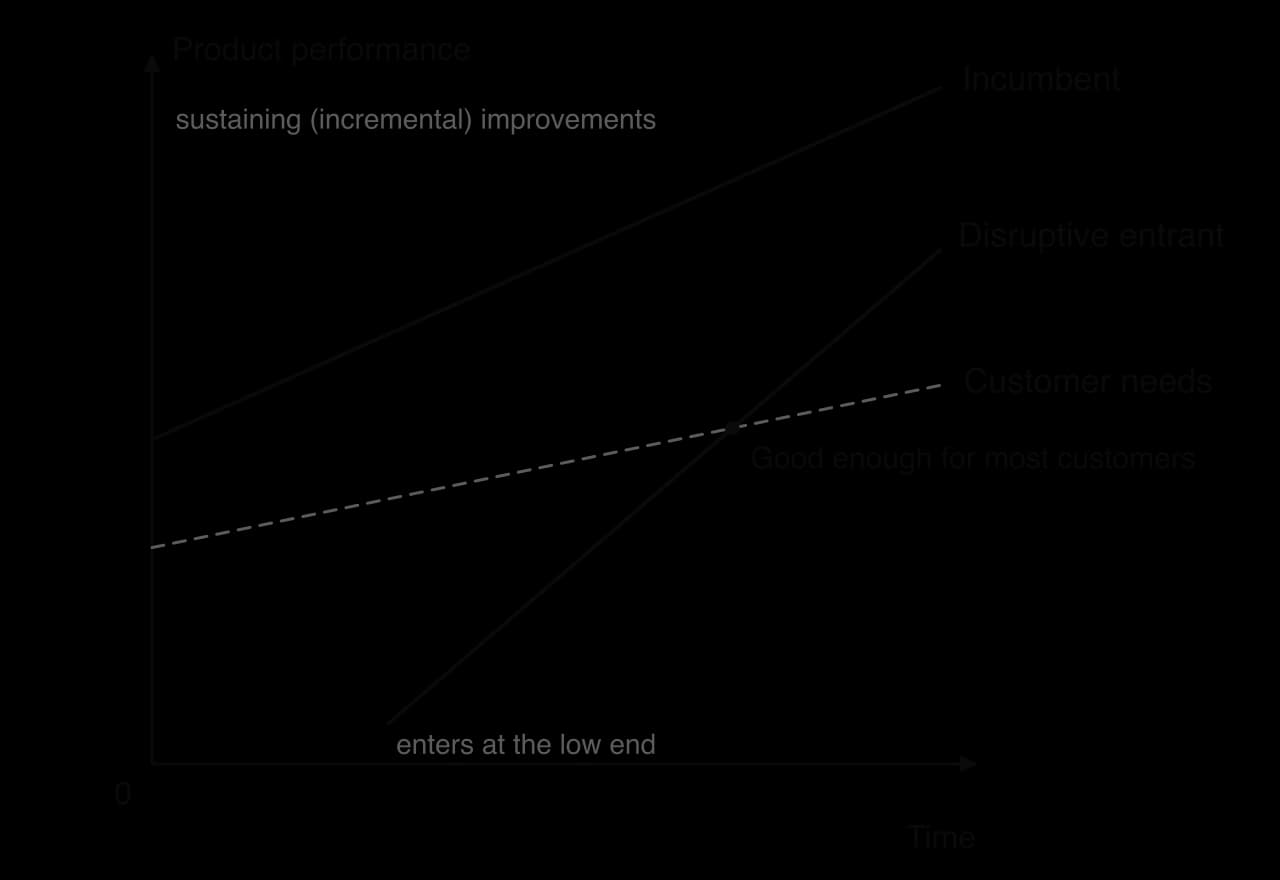
The diagram shows Christensen’s explanation. The established firm, or incumbent, keeps improving its product for its most demanding customers, with sustaining (incremental) improvements, until its performance is more than most customers need or want to pay for. The disruptive entrant starts below what mainstream customers need, so the incumbent sees no threat and ignores it. As the entrant’s product improves, it crosses the line of customer needs. From that point most customers are happy with the cheaper or more convenient product, and the incumbent loses them.
Christensen described two forms. Low-end disruption offers a cheaper, simpler product to customers who are overserved by existing products. New-market disruption reaches people who did not buy the product at all before, because it was too expensive or too complicated. His best-known example came from computer disk drives: in the early 1980s, smaller 5.25-inch drives performed worse than the 8-inch drives used in minicomputers, but they were cheaper and suited the new desktop computers, and they eventually took over the market.
 YouTube
The theory explains why disruption is so dangerous for successful businesses. Managers who listen to their best customers and invest where profits are highest act sensibly, yet these same decisions lead them to ignore a cheap product with low margins aimed at customers they do not serve. By the time the disruptive product is good enough for their own customers, the entrant has built the experience and scale to compete.
Comparing the two
Incremental innovation | Disruptive innovation | |
|---|---|---|
Nature of change | Small improvements to an existing product | A new product or business model with a different set of benefits |
Target customers | Existing, often the most demanding customers | Overlooked or new customers at first |
Who usually introduces it | Established market leaders | New entrants and smaller firms |
Initial performance | Better than before on familiar measures | Worse on familiar measures; better on price, simplicity or convenience |
Risk | Low | High for the innovator; very high for incumbents that ignore it |
Effect on the market | Strengthens existing leaders | Can replace the leaders and reshape the industry |
The table shows why the two need different management. Incremental innovation fits the existing organisation, its customers and its profits. Responding to disruption often requires a separate unit or a new business with its own goals, which may compete with the firm’s existing products.
The theory has critics. The historian Jill Lepore argued in 2014 that the idea had been stretched to explain almost any change and relied on selected case studies; some firms described as victims of disruption, such as the disk drive maker Seagate, remained leaders in their industries. Not every new technology is disruptive in Christensen’s sense, and many products that are cheaper at the start never become good enough to replace established ones.
Sources: Wikipedia, “Disruptive innovation” (citing Bower and Christensen, Harvard Business Review, 1995; Christensen, 1997; Lepore, The New Yorker, 2014).
Case study: Novo Nordisk and semaglutide
Novo Nordisk is a Danish pharmaceutical company specialising in medicines for diabetes and obesity. It employed more than 75,000 people in 2024, and at the end of 2025 more than 10,000 people worked in its research and development organisation. Its recent history shows both the rewards of R&D that meets an unmet need and the risks of depending on a single innovation.
Novo Nordisk’s R&D in this area builds on decades of research into GLP-1, a hormone that helps control blood sugar and appetite. In 1998 a Novo Nordisk team developed liraglutide, a GLP-1 medicine for type 2 diabetes. Its successor, semaglutide, needed to be injected only once a week. It entered clinical trials for diabetes in 2008, and the US Food and Drug Administration approved it as Ozempic in December 2017. A higher dose for weight management, sold as Wegovy, was approved in June 2021, meeting a large unmet need: Novo Nordisk’s own filings describe a “significant unmet medical need for safe and efficacious treatment options” for obesity.
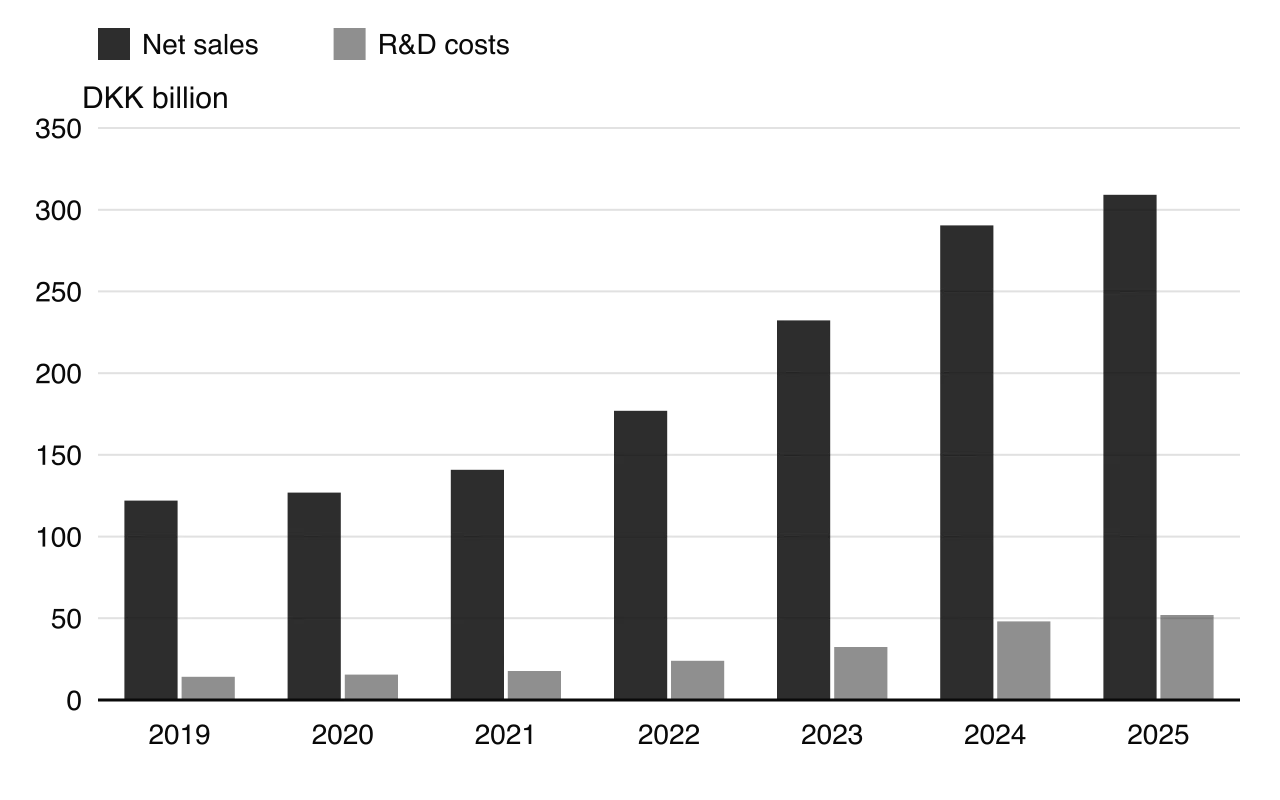
The chart shows the result. Net sales rose from DKK 122.0 billion in 2019 to DKK 309.1 billion in 2025, and R&D costs from DKK 14.2 billion to DKK 52.0 billion. In 2025, Ozempic earned DKK 127.1 billion, Wegovy DKK 79.1 billion and Rybelsus, a tablet form of semaglutide, DKK 22.1 billion. Together these three products made up about 74% of the company’s sales. Demand grew so fast that the FDA declared a shortage of Ozempic and Wegovy in August 2022, and by 2024 the company was running production around the clock to meet it.
Measure (DKK million) | 2019 | 2025 |
|---|---|---|
Net sales | 122,021 | 309,064 |
R&D costs | 14,220 | 52,039 |
R&D intensity | 11.65% | 16.84% |
Sales of Ozempic, Wegovy and Rybelsus (semaglutide) | Not comparable (Wegovy launched in 2021) | 228,288 (73.9% of net sales) |
Sources: Novo Nordisk A/S, Form 20-F 2025 and 2021 (SEC filings); R&D intensity and shares calculated from these figures.
Patents and the end of exclusivity
Semaglutide’s value depends heavily on patents. Novo Nordisk states that the compound patent for its semaglutide products expires in the United States in 2032, and in December 2025 China’s Supreme People’s Court upheld its Chinese semaglutide patent after a challenge. In other markets protection is ending. The core patents expired in India and Brazil in March 2026, the Canadian patent had already lapsed through an unpaid fee, and several Indian manufacturers, including Sun Pharmaceutical, Dr. Reddy’s and Zydus Lifesciences, prepared lower-priced generic versions. In the United States, generic manufacturers have challenged Novo Nordisk’s patents, and the company has settled several of these cases on confidential terms.
Competition also comes from new innovation. Novo Nordisk’s filings name Eli Lilly as its main competitor in this market; Eli Lilly’s revenue grew by 44.7% in 2025, to US$65.2 billion. In 2025 Novo Nordisk began a company-wide transformation in which about 9,000 employees were let go, to cut costs and move resources towards its growth areas of obesity and diabetes.
 YouTube
What the case shows
The case shows why R&D is so important in pharmaceuticals. Decades of research produced a medicine that met an unmet need in diabetes and then a latent need in obesity treatment, and a patent gave Novo Nordisk years of strong pricing power. The R&D was a long-term investment: liraglutide was developed in 1998, but most of the rewards came after 2021. It also shows innovative and adaptive creativity together: the original idea of a GLP-1 medicine was innovative, while once-weekly dosing, a higher dose for weight loss and a tablet form were adaptations of it.
The case also shows the risks. Dependence on one molecule makes the company vulnerable when patents expire or a competitor launches a better product, which is why it raised R&D spending to 16.84% of sales to find new products. The limits of the evidence should be noted too. Sales figures are in Danish kroner, so exchange rates affect comparisons with Eli Lilly; part of the sales growth came from price and from supply catching up with demand, not only from R&D; and it is too early to know how much generic competition after 2026 will reduce sales.
Explain how Novo Nordisk’s R&D addressed both unmet and latent needs.
Analyse the importance of patents to Novo Nordisk, using the data on semaglutide sales and patent expiry.
To what extent does Novo Nordisk’s dependence on semaglutide show the risks of R&D?
Sources: Novo Nordisk A/S, Form 20-F 2024 and 2025; Eli Lilly and Company, Form 10-K 2025; Wikipedia, “Semaglutide” (for approval dates, shortages and patent history).
Exam practice
R&D questions appear in Paper 2 at HL, often with data on R&D spending, sales or patent expiry, and the ideas suit Paper 3, where social enterprises often meet unmet needs with new products or services. The statement on the importance of R&D is evaluative, so extended responses must weigh benefits against costs and risks and reach a judgment. The other statements (unmet needs, intellectual property, incremental and disruptive innovation) are tested with “explain”, “distinguish” or “analyse”.
The next questions refer to the following case.
Solara is a Spanish company that designs and sells portable solar panels for camping and outdoor use (hypothetical data). Last year its sales revenue was €48 million and it spent €3.6 million on R&D. Its best-selling product, a foldable panel, is protected by a patent that expires in two years. A Chinese competitor has started selling a similar panel at a lower price in markets where Solara has no patent.
Extended responses on R&D usually ask for a judgment about its importance in one business’s situation.
Summary
Research and development (R&D) is the systematic work a business does to discover new knowledge and turn it into new or improved products and processes.
An invention is a new idea or device; an innovation is a new idea brought successfully to market or into use.
R&D intensity (R&D spending ÷ sales revenue × 100) is highest in pharmaceuticals and technology and lowest in consumer goods.
R&D provides new products for the pipeline, competitive advantage, lower costs and growth, but it is costly, slow and uncertain, so its importance depends on the industry, finance, IP protection and objectives.
Products that meet unmet and latent needs face little competition at first; adaptive creativity improves existing products, while innovative creativity creates new ones.
Patents protect inventions (usually 20 years), copyright protects creative works (usually life plus 50 or 70 years) and trademarks protect brand identity (10 years, renewable); protection is territorial, costly to enforce and ends.
Incremental innovation improves existing products step by step; disruptive innovation starts with overlooked customers and improves until it displaces established firms.
Self-check
- To do:
I can define research and development, invention and innovation, and explain the difference between invention and innovation.
- To do:
I can calculate R&D intensity and explain why it differs between industries.
- To do:
I can evaluate the importance of R&D for a business, including its costs and risks and what its importance depends on.
- To do:
I can explain why products that meet unmet and latent needs are important, with a real example.
- To do:
I can distinguish between adaptive and innovative creativity.
- To do:
I can explain what patents, copyright and trademarks protect, how long they last and their limitations.
- To do:
I can distinguish between incremental and disruptive innovation and draw Christensen’s diagram.