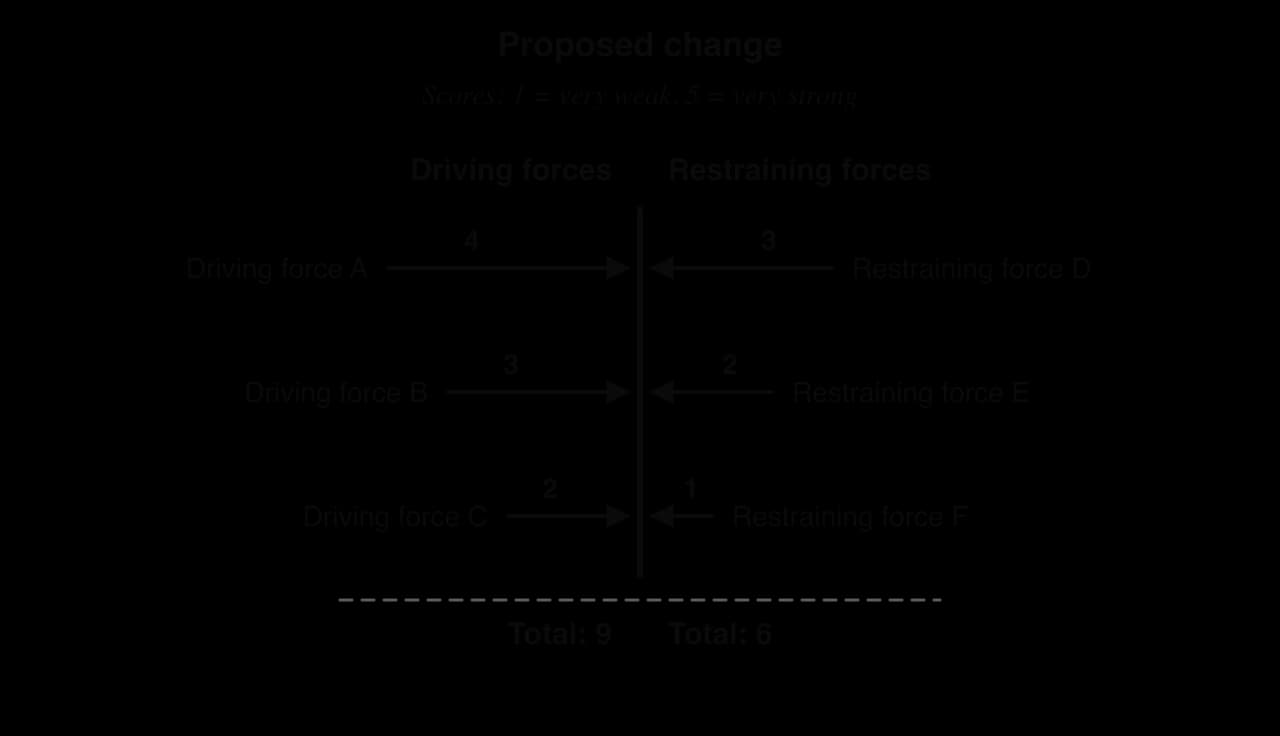
Construct a scored force field diagram for a proposed change, interpret the balance of driving and restraining forces, suggest strategies to make the change succeed, and explain the limits of the tool.
Each is in the Business glossary, with every other term in the subject.
The internal and external factors that push an organisation towards a proposed change, such as new technology, competition, customer demand, cost savings or support from employees.
A decision-making and change-management tool, developed by Kurt Lewin, that identifies and scores the forces supporting and opposing a proposed change, to judge whether it is likely to succeed and how to manage it.
In force field analysis, a situation that stays stable because the driving and restraining forces acting on it are equal in strength, but that changes as soon as either set of forces changes.
The internal and external factors that hold an organisation back from a proposed change, such as its cost, a lack of finance, employees' fear of job losses, existing culture or regulation.
With a free account, Augment remembers where you stopped and what you have practiced.
Define force field analysis, driving forces and restraining forces.
Explain Lewin’s idea that a situation stays stable while driving and restraining forces are in balance.
Construct a force field diagram for a proposed change, with each force scored for its strength.
Interpret the totals of a force field diagram and explain what they suggest about a proposed change.
Explain strategies to strengthen driving forces and weaken restraining forces.
Apply force field analysis to a real change, using evidence to judge the strength of each force.
Explain the limitations of force field analysis.
Every business decision to change something, such as introducing new technology, restructuring a department or entering a new market, meets forces that push the change forward and forces that hold it back. Force field analysis is a tool for listing these forces, judging how strong each one is and planning how to make a change succeed. It is used, for example, by managers deciding whether to move staff to a four-day working week, an idea tested by 61 British companies in 2022.
Force field analysis is a tool for managing change, one of the key concepts of the course. It also links to ethics, because the people affected by a change are often the main source of restraining forces, and the way managers weaken their resistance can be fair and open or manipulative. A force field analysis of a sustainability project, such as switching to renewable energy, shows the pressures for and against sustainability in a business.
Force field analysis was developed by Kurt Lewin (1890–1947), a German-born American psychologist who studied how groups and organisations behave and how they change. He developed the idea in the 1940s, and his papers on it were collected after his death in Field Theory in Social Science (1951). Lewin argued that the behaviour of a person or group at any moment is the result of all the forces acting on them at that time, which he called their field.
Applied to an organisation, the idea is that any situation, such as the current level of output, the current working hours or the current way of serving customers, is held in place by two sets of forces pushing against each other. Driving forces push towards change. Restraining forces resist it. When the two sets are equal, the situation stays where it is, in what Lewin called a quasi-stationary equilibrium. It is stable, but it can move as soon as the balance shifts.
A change happens only when the driving forces become stronger than the restraining forces. This can be achieved in two ways: by adding to or strengthening the driving forces, or by removing or weakening the restraining forces. Lewin argued that the second way is often more effective, because pushing harder on a change usually produces more resistance, while removing the reasons for resistance lets the situation move with less conflict.
Using the tool well therefore depends on identifying both kinds of force accurately and judging how strong each one is.
Driving forces are often visible and easy to list, because they are usually the reasons managers give for proposing a change. Restraining forces are harder to see, because people may not state their real concerns openly.
The diagram shows the standard layout. The proposed change is written at the top, with a central vertical line representing the current situation. Each driving force is an arrow pointing towards the line from the left, and each restraining force is an arrow pointing towards it from the right. The length of each arrow, and the number on it, shows the strength of the force. The totals at the bottom summarise the balance.
 YouTube
Forces can come from inside the business or from its external environment. A careful analysis looks at both, and at every group of stakeholders that the change affects.
Source | Possible driving forces | Possible restraining forces |
|---|---|---|
Internal: finance | Expected cost savings; higher profit; strong cash flow to fund the change | Cost of the change; lack of finance; poor liquidity |
Internal: people | Support from employees and managers; a leader who champions the change | Fear of job losses or more work; loss of status; lack of skills; existing organisational culture |
Internal: operations | Old equipment that needs replacing; low productivity | Disruption to production during the change; existing contracts and systems |
External: market | Competitors that have already changed; customer demand | Customers who prefer the current product or service |
External: STEEPLE | New technology; new regulation that requires the change; social trends | Laws that limit the change; trade unions; economic uncertainty |
Tools that the business already uses can help to find the forces. A STEEPLE analysis gives the external factors, and a SWOT analysis gives the strengths and weaknesses that affect whether the business can carry out the change. Stakeholder mapping shows which groups have the power and interest to support or block it.
Some forces are strong enough to stop a change on their own, such as a law that forbids it. External pressure can also be a strong restraining force without stopping a change. In 2023 the UK local government minister asked South Cambridgeshire District Council in England to end its four-day week trial immediately, arguing that it might breach local government law and offer poor value for money to local taxpayers. The council continued the trial, but the pressure from central government added a restraining force that its managers had to weigh.
A force field diagram is constructed in a fixed sequence of eight steps, which turn a list of pros and cons into a scored picture that can be used to make a decision and plan the change.
State the proposed change clearly at the top of the diagram (for example, “Introduce self-service ordering in all restaurants by June”). A clearly stated change makes the forces easier to identify.
Describe the current situation that the change will replace. The central line represents it.
Identify the driving forces and list them on the left. Involve the people affected, because they often know forces that managers do not see.
Identify the restraining forces and list them on the right.
Score each force for its strength, usually on a scale of 1 (very weak) to 5 (very strong). Use evidence where it exists: survey results, costs, sales data, the experience of other firms.
Draw the arrows with lengths in proportion to the scores, all pointing towards the central line, and write the score on each arrow.
Add up each side and compare the totals.
Decide and plan: judge whether to proceed, and which forces to strengthen or weaken to make the change succeed.
The totals give a first indication of whether a change is likely to succeed. If the driving forces are clearly stronger, the change can go ahead, although the restraining forces still need to be managed. If the restraining forces are stronger, the change is likely to fail unless the balance is shifted, so the business should either plan actions to shift it or decide not to proceed. If the totals are close, small changes in either set of forces will decide the outcome.
The totals should not be treated as an exact calculation. The scores are judgments, so a difference of one or two points may simply reflect the opinion of the person scoring. A single very strong restraining force, such as a law that forbids the change or a lack of any finance to pay for it, can block a change however many driving forces there are. Interpreting a force field diagram therefore means looking at the individual forces as well as the totals, and asking which of them can be changed.
The totals also change over time. A force field diagram is a snapshot of the situation when it is drawn; a competitor’s move, a new law or a change in the economy can strengthen or weaken forces within months. Managers who use the tool well return to it as the change progresses.
The real value of force field analysis is that it turns a decision into a plan. Once the forces are scored, managers can choose actions that shift the balance in favour of the change. There are three broad approaches:
Strengthen existing driving forces, for example by publishing evidence of cost savings, giving managers targets linked to the change, or showing customers the benefits.
Add new driving forces, for example by offering incentives to employees who support the change, or by finding a new benefit such as a lower environmental impact.
Weaken or remove restraining forces, for example by guaranteeing jobs, providing training, involving staff in planning the change, phasing it in, or finding cheaper ways to finance it.
Following Lewin, managers often focus on weakening restraining forces. Increasing pressure on employees who resist a change, for example by ordering them to accept it, may add a driving force on paper but increase their resistance in practice. Removing the cause of the resistance, for example by showing that nobody will lose their job, reduces the tension instead of adding to it.
Many of the actions that weaken restraining forces are the strategies for reducing resistance to change used in change management: education and communication, participation and involvement, facilitation and support, negotiation and agreement and, at the extreme, manipulation and co-optation or coercion. Force field analysis shows where each strategy is needed.
Restraining force | Strategy to weaken it | Possible drawback |
|---|---|---|
Employees fear job losses | Guarantee jobs or redeploy staff; explain the reasons for the change (education and communication) | A job guarantee reduces the cost savings |
Employees lack the skills | Training and support (facilitation and support) | Training costs money and time |
Employees were not consulted | Involve them in designing the change (participation and involvement) | Slower decisions; staff may reject the change |
Cost of the change | Lease instead of buying; phase the change in; seek grants | Higher total cost over time |
Customers prefer the old way | Keep the old option alongside the new one for a time; explain the benefits | Fewer savings while both run |
A trade union opposes the change | Negotiate a package, such as pay or hours, in return for agreement (negotiation and agreement) | Concessions add to costs |
The best strategy depends on how much time the business has, the power of the people resisting, the cost of each action and the leadership style and culture of the organisation. Coercion may work quickly in a crisis, although it damages trust. Participation takes longer and usually produces a change that lasts.
Force field analysis can be applied to almost any proposed change. It is especially useful where people’s attitudes matter as much as the numbers.
Human resource management: introducing flexible working, teleworking or a new pay system; restructuring or delayering; a change of organisational culture.
Operations: introducing new technology or automation, moving to lean production, relocating production or adopting a circular business model.
Marketing: entering a new market, changing the brand or moving sales online.
Finance: a major investment, where the force field adds qualitative factors to the results of investment appraisal.
Social enterprises: planning a change in a social enterprise, such as scaling up or changing its source of funding, where the views of members, volunteers and donors carry great weight.
The tool works well together with others. A decision tree can compare the expected financial results of options, while force field analysis shows whether the people involved will make the chosen option work. STEEPLE and SWOT help to identify the forces, and force field analysis then scores them and turns them into a plan.
Advantages | Limitations |
|---|---|
Simple to understand and quick to draw, so it can be used in meetings with the people affected. | Scores are subjective: two managers can score the same force very differently, and the totals depend on who does the scoring. |
Makes managers consider forces against a change, not only the benefits, and identify resistance early. | Forces are not truly additive or independent: one force can affect another, and a single very strong force can outweigh all the others. |
Turns a decision into a plan, by showing which forces to strengthen or weaken. | The list of forces may be incomplete, especially if only senior managers take part. |
Involving staff in the analysis is itself a way of reducing resistance. | It is a snapshot: forces change over time and the diagram soon becomes out of date. |
Works with qualitative factors (attitudes, culture, ethics) that numerical tools miss. | It does not measure costs, revenues or risks in money terms, so it should be combined with quantitative tools. |
Force field analysis is most useful when the forces are based on evidence, the people affected help to identify and score them, and the result is used to plan actions rather than to produce a single number. It is least reliable when one person scores the forces to support a decision that has already been made. For that reason, a force field analysis should always state who carried it out and on what evidence the scores are based.
A four-day working week with no loss of pay is one of the most discussed changes to working practices of recent years. Between June and December 2022, 61 companies in the United Kingdom, with about 2,900 employees, took part in a six-month trial of a four-day week. The trial was organised by the not-for-profit groups 4 Day Week Global and the 4 Day Week Campaign with Autonomy, a research organisation, and evaluated by researchers from the University of Cambridge, Boston College and other universities. The results were published in February 2023.
The companies came from many sectors. The largest groups were marketing and advertising (eight firms), professional services (seven) and charities and non-profits, with others in healthcare, retail, construction and manufacturing. Each company designed its own model, as long as pay stayed at 100% and working time was meaningfully reduced: some gave everyone Friday off, others staggered days off between teams, and some made the day off conditional on meeting targets.
Of the 61 companies, 56 (92%) continued with the four-day week after the trial and 18 said the change was permanent. Of the five that did not continue, two extended their trials and three paused the policy. Among the companies that supplied data, revenue rose by 1.4% on average over the trial period, and was about 35% higher than in a comparable period in previous years. Employees reported less stress and burnout: 39% said they were less stressed and 71% reported lower levels of burnout by the end.
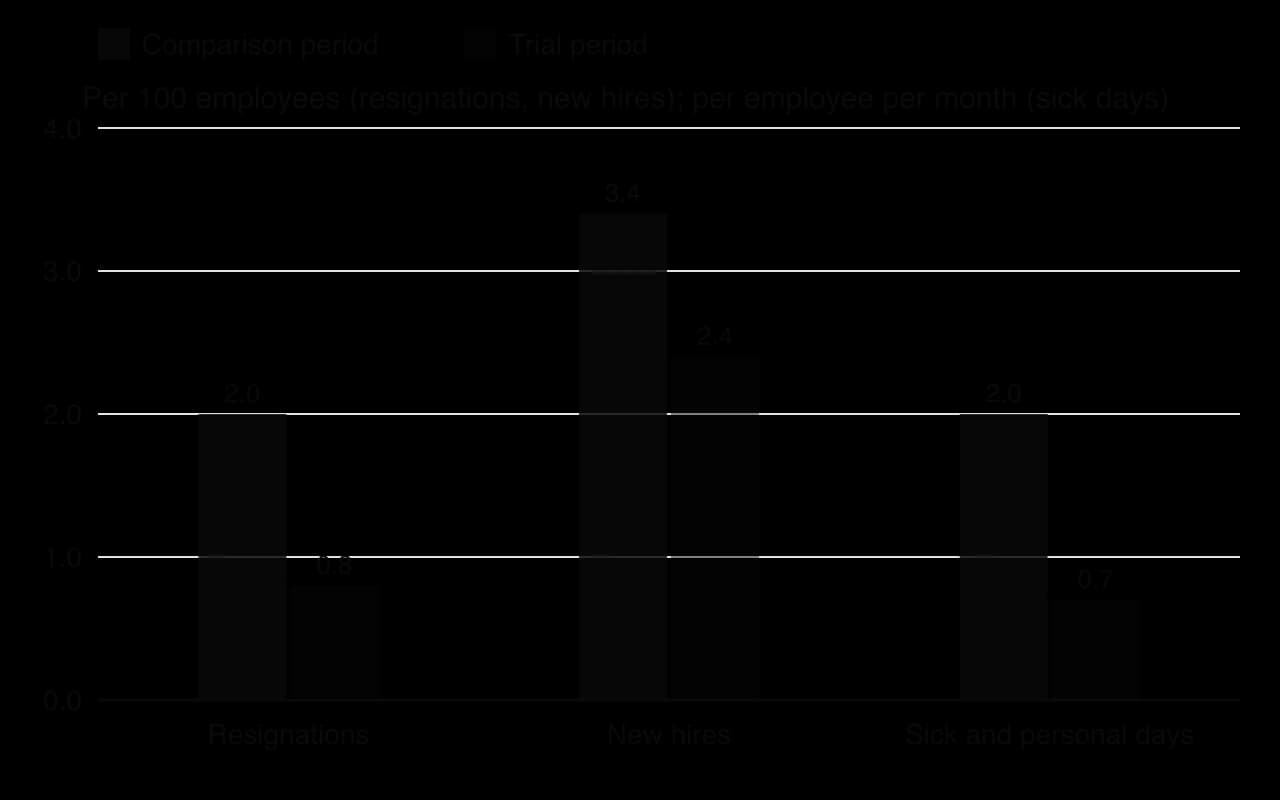
The chart shows changes that matter to employers. Resignations fell from about 2 to 0.8 per 100 employees, which the researchers reported as a fall of 57%, and sick and personal days fell from 2.0 to 0.7 per employee per month, a fall of 65%. New hires fell from 3.4 to 2.4 per 100 employees, which is consistent with fewer people leaving. A follow-up report in February 2024 found that at least 54 of the 61 companies still had a four-day week and at least 31 had made it permanent.
The results of the pilot can be used to score the forces for and against a four-day week in a typical participating company. The scores are judgments, based on the evidence of the pilot.
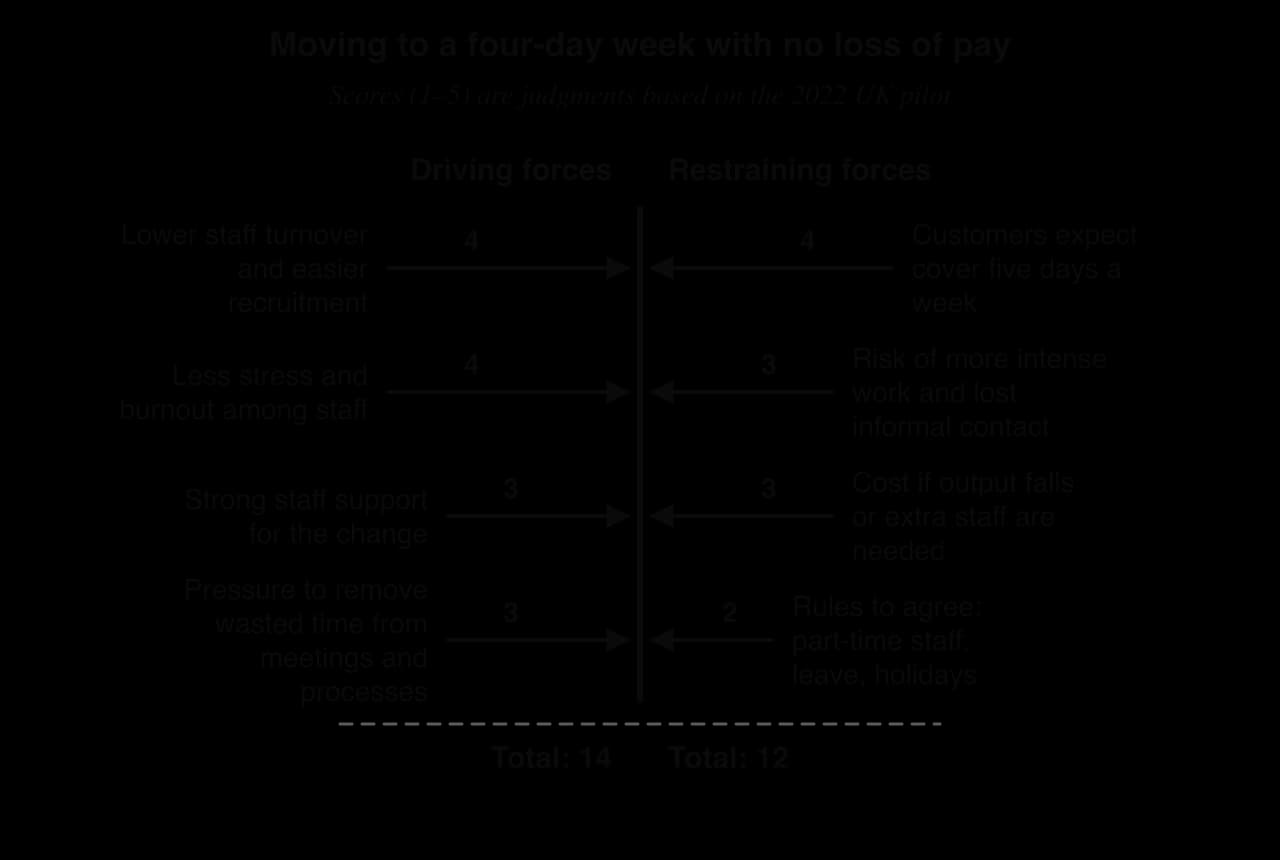
Driving forces. The fall in resignations makes lower staff turnover and easier recruitment one of the two strongest driving forces (4). Lower stress and burnout (4) reduce sickness absence. Strong staff support for the change (3) makes it easier to introduce: 90% of employees said they wanted to continue, and 15% of those who preferred a four-day week said no amount of money would make them accept a five-day week again. The need to fit five days of work into four put pressure on managers to remove wasted time (3): companies shortened meetings, changed email habits, introduced uninterrupted “focus” periods and automated routine tasks.
Restraining forces. Customers who expect service five days a week are a strong restraining force (4), which is why many companies staggered days off between staff. Some employees reported that their work had become more intense or that there was less informal contact with colleagues, which concerned creative firms in particular (3). If output falls or extra staff must be hired, the change raises costs (3); the researchers found that companies tried to keep 100% of output without recruiting, and only a few cut clients or projects. Finally, firms had to agree new rules for part-time staff, holidays and annual leave (2).
The pilot shows the strategies of force field analysis in practice. Companies had two months of preparation with workshops, coaching and mentoring, and most of what they did either weakened a restraining force or strengthened a driving force. A housing association with about 250 employees, for example, let each department design its own four-day week so that office, community and trades teams could all take part.
Force | Action taken by pilot companies | Strategy |
|---|---|---|
Customers expect cover five days a week (restraining) | Staggered days off between staff so the business stayed open; told clients about the change in advance | Weaken a restraining force |
Fear of more intense work (restraining) | Consulted staff on the model; let departments design their own rotas | Participation and involvement |
Risk of lower output (restraining) | Asked staff to sign productivity agreements; departments submitted plans for the change | Negotiation and agreement |
Pressure to remove wasted time (driving) | Shorter, less frequent meetings; new email habits; focus periods; automation of routine tasks | Strengthen a driving force |
The case supports Lewin’s argument that change happens when restraining forces are weakened. The companies that prepared carefully and involved their staff found that the restraining forces were smaller than expected, while the driving forces of retention and well-being grew stronger as the trial went on. The force field also explains why a few companies paused: where customer cover or workloads could not be managed, the restraining forces stayed strong.
The evidence has limits. The companies volunteered to take part, so they were likely to be more positive about a four-day week than an average firm, and most were small office-based businesses. Many companies did not supply full data, the researchers say the trends in resignations and sickness are not statistically significant, and the trial was organised by groups that campaign for shorter working weeks. A force field analysis of a factory or hospital, where output depends directly on hours worked, would score the restraining forces much higher.
Sources: Autonomy, The Results Are In: The UK’s Four-Day Week Pilot, February 2023; Autonomy, Making It Stick, 21 February 2024.
Explain why customers’ need for service five days a week is a strong restraining force, and suggest how a company could weaken it.
Analyse whether the scores in the force field diagram would be different for a manufacturing company that runs a production line.
Explain why the self-selection of companies limits the usefulness of the pilot results for a force field analysis.
Force field analysis is an HL tool, so it appears in Paper 2 and Paper 3, not in Paper 1. Questions may ask you to construct a force field diagram from a case, to explain the forces for and against a change, or to use the tool as part of an extended answer or a plan of action.
Structured questions often combine construction with explanation, as in the following example.
Extended-response questions ask you to use the tool to support a judgment, with the force field giving the structure of the argument and the case evidence justifying each score.
In Paper 3, force field analysis is one of the tools that suits a social enterprise planning a change, because the views of volunteers, members and funders often decide whether a plan succeeds.
Force field analysis, developed by Kurt Lewin, identifies and scores the forces for and against a proposed change.
Driving forces push towards a change; restraining forces resist it; a situation stays stable while they balance.
A force field diagram shows the change on a central line, with scored arrows for each force and a total for each side.
A change succeeds when driving forces exceed restraining forces, which can be achieved by strengthening drivers or, often more effectively, weakening restrainers.
Strategies for reducing resistance to change (communication, participation, facilitation, negotiation) are the main ways to weaken restraining forces.
The tool is simple and turns a decision into a plan, but the scores are subjective, forces are not truly additive and the diagram is only a snapshot.
I can define force field analysis, driving forces and restraining forces.
I can explain Lewin’s idea that a situation stays stable while the forces are in balance.
I can construct a force field diagram from a case, with a justified score for each force and totals.
I can interpret the totals and explain why they are not an exact calculation.
I can explain strategies to strengthen driving forces and weaken restraining forces.
I can apply force field analysis to a real change such as the UK four-day week pilot.
I can explain the advantages and limitations of force field analysis.
21 exam-style questions on this subtopic, written in the style of the IB papers. The first has its markscheme open. Counted on
Arquitectura Quimbaya is an architecture practice in Bogotá, Colombia, with 46 employees. The managing partner, Camila Restrepo, proposes a four-day working week (32 hours, same pay). She asked the five partners to list the forces for and against the change and to score each from 1 (weak) to 5 (strong).
Table 1: Forces affecting the proposed four-day week, with scores
Force | Score |
|---|---|
Partners fear that output per architect will fall | 4 |
Better staff wellbeing and lower labour turnover | 4 |
Clients expect contact with their architect five days a week | 4 |
Easier to attract experienced architects from rival practices | 3 |
Tight deadlines on current projects | 3 |
A rival practice in Medellín reported a successful trial | 2 |
Lower office energy and running costs | 2 |
Cost of new project scheduling software | 1 |
Using Table 1, construct a fully labelled force field analysis for the proposed four-day week.
4 marks
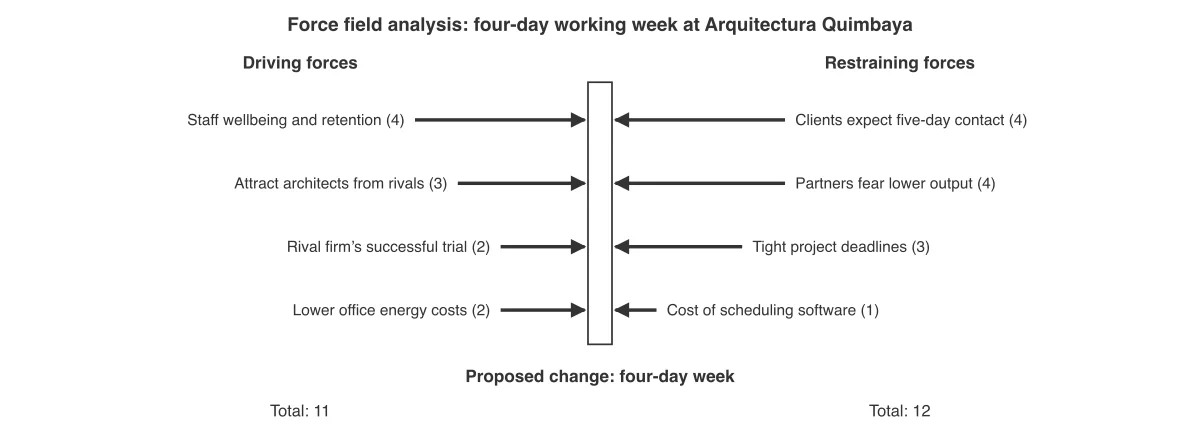
Driving forces (score) | Restraining forces (score) |
|---|---|
Staff wellbeing and lower labour turnover (4) | Clients expect five-day contact (4) |
Attract architects from rivals (3) | Partners fear lower output (4) |
Rival practice’s successful trial (2) | Tight project deadlines (3) |
Lower office running costs (2) | Cost of scheduling software (1) |
Total 11 | Total 12 |
Award [1] for the proposed change shown in the centre, [1] for correctly classifying all driving forces, [1] for correctly classifying all restraining forces, and [1] for showing the scores (arrow length or labels) and correct totals (11 and 12).
Deduct [1] for each misclassified force, up to the [1] available for that side.
Using your answer to (a), comment on whether Arquitectura Quimbaya should introduce the four-day week.
2 marks
Restraining forces (12) slightly exceed driving forces (11), so on these scores the change is not yet justified or would meet strong resistance.
However, the difference is small and the scores are subjective (set by partners who are themselves a restraining force); Camila could weaken restraining forces, e.g. arranging cover so clients have contact five days a week, or running a trial to test whether output falls.
Award [1] for a valid conclusion drawn from the totals and [1] for a further relevant comment (e.g. the narrow margin, subjectivity of scores, ways to weaken restraining forces). Accept OFR from (a).
Waikato Valley Dairy (WVD) processes milk into milk powder for export, in a rural town in New Zealand. It runs its plant 16 hours a day. Demand from Asian markets is rising, so the managers are considering moving to 24-hour production with 12-hour rotating shifts. They scored the forces for and against the change from 1 (weak) to 5 (strong).
Table 1: Force field analysis of 24-hour production at WVD
Driving forces | Score | Restraining forces | Score |
|---|---|---|---|
Rising export demand from Asia | 5 | Staff opposition to night shifts | 5 |
Lower unit costs from fuller use of equipment | 4 | Union agreement limits shift length | 3 |
A competitor already runs 24 hours | 2 | Difficulty recruiting in a rural area | 3 |
Higher maintenance costs | 2 |
Using Table 1, calculate the total score of the driving forces and of the restraining forces (no working required).
2 marks
Comment on your answer to (a).
2 marks
Hotel Ribeira Alta
[1] Hotel Ribeira Alta (HRA) is a privately held, four-star, 160-room hotel overlooking the river in Porto, Portugal. Its online reviews often praise the warm welcome from front-desk staff, many of whom have worked at the hotel for more than ten years.
[2] Operations manager Inês Carvalho proposes installing self-check-in kiosks in the lobby and offering mobile room keys through the hotel’s app. The number of front-desk staff would fall from 18 to 10, with the other 8 offered jobs in housekeeping or the restaurant. The system would cost €260 000 and save about €190 000 a year in labour costs.
[3] Inês has listed the forces for and against the change and given each a weighting from 1 (weak) to 5 (strong) after discussions with the senior management team (Table 1).
Table 1: Forces affecting the introduction of self-check-in kiosks and mobile keys
Force | Type | Weighting |
|---|---|---|
Labour cost savings of €190 000 a year | Driving | 4 |
Guests want faster check-in (a common complaint in reviews) | Driving | 4 |
Competitors already offer mobile check-in | Driving | 3 |
Shortage of front-desk staff in Porto | Driving | 3 |
Front-desk staff fear job losses | Restraining | 4 |
Capital cost of €260 000 | Restraining | 3 |
Older guests prefer a personal welcome | Restraining | 2 |
Risk of IT failure and cyberattacks |
The official deck for this part of the syllabus.
Define force field analysis.
Define driving forces.
Explain two ways in which WVD’s managers could weaken the restraining forces.
4 marks
Restraining |
2 |
HRA’s brand is built on personal service | Restraining | 2 |
Using Table 1, construct a fully labelled force field analysis for the proposed change.
4 marks
Calculate the payback period of the kiosks and mobile key system (show all your working).
2 marks
Explain two ways HRA’s management could reduce the restraining forces.
4 marks
Using your force field analysis and the information in the case, discuss whether HRA should introduce the self-check-in kiosks and mobile keys.
10 marks