T.8 Circular business models
Distinguish the linear and circular economy, explain the five circular business models with real examples, and evaluate their benefits and challenges for a business and its stakeholders.
- IB Business Management
- Part of T Business management toolkit
- SL and HL
Key terms introduced here
Each is in the Business glossary, with every other term in the subject.
- Circular business model
A way of creating value and earning revenue that keeps products, components and materials in use for longer and recovers their value, reducing the use of new resources and the creation of waste.
- Circular economy
An economic system in which products, components and materials are kept in use for as long as possible and at their highest value, through reuse, repair, remanufacturing and recycling, so that waste is designed out.
- Circular supply model
A circular business model in which a business replaces new, finite raw materials with renewable, bio-based or recovered materials as the inputs to its products.
- Linear economy
An economic system in which raw materials are extracted, made into products, used and then thrown away as waste, so that the value of the materials is lost at the end of each product's life.
- Planned obsolescence
The practice of designing products to wear out, break or become out of date after a limited time, so that customers need to buy replacements sooner.
- Product life extension
A circular business model in which a business extends the working life of its products through durable design, repair, maintenance, upgrading, refurbishment or resale.
- Product service system
A circular business model in which a business sells the use or result of a product as a service, such as leasing, renting or paying per use, while keeping ownership of the product and responsibility for its maintenance and recovery.
- Resource recovery
A circular business model in which a business recovers useful materials, components or energy from waste, by-products or used products and uses them to make new products.
- Sharing model
A circular business model, usually run through an online platform, that allows several users to share access to products or assets, so that each is used more intensively and fewer are needed.
Notes on T.8 Circular business models
Learning objectives
Define the linear economy, the circular economy and a circular business model.
Distinguish between a linear and a circular economy, using a diagram.
Explain the five circular business models: circular supply, resource recovery, product life extension, sharing and product service systems.
Apply the five models to a real or given organisation and suggest which ones suit it.
Calculate and compare the total cost to a customer of buying a product and of using it as a service.
Explain the advantages and challenges of circular business models for a business and its stakeholders.
Explain how circular business models support sustainability and the triple bottom line.
Explain how cradle to cradle design supports a circular business model (HL).
Introduction
Most products are made from new raw materials, used for a time and then thrown away. A circular business model is a way of running a business so that products and materials stay in use for as long as possible and their value is recovered at the end of their life. Signify, the Dutch lighting company formerly called Philips Lighting, earned 37% of its sales in 2025 from products and services designed in this way.
Circular business models are closely linked to the key concepts. They are a direct response to the demand for sustainability, they need creativity in product design and in how a business earns its revenue, and they are a source of change in operations, marketing and finance. They also raise questions of ethics when a business claims to be circular but makes little real difference to its use of resources.
From a linear to a circular economy
In a linear system, businesses extract raw materials, make them into products and sell them; customers use the products and then throw them away. This pattern is often summarised as take, make, dispose (or take, make, waste), and an economy that works in this way is a linear economy. Most industrial economies have worked like this for the last two centuries.
The linear economy has given many people access to cheap goods, but it has three serious weaknesses. It depends on a constant supply of new raw materials, some of which are scarce or found in only a few countries. It produces large amounts of waste that must be buried or burned. And every new product needs energy and materials, so emissions rise with output. For a business, the linear model also means that the value built into a product, such as the energy and labour used to make it, is thrown away when the customer has finished with it.
A circular economy is designed to keep products, components and materials in use at their highest value for as long as possible. Products are designed to last, to be repaired and to be taken apart. When a product can no longer be used, its parts and materials are recovered and become the inputs for new products. The Ellen MacArthur Foundation, a charity that promotes the idea, describes a circular economy as a system in which materials never become waste and nature is regenerated, and it bases the idea on three principles: eliminate waste and pollution, circulate products and materials at their highest value, and regenerate nature.
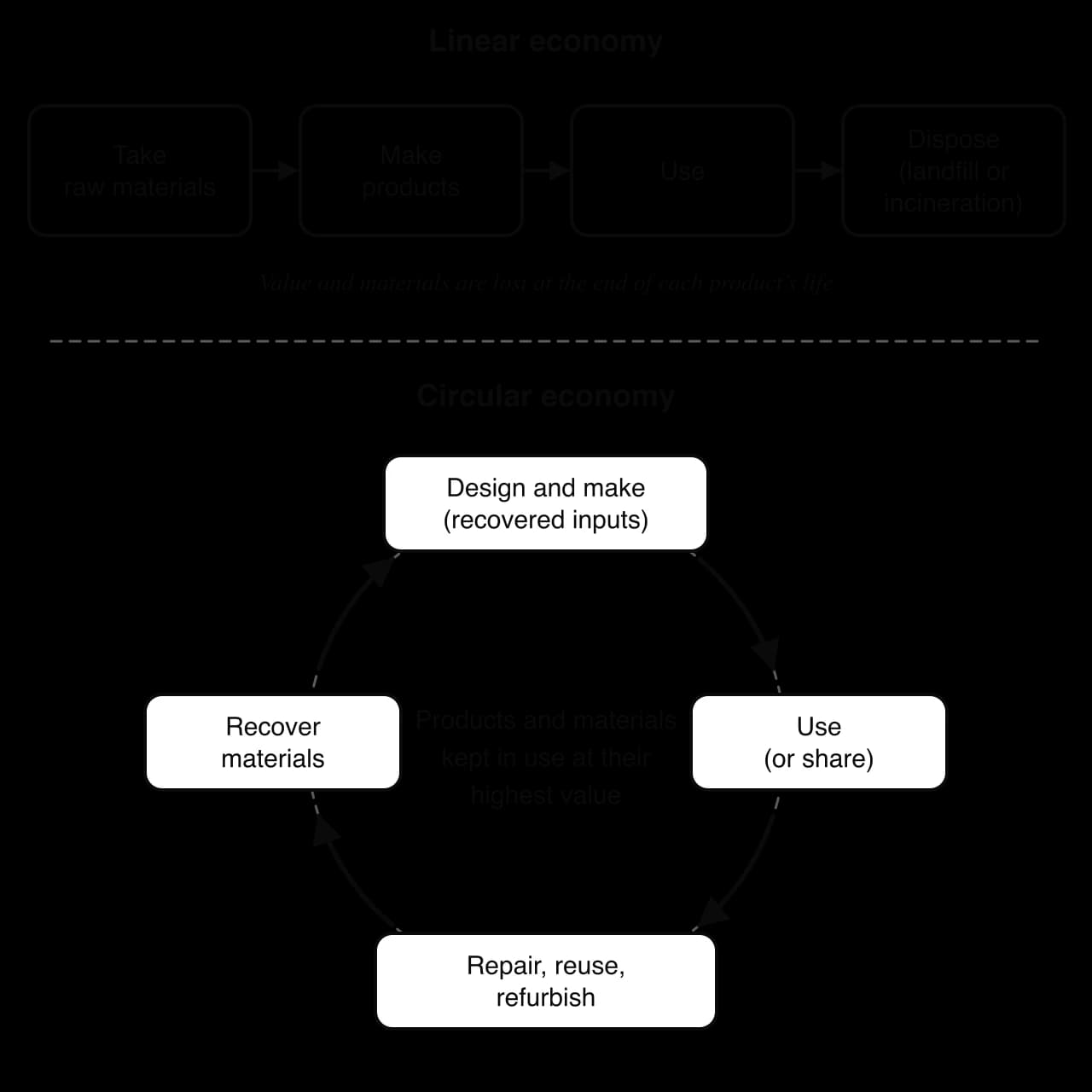
The diagram shows the key difference between the two systems. In the linear economy every arrow points forward and the process ends in landfill or incineration. In the circular economy the arrows form a loop: products return to use through repair and reuse, and materials return to production through recovery. The inner loops (repair and reuse) keep more value than the outer loop (recycling), because a repaired product keeps the work that went into making it, while recycling keeps only the material.
 YouTube
Why the circular economy matters for business
The circular economy is still small. Eurostat, the statistical office of the European Union, measures the circular material use rate: the share of all materials used in an economy that come from recycled waste. In 2024 the rate for the EU as a whole was 12.2%, so almost nine-tenths of the materials used were new.
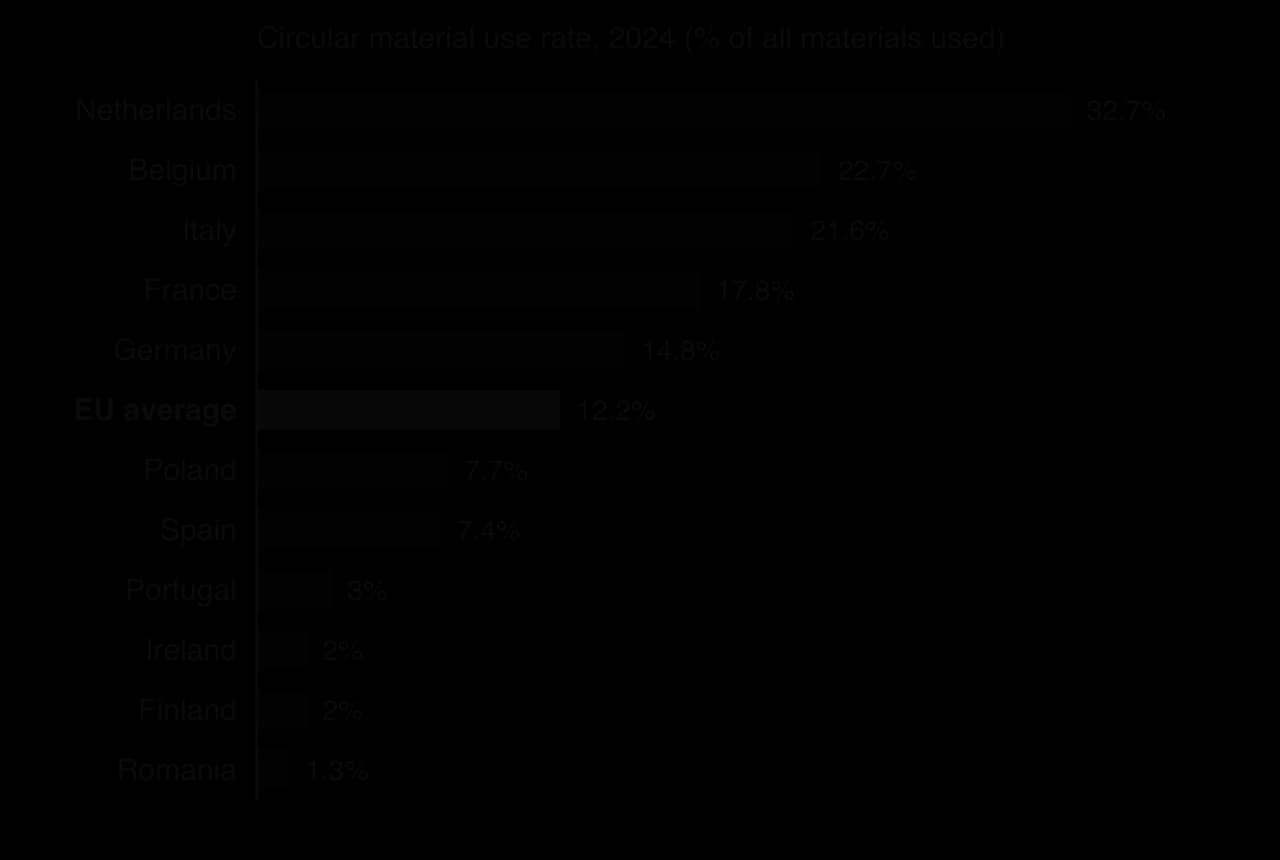
The chart shows large differences between countries. Countries with dense populations, strong waste collection systems and recycling industries, such as the Netherlands, Belgium and Italy, have high rates. Countries whose economies depend on extracting and processing new materials, such as Finland with its mining and forestry, have low rates even when they recycle well, because the denominator (all materials used) is so large. The figures measure only recycling, so they miss reuse, repair and sharing.
Several pressures are pushing businesses towards circular models:
Cost and supply of raw materials: price rises and shortages of metals, minerals and energy make recovered materials more attractive and reduce dependence on a few supplier countries.
Regulation: governments increasingly make producers responsible for collecting and recycling their products, ban some single-use items and set rules on repairability.
Customers and investors: many consumers, business customers and investors now prefer firms with credible environmental records, and some large buyers set circularity requirements in their contracts.
New technology: sensors, online platforms and 3D printing make it easier to track products, share them and make spare parts.
These pressures can be analysed with a STEEPLE analysis: most of them are economic, environmental, legal, social and technological factors in the external environment of the business.
What a circular business model is
A business model describes how an organisation creates value for its customers and earns revenue from doing so. In a linear business model the business earns revenue mainly by selling as many new products as possible; once a product is sold, the business has no further interest in it. A circular business model changes this logic. The business earns revenue in a way that rewards it for keeping products and materials in use, for example by charging for a service instead of selling the product, by selling repairs, or by turning waste into a new product.
The Organisation for Economic Co-operation and Development (OECD) groups circular business models into five types. Each acts at a different stage in a product’s life: the inputs the business uses, the way the product is used, or what happens at the end of its life.
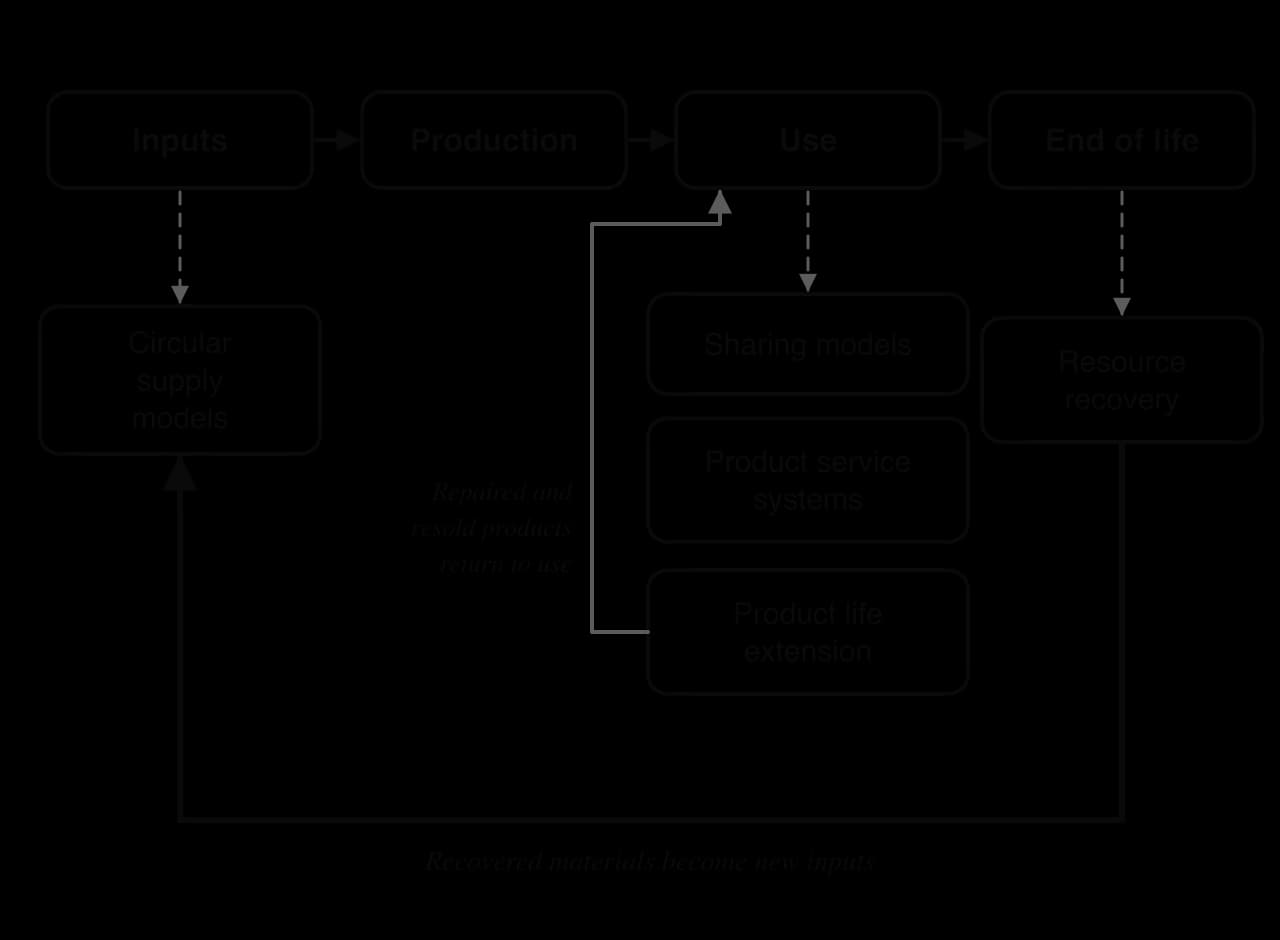
The diagram shows that the five models complement each other. A single business can use several at once: a clothing firm might use recycled fibres (circular supply), repair and resell used garments (product life extension) and turn worn-out garments into new fibre (resource recovery).
Model | Stage of the product’s life | How it keeps value | Example |
|---|---|---|---|
Circular supply | Inputs | Replaces new, finite raw materials with renewable, bio-based or recovered ones | Notpla’s seaweed-based packaging (UK) |
Resource recovery | End of life | Turns waste and by-products into raw materials or new products | Toast Ale, brewed with surplus bread (UK) |
Product life extension | Use | Makes products last longer through durability, repair, reuse and resale | Fairphone’s modular phones (Netherlands); Patagonia Worn Wear (USA) |
Sharing | Use | Lets several users share products that would otherwise sit idle | BlaBlaCar ride sharing (France) |
Product service system | Use | Sells the use or result of a product while the producer keeps ownership | Signify’s light as a service (Netherlands); Rolls-Royce Power by the Hour (UK) |
Circular supply models
A circular supply model replaces new, finite raw materials with materials that are renewable, bio-based (made from plants or other living sources), or recovered from earlier use. The business changes what goes into its products so that they cause less harm when they are made and can return safely to nature or to production at the end of their life.
Notpla, a London start-up, makes packaging from seaweed and plants as an alternative to single-use plastic. Its products include food containers coated with a seaweed-based material that can be composted at home, edible pouches for liquids and paper made from seaweed. Notpla was one of the winners of the Earthshot Prize, an international environmental award. Its business model depends on a renewable input instead of plastic made from oil.
Circular supply models are attractive where new raw materials are costly, scarce or harmful. They protect a business against price rises and supply shortages, and they can differentiate the product with customers who care about the environment. The difficulties are that renewable and recovered inputs may cost more than established materials, may not yet be available in large and consistent quantities, and may perform differently, which can force the business to redesign its products and processes.
Resource recovery models
A resource recovery model recovers materials or energy from waste or by-products and uses them to make new products. Instead of paying to dispose of waste, the business treats it as a raw material. Resource recovery includes recycling, but also the use of one firm’s by-products as another firm’s inputs, and the recovery of valuable components from used products.
Toast Ale, a brewery founded in the United Kingdom in 2016 by the food-waste campaigner Tristram Stuart, brews beer using unsold bread from bakeries and caterers that would otherwise be thrown away. In the Kalundborg Symbiosis in Denmark, a power station, a refinery, a pharmaceutical plant and other firms exchange by-products such as steam, surplus heat, water and gypsum, so that one firm’s waste becomes another firm’s input. Signify, the lighting company, aims to harvest spare parts from luminaires at the end of their life for use in other products.
Resource recovery can reduce both the cost of raw materials and the cost of waste disposal. It can also create a new revenue stream from materials that had no value before. Its limits are practical. Used products must be collected, sorted and cleaned, which needs logistics and costs money; mixed or contaminated materials are hard to separate; and recycled materials are often of lower quality than new ones. When the price of new materials falls, recovered materials can become uncompetitive.
Resource recovery sits at the end of the loop, so it keeps the least value. A product that is melted down loses the energy, labour and design that went into it. This is why circular thinking puts reuse and repair ahead of recycling, and recycling ahead of disposal.
Product life extension models
A product life extension model makes products last longer, so that fewer new products are needed. A business can design products to be durable and easy to repair, offer repair and upgrade services, take products back and resell them, or remanufacture them so that they work like new. Revenue comes from the repairs, spare parts, upgrades and second-hand sales, as well as from the original sale.
Fairphone, a Dutch social enterprise founded in Amsterdam in 2013, designs smartphones with modular parts that users can replace themselves. The repair website iFixit gave most of its phones a repairability score of 10 out of 10, and the company sells spare parts and offers long software support. Fairphone sold 103,053 phones in 2024 and 145,259 in 2025, a very small number beside the large phone makers, which shows both the appeal and the limits of the model.
Patagonia, the American outdoor clothing company, launched a trade-in programme under its Worn Wear name in 2017, through which customers return used Patagonia clothing so that it can be resold to new owners. In 2019 it added ReCrafted, a range that makes new garments from the fabric of used ones. Both programmes extend the life of garments and give Patagonia revenue from the same item more than once.
Product life extension is the opposite of planned obsolescence, the practice of designing products to wear out, break or go out of date quickly so that customers buy replacements. Planned obsolescence supports sales in a linear model but raises ethical questions and creates waste. A business that moves to product life extension accepts that customers will replace products less often, so it must earn more from each product through a higher price, services or resale.
Sharing models
Many products are used for only a small part of their life. A car is parked most of the day; a power drill may be used for a few minutes a year. A sharing model increases the use of such products by allowing several people to share them, usually through an online platform that matches owners with users. Fewer products are needed to meet the same demand, so fewer resources are used to make them.
BlaBlaCar, founded in Paris in 2006, is a ride-sharing platform that connects drivers who have empty seats on long journeys with passengers travelling the same way, who share the cost of the trip. It reported 100 million members in 2022 and operates in more than twenty countries. The platform does not own any cars; in 2012 it introduced online booking and payment, which became the basis of its business model. Other sharing models include tool libraries, car clubs, coworking spaces and platforms for renting clothes for one occasion.
Sharing models can grow quickly and cheaply because the platform does not need to own the assets. Their value to the environment depends on how they change behaviour. If shared cars replace private cars, fewer cars are made; if cheap shared rides attract people who would otherwise have taken a train, emissions may rise. This is known as a rebound effect: an efficiency gain lowers the cost of using a product and so increases its use, which offsets part of the saving. Sharing models also face trust and safety problems between strangers and, in some cases, regulation of the platform economy.
Product service systems
In a product service system the customer pays for the use of a product, or for the result it delivers, instead of buying the product. The producer keeps ownership and is responsible for maintaining, repairing and eventually recovering the product. Because the producer earns more when the product lasts longer and uses fewer resources, the model gives it a financial reason to design durable, efficient and repairable products, which is the opposite of the incentive in a linear model.
Product service systems take three main forms:
Product-oriented services: the customer buys the product, and the business sells maintenance, repair or take-back services with it, such as a maintenance contract for a machine. Ownership passes to the customer, so this is the weakest form; in the other two the producer keeps ownership.
Use-oriented services: the customer pays to use a product that the business owns, through leasing, renting or a subscription.
Result-oriented services: the customer pays for an agreed result, such as a level of light in a building, a number of flying hours or a clean set of uniforms, and the business decides how to deliver it.
Rolls-Royce, the British aircraft engine maker, offers airlines a service called Power by the Hour, under which an airline pays a fixed amount for each hour an engine flies, and Rolls-Royce is responsible for maintaining it. The idea dates from 1962, when Bristol Siddeley, a British engine maker later bought by Rolls-Royce, first offered it, and Rolls-Royce revived it in the 1980s. The airline gets predictable costs and reliable engines; Rolls-Royce earns a steady revenue stream over many years and has every reason to keep its engines in service for as long as possible.
For the customer, a product service system changes a large one-off purchase (capital expenditure) into regular payments (revenue expenditure). This can protect liquidity and remove the risk of owning equipment that becomes out of date. Whether it is cheaper overall depends on the total cost of each option over the life of the product.
The calculation ignores the fact that money paid later is worth less than money paid now, and it assumes that energy prices and the service fee stay fixed. Both affect the real comparison, so the result is one input to the decision, alongside qualitative factors such as risk and liquidity.
Applying the five models to an organisation
Circular business models are a toolkit tool, so they are used to analyse a real or given organisation and to suggest changes. A useful method is to work through the stages of the product’s life, asking at each stage which model could reduce the use of new resources and how the business would earn revenue from it.
Map the product’s life: what the product is made from, how it is made, how customers use it, how long it lasts and what happens to it afterwards.
Find the losses: where materials are wasted, where products sit unused, where they break early or are thrown away while still useful.
Match a model to each loss: circular supply for harmful inputs, sharing or a product service system for products that are under-used, product life extension for products that break or go out of date, resource recovery for waste.
Check the business case: how the model would earn revenue, what it would cost, and whether customers would accept it.
Judge which model or combination fits best in light of the firm’s objectives, finance, customers and capabilities.
Advantages of circular business models
Circular business models can benefit the business, its customers and other stakeholders at the same time, which is why many firms present them as a source of competitive strength as well as a duty.
For the business | For customers and other stakeholders |
|---|---|
Lower spending on raw materials and waste disposal over time, and less exposure to price rises and shortages. | Customers can pay for use instead of buying, which lowers the cost of entry and the risk of owning products that become out of date. |
New and more stable revenue streams from services, repairs, spare parts, subscriptions and resale. | Products that last longer and can be repaired reduce the total cost of ownership. |
Closer, longer relationships with customers, who return for services and upgrades, which supports brand loyalty. | Less waste and pollution benefit local communities and the natural environment. |
Differentiation and a stronger brand with customers, employees and investors who value sustainability. | New jobs in repair, remanufacturing, collection and recycling, often local. |
Readiness for stricter regulation on waste, packaging, repairability and emissions. | Governments meet environmental targets and depend less on imported raw materials. |
The advantages build over the long term. Many of them, such as lower material costs and stable service revenue, appear only after the business has invested in new designs, collection systems and service capabilities.
Challenges of circular business models
Moving from a linear to a circular model is a large change for most businesses, and many attempts fail or stay small. The main challenges are financial, operational and cultural.
Finance and cash flow: in a product service system the business pays to make the product but receives the revenue in small amounts over many years. It needs more finance at the start and carries the products as assets, which can weaken its cash flow and liquidity.
Higher costs at first: durable, repairable products and recovered materials can cost more than standard ones, and collection, sorting and refurbishment need new logistics.
Customer behaviour: many customers prefer to own products, want the newest model or distrust second-hand and shared goods. Take-back schemes work only if customers return products.
Risk of lower sales of new products: longer product lives mean fewer replacements, which threatens revenue unless services make up the difference.
New skills and culture: the business must learn to repair, refurbish and manage long service contracts, which needs training and changes how people are managed and paid.
Measuring real impact: some claims of circularity are exaggerated. A business that markets a small circular product line while the rest of its activity stays linear risks accusations of greenwashing, which damage its reputation.
Some challenges lie outside the business. Recycling infrastructure is weak in many countries, waste rules differ between countries, and the price of new raw materials often does not reflect the environmental damage they cause, which makes recovered materials look expensive by comparison.
Evaluation: when circular business models succeed
Whether a circular business model suits an organisation depends on several factors:
The type of product: durable, high-value products that need maintenance (engines, lighting, machinery, furniture) suit product service systems and life extension; cheap, fast-changing products are harder to keep in use.
The customers: business customers often value predictable costs and service contracts; individual consumers may prefer ownership and low prices.
Finance: a firm with strong cash flow and access to long-term finance can fund products that earn revenue over many years; a small firm may not.
Objectives and culture: a business whose objectives include environmental targets, such as a social enterprise or a firm with a strong commitment to corporate social responsibility, will accept slower returns; one focused on short-term profit may not.
The external environment: raw material prices, regulation, recycling infrastructure and customer attitudes can all make circular models easier or harder.
In most cases the strongest strategy is a combination of models suited to the product, introduced in stages. A business might begin with a repair service or a take-back scheme, learn from it, and move later to a full product service system. A complete move to a circular model in one step carries high financial and operational risk.
Circular business models and sustainability
Circular business models are a practical way for a business to act on the triple bottom line: people, planet and profit. They aim to improve environmental sustainability by using fewer new resources and creating less waste, while also supporting economic sustainability through new revenue streams and lower costs, and social sustainability through local jobs and access to products people could not afford to buy.
Key concept | How it applies to circular business models |
|---|---|
Sustainability | The models reduce resource use and waste, and help a business meet the needs of today’s customers without damaging the resources future generations will need. |
Creativity | Circular models need new product designs (modular, repairable, compostable) and new ways of earning revenue (paying per use, selling results). |
Change | Moving from selling products to selling services changes a firm’s operations, finance, marketing and human resources, and often meets resistance to change. |
Ethics | A firm must report its circularity honestly; exaggerated claims mislead customers and investors. |
Circularity is not automatically sustainable. Shipping used products across the world for repair, or a rebound effect that increases total use, can cancel part of the environmental gain. A circular business model is therefore judged by its measured effect on the use of resources and on emissions.
Cradle to cradle design (HL only)
Cradle to cradle design is an approach to designing products so that all their materials can return safely to nature or be recovered and reused at the same quality. It separates biological nutrients, which can safely break down in nature, from technical nutrients, such as metals and plastics, which are recovered and reused in industrial cycles.
Cradle to cradle design supports every circular business model. Products designed for disassembly are easier to repair (product life extension) and to recover at the end of their life (resource recovery). Safe, compostable materials suit circular supply. A product service system gives the producer a reason to design in this way, because the producer gets the product back and gains from being able to reuse its parts. Signify’s luminaires at Schiphol Airport, designed so that single components can be replaced and the fittings returned for reuse or recycling, show cradle to cradle principles working inside a product service system.
Case study: Signify and light as a service
Signify, which describes itself as the world leader in lighting, was formerly Philips Lighting, the lighting business of the Dutch electronics group Philips. In 2025 it had sales of €5,765 million and about 26,600 employees in 71 markets. Most lighting companies earn revenue by selling lamps and luminaires (light fittings), which follows the linear model: the more fittings they sell, and the more often customers replace them, the more revenue they earn. Signify has added a different model, under which a customer pays for light instead of buying the equipment.
The Schiphol contract
In April 2015 Schiphol Group, which runs Amsterdam Airport Schiphol, announced a contract with Philips Lighting and the engineering firm Cofely (now ENGIE) for the lighting in its terminal buildings. Schiphol pays for the light it uses, while the lighting company remains the owner of all the fittings and installations. The partners share responsibility for the performance and durability of the system and for its reuse and recycling. At the end of the contract the fittings are upgraded and used elsewhere or recycled.
In the airport’s Lounge 2 transfer hall, the luminaires were specially designed so that a single faulty component can be replaced without changing the whole fitting. Schiphol made no upfront investment: it pays a monthly service fee that includes energy and maintenance. ENGIE installed the system and signed a five-year maintenance contract, with an option for five more years, and each luminaire is connected to a control system that reports faults immediately. The new luminaires were reported to use 50% less electricity than those they replaced and to last 75% longer.
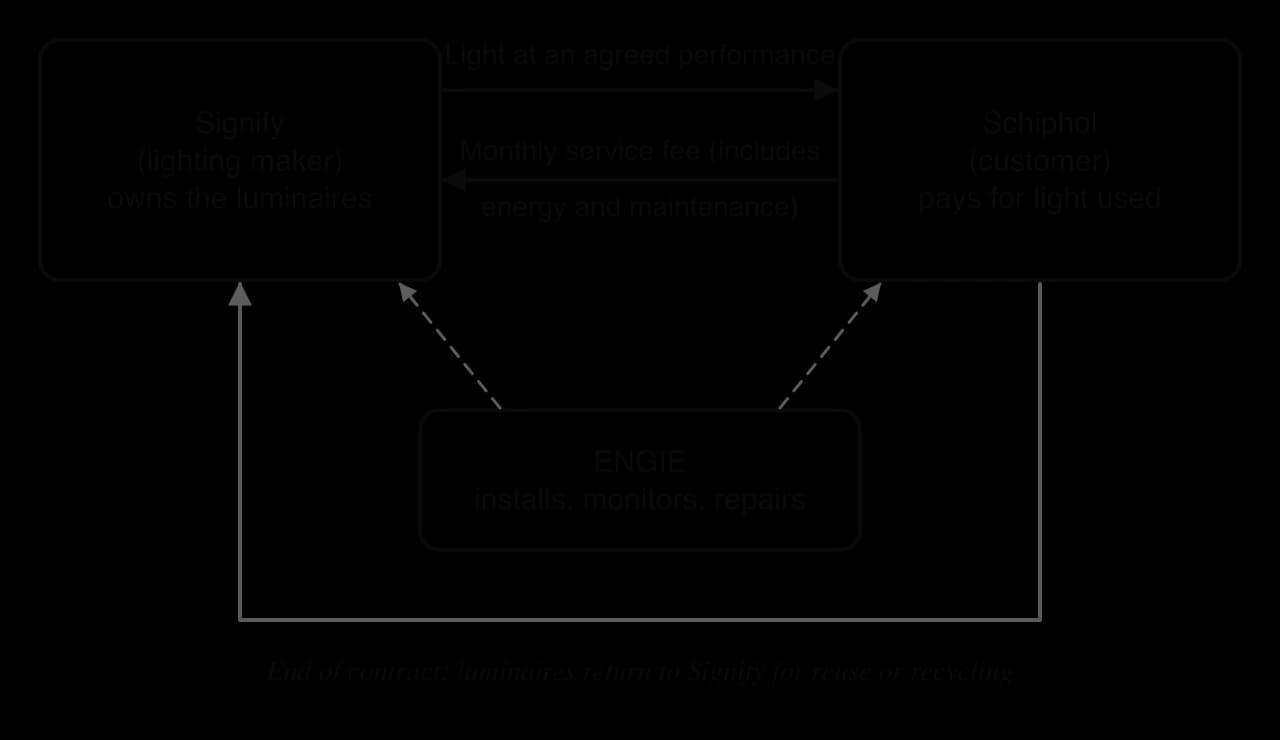
The arrangement is a result-oriented product service system. Schiphol buys an outcome (an agreed level of light) instead of a product. Because Signify owns the fittings and pays for their repair, it has a direct financial reason to make them efficient, durable and easy to repair, and to recover their parts at the end. The contract also contains elements of product life extension (replaceable parts, maintenance) and resource recovery (reuse and recycling at the end of the contract).
Circular revenues across the business
Signify measures the share of its sales that comes from what it calls circular revenues: serviceable luminaires whose parts can be easily replaced, circular components, intelligent systems and circular services such as light as a service. In 2019 these made up 16% of sales. The company set a target of doubling the share to 32% by 2025 and passed it: circular revenues reached 33% of sales in 2023, 35% in 2024 and 37% in 2025.
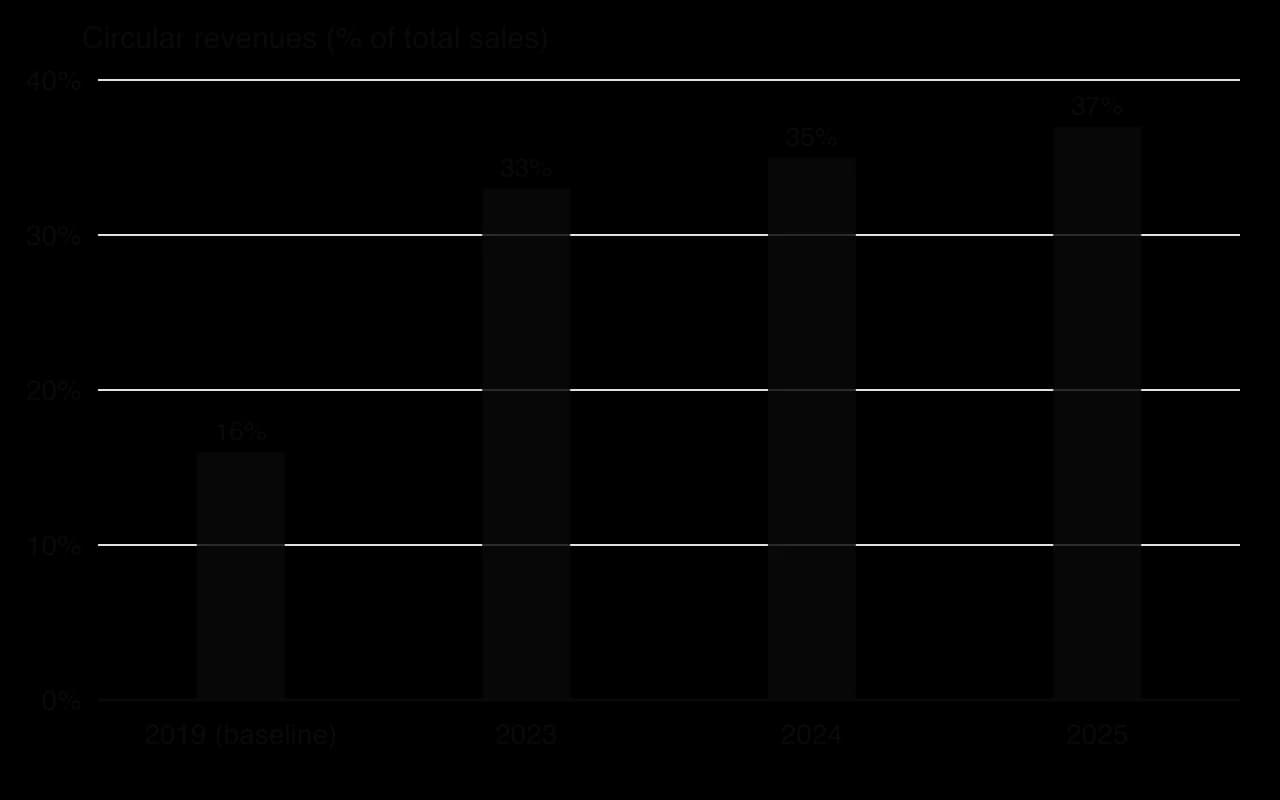
The chart shows rapid growth in the circular share, but it should be read with care. More than half of Signify’s circular revenues come from luminaires that meet its serviceability criteria, such as replaceable drivers and LED boards, not from service contracts. Selling a repairable luminaire is a step towards product life extension, but the customer still buys the product, so the strongest circular incentive, ownership by the producer, applies only to a small part of the business.
The circular share also grew while total sales fell, from €6,704 million in 2023 to €6,143 million in 2024 and €5,765 million in 2025. In absolute terms, circular revenues fell slightly, from about €2.2 billion in 2023 (33% of €6,704 million) to about €2.1 billion in 2025 (37% of €5,765 million), so the rising share partly reflects falling sales of other products. For 2026–2030 Signify has set a new target based on recycled content and revenue from light as a service, a sign that it sees service models as the next stage.
What the case shows, and its limits
Selling luminaires (linear) | Light as a service (Schiphol) | |
|---|---|---|
Who owns the luminaires | The customer | Signify |
How Signify earns revenue | One-off sale; more revenue when fittings are replaced | Monthly fee for the length of the contract |
Who pays for energy and repairs | The customer | Included in the fee |
Signify’s incentive | Sell more fittings | Make fittings efficient, durable and repairable |
End of life | Customer disposes of the fittings | Fittings return to Signify for reuse or recycling |
The Schiphol contract shows how a product service system aligns the interests of the producer, the customer and the environment. Schiphol avoids a large capital expenditure and the risk of owning equipment; Signify earns a long-term revenue stream and gains from efficiency and durability; fewer fittings are made and thrown away. It also shows the challenges: Signify must finance the equipment itself, rely on a partner for maintenance, and agree performance measures in a long contract.
The case has limits as evidence. The figures on energy use and product life come from the companies involved and were not independently tested, and a single airport contract may not be typical of smaller customers, who may not want long contracts. Signify’s circular revenue figure is a measure the company defines itself, although its auditor gave reasonable assurance on it.
Sources: Signify (Philips Lighting) press release, 16 April 2015; Signify, Schiphol Airport Circular Lighting case study, 2019; Signify, Annual Report 2025.
Explain why Signify has a stronger incentive to make long-lasting luminaires under the Schiphol contract than when it sells luminaires.
Analyse the impact of light as a service on Signify’s cash flow and on Schiphol’s cash flow.
Suggest why a small business might prefer to buy its lighting rather than pay for it as a service.
Exam practice
Circular business models can appear in Paper 1 and Paper 2 and in the internal assessment. Questions usually ask you to explain a model, apply one or more models to the business in the case, or discuss whether a business should adopt a circular model, often with reference to sustainability.
Short-answer questions often ask for two linked points about a model, applied to the business in the case.
Summary
A linear economy follows take, make, dispose; a circular economy keeps products and materials in use at their highest value and designs out waste.
A circular business model earns revenue by keeping products and materials in use and recovering their value.
Circular supply models change the inputs; resource recovery turns waste into new inputs.
Product life extension makes products last longer through durability, repair, refurbishment and resale.
Sharing models let several users share under-used products, usually through a platform.
Product service systems sell use or results; the producer keeps ownership and gains from durability and efficiency.
Benefits include lower material costs, new revenue streams and a stronger brand; challenges include finance, customer behaviour, collection costs and the risk of greenwashing.
Success depends on the product, the customers, the firm’s finance and objectives and the external environment.
Self-check
- To do:
I can define the linear economy, the circular economy and a circular business model.
- To do:
I can draw and explain a diagram of the linear and the circular economy.
- To do:
I can explain the five circular business models, with a real example of each.
- To do:
I can apply the five models to a given business and suggest which suit it.
- To do:
I can calculate and compare the total cost of buying a product and using it as a service.
- To do:
I can explain the advantages and challenges of circular business models for different stakeholders.
- To do:
I can explain how circular business models support sustainability and the triple bottom line.
- To do:
I can explain how cradle to cradle design supports circular business models (HL).
Questions on T.8
33 exam-style questions on this subtopic, written in the style of the IB papers. The first has its markscheme open. Counted on
Question 1 · BM-001826 marks
Tumi Dlamini grew up in Soweto, South Africa, where old car tyres are often dumped or burned. In 2022 she started Tread Again, which collects worn tyres from local garages free of charge and cuts them into soles for sandals. The uppers are made from offcuts of traditional shweshwe cotton fabric, bought cheaply from a clothing factory. Tumi employs six young people from her neighbourhood, whom she trained herself, and sells the sandals at craft markets and through an online shop to customers in Europe.
- (a)
Explain how Tumi has shown creativity as an entrepreneur.
4 marks
Markscheme (a)
She saw a waste product (dumped tyres) as a free raw material, turning a local problem into a business opportunity.
She combined two unusual inputs (tyre soles and shweshwe offcuts) to create a distinctive product with a strong USP and a story that appeals to overseas buyers.
She created a low-cost production process: free tyres, cheap offcuts and staff she trained herself.
She found new markets (online sales to Europe) beyond local craft markets.
Award [1]–[2] for a limited explanation, e.g. a general statement that Tumi had a new idea, with little development.
Award [3]–[4] for an explanation of at least two ways in which Tumi showed creativity, in the context of Tread Again.
- (b)
Outline the circular business model used by Tread Again.
2 marks
Markscheme (b)
Resource recovery model: Tread Again recovers waste (worn tyres, fabric offcuts) and turns it into secondary raw materials for new products, diverting it from dumping or burning.
Award [1] for naming the resource recovery model (accept “circular supply” only if justified by the use of recovered materials replacing virgin inputs) and [1] for outlining how Tread Again uses it.
Question 2 · BM-002757 marks
Genbrug Garderobe is a clothing rental business in Copenhagen, Denmark. Members pay DKK 399 a month to borrow up to four items at a time. Non-members can rent single items for DKK 150 each. When an item is too worn to rent, it is repaired and sold in the shop. In September, Genbrug Garderobe had 1 200 members, made 650 single rentals and sold 300 used items at an average price of DKK 120.
- (a)
Calculate Genbrug Garderobe’s total revenue for September (show all your working).
3 marks
- (b)
Explain how Genbrug Garderobe’s circular business model allows it to earn two revenue streams from the same item of clothing.
4 marks
Answer it, then compare with the markscheme.Check this one with a free account
Question 3 · BM-00420HL only · 6 marks
Groeneveld Floors B.V. (GF)
Groeneveld Floors B.V. (GF) makes carpet tiles for offices in Eindhoven, the Netherlands. Since 2023 its tiles have been designed so that, at the end of their life, the nylon top layer can be separated from the backing. GF collects used tiles from customers free of charge; the nylon is chemically recycled into new yarn, and the backing, made from a plant-based material, can be composted.
GF uses no glue that would contaminate the materials, and designs each tile so that it can be lifted and replaced individually. Recycled yarn currently costs GF about 12 % more than new nylon.
- (a)
Describe two features of cradle to cradle design and manufacturing shown by GF.
4 marks
- (b)
Explain one disadvantage for GF of cradle to cradle manufacturing.
2 marks
Answer it, then compare with the markscheme.Check this one with a free account
Flashcards for T.8
The official deck for this part of the syllabus.
T.8 Circular business models · front
Define the term linear economy.
T.8 Circular business models · front
The pattern of a linear economy is often summarised as [three verbs] (or take, make, waste).
- T.8 Circular business models124 cards
Carry on with T.8 in Augment
With a free account, Augment remembers where you stopped and what you have practiced.