Describe the purpose and contents of a business plan, explain who uses it and why, build its financial section from data, and evaluate how far a plan can be relied on.
Each is in the Business glossary, with every other term in the subject.
A written document that sets out the aims of a new or existing business, the strategies it will use to reach them, and the resources and finance it needs, usually with forecasts for the next three to five years.
A short overview at the start of a business plan that states the business idea, its market, its management, its main financial forecasts and the finance requested, so that a reader can judge the plan quickly.
The section of a business plan that sets out the start-up costs, the sources of finance, and forecasts of sales, cash flow and profit, often with a break-even analysis.
The section of a business plan that explains how the business will produce its goods or deliver its services, including premises, equipment, suppliers, production methods, capacity and quality control.
A short slide presentation of a business plan that entrepreneurs use to persuade investors to fund a business, covering the problem, solution, market, business model, team, forecasts and finance requested.
Define a business plan and outline its purposes: planning, securing finance and setting objectives.
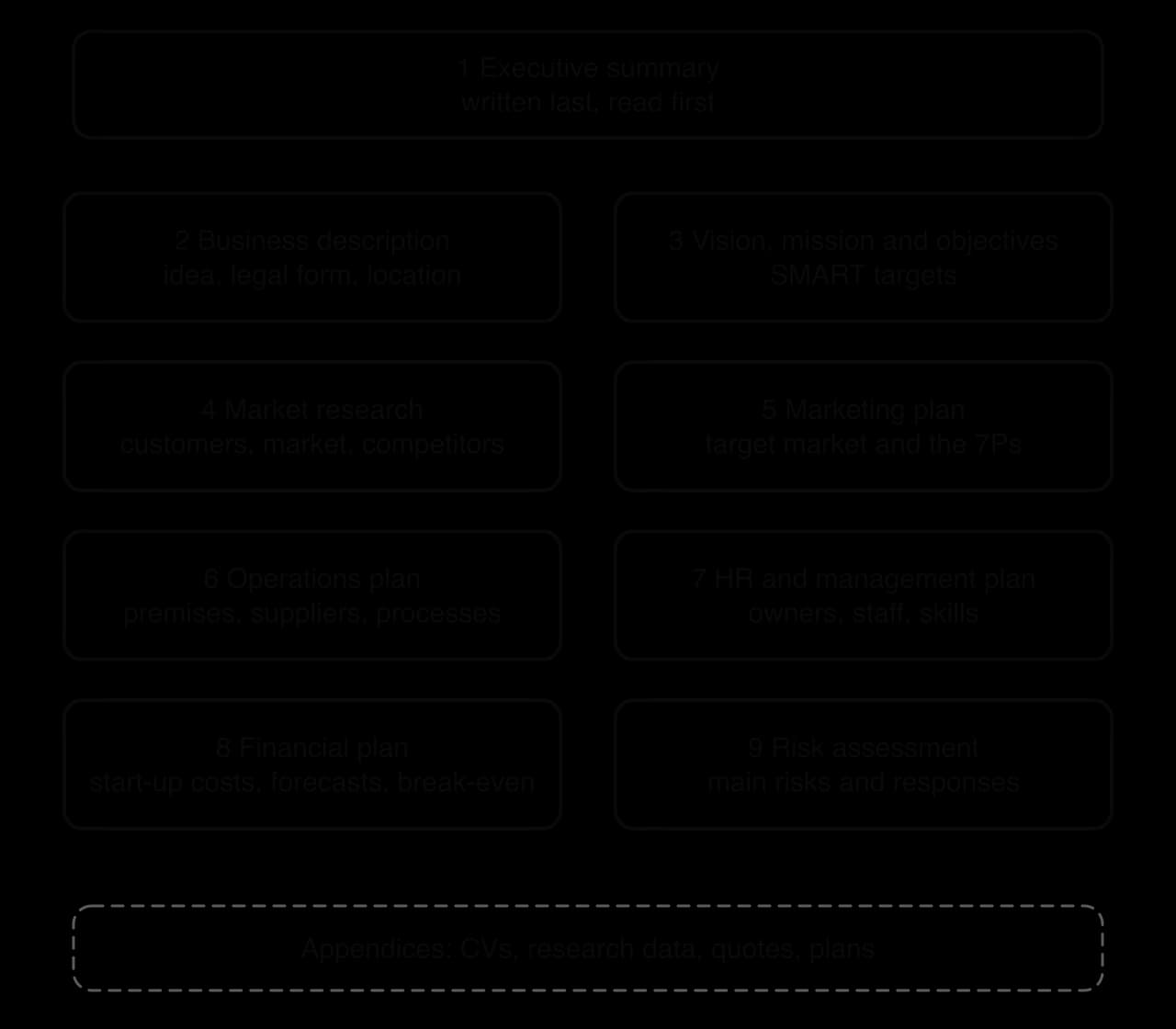
Describe the typical contents of a business plan, from the executive summary to the risk assessment.
Explain how the market research, marketing, operations and HR sections feed the financial plan.
Calculate the start-up costs, break-even quantity and margin of safety of a planned business.
Prepare a simple cash flow forecast for a new business and comment on what it shows.
Explain why different stakeholders use a business plan and what each looks for in it.
Explain the limitations of a business plan, including the reliability of its forecasts.
Apply the structure of a business plan to a real start-up.
A business plan is a written document that describes a business idea and sets out how the business will be organised, marketed, staffed and financed over the next few years. Most new businesses write one before they start trading, and established businesses write them when they plan a major change, such as opening in a new country or launching a new product range.
A business plan brings the whole of business management together in one document. Its marketing section uses market research and the marketing mix, its operations and human resources (HR) sections describe how the product will be made and who will make it, and its financial plan uses cash flow forecasts and break-even analysis. It is also where an entrepreneur shows creativity, in the idea itself, and responds to change, because a plan describes an opportunity that has opened up in the market.
19 exam-style questions on this subtopic, written in the style of the IB papers. The first has its markscheme open. Counted on
Rukiga Hills Eco-Lodge (RHEL)
Brenda and Samuel Tumusiime opened Rukiga Hills Eco-Lodge (RHEL), a partnership, beside Lake Bunyonyi in Uganda in January 2025. RHEL has eight cottages built from local materials and offers canoe trips and guided walks. Before opening, the couple wrote a business plan to obtain a bank loan. Table 1 compares the forecasts in the business plan with the actual results for the first six months.
Table 1: RHEL’s forecast and actual results, January to June 2025 (UGX million)
Forecast | Actual | |
|---|---|---|
Room bookings | 168 | 112 |
Meals and tours | 42 | 35 |
Total revenue | 210 | 147 |
Staff wages | 72 | 72 |
Food and supplies | 38 | 34 |
Loan interest | 18 | 18 |
Marketing | 12 | 24 |
Maintenance and utilities | 28 | 27 |
The official deck for this part of the syllabus.
What is a business plan?
Over how many years does a business plan usually forecast?
With a free account, Augment remembers where you stopped and what you have practiced.
Scope: The business plan is an SL and HL toolkit tool. Students describe what a business plan contains and why it is written, explain who uses it, apply its structure to a real organisation and explain its limitations; the financial calculations it contains (cash flow forecasts, break-even analysis) are taught in full in the finance and operations units.
Starting a business means making many decisions at once: what to sell, to whom, at what price, where, with which staff and with how much money. A business plan puts all of these decisions in one place, in a fixed order, so that the owners and anyone they ask for money can check that the decisions fit together. When a plan forecasts high sales but has no marketing budget, or needs ten staff but has no money for wages, the gap can be corrected on paper before it causes real losses.
A business plan is a forward-looking document. Its figures are forecasts and estimates, not records of what has happened, and it describes intentions rather than facts. Writing it makes the owners think ahead, but its figures can be wrong, because the future rarely turns out exactly as planned.
A business plan serves three main purposes, and most plans serve all three at once.
Planning. Writing the plan makes the owners research the market, estimate costs and think through problems before they spend money. Many weak ideas are dropped or changed at this stage, which is far cheaper than discovering the problems after opening.
Securing finance. Banks, business angels, venture capital firms and government schemes usually ask for a business plan before they lend or invest. The plan shows how much money is needed, what it will be spent on, and how and when it will be repaid or earn a return.
Setting objectives. The plan states the business’s objectives, ideally as SMART objectives (specific, measurable, achievable, realistic and time-bound), so that progress can be measured. Once the business is trading, actual sales, costs and cash can be compared with the plan to show whether it is on track.
A plan has two further uses. It communicates the idea to people the business needs, such as a new partner, key employees or a landlord. It also acts as a benchmark: when results differ from the plan, managers can find out why and change course early.
Starting a business is risky. In the United Kingdom, 38.4% of the businesses born in 2019 were still trading five years later, so most new businesses close within five years. A business plan cannot remove this risk, but it can show the owners where the main risks lie and how large they are before they commit their savings.
Sources: Office for National Statistics, Business demography, UK: 2024 (released 20 November 2025).
There is no single legal format for a business plan, but plans written for banks and investors follow a similar order. The order is logical: each section depends on the ones before it. The market research shows who the customers are, the marketing plan shows how to reach them, the operations and HR plans show how to serve them, and the financial plan turns all of this into numbers.
The diagram shows nine sections and an appendix. Each section answers a particular question that a reader of the plan asks.
The executive summary is a short overview of the whole plan, usually one or two pages. Busy readers, such as a bank’s lending officer or an investor who receives hundreds of plans, often read only the summary first and decide from it whether to read on. It therefore states the idea, the target market, what makes the business different, the management team, the key financial forecasts and the amount of finance requested.
The business description explains what the business is and does: the product or service, the customer problem it solves, its location, its legal form (for example a sole trader or a privately held company) and, for an existing business, its history and current performance. It also explains why the owners believe there is an opportunity now, for example a change in technology, regulation or tastes.
A plan normally states the vision statement (what the business hopes to become in the long term) and the mission statement (its purpose and how it will achieve it). It then sets objectives for the next few years, such as a sales revenue target, a number of customers, a market share or a date by which the business should become profitable. Clear objectives give lenders and investors something to measure the business against.
The market research section shows that customers want the product and will pay for it. It describes the target market, estimates the market size and its growth, and analyses competitors and their prices. It draws on primary research (surveys, interviews, test sales) and secondary research (industry reports, government statistics). Tools from the toolkit often appear here: a STEEPLE analysis of the external environment and a SWOT analysis of the business’s own position.
The market research section matters more than any other, because the sales forecast in the financial plan depends on it. A plan whose sales forecast is not supported by evidence of demand is a common reason for a lender to reject it.
The marketing plan explains how the business will reach its target market. It sets out the unique selling point, the brand, and decisions on the marketing mix: the product range, prices, promotion and distribution, and for a service business also people, processes and physical evidence. It also states the marketing budget, which reappears as a cost in the financial plan.
The operations plan describes how the product will be made or the service delivered. It covers premises and location, equipment, suppliers and the terms they offer, production methods, capacity, quality control and any licences or permits needed. A lender reads it to check that the business can actually deliver what the marketing plan promises, at the costs the financial plan assumes.
The HR and management plan introduces the owners and managers, their experience and their roles, and shows the planned organisation structure. It also covers workforce planning: how many employees the business needs, with which skills, when they will be recruited and how much they will be paid. Investors judge the team as well as the idea, because the same idea can succeed or fail depending on who runs it, so this section can decide whether a plan is funded.
The financial plan turns every other section into figures. It usually contains the start-up costs and how they will be financed, a sales forecast, a cash flow forecast (normally monthly for the first year), a forecast of profit, a break-even analysis and, for a business already trading, its recent accounts.
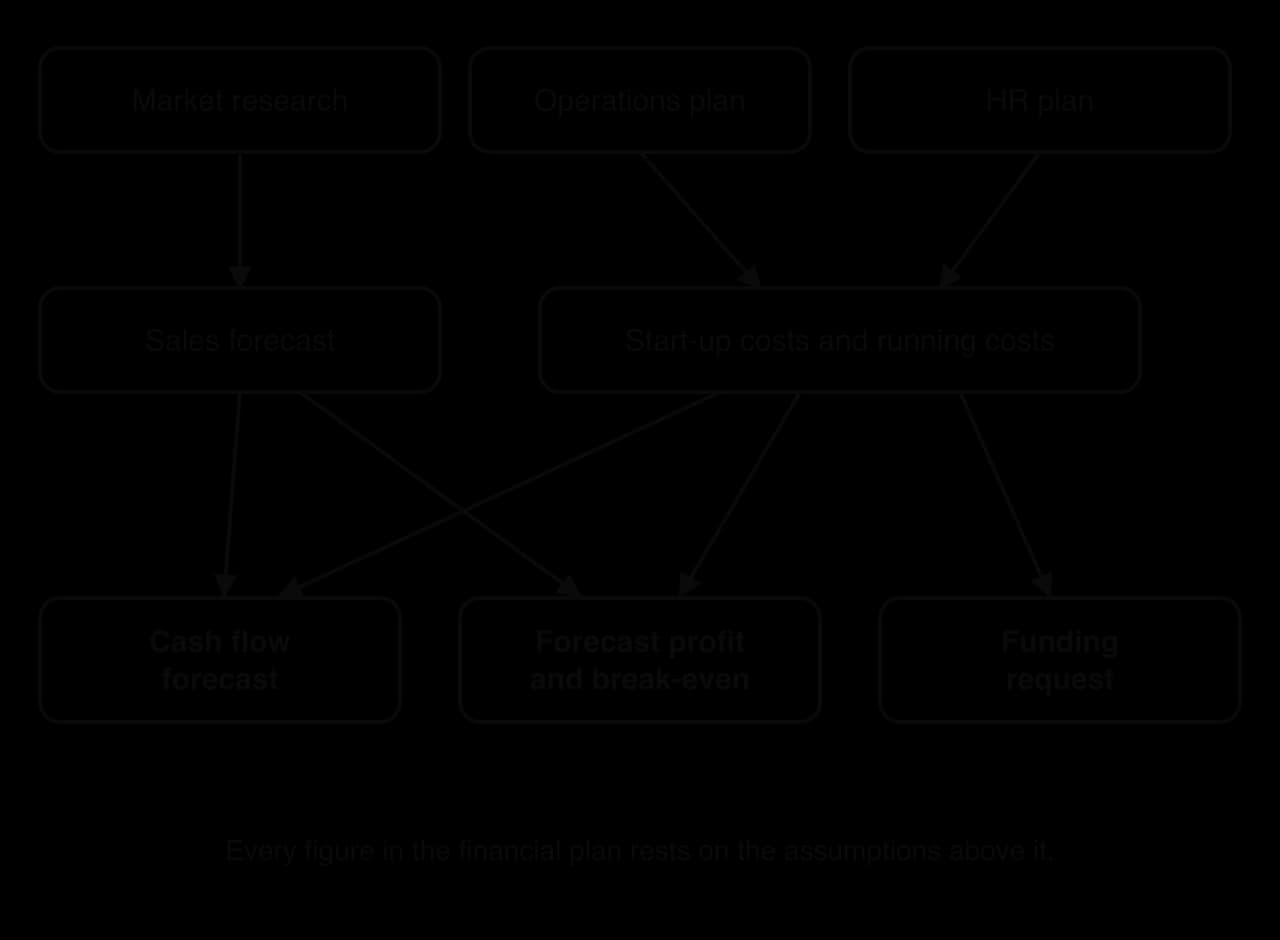
The diagram shows why the financial plan cannot be written on its own. The sales forecast comes from the market research; the start-up and running costs come from the operations and HR plans. These two sets of figures then produce the cash flow forecast, the forecast profit and break-even, and the funding request. A small error in an early section therefore spreads through the whole plan.
Start-up capital is the money needed before the business earns any revenue: equipment, fitting out the premises, initial stock, deposits, legal costs and launch marketing. A sensible plan also includes a contingency sum for costs that are higher than expected. The funding request then shows how the total will be covered, for example by the owners’ savings, a bank loan, a government grant or investors.
Lenders want to know how much the business must sell to cover its costs. Break-even quantity is found by dividing fixed costs by the contribution per unit (the selling price minus the variable cost per unit). The margin of safety is the amount by which forecast sales exceed the break-even quantity. A large margin of safety tells a lender that sales could fall short of the forecast without the business making a loss.
A new business usually has little cash, and it can fail even when it is forecast to make a profit if cash runs out first. The cash flow forecast shows the expected cash inflows and outflows month by month, and the closing balance at the end of each month. It follows a standard layout: opening balance, cash inflows, cash outflows, net cash flow and closing balance, with negative figures in brackets.
A good plan admits what could go wrong. The risk assessment lists the main risks, how likely each one is, how much damage it would do and how the business would respond. Lenders are more confident in owners who have thought about risks than in owners who present only the best case.
Risk for Bean There | Likelihood | Impact | Planned response |
|---|---|---|---|
Sales grow more slowly than forecast | Medium | High | Arranged overdraft; cut opening hours in the first months; extra student promotions |
A large coffee chain opens nearby | Low | High | Focus on local suppliers and a loyalty scheme; keep prices close to the chain’s |
Coffee bean prices rise | Medium | Medium | Contract with one roaster for 12 months; review menu prices each term |
A key employee leaves | Medium | Low | Train all staff on the coffee machines; keep a list of part-time staff |
Some risks can be expressed in numbers. A decision tree can weigh the probability and financial effect of each outcome of a risky choice, and the break-even analysis shows how far sales can fall before the business makes a loss.
Supporting documents go at the end: the owners’ CVs, survey results, quotes from suppliers, plans of the premises, letters of intent from early customers, and the detailed monthly forecasts. Keeping them separate keeps the main plan short and readable.
Governments publish business plan templates to help new firms. The US Small Business Administration (SBA), for example, describes two formats. Its traditional plan has sections for the executive summary, company description, market analysis, organisation and management, service or product line, marketing and sales, funding request and financial projections, and can be dozens of pages long. Its “lean start-up” format fits on one page and lists key partners, key activities, key resources, value proposition, customer relationships, customer segments, channels, cost structure and revenue streams. The SBA notes that lenders and investors commonly ask for the traditional format.
Sources: US Small Business Administration, business guide on writing a business plan, sba.gov (accessed October 2026).
Traditional plan | Lean (one-page) plan |
|---|---|
Detailed: often 20–40 pages with appendices | One page, quick to write and change |
Full financial forecasts for several years | Main costs and revenue streams only |
Suited to bank loans and formal investment | Suited to testing an idea quickly and changing it often |
Slow to update when conditions change | Easy to rewrite as the business learns |
A business plan is read by several stakeholders, and each reads it for a different reason. The owners use it to plan; outsiders use it to decide whether to lend, invest, supply or work for the business.
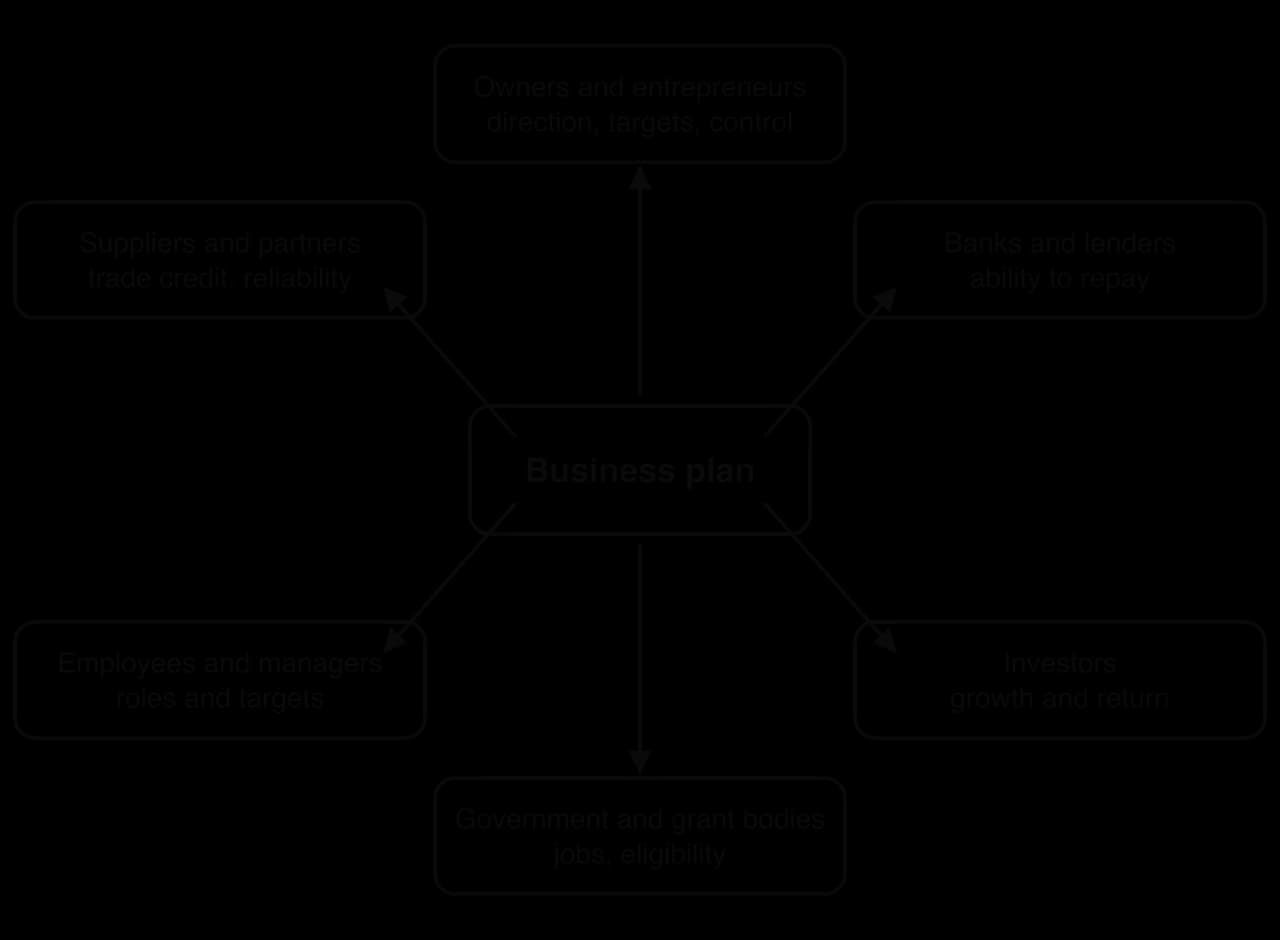
User | What they want to know | Sections they read most closely |
|---|---|---|
Owners and entrepreneurs | Whether the idea is viable; what targets to aim for | All sections, especially the forecasts and objectives |
Banks and other lenders | Whether the loan and interest can be repaid on time, and what security exists | Cash flow forecast, break-even, funding request, owners’ own investment |
Investors (business angels, venture capital) | Whether the business can grow fast enough to give a high return on their shares | Market size, competitive advantage, management team, growth forecasts |
Government agencies and grant bodies | Whether the business meets the scheme’s conditions and creates jobs | Business description, HR plan, location, funding request |
Employees and managers | Their roles, targets and the security of their jobs | Objectives, HR plan, operations plan |
Suppliers and partners | Whether to offer trade credit and long-term contracts | Financial plan, operations plan |
Because users read the plan differently, the same business may write different versions of it. A plan for a bank stresses steady cash flow and security for the loan, while a pitch deck for venture capital investors stresses the size of the market and how quickly the business could grow. A plan for a bank that promises very fast growth can even worry the lender, because rapid growth usually needs heavy spending and creates cash flow problems.
In the United Kingdom, the government-backed Start Up Loans scheme lends between £500 and £25,000 to people starting or running a business that has traded for less than five years, at a fixed interest rate of 7.5% a year repaid over one to five years. Applicants receive free help to write their business plan, and successful applicants receive up to twelve months of free mentoring, so the plan becomes the basis of both the loan and the support that follows it.
Sources: GOV.UK, “Start Up Loans” (accessed October 2026).
Start-ups seeking investment often present a short version of their plan as a slide presentation. A pitch deck usually has 10–20 slides: the problem, the solution, the market size, the product, the business model (how the business earns money), the competition, the team, the financial forecasts and the amount of money being raised. It does not replace the full plan; investors who are interested after the pitch ask for the detailed plan and check its figures.
The key concepts appear in business plans in practical ways, and lenders and investors increasingly ask about them.
Key concept | How it appears in a business plan |
|---|---|
Change | Most plans describe an opportunity created by change: new technology, new regulation or new consumer habits. Plans must also be revised as conditions change. |
Creativity | The business idea, the unique selling point and creative ways to reach customers on a small budget. |
Ethics | Honest forecasts: presenting unrealistic figures to win a loan or investment misleads stakeholders and can amount to fraud. |
Sustainability | Many lenders and grant schemes ask how the business will manage its environmental and social impact, and a plan must show the business can survive financially. |
Better decisions before money is spent. Researching the market and estimating costs shows weaknesses early, when changing the idea is cheap.
Access to finance. Most banks and investors will not lend or invest without one, so a good plan widens the choice of finance.
Clear objectives and a benchmark. Actual results can be compared with the forecasts, and variances investigated.
Coordination. Marketing, operations, HR and finance decisions are made to fit together, and staff and partners understand the direction of the business.
Thinking about risk. A risk assessment and a margin of safety show how much can go wrong before the business fails.
Forecasts are uncertain. Sales forecasts for a new business have no past data to rely on, and every figure in the financial plan depends on them.
Optimism. Owners are usually enthusiastic about their idea and tend to overestimate sales and underestimate costs and the time to break even.
Plans date quickly. Competitors, costs, technology and the economy change, so a plan can be out of date within months unless it is revised.
Rigidity. Owners may stick to the plan when the market shows that a different approach would work better.
Time and cost. A detailed plan takes weeks to research and write, which a very small business may not be able to afford.
No guarantee. A well-written plan does not make the business succeed; execution, the team and luck matter as much.
Quibi, a US mobile video streaming service, shows the limits of even a well-funded plan. It raised about $1.75 billion from investors and launched on 6 April 2020 with a forecast of 7.4 million subscribers in its first year. By the time it announced its closure on 21 October 2020 it had about 500,000 subscribers. Its founders blamed partly the timing of the launch during the COVID-19 pandemic, a change in conditions that its plan had not allowed for.
Sources: Quibi, Wikipedia (citing the Wall Street Journal, 21 October and 2 November 2020; Deadline, 21 October 2020; NBC News, 22 October 2020), accessed October 2026.
The quality of the market research: primary evidence of demand (test sales, pre-orders) makes the sales forecast far more reliable than guesses.
The size and stage of the business: a sole trader opening a market stall may need only a one-page plan, while a start-up seeking millions from investors needs a detailed one.
How fast the market changes: in fast-changing markets a short, frequently revised plan is more useful than a long, fixed one.
Whether it is used: a plan that is written only to win a loan and then left in a drawer has little value for managing the business.
The honesty of its authors: realistic forecasts with a sensitivity check (“what if sales are 20% lower?”) are more useful than a best-case plan.
On balance, a business plan is most valuable as a way of thinking through a business before committing money, and as the evidence lenders and investors need. Its main weakness, the uncertainty of its forecasts, is reduced when the plan is based on primary research, includes a contingency and a margin of safety, and is revised regularly once the business is trading.
 YouTube
Airbnb, the online platform for short-term accommodation, shows what investors look for in a business plan and how a plan presented as a pitch deck can help a start-up raise finance. The company was founded in San Francisco in August 2008 by Brian Chesky, Joe Gebbia and Nathan Blecharczyk, and its website launched on 11 August 2008 as “AirBed & Breakfast”. The idea came from renting out air mattresses in Chesky and Gebbia’s flat during a design conference in October 2007, when hotel rooms in the city were scarce.
The founders had little money. They raised about $30,000 by selling novelty breakfast cereals named after the 2008 US presidential candidates. In January 2009 they joined Y Combinator, a start-up accelerator, which provided training and $20,000 in exchange for a 6% stake. In March 2009 the company shortened its name to Airbnb, and in April 2009 Sequoia Capital, a venture capital firm, led a seed investment of $600,000.
The deck the founders used with early investors has since been widely published. Its slides follow the structure of a business plan in compressed form.
Slide | Content | Business plan section it replaces |
|---|---|---|
Problem | Price is a concern for travellers booking online; hotels leave travellers disconnected from the city and its culture; there is no easy way to book a room with a local or become a host | Business description |
Solution | A website where people rent out space to travellers, so guests save money, hosts earn money and both share culture | Business description; unique selling point |
Market validation | About 630,000 users on CouchSurfing (a free hosting site) and about 17,000 temporary housing listings on Craigslist in San Francisco and New York | Market research (secondary evidence of demand) |
Market size | About 2 billion trips booked worldwide, narrowed to the budget and online trips the service could serve | Market research (market size) |
Business model | A 10% commission on each booking, with forecast revenue of about $200 million for 2008–2011 | Financial plan (revenue model and forecast) |
Adoption strategy | Listings at big events, partnerships with budget travel sites, posting listings to Craigslist | Marketing plan |
Competition and advantages | A grid of competitors by price and online or offline booking; first to market, ease of use, host profiles, design and brand | Market research (competitors); marketing plan |
Team, press and testimonials | The three founders; early media coverage; quotes from users | HR and management plan; evidence of demand |
Sources: Business Insider (republished by Yahoo, 4 June 2020); Slidebean, “Airbnb pitch deck: teardown and redesign” (2023); a SlideShare reproduction of the deck. Reproductions differ slightly on some market-size figures.
The deck shows how investors read a plan. The problem and solution slides explain why the business should exist. The market validation slide uses secondary data from existing websites to argue that demand already exists, because thousands of people were already renting rooms informally. The market size slide shows a venture capital investor that the potential prize is large enough to justify a risky investment. The business model slide links the idea to revenue through a single, simple assumption: a 10% commission on each booking.
The deck also shows the limits of planning. Its revenue forecast rested on assumptions about market share that no start-up could prove at the time, so an investor could not rely on the figures alone. Early investors also had to judge the founders themselves and the evidence of early demand. The plan was a starting point that the business changed many times, for example by moving from air mattresses at conferences to whole homes worldwide.
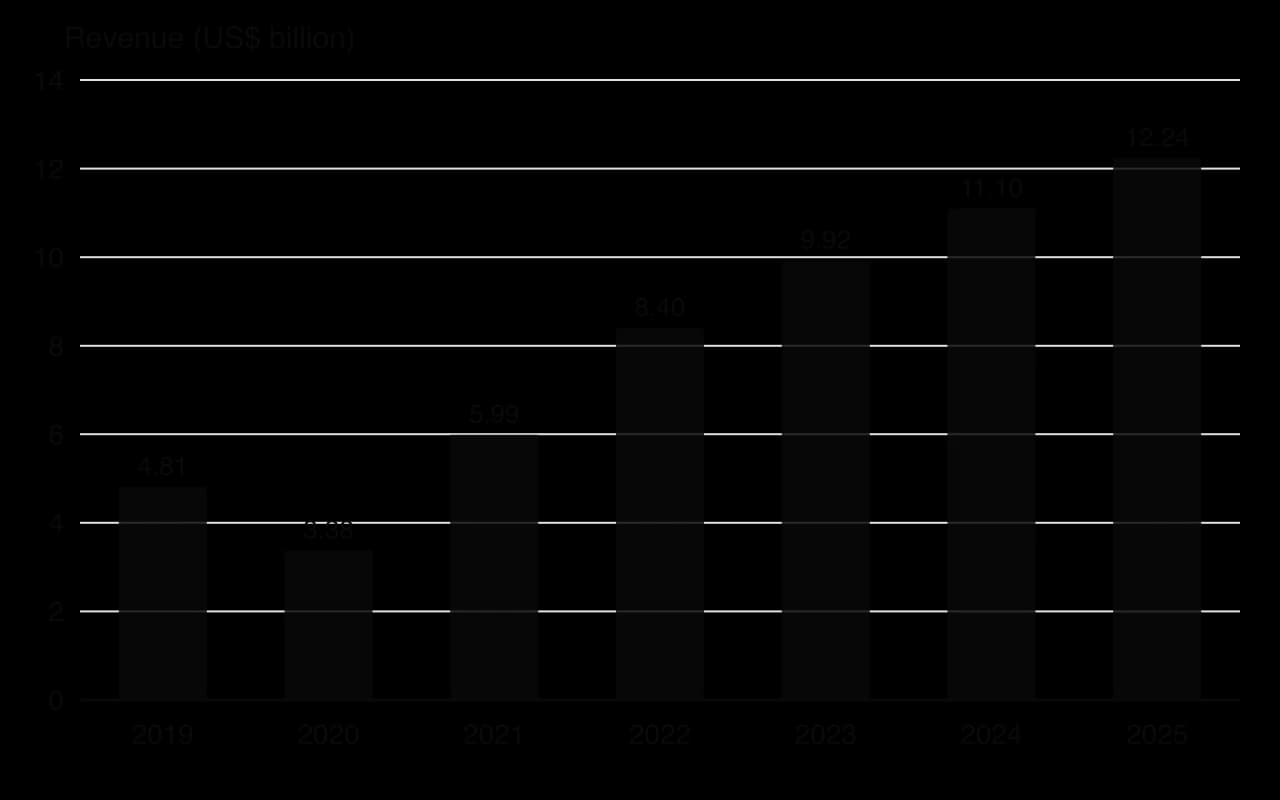
The later results put the early forecast in context. Airbnb listed its shares on the Nasdaq stock exchange in December 2020, raising $3.5 billion. Its revenue fell from $4.81 billion in 2019 to $3.38 billion in 2020, when the pandemic stopped most travel, then grew every year to $12.24 billion in 2025. By May 2026 it reported more than 5.5 million hosts and more than 9 million active listings.
The original deck forecast revenue of about $200 million for 2008–2011 combined. Airbnb’s revenue in 2025 alone was about 60 times that figure. Forecasts for a new kind of business can turn out wrong in either direction, which is why investors examine the assumptions behind a forecast as closely as the totals.
Sources: Airbnb, Inc., Form 10-K filings (SEC company facts, revenue 2019–2025); Airbnb Newsroom, “About us” (updated May 2026); Airbnb, Wikipedia (founding, funding and IPO), accessed October 2026.
Explain why the founders included a “market validation” slide before asking for money.
Analyse which sections of a full business plan are missing from the pitch deck, and why an investor would ask for them before investing.
Explain one reason why the deck’s revenue forecast was unreliable.
Business plans appear in exams in several ways. A Paper 1 or Paper 2 case may describe an entrepreneur preparing a plan and ask what it should contain, who will read it or how useful it is. Paper 2 often provides data from a plan and asks you to calculate break-even, prepare a cash flow forecast or comment on the forecasts. Paper 3 (HL) asks for a plan of action for a social enterprise, which uses the same logic of objectives, resources, finance and risks.
The next question practises the calculations that appear in a financial plan.
The extended response asks for a judgement about how useful a plan is in a particular case.
A business plan sets out a business’s aims, strategies, resources and finance, with forecasts for the next few years.
Its main purposes are planning, securing finance and setting objectives against which results can be measured.
A typical plan contains an executive summary, business description, objectives, market research, marketing plan, operations plan, HR plan, financial plan and risk assessment.
The financial plan (start-up costs, cash flow forecast, break-even, funding request) is built from the market research and the cost estimates in the other sections.
Owners, banks, investors, government agencies, employees and suppliers read the plan for different reasons.
A pitch deck is a short slide version of the plan used to persuade investors.
Plans are limited by uncertain and often optimistic forecasts and by changing conditions, so they must be based on good research and revised regularly.
I can define a business plan and outline its three main purposes.
I can describe the sections of a business plan in order and say what each one contains.
I can explain how the market research and cost estimates feed the financial plan.
I can calculate start-up costs, the break-even quantity and the margin of safety for a planned business.
I can prepare a simple cash flow forecast in the IB layout and comment on it.
I can explain what different users look for in a business plan.
I can explain the limitations of a business plan and what its usefulness depends on.
I can apply the structure of a business plan to a real start-up such as Airbnb.
168 |
175 |
In March, heavy rain washed away part of the road to the lake for three weeks. RHEL has only 14 reviews on travel websites, while two older lodges nearby have more than 500 each.
Using Table 1, calculate the percentage difference between RHEL’s actual and forecast total revenue (show all your working).
2 marks
= −30 % (actual revenue was 30 % below forecast)
Award [1] for correct working and [1] for the correct answer.
Using Table 1, calculate RHEL’s actual profit or loss for the six months (show all your working).
2 marks
147 − 175 = −UGX 28 million (a loss of UGX 28 million)
Award [1] for correct working and [1] for the correct answer, clearly shown as a loss. Award a maximum of [1] if the currency/units are missing.
Explain two reasons why RHEL’s actual revenue was lower than forecast.
4 marks
Low brand awareness: only 14 online reviews compared with over 500 for established lodges, so tourists are less likely to book a new, unknown lodge.
An external shock: the road was closed for three weeks in March, preventing guests from reaching the lodge.
Optimistic forecasts: new businesses often overestimate demand because they have no past data (the forecast assumed occupancy RHEL could not yet achieve).
Competition: two established lodges nearby with loyal customers and strong reputations.
Mark as 2 + 2: award [1] for each reason and an additional [1] for explaining it using the stimulus.
Explain two benefits for Brenda and Samuel of having written a business plan before opening RHEL.
4 marks
Obtaining finance: the plan persuaded the bank to lend, as it showed forecast revenue, costs and how the loan would be repaid.
Monitoring performance: the forecasts give targets against which actual results can be compared (as in Table 1), so the owners can see quickly that revenue is 30 % below forecast and react, e.g. by targeting more reviews.
Planning and thinking ahead: it forced them to research the market, competitors and costs before investing.
Mark as 2 + 2: award [1] for each benefit and an additional [1] for explaining it in the context of RHEL.
Cladach Seaweed (CS)
[1] Ciarán Byrne, a marine biologist, and Aoife Walsh, a former chef, plan to start Cladach Seaweed (CS) on the coast of Connemara, Ireland. CS would grow kelp on ropes in a sheltered bay and sell it fresh to restaurants and dried to health food shops. Seaweed farming needs no fertilizer, fresh water or feed, and the kelp absorbs carbon and nutrients from the sea.
[2] Demand for seaweed in Europe is growing, as consumers look for plant-based and sustainable foods. The Irish government has set targets for low-carbon food production, and new harvesting machines have reduced the labour needed. However, a licence to farm in the bay can take up to two years to obtain, and some local residents and fishers object to farms that change the view or use fishing areas.
[3] Ciarán and Aoife need €90 000 for boats, ropes and a drying shed. Their bank has asked them for a business plan.
Using a STEEPLE analysis, explain two external factors that create opportunities for CS.
4 marks
Explain two challenges Ciarán and Aoife may face in starting CS.
4 marks
Explain two elements that CS’s business plan should contain to persuade the bank to lend €90 000.
4 marks
Patinet Urbà (PU)
Patinet Urbà (PU) is a start-up in Barcelona, Spain, that rents out electric scooters through a mobile app. It began operating eight months ago with 300 scooters, and the number of rides has grown every month (Table 1).
The founders, Jordi Puig and Amaia Etxeberria, want to raise €2 million from a venture fund to expand to Valencia and Seville. The fund has asked for a business plan that includes a five-year sales forecast. Jordi wants to extend the growth of the first eight months. Amaia points out that Barcelona’s city council is reviewing the licences of scooter operators after complaints about scooters parked on pavements, and that rides fall sharply in winter.
Table 1: Rides per month since PU began operating
Month | 1 | 2 | 3 | 4 | 5 | 6 | 7 | 8 |
|---|---|---|---|---|---|---|---|---|
Rides (000) | 4.0 | 5.2 | 6.1 | 7.9 | 9.4 | 11.2 | 12.1 | 14.0 |
Using Table 1, calculate the percentage increase in rides from month 1 to month 8 (show all your working).
2 marks
Explain two reasons why the venture fund requires a sales forecast in PU’s business plan.
4 marks
Discuss the benefits and limitations for PU of preparing a five-year sales forecast for its business plan.
10 marks