C.4 Stress and coping
Explain how arousal and anxiety affect performance and well-being, apply the main theories and measures of anxiety, and evaluate the coping strategies athletes and exercisers use to manage stress.
- IB Sports, Exercise and Health Science
- SL and HL
What C.4 covers
From the subject guide: what you need to know and be able to do.
How stress and anxiety affect performance and health, and how to manage them.
2 subtopics in Stress and coping
Each one has its own page once something is published for it.
- C.4.1Arousal and anxietynotes
- C.4.2Copingnotes
An overview of C.4 Stress and coping
Stress and coping studies how the demands of sport and exercise activate the body and mind, how that activation and the worry that can come with it affect performance, and how people manage it. The same ideas explain a missed penalty in a final and the anxiety that keeps some people from exercising at all, so they matter for both performance and mental health.
The questions behind the topic
The topic is built around two linked questions: how do stress and anxiety show themselves in the body and mind and affect performance and health, and how can specific coping strategies be used to manage them? The first is answered by theories of arousal and anxiety; the second by models of stress and coping. Everyday situations make them concrete:
Why does a golfer’s putting fall apart under pressure while a weightlifter performs best when highly activated?
Why can a small rise in nerves cause a sudden collapse in performance that does not recover when the athlete calms down slightly?
How can a coach tell how anxious an athlete is, when questionnaires depend on honest answers?
Why does one player see a penalty shoot-out as a challenge and a teammate see it as a threat?
How can slow breathing lower heart rate before a free throw or a shooting event?
Why does seeking support work better than ignoring a problem, and when does it help to accept what cannot be changed? (HL)
What the topic covers
Subtopic | Main question it answers | Level |
|---|---|---|
C.4.1 Arousal and anxiety | How do arousal and anxiety affect performance, which theories explain the relationship, and how can anxiety be measured? | SL and HL |
C.4.2 Coping | What are stressors, how are they appraised, and which coping strategies (problem-focused, emotion-focused, avoidance-focused, self-talk and relaxation) help people manage them? | SL and HL, with an HL-only part |
Arousal and anxiety begins with arousal as a continuum of activation and compares three theories of how it affects performance: drive theory, inverted U theory and the individual zone of optimal functioning. It then separates state anxiety from trait anxiety and cognitive anxiety from somatic anxiety, and uses these to explain multidimensional anxiety theory and catastrophe theory. Coping starts from the transactional model of stress, in which a stressor is appraised before a response follows, and then sorts coping strategies into three categories, with self-talk and relaxation skills as two practical tools.
How the subtopics connect
The two subtopics describe one process, shown in the concept map. A stressor, such as a final, a selection decision or an injury, raises arousal and may produce anxiety. Arousal and anxiety explains what that activation does to performance. Coping explains how the person judges the stressor, as a challenge appraisal or a threat appraisal, and what they do about it. Effective coping lowers anxiety and heart rate and brings arousal back into a useful range, so the second subtopic feeds back into the first.
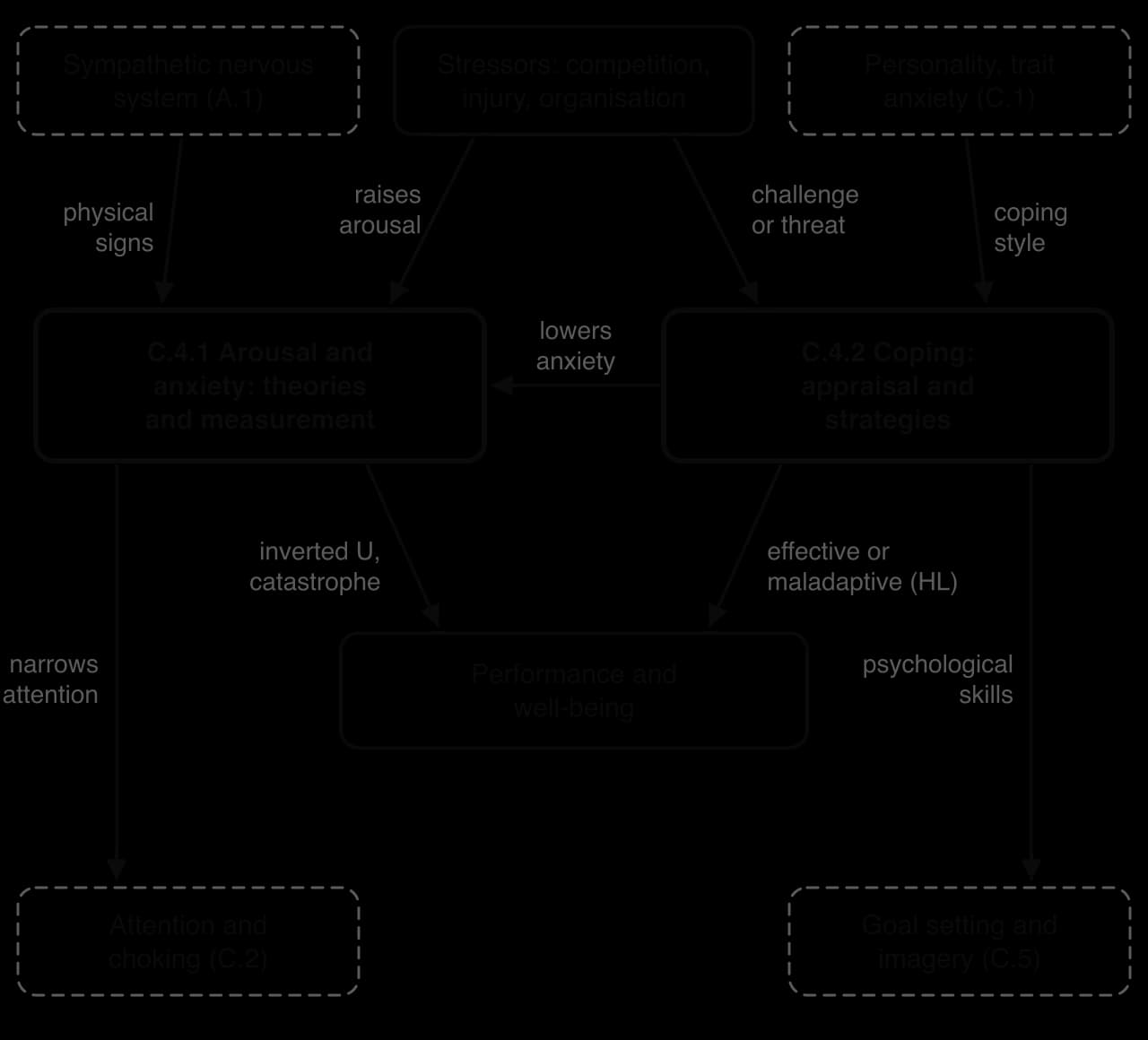
The map also shows links beyond the topic. The physical signs of arousal, a faster heart rate, faster breathing and sweating, are produced by the sympathetic nervous system and epinephrine, studied in exercise physiology. Relaxation techniques work by increasing the activity of the parasympathetic nervous system, which slows the heart. Within sports psychology, personality and trait anxiety shape how strongly a person reacts, high anxiety narrows attention and can lead to choking, and psychological skills such as goal setting and imagery are themselves ways of coping.
Health and performance lenses
Health lens | Performance lens |
|---|---|
Anxiety is one of the most common mental health problems in young people; recognising its signs is the first step to support. | The best level of arousal depends on the task: lower for fine, complex skills such as archery, higher for gross, simple skills such as weightlifting. |
Stress from injury, illness or life outside sport affects well-being, and poor coping is linked with burnout and dropout. | Catastrophe theory explains sudden collapses under pressure and why recovery needs a large fall in arousal. |
Regular physical activity and relaxation skills help manage everyday stress. | Self-talk, breathing techniques and routines help athletes keep anxiety in a facilitative range. |
Elite sport now has athlete welfare and mental health support systems (HL). | Matching the coping strategy to whether the stressor can be controlled improves performance (HL). |
The topic also connects to injury in biomechanics. An injury is a major stressor, high levels of stress are linked with a higher risk of being injured, and the coping strategies of this topic support rehabilitation. In motor learning, beginners perform worst under high arousal because their skills are not yet automatic, which drive theory explains through the dominant response.
How SL and HL differ
HL students study everything SL students study, plus additional higher level material. In this course that extra material is mostly added inside subtopics rather than as separate subtopics. Most pages are therefore read by everyone, and contain sections with headings ending “(HL only)” that SL students can skip. Questions on the HL material appear only in the HL papers.
In Stress and coping, neither subtopic is HL only, and Arousal and anxiety contains no HL material: both levels study it in full. Coping has two HL-only parts:
the difference between a controllable stressor and an uncontrollable stressor, and the goodness-of-fit hypothesis: problem-focused coping suits stressors that can be controlled, and emotion-focused coping suits those that cannot;
why the effectiveness of a coping strategy depends on the person and the situation, why seeking social support is the most effective strategy for athletes, and the difference between effective strategies and maladaptive coping, such as disengagement, venting and self-blame.
Assessment
Questions on Stress and coping appear in all three parts of the external assessment. Paper 1A asks multiple-choice questions, for example which type of anxiety a described symptom shows or which theory a graph represents. Paper 1B gives data from a study, such as anxiety scores and performance, or heart rate before and after a relaxation programme, and asks students to describe trends, calculate changes and evaluate the method. Paper 2 asks short-answer and extended-response questions. HL-only material on controllable stressors and effective coping appears only in the HL papers.
The topic tends to produce these kinds of question:
distinguishing arousal, anxiety and stress, state and trait anxiety, or cognitive and somatic anxiety;
sketching and annotating the graphs of drive theory, inverted U theory, multidimensional anxiety theory and catastrophe theory;
applying a theory to a described performance, such as a collapse in a final;
evaluating subjective and objective measures of anxiety;
classifying named coping strategies as problem-focused, emotion-focused or avoidance-focused;
evaluating a theory of arousal or a coping strategy;
choosing and justifying a coping strategy for a controllable or uncontrollable stressor (HL).
Carry on with C.4 in Augment
With a free account, Augment remembers where you stopped and what you have practiced.