C.3 Motivation
Explain what drives people to start, persist with and enjoy sport and exercise, apply achievement motivation and self-determination theory, and design a motivational climate that supports them.
- IB Sports, Exercise and Health Science
- SL and HL
What C.3 covers
From the subject guide: what you need to know and be able to do.
What drives people to take part and keep going, and how to influence it.
3 subtopics in Motivation
Each one has its own page once something is published for it.
- C.3.1Achievement motivationnotes
- C.3.2Self-determinationnotes
- C.3.3Motivational climatenotes
An overview of C.3 Motivation
Motivation studies the psychological processes that direct and energise behaviour in sport and exercise: why people choose an activity, how hard they try and how long they keep going. It matters for health, because most people who start an exercise programme need lasting motivation to gain its benefits, and for performance, because the quality of an athlete’s motivation affects effort, anxiety, enjoyment and the risk of dropping out.
The questions behind the topic
The topic is built around one central question: what psychological processes drive behaviour in sport and exercise, and how can coaches, teachers and others influence them? Three theories answer it from different angles, and the third subtopic turns them into practical steps. Everyday situations make the question concrete:
Why do some athletes seek out strong opponents while others avoid any contest they might lose?
Why do some children love a sport at ten and drop out by fifteen?
Can paying people to exercise make them more active in the long term?
Why does one coach’s team enjoy training and keep improving, while another coach’s team is anxious and quick to give up?
Why does an athlete who only cares about beating others struggle when they move up to a higher level? (HL)
What the topic covers
Subtopic | Main question it answers | Level |
|---|---|---|
C.3.1 Achievement motivation | How do personality and the situation combine to decide whether people approach or avoid a challenge, and how do people define success? | SL and HL, with an HL-only part |
C.3.2 Self-determination | How do the needs for autonomy, competence and relatedness shape the quality of motivation, from amotivation to intrinsic motivation? | SL and HL, with an HL-only part |
C.3.3 Motivational climate | How does the environment that a coach or teacher creates affect motivation, and how can a mastery climate be built? | SL and HL |
Achievement motivation covers need achievement theory, in which the need to achieve and the need to avoid failure combine with the probability and value of success to produce approach behaviour or avoidance behaviour, and achievement goal theory, with its task orientation and ego orientation. Self-determination covers self-determination theory, the three basic psychological needs and the continuum from amotivation through controlled motivation to autonomous motivation and intrinsic motivation. Motivational climate contrasts the mastery climate with the ego climate and sets out the TARGET structures for designing sessions.
How the subtopics connect
The concept map shows how the three subtopics fit together. Coaches, teachers and parents create a motivational climate through how they design sessions, give feedback and recognise success. The climate shapes which goal orientation a performer develops: a mastery climate encourages task orientation, and an ego climate encourages ego orientation. The same climate supports or thwarts the needs for autonomy, competence and relatedness, which decides whether motivation becomes autonomous or controlled.
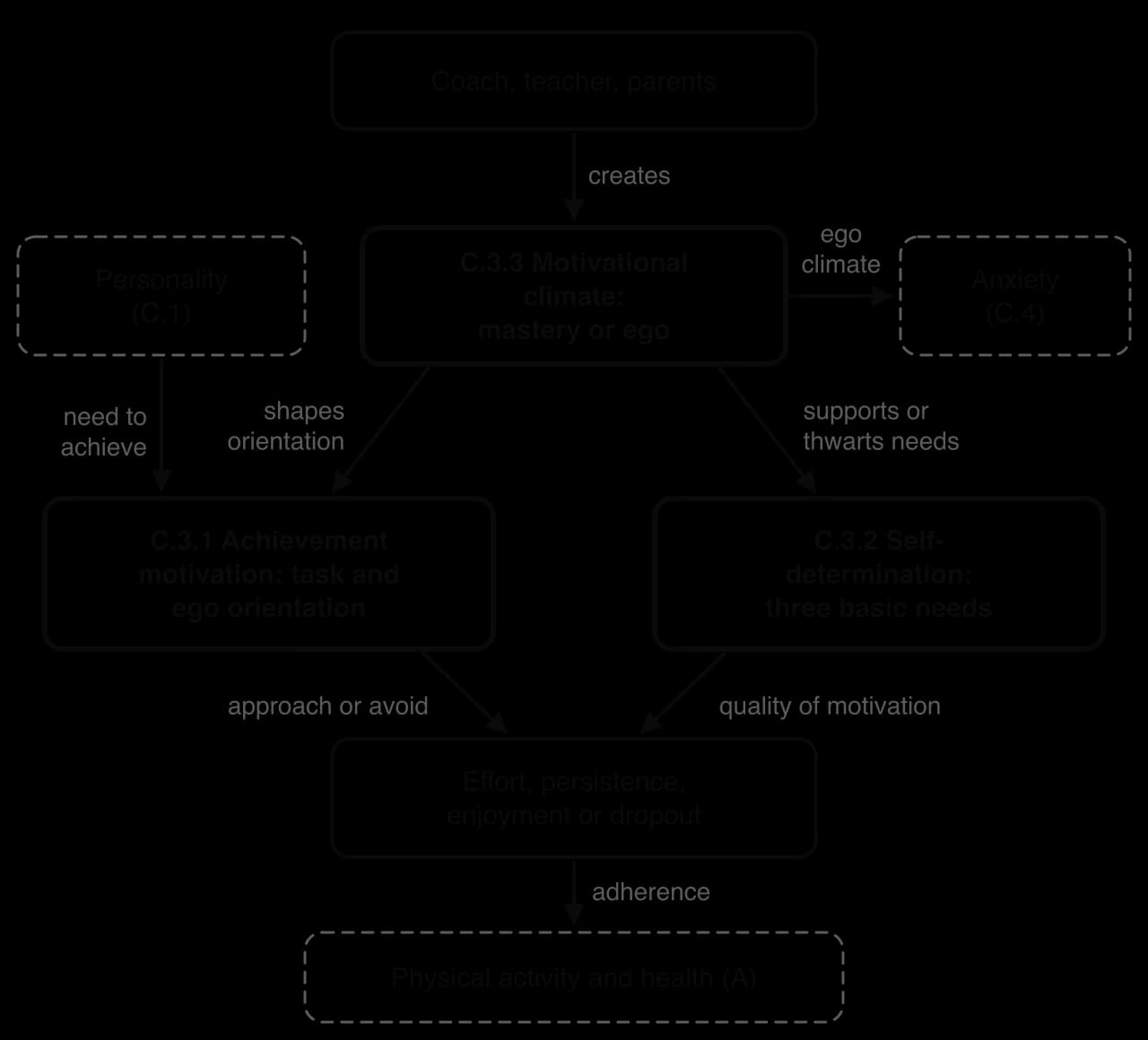
Achievement motivation and self-determination therefore explain the same behaviour from two directions. The first asks how people judge success and whether they approach or avoid a challenge; the second asks why they take part and how self-determined that reason is. Both predict that task-oriented, autonomously motivated performers try harder, enjoy their sport more and are less likely to drop out.
The map also shows links beyond the topic. The need to achieve is a personality factor, so motivation builds on individual differences. An ego climate raises anxiety, because worth depends on beating others, which links motivation to arousal and anxiety. Motivation is also the main psychological factor in exercise adherence, and so in whether the health benefits of physical activity are ever achieved.
Health and performance
Health lens | Performance lens |
|---|---|
Autonomous motivation predicts long-term exercise adherence better than controlled motivation such as rewards or guilt. | Task orientation is linked to greater effort, use of practice and persistence after failure. |
Financial incentives raise activity while they are paid, but the effect often fades once they stop. | High ego orientation with low perceived ability can lead to self-handicapping and withdrawal of effort (HL). |
A mastery climate in physical education increases enjoyment and lowers anxiety for children of every ability. | A mastery climate encourages athletes to report fatigue and injury rather than hide them. |
Motivation links to both of the other themes. In exercise physiology, training adaptations only happen when people keep training, so the principles of training depend on motivation to follow them. In biomechanics and injury, an ego climate in which rest is seen as weakness can lead athletes to hide pain or overload, which raises the risk of overuse injuries. Within sport psychology, motivation connects to goal setting, since process and performance goals support task orientation.
How SL and HL differ
HL students study everything SL students study, plus additional higher level material. In this course that extra material is mostly added inside subtopics rather than as separate subtopics. Most pages are therefore read by everyone, and contain sections with headings ending “(HL only)” that SL students can skip. Questions on the HL material appear only in the HL papers.
In Motivation, no subtopic is HL only, and Motivational climate contains no HL material: both levels study it in full. Two subtopics have HL-only parts:
Achievement motivation: why high ego orientation becomes a problem when task orientation and perceived ability are both low, including ego protection, self-handicapping and dropout, and what this means for coaching and physical education.
Self-determination: self-determination theory as a meta-theory of six mini-theories: cognitive evaluation theory (including the overjustification effect), organismic integration theory (external, introjected, identified and integrated regulation), causal orientations theory, basic psychological needs theory, goal contents theory and relationships motivation theory.
Assessment
Motivation is examined in all three parts of the external assessment. Paper 1A asks multiple-choice questions, for example which type of motivation a quotation shows or which TARGET structure a coaching change belongs to. Paper 1B often gives data from a questionnaire or intervention study, such as goal orientation or enjoyment scores in two groups, and asks students to compare them, judge significance and evaluate the method. Paper 2 asks short-answer and extended-response questions. HL-only material appears only in the HL papers.
The topic tends to produce these kinds of question:
distinguishing between task and ego orientation, intrinsic and extrinsic motivation, or mastery and ego climates;
placing a described athlete on the self-determination continuum and justifying the choice;
explaining the resultant tendency in need achievement theory and how a coach can change the situational factors;
applying TARGET to design a session for a named group, such as beginners in physical education;
evaluating a theory of motivation, or the use of rewards to increase physical activity;
explaining the problems of high ego orientation, or one of the six mini-theories (HL).
Carry on with C.3 in Augment
With a free account, Augment remembers where you stopped and what you have practiced.