Distinguish mastery and ego motivational climates, explain their effects on motivation, anxiety and dropout, and apply the TARGET approach to design sessions that build a mastery climate.
Each is in the SEHS glossary, with every other term in the subject.
A motivational climate in which success is defined as winning and outperforming others, with public comparison, recognition mainly for the most able, rivalry between teammates and punishment of mistakes; also called a performance climate.
A motivational climate in which success is defined as effort, learning and personal or team improvement, cooperation is encouraged and mistakes are treated as part of learning; also called a task-involving climate.
The psychological environment that a coach, teacher, parent or peer group creates through session design, instruction, feedback and rewards, which signals how success is defined and influences athletes’ motivation.
A 33-item self-report questionnaire, the Perceived Motivational Climate in Sport Questionnaire-2, that measures how athletes perceive the task-involving (mastery) and ego-involving climate created by their coach.
A framework of six areas of the learning environment (task, authority, recognition, grouping, evaluation and time) that coaches and teachers structure to create a mastery motivational climate.
Outline what is meant by motivational climate and how coaches create it through session design, instruction and feedback.
Distinguish between a mastery climate and an ego climate.
Describe the outcomes associated with each climate, using research evidence.
Explain how the motivational climate influences an athlete’s goal involvement and, over time, their goal orientation.
Outline how the perceived motivational climate is measured with the PMCSQ-2.
Describe each area of TARGET in its mastery and ego form.
Apply TARGET to design a session that fosters a mastery climate.
Evaluate when an ego climate might seem effective and why a mastery climate is more effective over time.
The motivational climate is the psychological atmosphere of a training group: what the coach praises, how sessions are organised and what athletes come to believe counts as success. Two teams with the same facilities and equally talented players can feel completely different to train in, and research shows that this difference affects enjoyment, anxiety, effort and whether young athletes stay in sport.
Health lens | Performance lens |
|---|---|
A mastery climate in PE and community sport is associated with enjoyment, intentions to stay active and lower anxiety, which supports lifelong physical activity and well-being. | A mastery climate supports effort, learning and persistence over many seasons, which is how athletes develop; an ego climate may push short-term results but carries risks of anxiety, cheating and dropout. |
With a free account, Augment remembers where you stopped and what you have practiced.
Carole Ames, working in education, showed that the way a classroom is organised tells pupils what success means. Sport psychologists applied the idea to coaching. Every coaching decision, from how drills are organised to who is praised and for what, sends a message about whether success means improving or beating others. Taken together, these messages form the motivational climate.
Coaches create the climate through three main channels. Session design includes which tasks are set, how athletes are grouped and how much time is given to learn. Instruction includes what athletes are told the purpose of an activity is, for example "find a way to keep possession" or "beat the other group". Feedback includes what is praised, what is criticised and how mistakes are treated, in words, tone and body language, as well as who is selected and rewarded.
What matters for motivation is the perceived climate: how athletes interpret the environment. Two players in the same squad can perceive it differently, depending on their own goal orientation, their position in the team and how the coach treats them personally. For this reason the climate is measured by asking athletes what they experience, not by asking the coach what they intend.
Research identifies two contrasting climates. They are usually measured as two separate dimensions, so a team can be high in one and low in the other, or show features of both.
A mastery climate (also called a task-involving climate) emphasises individual and team development. Success is defined as learning, improving and giving full effort. The coach recognises effort, cooperation and improvement, treats mistakes as a normal part of learning, gives every athlete an important role, and judges progress against each athlete’s own previous performance.
In a mastery climate, a gymnastics coach might set each gymnast a personal target for the session, praise a gymnast who finally lands a skill she has been working on for weeks, ask experienced gymnasts to help beginners, and treat a fall as information about the take-off. Winning competitions still matters, but it is seen as the result of learning, not as the only measure of worth.
An ego climate (also called a performance climate or ego-involving climate) emphasises winning, competition and comparison with others. Success is defined as being better than teammates or opponents. The coach gives most attention and praise to the most able, punishes mistakes, ranks athletes publicly and encourages rivalry within the team. In its extreme form, winning becomes the only thing that counts, "at all costs".
In an ego climate, the same gymnastics coach might post the session’s scores on a board, spend most of the time with the two best gymnasts, shout at a gymnast who falls and select only the highest scorers for competitions. Gymnasts quickly learn that what counts is ranking, not improvement.
Feature | Mastery climate | Ego climate |
|---|---|---|
Success is defined as… | Effort, learning, improvement | Winning, beating others, being the best |
Mistakes are… | Part of learning; information | Punished; a sign of low ability |
Recognition goes to… | Effort and improvement, for everyone | The most able and the winners |
Comparison is… | With one’s own previous performance | With teammates and opponents, often public |
Relationships between teammates | Cooperation; helping each other learn | Rivalry within the team |
Every athlete’s role | Important; all contribute | Mostly for the best players |
Typical coach statement | "Better than last week: what made the difference?" | "Only the top three are travelling." |
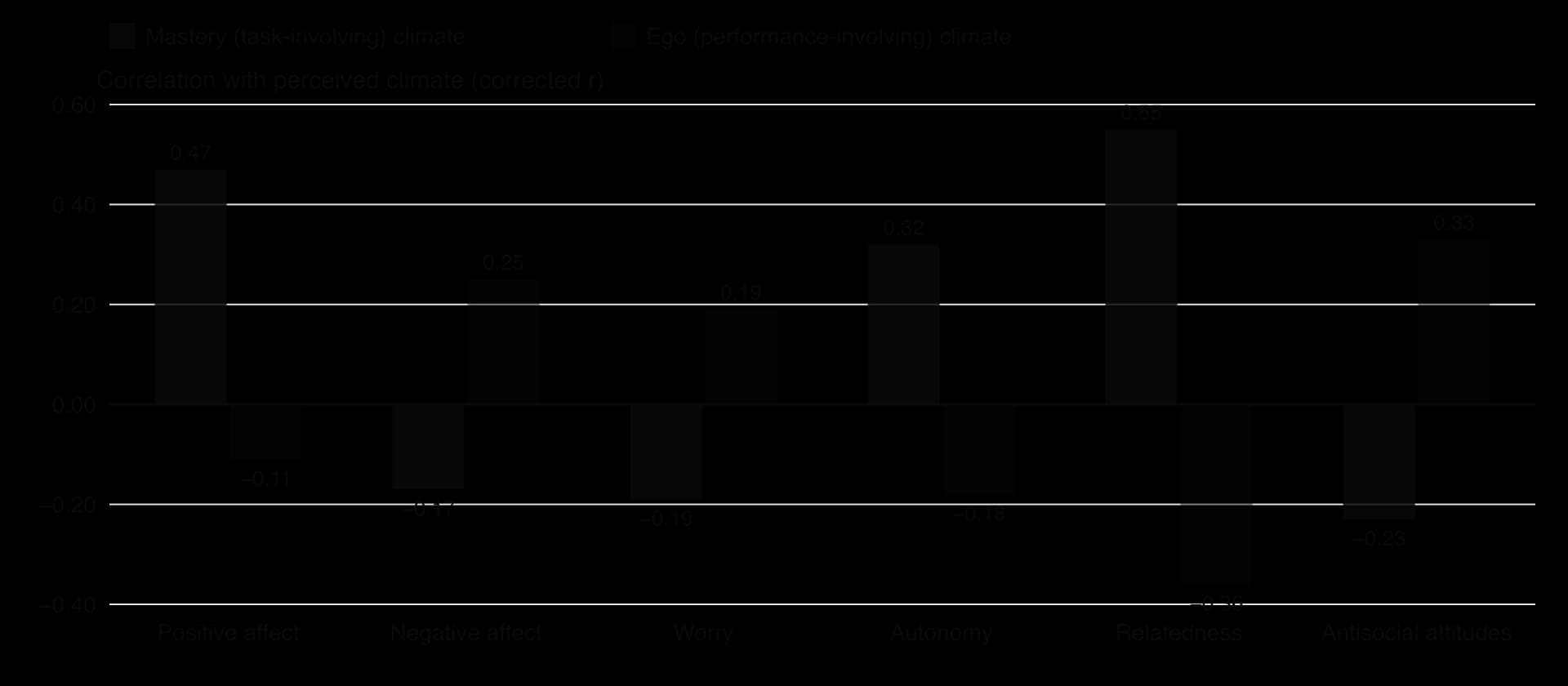
The effects of the two climates have been examined in hundreds of studies with athletes, PE pupils and exercisers. A systematic review of research from 1990 to 2014 combined 104 published studies (121 independent samples, a total of 34,156 participants, mean ages from 10 to 38 years). It calculated the average correlation between each perceived climate and a range of outcomes.
The chart shows a consistent pattern. A perceived mastery climate is moderately and positively related to positive affect (enjoyment, satisfaction and interest), to feeling autonomous and to feeling related to others in the group, and negatively related to negative affect, worry and antisocial attitudes. A perceived ego climate shows almost the reverse: it is positively related to negative affect, worry and antisocial attitudes such as accepting cheating and intimidation, and negatively related to relatedness and autonomy.
The same review found that a mastery climate was associated with higher perceived competence, higher self-esteem, more intrinsic forms of motivation, adaptive strategies such as persistence and effort, the experience of flow, and better objective performance (a small positive correlation of 0.25). An ego climate showed no association with objective performance, but was associated with extrinsic regulation, amotivation, maladaptive strategies and perfectionism.
Outcome | Mastery climate | Ego climate |
|---|---|---|
Enjoyment and positive affect | Higher | Slightly lower |
Anxiety, worry and negative affect | Lower | Higher |
Effort and persistence | Higher | No consistent link; more maladaptive strategies |
Teamwork and relatedness | Higher | Lower |
Sportspersonship | More prosocial attitudes | More acceptance of cheating and intimidation |
Objective performance | Small positive association | No association |
Motivation type | More intrinsic, autonomous | More extrinsic, more amotivation |
Sources: Harwood, Keegan, Smith & Raine, Psychology of Sport and Exercise, 2015.
One such intervention trained youth basketball coaches in the United States in the Mastery Approach to Coaching, a short workshop on encouragement, instruction after mistakes and praising effort. Other coaches received no training and acted as a control group. Over the season, athletes of the trained coaches perceived a more mastery-involving climate and reported decreases in both cognitive and somatic anxiety, while athletes of the untrained coaches reported increases in anxiety. The effects were similar for boys’ and girls’ teams.
Sources: Smith, Smoll & Cumming, Journal of Sport and Exercise Psychology, 2007.
Because coaches were assigned to an intervention or a control condition, this study provides stronger evidence than correlations that the climate itself changes anxiety. Its limits are that it covered one sport, one season and one country, and the outcomes were self-reported by the athletes.
The mechanism follows from achievement goal theory. In an ego climate, success depends on outperforming others, which is never fully under an athlete’s control. Every mistake is public and every comparison is a test of ability, so athletes appraise training and competition as threats. This raises cognitive anxiety (worry about being judged) and, for athletes with low perceived ability, encourages self-handicapping, reduced effort and eventually dropout. Among 519 adolescent female footballers aged 10–19, lower perceived mastery climate was the main predictor of a higher risk of dropping out.
Sources: Gredin et al., Science and Medicine in Football, 2022.
An ego climate can also push athletes to train beyond what is healthy. When status in the team depends on being better than others and rest is seen as weakness, athletes may hide fatigue or injury and increase their training load. A sustained imbalance between load and recovery is associated with non-functional overreaching and overtraining syndrome, and with burnout, a state of physical and emotional exhaustion and reduced sense of accomplishment.
A motivational climate influences what an athlete tries to achieve in a particular session, their goal involvement. In a mastery climate, even an ego-oriented player tends to become task-involved during drills that reward improvement. In an ego climate, even a task-oriented player is pushed towards comparing themselves with others. Over months and seasons, repeated involvement of one kind is thought to shift the athlete’s stable task orientation or ego orientation.
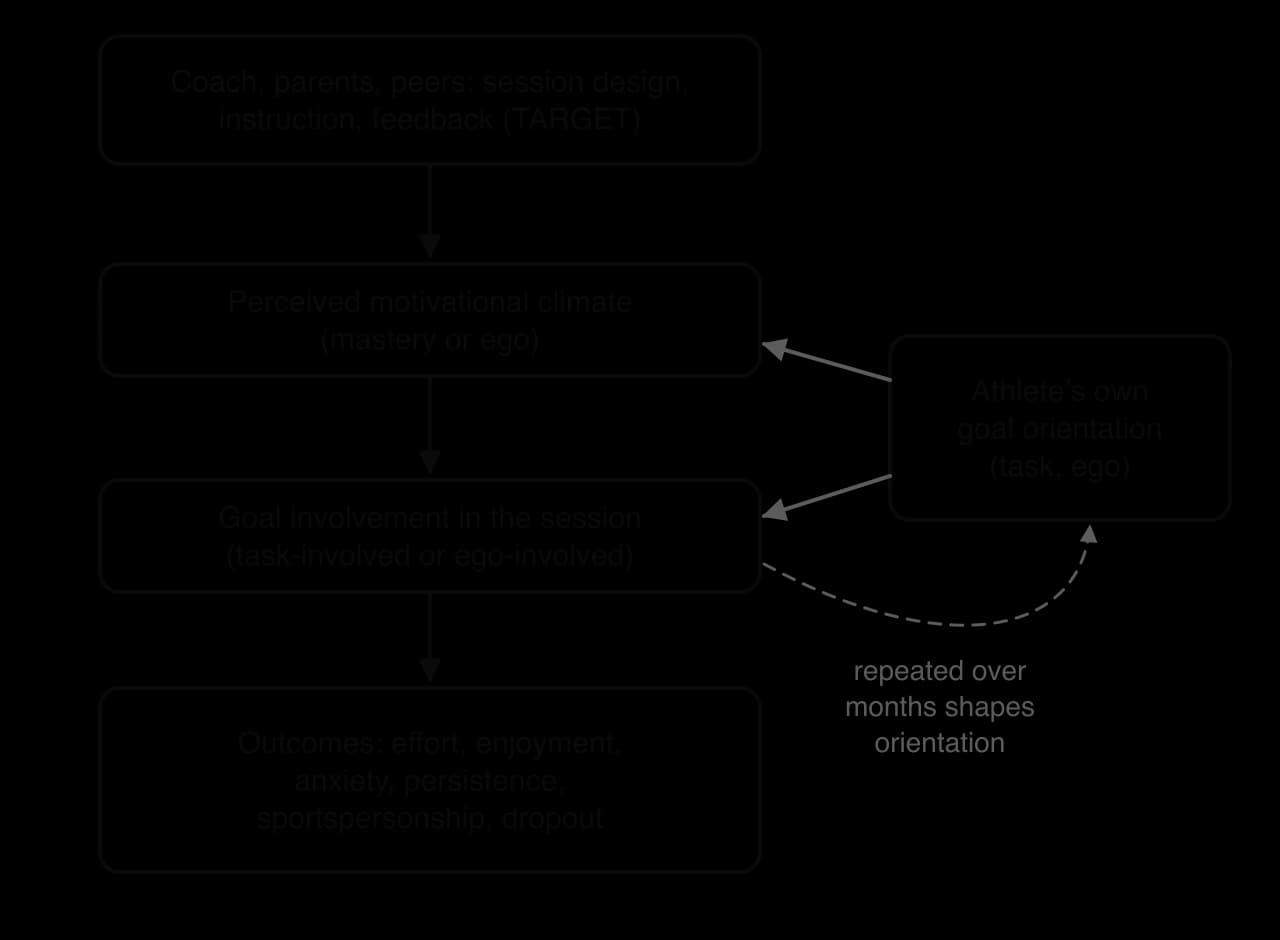
The relationship runs both ways. Across the studies in the systematic review, a perceived mastery climate correlated moderately with task orientation (0.46) and a perceived ego climate with ego orientation (0.36), while mastery climates showed no link with ego orientation. The relationship may arise because climates socialise athletes, because athletes choose clubs whose climate suits them, or because athletes perceive the climate through their own orientation. Most likely all three processes operate.
The climate also links to self-determination theory. A mastery climate supports the three basic psychological needs: autonomy (athletes share decisions), competence (every athlete can experience improvement) and relatedness (cooperation instead of rivalry). The chart shows the strong association between a mastery climate and relatedness. Satisfying these needs is associated with more autonomous motivation, enjoyment and persistence.
Coaches are not the only source of climate. Parents create a climate through what they ask and praise after a match, and peers create one through how they treat mistakes and whether they compare or help. Research measures coach-, parent- and peer-created climates separately, and studies of young athletes suggest that the combination matters more than any single source.
Researchers at the University of Birmingham have extended the idea into empowering and disempowering climates. An empowering climate combines mastery features with support for autonomy and good relationships; a disempowering climate combines ego features with controlling coaching, such as threats, guilt and conditional attention. The Empowering Coaching programme, used in the European PAPA project in grassroots football, trains coaches to create the empowering version.
 YouTube
The perceived climate is most often measured with the Perceived Motivational Climate in Sport Questionnaire-2 (PMCSQ-2). Athletes rate 33 statements about their team on a five-point scale. Its task-involving scale has three subscales (cooperative learning, effort and improvement, and important role), and its ego-involving scale has three (punishment for mistakes, unequal recognition and rivalry between team members).
Like any self-report measure, the PMCSQ-2 depends on honest answers and on the athlete’s interpretation, which is partly the point, because the perceived climate is what affects motivation. Researchers combine it with observation of coach behaviour when they want to know what the coach actually does.
To create a mastery climate, coaches need to know which parts of their coaching to change. TARGET is a framework for doing this. It was developed by Joyce Epstein from research on families and schools and adapted by Carole Ames for classrooms, and sport psychologists then applied it to coaching. Each letter names one area of the learning environment that a coach controls.
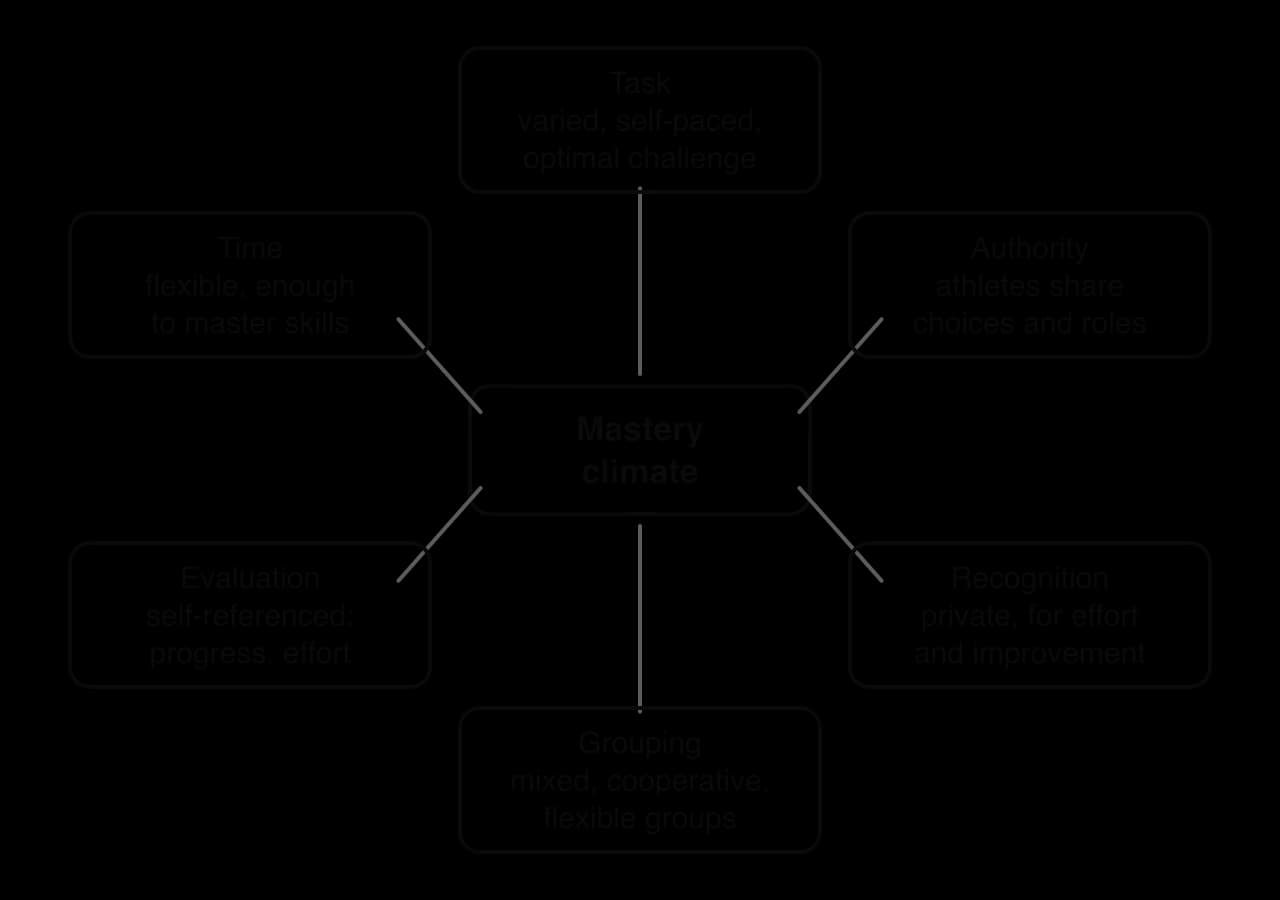
Area | What it covers | Mastery version | Ego version |
|---|---|---|---|
Task | The activities athletes are asked to do | Varied, optimally challenging tasks with several levels; individual targets | The same task for everyone; tasks that expose who is best |
Authority | Who makes decisions | Athletes share choices (drills, roles, leadership, self-chosen difficulty) | The coach makes all decisions; no athlete input |
Recognition | What is rewarded and how | Private recognition of effort, improvement and helping others | Public recognition of winners and the most able only |
Grouping | How athletes are organised | Mixed-ability, cooperative, flexible groups | Groups by ability that stay fixed; rivalry between athletes |
Evaluation | How progress is judged | Self-referenced: personal targets, effort, improvement; athletes evaluate themselves | Norm-referenced: rankings, comparison with teammates, public results |
Time | How time is used | Flexible: enough time to master a skill; pace adapted to the learner | Fixed: everyone must learn at the same pace; little time for slower learners |
Each area works through the mechanisms of achievement goal theory. Task design sets the probability of success for each athlete, so everyone can experience progress. Authority gives athletes a sense of ownership, which supports autonomy. Recognition and evaluation define success; if they reward improvement, every athlete can succeed, while if they reward only winners, most athletes are told they have failed. Grouping decides whether teammates are partners or rivals. Time allows slower learners to reach mastery instead of being labelled as having low ability.
Real coaching examples make each area concrete. In swimming, the task area might use lanes with different send-off times so every swimmer completes the set at a challenging pace. A volleyball coach shares authority by letting the setter choose the attacking options in a game, and recognition by naming the "most improved" and "best effort" players privately after training. Grouping in youth football can mix experienced and new players in pairs for passing drills. Evaluation in athletics can mean that each athlete records their own personal bests in a training diary. Time in gymnastics means a new skill is practised over several weeks before it is tested.
A session plan can be checked area by area. The worked example applies TARGET to a typical youth team session.
The same framework applies in health settings, where the people most at risk of stopping exercise are often the least confident.
The weight of evidence favours a mastery climate, but a balanced judgement considers when an ego climate might seem useful and what the outcome depends on.
Some coaches argue that sport is about winning and that public comparison, rivalry and pressure prepare athletes for competition. In the short term this can appear to work. Before a selection trial or a final, a strongly ego-involving message can raise effort, particularly in athletes who are high in ego orientation and confident that they are among the best, because for them comparison promises success. Elite sport also contains unavoidable ego-involving features: selection, rankings, contracts and media attention.
The evidence suggests these gains are fragile. Across the studies in the systematic review, an ego climate showed no association with objective performance, while a mastery climate showed a small positive one. The costs of an ego climate (anxiety, worry, antisocial attitudes, weaker relationships and dropout) accumulate over time and fall most heavily on athletes with lower perceived ability, who are often younger, later-maturing or recovering from injury.
A mastery climate keeps every athlete motivated, not only the current best. Skills improve through deliberate effort on weaknesses, which athletes avoid if mistakes are punished. Athletes who enjoy training stay in the sport longer, and long-term participation is needed both for elite development (talent emerges at different ages) and for health. A mastery climate also does not prevent athletes from being highly competitive: many elite athletes are high in both task and ego orientation, and a mastery climate gives them a second, controllable source of success when results go against them.
The athlete’s own orientation and perceived ability: an athlete high in ego orientation and confident of winning may tolerate an ego climate well; one with low perceived ability is the most harmed by it.
Level and stage: in children’s and recreational sport the case for a mastery climate is strongest; in elite sport some ego-involving features are unavoidable, so the coach’s task is to stop them dominating.
Culture: most evidence comes from Western Europe and North America. Studies elsewhere generally find effects in the same direction, but expectations about authority and public comparison differ between cultures, so how TARGET is applied may need adapting.
Consistency: the climate is created by parents and peers as well as the coach, and a mastery climate in training can be undermined by an ego climate at home.
On balance, a mastery climate is the better default in almost every setting, because its benefits for enjoyment, effort, relationships and persistence are consistent and its link with performance is positive, while the advantages claimed for an ego climate are short-term and limited to a few athletes. The most realistic aim for competitive sport is a climate that is high in mastery features and uses competition as information, rather than one that removes competition altogether.
Norway is often cited as a national example of a mastery-oriented youth sport system. The Norwegian Olympic and Paralympic Committee and Confederation of Sports (NIF), the umbrella body for organised sport, sets binding rules for all sport for children up to and including the year they turn 12. Provisions on children’s competitions were first adopted in 1987; the Children’s Rights in Sport were added in 2007, and both were revised in 2015 and 2019.
The current version lists eight rights for children: safety, friendship and enjoyment, achievement (the right to experience mastery and to learn many different skills), influence (to be heard and to take part in planning), the freedom to choose which and how many sports to play and how much to train, competitions for all (the right to choose whether or not to compete), activities on the children’s terms (suited to their age and maturity), and the right of everyone to play whatever their family’s finances. The provisions turn these rights into rules.
Provision (summary) | Age | TARGET area |
|---|---|---|
Local competitions, mainly within the child’s own club | From the year the child turns 6 | Task, Grouping |
Results lists, tables and rankings may be used, if appropriate | Only from the year the child turns 11 | Evaluation |
Regional competitions | From the year the child turns 9 | Task, Time |
Open competitions in Norway, the Nordic countries and the Barents region | From the year the child turns 11 | Task, Time |
No national, European or world championships or equivalent competitions | Up to and including the year the child turns 12 | Evaluation, Recognition |
If prizes are awarded, every child receives one | All of children’s sport | Recognition |
Children choose whether to compete and have a say in planning | All of children’s sport | Authority |
Development plan: play to age 6, varied activities 7–9, varied high activity with some specialisation 10–12 | Up to 12 | Task, Time |
Sources: Norwegian Olympic and Paralympic Committee and Confederation of Sports (NIF), Children’s Rights in Sports and the Provisions on Children’s Sports, adopted 2007, revised 2019.
Seen through TARGET, the system is designed to remove the main ego-involving features of youth sport before adolescence. Evaluation by rankings is delayed until 11, recognition is shared by everyone, children choose how much to compete and train (authority), and the development plan protects varied tasks and time to learn rather than early specialisation. Each sports federation must adopt sanctions for breaking the provisions, such as fines for clubs, and serious or repeated violations are reported to NIF’s adjudication committee.
Participation is high. More than 80% of Norwegian children take part in organised sport, most starting before the age of 10, although, as in other countries, many stop as they get older. At the elite level, Norway, a country of about 5.5 million people, topped the medal table at the Winter Olympics of 2002, 2014, 2018, 2022 and 2026. Its 37 medals at Beijing 2022 equal about 6.8 medals per million inhabitants, compared with about 0.3 for Germany, the second-placed nation.

The medal record is often presented as proof that a mastery climate in childhood produces elite success, but the data cannot show this. Norway was already a leading nation in 1994 (second) and 2002 (first), before any child who grew up under the 2007 rights could have reached senior level, although earlier versions of the provisions date back to 1987.
Many other factors also differ between Norway and other countries: snow and a strong skiing culture, high national wealth, public funding for clubs and facilities, an elite support system, and a small number of sports in which Norway specialises. A national comparison has no control group, so any link between the rules and medals is a correlation that may be confounded.
What the case does show is that a mastery-oriented framework can be applied to an entire national sport system, and that it is compatible with world-leading elite performance. The strongest argument for it rests on the research into climates and on its aims for children: broad participation, enjoyment and lifelong activity, which matter through the health lens whether or not they produce medals.
Sources: NIF, 2007, revised 2019; Moa, Berntsen & Lagestad, Frontiers in Public Health, 2020 (participation); International Olympic Committee medal tables, via Wikipedia, 2026; World Bank, population 2022, 2026.
State which TARGET area each of the Norwegian provisions mainly affects, and suggest one area the rules cannot control.
Discuss whether Olympic medal data can be used as evidence that a mastery climate in children’s sport improves elite performance.
Suggest how the rights to influence and freedom to choose might support autonomy, competence and relatedness.
Questions on motivational climate cover definitions and comparisons of the two climates, application of TARGET to a named sport or exercise setting, data from climate interventions, and extended responses that evaluate the climates.
Questions on TARGET often give a coaching action and ask which area it belongs to.
Some questions test the outcomes associated with each climate.
A study trained 20 youth football coaches in a mastery-climate programme; another 20 coaches received no training (control). Players completed an anxiety questionnaire (scores 15–60; higher = more anxious) at the start and end of the season. The results are shown (hypothetical data).
Group | n (players) | Pre-season anxiety, mean ± SD | End-of-season anxiety, mean ± SD |
|---|---|---|---|
Intervention coaches | 120 | 34.0 ± 7.2 | 30.1 ± 6.8 |
Control coaches | 105 | 33.6 ± 7.5 | 35.9 ± 8.1 |
Distinguish questions need a clear contrast on the same feature.
Application questions name the setting; answers must stay in it.
The motivational climate is the psychological environment created by coaches (and parents and peers) through session design, instruction and feedback; it is the perceived climate that affects motivation.
A mastery climate defines success as effort, learning and improvement, with cooperation and mistakes treated as learning.
An ego climate defines success as winning and beating others, with public comparison, unequal recognition, rivalry and punishment of mistakes.
Mastery climates are associated with enjoyment, relatedness, autonomy, lower anxiety, sportspersonship, persistence and better objective performance; ego climates with anxiety, worry, antisocial attitudes and dropout.
The climate shapes goal involvement in each session and, over time, task and ego orientation; it is measured with the PMCSQ-2.
TARGET (task, authority, recognition, grouping, evaluation, time) gives coaches six areas to structure for a mastery climate.
An ego climate may appear effective in the short term for confident, ego-oriented athletes, but a mastery climate is more effective for enjoyment, teamwork and performance over time.
National systems such as Norway’s Children’s Rights in Sport apply mastery principles to all children’s sport, although medal data cannot show cause and effect.
I can define motivational climate and outline how session design, instruction and feedback create it.
I can distinguish a mastery climate from an ego climate using at least four features.
I can describe the outcomes associated with each climate and quote research evidence.
I can explain why an ego climate can be anxiety-inducing and lead to dropout.
I can explain how the climate influences goal involvement and goal orientation.
I can outline the PMCSQ-2 and its subscales.
I can describe all six TARGET areas in their mastery and ego forms.
I can apply TARGET to design a session for a named sport or exercise group.
I can evaluate when an ego climate might seem useful and why a mastery climate works better over time.