C.1 Individual differences
Explain how personality and mental toughness help account for differences in how people take part, persist and perform in sport and exercise, and judge what self-report evidence can and cannot show.
- IB Sports, Exercise and Health Science
- SL and HL
What C.1 covers
From the subject guide: what you need to know and be able to do.
Why some people succeed and thrive in sport more than others.
2 subtopics in Individual differences
Each one has its own page once something is published for it.
- C.1.1Personalitynotes
- C.1.2Mental toughnessnotes
An overview of C.1 Individual differences
Individual differences studies why people respond differently to the same sport, exercise programme or pressure: the personality traits that make each person distinctive, and the mental toughness that helps some people manage challenge and setbacks. These differences help explain who takes up and keeps up physical activity, who follows a rehabilitation programme, and who performs well when the stakes are high.
The questions behind the topic
The topic is built around one central question: which characteristics explain how and why some people succeed, and feel well, in sport and health settings more than others? Each subtopic answers part of that question, and each answer comes with limits, because personality is measured mainly by questionnaires. Everyday situations make the question concrete:
Why do some people keep exercising for decades while others stop within weeks of starting?
Is there a “sporting personality”, and could a questionnaire pick out the future champions in a squad?
Why do some players make fewer errors when a match is close, while others make more?
Can mental toughness be trained, or is it fixed early in life?
Why does a team that keeps losing sometimes appear to stop trying altogether? (HL)
How does the way an athlete explains a defeat affect how confident they feel before the next game? (HL)
What the topic covers
Subtopic | Main question it answers | Level |
|---|---|---|
C.1.1 Personality | What is personality, where does it come from, how is it measured, and does it predict how people behave and perform in sport and exercise? | SL and HL, with an HL-only part |
C.1.2 Mental toughness | What is mental toughness, how is it measured and developed, and how does it help people cope with pressure and setbacks? | SL and HL, with an HL-only part |
Personality introduces the trait approach, the Big Five traits (openness, conscientiousness, extraversion, agreeableness and neuroticism), the roles of genes and environment, and the interactionist approach, in which behaviour depends on both the person and the situation. Mental toughness describes one aspect of personality through the 4Cs model (challenge, commitment, control and confidence), compares it with resilience, and evaluates how it is measured and whether it can be developed.
How the subtopics connect
The concept map shows the topic as a chain from causes to behaviour. Personality traits develop from an interaction of genes, shown by their moderate heritability, and the environment a person grows up in. Mental toughness is one aspect of personality, so the same questions about inheritance, measurement and change apply to both subtopics.
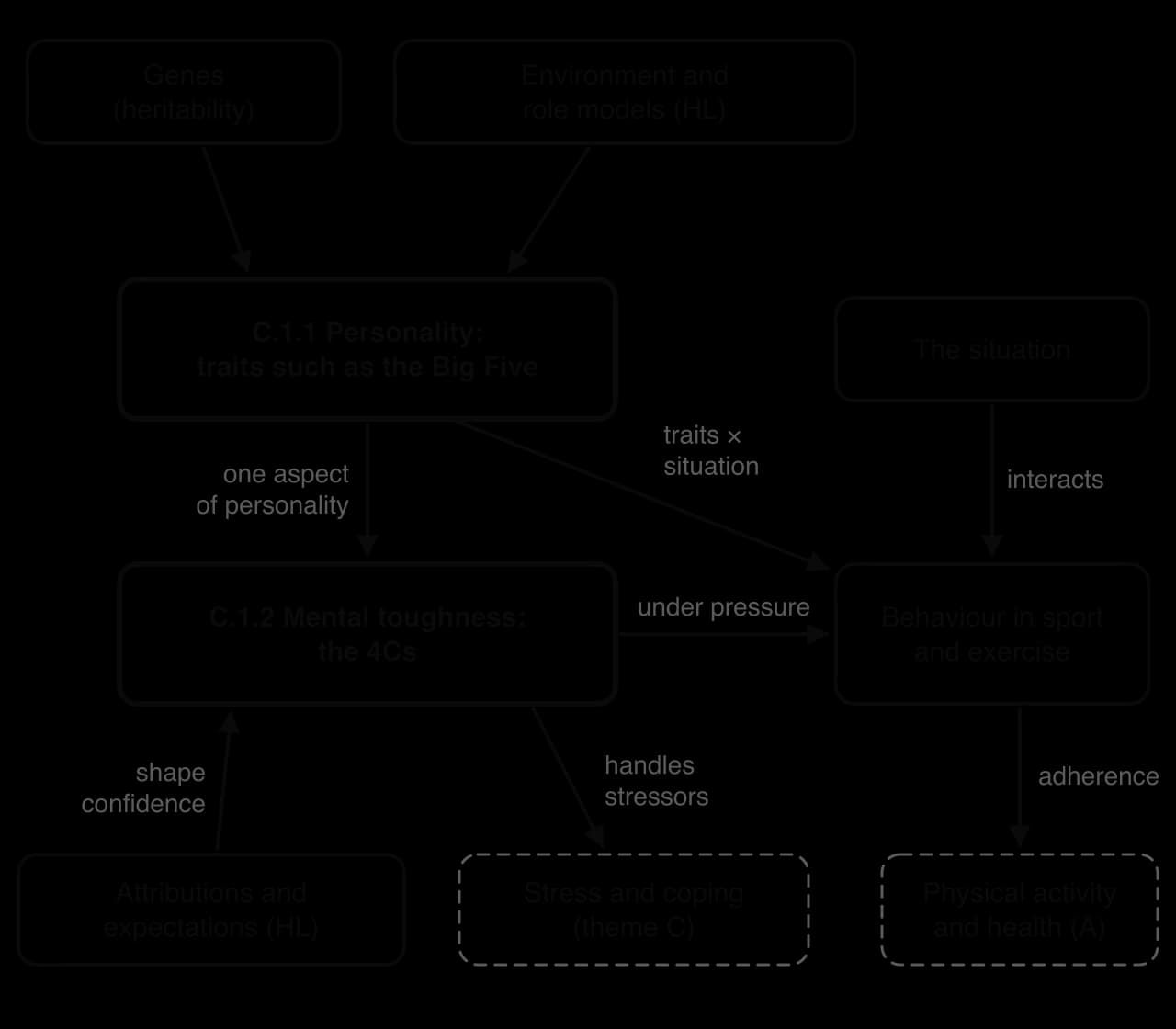
Neither traits nor mental toughness decide behaviour on their own. A conscientious athlete may still miss training when a new job takes up their time, and a mentally tough player may still make errors when the pressure is unusual. The interactionist view therefore treats behaviour as the product of traits and the situation together. At HL, social learning theory adds how behaviour is learned from role models, and attribution theory, the self-fulfilling prophecy and learned helplessness explain how expectations and explanations of success and failure build or erode confidence.
The map also shows links beyond the topic. Mental toughness shapes how a person appraises a stressor and chooses a coping strategy, so it connects directly to stress and coping. The need to achieve in achievement motivation is itself a personality factor. Traits such as conscientiousness are linked to keeping up physical activity, which connects individual differences to the health benefits of exercise.
Health and performance
Health lens | Performance lens |
|---|---|
Conscientious adults are more likely to start and keep up regular physical activity and to complete a rehabilitation programme after injury. | Mental toughness helps athletes maintain or improve performance under pressure and recover from mistakes within a game. |
Higher mental toughness is linked to fewer symptoms of depression and burnout and better sleep quality (HL). | How an athlete attributes a win or a loss affects their confidence and effort in the next competition (HL). |
A culture that praises “toughness” can lead athletes to hide pain, injury or low mood rather than seek help. | No personality profile predicts who will become elite, so personality tests are not used fairly for team selection (HL). |
Individual differences link to both of the other themes. In exercise physiology, adherence to an exercise programme decides whether its health benefits, such as lower blood pressure or better blood glucose control, are ever achieved. In biomechanics and injury, personality and mental toughness affect whether athletes report pain early, take risks, and complete rehabilitation. Within sport psychology, the topic is the base for motivation, anxiety and coping, because each of these differs between individuals.
The topic also raises a recurring point about how knowledge is produced. Most of the evidence comes from self-report questionnaires, which are affected by social desirability bias, and from correlational studies, which cannot show that a trait causes a behaviour. Findings are therefore stated as associations, and individual athletes often differ from the group average.
How SL and HL differ
HL students study everything SL students study, plus additional higher level material. In this course that extra material is mostly added inside subtopics rather than as separate subtopics. Most pages are therefore read by everyone, and contain sections with headings ending “(HL only)” that SL students can skip. Questions on the HL material appear only in the HL papers.
In Individual differences, no subtopic is HL only, but both subtopics have HL-only parts:
Personality: social learning theory (the Bobo doll study, observational learning and its four processes, and vicarious reinforcement); how personality can change over a lifetime through experience, coaching and reflection; and why no personality profile predicts sporting success, including the iceberg profile and the ethics of testing.
Mental toughness: the self-fulfilling prophecy and the Pygmalion effect; learned helplessness and how coaches can prevent it; the links between mental toughness and health (burnout, depressive symptoms, sleep); and attribution theory, with locus of control, locus of stability and attribution retraining.
Assessment
Individual differences is examined in all three parts of the external assessment. Paper 1A asks multiple-choice questions, for example which Big Five trait describes a tendency to be organised and reliable, or which of the 4Cs a behaviour shows. Paper 1B often gives data from a questionnaire study, such as mental toughness scores of two groups, and asks students to compare the groups, judge whether a difference is significant and evaluate the use of self-report. Paper 2 asks short-answer and extended-response questions. HL-only material appears only in the HL papers.
The topic tends to produce these kinds of question:
outlining a Big Five trait or one of the 4Cs with a sporting example of the behaviour it produces;
distinguishing between mental toughness and resilience, or between the trait and interactionist approaches;
evaluating self-report questionnaires as a way of measuring personality or mental toughness;
discussing whether personality can predict sporting performance or exercise adherence;
explaining social learning theory, learned helplessness or attribution retraining with an example (HL).
Carry on with C.1 in Augment
With a free account, Augment remembers where you stopped and what you have practiced.