Describe and evaluate the five sampling techniques, explain how sampling bias arises and why a large sample cannot correct it, and judge how far a study’s sample allows its findings to be generalised.
Each is in the Psychology glossary, with every other term in the subject.
A sampling technique in which the researcher uses whoever is available and willing at the time, such as students in a class; also called convenience sampling.
A sampling technique in which the researcher deliberately chooses participants who have the characteristics or experiences the study needs, common in qualitative research.
A sampling technique in which every member of the target population has an equal chance of being selected, for example by drawing names or using a random number generator.
A sample whose characteristics, such as age, sex, culture and income, match those of the target population closely enough for findings to be generalised to it.
The group of participants actually selected to take part in a study, drawn from the target population.
A systematic error that occurs when some members of the target population are more likely than others to be included in a sample, so the sample does not represent the population.
The list or source from which a sample is actually drawn, such as an electoral register, a school roll or a telephone directory; a biased frame produces a biased sample.
The procedure used to select participants for a study from the target population, such as random, stratified, opportunity, self-selected or snowball sampling.
Explain the difference between a target population, a sampling frame and a sample, and why representativeness matters.
Describe random, stratified, opportunity, self-selected and snowball sampling, and how each is carried out.
Evaluate the advantages and disadvantages of each sampling technique, and suggest which suits a given research question.
Explain how sampling bias arises, including through the sampling frame, non-response and attrition.
Explain how sample size affects the precision of findings, and why a large sample cannot make up for a biased one.
Discuss how sampling affects the generalisability of quantitative findings and the transferability of qualitative findings, including across cultures.
Apply knowledge of sampling to evaluate the sample of an unfamiliar study.
Researchers can almost never study everyone they want to draw conclusions about, so they study a smaller group and reason from it to the larger one. The sampling technique is the procedure that decides who that smaller group is, and it determines how far a study’s findings can be trusted to apply to anyone else.
Sampling is a central question of bias: sampling bias occurs when a sample systematically leaves out some kinds of people, and it produces findings that describe only the people who were included. Much of the evidence in psychology comes from a narrow range of people, mostly university students in Western countries, so sampling also raises questions of perspective and cultural generalisability across every approach and context.
With a free account, Augment remembers where you stopped and what you have practiced.
A sampling technique in which people choose to take part, for example by answering an advertisement or an online invitation; also called volunteer sampling.
A sampling technique in which initial participants recruit further participants from their own contacts, used to reach hidden or hard-to-reach populations.
A sampling technique in which the target population is divided into subgroups, such as age bands, and participants are randomly selected from each subgroup in proportion to its size in the population.
The whole group of people that a researcher wants to draw conclusions about and from which the sample is selected.
Scope: Part of research methodology. It covers five sampling techniques (self-selected, opportunity, stratified, random and snowball) and the advantages and disadvantages of each. Purposive sampling, common in qualitative research, is included as a useful addition beyond these five.
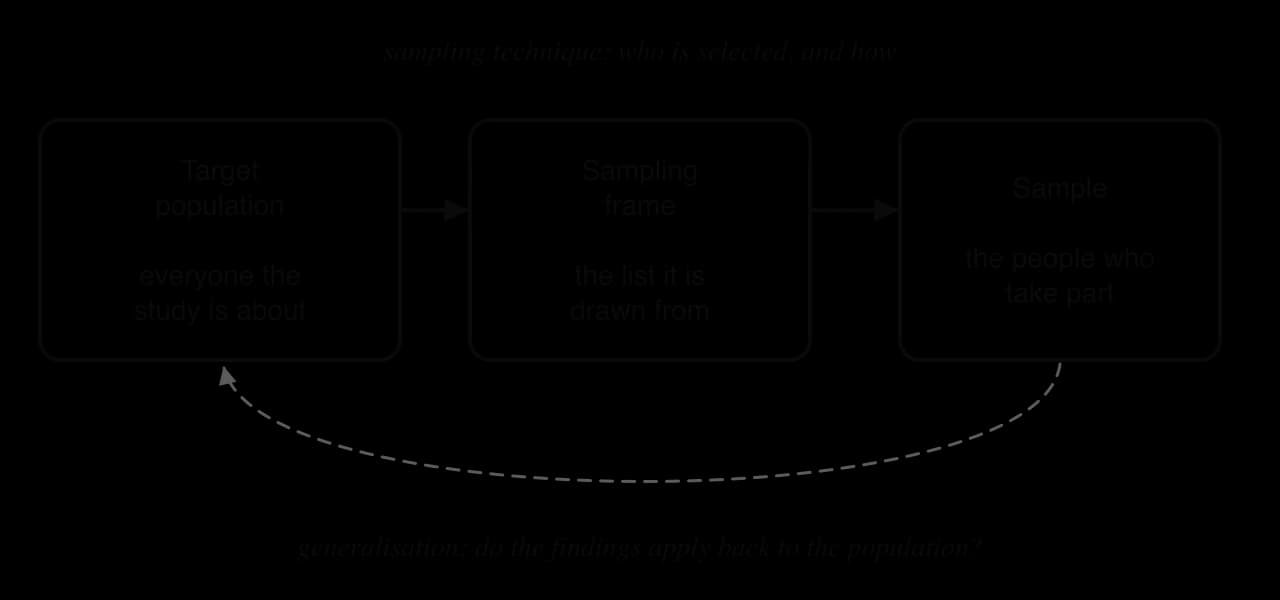
Every study starts with a group the researcher wants to understand. This is the target population: all adolescents in Kenya, all patients diagnosed with depression in one city, all first-year students at a university. The sample is the group of people who actually take part. The aim is for the sample to be a smaller version of the population, so that what is true of the sample is likely to be true of the population.
Between the two sits a practical step. A researcher can only select people they can find, so they need a list or source of potential participants, such as a school roll, an electoral register, a patient database or the members of an online panel. This is the sampling frame. If the frame leaves out part of the population, the sample will leave it out too, whatever technique is used to choose people from the frame.
A representative sample has the same characteristics as the population in the proportions that matter for the research question: age, sex, culture, income, education, health. Which characteristics matter depends on the study. For research on memory in older adults, age and education matter a great deal; for a study of colour perception, eye-colour genetics might matter more than income.
Representativeness is what allows a researcher to generalise: to claim that findings from the sample apply to the population. In quantitative research this is called generalisability, or external validity. Qualitative research usually does not aim for statistical representativeness; instead it asks whether its findings are transferable to other settings, which readers judge from a detailed description of who took part.
Sampling bias is systematic, not random. A small sample chosen fairly may by chance contain slightly more women than men; that is sampling error, and it shrinks as samples get larger. A sample drawn only from people who own a car will always contain too many wealthier people, however many are chosen; that is bias, and a larger sample does not reduce it.
The sampling frame. The list misses part of the population, for example an online survey cannot reach people without internet access.
The selection method. The researcher chooses people who are easy to reach or who seem willing, so the sample reflects the researcher’s choices.
Self-selection. People who volunteer differ from those who do not: they tend to be more interested in the topic, more educated, more sociable and more confident.
Non-response bias. Some people selected refuse or do not reply, and if non-responders differ from responders, the final sample is biased even if the original selection was fair.
Attrition. In longitudinal studies participants drop out over time, and those who leave (often the most unwell, the poorest or the most mobile) differ from those who stay.
Most published psychology research has relied on a very narrow slice of humanity. Arnett (2008) analysed articles in six leading journals of the American Psychological Association and found that 68% of their samples came from the United States and 96% from Western industrialised countries, which together hold about 12% of the world’s population. Henrich, Heine and Norenzayan (2010) described these participants as WEIRD: from Western, Educated, Industrialised, Rich and Democratic societies. Reviewing research on visual perception, fairness, cooperation, moral reasoning and self-concept, they concluded that WEIRD participants are often outliers compared with the rest of the species, not typical humans.
This is a problem of sampling with consequences for perspective. When a theory is built on WEIRD samples and then described as a theory of “human” cognition or relationships, it may describe one cultural group. It is one reason for the growth of cross-cultural research, the emic approach and Indigenous psychologies, which study behaviour in the groups that most research has left out.
Sampling techniques fall into two groups. In probability sampling (random sampling and stratified sampling), every member of the population has a known chance of selection, and chance rather than anyone’s choice decides who is selected. In non-probability sampling (opportunity sampling, self-selected sampling and snowball sampling), selection depends on availability, willingness or social networks. Probability techniques give the best chance of a representative sample, but they need a complete sampling frame, which is often impossible to obtain.
Obtain a complete list of the target population (the sampling frame).
Number every member of the list.
Use a random number generator (or names drawn from a container) to select the required number of people.
Contact everyone selected; replacing people who refuse with others breaks the randomness.
Random sampling is used where accurate estimates for a population are needed. In the US National Comorbidity Survey Replication, Kessler and colleagues (2005) used a nationally representative household sample, interviewing 9,282 English-speaking adults face to face to estimate how many Americans meet the criteria for a mental health disorder during their lifetime. The estimate, 46.4% for any disorder, is meaningful only because the sample was drawn by probability methods rather than from people who volunteered.
Because selection depends only on chance, random sampling removes the researcher’s influence over who is chosen, and with a large enough sample, all characteristics of the population, including ones nobody has measured, tend to appear in the right proportions. It also allows the size of sampling error to be calculated. Its limitations are practical: complete lists of a population rarely exist; contacting randomly selected people is slow and expensive; and those selected can refuse, so a random selection can become a biased sample through non-response. A small random sample can also be unrepresentative purely by chance.
 YouTube
Decide which characteristics are relevant to the research question (for example school grade, sex or region).
Find out the proportion of the population in each stratum.
Calculate how many participants each stratum should provide.
Select that number from each stratum at random.
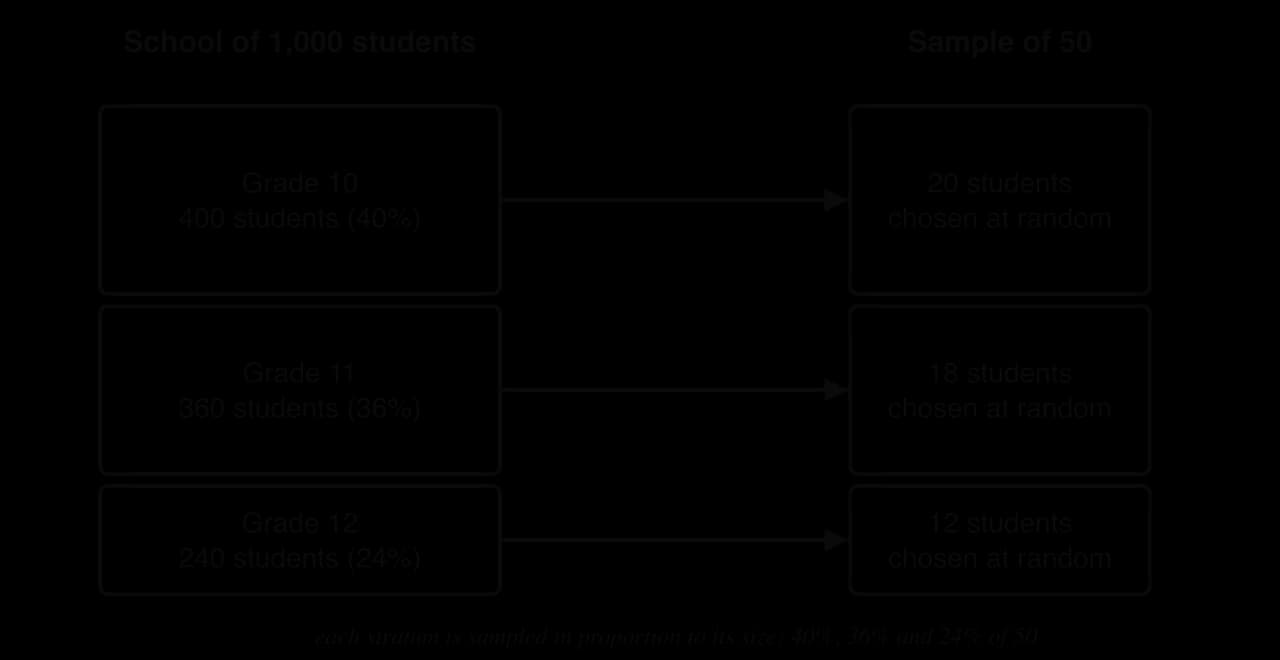
Large national health and social surveys often stratify by region, age and sex so that every part of the country is represented. Stratification is also used when a small group must not be missed. A random sample of 200 students from a school where only 5% belong to a minority group might, by chance, contain very few of them; stratifying guarantees ten.
Stratified sampling produces a sample that is representative on the chosen characteristics by design rather than by chance, which matters most in small samples and for small subgroups. Because selection within strata is random, it keeps the advantages of random sampling. Its limitations are that the researcher must know the population proportions in advance, must decide which characteristics to stratify by (an unmeasured characteristic may matter more), and needs a sampling frame that records those characteristics. It is the most time-consuming of the five techniques.
When people are chosen within strata by availability rather than at random, the technique is called quota sampling, which keeps the proportions but loses the randomness.
Opportunity sampling is by far the most common technique in psychology. Laboratory experiments are frequently run with university students recruited on campus, often for course credit: Loftus and Palmer’s 45 participants were students at the University of Washington. School-based class practicals usually use classmates. The researcher approaches people who are present and asks them to take part.
Opportunity samples are quick, cheap and convenient, which makes it possible to run many studies and to replicate them. For experiments that test basic processes, such as how the wording of a question affects memory, a convenience sample can be acceptable, because random allocation to conditions (not random sampling) is what protects the causal conclusion. The limitations are serious for generalisation: the sample reflects who was available in one place at one time, which usually means young, educated and Western participants, and the researcher’s choice of whom to approach can introduce bias (approaching people who look friendly or similar to themselves).
In self-selected sampling the researcher advertises and participants decide whether to respond. Milgram (1963) recruited 40 men aged 20 to 50 from New Haven and surrounding communities through a newspaper advertisement and letters sent by post, offering $4.50 for taking part in what was described as a study of memory and learning at Yale University. Hazan and Shaver (1987) printed a “love quiz” in a local newspaper and analysed the replies readers sent in. Online surveys shared on social media are the modern equivalent.
Self-selected sampling can reach large numbers of people cheaply, and because participants have chosen to take part, they are usually willing and cooperative, which suits long or demanding studies and supports informed consent. The main limitation is volunteer bias: the people who respond differ from those who do not. They are more interested in the topic (readers who answered a love quiz may have been unusually interested in their relationships), and often more educated and more motivated. Payment can also attract particular groups. Milgram’s volunteers, for example, were all men who read the local paper and were willing to visit a university.
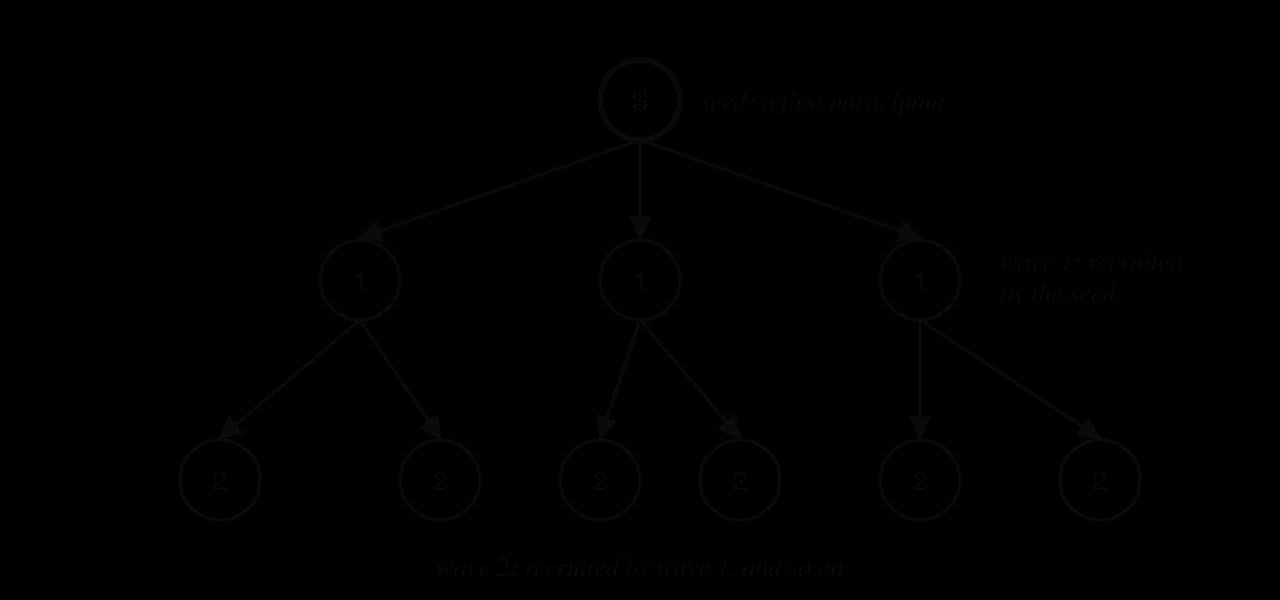
Some populations have no list and do not answer advertisements: people who inject drugs, undocumented migrants, members of stigmatised groups, or people with a rare condition. In snowball sampling the researcher finds a few members (the “seeds”) and asks each to pass on the invitation to others they know. Trust travels with the invitation, so people who would never respond to a stranger may agree when a friend asks.
Heckathorn (1997) developed respondent-driven sampling to make snowball samples more useful for studying hidden populations such as people who inject drugs. Participants are rewarded both for taking part and for recruiting others, recruitment is tracked wave by wave, and statistical weighting corrects for the tendency of people to recruit others similar to themselves. It shows how a non-probability technique can be adapted to reduce its bias.
Snowball sampling is often the only practical way to reach hidden or vulnerable groups, and it can build trust with communities that have reason to avoid researchers. Its limitations are that the sample is made up of connected people, so isolated members of the population, who may have quite different experiences, are missed; the first participants shape the whole sample; and passing on invitations can threaten confidentiality, because participants learn who else is taking part. For these reasons snowball samples are rarely representative, and they are used mainly for qualitative and exploratory research.
Purposive sampling suits qualitative research, which asks questions such as “How do young refugees experience their first year at a new school?”. The aim is not to estimate how common something is but to understand it in depth, so the researcher selects people who can speak to the question: in this case, young refugees who have recently started school. Purposive samples are small and chosen for information, not for representativeness. Researchers often keep sampling until new interviews stop producing new themes, a point called data saturation.
The strength of purposive sampling is that every participant contributes relevant data. Its limitation is that the researcher’s judgement decides who is included, so the researcher should explain the selection criteria clearly and reflect on how their choices may have shaped the findings. Purposive samples are often recruited using one of the other techniques (for example through snowball recruitment within a community), so the two labels can apply to the same sample.
Technique | How participants are chosen | Main advantage | Main disadvantage | Typical use |
|---|---|---|---|---|
Random | Every member of the population has an equal chance | No researcher bias in selection; can be representative | Needs a full list; non-response; costly | Prevalence surveys, national studies |
Stratified | Random selection within subgroups, in proportion | Representative on key characteristics by design | Needs population data; time-consuming | Surveys needing all subgroups |
Opportunity | Whoever is available at the time | Quick, cheap, easy | Unrepresentative; researcher chooses whom to approach | Laboratory experiments, class practicals |
Self-selected | People respond to an advertisement or invitation | Large numbers; willing participants | Volunteer bias | Online surveys, studies needing commitment |
Snowball | Participants recruit others they know | Reaches hidden populations; builds trust | Connected, unrepresentative sample; confidentiality | Research with hidden or stigmatised groups |
 YouTube
Researchers also need to distinguish sampling from random allocation. Sampling decides who is in the study; allocation decides which condition each participant experiences in an experiment. A laboratory experiment with an opportunity sample and random allocation can support a causal conclusion about the people studied, but not a generalisation to everyone; a random sample in a correlational survey supports generalisation, but not a causal conclusion.
Larger samples reduce sampling error: the chance difference between a sample and its population. The reduction follows the square root of the sample size, so quadrupling a sample only halves the error. For a survey estimating a percentage, a fair sample of about 100 people gives a margin of error of roughly ±10 percentage points, while about 1,000 gives roughly ±3. Beyond a few thousand, further increases add little precision.
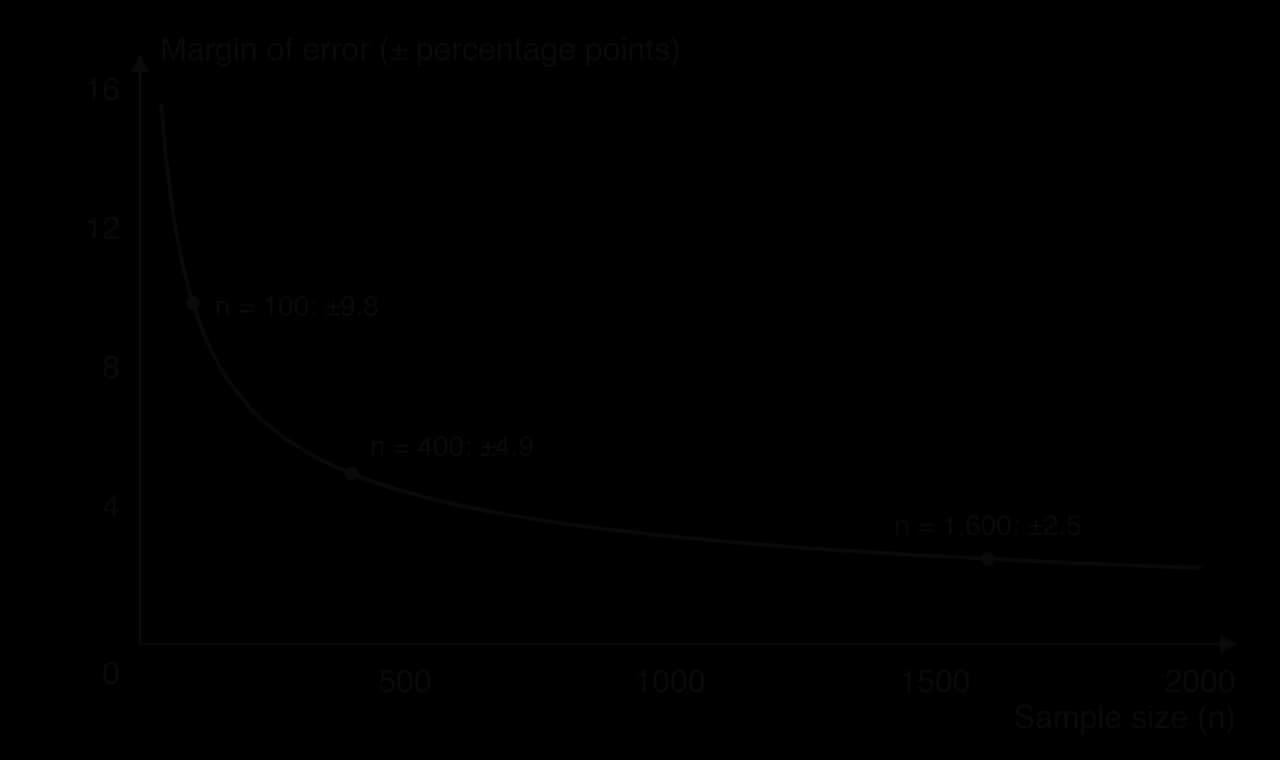
Sample size also affects whether a real effect is detected. A small experiment may fail to find a genuine difference, a type II error, because chance variation hides it; this is a question of statistical power. Small studies that do find significant effects tend to overestimate their size, which is one reason many published findings shrink or disappear when replicated with larger samples.
In qualitative research the logic is different. A focus group may have six people and an interview study twelve, and that can be appropriate if the aim is depth and the participants have the relevant experience. Researchers justify qualitative sample size by data saturation and by the richness of the data rather than by statistical precision.
Cross-cultural research faces a particular difficulty: the samples from different countries must be comparable, yet the practical means of reaching people differ from country to country. Buss (1989) collected questionnaires on mate preferences from 10,047 people in 37 samples in 33 countries. The sampling techniques varied widely. In Estonia, one subsample was every couple applying for a marriage licence at one location over a set period and another was 200 high school students; in Venezuela, researchers contacted every fifth house in neighbourhoods that varied in social class; the West German sample was recruited through newspaper advertisements; and many samples were university students.
Buss stated that the samples could not be considered representative of their countries: rural, less-educated and lower-income people were under-represented in most of them. He argued that because the same sex differences appeared despite such varied sampling methods, the consistency was unlikely to be produced by any one method’s bias. The same evidence can be read more cautiously: if most samples came from the more educated, urban sections of each society, the findings may describe a global educated class rather than each culture as a whole.
Comparable sampling is not only about technique. Students in one country may be a highly selected elite, while in another most young people attend university, so “a sample of students” means something different in each. Language, literacy and the meaning of questions also vary, which links sampling to measurement equivalence and to the dangers of an imposed etic.
Ethical requirements affect who ends up in a sample. Informed consent means that only people willing to take part are studied, so every sample is to some extent self-selected; the right to withdraw means that those who find a study difficult may leave, biasing the final data towards those who did not. Parental consent requirements for children under 16 can exclude children whose parents are hard to reach.
Some techniques raise their own ethical issues. Snowball sampling can show participants who else belongs to a stigmatised group, so researchers take care that recruiters do not learn whether their contacts took part. Payment can put pressure on people with low incomes to take part in studies they would otherwise refuse. Over-studying convenient groups, such as students, and under-studying others, such as older people or ethnic minorities, is also an ethical issue, because treatments and policies built on unrepresentative research may serve some groups worse than others. Including under-represented groups is part of researchers’ responsibility.
The most famous failure of sampling in history comes from political polling rather than from psychology, but it is the clearest demonstration that a huge sample can be badly wrong. The lesson applies directly to modern online samples and to research that recruits only from easily reached groups.
The Literary Digest was a popular American magazine that had correctly predicted the winners of several earlier presidential elections with its large “straw polls”. In 1936 it aimed to predict whether the Democratic president, Franklin D. Roosevelt, or the Republican candidate, Alf Landon, would win the presidential election.
The magazine sent mock ballots to about ten million people. Its sampling frame was its own readers, plus lists of registered car owners and telephone users. About 2.38 million ballots were returned, one of the largest samples in the history of survey research. Bias could therefore enter at two points: through who was on the lists, and through who chose to reply.
At the same time, George Gallup’s American Institute of Public Opinion surveyed a much smaller quota sample of about 50,000 people, chosen so that different groups of voters appeared in roughly the proportions found in the electorate.
The Digest predicted that Landon would win 57% of the popular vote and 370 of the 531 electoral votes. Roosevelt won 60.8% of the popular vote and 523 electoral votes, carrying every state except Maine and Vermont. The poll’s error on the margin between the candidates was about 39 percentage points. Gallup’s final poll predicted a Roosevelt victory with 55.7% of the vote and 481 electoral votes.
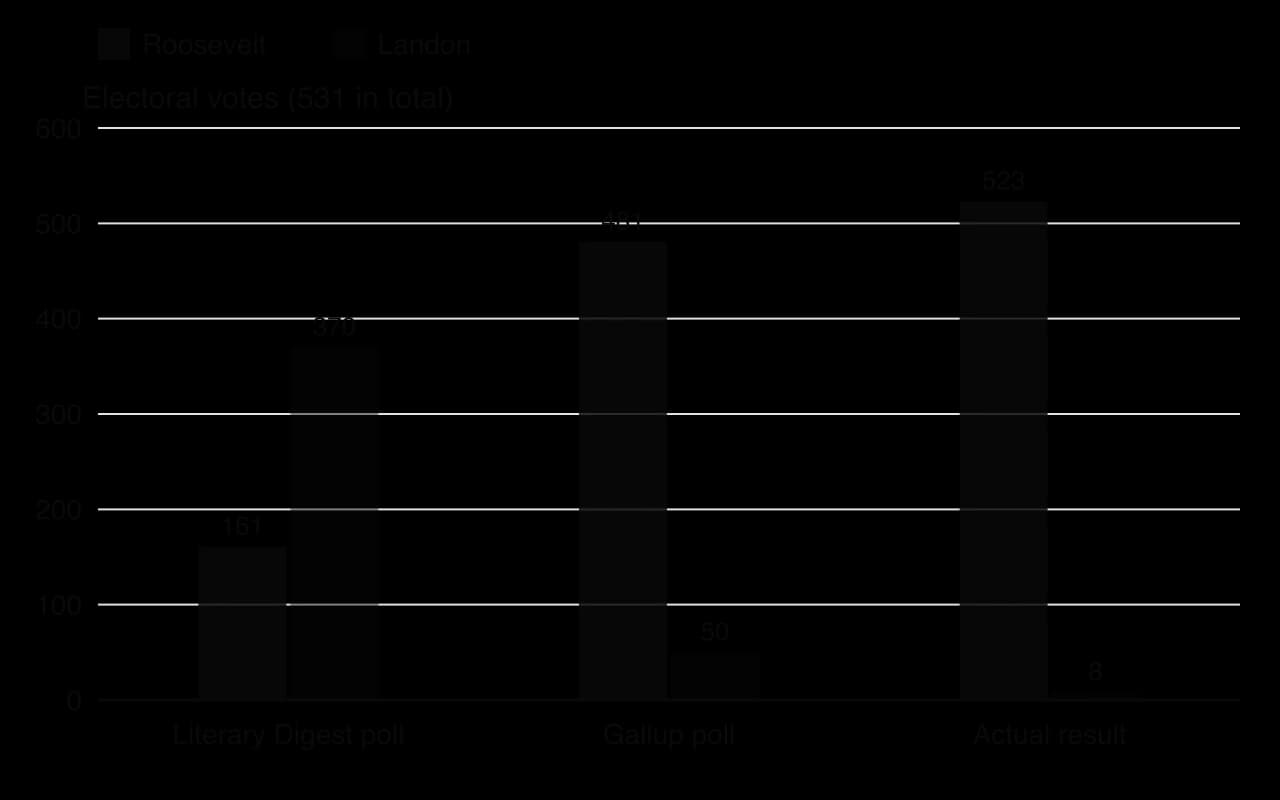
The sample did not represent the electorate. In 1936, during the Great Depression, owning a car or a telephone, or subscribing to a magazine, was more common among wealthier households, which were more likely to vote Republican. Later analysis by Squire (1988) found that the frame was only part of the problem: non-response bias was the main cause of the size of the error, because people who strongly opposed Roosevelt were more likely to return their ballots.
The case shows two separate sources of sampling bias working in the same direction: a frame that over-represented some groups, and self-selection among those contacted. Neither was solved by the size of the sample. Psychology research recruited through online advertisements faces the same two problems: only people who use a particular platform see the invitation, and only those interested in the topic take part.
Because the sample was so large, the Digest’s estimate was extremely precise; repeating the same procedure would have given almost the same wrong answer. This illustrates the difference between reliability and validity: a consistent measure can still be consistently wrong.
The poll measured voting intention, not a psychological process, but the reasoning transfers. When research participants are mostly volunteers, students or WEIRD samples, the question is the same as in 1936: in what ways do the people who took part differ from the people the conclusions are about, and could those differences affect the behaviour being studied?
Sources: Wikipedia, “The Literary Digest” and “1936 United States presidential election” (accessed 2026); Squire, P. (1988). Why the 1936 Literary Digest poll failed. _Public Opinion Quarterly, 52(1), 125–133._
Concept | How sampling is involved |
|---|---|
Bias | Sampling bias from the frame, self-selection, non-response and attrition; researcher bias in whom to approach; the over-representation of WEIRD participants. |
Measurement | Sample size determines precision and statistical power; a precise estimate from a biased sample is still invalid. |
Perspective | Who is sampled decides whose behaviour and experience a theory describes; under-studied cultures and Indigenous communities are missing from much of the evidence. |
Responsibility | Consent and withdrawal shape samples; snowball sampling threatens confidentiality; excluding groups can make treatments and policies serve them poorly. |
Causality | Random sampling supports generalisation, while random allocation supports causal conclusions; the two are separate. |
Sampling appears in Paper 2 Section A (describing the sampling technique of a class practical), in Paper 2 Section B (evaluating the sample of an unseen study) and in the internal assessment (justifying the technique for a population of interest).
The target population is the group a study is about; the sampling frame is the list it is drawn from; the sample is who takes part.
A representative sample matches the population on relevant characteristics and allows generalisation; qualitative research judges transferability instead.
Sampling bias is systematic and comes from the frame, the selection method, self-selection, non-response and attrition; a larger sample does not remove it.
Random and stratified sampling are probability techniques: they give the best chance of representativeness but need a complete sampling frame and are costly.
Opportunity sampling is quick and cheap but unrepresentative; self-selected sampling reaches many willing people but suffers from volunteer bias.
Snowball sampling reaches hidden populations through participants’ contacts; purposive sampling selects people with the experiences a qualitative study needs.
Larger samples improve precision and power, with diminishing returns; size and representativeness are separate questions.
The Literary Digest poll of 1936 shows that 2.38 million biased replies predicted the wrong winner while a small representative sample did not.
I can explain the difference between a target population, a sampling frame and a sample.
I can describe how random, stratified, opportunity, self-selected and snowball samples are obtained.
I can evaluate each sampling technique and suggest the best one for a research question.
I can explain how sampling bias arises, including non-response and attrition.
I can explain why sample size affects precision but cannot correct a biased sample.
I can discuss how sampling affects generalisability and transferability, including across cultures.
I can evaluate the sample of an unfamiliar study with reference to bias.