1.9 The binomial theorem · IB Maths AA | Augment Education
1.9 The binomial theorem
Expand any power of a binomial with Pascal's triangle or the binomial theorem, find a single term or coefficient from the general term, and use expansions for products and approximations.
IB Mathematics: Analysis and Approaches
Part of 1 Number and algebra
SL and HL
Key terms introduced here
Each is in the Maths AA glossary, with every other term in the subject.
A triangular array of numbers with 1 at the ends of each row, in which every other entry is the sum of the two entries directly above it. Row n (counting from row 0) holds the binomial coefficients (0n),…,(nn).
to find binomial coefficients.
Expand (a+b)n for n∈N, including brackets with negative, fractional and algebraic terms.
Find a specific term or coefficient in an expansion, including the constant term, from the general term.
Determine an unknown constant in a binomial expression from a given coefficient.
Find coefficients in the product of a bracket and a binomial expansion.
Estimate powers such as 1.0210 by using the first few terms of an expansion.
A binomial is an expression with two terms, such as x+2 or 3−2x. Raising a binomial to a small power, such as (x+2)2, is ordinary algebra, but multiplying out (x+2)10 bracket by bracket would take a long time and invite mistakes. The binomial theorem gives every term of (a+b)n directly, using a family of whole numbers called binomial coefficients.
The same coefficients count the ways of choosing objects from a set, so the binomial theorem connects algebra with counting and probability. The number of ways of getting exactly 3 heads in 10 coin tosses, for example, is one of these coefficients. Expansions also give quick, accurate approximations to powers of numbers close to 1.
Expanding powers of a binomial
Small powers by multiplying out
The first few powers of a+b can be found by multiplying out one bracket at a time and collecting like terms.
Several patterns appear in every line. The expansion of (a+b)n has n+1 terms. The powers of a fall by one from an to a0, while the powers of b rise by one from b0 to bn, so the two powers in each term always add up to n. The coefficients (the numbers in front) read the same forwards and backwards: 1,4,6,4,1.
Why the coefficients appear
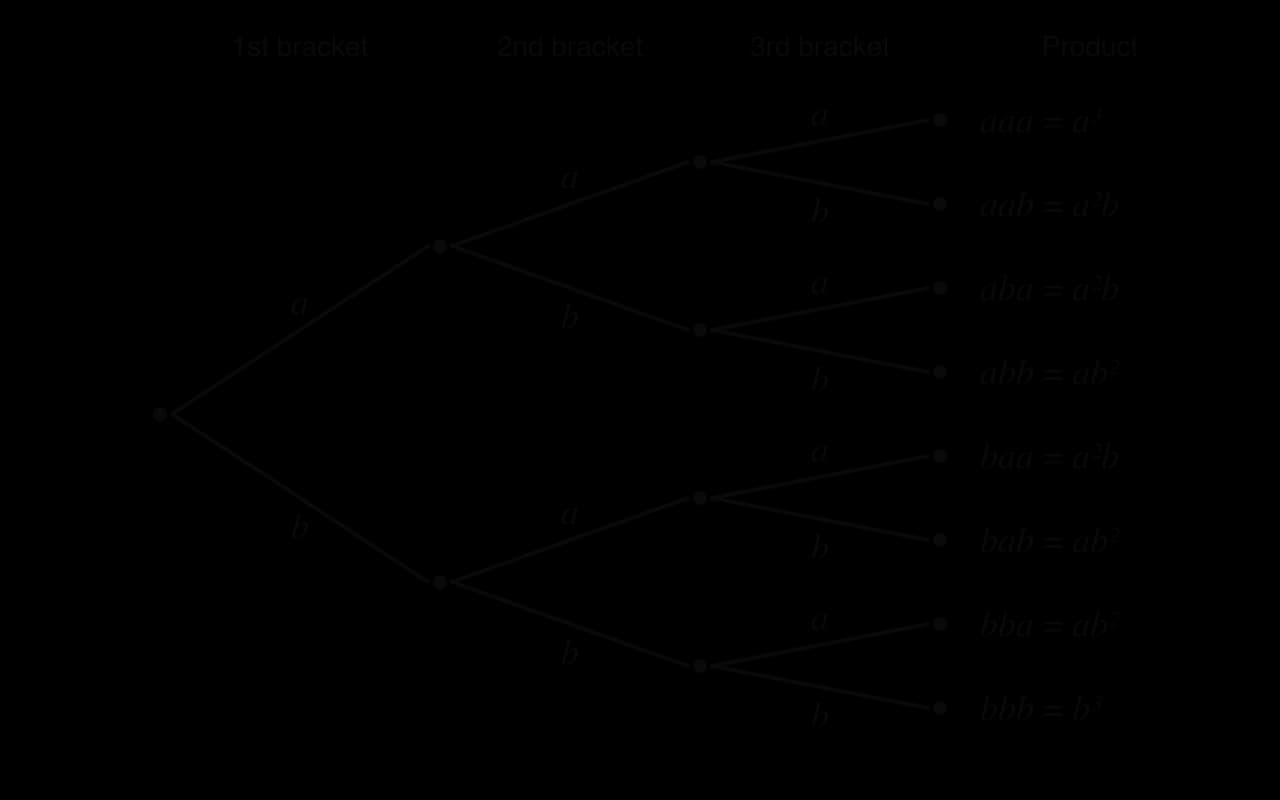
Expanding (a+b)3=(a+b)(a+b)(a+b) means choosing either a or b from each of the three brackets, multiplying the choices, and adding the results for every possible set of choices. The tree diagram lists all 2×2×2=8 ways.
Three of the eight paths choose b exactly once, so a²b appears three times and its coefficient is 3. The coefficient of each term counts the paths that produce it.
The term a2b arises whenever b is chosen from exactly one bracket. There are 3 ways to pick that bracket, so the coefficient of a2b is 3. In general, the coefficient of an−rbr in (a+b)n is the number of ways of choosing which r of the n brackets supply a b. This counting idea is the reason behind every result that follows.
Pascal's triangle
Writing the coefficients of (a+b)0,(a+b)1,(a+b)2,… in rows gives Pascal's triangle.
Each entry is the sum of the two entries above it, and row n adds up to 2ⁿ.
The addition rule works because of the way one row is built from the previous one. Multiplying the expansion of (a+b)n by one more factor (a+b) gives each term of (a+b)n+1 two sources: a term multiplied by a and its neighbour multiplied by b. Their coefficients add.
Each row also adds up to a power of 2. Substituting a=b=1 into (a+b)n gives 2n, and it also gives the sum of the coefficients in row n.
Pascal's triangle is efficient for small powers, but finding row 12 means writing out every row before it. For larger powers, and for finding one term without the others, a formula for each entry is far more useful. That formula uses factorials.
Factorials and binomial coefficients
Factorial notation
The first few values are 1!=1, 2!=2, 3!=6, 4!=24, 5!=120 and 6!=720. Factorials grow very quickly: 10!=3628800. Each factorial is the previous one multiplied by one more number, n!=n×(n−1)!, and this relation is the key to simplifying expressions with factorials.
The value 0!=1 follows from the same relation. Putting n=1 into n!=n×(n−1)! gives 1!=1×0!, so 0!=1. It also makes the formulas for binomial coefficients work at the ends of each row.
The binomial coefficient
The formula comes from counting. Choosing r objects one after another from n can be done in n(n−1)⋯(n−r+1)=(n−r)!n! ordered ways, but each group of r objects is counted r! times, once for every order in which it could have been picked. Dividing by r! removes the repeats. Counting arguments of this kind are developed fully in 1.10 (HL).
Some values are worth recognising at once.
Coefficient
Value
Reason
(0n) and (nn)
1
One way to choose nothing, and one way to choose everything
(1n) and (n−1n)
n
(2n)
2n(n−1)
(3n)
6n(n−1)(n−2)
Evaluating binomial coefficients by hand
Most of the factorials in r!(n−r)!n! cancel. Cancelling the larger of r! and (n−r)! leaves a short product on the top divided by a small factorial:
(rn)=r!n(n−1)(n−2)⋯(n−r+1)
The top has exactly r factors, counting down from n.
Evaluating binomial coefficients with technology
A graphic display calculator (GDC) has an nCr function in its probability menu: entering n, then nCr, then r gives (rn) directly. A GDC can also display a whole row of Pascal's triangle by putting a list of values r=0,1,…,n into nCr, which is useful for checking an expansion. Spreadsheets have the same function (COMBIN in most programs).
Symmetry and other properties
Each row of Pascal's triangle reads the same in both directions. Choosing r objects to take is the same as choosing the n−r objects to leave behind, so
(rn)=(n−rn)
The formula agrees: swapping r and n−r in r!(n−r)!n! only changes the order of the two factorials on the bottom. Symmetry halves the work by hand, as in (1720)=(320).
The addition rule of Pascal's triangle can also be written with binomial coefficients:
(rn)+(r+1n)=(r+1n+1)
For example, (25)+(35)=10+10=20=(36), the shaded entries in Pascal's triangle.
The binomial theorem
Statement of the theorem
Combining the counting argument with the formula for (rn) gives the binomial theorem.
The theorem holds for any a and b: numbers, variables, negative terms, fractions or powers of x. The reason is the one shown by the tree diagram. In the product of n brackets (a+b), the term an−rbr arises once for every way of choosing which r brackets supply the b, and there are (rn) such ways.
Expanding with the binomial theorem
To expand a binomial such as (2x−3)4, identify a and b with their signs and coefficients, here a=2x and b=−3, and substitute them as whole bracketed terms. Laying the work out as a table keeps the powers and signs under control.
Terms with negative powers of x
When one term of the binomial is a reciprocal such as x2, the powers of x from the two parts combine. In (x−x2)5 the term with r factors of −x2 contains x5−r×x−r=x5−2r, so the powers of x fall by 2 each time.
The general term
Finding one term without expanding
Often only one term of an expansion is needed, such as the coefficient of x3 in (3+2x)7. Each term of the binomial theorem has the same shape, so a single formula describes all of them.
The method for finding a particular term has three steps.
Write the general term with a and b substituted, and collect the powers of x into a single power xsomething in r.
Set that power equal to the power wanted and solve for r. The value of r must be an integer from 0 to n; if it is not, there is no such term and the coefficient is 0.
Substitute r back into the general term and evaluate.
The constant term
The constant term of an expansion is the term independent of x, that is, the term in x0. It exists only when the powers of x from a and b can cancel exactly, which happens when one part of the binomial has a positive power of x and the other a negative power.
The same method finds any power. A useful check comes before any arithmetic: if the equation for r gives a fraction or a value outside 0≤r≤n, the term does not exist. In (2x−x1)6 every power of x is even, because 6−2r is even, so there is no term in x3 and its coefficient is 0.
Finding an unknown constant
When a binomial contains an unknown constant, a given coefficient produces an equation for it. Write the relevant term in terms of the constant, set it equal to the given value and solve.
Products of a bracket and a binomial expansion
Some questions ask for a coefficient in a product such as (2−x)(1+3x)5. There is no need to expand the whole product. A term in x2 comes from multiplying each term of the first bracket by the term of the expansion that brings the power up to exactly x2:
the 2 in the first bracket times the x2 term of (1+3x)5;
the −x in the first bracket times the x term of (1+3x)5.
So only the first few terms of the binomial expansion are needed.
The first bracket can itself contain powers of x that skip a term. In (1−x2)(2+x)5, the x3 term needs the x3 term of (2+x)5 (times 1) and the x term (times −x2), but not the x2 term.
Approximations using the binomial theorem
Powers of numbers close to 1
When x is small, the powers x2,x3,… are much smaller still. In the expansion of (1+x)n the later terms shrink rapidly, so the first few terms give a good approximation. This is the binomial theorem used as a tool for estimation.
(1+x)n=1+nx+(2n)x2+(3n)x3+⋯
The graph compares y=(1+x)5 with the first two and the first three terms of its expansion. Close to x=0 the three curves are almost indistinguishable; further away, the line y=1+5x separates first and the quadratic follows the curve for longer.
y = (1 + x)⁵
y = 1 + 5x
y = 1 + 5x + 10x²
Near x = 0 the first terms of the expansion fit the curve closely. Each extra term keeps the approximation accurate over a wider interval.
Choosing the value of x
The approximation works only when the number substituted for x is small. To estimate 0.9958, write 0.995=1−0.005; to estimate 1.996, write 1.99=2−0.01 and use the expansion of (2−x)6. A question often gives the expansion in terms of x first and asks for a suitable value of x.
Binomial coefficients and probability
The binomial coefficients also count outcomes. When a fair coin is tossed n times, each sequence of heads and tails is equally likely, and there are 2n sequences in total. A sequence with exactly r heads is fixed by choosing which r of the n tosses are heads, so there are (rn) such sequences. This is the same choice as picking which brackets supply b in (a+b)n, and it explains why row n of Pascal's triangle adds up to 2n.
Expanding (21+21)6 with the binomial theorem gives one term for each possible number of heads, and the term with r=3 is (36)(21)3(21)3=6420. Replacing 21 by probabilities p and 1−p leads to the binomial distribution in 4.8.
Exam-style questions on the binomial theorem
Binomial questions appear on both papers. The non-calculator paper tests expansions and coefficients that need careful arithmetic by hand; the calculator paper adds unknown constants and equations that are faster to solve with a GDC.
A second common type gives a coefficient and asks for an unknown constant, then uses that constant in a further part.
Self-check
To do:
I can evaluate factorials and simplify expressions such as (n−1)!(n+1)!.
To do:
I can evaluate (rn) by hand, with a GDC and from Pascal's triangle, and use (rn)=(n−rn).
To do:
I can expand (a+b)n when a or b is negative, a multiple of x or a reciprocal of x
To do:
I can write the general term (rn)an−rbr and use it to find a given term, coefficient or the constant term.
To do:
I can explain why an expansion has no term in a particular power of x.
To do:
I can find an unknown constant from a given coefficient, keeping all valid solutions.
To do:
I can find a coefficient in the product of a bracket and a binomial expansion.
To do:
I can choose a suitable value of x and use the first terms of an expansion to estimate a power such as 1.0210.
has probability density function
fn(x)={n(1−x)n−1,0,0≤x≤1otherwise.
(a)
Show that ∫01fn(x)dx=1 for all n∈Z+.
[2]2 marks
Markscheme (a)
∫01n(1−x)n−1dx=[−(1−x)n]01
(b)(i)
Consider the case n=3.
Find E(X3).
[2]2 marks
Markscheme (b)(i)
E(X3)=∫013x(1−x)2dx
(b)(ii)
Find the median of X3, and hence state whether the median of X3 is greater than or less than E(X3)
(c)
By using the substitution u=1−x, show that E(Xn)=n+11
(d)
Show that Var(Xn)=(n+1)2(n+2)n
(e)
Show that the median of Xn is mn=1−2−n1
(f)(i)
Show that, for n∈Z+, the inequality E(Xn)>mn
(f)(ii)
By using the binomial theorem, prove that E(Xn)>mn for all integers n≥2.
[3]
(g)(i)
Use l'Hôpital's rule to find n→∞limnmn.
[3]3 marks
Markscheme (g)(i)
nmn=n11−2−n1
(g)(ii)
Hence find n→∞limE(Xn)mn
Question 2 · AA-006036 marks
The random variable X is such that X∼B(7,p), where 0<p<1. It is given that P(X=2)=P(X=3).
So 1.996≈62.104. (A calculator gives 62.10384…, which agrees to 3 decimal places.)
(b) The constant term has 9−3r=0, so r=3.
(39)k3=84k3=672⇒k3=8⇒k=2
(c) For x3, 9−3r=3 gives r=2.
(29)22=36×4=144
The coefficient of x3 is 144.
(d) A term in x2 would need 9−3r=2, so r=37, which is not an integer. Every power of x in the expansion is of the form 9−3r, a multiple of 3, so there is no term in x2.
.
M1A1
=0−(−1)=1AG
(M1)
=41A1
.
[2]2 marks
Markscheme (b)(ii)
1−(1−m)3=21 or solving ∫0m3(1−x)2dx=0.5 on a GDC (M1)
m=0.206(0.206299…=1−2−31)
.
[4]4 marks
Markscheme (c)
E(Xn)=∫01nx(1−x)n−1dxM1
=∫10n(1−u)un−1(−du)=n∫01(un−1−un)du
Note: Award A1 for the correct integrand and correct limits (or their reversal with the sign change).