1.8 Infinite geometric series
Decide whether an infinite geometric series converges, find its sum to infinity, find the values of x for which a series in x converges, and apply sums to infinity to recurring decimals, bouncing balls and fractals.
- IB Mathematics: Analysis and Approaches
- Part of 1 Number and algebra
- SL and HL
Key terms introduced here
Each is in the Maths AA glossary, with every other term in the subject.
- Convergent series
An infinite series whose partial sums approach a finite limit as the number of terms increases. A geometric series converges exactly when .
- Divergent series
An infinite series whose partial sums do not approach a finite limit: they grow without bound or keep oscillating. A geometric series with and diverges.
- Fractal
A shape built by repeating the same construction at smaller and smaller scales, so that parts of it look like the whole. The Koch snowflake is an example.
- Partial sum
The sum of the first terms of a series. The sum of an infinite series is the value the partial sums approach as increases, if there is one.
- Recurring decimal
A decimal in which a digit or block of digits repeats forever, such as or . Every recurring decimal is a rational number.
- Sum to infinity
The limit that the partial sums of a series approach as increases without bound. For a geometric series with , .
Notes on 1.8 Infinite geometric series
Adding infinitely many positive numbers does not always give an infinite total. The numbers go on forever, yet their sum never exceeds 1, and adding more and more terms brings the total as close to 1 as desired. Geometric series with a common ratio between and all behave like this. Their sums to infinity describe quantities built from infinitely many shrinking parts, such as the total distance a bouncing ball travels before it comes to rest, and they show that every recurring decimal is a fraction.
From finite sums to infinite sums
A sum that settles down
A square of side 1 has area 1. Shade half of it, then half of what is left, then half of what is still left, and so on. The shaded pieces have areas , each piece half the size of the one before.
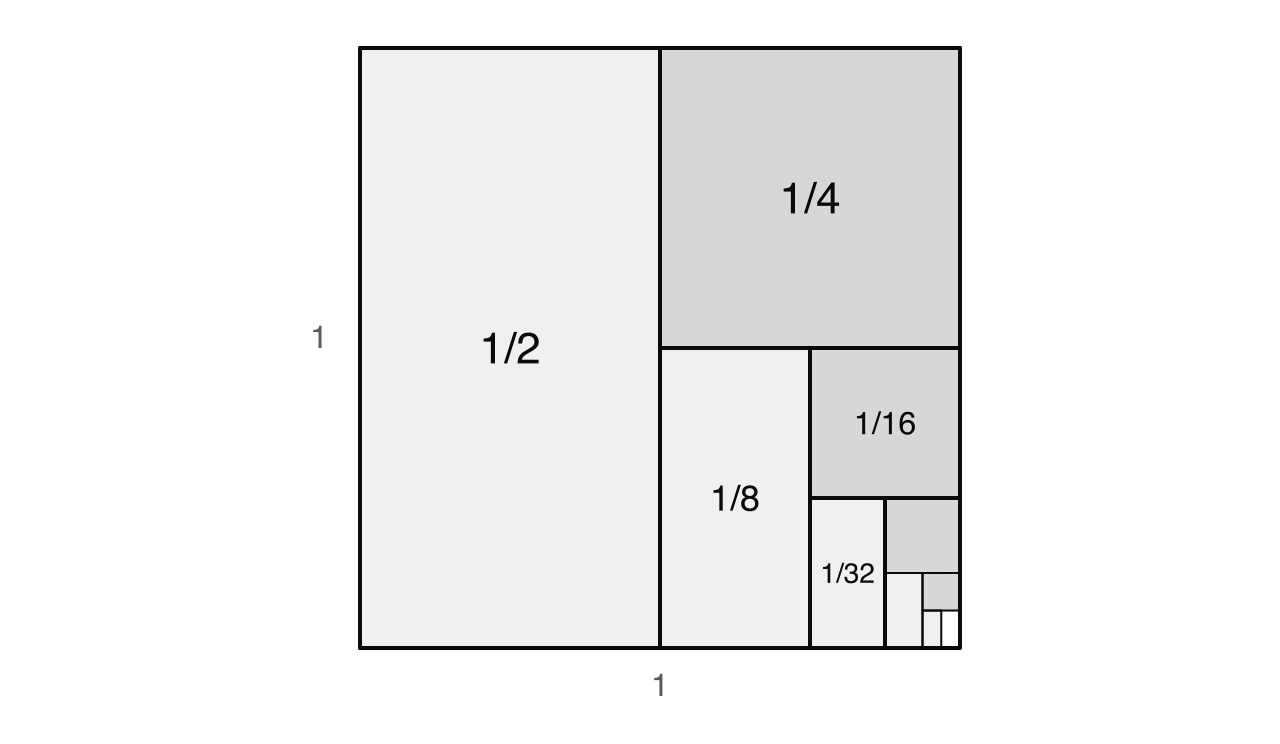
After pieces, the uncovered part has area , so the shaded area is . This is never quite 1, but it can be made as close to 1 as desired by taking enough pieces: after 10 pieces the gap is less than , and after 20 it is less than one millionth. The infinite sum
is therefore given the value 1.
Partial sums
An infinite sum cannot be calculated by adding all its terms one at a time. Instead, it is studied through its partial sums: the sums of the first term, the first two terms, the first three terms, and so on.
For the series , with and , the partial sums are
1 | 2 | 3 | 4 | 5 | 6 | 7 | 8 | |
|---|---|---|---|---|---|---|---|---|
8 | 12 | 14 | 15 | 15.5 | 15.75 | 15.875 | 15.9375 |
Each partial sum closes half of the remaining gap to 16. The sequence of partial sums gets as close to 16 as desired, without ever reaching it.
- y = 16 − 16(0.5)ˣ
Convergence and divergence
The value that the partial sums approach is called the sum to infinity of the series. The idea of "approaching a value as increases" is the idea of a limit, which 5.1 develops for functions. Here it is enough to know that gets as close as desired to a fixed number when is large enough.
A convergent series has a finite sum to infinity even though it has infinitely many terms. A divergent series has no sum to infinity. Three simple examples show the possibilities:
converges: its partial sums approach .
diverges: its partial sums grow without bound.
diverges: its partial sums jump between two values forever and never settle.
The sum to infinity of a geometric series
Why rⁿ approaches 0 when |r| < 1
The sum of the first terms of a geometric series, from 1.3, is
The only part of this formula that changes as grows is . So the behaviour of for large depends entirely on what happens to .
1 | 2 | 5 | 10 | 20 | 50 | |
|---|---|---|---|---|---|---|
0.5 | 0.25 | 0.03125 | 0.000977 | |||
0.25 | 0.000977 | |||||
0.9 | 0.81 | 0.590 | 0.349 | 0.122 | 0.00515 | |
1 | 1 | 1 | 1 | 1 | 1 | |
1.1 | 1.21 | 1.61 | 2.59 | 6.73 | 117 |
When , multiplying by makes a number smaller in size, by the same fraction each time. Repeating this shrinks towards 0, and it eventually falls below any positive number, however small. For example, as soon as , using the method of 1.7. When is negative, alternates in sign, but its size still shrinks to 0. When , the size of grows without bound, and when it stays at size 1.
Deriving the formula
When , the term in approaches 0 as increases. The numerator therefore approaches , while the denominator does not change. So the partial sums approach
The formula gives for , matching the table of partial sums. The difference between the sum to infinity and a partial sum is
which shows directly how the gap shrinks as does.
What happens when |r| ≥ 1
Common ratio | Behaviour of | Partial sums | Series |
|---|---|---|---|
approaches 0 | approach | converges | |
stays 1 | , grows without bound | diverges | |
alternates | alternate | diverges | |
grows without bound | grow without bound in size | diverges | |
alternates in sign, grows in size | alternate in sign, grow in size | diverges |
(In every case . If , every term is 0 and the sum is trivially 0.)
Finding sums to infinity
When a series is written in sigma notation, the first term is found by substituting the lower limit, not by reading the number in front of the bracket. In part (d), the 5 is not the first term because the sum starts at , not .
When is negative the partial sums move alternately above and below the sum to infinity, closing in from both sides. For , with , the sum to infinity is .
- upper bound
- lower bound
Finding the first term or the common ratio
The formula links three quantities, so knowing any two gives the third. Questions often combine it with the formula for a single term, , to give simultaneous equations.
How close is a partial sum?
The gap shows how many terms are needed for a partial sum to be within a given distance of the sum to infinity. This uses the logarithm methods of 1.7.
Series whose common ratio depends on x
Finding where a series converges
When the terms of a geometric series contain a variable, the common ratio may depend on that variable. The series then converges for some values of and diverges for others. The condition becomes an inequality in , which is best written as a double inequality:
Solving both parts at once gives the interval of values of for which the sum to infinity exists.
Common ratios that are fractions in x
Sometimes the common ratio has the variable in a denominator, or the terms must first be divided to find . The method is the same, but the inequality needs more care.
Applications of infinite geometric series
Recurring decimals
A recurring decimal is an infinite geometric series in disguise. The decimal means , a series with first term and common ratio . A dot over a digit (or over the first and last digits of a repeating block) shows that it repeats: and
The same method gives a result that often surprises students: . The decimal is exactly equal to 1, just as is another way of writing 1. The partial sums are all less than 1, but the infinite sum is their limit, which is exactly 1.
The total distance travelled by a bouncing ball
When a ball is dropped, it bounces back to a fraction of the height it fell from. If that fraction stays the same on every bounce, the heights form a geometric sequence (as in 1.3), and the total distance the ball travels is an infinite geometric series.
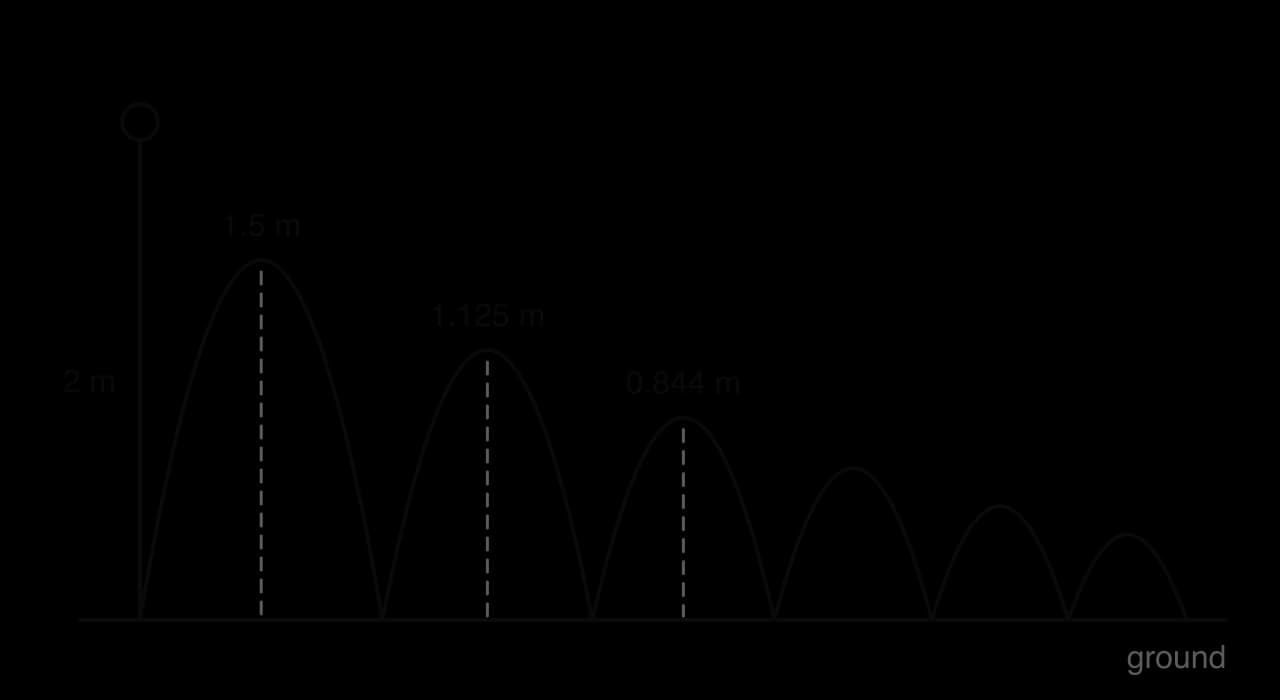
The model predicts infinitely many bounces in a finite total distance. In reality a ball stops after a finite number of bounces, because the model ignores effects such as the ball's deformation and air resistance when the bounces become very small. The geometric model is still an accurate approximation for the total distance, since the tiny later bounces contribute almost nothing to it.
Zeno's paradox and infinitely many steps
The Greek philosopher Zeno of Elea argued that motion is impossible: to walk 1 m, a person must first walk half the distance, then half of what remains, then half of that, and so on, completing infinitely many stages. He concluded that the walk could never be finished. The stages have lengths metres, and their sum to infinity is 1 m. If the person walks at a constant speed and takes seconds for the first half, the times of the stages are , with sum seconds, which is finite. Infinitely many stages can be completed in a finite time because their durations form a convergent series.
The Koch snowflake
A fractal is a shape built by repeating the same construction on smaller and smaller scales. The Koch snowflake starts with an equilateral triangle of side 1. At each stage, the middle third of every side is replaced by two sides of a smaller equilateral triangle pointing outwards.
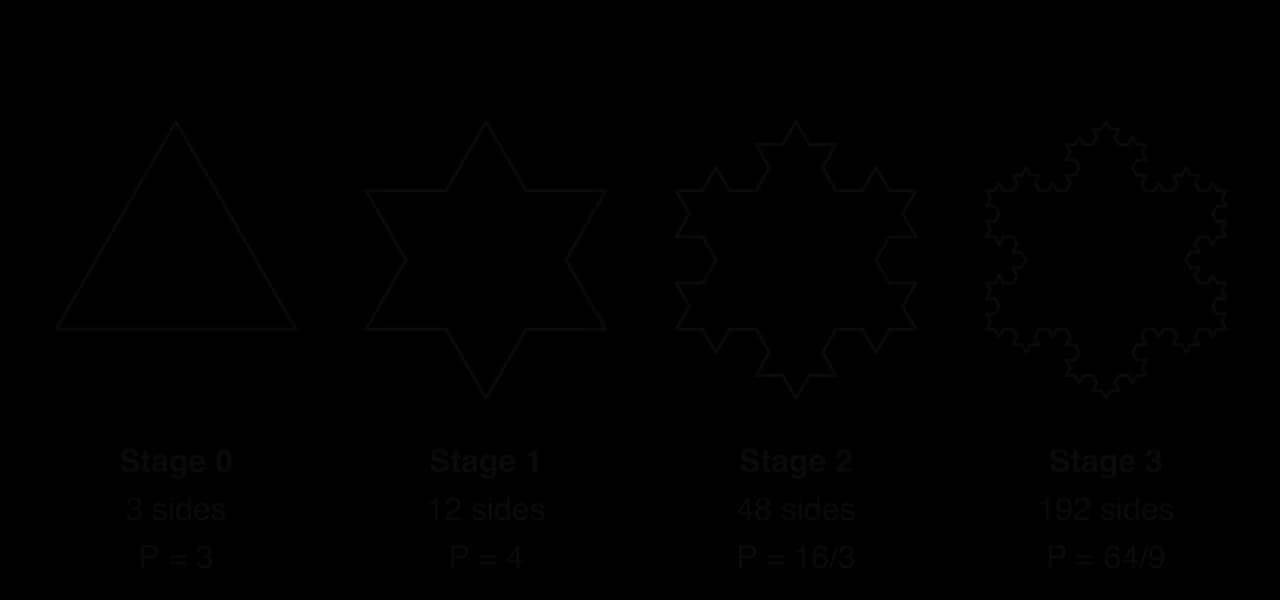
Each stage replaces every side by 4 sides, each as long. After stages there are sides of length , so the perimeter is
This is a geometric sequence with , so the perimeter grows without bound. The area behaves differently, because the area added at each stage forms a convergent geometric series.
The Koch snowflake therefore has a finite area, of the starting triangle, enclosed by a boundary of infinite length.
Exam-style questions on infinite geometric series
Sum to infinity questions appear on both papers. They often begin with finite geometric series from 1.3 and end with a sum to infinity, and the condition is regularly tested, either by rejecting a value of or by finding the values of for which a series converges.
Further points that earn or lose marks:
The formula is in the formula booklet; the condition must still be checked or stated.
A question asking for an exact answer, such as a recurring decimal as a fraction, needs the fraction in its simplest form, not a decimal approximation.
In contextual questions, such as a bouncing ball, explain how the series was set up (which distances are counted twice) before using the formula.
Self-check
- To do:
I can explain what a partial sum is and how partial sums decide whether a series converges.
- To do:
I can explain why when , and derive from the formula for .
- To do:
I can decide whether a geometric series converges and find its sum to infinity when it does.
- To do:
I can find or from a sum to infinity, rejecting any value of with .
- To do:
I can find the values of for which a series with a common ratio in terms of converges.
- To do:
I can write a recurring decimal as a fraction using a sum to infinity.
- To do:
I can find the total distance travelled by a bouncing ball, counting each rebound twice.
- To do:
I can explain how the Koch snowflake has an infinite perimeter but a finite area.
Questions on 1.8
38 exam-style questions on this subtopic, written in the style of the IB papers. The first has its markscheme open. Counted on
Question 1 · AA-0042615 marks
Asha and Bruno play a game in which they take turns to throw a dart at a small target, with Asha throwing first. The first player to hit the target wins and the game stops.
Each time Asha throws, the probability that she hits the target is 0.3. Each time Bruno throws, the probability that he hits the target is 0.4. All throws are independent.
- (a)
Find the probability that Bruno wins with his first throw.
2 marks
Markscheme (a)
(M1)
A1
- (b)
Show that the probability that Asha wins with her th throw is .
3 marks
Markscheme (b)
before Asha's th throw, Asha and Bruno have each missed times M1
probability that one round with both missing is A1
A1
AG
- (c)
Find the probability that Asha wins the game.
3 marks
Markscheme (c)
recognition of an infinite geometric series with , (M1)
(A1)
A1
- (d)
Given that the game ends within the first three throws, find the probability that Asha wins.
4 marks
Markscheme (d)
(M1)(A1)
(A1)
A1
Note: Accept .
- (e)
Find the least number of throws, , such that the probability that the game lasts for more than throws is less than 0.01.
3 marks
Markscheme (e)
attempt to find for odd and even (M1)
: , : (A1)
A1
Note: Award (M1)(A0)A0 for from only considering complete rounds, .
Question 2 · AA-0056715 marks
Kofi and Lena play a game with a biased coin. The probability that the coin shows heads on any toss is , independently of all other tosses.
They take turns to toss the coin, with Kofi going first. The first player to toss a head wins the game.
- (a)
Write down the probability that Kofi wins the game with his first toss.
1 mark
- (b)
Find the probability that Lena wins the game with her first toss.
2 marks
- (c)
Show that the probability that Kofi wins the game with his second toss is .
2 marks
- (d)
Show that the probability that Kofi wins the game is .
4 marks
- (e)
The rules are changed. Each player may now toss the coin at most three times. If none of the six tosses shows a head, the game is a draw.
Find the probability that the game is a draw.
2 marks
- (f)
Given that the game is not a draw, find the probability that Kofi wins.
4 marks
Answer it, then compare with the markscheme.Check this one with a free account
Question 3 · AA-005786 marks
The discrete random variable has probability distribution
where is a constant.
- (a)
Find the value of .
3 marks
- (b)
Find the probability that is an even number.
3 marks
Answer it, then compare with the markscheme.Check this one with a free account
Try a quick-fire question
One of 40 short multiple-choice questions on 1.8. Pick an answer to see why it's right or wrong.
An infinite geometric series has common ratio . When does it have a finite sum?
From the formula booklet
The entries of the mathematics: analysis and approaches formula booklet that 1.8 uses. Each opens in the explained booklet.
Carry on with 1.8 in Augment
With a free account, Augment remembers where you stopped and what you have practiced.