3.1 Distance, midpoint, volume and surface area · IB Maths AA | Augment Education
3.1 Distance, midpoint, volume and surface area
Find distances and midpoints in three dimensions, calculate the volume and surface area of pyramids, cones, spheres, hemispheres and composite solids, and find angles inside solids.
IB Mathematics: Analysis and Approaches
Part of 3 Geometry and trigonometry
SL and HL
Key terms introduced here
Each is in the Maths AA glossary, with every other term in the subject.
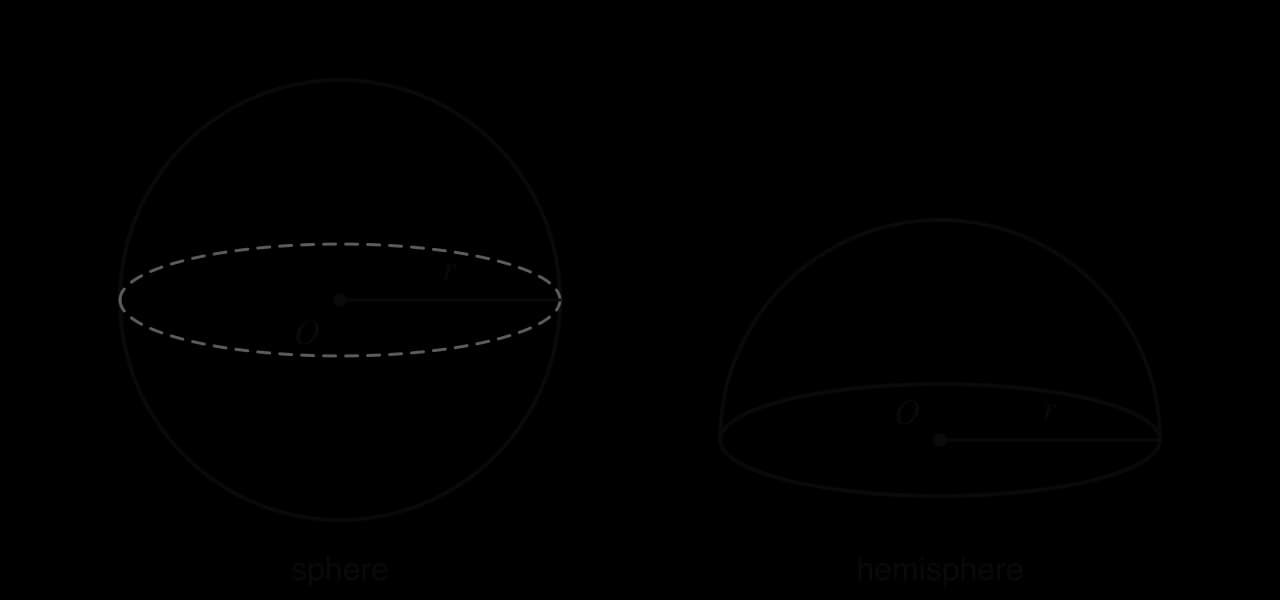
Half of a sphere, cut off by a plane through its centre. A solid hemisphere of radius r has volume 32πr3
Notes on 3.1 Distance, midpoint, volume and surface area
32 min readLast reviewed
Three-dimensional geometry describes the space objects actually occupy. Engineers find the volume of concrete in a pyramid-shaped foundation, packaging designers find the area of card needed for a cone, and pilots and drone operators find the straight-line distance between two points at different heights. All of these rely on a small set of measurements: distance, volume, surface area and angle.
Most methods for solids reduce a three-dimensional problem to a two-dimensional one. A right-angled triangle hidden inside a solid gives a distance through Pythagoras's theorem or an angle through a trigonometric ratio, and a solid that looks complicated is usually a combination of simple ones.
Coordinates in three dimensions
Questions on 3.1
83 exam-style questions on this subtopic, written in the style of the IB papers. The first has its markscheme open. Counted on
Question 1 · AA-000576 marks
The points A(5,−1,2) and B are the endpoints of a diameter of a sphere. The centre of the sphere is M(2,1,4)
Try a quick-fire question
One of 38 short multiple-choice questions on 3.1. Pick an answer to see why it's right or wrong.
A right cone has base radius 3 cm and height 4 cm. What is its volume?
From the formula booklet
The entries of the mathematics: analysis and approaches formula booklet that 3.1 uses. Each opens in the explained booklet.
The point exactly halfway along a line segment. Its coordinates are the means of the endpoints' coordinates: (2x1+x2,2y1+y2,2z1+z2) in three dimensions.
A solid with two identical, parallel end faces joined by flat sides, so every slice parallel to the ends is the same shape, its cross-section. Volume = cross-sectional area × length.
A pyramid whose apex lies directly above the centre of its base, so the line from the apex to that centre is perpendicular to the base. Its volume is V=31Ah.
The set of all points in space at a fixed distance r, the radius, from a fixed point, the centre. A solid sphere has volume 34πr3 and surface area 4πr2.
The total area of all the faces and curved surfaces that enclose a solid, measured in square units.
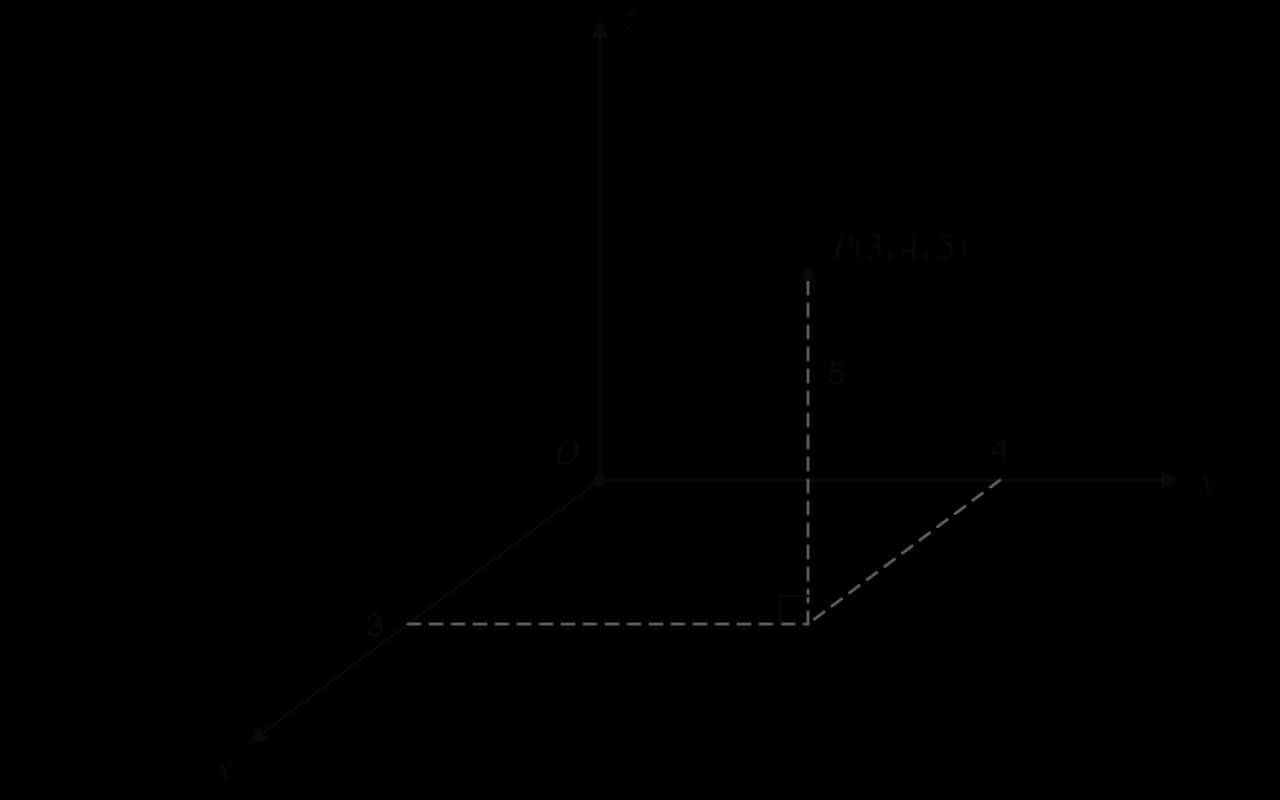
A point in a plane needs two coordinates. A point in space needs three, measured along three axes that meet at the origin O and are each perpendicular to the other two. The x- and y-axes form a horizontal plane, and the z-axis points upwards. The point (x,y,z) is reached from the origin by moving x units parallel to the x-axis, y units parallel to the y-axis and z units parallel to the z-axis.
To reach P(3, 4, 5), move 3 along x and 4 along y in the horizontal plane, then 5 up. The vertical dashed line meets the horizontal plane at a right angle.
The axes are drawn in perspective: the x-axis comes out of the page towards the reader, so it is drawn sloping down to the left. Three planes contain two of the axes each: the xy-plane (z=0), the xz-plane (y=0) and the yz-plane (x=0). A point such as (3,4,0) lies in the xy-plane, directly below P(3,4,5).
Distance between two points
Distance in two dimensions
For two points (x1,y1) and (x2,y2) in a plane, the horizontal and vertical differences x2−x1 and y2−y1 are the two shorter sides of a right-angled triangle whose hypotenuse joins the points. Pythagoras's theorem gives the distance:
d=(x1−x2)2+(y1−y2)2
The order of subtraction does not matter, because each difference is squared: (x1−x2)2=(x2−x1)2.
Distance in three dimensions
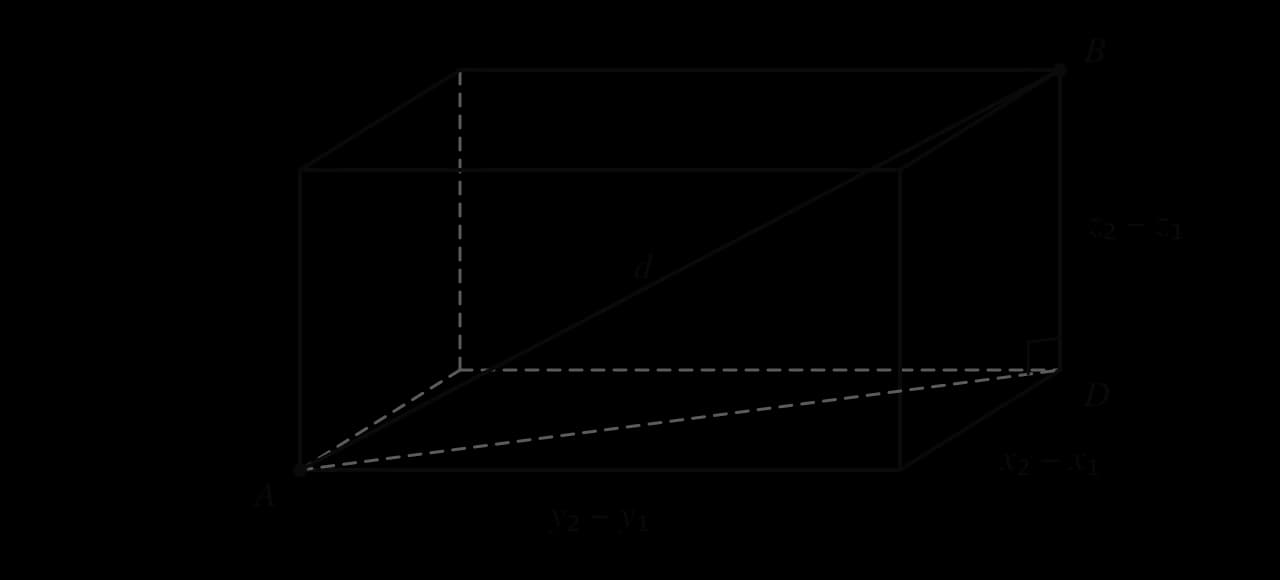
In space, the two points A(x1,y1,z1) and B(x2,y2,z2) are opposite corners of a cuboid whose edges are parallel to the axes. The edges have lengths equal to the differences in the three coordinates, and the distance AB is the length of the cuboid's space diagonal.
Two right-angled triangles give the space diagonal: first AD across the base, then AB using AD and the vertical edge DB.
Pythagoras's theorem is used twice. In the base, AD2=(x2−x1)2+(y2−y1)2. The edge DB is vertical, so it is perpendicular to every line in the base, including AD. Triangle ADB therefore has a right angle at D, and
AB2=AD2+DB2=(x2−x1)2+(y2−y1)2+(z2−z1)2
Writing the three differences on their own line before squaring keeps the signs under control. Each squared term is positive or zero, so a negative number under the square root always means an arithmetic slip.
Using distances to classify triangles
Three side lengths decide the shape of a triangle. Equal lengths show that a triangle is isosceles or equilateral, and if the squares of the two shorter sides add up to the square of the longest side, the converse of Pythagoras's theorem shows that the triangle is right-angled. Working with squared distances avoids square roots until the end.
Finding an unknown coordinate
When a distance is given and one coordinate is unknown, the distance formula becomes an equation. Squaring both sides removes the square root, and the result is usually a quadratic equation with two solutions. Both are valid unless the context rules one out: geometrically, there are two points on a line at a given distance from a fixed point.
The midpoint of a line segment
The midpoint of a line segment is halfway between its endpoints in every direction at once. Halfway in the x-direction is the mean of the two x-coordinates, and the same is true for y and z.
Finding an endpoint from the midpoint
If the midpoint M and one endpoint A are known, the other endpoint B is as far beyond M as A is before it. Each coordinate satisfies 2xA+xB=xM, so xB=2xM−xA, and similarly for y and z.
Prisms, cylinders and cuboids
The volume and surface area of a solid measure two different things. Volume is the amount of space inside, in cubic units (cm3, m3). Surface area is the total area of the outside, in square units (cm2, m2), and equals the area of the solid's net, the flat shape that folds up to make it.
A cuboid is a prism with a rectangular cross-section, and a cylinder behaves like a prism with a circular cross-section. Their standard results are prior knowledge.
Solid
Volume
Surface area
Cuboid, l×w×h
V=lwh
2(lw+lh+wh)
Prism, cross-section area A, length h
V=Ah
Two ends plus the area of every rectangular side
Cylinder, radius r, height h
V=πr2h
Curved surface 2πrh; closed cylinder 2πrh+2πr2
The curved surface of a cylinder unrolls into a rectangle whose length is the circumference of the base, 2πr, and whose width is the height h. A closed cylinder adds two circular ends, but a pipe or an open tube has none, and a can without a lid has only one, so always decide which faces a real object has.
Right pyramids
A pyramid has a polygon for a base and triangular faces that meet at a single point, the apex. The base may be a triangle, a square, a rectangle or any other polygon.
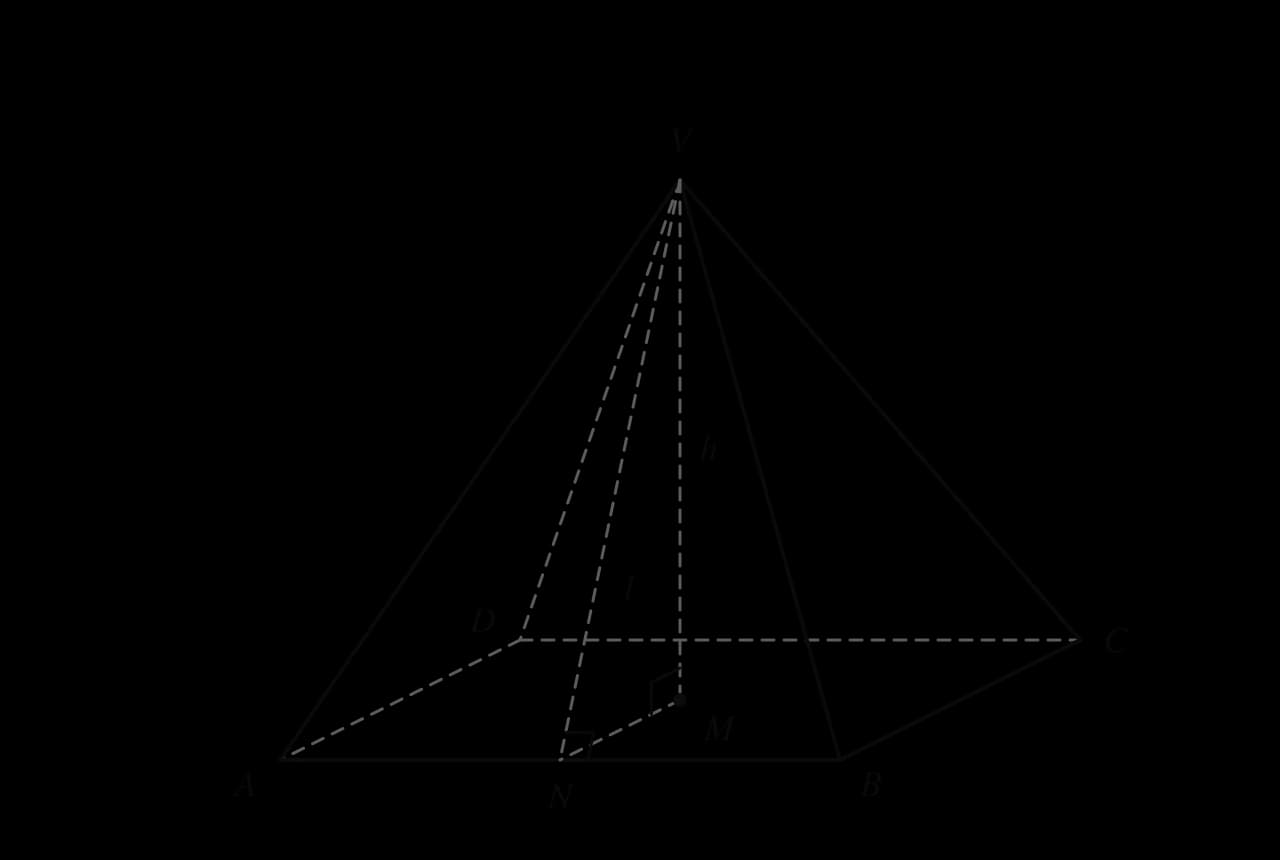
In a right pyramid on a square or rectangular base, the triangular faces come in congruent pairs, and opposite faces are mirror images of each other. The height of a triangular face, measured from the apex to the midpoint of a base edge, is the slant height l of that face. It is longer than the perpendicular height h, because h, half the base side and l form a right-angled triangle with l as the hypotenuse.
Triangle VMN has a right angle at M: the height h, half the base side MN and the slant height l. Triangle VMA, using half the base diagonal, gives the edge VA.
Volume of a pyramid
The volume of any pyramid, whatever the shape of its base, is one third of the volume of the prism with the same base and height.
V=31Ah
where A is the area of the base and h is the perpendicular height. One way to see the factor 31 is to split a cube of side 2a into six identical square-based pyramids, each with its apex at the centre of the cube and one face of the cube as its base. Each pyramid has base area 4a2 and height a, and six of them make up the cube's volume 8a3, so each has volume
68a3=34a3=31×4a2×a=31Ah
Surface area of a pyramid
There is no single formula for the surface area of a pyramid. Add the area of the base to the areas of the triangular faces, using the slant height of each face as the height of its triangle. For a square base of side s and slant height l, the total is s2+4×21sl=s2+2sl.
Right cones
A cone is the limit of a pyramid whose base has more and more sides: the polygonal base becomes a circle, and the triangular faces merge into one curved surface. The same factor of 31 therefore appears in its volume.
The volume of a right cone is one third of the volume of the cylinder with the same base and height, and its curved surface area depends on the slant height.
V=31πr2hCurved surface area=πrl
Where the curved surface area comes from
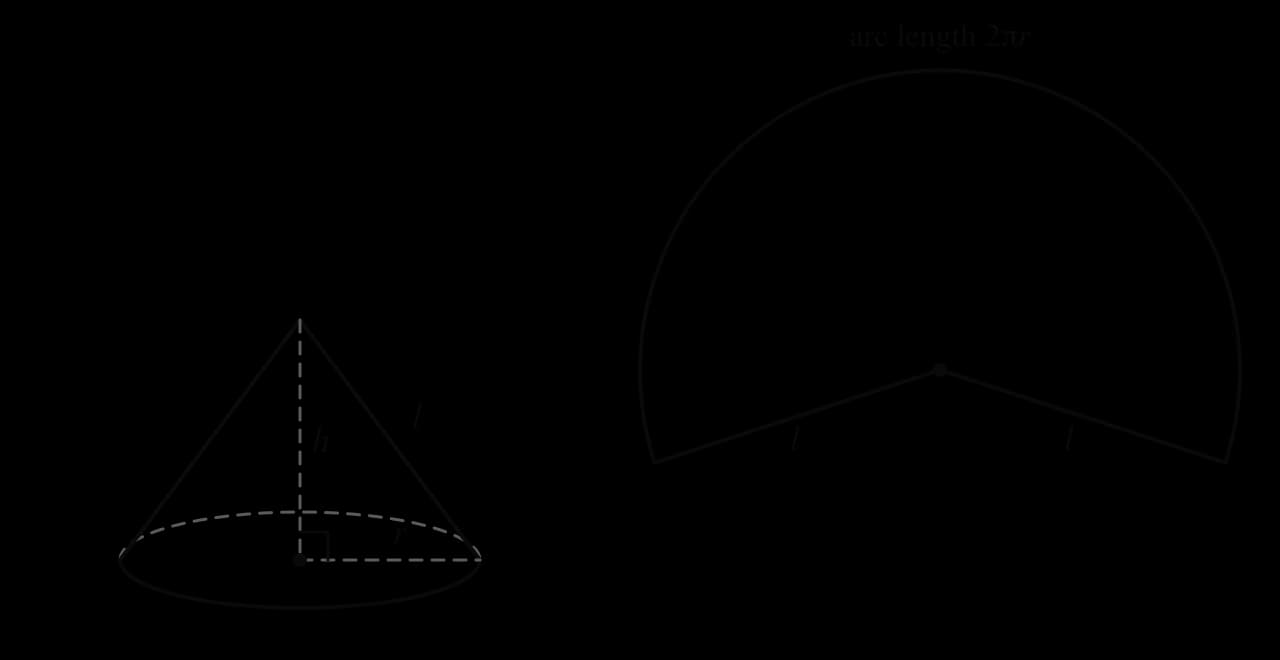
Cutting the curved surface of a cone along a slant line and flattening it gives a sector of a circle. The radius of the sector is the slant height l, and the length of its arc is the circumference of the cone's base, 2πr.
Opened out, the curved surface of a cone is a sector of radius l. Its arc wraps around the base, so the arc length is 2πr.
A full circle of radius l has circumference 2πl and area πl2. The sector's arc is the fraction 2πl2πr=lr of the full circumference, so its area is the same fraction of the full area:
Curved surface area=lr×πl2=πrl
A closed (solid) cone also has a circular base, so its total surface area is πrl+πr2.
Working backwards from a volume or area
A question may give the volume or the surface area and ask for a length. Substitute what is known, then rearrange; the unknown is often under a square or cube root.
Spheres and hemispheres
A sphere has a single curved surface and no edges. A solid hemisphere has two surfaces: a curved surface, which is half of the sphere's, and a flat circular face of radius r.
A hemisphere has a curved surface (half a sphere's) and a flat circular face of the same radius.
The formulas for the sphere follow from calculus and are given; the hemisphere's are built from them.
Solid
Volume
Surface area
Sphere, radius r
V=34πr3
A=4πr2
Hemisphere, radius r
V=32πr3
Curved surface 2πr2
Coordinates and solids combine naturally. The centre of a sphere is the midpoint of any diameter, and the radius is half the length of that diameter.
Composite solids
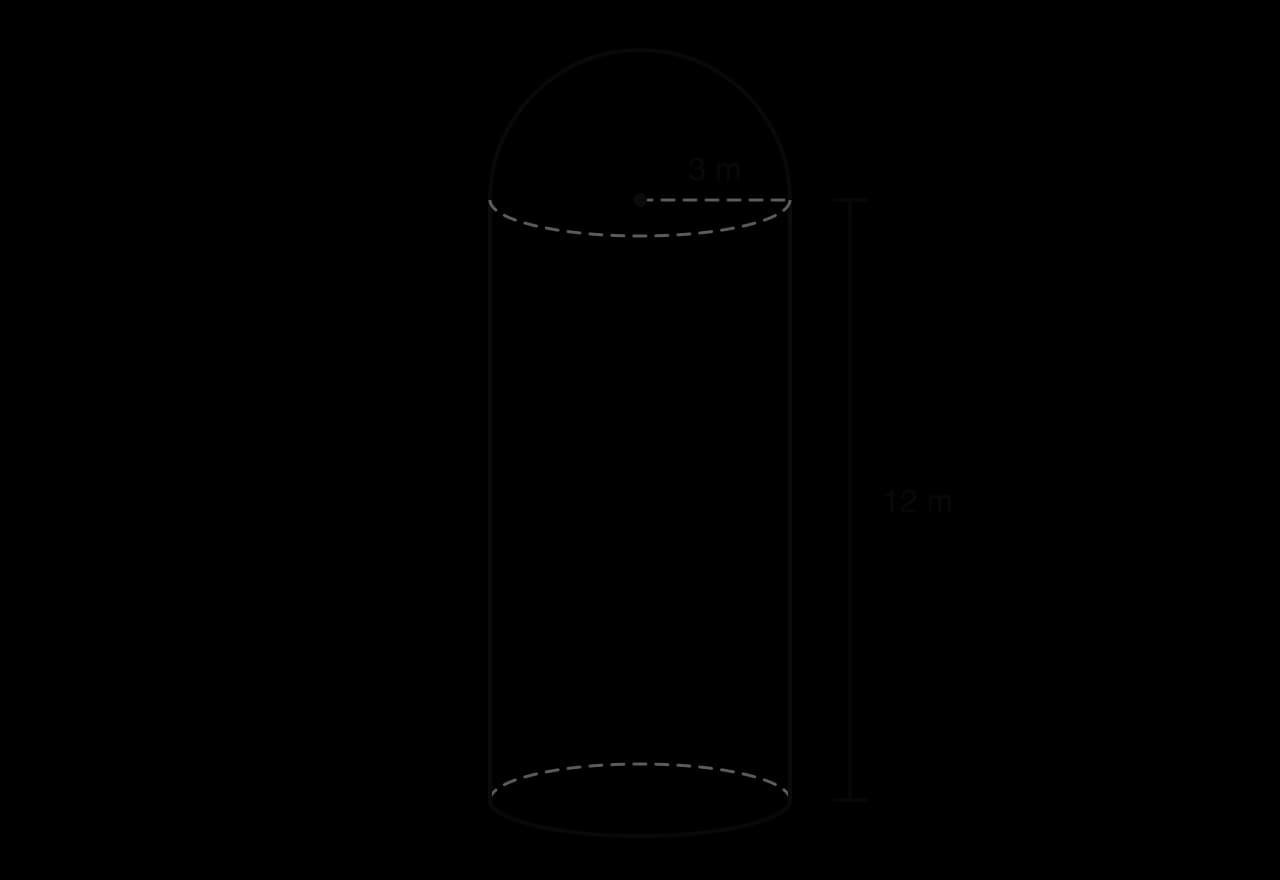
Many real objects are combinations of the basic solids: a grain silo is a cylinder with a hemispherical roof, a pencil is a hexagonal prism with a cone at one end, and a capsule is a cylinder with a hemisphere at each end. Volumes add directly. Surface areas need more care, because a face where two solids are joined is inside the object and is not part of its surface.
A reliable method for any composite solid:
Split the solid into basic shapes and write down the dimensions of each.
For volume, add the volumes of the parts (or subtract, for a hole or a cut-out).
For surface area, list every exposed surface, then add their areas. Leave out any face that is joined to another part or that rests on the ground if the question says so.
The silo's hemispherical roof sits exactly on the top of the cylinder, so the circle where they meet is not part of the outside surface.
The height of a composite solid is often given as a total, and the dimensions of each part must be worked out before any formula is used.
Angles inside solids
An angle in three dimensions is found the same way as in two: identify a triangle that contains the angle, find enough of its sides, and use trigonometry. Inside cuboids, prisms, pyramids and cones the triangle is usually right-angled, because vertical edges and heights are perpendicular to horizontal faces. In a right-angled triangle with an angle θ, the trigonometric ratios are
These are developed fully in 3.2; inside a solid they are used exactly as in a flat triangle.
The angle between two intersecting lines
Two lines that meet at a point always lie in one plane, so the angle between them is an ordinary angle in a triangle. Draw the triangle separately, flat on the page, label the lengths that are known, and look for a right angle. If there is none, the cosine rule from 3.2 finds the angle from three sides.
The angle between a line and a plane
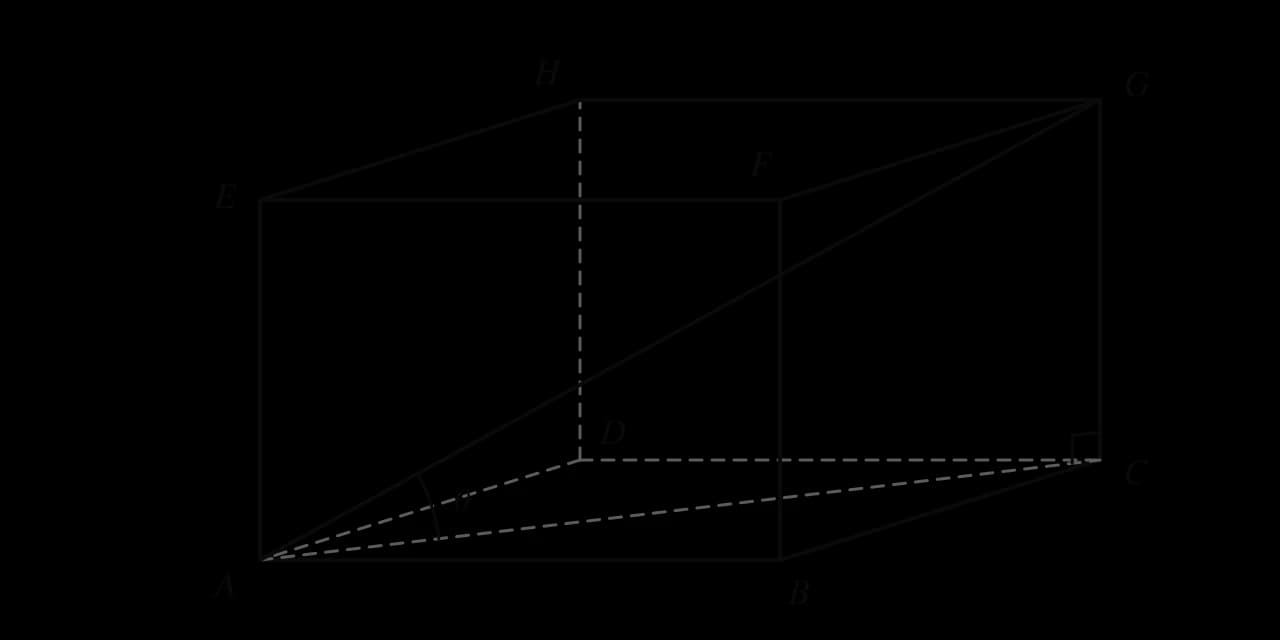
A line that meets a plane at a point makes different angles with different lines in the plane, so the angle with the plane needs a precise definition. The natural choice is the smallest of these angles, the one made with the line's projection: the shadow it would cast on the plane under light shining perpendicular to the plane.
The angle between a line and a plane always sits in a right-angled triangle made of three parts: the line itself (the hypotenuse), the perpendicular from a point on the line to the plane, and the projection.
The projection of AG onto the base is AC, because G lies directly above C. The angle between AG and the base is the angle θ in the right-angled triangle ACG.
The method has four steps:
Find the point where the line meets the plane (here A).
Choose another point on the line (here G) and find the foot of the perpendicular from it to the plane (here C, directly below G).
Draw the right-angled triangle formed (here ACG, with the right angle at C) and find two of its sides.
Use a trigonometric ratio to find the angle at the point where the line meets the plane.
Angles in a pyramid
In a right pyramid, two different angles with the base are common: the angle between a sloping edge (such as VA) and the base, and the angle between a sloping face and the base, measured along the slant height VN. Both use the perpendicular height VM, because M is the foot of the perpendicular from the apex V.
Exam-style questions on three-dimensional geometry
The next question is set without a calculator, so answers stay exact in terms of π, and the "show that" part must reach the given result with every step visible.
Self-check
To do:
I can find the distance between two points in two or three dimensions, and explain why the formula follows from Pythagoras's theorem.
To do:
I can find the midpoint of a line segment, and find an endpoint given the midpoint and the other endpoint.
To do:
I can find an unknown coordinate from a given distance, giving every possible value.
To do:
I can calculate the volume and surface area of right pyramids, right cones, spheres and hemispheres.
To do:
I can find the slant height of a cone or a pyramid from the perpendicular height, and use each height in the right formula.
To do:
I can find the volume and surface area of a composite solid, leaving out the faces that are joined or hidden.
To do:
I can find a length or radius from a given volume or surface area.
To do:
I can find the angle between two intersecting lines, and between a line and a plane, inside a solid.
.
(a)
Find the coordinates of B.
[2]2 marks
Markscheme (a)
25+x=2, 2−1+y=1, 22+z=4 (or MB=AM) (M1)
B(−1,3,6)A1
Note: Award (M1)A0 if one coordinate is incorrect.
(b)
Find the exact value of AB.
[2]2 marks
Markscheme (b)
AB=(5−(−1))2+(−1−3)2+(2−6)2
(c)
Find the exact surface area of the sphere.
[2]2 marks
Markscheme (c)
radius =17 (seen anywhere) (A1)
surface area =4π(17)2=68π
Question 2 · AA-000586 marks
Consider the points P(k,2,−1) and Q(3,2k,1), where k∈R. The distance between P and Q is 25.
(a)
Find the possible values of k.
[4]4 marks
(b)
For the integer value of k, find the coordinates of the midpoint of [PQ].
Since AB2+AC2=8+9=17=BC2, the converse of Pythagoras's theorem shows that the triangle has a right angle at A, the vertex opposite the longest side BC.
The two sides that meet at the right angle are a base and a perpendicular height, so
Area=21×AB×AC=21×8×3=32≈4.24 square units
(k−3)2+16+4=36
(k−3)2=16
Take square roots, remembering both signs.
k−3=±4⇒k=7 or k=−1
Check k=7: 16+16+4=36=6. Both values are correct.
by
+5
. The same holds for
y
(
−3
and
−3
) and
z
(
+3
and
+3
).
Check: the midpoint of (1,2,5) and (7,−4,1) is (28,2−2,26)=(4,−1,3), as given.
; solid hemisphere
2πr2+πr2=3πr2
.
.
G is directly above C, so triangle ACG has a right angle at C.
AG=102+52=125=55≈11.2 cm
The three-dimensional distance formula gives the same result in one step: 82+62+52=125.
(b) The projection of AG onto the base is AC. In triangle ACG, the side opposite θ is CG=5 and the adjacent side is AC=10.
tanθ=105⇒θ=26.565…°≈26.6°
In triangle VMA (right angle at M):
tan(VA^M)=5212⇒VA^M=59.491…°≈59.5°
(b) The face VAB meets the base along AB, and VN and MN are both perpendicular to AB, so the angle between the face and the base is VN^M. Here MN=5 cm.
tan(VN^M)=512⇒VN^M=67.380…°≈67.4°
(c) The slant height is VN=122+52=13 cm. Triangle VAB is isosceles, and VN splits it into two right-angled triangles, so angle AVN is half of angle AVB. In triangle VNA, AN=5 is opposite and VN=13 is adjacent.
tan(AV^N)=135⇒AV^N=21.037…°
AV^B=2×21.037…°=42.075…°≈42.1°
. This is directly below
V
, which confirms the pyramid is a right pyramid.
(b) Use the distance formula.
VA=(3−0)2+(3−0)2+(8−0)2=82=9.055…≈9.06
(c) The base has area 62=36 and the height is VM=8.
V=31×36×8=96 units3
(d) The projection of VA onto the base is AM=32+32=32, and VM=8 is perpendicular to the base.
tanθ=328⇒θ=62.061…°≈62.1°
(e) Let N be the midpoint of AB, so N=(3,0,0). The slant height of each face is
VN=(3−3)2+(3−0)2+(8−0)2=73
Each triangular face has area 21×6×73=373. Add the four faces and the base.
Total=36+4×373=36+1273=138.528…≈139 units2
Marks are typically for finding the slant height, the area of one face, multiplying by four, and including the base.
VcylinderVsphere=2πr334πr3=34×21=32
so the volume of the sphere is 32 of the volume of the cylinder.
(c) Use the cylinder's volume to find r.
2πr3=54π⇒r3=27⇒r=3 cm
Surface area of sphere=4π×32=36π cm2
(M1)
=68(=217)A1
Note: Accept AB=2AM=29+4+4.
A1
Note: Award (A0)A1FT for 4πr2 with their radius from part (b). Award A0 for 272π (diameter used as radius).