
Solve polynomial and rational inequalities analytically with critical values and sign diagrams, and graphically using a GDC, without multiplying by expressions of unknown sign.
Each is in the Maths AA glossary, with every other term in the subject.
A value of at which an expression in an inequality is zero or undefined. Critical values split the number line into intervals on which the sign of the expression does not change; a sign diagram records that sign on each interval.
An inequality using or , so equality is not allowed. A non-strict inequality uses or
With a free account, Augment remembers where you stopped and what you have practiced.
An inequality compares two quantities that need not be equal. Solving it means finding every value of for which the comparison is true, so the answer is usually a whole interval or a union of intervals rather than a list of numbers. Inequalities describe conditions such as "the profit is at least zero", "the concentration stays below a safe level" or "the curve lies above the line".
Linear and quadratic inequalities can be solved with a few rules and a sketch. For polynomials of higher degree and for rational functions, the same rules need more care, because multiplying by an expression whose sign changes can reverse an inequality on part of the number line without warning. Critical values and sign diagrams give a reliable method that works in every case.
An inequality uses one of four symbols. A strict inequality uses or ; a non-strict inequality uses or and also allows equality.
The difference matters at the boundary of a solution. The solution of is , while the solution of
A solution can be written with inequalities or in interval notation. A round bracket means the endpoint is excluded; a square bracket means it is included; always takes a round bracket. The symbol (union) joins separate intervals.
Inequality form | Interval notation | Number line |
|---|---|---|
or |
The IB uses outward-facing square brackets, , for open intervals; round brackets mean the same thing and are equally acceptable. With inequalities, a union is written with the word "or": " or
An inequality is preserved when
the same quantity is added to or subtracted from both sides;
both sides are multiplied or divided by the same positive number.
It is reversed when both sides are multiplied or divided by the same negative number: from , dividing by gives .
When the multiplier is an expression such as or , its sign depends on : positive for some values and negative for others. Multiplying by it would keep the inequality for some values of and reverse it for others, so a single answer cannot be correct.
The inequality is true for exactly those values of where the graph of is on or higher than the graph of
So a graphical solution has three steps:
Draw both graphs (or the single graph of ).
Find the -coordinates of the intersection points, and any vertical asymptotes.
Read off the intervals where the graph of is higher than the graph of
Moving everything to one side gives an equivalent form: is the same as , which is true where the graph of
A graphic display calculator (GDC) draws both graphs and finds their intersections with its intersection tool, or the zeros of with its zero (root) tool. This handles inequalities that are hard or impossible to solve algebraically.
The analytic method rests on one fact: a polynomial or rational expression can only change sign at a value where it is zero or undefined. Between two such values the graph is unbroken and never meets the -axis, so the expression keeps the same sign throughout the interval.
The critical values split the number line into intervals. One test value in each interval, or the signs of the factors, gives the sign of on the whole interval.
Rearrange the inequality so that one side is : , , and so on.
Factorise fully, writing it as a single fraction if it is rational.
Find the critical values: the zeros of the numerator and of the denominator.
For a polynomial in factorised form, the sign on each interval comes from the signs of the factors. With the leading coefficient positive, the sign in the right-most interval is always . Moving left, the sign changes at each simple root.
A polynomial that is not yet factorised is first factorised using the factor theorem.
At a root of even multiplicity the factor does not change sign, so neither does the polynomial: the graph touches the axis and turns back. The sign is the same on both sides of such a critical value.
Rational inequalities are where multiplying by an unknown expression most often goes wrong. Two safe methods exist.
Subtract so that one side is , combine into a single fraction, and draw a sign diagram. The critical values are the zeros of the numerator and of the denominator. A zero of the denominator is never part of the solution, because the expression is undefined there.
A square is never negative, so multiplying both sides by , which is positive for every , keeps the direction of the inequality. For
Collect everything on one side and factorise, taking out the common factor rather than expanding:
So , which is a quadratic inequality with solution or
Both methods give the same answer. Method 1 is usually shorter for a single fraction; Method 2 is convenient when the denominators are linear and the resulting polynomial factorises easily.
When the inequality compares two fractions, Method 1 combines them over a common denominator. The denominators then appear as factors in the sign diagram.
If the denominator has no real zeros and a positive leading coefficient, it is positive for every , and multiplying by it is safe. For example,
since for all . So
The same reasoning applies whenever the sign of the multiplier is known from the context or the domain. If the question states , multiplying by keeps the inequality.
Sometimes the numerator has a repeated root, and the same care with even multiplicity applies as for polynomials.
A sketch of both sides shows the shape of the solution; algebra then gives the exact boundaries. When the intersections cannot be found exactly, a GDC gives them to 3 significant figures.
In a modelling problem the domain often fixes the sign of an expression, which makes multiplying safe, and the answer must be interpreted: a number of items is a whole number, a time is positive.
The question that follows combines polynomial factorisation with a rational inequality, as is typical of Paper 1 (no GDC).
I can solve an inequality graphically, using a GDC to find intersection points or zeros.
I can explain why multiplying by an expression of unknown sign can lose or add solutions.
I can find the critical values of a polynomial or rational inequality.
I can draw a sign diagram, including at roots of even multiplicity.
I can solve polynomial inequalities after factorising with the factor theorem.
I can solve rational inequalities by bringing everything to one side, or by multiplying by a square.
I can decide which critical values are included, and always exclude zeros of a denominator.
I can write a solution set with inequalities or interval notation and interpret it in context.
30 exam-style questions on this subtopic, written in the style of the IB papers. The first has its markscheme open. Counted on
Let , for . It is given that is a factor of .
Factorize fully.
3 marks
attempt to divide by or to compare coefficients M1
Solve the inequality , for .
5 marks
Consider the inequality , where ,
One of 28 short multiple-choice questions on 2.15. Pick an answer to see why it's right or wrong.
Given that , which statement is always true?
open circles at both ends |
filled circles at both ends |
or | open at 3, filled at 7 |
The cubic has a positive leading coefficient, so the graph is below the axis to the left of the first zero, and again between the second and third zeros.
The solution is or . The inequality is strict, so the zeros themselves are excluded.
Draw a sign diagram, finding the sign on each interval.
Choose the intervals on which has the sign the inequality asks for. Include zeros of the numerator for or ; never include zeros of the denominator.
Interval | Product | |||
|---|---|---|---|---|
The product is positive for and for . The inequality is strict, so the critical values are excluded.
The solution is or ; in interval notation, .
The critical values are , and . The leading coefficient is positive, so the sign is for and alternates moving left: on , on , for .
The inequality is non-strict, so the zeros are included. The solution is
The critical values are (simple) and (double). For every factor is positive, so the product is positive. At the sign does not change, so the product is also positive for . At it changes, so the product is negative for .
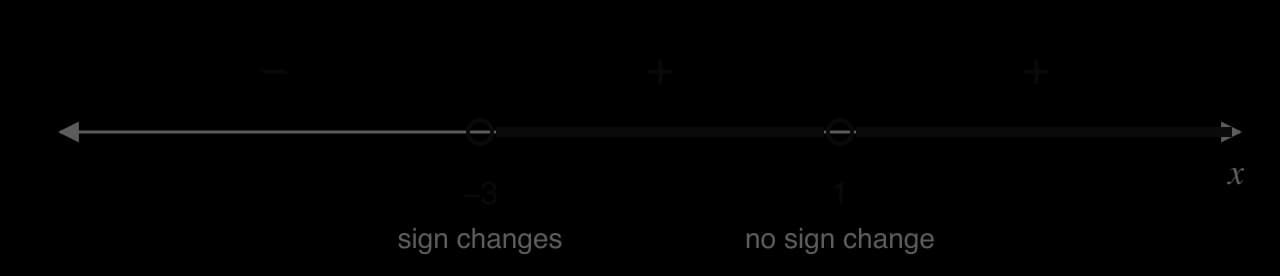
(a) The product is strictly positive for and . At it is zero, which is not greater than zero. The solution is
(b) Now the zeros are included: and both satisfy the inequality, and the solution is .
The critical values are (numerator zero) and (denominator zero).
Interval | Fraction | ||
|---|---|---|---|
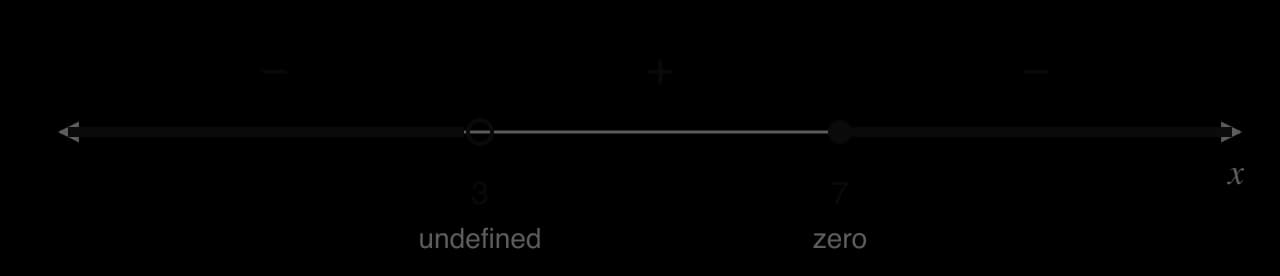
The fraction is negative or zero for and for . The solution is or .
Bring everything to the left and combine:
The critical values are , and .
Interval | Fraction | |||
|---|---|---|---|---|
The solution is or .
The graph confirms the answer: the curves intersect only at , and the asymptotes at and are the other boundaries.
The numerator factorises as , so the critical values are , and (with and ).
Interval | Fraction | ||
|---|---|---|---|
The fraction is on and on , including the zeros and excluding .
The solution is or .
The numerator is never negative and is zero only at . So the fraction is positive when , zero at , and negative when .
The solution is . (The point , where the fraction equals zero, is already inside this interval.)
This matches the graph of in 2.13: its right-hand branch has a minimum at , so it never goes below , while the left-hand branch is entirely below .
(b) Hence find the exact solution of .
(a) The graphs intersect three times, at , and .
(b) The denominator is always positive, so multiply by it without changing the direction:
The GDC suggests is a root: . Dividing by
and gives
The solution is or
Solve . Since , multiplying by keeps the direction:
The roots of are
The quadratic is between its roots: , approximately. The number of items is a whole number, so the average cost is at most 20 dollars when between and items are made.
Check the endpoints: and ; and
(b) Hence factorise fully. [3 marks]
(c) Solve the inequality . [3 marks]
(d) Hence, or otherwise, solve the inequality . [4 marks]
(a) , so is a factor of by the factor theorem.
(b) Dividing by (synthetic division with on gives
(c) The critical values are , and . The leading coefficient is positive, so the signs from the right are (for ),
(d) The numerator is , so the fraction is
Interval | Fraction | |||
|---|---|---|---|---|
The fraction is for and for . The zeros and
The solution is or .
A1
Hence solve the inequality .
2 marks
A1
A1
Note: Accept . Award A1A0 if non-strict inequalities are used throughout.
Solve the inequality.
5 marks
Hence solve , where , .
2 marks