4 Power, places and networks
See how the three parts of the unit fit together, from global power to the flows that connect places and the forces that speed or slow them, with the case studies, core links and Paper 3 demands.
- IB Geography
- HL only
What 4 covers
From the subject guide: what you need to know and be able to do.
HL extension: global power and the flows of people, money, goods and ideas that link places.
3 subtopics in Power, places and networks
Each one has its own page once something is published for it.
- 4.1Global interactions and global power181 questions · notes
- 4.2Global networks and flows242 questions · notes
- 4.3Human and physical influences on global interactions192 questions · notes
An overview of 4 Power, places and networks
Power, places and networks studies how places are connected by flows of goods, money, people and information, which places and institutions hold power over those flows, and what speeds them up or holds them back. These global interactions arise from disparities between places, and they run in more than one direction: Chinese firms invest in Europe, migrants in the Gulf send money to South Asia, and trade between lower-income regions grows faster than trade between rich ones.
Questions that frame the unit
The unit follows three lines of geographical inquiry. The first asks how global power and influence vary from place to place, and how a country’s participation in global interactions can be measured. The second asks how different places become interconnected by flows and by the networks of transnational corporations. The third asks how political, technological and physical processes influence those interactions, accelerating them in some places and limiting them in others.
These inquiries lead to real questions that geographers try to answer with evidence:
Why do the USA and China rank only 28th and 85th on the KOF Globalisation Index, far behind the Netherlands, when both shape the world economy far more?
Why did Sri Lanka lease 70% of the port of Hambantota to a Chinese company for 99 years in 2017, and does the deal show “debt-trap diplomacy”?
Why are remittances equal to 47.2% of Tajikistan’s GDP but only 3.7% of India’s, when India receives more remittances than any other country?
Why did Apple capture about 58.5% of the price of an iPhone 4 as profit while the Chinese workers who assembled it received about 1.8%?
Why do landlocked developing countries pay about two and a half times as much as their coastal neighbours to export a container?
What the unit covers
The unit has three subtopics, which move from who holds power, to the flows that link places, to the forces that shape those flows.
Subtopic | Main question | Case study and detailed examples |
|---|---|---|
4.1 Global interactions and global power | How can participation in global interactions be measured, what makes a superpower, and how much power do global groups and lenders hold? | Case study: China, a rising superpower (the Belt and Road Initiative, Hambantota). Detailed example: the USA, the established superpower. Examples: the KOF index and DHL report, the G7, G20 and OECD, OPEC and OPEC+ (and the UAE’s exit from both in May 2026), IMF conditions in Greece and Sri Lanka, the New Development Bank and the AIIB |
4.2 Global networks and flows | What are the size and direction of global flows, and how do TNCs network places through FDI and outsourcing? | Case study: Apple, an outsourced supply chain centred on China and moving partly to India. Detailed example: Inditex (Zara) and proximity sourcing. Examples: Zambia’s debt and the Common Framework, remittances to India, Nepal and Tajikistan, cocaine routes, counterfeit goods, near-shoring to Mexico |
4.3 Human and physical influences on global interactions | How do political rules, technology and the physical environment speed up or limit global interactions? | Case study: the African Continental Free Trade Area. Examples: the EU, USMCA, RCEP and Brexit, the WTO, Shenzhen, Jebel Ali and the maquiladoras, the UK points system, the H-1B visa and the kafala system, containerisation, Tonga’s cable break in 2022, small island and landlocked states |
Several places reappear from different angles. China is a superpower in the first subtopic, the world’s largest exporter of goods in the second and an example of special economic zones in the third; Zambia is a debtor in the second and a resource-dependent, landlocked state in the third; Tonga depends on remittances for 39.4% of its GDP and on a single submarine cable for its internet.
How the subtopics connect
The concept map shows the main links. The states, groups and lenders of the first subtopic set many of the rules under which flows move: IMF votes, OPEC quotas and the decisions of the G20 all shape trade, loans and investment. The second subtopic describes those flows and the supply chains of TNCs, in which design and branding stay in core regions while assembly moves to lower-cost places.
The third subtopic explains why the flows are fast in some places and slow in others, and the dashed loop shows that rules and technology in turn redistribute power, as China’s entry to the World Trade Organization in 2001 helped to make it the world’s largest exporter.
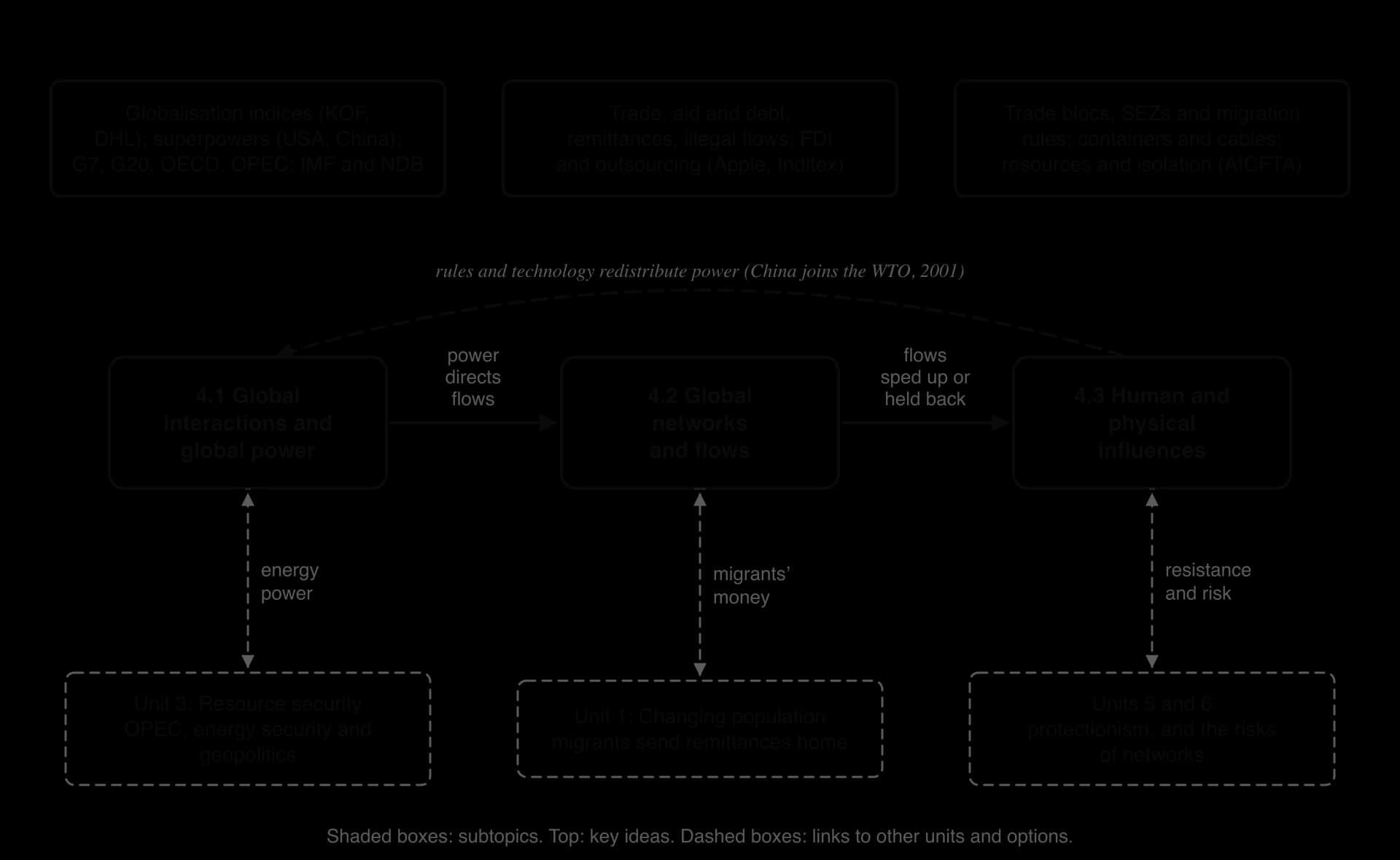
The unit is the starting point for the rest of the HL extension. Its flows of migrants and culture are the subject of the unit on human development and diversity, where diasporas, resistance to TNCs and protectionism are studied, and its supply chains and data networks are the source of the risks examined in the unit on global risks and resilience.
Key concepts in Power, places and networks
Power is the central concept of the unit, joined by spatial interactions, scale and interdependence, the mutual dependence that makes events in one place matter in others.
Concept | How it appears in the unit |
|---|---|
Power | Hard, soft and smart power; the USA’s votes in the IMF and the role of the dollar; China’s lending through the Belt and Road Initiative; firms such as Apple capturing most of the value of a supply chain. |
Place | Small open economies such as Singapore and the Netherlands are the most globalised; landlocked and island states pay more for every flow; Zhengzhou and Shenzhen hold supplier clusters that are hard to move. |
Process | Outsourcing, offshoring and foreign direct investment; containerisation and submarine cables creating a shrinking world; trade blocs integrating economies step by step. |
Possibility | Whether the world becomes multipolar, whether the AfCFTA raises trade within Africa, and whether supply chains move from China to India and Mexico. |
Spatial interactions | Trade, aid, debt, remittances and illegal flows, shown with flow maps, Sankey diagrams and topological maps. |
Scale | Power held by superpowers, regional powers, global cities and TNCs; isolation acting on a Pacific island state, a landlocked country and a mountain village. |
The unit builds directly on the core. It takes globalisation, the transnational corporation and the global shift of manufacturing from the unit on climate change, where they explain rising emissions, and asks how they distribute power and connect places. It takes migration and the classification of countries into low-income, middle-income and high-income groups from the unit on population, and turns migrants into senders of remittances. From the unit on resource consumption it takes energy security and geopolitics, which explain OPEC’s influence on importing countries since 1973. The options add further links: low-cost airlines and international tourism connect it with Leisure, tourism and sport, and global cities with Urban environments.
How SL and HL differ
Power, places and networks is one of the three HL extension units, studied only by HL students and examined in Paper 3. SL students do not study it. Its first subtopic is recommended as the introduction to the whole HL extension, because the measures of globalisation, the flows and the influences that the unit explains are used in the other two units.
The unit builds on the SL and HL core rather than repeating it. Globalisation, TNCs and the global shift, migration, the income groups and core–periphery patterns, energy security and geopolitics are core concepts that the unit reuses, adding how participation is measured, what makes a superpower, how flows network places and what limits them. Paper 3 questions on the unit expect this core knowledge, and the options, to be brought into the answer.
Assessment
The unit is examined in Paper 3, which sets one question on each HL extension unit; candidates answer one of the three. Each question has two parts on the same unit: part (a), worth 12 marks, asks candidates to analyse, explain or examine, and part (b), worth 16 marks, gives a quoted statement to discuss or to judge how far they agree with. Part (a) rewards detailed, structured analysis and needs no synthesis or evaluation. Part (b) reaches the top band only with both a synthesis of well-evidenced themes from across the HL extension and the core and a critical evaluation that weighs perspectives and the certainty of the evidence.
Questions on the unit tend to ask how FDI or outsourcing connects places, how global lending institutions or groups exercise power, or how far technology rather than politics has accelerated globalisation. Typical part (b) statements claim that superpowers have less influence than before, that distance no longer matters, or that remittances now matter more than trade.
Carry on with 4 in Augment
With a free account, Augment remembers where you stopped and what you have practiced.