Notes on 6.3 Local and global resilience
Learning objectives
Define resilience in the context of global risks, and identify the strategy that answers each geopolitical, economic and environmental risk of global interactions.
Describe the types of international civil society organisation and the strategies they use, from awareness campaigns and lobbying to litigation, boycotts and certification.
Evaluate the success of international civil society organisations in raising awareness of, and finding solutions for, environmental and social risks, using one environmental and one social example.
Explain why TNCs and governments are re-shoring, near-shoring and friend-shoring production, and evaluate the costs and benefits for different places.
Explain how governments and civil society use crowd-sourcing, crowdfunding and citizen science to build resilience, and outline their limitations.
Examine how cybersecurity, e-passports, biometrics and digital identity manage global flows of data and people, and the privacy and exclusion concerns they raise.
Evaluate sources of evidence on global risks, comparing civil society reports with company and government data.
Discuss how perspectives on the severity of global risks and the priorities for action vary between stakeholders and places.
Introduction
Global interactions bring risks as well as benefits: supply chains break, computer networks are attacked, identities are stolen, and pollution and labour abuse travel along the chains that bring goods to consumers. People, organisations and governments are responding by trying to build resilience to these risks, using new organisations, new strategies and new technologies.
The central concept is possibility: the range of ways that the future of global interactions could be managed, and how far each would reduce risk. Power runs through every strategy, because each one shifts influence between governments, transnational corporations (TNCs), civil society and citizens. The topic builds on the risks of global interactions, which include hacking, supply-chain disruption, transboundary pollution and the pollution created by the global shift of industry, and on the work of civil society and non-governmental organisations in responding to climate change.
Resilience to the risks of global interactions
Resilience is the capacity of people, places or systems to absorb a shock, recover from it, and adapt so that they are better able to cope in future. In the study of climate change it is the opposite side of vulnerability. Applied to global interactions, resilience means that a supply chain, a computer network, a border system or a community can keep working when something goes wrong elsewhere in the world, and can learn from the disruption.
Resilience can be built in three broad ways. Systems can be made more robust, so that they resist shocks (stronger cybersecurity, factory safety inspections). They can be given redundancy, so that a failure in one part is covered by another (several suppliers in different countries, data stored in more than one place). And they can be made more adaptable, so that information reaches decision-makers quickly and they can change course (crowd-sourced crisis maps, civil society watchdogs). The diagram links the main risks of global interactions to the strategies that answer them.
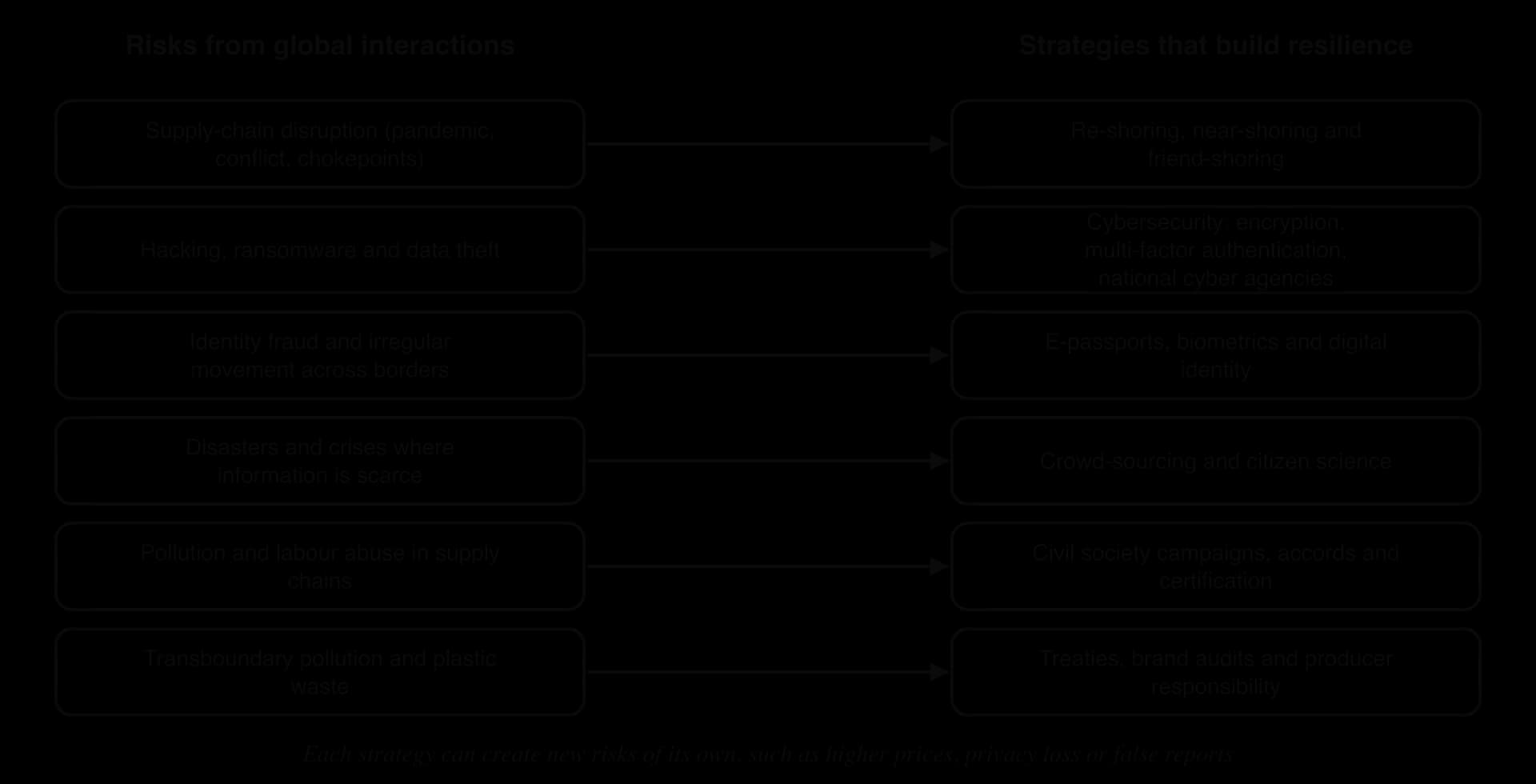
Strategies to build resilience are chosen by different actors with different aims. A government may value national security and jobs, a TNC its costs and reputation, a civil society organisation the rights of workers or the health of the environment, and a citizen their privacy and income. The same strategy can therefore look like a solution to one group and a new risk to another, a theme that runs through the rest of the topic.
International civil society organisations
Civil society is the space outside government and business where people organise around shared interests and values: charities, campaign groups, trade unions, faith groups, professional bodies and community associations. A civil society organisation (CSO) works across borders when it operates in several countries or campaigns on global issues.
Many international CSOs are international non-governmental organisations (INGOs), formally registered organisations with offices and members in many countries, such as Greenpeace, Amnesty International, Oxfam and Médecins Sans Frontières (MSF). Others are looser coalitions and networks that link hundreds of local groups, such as Break Free From Plastic or the Clean Clothes Campaign.
Types of international civil society organisation
CSOs can be grouped by what they mainly do, although most combine several roles.
Type | What it does | Examples |
|---|---|---|
Campaigning | Raises awareness and puts pressure on governments and companies to change policy or behaviour | Greenpeace, 350.org, Break Free From Plastic |
Research | Produces evidence through investigations, testing and reports, often used by others | Oxfam’s annual inequality reports; Greenpeace Research Laboratories |
Service delivery | Provides health care, relief, education or other services directly | MSF, the Red Cross and Red Crescent Movement |
Watchdog | Monitors whether governments and companies keep their commitments and obey the law, and exposes failures | Human Rights Watch, Amnesty International, the NGO Shipbreaking Platform |
The watchdog role is especially important for global interactions, because supply chains cross many jurisdictions and no single government monitors the whole chain.
Strategies
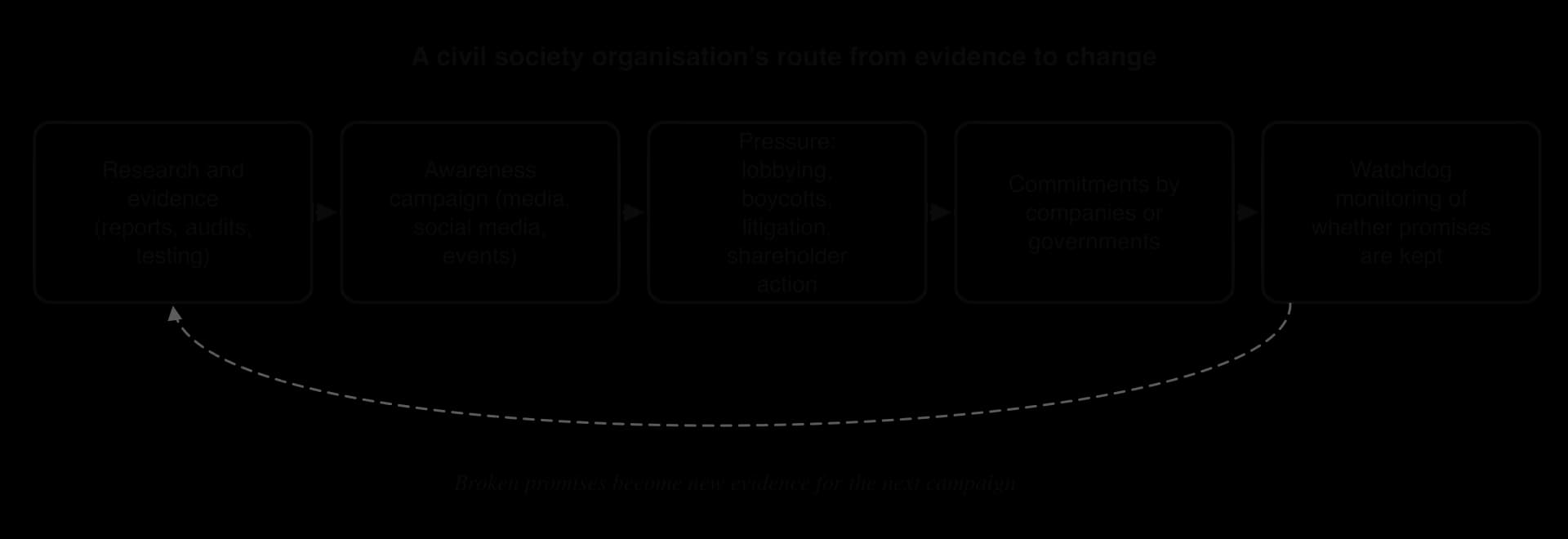
International CSOs use a range of strategies, usually in sequence, from gathering evidence to monitoring whether change is delivered.
Research and reports. Evidence gives a campaign credibility: laboratory tests of clothing, interviews with miners, satellite images of fires, or audits of branded litter. Oxfam publishes an annual report on global inequality timed to coincide with the World Economic Forum in Davos.
Awareness campaigns. An awareness campaign uses media, social media, events and stunts to inform the public and change attitudes.
Lobbying. Lobbying is direct pressure on legislators, officials and negotiators, at national parliaments or at international talks such as the plastics treaty negotiations.
Litigation. Taking governments or companies to court, at home or abroad, can force action that politics will not deliver, as climate cases in the Netherlands have shown.
Boycotts and consumer pressure. A boycott is a refusal to buy from, use or deal with a company or country as a protest; the threat of one can damage a brand, whose value depends on its reputation.
Shareholder action and divestment. CSOs buy shares to raise issues at annual meetings, or persuade investors to sell holdings in polluting firms (the fossil-fuel divestment campaign led by 350.org).
Partnerships and certification. Some CSOs work with companies to design standards, such as the Forest Stewardship Council for timber, the Roundtable on Sustainable Palm Oil or Fairtrade, and certify products that meet them. WWF helped to found both the Forest Stewardship Council and the Roundtable on Sustainable Palm Oil.
Awareness on its own rarely changes policy, so campaigns usually move on to direct pressure on decision-makers.
Environmental and social campaigns
Several well-known campaigns show how these strategies work for environmental and social risks.
Greenpeace: Detox My Fashion
In July 2011 Greenpeace published tests showing that suppliers of major clothing brands were discharging hazardous chemicals into rivers in China, and launched its Detox My Fashion campaign. It asked brands to commit to eliminating hazardous chemicals from their supply chains by 2020, using public protests outside shops, social media and laboratory testing of clothes.
Puma, Nike and Adidas made the commitment within weeks of the first report. By 2018, 80 companies, together responsible for about 15% of global clothing production, had made the pledge, and Greenpeace reported that all of them had made significant progress. The campaign relied on the value of brands’ reputations, which made companies take responsibility for dyeing mills they did not own.
Amnesty International: cobalt and child labour
In 2016 Amnesty International and the Congolese organisation Afrewatch published an investigation tracing cobalt mined by hand in the Democratic Republic of the Congo (DRC), including by children, through smelters in China to the batteries of smartphones and electric vehicles sold by major technology and car companies. The report led several companies to publish their cobalt suppliers and join industry initiatives to audit their supply chains, but artisanal mining and child labour continue, because poverty drives families into the mines and the supply chain has many intermediaries.
Oxfam: Behind the Brands
From 2013 to 2016 Oxfam’s Behind the Brands campaign scored the world’s ten largest food and drink companies on their policies on land, women, small farmers, workers, water, climate and transparency, and published the scores online. Public pressure, focused on one issue at a time, persuaded companies such as The Coca-Cola Company and PepsiCo to adopt zero-tolerance policies on land grabs in their supply chains, and cocoa buyers to commit to support women farmers. Ranking rivals against each other proved a powerful tool, because no company wanted to come last.
Médecins Sans Frontières: the Access Campaign
MSF, a medical humanitarian organisation, launched its Access Campaign in 1999 to lower the prices of medicines and vaccines in lower-income countries. It combined evidence from its own clinics with lobbying on patent rules and support for generic producers, and it is widely credited with helping to cut the price of HIV treatment in lower-income countries. The campaign shows a service-delivery INGO using its frontline experience as evidence for global policy change.
Measuring the success of civil society organisations
Success is hard to measure, because a CSO rarely acts alone and change may have several causes. Geographers judge it against several criteria:
Awareness: media coverage, public recognition of an issue and changes in what consumers say they value.
Policy change: new laws, treaties or regulations that can be linked to the campaign.
Corporate change: commitments by companies, and evidence that they have been carried out.
Outcomes on the ground: fewer factory deaths, cleaner rivers, less plastic litter or lower medicine prices.
Durability: whether the change lasts after the campaign moves on.
CSOs also face real limits. They depend on donations or grants, which can push them towards issues that attract funding in high-income countries. Many of the largest INGOs are based in the Global North, so critics ask whose priorities they represent and whether local groups in the places affected are heard. Their legitimacy can be questioned, because they are not elected. Some governments restrict them, through laws on foreign funding, internet controls or the arrest of activists, which limits what they can do in the places where risks are greatest. And companies can respond with pledges that are easier to make than to keep.
Strengths of international CSOs | Limitations of international CSOs |
|---|---|
Independent of governments and companies, so trusted by many members of the public | Not elected; their legitimacy to speak for affected communities can be questioned |
Can investigate across borders where no single government monitors a supply chain | Depend on donations; may favour issues that appeal to donors in HICs |
Use brands’ reputations to win quick corporate commitments | Commitments may be greenwashing and hard to verify without a watchdog |
Link local groups into global networks, giving them a voice at international talks | Restricted or banned by some governments; staff and partners can face danger |
Provide services and evidence from the front line (MSF, Red Cross) | Small budgets compared with the TNCs and states they challenge |
Social action: the Accord on Fire and Building Safety in Bangladesh
On 24 April 2013 the Rana Plaza building in Savar, near Dhaka, collapsed, killing 1,134 people and injuring about 2,500. The nine-storey building, built on a former pond without proper permits, housed five garment factories making clothes for international brands including Benetton, Primark, Mango, Joe Fresh and Walmart. Cracks had appeared the day before; the shops and bank on the lower floors closed, but factory managers ordered workers back to their machines.
Three weeks later, on 15 May 2013, the Accord on Fire and Building Safety in Bangladesh was signed. It was a five-year, legally binding agreement between brands and retailers and two global trade union federations, IndustriALL and UNI Global Union, with eight Bangladeshi unions and four NGO witnesses, among them the Clean Clothes Campaign and the Worker Rights Consortium. More than 200 brands from over 20 countries signed. Unlike earlier voluntary codes of conduct, the brands committed to pay for independent inspections, to publish the results, to help pay for repairs, and to stop buying from factories that refused to make them safe, with disputes settled by binding arbitration.
Accord on Fire and Building Safety: fact file | |
|---|---|
Trigger | Rana Plaza collapse, Savar, 24 April 2013: 1,134 deaths |
Signed | 15 May 2013; renewed as the Transition Accord (2018) and the International Accord (2021) |
Parties | Over 200 brands from 20+ countries; IndustriALL and UNI; eight Bangladeshi unions; four NGO witnesses |
Results to 2019 | Over 2,000 factories inspected, over 150,000 hazards found, 1.4 million workers trained, about 90% of initial repairs completed |
Today | International Accord covers Bangladesh and Pakistan, with 280–300 brands, over 56,000 inspections and over 1,000 complaints resolved (2026) |
Alternative | The Alliance for Bangladesh Worker Safety, formed by 17 North American retailers led by Walmart and Gap in July 2013, without legally binding payment commitments |
The Accord is widely regarded as one of the most successful civil society actions on supply-chain risk, because it moved from awareness to binding obligations with independent monitoring.
Its limits are also clear. It covers building and fire safety, not wages or the right to organise. It depends on brands choosing to sign, and some large North American retailers chose the weaker Alliance instead. Bangladesh’s government and factory owners argued that a foreign-led body undermined national sovereignty, and in 2020 its local work passed to a national body, the RMG Sustainability Council, while the brands’ commitments continued through the International Accord.
The case shows that civil society achieves most when it combines public pressure with a legal agreement that the most powerful actors in the chain, the brands, must keep.
Sources: Wikipedia, “2013 Savar building collapse” and “Accord on Fire and Building Safety in Bangladesh” (accessed 2026); International Accord website (2026); Greenpeace, “Destination Zero” (2018).
Case study: Break Free From Plastic and the brand audits
The risk: plastic pollution along global flows
Plastic packaging is a product of global interactions. Polymers made from oil and gas in petrochemical plants in the United States, the Middle East and China are shipped as pellets to factories worldwide, turned into bottles, sachets and wrappers, and sold by TNCs in almost every country. Much of it ends up in places with little or no waste collection, where it is burned in the open, dumped in rivers or washed into the sea. The places that suffer most, often in South and Southeast Asia, Africa and Latin America, are rarely the places where the plastic was made or where the brands that use it are based.
For years the debate about responsibility focused on countries. Studies ranked the countries that let the most plastic reach the sea, and several of the top places were in Southeast Asia, which suggested that the solution was better waste management in lower-income countries. Many civil society groups in those countries argued that this framing put the burden on the places with least power and ignored the companies that made and sold the packaging.
The organisation and its method
Break Free From Plastic (BFFP) is a global coalition of civil society organisations and individuals, with regional networks in Asia Pacific, Africa, Europe, Latin America and the Caribbean, and the United States and Canada. By 2026 it described itself as a movement of more than 13,000 organisations and individuals working for “a future free from plastic pollution”, with an emphasis on prevention, cutting plastic production and use, rather than clean-up.
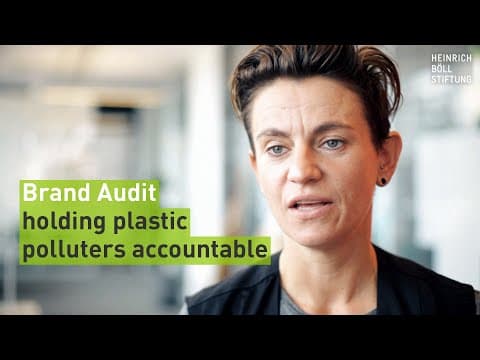
Its main tool is the brand audit. Volunteers clean up a beach, river bank, street or park, then sort and count every piece of plastic by its brand and the company that owns the brand, recording the type of item and the location. The method is a form of citizen science: thousands of volunteers in many countries collect data with a standard protocol, which no single researcher could gather. The audits turn litter into evidence about responsibility, because each piece can be traced to a company at the top of a global supply chain.
 YouTube
The evidence
In 2024 researchers from universities and research institutes published the results of five years of audits (2018–2022), carried out with BFFP, in the peer-reviewed journal Science Advances. The data came from 1,576 audit events in 84 countries. Half of all items had no visible brand, which the authors argued shows the need for companies to be required to report their packaging. Of the branded items, a small number of companies accounted for a large share.
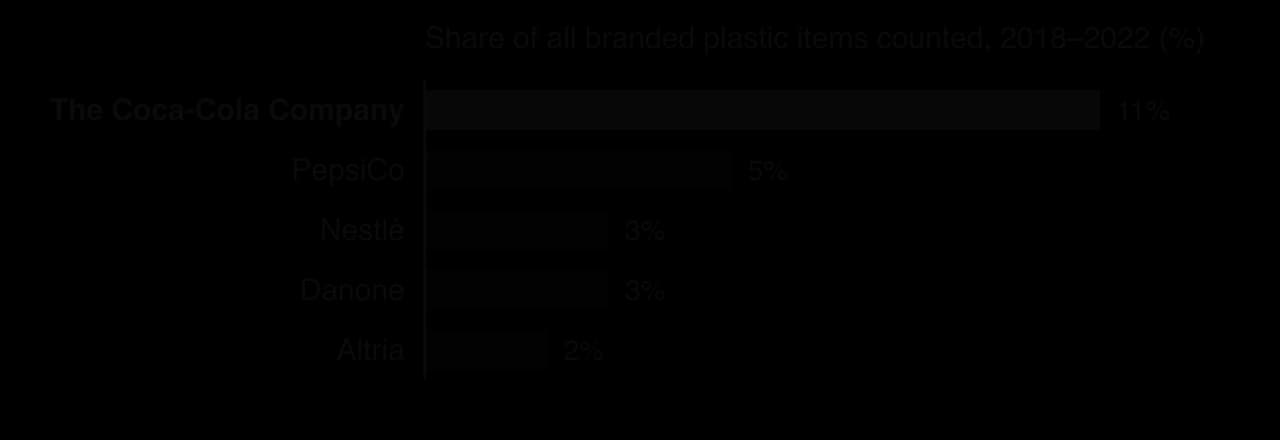
The study found a strong relationship between a company’s share of global plastic production and its share of branded plastic pollution: a company that produced 1% of the plastic was responsible for about 1% of the pollution. Food and drink companies were especially large polluters, because so much of their packaging is single-use. The authors concluded that phasing out single-use and short-lived plastic products by the largest companies would greatly reduce global plastic pollution.
Responses and outcomes
BFFP used the audit results in three ways. First, it ran awareness campaigns naming the top “corporate polluters” each year, which received wide media coverage and changed the public story from careless consumers in poorer countries to the companies that design single-use packaging. Second, it lobbied governments for laws on extended producer responsibility (making producers pay for the collection and recycling of their packaging) and for bans on single-use items. Third, it pressed for a global treaty that would cut plastic production, not only improve waste management.
Corporate responses were mixed. Several large companies made voluntary pledges in the late 2010s on recycled content and reusable packaging, but some have since been scaled back. In December 2024 The Coca-Cola Company replaced its goal of 50% recycled material in its packaging by 2030 with a target of 35–40% by 2035, and dropped its goal of selling 25% of its drinks in refillable or returnable containers by 2030 without setting a new one; reusable packaging had made up only 1.2% of its plastic packaging in 2023. Critics, including BFFP members, called the change greenwashing; the company said it would keep investing where collection systems exist.
At the global scale, the evidence fed into negotiations on a plastics treaty. In March 2022 the UN Environment Assembly agreed resolution 5/14 to negotiate a legally binding treaty covering the whole life cycle of plastics. The talks are shown in the timeline.
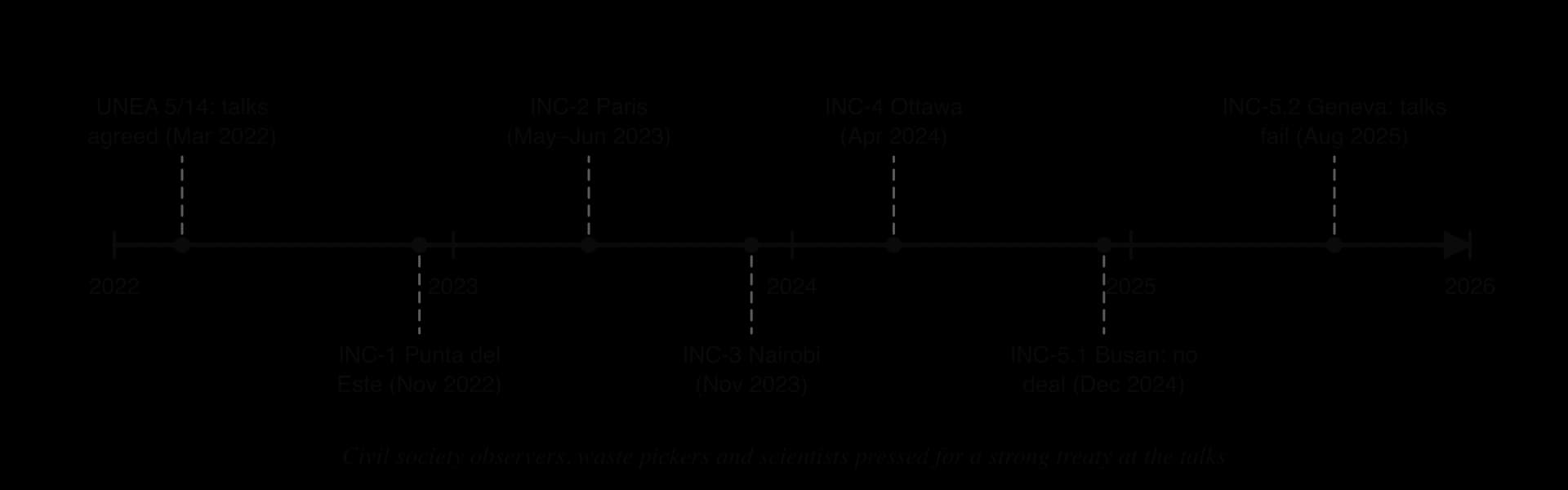
The negotiations divided states into two main groups. A High Ambition Coalition of 75 states (by September 2025) wanted limits on plastic production and controls on harmful chemicals; a minority of oil-, gas- and petrochemical-producing states opposed production limits and wanted a treaty focused on waste. At the fourth round in Ottawa in April 2024, 196 fossil-fuel industry lobbyists registered, more than the number of scientists present. A further session in Geneva in February 2026 was mainly administrative and elected a new chair. Civil society groups, waste pickers, Indigenous peoples and scientists campaigned throughout for a strong treaty.
How successful has the action been?
Criterion | Evidence of success | Evidence of limits |
|---|---|---|
Awareness | Brand audits made “corporate polluter” rankings a regular news story; the debate shifted from countries to companies | Awareness does not by itself change packaging |
Evidence | Volunteer data published in a peer-reviewed journal (2024), giving it scientific credibility | Half of items unbranded; audit sites are chosen by volunteers, not sampled at random |
Corporate change | Companies made public pledges on recycled content and reuse | Coca-Cola scaled back its targets in December 2024; reuse remains marginal |
Policy change | Contributed to national bans and producer-responsibility laws, and to the treaty mandate of 2022 | No treaty by October 2026; petrochemical states and industry lobbying blocked production limits |
Equity and voice | Gave groups in the Philippines, Indonesia, India and Africa a global platform | Negotiating power still lies with large producing and consuming states |
BFFP has been highly successful in raising awareness and in reframing who is responsible, and partly successful in finding solutions at the national scale. At the global scale it has so far been unable to overcome the power of producing states and the petrochemical industry. The case shows the typical strengths of civil society, its ability to gather evidence across borders and shift public debate, and its typical limit, the lack of any power to compel governments or TNCs that do not wish to change.
What the case study shows about the key concepts
Power: the case is about who is held responsible. Brand audits moved attention from the places with least power (countries with weak waste systems) to the companies with most power over packaging design, but producing states and industry lobbies retain the power to block a treaty.
Possibility: the futures range from a treaty with production limits to continued voluntary pledges; each would distribute the costs of plastic pollution differently.
Spatial interactions and scale: the action links local clean-ups on beaches in Manila to global brands, peer-reviewed science and UN negotiations.
How far does the brand audit evidence prove that companies, rather than countries, are responsible for plastic pollution?
Why have voluntary corporate pledges on plastic proved less effective than the Accord’s legally binding commitments on factory safety?
Suggest how BFFP could increase its influence on the treaty negotiations.
Sources: Cowger et al., “Global producer responsibility for plastic pollution”, Science Advances 10 (2024), via PubMed; Break Free From Plastic website (2026); Wikipedia, “Global plastic pollution treaty” (accessed 2026); Food Dive and Mongabay reports on Coca-Cola’s packaging goals (December 2024).
Re-shoring, near-shoring and friend-shoring
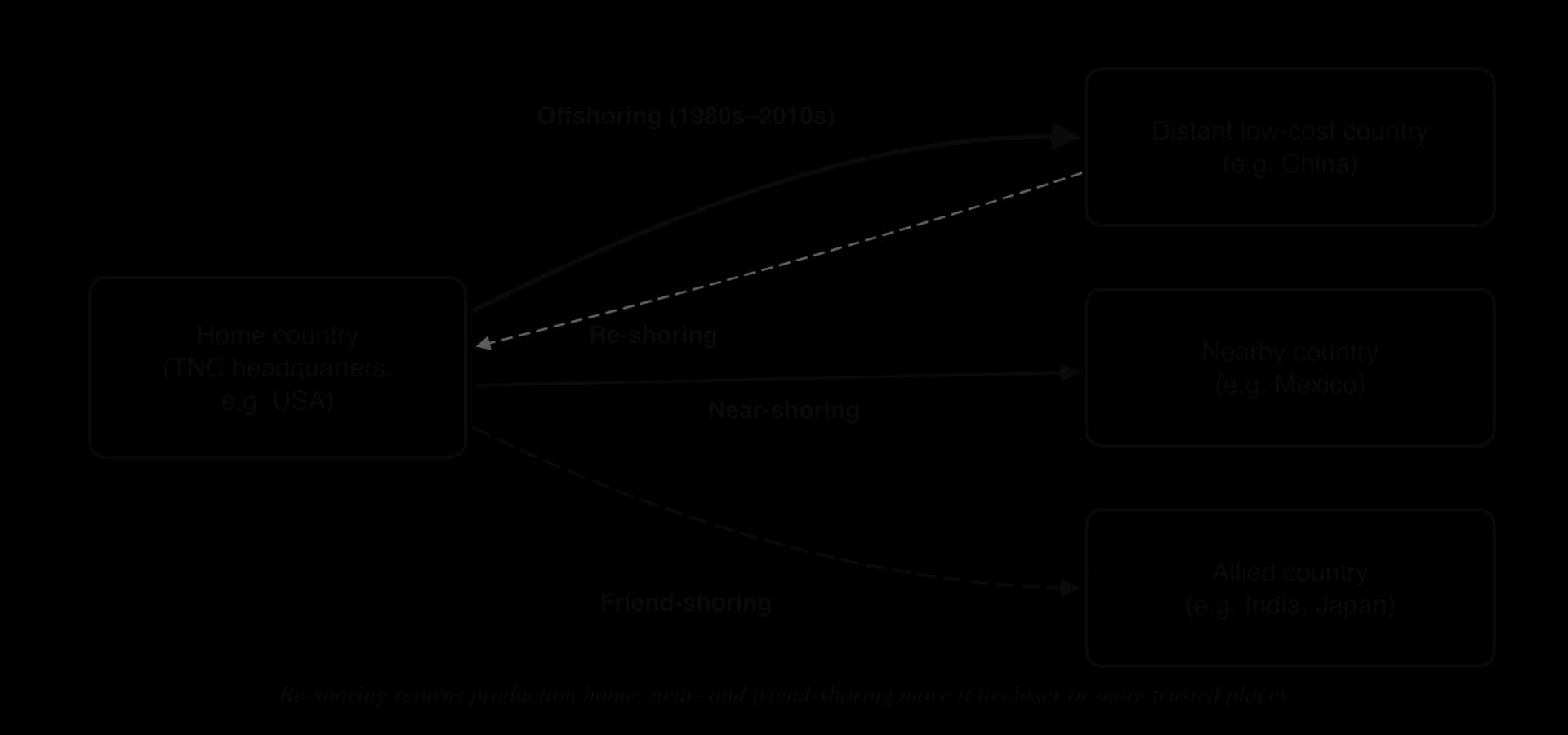
From the 1980s to the 2010s, TNCs in high-income countries moved much of their manufacturing abroad. They used outsourcing (contracting work to other firms) and offshoring (moving production to another country, whether to their own factories or to suppliers), mainly to East and Southeast Asia, where labour was cheaper. The result was long, efficient, low-cost supply chains, often built on just-in-time production, in which parts arrive only when they are needed and little stock is held.
These long chains proved fragile. The COVID-19 lockdowns of 2020–22, the shortage of computer chips, the blockage of the Suez Canal in 2021, attacks on shipping in the Red Sea from 2023 and rising tension between the United States and China all showed that a disruption in one place could halt production on the other side of the world. This supply-chain risk has led TNCs and governments to bring some production home, which is re-shoring, or closer to home or to more trusted places.
Re-shoring is not the only way to shorten a supply chain. A firm can also move production to a country next to its main market, which is near-shoring.
A third option responds to political rather than physical risk. Friend-shoring moves production to countries that are political allies, so that supply chains are less exposed to sanctions, export controls or conflict. The term became widely used after the US Treasury Secretary Janet Yellen promoted it in 2022.
Why TNCs and governments are re-shoring
Supply-chain risk. Shorter and more diverse chains are less exposed to pandemics, disasters, chokepoints and conflict.
Rising costs in Asia. Wages in China’s coastal provinces have risen many times over since 2000, and shipping costs and times have become less predictable.
Automation and new technology. Robots and 3D printing reduce the share of labour in production costs, so the wage gap matters less.
Government policy. Subsidies, tax credits and tariffs encourage domestic production of goods seen as strategic, such as semiconductors, batteries, solar panels and medicines.
National security. Governments want key technologies made at home or by allies, partly in response to geopolitical rivalry.
Customers and brands. Some consumers prefer goods made nearby, and shorter chains allow faster responses to fashion and demand.
Semiconductors: policy-driven re-shoring
Semiconductors (computer chips) are the clearest case of government-driven re-shoring. The most advanced chips are made mainly in Taiwan, which many governments see as a single point of failure in the global economy. The US CHIPS and Science Act, signed on 9 August 2022, provides US$52.7 billion for semiconductors, including US$39 billion in manufacturing subsidies and a 25% investment tax credit. Firms receiving subsidies may not expand production of advanced chips in China. The European Union passed its own Chips Act in 2023, and Japan, South Korea and India have similar programmes.
The Taiwanese company TSMC, the world’s largest contract chipmaker, announced a factory in Phoenix, Arizona, in 2020 with a budget of US$12 billion. By 2025 its planned investment had risen to US$165 billion for six factories, supported by US$6.6 billion in CHIPS Act grants. Its first factory began production in early 2025, and Apple said in 2026 that it would buy more than 100 million chips from the site that year. TSMC has also estimated that chips made in the United States cost at least 50% more than chips made in Taiwan, because of higher construction and labour costs and a shortage of skilled workers.
Other projects show the limits of policy-driven re-shoring. Intel announced two chip factories near Columbus, Ohio, in January 2022, with an initial investment of US$20 billion, but in February 2025 it postponed the completion of the first, originally planned for 2025, to around 2030 as its finances weakened. The Inflation Reduction Act, also signed in August 2022, added tax credits for batteries, solar panels and other clean-energy equipment made in the United States, which drew new factories to states such as Georgia and Tennessee.
Many firms choose diversification rather than a full return home: they keep most production in China but add a second source in another country, as Apple’s suppliers have done by expanding iPhone assembly in India. Such a “China plus one” strategy adds redundancy without the high costs of producing in the home country.
Near-shoring to Mexico
Near-shoring is changing the geography of trade in North America. Mexico’s position next to the United States, its membership of the United States–Mexico–Canada Agreement and its lower wages make it attractive to companies that want to shorten supply chains or avoid tariffs on Chinese goods.
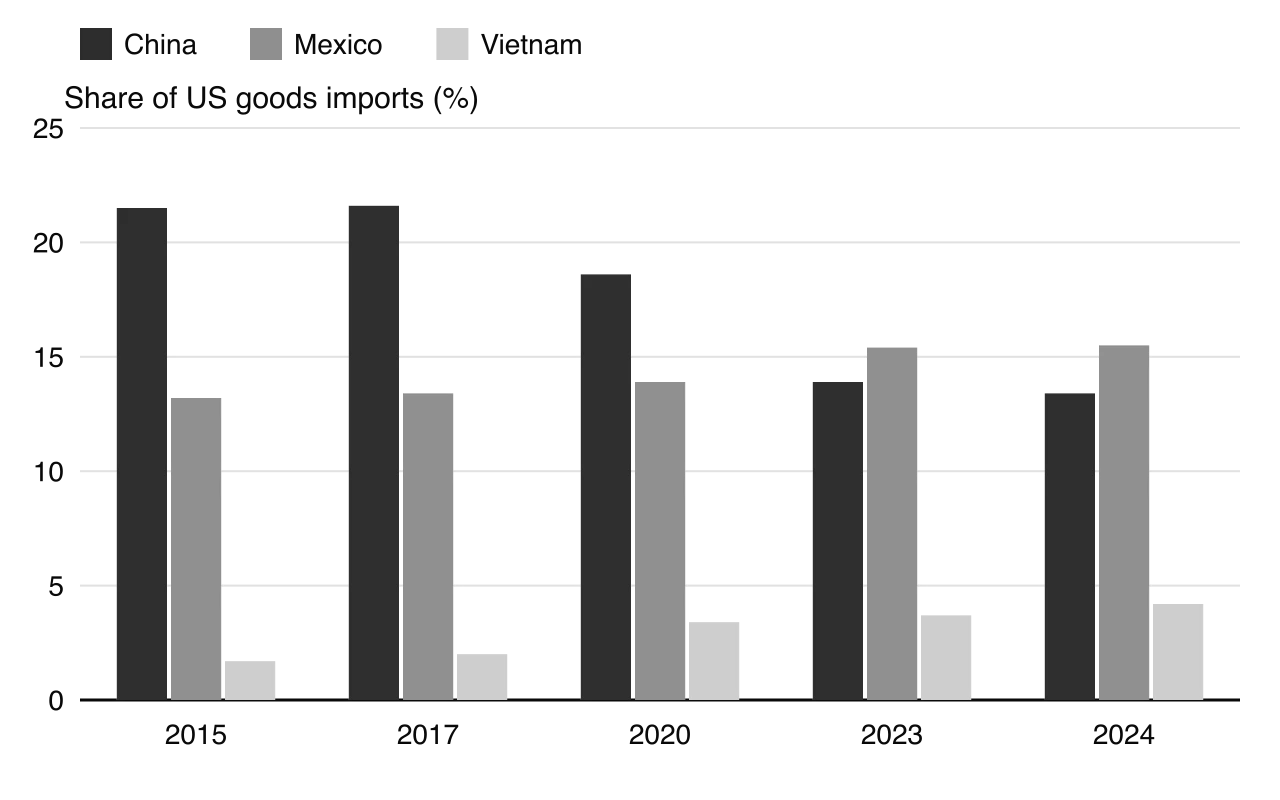
The chart shows a redistribution of US imports rather than a large return of production to the United States. Much of the trade that left China went to Mexico and to Vietnam, and some of those factories are themselves owned by Chinese firms or use Chinese parts, so the supply chain has changed shape more than it has shortened.
Evaluating re-shoring
Stakeholder or place | Gains | Losses or risks |
|---|---|---|
Home country (e.g. USA) | Greater security of supply for strategic goods; some skilled jobs; tax revenue | High subsidy costs; jobs fewer than hoped because factories are automated; skills shortages |
TNCs | Lower risk of disruption; subsidies; closeness to customers | Higher production costs (TSMC: at least 50% more in the US); duplication of factories |
Consumers | More reliable supply in a crisis | Higher prices for goods made in high-cost places or protected by tariffs |
Near-shore hosts (e.g. Mexico) | Investment, jobs and exports | Pressure on water, energy and infrastructure in northern industrial cities; dependence on one market |
Former hosts (e.g. China, other Asian exporters) | Moves up the value chain into higher-value goods | Loss of orders and jobs in labour-intensive industries |
Lower-income countries outside allied blocs | Some may gain if friend-shoring is broad | Risk of exclusion from supply chains if friend-shoring favours rich allies |
Re-shoring builds resilience for the home country by adding redundancy and reducing dependence on rivals, and it is most justified for a few strategic goods such as advanced chips and medicines. As a general strategy it is costly: it raises prices, needs large subsidies and creates relatively few jobs because new factories are highly automated. It also exports risk to others, since the workers and regions that lose orders bear the cost of someone else’s resilience. Near-shoring and diversification offer much of the security at lower cost, which is why trade data show more of them than of true re-shoring.
Crowd-sourcing technologies
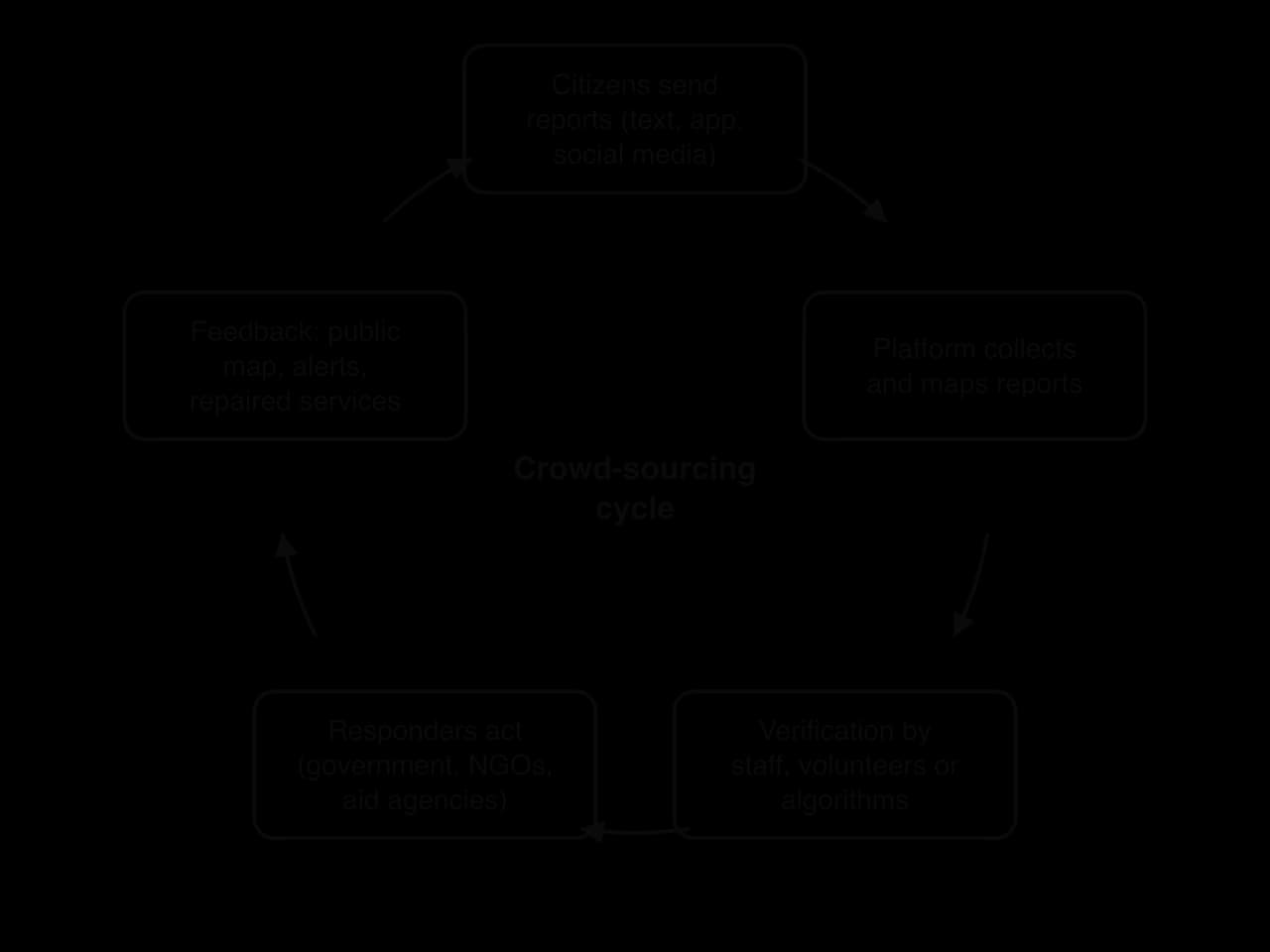
Mobile phones, the internet and social media allow large numbers of people to share information quickly. Crowd-sourcing uses this to gather information, ideas, labour or money from many people, usually online, and is used by governments and civil society to build resilience to crises and everyday risks.
Ushahidi: from Kenya to the world
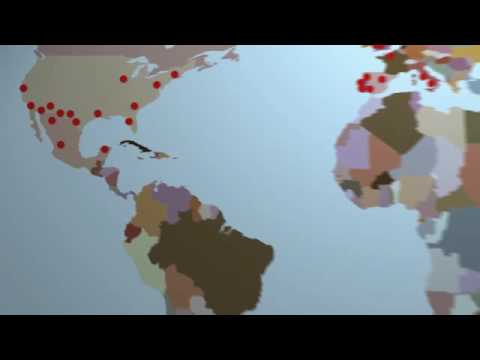
Ushahidi (Swahili for “testimony” or “witness”) was founded in Nairobi in 2008 by Erik Hersman, Ory Okolloh, Juliana Rotich and David Kobia, after the disputed Kenyan presidential election of December 2007 led to widespread violence. Its first version collected eyewitness reports of violence sent by text message and email and plotted them on an online map, at a time when official information was scarce. The software was made open-source, so anyone could set up a map.
The platform was later used after the earthquakes in Haiti and Chile (2010) and Christchurch (2011) and to monitor elections in Nigeria (2011) and Kenya (2013 and 2017). By 2017 it reported about 125,000 deployments in more than 160 countries, although most were for training, testing or evaluation rather than live crises.
 YouTube
Ushahidi shows a new kind of spatial interaction: reports from people on the ground in one country are processed by volunteers in others and used by governments and aid agencies. It also shows the limits. Eyewitness reports need verification, which depends on media, NGOs and volunteers; false or malicious reports can spread; and people without phones or internet access are left out of the map.
Other uses by government and civil society
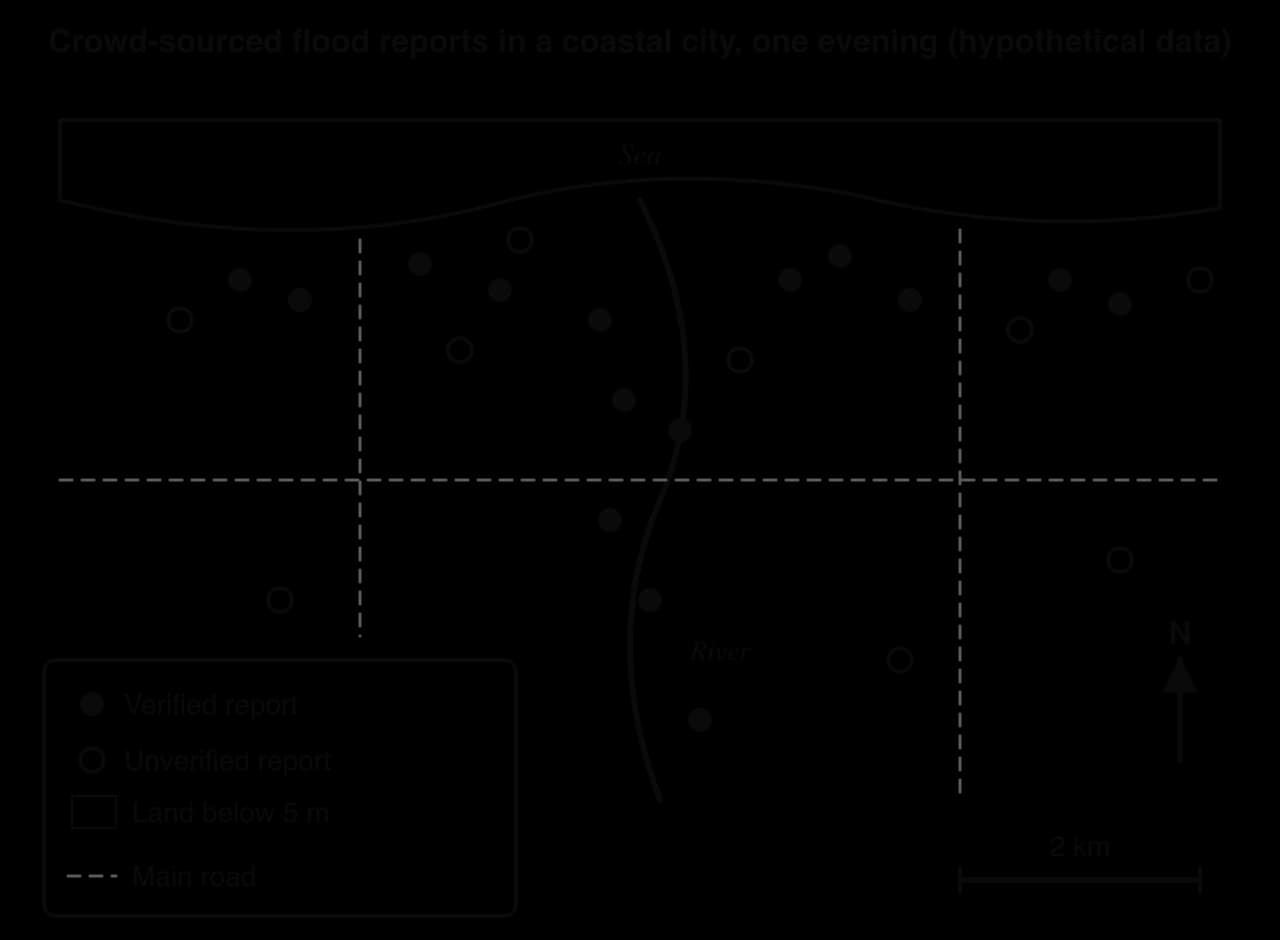
Flood reporting. PetaBencana, in Jakarta and other Indonesian cities, collects flood reports posted by residents on social media and messaging apps and maps them in real time for the public and the disaster agency.
Mapping disaster zones. Volunteers worldwide trace roads and buildings on satellite images in OpenStreetMap through the Humanitarian OpenStreetMap Team, giving responders maps of places that official maps do not cover (crowdsourced mapping is also used in managing geophysical hazards).
Reporting problems to government. Platforms such as FixMyStreet in the United Kingdom let residents report potholes, fly-tipping and broken street lights directly to the council, a form of e-participation.
Traffic and transport. Navigation apps such as Waze combine location data from millions of drivers to show congestion and accidents; some city authorities share data with them.
Citizen science. Volunteers collect scientific data, such as the brand audits of plastic litter or networks of low-cost air-quality sensors run by groups such as Sensor.Community, which fill gaps between official monitoring stations.
Crowdfunding. Online platforms raise small donations from many people for disaster relief, medical bills or community projects.
A map of crowd-sourced reports records where people say there is a problem, so it needs to be read against other evidence. Verified reports cluster where the physical geography predicts flooding, on low land beside the coast and river, while some unverified reports lie on higher ground and may be false, out of date or from people who are worried rather than flooded.
Citizen science builds resilience by filling gaps in official data, such as air quality between monitoring stations. Crowd-sourcing can raise money as well as information, through crowdfunding.
Evaluating crowd-sourcing
Crowd-sourcing builds resilience because it is fast, cheap and local: people on the ground know where the water is rising or which road is blocked long before officials do. It also gives citizens a voice, which can strengthen trust between them and governments. Its weaknesses come from the same openness.
Reports can be wrong, exaggerated or deliberately false, so verification is essential. The digital divide, the gap between people who have access to digital technology and the skills to use it and those who do not, means that the poorest, oldest and most remote people are often missing from crowd-sourced maps. Location data can expose people to surveillance by governments or criminals, which is a serious risk in conflicts and under repressive governments. Crowdfunding tends to reward causes and people with large social networks and good stories, not necessarily the greatest need.
Managing global flows of data and people
Cybersecurity
Global flows of data, through submarine cables, data centres and the internet, carry finance, trade, government services and private communication. Their growth has created new risks: cybercrime, hacking and ransomware attacks that lock computer systems until a ransom is paid, and theft of personal data. These risks have made cybersecurity a priority for governments, companies and individuals.
Cybersecurity works at several scales:
Individual: strong passwords, multi-factor authentication (a second check, such as a code sent to a phone), software updates and awareness of phishing emails.
Organisation: encryption of data, backups kept offline so that ransomware cannot destroy them, monitoring of networks and plans for responding to an attack.
National: cyber agencies such as the United Kingdom’s National Cyber Security Centre, formed in October 2016 as part of GCHQ, which advise the public and private sectors and respond to major incidents.
International: cooperation through agreements such as the Council of Europe’s Budapest Convention on Cybercrime (2001), joint warnings by allied agencies, and NATO’s Cooperative Cyber Defence Centre of Excellence in Tallinn.
Estonia: resilience after attack
Estonia is one of the most digitised states in the world: almost all public services are online, using a national digital identity card and a data exchange system called X-Road, launched in 2001, which lets government databases share information securely without storing it all in one place. From 27 April 2007, during a dispute with Russia over moving a Soviet war memorial in Tallinn, Estonia’s parliament, ministries, banks and media were hit by waves of distributed denial-of-service attacks, which flood websites with traffic until they fail. Estonia blamed the Russian state; Russia denied involvement, and responsibility has never been proven.
After the attacks, NATO set up its Cooperative Cyber Defence Centre of Excellence in Tallinn in 2008, Estonia created a volunteer cyber defence unit, and it made its digital state more resilient by spreading data across systems and keeping backup copies of key government data abroad. X-Road’s design, in which each organisation keeps its own data and exchanges are encrypted and logged, has since been adopted by Finland and other countries. The case shows that a small state can build resilience through design, international partnership and public trust, although the same digital systems make it a target.
E-passports, biometrics and digital identity
Global flows of people have grown with tourism, business travel and migration, and states want to move legitimate travellers quickly while detecting fraud and security threats. An e-passport contains a chip that stores the holder’s details and biometric data, so that border systems can check that the document is genuine and that the person carrying it is its owner.
The chip stores biometric data, which link the document to the body of the person carrying it.
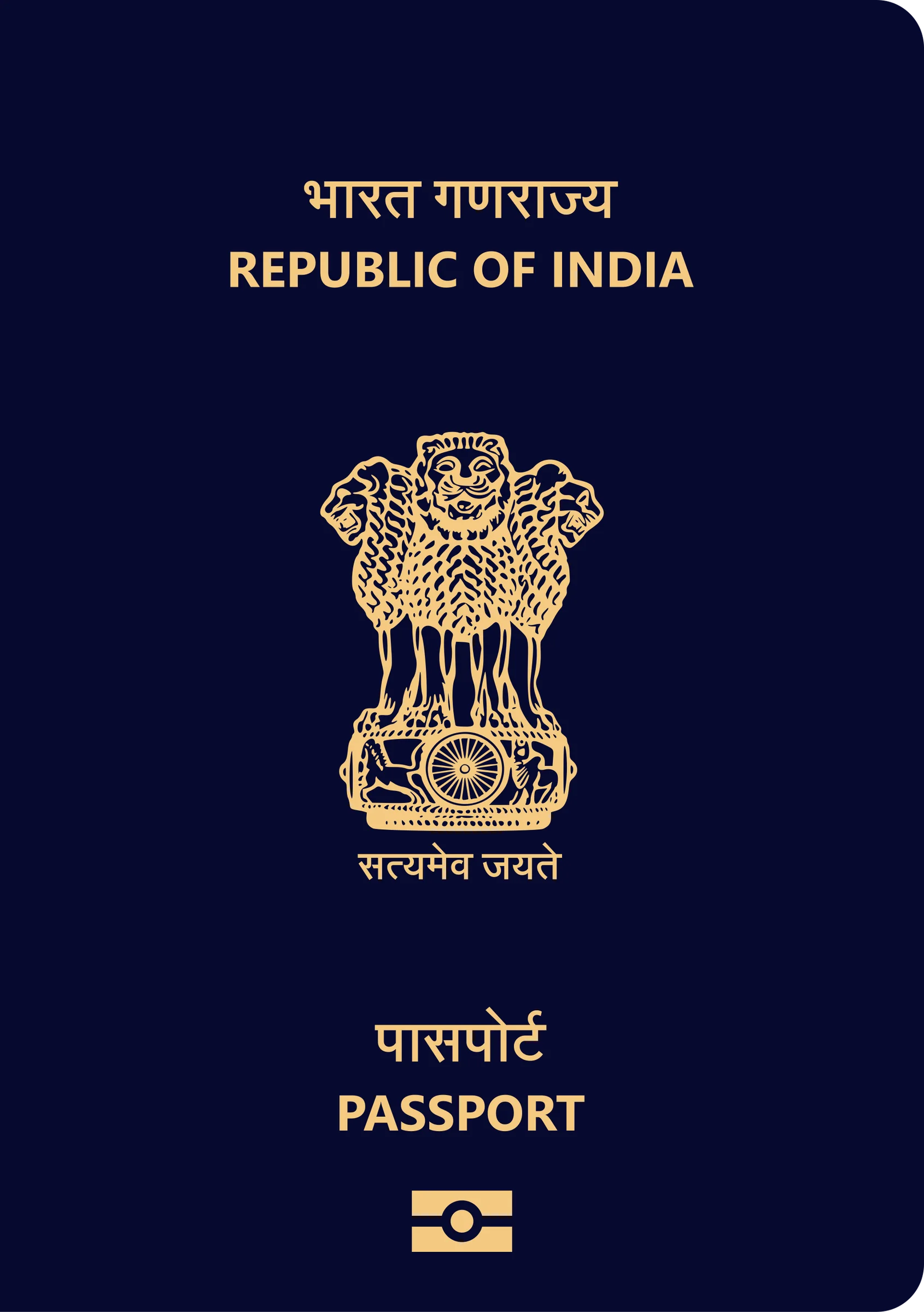
Malaysia issued the first biometric passport in 1998. About 60 countries were issuing them by 2008 and more than 150 by 2019, following a standard set by the International Civil Aviation Organization (ICAO Doc 9303), so that any border can read any country’s passport. The data are signed with the issuing state’s digital key, which makes forgery difficult. E-passports allow automated e-gates at airports, where a camera compares the traveller’s face with the photograph on the chip, which speeds up border crossing and frees officers for other checks.
The European Union’s Entry/Exit System, introduced from 12 October 2025 and fully in place by 10 April 2026, replaces passport stamps for non-EU short-stay travellers in 29 European countries with an electronic record of their entries and exits, including facial images and fingerprints. It is designed to detect people who stay longer than allowed and to identify people using false identities.
E-passports are part of a wider move to digital identity, an electronic means of proving who a person is when using online services, banking or border systems. India’s Aadhaar system, which links a 12-digit number to each resident’s fingerprints, iris scans and photograph, has enrolled more than a billion people and is used to deliver welfare payments and open bank accounts.
Evaluating technologies for managing flows
Technology | Benefits | Concerns |
|---|---|---|
Cybersecurity | Protects services, businesses and personal data; reduces the impact of ransomware and data breaches | Costly for small firms and poor countries; state cyber powers can also be used for surveillance |
E-passports and e-gates | Faster border crossing; harder to forge; frees officers for risk-based checks | Chips can be read or cloned without strong security; biometric data are valuable to hackers |
Biometric border systems (EU Entry/Exit System) | Detects overstays and false identities; replaces stamps | Queues while systems start; large databases of foreign travellers raise privacy concerns |
Digital identity (Aadhaar) | Brings people into banking and welfare; reduces fraud in payments | People whose fingerprints fail to scan, or who lack documents, can be excluded from services; data leaks; surveillance |
These technologies make flows of data and people faster and safer for those who are included, and they reduce some of the risks of global interactions, such as identity fraud and cybercrime. But they concentrate large amounts of personal data in a few systems, which creates new targets for hackers and new powers for states. Their effects are unequal: frequent travellers from rich countries pass through e-gates, while refugees, stateless people and others without recognised documents can find it harder to move, work or receive services. Judging them therefore depends on the balance between security and personal freedom, a balance that different societies set differently.
Sources: Wikipedia, “CHIPS and Science Act”, “TSMC Arizona”, “Ushahidi”, “2007 cyberattacks on Estonia”, “X-Road”, “National Cyber Security Centre (United Kingdom)”, “Biometric passport” and “Entry/Exit System” (accessed 2026); US Census Bureau, Top Trading Partners, December 2015, 2017, 2020, 2023 and 2024; Axios and Fortune on Intel Ohio (28 February 2025).
Perspectives on the severity of risks and priorities for action
People do not agree on which global risks are most serious or what should be done first. Their views depend on their values, their interests, their exposure to each risk and the power they have to respond. The same event, such as a pandemic that closes factories, is a supply-chain problem for a TNC, a jobs crisis for a garment worker, a security question for a government and an opportunity for a firm in a near-shore country.
Stakeholder | Risks often seen as most severe | Typical priorities for action |
|---|---|---|
Governments of HICs | Supply-chain dependence on rivals; cyberattacks on infrastructure; irregular migration | Re-shoring and friend-shoring of strategic goods; national cyber agencies; biometric borders |
Governments of LICs and MICs | Loss of export orders and investment; pollution and climate impacts caused elsewhere; exclusion from technology | Attracting investment; finance and technology transfer; fair access to markets |
TNCs | Disruption of supply; reputational damage from abuse or pollution in the chain; data breaches | Diversifying suppliers; cybersecurity; voluntary standards and certification |
International CSOs | Labour abuse, pollution and inequality along supply chains; loss of privacy and freedom | Binding rules for companies; treaties; transparency and watchdog monitoring |
Citizens in HICs | Prices, jobs and personal data security | Affordable goods; secure jobs; privacy |
Citizens and workers in LICs | Unsafe work, pollution, low wages, being left out of digital systems | Safe jobs, clean air and water, access to services and connectivity |
The table shows that the most powerful actors, HIC governments and large TNCs, tend to frame resilience as security of supply for themselves, while CSOs and workers in lower-income countries frame it as protection from harm along the chain. These framings lead to different strategies. Re-shoring protects the home country’s supply but may cost jobs in the host country; a factory safety accord protects workers but raises costs for brands and suppliers. Priorities also vary with scale and time: a government facing an election may prioritise prices and jobs today, while a CSO campaigning on plastic or climate may prioritise risks that grow over decades.
Scoring strategies against criteria
One way to compare resilience strategies is to score each against the same criteria. The scores are judgments, so different stakeholders would weight them differently.
Strategy | Cost | Scale of impact | Speed | Main beneficiaries | New risks created |
|---|---|---|---|---|---|
Civil society campaigns and accords | Low for the public; costs fall on brands and suppliers | From one supply chain to a whole industry | Slow to agree; fast once binding | Workers, communities, ecosystems | Greenwashing; disputes over sovereignty |
Re-shoring | Very high (subsidies, higher production costs) | National, a few strategic sectors | Slow: factories take years | Home country, its skilled workers | Higher prices; lost orders in former hosts |
Near-shoring and friend-shoring | Medium | Regional | Medium | Nearby and allied countries | New dependence; exclusion of non-allies |
Crowd-sourcing | Very low | Local to national | Very fast | People affected by crises; responders | False reports; privacy; the digital divide |
Cybersecurity | Medium to high | From one firm to whole states | Ongoing | Governments, firms, citizens | State surveillance; costs for the poorest |
E-passports and biometric borders | High to set up, then low | International | Fast once installed |
Resilience strategies can therefore create new risks as well as reduce old ones. Re-shoring raises consumer prices and hurts former host economies; crowd-sourced data can be false or exploited; biometric borders raise privacy and exclusion concerns; civil society campaigns can lead to pledges that are not kept. The most useful judgment of a strategy asks who gains, at what scale and over what time, and whether it moves risk from one group to another rather than reducing it.
Exam practice
In Paper 3 the Unit 6 question has two parts: part (a) for 12 marks and part (b) for 16 marks. Questions on resilience often ask how strategies build resilience, how successful civil society organisations have been, or how perspectives on risks differ.
Part (b) usually starts from a quoted statement and asks how far it holds, so it needs both sides of an argument.
A matching part (b) on the same unit asks for a wider judgment across strategies and stakeholders.
Summary
Resilience to the risks of global interactions comes from making systems more robust, adding redundancy and improving the flow of information so that people can adapt.
International civil society organisations campaign, research, deliver services and act as watchdogs; their strategies include awareness campaigns, lobbying, litigation, boycotts, shareholder action and certification.
Campaigns such as Greenpeace’s Detox My Fashion, Amnesty International’s cobalt investigation, Oxfam’s Behind the Brands and MSF’s Access Campaign show how evidence and brand reputation can change corporate behaviour.
The Accord after Rana Plaza (2013) is a social CSO action that succeeded because it was legally binding and independently monitored; it covered over 2,000 factories but not wages.
Break Free From Plastic’s brand audits (1,576 audits in 84 countries) shifted responsibility for plastic pollution from countries to companies, but a global plastics treaty had not been agreed by 2026.
Re-shoring, near-shoring and friend-shoring reduce supply-chain risk, but they are costly, create few jobs and move risk to former host countries; US trade data show more near-shoring and diversification than re-shoring.
Crowd-sourcing, crowdfunding and citizen science, from Ushahidi to PetaBencana, give fast, cheap and local information but need verification and leave out people on the wrong side of the digital divide.
Cybersecurity, e-passports, biometrics and digital identity make flows of data and people safer and faster, but raise concerns about privacy, surveillance and exclusion.
Perspectives on the severity of risks and priorities for action differ between governments, TNCs, CSOs and citizens in HICs and LICs, and every resilience strategy can create new risks for someone.
Self-check
- To do:
I can define resilience and link each main risk of global interactions to a strategy that answers it.
- To do:
I can describe the types of international CSO and their strategies, with named examples.
- To do:
I can evaluate the success of Break Free From Plastic and of the Accord on Fire and Building Safety, using evidence and criteria.
- To do:
I can distinguish re-shoring, near-shoring and friend-shoring and evaluate them for different places, using semiconductors and US trade data.
- To do:
I can explain how crowd-sourcing, crowdfunding and citizen science build resilience and outline their limits.
- To do:
I can examine the benefits and concerns of cybersecurity, e-passports, biometrics and digital identity.
- To do:
I can evaluate sources of evidence on global risks for purpose, method and bias.
- To do:
I can discuss how and why perspectives on risks and priorities differ between stakeholders and places.