S3 Classification of matter
Structure 3: classifying elements with the periodic table and organic compounds by functional group, the trends this predicts, and exactly what HL adds to each subtopic.
- IB Chemistry
- SL and HL
2 subtopics in Classification of matter
Each one has its own page once something is published for it.
- S3.1The periodic table: classification of elements189 questions · notes · 96 quick fire
- S3.2Functional groups: classification of organic compounds264 questions · notes · 140 quick fire
Key terms introduced here
Each is in the Chemistry glossary, with every other term in the subject.
- Colour wheel
A circle of the visible colours (red, orange, yellow, green, blue, violet) with their wavelength ranges, printed in the data booklet, in which complementary colours lie opposite each other.
- Complex ion
A central metal ion surrounded by ligands bonded to it by coordination bonds, such as .
- infrared spectroscopy
A technique that measures which frequencies of infrared radiation a sample absorbs; each absorption comes from a bond vibration, so the spectrum shows which bonds and functional groups are present.
An overview of S3 Classification of matter
Structure 3 is about classification. Elements are arranged in the periodic table by atomic number and electron configuration, and organic compounds are grouped by their functional groups; both arrangements let chemists predict the properties and reactions of a substance they have never met from those of its relatives.
How the subtopics fit together
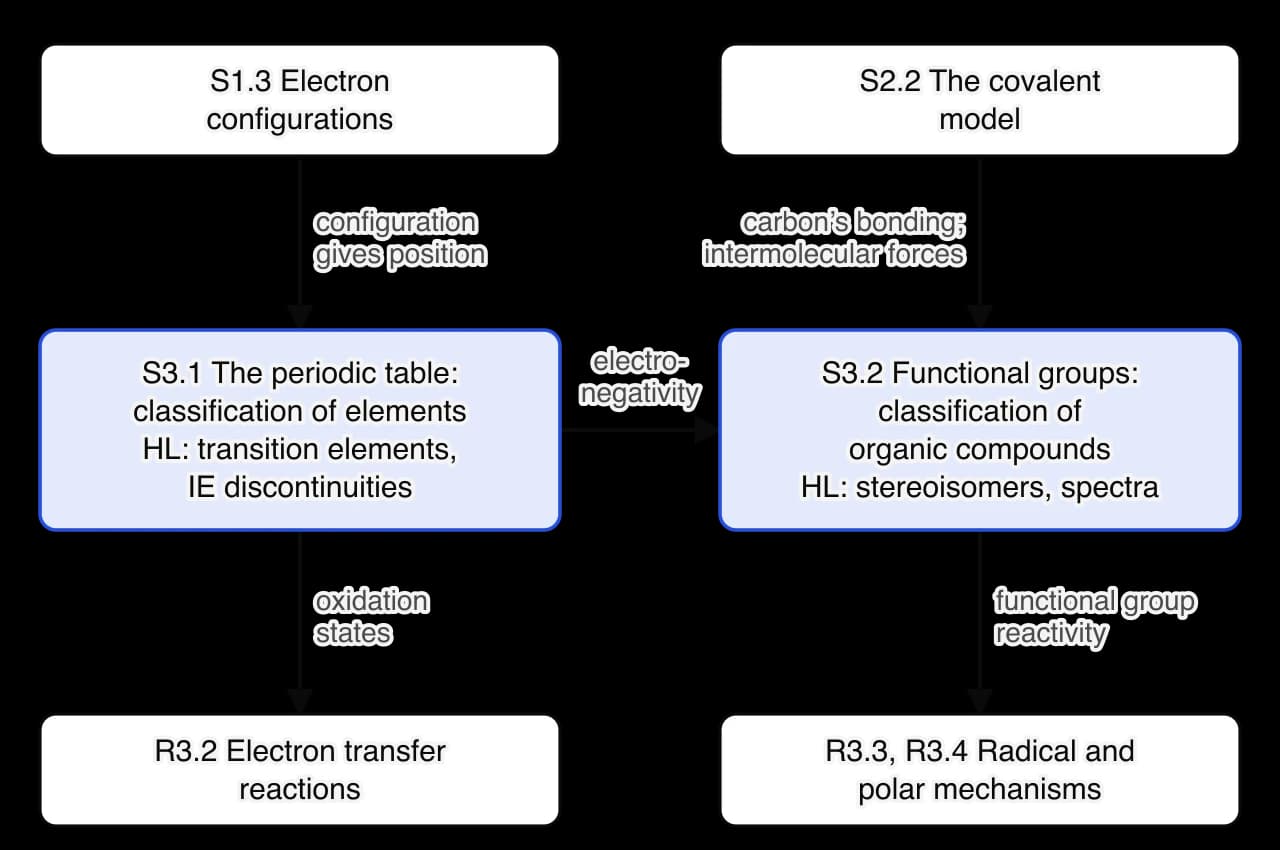
S3.1 The periodic table: classification of elements. Periods, groups and blocks, and the positions of metals, metalloids and non-metals. The period number gives the outermost occupied main energy level and the group the number of valence electrons, so an electron configuration can be read from an element's position. Periodicity covers the trends in atomic and ionic radius, ionization energy, electron affinity and electronegativity, the reactions of group 1 metals with water and of group 17 elements with halide ions, the change from basic metal oxides through amphoteric to acidic non-metal oxides, and oxidation states.
S3.2 Functional groups: classification of organic compounds. The formulas used to represent organic molecules (empirical, molecular, full and condensed structural, stereochemical and skeletal), the common functional groups, homologous series and their general formulas, the trend in boiling point along a series, IUPAC names for compounds with up to six carbon atoms in the parent chain, and structural isomers.
Big ideas across the topic
Classification allows prediction. A periodic table arranged by atomic number predicts that sodium and potassium react with water in the same way, and that potassium reacts faster. A homologous series predicts that hexan-1-ol behaves like ethanol and boils at a higher temperature. In both cases the pattern comes from structure: valence electrons for elements, functional groups for organic compounds.
Trends have causes. The periodic trends are explained by two quantities, the nuclear charge felt by the outer electrons and their distance from the nucleus, both of which follow from electron configurations (S1.3). The same trends decide the charges of ions (S2.1), where a compound sits on the bonding triangle (S2.4), how easily metals are oxidized and halogens reduced (R3.2), and why non-metal oxides such as and cause acid rain while metal oxides neutralize acids (R3.1).
Functional groups decide reactivity. The Reactivity strand is organized around what functional groups do. Alkanes undergo radical substitution (R3.3), halogenoalkanes nucleophilic substitution and alkenes electrophilic addition (R3.4), alcohols are oxidized to aldehydes, ketones and carboxylic acids (R3.2), and fuels burn (R1.3). The functional group also sets the intermolecular forces between molecules (S2.2), and monomers with suitable groups form polymers (S2.4).
Evidence from instruments. Classifying a compound means knowing its structure. HL students learn to deduce structures from mass spectra, infrared spectra and ¹H NMR spectra, which extend the mass spectrometry of elements in S1.2 and the bond polarity of S2.2 to the identification of unknown organic compounds.
Standard level and higher level
No subtopic in Structure 3 is HL only, but HL nearly doubles the topic: Structure 3 takes 16 teaching hours at SL and 31 at HL. Both subtopics end with HL understandings that build on the SL ones.
Subtopic | Studied at SL and HL | Added at HL |
|---|---|---|
S3.1 The periodic table | Periods, groups and blocks; metals, metalloids and non-metals; electron configurations from position, up to ; periodicity of atomic radius, ionic radius, ionization energy, electron affinity and electronegativity; group 1 and group 17 reactions; the oxides continuum; oxidation states | Discontinuities in first ionization energy across a period as evidence for sublevels; the characteristic properties of transition elements (variable oxidation state, high melting point, magnetic and catalytic properties, coloured compounds, complex ions); variable oxidation states from successive ionization energies and the configurations of first-row transition element ions; colour of complexes from split d-orbitals, with the colour wheel |
S3.2 Functional groups | Types of formula; the functional groups halogeno, hydroxyl, carbonyl, carboxyl, alkoxy, amino, amido, ester and phenyl; twelve homologous series; boiling point trends; IUPAC naming; structural isomers (chain, position and functional group) | Stereoisomers: cis–trans isomerism and chirality, with enantiomers and optical activity; fragmentation in mass spectrometry; infrared spectroscopy; ¹H NMR spectroscopy (number of signals, chemical shift, integration and splitting patterns); combining data from several techniques to determine a structure |
Several boundaries are easy to misplace. The general increase in first ionization energy across a period and its decrease down a group are SL; the dips between groups 2 and 13 and between groups 15 and 16 are HL. Simple transition element ion configurations such as are SL (S1.3), while explaining variable oxidation states from successive ionization energies is HL. Structural isomerism is SL, but every form of stereoisomerism is HL. Identifying a phenyl group is SL, while the delocalized structure of benzene, supported by the existence of only three isomers of dibromobenzene, is HL (S2.2). All spectroscopy of organic compounds, including mass spectra, infrared and NMR, is HL.
Flashcards for S3
The official decks for this part of the syllabus.
- S3.1 The periodic table: classification of elements392 cards
- S3.2 Functional groups: classification of organic compounds603 cards
From the data booklet
The entries of the chemistry data booklet that S3 uses. Each opens in the explained booklet.
- Names of the elements6. Names of the elements
- The periodic table7. The periodic table
- Melting points and boiling points of the elements at 101.325 kPa8. Melting points and boiling points of the elements at 101.325 kPa
- First ionization energy, electron affinity and electronegativity of the elements9. First ionization energy, electron affinity and electronegativity of the elements
- Atomic and ionic radii of the elements10. Atomic and ionic radii of the elements
- Boundary wavelengths: 400 nm, 424 nm, 491 nm, 575 nm, 585 nm, 647 nm, 700 nm.15. Colour wheel with wavelengths of the visible spectrum
- Wavelength ranges read from the colour wheel above (the booklet prints no table)15. Colour wheel with wavelengths of the visible spectrum
- Violet15. Colour wheel with wavelengths of the visible spectrum › Wavelength ranges read from the colour wheel above (the booklet prints no table)
- Blue15. Colour wheel with wavelengths of the visible spectrum › Wavelength ranges read from the colour wheel above (the booklet prints no table)
- Green15. Colour wheel with wavelengths of the visible spectrum › Wavelength ranges read from the colour wheel above (the booklet prints no table)
And 41 more in the data booklet.
Carry on with S3 in Augment
With a free account, Augment remembers where you stopped and what you have practiced.