Use STEEPLE analysis to identify the social, technological, economic, environmental, political, legal and ethical factors affecting an organisation, prioritise them, feed them into a SWOT analysis and explain the tool’s limitations.
Each is in the Business glossary, with every other term in the subject.
Changes in the economy that affect a business, such as economic growth, inflation, interest rates, exchange rates, unemployment, taxation and consumer incomes.
Changes in the natural environment, and in concern for it, that affect a business, such as climate change, extreme weather, the supply of natural resources, pollution and waste.
Moral expectations about how a business should behave that go beyond the law, such as fair treatment of workers and suppliers, honest marketing and responsibility towards the environment and communities.
The factors outside an organisation that affect its activities and performance but that it cannot directly control, such as economic conditions, laws, technology and social trends.
A sustained rise in the general level of prices in an economy over time, which reduces the purchasing power of money.
Laws and regulations that affect how a business operates, such as employment law, consumer protection, health and safety, competition law, data protection and product standards.
Government actions and political conditions that affect a business, such as tax and spending policy, trade policy, subsidies, political stability and relations between countries.
Distinguish between the internal and the external environment of a business.
Describe the seven STEEPLE factors, with real examples of each.
Explain how one external factor can be an opportunity for one business and a threat to another.
Construct a STEEPLE analysis for an organisation from a case.
Apply a scoring method to prioritise external factors by impact and likelihood.
Explain how STEEPLE analysis links to SWOT analysis and supports decisions in every unit.
Explain the limitations of STEEPLE analysis.
Every business operates in an environment it cannot control: governments change taxes and laws, economies grow and shrink, technology moves on and customers change what they want. STEEPLE analysis is a tool for listing these outside forces in an orderly way and judging which of them matter most for a particular organisation and decision.
The tool is closely tied to the key concept of change, because its purpose is to spot change in the outside world early enough to respond. Two of its factors, environmental and ethical, bring sustainability and ethics directly into business planning.
48 exam-style questions on this subtopic, written in the style of the IB papers. The first has its markscheme open. Counted on
Areco Leather
[1] Curtiembre Areco SA (Areco Leather) is a family-owned company in Buenos Aires province, Argentina. It tans cattle hides and makes belts, bags and saddles, which it sells through 30 shops across Argentina. It employs 180 people, many of them craftspeople trained over decades.
[2] Argentina’s economy has been unstable: inflation was above 100 % in 2023 and 2024, and the peso lost much of its value. Domestic sales of Areco’s products have fallen by a third since 2022. However, the weak peso has made Argentine leather cheaper for foreign buyers, and a fashion house in Milan has asked Areco to supply 5 000 handbags a year.
[3] Areco’s managing director, Lucía Fernández, has proposed a new strategic objective: “to earn 50 % of our revenue from exports by 2030”. Areco has no export experience, and its website is only in Spanish. Its leather has a strong reputation for quality in Argentina.
[4] Tanneries use large amounts of water and chemicals. New European Union rules will require importers to show that leather is not linked to deforestation. Areco buys hides from many small ranches, some of them in the Chaco region, where forest is being cleared for cattle.
Using information in the case, construct a SWOT analysis for Areco in relation to its new strategic objective.
4 marks
Strengths (internal) | Weaknesses (internal) |
|---|---|
|
The official deck for this part of the syllabus.
What is the external environment of a business?
What is the internal environment of a business?
With a free account, Augment remembers where you stopped and what you have practiced.
Changes in society that affect a business, such as demographics (the size, age and make-up of the population), lifestyles, tastes, attitudes, education and culture.
A framework for analysing the external environment of an organisation under seven headings: social, technological, economic, environmental, political, legal and ethical factors.
Changes in technology that affect a business, such as new products and materials, automation, digital platforms, communication and production methods.
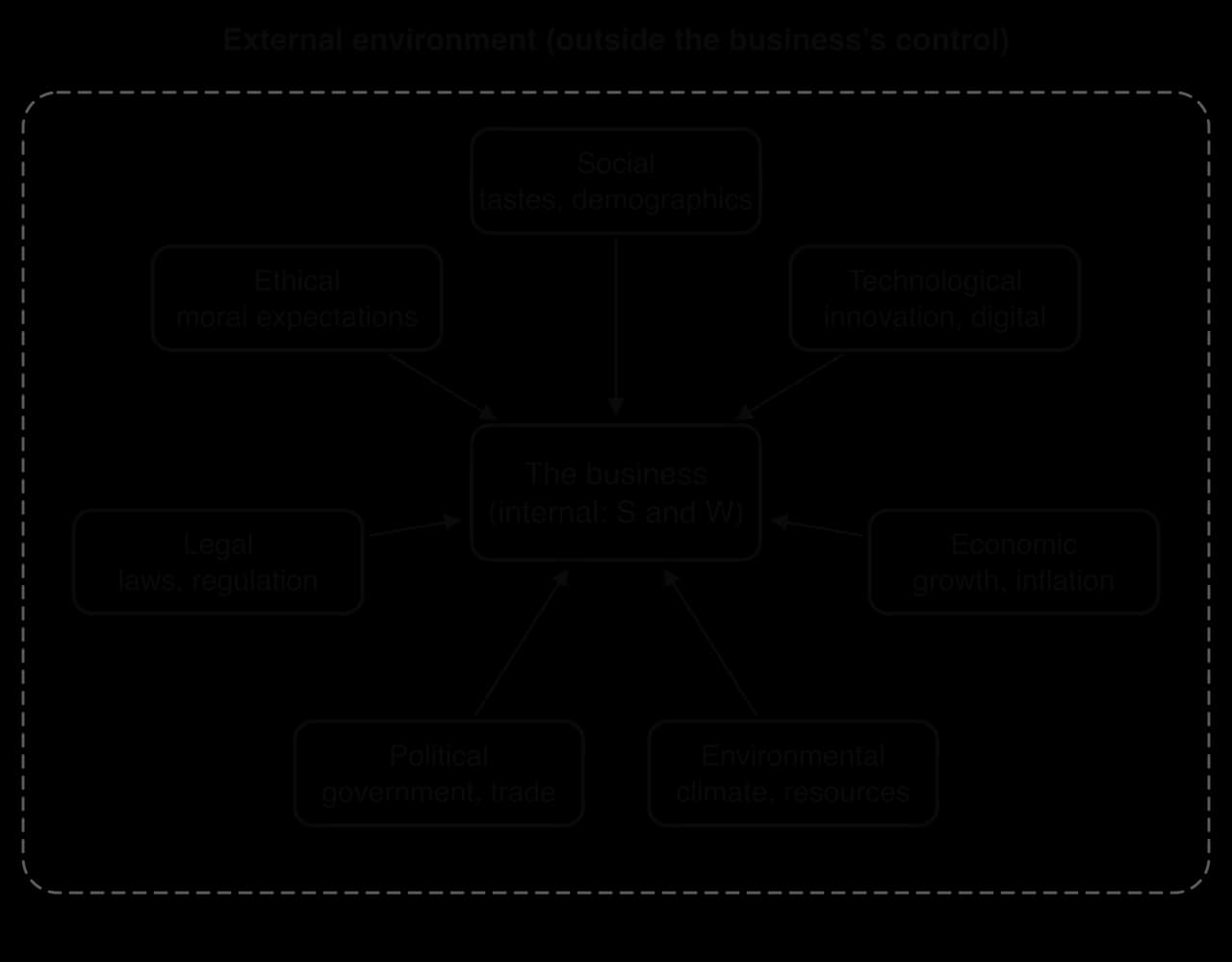
A business has two environments. The internal environment is everything the business itself controls: its staff, products, finance, culture and operations. These are the source of its strengths and weaknesses. The external environment is everything outside the business that affects it but that it cannot control, such as the state of the economy, new laws or a change in population.
Managers cannot change the external environment, but they can study it and respond. A retailer cannot stop a recession, but it can cut costs and stock cheaper products before demand falls. A carmaker cannot change emissions laws, but it can invest early in electric vehicles so that it is ready before stricter rules take effect.
STEEPLE is one of a family of similar frameworks. The shortest, PEST, has four headings (political, economic, social, technological). PESTLE (or PESTEL) adds legal and environmental factors, and STEEPLE adds ethical factors as well. The headings are the same ideas in a different order, so a STEEPLE analysis covers everything a PEST or PESTLE analysis does.
The diagram shows the central idea of the tool. The seven factors surround the business and push on it from outside. Each factor can affect costs, demand, the way the business operates or what it is allowed to do. The analysis asks two questions about each factor: what is changing, and what does that change mean for this organisation?
 YouTube
Each heading collects a group of related changes. The headings matter less than the analysis: the aim is to find every important external change, place it under the most suitable heading and explain its effect on the business.
Social factors are changes in the population and in the way people live, think and spend. They include the size and age structure of the population, migration, family size, education, lifestyles, tastes and fashions, attitudes to health, and culture and religion. Social change usually happens slowly, but it is hard to reverse and changes demand for whole industries.
Japan shows how a demographic trend shapes markets. People aged 65 and over made up 29.8% of its population in 2024, up from 28.6% in 2019. An ageing population raises demand for healthcare, care services and products designed for older customers, while it shrinks the pool of young workers and young consumers.
Technological factors are changes in the knowledge, equipment and methods available to businesses and consumers. New technology can create whole new markets, lower costs through automation, change how products are sold and make existing products obsolete. Technological change is often fast, so businesses that are slow to adapt can lose their market quickly.
Online shopping is a clear example. E-commerce made up 11.2% of US retail sales at the end of 2019, jumped to 16.3% in the second quarter of 2020 when shops closed during the COVID-19 pandemic, and was 17.1% in the second quarter of 2026. The change forced retailers with large shop networks to invest in websites, apps and delivery, and gave online-only rivals an opportunity.
Economic factors are changes in the wider economy that affect costs, prices and demand. The main ones are economic growth or recession, inflation, unemployment, interest rates, exchange rates, taxes and the level of consumer income. Economic factors often change within months, and they affect almost every business at once.
Inflation is one of the economic factors that most often appears in a STEEPLE analysis, because it affects both costs and demand.
Inflation in the United Kingdom rose to 7.9% in 2022, from 2.5% in 2021, as energy and food prices rose sharply. Businesses faced higher costs for energy, materials and wages, and customers whose incomes did not keep up had less to spend on non-essential products. In conditions like these, discount retailers can win customers who trade down, while sellers of luxury and non-essential goods usually find demand weaker.
Environmental factors are changes in the natural environment and in concern for it. They include climate change and extreme weather, the availability of natural resources such as water and raw materials, pollution and waste, and customers’ and investors’ demand for sustainable products. Many environmental issues also produce new laws, so environmental and legal factors often appear together.
The drought of 2022 in Europe shows a direct cost effect. In August 2022 the water level of the River Rhine fell so low that barges could carry only 25–35% of their usual load. German chemical, steel and energy firms that ship raw materials along the river faced much higher transport costs and supply delays.
Political factors are the actions and stability of governments. They include government policy on taxes and spending, trade policy (such as tariffs and other trade barriers), subsidies and grants, the political stability of a country, relations between countries and elections that may change policy. Political factors decide many of the rules within which a business operates.
Governments also use taxes to change behaviour. The United Kingdom announced a soft drinks levy in March 2016 that began on 6 April 2018: 18p per litre on drinks with 5–8 grams of sugar per 100 ml and 24p per litre on drinks with 8 grams or more. More than half of manufacturers cut the sugar in their drinks before the levy started, so that their products paid less tax or none at all. The decision to tax sugar was a political factor; once the levy became law, paying it was also a legal requirement.
Legal factors are the laws and regulations that a business must obey. They include employment law (minimum wages, working hours, discrimination), consumer protection, health and safety, competition law, data protection, product standards and environmental regulation. Breaking the law can bring fines, legal action and damage to a business’s reputation.
Data protection law shows the size of the risk. In May 2023 Ireland’s Data Protection Commission fined Meta Platforms Ireland €1.2 billion under the General Data Protection Regulation (GDPR) for transferring the personal data of Facebook users in Europe to the United States, and ordered it to stop the transfers within five months.
Ethical factors are the moral expectations that customers, employees, investors and the public have of a business, beyond what the law requires. They include fair treatment and pay of workers in the supply chain, animal welfare, honest marketing, fair taxation and responsible use of data. A business that falls short can lose customers, staff and investors, even if it has broken no law.
Ethical expectations often become law over time. Concern among consumers, investors and campaign groups about forced labour in global supply chains is an ethical factor: it put pressure on brands to check their suppliers long before any law required it. The same concern led the European Union to adopt a Forced Labour Regulation in November 2024, which is a legal factor. From 14 December 2027, no product made with forced labour may be sold in or exported from the EU, so businesses must check their suppliers’ suppliers as well as their own factories.
The seven factors are summarised in the table, with the kind of question each one raises.
Factor | Examples of external changes | Question for the business |
|---|---|---|
Social | Ageing population, migration, health and lifestyle trends, changing tastes | Who will our customers and workers be, and what will they want? |
Technological | Automation, artificial intelligence, e-commerce, new materials | Could new technology lower our costs, create new products or make ours obsolete? |
Economic | Growth or recession, inflation, interest rates, exchange rates, unemployment | How will costs and customers’ spending change? |
Environmental | Climate change, extreme weather, scarce resources, waste | How do changes in the natural world affect our supply, costs and reputation? |
Political | Taxes, trade policy and tariffs, subsidies, political stability | What are governments likely to do, and how will it affect us? |
Legal | Employment, consumer, competition, data protection and product laws | Which laws apply to us, and which new ones are coming? |
Ethical | Expectations on working conditions, animal welfare, fair tax, honest marketing | What do our stakeholders expect of us beyond the law? |
Sources: UN World Population Prospects via World Bank (Japan, 2024); US Census Bureau via FRED (e-commerce share, 2026); IMF via World Bank (UK inflation, 2022); Wikipedia, “2022 European drought” (Rhine); HM Treasury (soft drinks levy, 2016–2018); Data Protection Commission, Ireland (May 2023); European Commission, Forced Labour Regulation (2024).
An external factor is neither good nor bad in itself. Its effect depends on the business, its products and its position. The same change can be an opportunity for one firm and a threat to another, and sometimes both for the same firm.
The UK soft drinks levy was a threat to makers of sugary drinks, which faced either a tax or the cost of changing their recipes, with the risk that customers would not like the new taste. For makers of low-sugar drinks and bottled water it was an opportunity, because their products became relatively cheaper. Inflation is a threat to most businesses, but it can be an opportunity for discount retailers whose customers trade down from premium brands.
A STEEPLE analysis is useful only when it is built for a specific organisation and a specific decision, such as entering a new country, launching a product or choosing a location. A general list of world events that is not linked to a decision gives managers little to act on. The process has five steps.
Define the purpose and scope. State the organisation, the decision and the market or country being analysed, and the time period (for example, the next three to five years).
Gather information. Use secondary research such as government statistics, central bank reports, industry studies, news and competitors’ reports, and any primary research the business can afford.
List the factors under each heading. Note the change itself, with evidence and data where possible.
Explain the impact of each factor. State whether it is an opportunity or a threat for this organisation and how it affects costs, demand, operations or reputation.
Prioritise and act. Rank the factors by their likely impact and the likelihood that they happen, then decide which ones the business must respond to and how.
A STEEPLE analysis is normally set out as a table with one row per factor and columns for the change, the evidence and the impact. Not every heading needs the same number of points. For a software business, technological and legal factors may fill most of the table; for a farm, environmental and economic factors may matter most.
A full STEEPLE analysis can list twenty or thirty factors, far more than a business can respond to at once. Managers therefore rank them. The two usual criteria are the impact a factor would have on the business and the likelihood that the change will happen within the planning period.
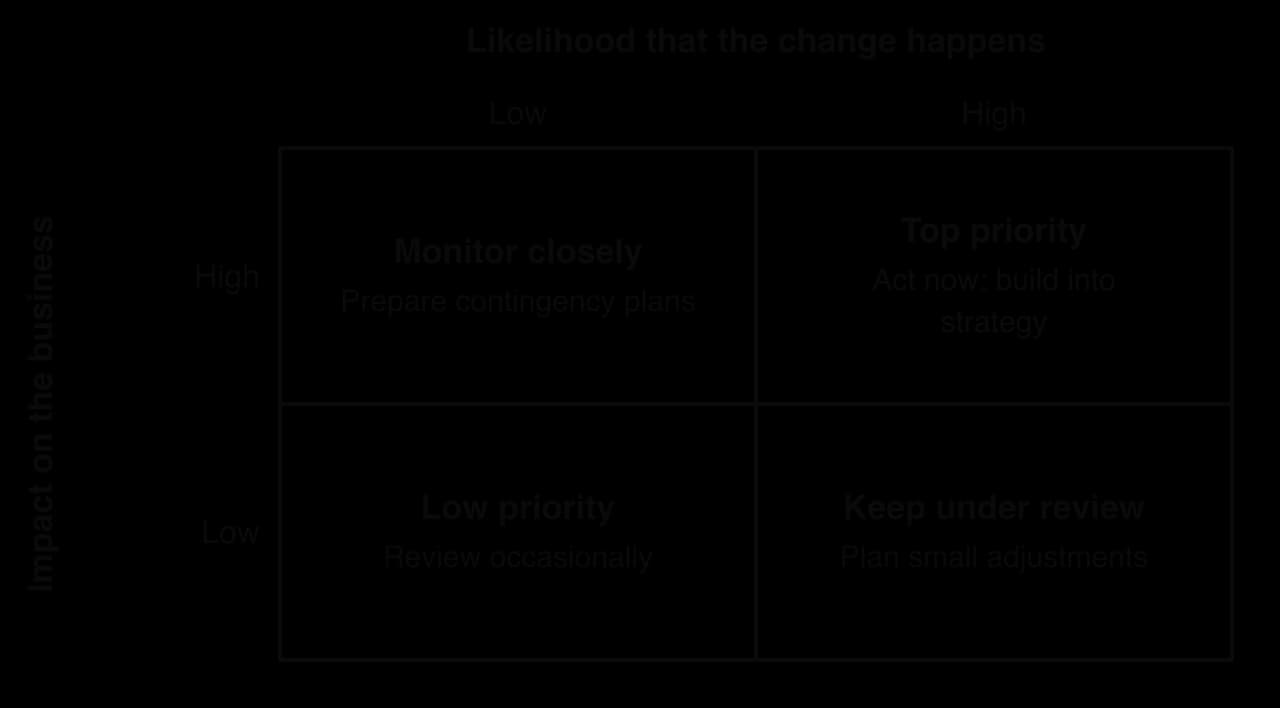
The grid shows how the two criteria combine. A change that is both likely and serious, such as a tax rise that has already been announced, belongs in the business’s strategy now. A serious but uncertain change, such as a possible trade dispute, should be watched closely, with a plan ready in case it happens. Minor changes need little attention, however likely they are.
A simple way to rank factors is to score each one for impact and likelihood on a scale of 1 (low) to 5 (high) and multiply the two scores. The product gives a priority score out of 25.
STEEPLE analysis is closely linked to SWOT analysis. A SWOT has two internal parts, strengths and weaknesses, and two external parts, opportunities and threats. A STEEPLE analysis is a systematic way of finding the opportunities and threats, so managers often carry it out first and then transfer its main findings into the SWOT.
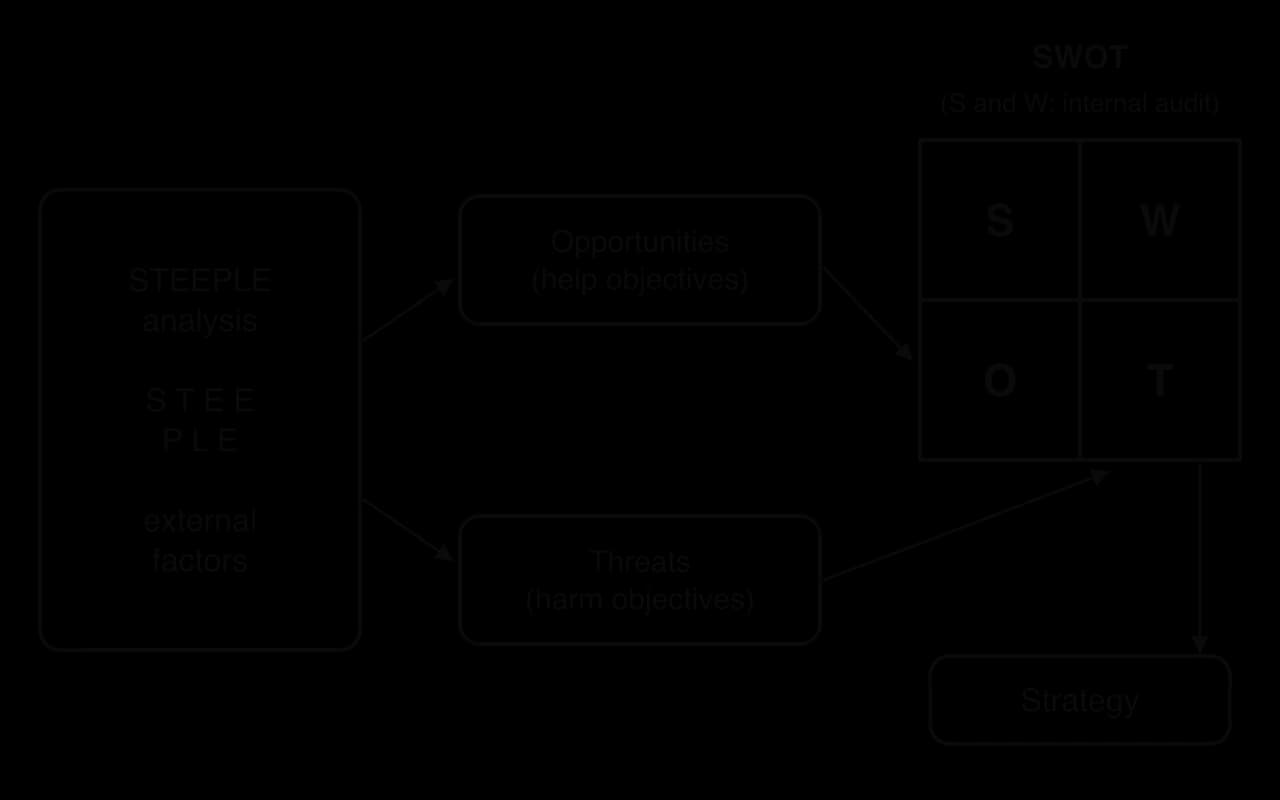
The flow diagram shows the order of the work. Only the factors with the highest priority need to go into the SWOT, which keeps it short and focused. Combining the two tools lets managers see how the business’s own strengths can be used to take an opportunity, or which weaknesses leave it exposed to a threat. For Lumo, its experience of running a bike fleet in Swedish cities (a strength) helps it take the opportunity of rising cycling in Berlin, while its reliance on borrowing (a weakness) makes higher interest rates a serious threat.
STEEPLE also supports other tools. Its findings help a business choose a growth strategy in the Ansoff matrix, estimate the probabilities in a decision tree and describe the market in a business plan.
Because every decision is affected by the outside world, STEEPLE analysis is used throughout business management. The table gives typical uses in each unit.
Unit | Typical use of STEEPLE analysis |
|---|---|
1 Introduction to business management | Setting strategic objectives; deciding whether to grow or enter a new country; assessing the effect of a multinational company on a host country. |
2 Human resource management | Planning the workforce: demographic change, migration, education, minimum wage laws, new technology and remote working. |
3 Finance and accounts | Forecasting cash flow and appraising investments: interest rates, inflation, exchange rates, taxes and grants. |
4 Marketing | Market research and planning: changing tastes, incomes, advertising rules, digital marketing and ethical expectations of brands. |
5 Operations management | Choosing a location and managing supply: transport costs, energy prices, environmental rules, political stability and labour standards in the supply chain. |
Different organisations use the tool in different ways. A large multinational may employ analysts who update a STEEPLE for each country every year. A small business or a social enterprise is more likely to carry out a short analysis when it faces a major decision, such as moving premises or applying for a grant.
STEEPLE analysis is simple to understand and covers the whole external environment, which makes it a useful starting point for planning. It encourages managers to look beyond the business and its immediate competitors and to think about change before it happens. It also has important limitations.
The environment changes quickly. A STEEPLE analysis is a snapshot. Interest rates, exchange rates, technology and politics can change within months, so an analysis can be out of date soon after it is finished and must be repeated regularly.
There are many factors. A full analysis can list dozens of factors, and managers may spend so long collecting them that the important few are lost among the minor ones. Prioritisation is needed to make it useful.
Judgments are subjective. Deciding which factors matter, whether they are opportunities or threats, and how to score them depends on the views and experience of the people doing the analysis. Different managers may reach different conclusions from the same facts.
Data may be unreliable or incomplete. Forecasts of growth, inflation or policy are often wrong, and good data may be expensive or unavailable, especially for small businesses or for less developed markets.
Factors overlap. Many changes fit more than one heading (a carbon tax is political, legal, economic and environmental), which can lead to double counting or confusion.
It describes but does not decide. The tool lists external factors but does not tell managers what to do. It must be combined with internal analysis (a SWOT) and with other tools to reach a decision.
How useful a STEEPLE analysis is depends on several things: how carefully it is focused on one decision, how good and recent its data are, how often it is updated, and whether the business is in a fast-changing industry (such as technology or energy) or a stable one. It is most valuable when it is used to prioritise a few key factors and is followed by action, and least valuable when it becomes a long list that nobody uses.
BYD is a Chinese manufacturer of electric vehicles and batteries, based in Shenzhen, and in 2025 it was the world’s largest seller of battery electric vehicles. It began selling passenger cars in Europe in 2021, starting in Norway, and expanded to Germany, France, the Netherlands, the United Kingdom and other countries over the next three years. Its expansion is a clear example of how every STEEPLE factor can shape a single strategic decision.
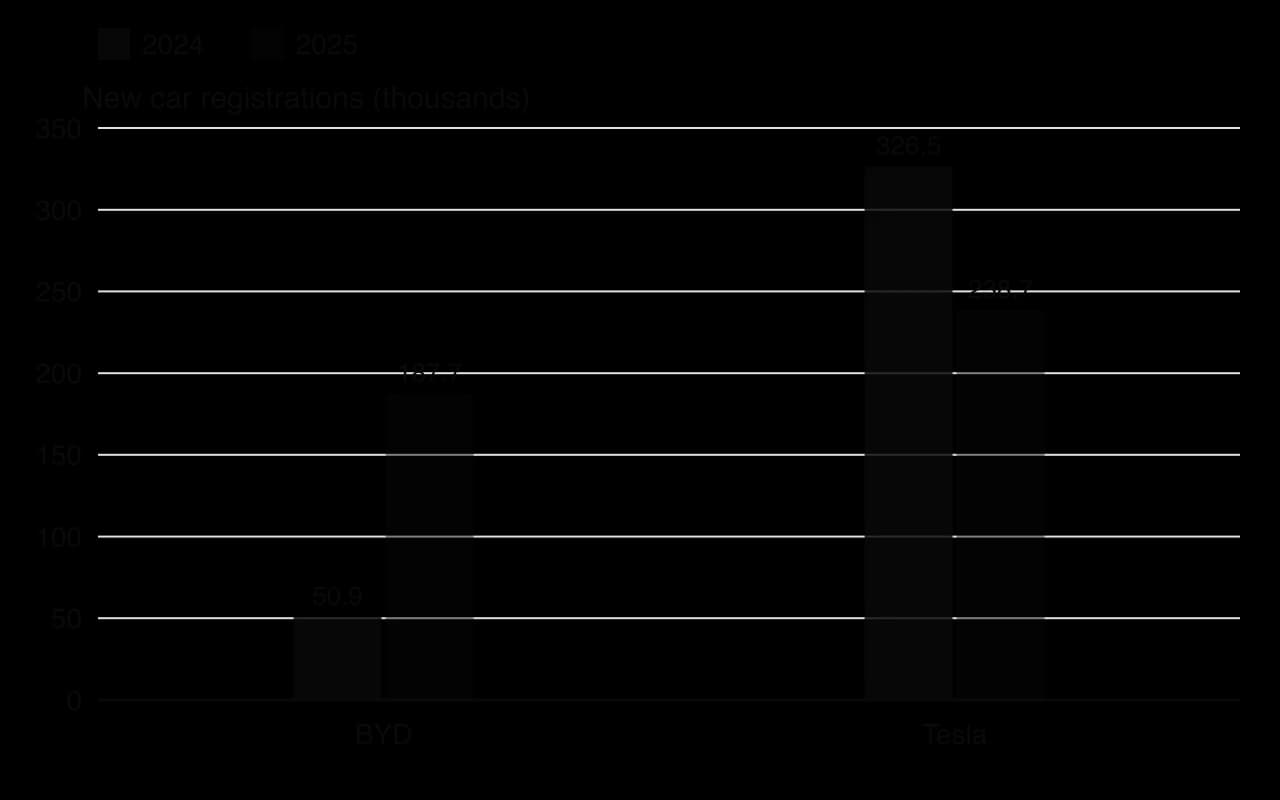
The chart shows how fast BYD grew. Its new car registrations in the EU, EFTA countries and the United Kingdom rose from 50,912 in 2024 to 187,657 in 2025, an increase of 268.6%. In the same period registrations of Tesla, the best-known electric car brand in Europe, fell from 326,525 to 238,656. In December 2025 BYD’s share of new car registrations in the EU was 1.9%, up from 0.7% a year earlier, which shows that BYD is still a small player in a very large market.
Political factors had the largest effect on its plans. In October 2024 the European Commission imposed countervailing duties on battery electric cars imported from China, after an investigation found that Chinese producers benefited from unfair subsidies that threatened EU carmakers. The duty was 17.0% for BYD, 18.8% for Geely and 35.3% for SAIC, for five years. The duties applied to battery electric cars only, so BYD’s plug-in hybrid models were not affected.
BYD’s response was to build cars inside the EU, where the duties do not apply. It chose Szeged in Hungary for its first European car factory, a plan first announced in December 2023, with a planned capacity of 200,000 vehicles a year. Trial production began in January 2026, but in June 2026 BYD said that full assembly would start only in the fourth quarter of 2026, about a year late, and it paused a planned $1 billion factory in Turkey to concentrate on Hungary.
Environmental, legal and economic factors create the opportunity. Concern about climate change and air quality in cities (an environmental factor) has pushed governments to tighten the rules on vehicle emissions. EU law adopted in 2023 set a 100% cut in carbon dioxide emissions from new cars by 2035, which would in effect end the sale of new petrol and diesel cars; in December 2025 the European Commission proposed lowering the target to a 90% cut, and the change was still being negotiated in mid-2026. Under either version, the law (a legal factor) moves demand towards electric cars. The market is already growing (an economic factor): battery electric cars rose from 13.6% of new car registrations in the EU in 2024 to 17.4% in 2025.
Technological factors support the opportunity. Battery and charging technology is improving quickly and battery costs have fallen, which makes electric cars cheaper to build. Many buyers still see electric cars as expensive, so price matters. BYD designs and makes its own Blade batteries, an internal strength that lets it take advantage of these external changes and compete on price.
Social, legal and ethical factors add risks. Many European buyers are loyal to established European brands and know little about Chinese ones, so building awareness and trust is a challenge. Under EU law BYD must also meet strict rules on safety, data and batteries.
Ethical scrutiny of its supply chain is also intense. In December 2024 prosecutors in Brazil said they had found 163 Chinese workers in “slavery-like conditions” at the site of a BYD factory under construction in Camaçari, employed by a contractor; BYD said it would end the contract. With the EU’s Forced Labour Regulation due to apply from December 2027, such cases show why European buyers, regulators and investors look closely at working conditions in its supply chain.
Factor | Change | Impact on BYD in Europe | O/T | Priority |
|---|---|---|---|---|
Social | Buyers are loyal to established brands and price-sensitive | Must build trust in a new brand; lower prices attract buyers | O and T | Medium |
Technological | Battery and charging technology improving fast; battery costs falling | In-house batteries let BYD turn these changes into lower costs | O | High |
Economic | Battery electric cars rising from 13.6% to 17.4% of EU registrations (2024–2025) | Fast-growing market for BYD’s main products | O | High |
Environmental | Concern about climate change and urban air quality | Long-term shift of demand towards low-emission cars | O | High |
Political | EU countervailing duty of 17.0% on BYD’s imported electric cars (2024) | Higher costs or lower margins on imports; reason to build in Hungary | T | Very high |
Legal | EU CO2 limits for new cars (2035 target under review); rules on safety, data and batteries; Forced Labour Regulation from 2027 | Emission limits favour electric cars; compliance costs and supply chain checks | O and T | High |
Ethical | Labour conditions at the Brazil construction site (2024) | Risk to reputation with European buyers and regulators | T | Medium |
The analysis shows why STEEPLE is useful. A single political decision, the EU duties, changed BYD’s choice of location and product mix, while environmental, legal and economic factors explain why it still wanted to enter the market. The priority column is a judgment rather than a calculation, which is one of the tool’s limits.
The case also shows how fast factors change: within two years the duties, the factory timetable and the market’s growth all moved, so any STEEPLE analysis of BYD needs frequent updating. The evidence has limits too, since registration figures come from an industry body and press reports, and factory timetables come from company statements that have already changed several times.
Sources: European Commission press release IP/24/5589 (29 October 2024); ACEA new car registrations for 2025 (27 January 2026), via CnEVPost; ACEA, new car registrations 2025 (27 January 2026); European Commission automotive package proposal (16 December 2025); Council of the EU progress report (June 2026); electrive.com (2 February 2026); Reuters via EVwire (11 June 2026); Associated Press (30 December 2024); European Commission, Forced Labour Regulation (2026); Wikipedia, “BYD Auto” (European market entry, 2026).
Explain why the EU’s countervailing duties are a political factor and how they influenced BYD’s decision to build a factory in Hungary.
Using the data, explain one opportunity and one threat that BYD faces in Europe.
Explain two limitations of using a STEEPLE analysis to plan BYD’s European strategy.
STEEPLE analysis can appear in Papers 1, 2 and 3. Short questions ask students to define a factor, explain how a factor affects the business in the case, or construct a STEEPLE analysis from the stimulus. In extended responses it is one of the tools that can be applied to decisions such as entering a new market, changing location or launching a product.
“Explain” questions on STEEPLE need two separate factors, each identified and then applied to the business in the case.
The external environment is made up of factors outside a business’s control; the internal environment gives its strengths and weaknesses.
STEEPLE analysis groups external factors under seven headings: social, technological, economic, environmental, political, legal and ethical.
The same factor can be an opportunity for one business and a threat to another, so its impact must be explained for the organisation in question.
A STEEPLE analysis is constructed for a specific decision: gather evidence, place each change under a heading, explain its impact, then prioritise.
Factors can be prioritised by scoring their impact and likelihood and multiplying the scores.
STEEPLE supplies the opportunities and threats of a SWOT analysis and supports decisions in every unit.
Its limitations are fast change, the large number of factors, subjective judgments, unreliable data and overlap between headings.
I can distinguish between the internal and the external environment of a business.
I can describe each of the seven STEEPLE factors with a real example.
I can explain why one external factor can be an opportunity for one business and a threat to another.
I can construct a STEEPLE analysis for an organisation from a case, explaining the impact of each factor.
I can prioritise factors by scoring impact and likelihood.
I can explain how STEEPLE analysis feeds into a SWOT analysis and supports decisions in each unit.
I can explain the limitations of STEEPLE analysis for a specific business.
reputation for quality leather
established production and 30 shops
|
Opportunities (external) | Threats (external) |
|---|---|
|
|
Award [1] for each quadrant containing at least one relevant point from the case, up to [4].
Do not award the mark for a quadrant if the point is placed in the wrong quadrant (e.g. the weak peso as a strength).
Explain two tactical objectives that Areco’s departments could set to help achieve the strategic objective.
4 marks
Possible tactical objectives:
Marketing: launch an English and Italian version of the website by June 2026; attend two international leather trade fairs in 2026.
Operations / purchasing: by 2027 buy 100 % of hides from ranches that can prove they are deforestation-free, so that exports to the EU are allowed.
Operations: increase handbag capacity to meet the Milan order of 5 000 a year by the end of 2026.
HR: recruit an export manager with EU experience within six months; train staff in export documentation.
Finance: arrange export finance or currency protection by the end of 2026.
Mark as 2 + 2. For each objective, award [1] for a relevant tactical objective and [1] for explaining how it helps Areco reach 50 % of revenue from exports by 2030.
Award a maximum of [2] if the objectives given are strategic rather than tactical or are not linked to Areco.
Analyse how changes in Areco’s external environment (paragraphs 2 and 4) have influenced its objectives.
6 marks
Answers may use STEEPLE:
Economic: high inflation and falling domestic sales make growth in Argentina unrealistic, pushing Areco from domestic growth towards survival and then export growth; the weak peso creates an export opportunity, leading to the 50 % export objective.
Legal / political: EU deforestation rules mean the export objective depends on new sourcing objectives (traceable hides), changing purchasing and operations targets.
Environmental / ethical: concern about deforestation and tannery pollution means Areco may need environmental or ethical objectives to be accepted by European buyers.
Social: demand from fashion houses abroad for high-quality leather goods.
Interrelationships: the opportunity (weak peso) and the threat (EU rules) affect the same objective, so Areco’s objectives must change at both strategic and tactical levels; if the peso recovers, the export objective could become less attractive.
Award [1]–[2] for a description of one or two external changes with little link to objectives.
Award [3]–[4] for an analysis of how external changes have influenced Areco’s objectives, with some use of the case.
Award [5]–[6] for a balanced analysis that covers changes in both paragraphs, uses the case effectively and shows how they affect strategic and/or tactical objectives.
Kaleva Print Oy is a Finnish company that prints regional newspapers and earns most of its revenue from selling advertising space in them. Spending on newspaper advertising in Finland fell from €310 million in 2023 to €263.5 million in 2025, as advertisers moved to social media and search engines. Kaleva Print’s market share over the same period stayed at about 18 %.
Calculate the growth of the Finnish newspaper advertising market between 2023 and 2025 (show all your working).
2 marks
Explain two implications for Kaleva Print of operating in a declining market, even though its market share has stayed the same.
4 marks
Dommel Cycles
[1] Dommel Cycles (DC) is a private limited company in Utrecht, the Netherlands, that designs and assembles electric cargo bikes. Its customers are mainly young families and small delivery businesses. DC’s single assembly line can produce a maximum of 8 000 bikes a year.
[2] Sales have grown every year since 2021 (Table 1). Lotte Bosman, DC’s marketing director, has forecast sales of 9 500 bikes for 2026. Her forecast extends the recent trend and assumes that the Dutch government will introduce a subsidy of €1 000 for every household that buys a cargo bike. The subsidy has been proposed but has not yet been approved by parliament.
[3] Based on Lotte’s forecast, the operations director, Joost Bakker, wants to build a second assembly line costing €2.4 million, financed by a bank loan. The finance director, Lieke Jansen, is cautious. She points out that two Chinese manufacturers have entered the Dutch market with cheaper models, and that DC’s forecast for 2025 was 8 % higher than actual sales.
Table 1: DC’s sales of cargo bikes (units), 2021–2026
Year | 2021 | 2022 | 2023 | 2024 | 2025 | 2026 (forecast) |
|---|---|---|---|---|---|---|
Units sold | 4 200 | 5 100 | 6 300 | 7 000 | 7 600 | 9 500 |
Define the term sales forecasting.
2 marks
Using Table 1, calculate the percentage increase in DC’s forecast sales for 2026 compared with its actual sales in 2025 (show all your working).
2 marks
Explain two benefits to DC of producing a sales forecast.
4 marks
Discuss whether DC should use Lotte’s sales forecast as the basis for its decision to build a second assembly line.
10 marks