B.3 Injury
Explain why sports injuries happen, classify them by mechanism and tissue, and evaluate how they are prevented, treated and managed through a safe return to activity, including concussion.
- IB Sports, Exercise and Health Science
- SL and HL
What B.3 covers
From the subject guide: what you need to know and be able to do.
What causes sports injuries, and how they are prevented and treated.
2 subtopics in Injury
Each one has its own page once something is published for it.
- B.3.1Causes of injurynotes
- B.3.2Interventions related to injurynotes
An overview of B.3 Injury
Injury studies why the body’s tissues are damaged during sport and exercise, how that damage is classified, and how injuries are prevented, treated and rehabilitated. For health, injury is one of the main reasons that people stop being physically active; for performance, the athletes who stay available to train and compete are a large part of any team’s success.
The questions behind the topic
The topic is built around one central question: what causes injuries to bones, muscles, joints and the brain, and what can be done to prevent them and to treat them when they happen? Every idea in it follows from a simple principle, the load–capacity balance: a tissue is injured when the load on it is greater than it can withstand. Real situations make the question concrete:
Why are female footballers several times more likely than male footballers to rupture the anterior cruciate ligament?
Why does a new runner who increases weekly distance too quickly develop shin pain, when nothing was hurt on any single run?
Why does a cycle helmet greatly reduce the risk of a skull fracture but only partly reduce the risk of concussion?
Is ice still the right first treatment for a sprained ankle?
Why does a player who has had a concussion return to sport through a series of stages instead of on a fixed date?
How can changing a runner’s stride or a fast bowler’s action lower the risk of an overuse injury? (HL)
What the topic covers
Subtopic | Main question it answers | Level |
|---|---|---|
B.3.1 Causes of injury | Which internal and external factors make an injury more likely, how do acute and cumulative trauma differ, and which injuries affect each type of tissue? | SL and HL, with an HL-only part |
B.3.2 Interventions related to injury | How can the risk of injury be lowered, how are injuries treated and rehabilitated, and how does a person return safely to learning and sport after concussion? | SL and HL |
Causes of injury separates internal risk factors, such as age, sex, previous injury and the effects of training, from external risk factors, such as equipment, surface, weather and rules. It then classifies injuries by how the force was applied, acute trauma or cumulative trauma, and by the tissue damaged: ligaments (sprains), muscles (strains), bones (fractures and stress fractures), skin and the brain. Interventions related to injury follows the injury in time, from injury prevention through first treatment of inflammation and rehabilitation to return to play.
How the subtopics connect
The two subtopics form one sequence, shown in the concept map. Causes of injury explains why tissue fails; Interventions related to injury acts on the causes that can be changed. A risk factor that can be modified, such as poor conditioning, unsuitable footwear or a dangerous tackle, points directly to an intervention, such as a warm-up programme, better equipment or a rule change. Factors that cannot be modified, such as age, sex or a previous injury, show who needs that intervention most.
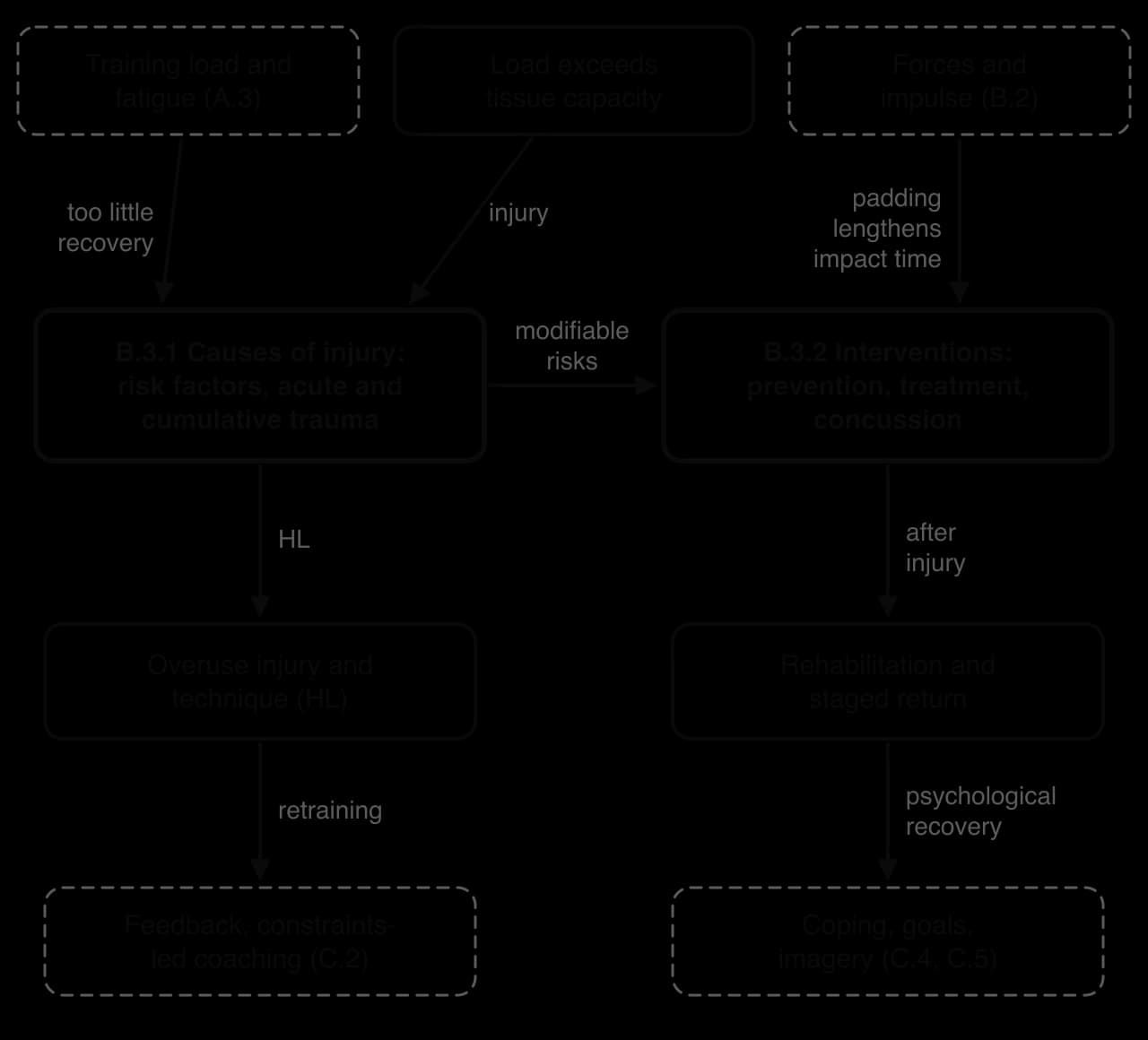
The map also shows the links with the rest of the course. Personal protective equipment lowers the peak force of a blow by lengthening the time of impact, an application of impulse from the study of forces and motion. Training load and recovery, from the physiology theme, decide whether tissues adapt and grow stronger or become fatigued and fail; too little recovery is a common cause of overuse injury. At HL, faulty technique is treated as a cause of overuse injury, and correcting it draws on feedback and the constraints-led approach from motor learning.
Rehabilitation is as much a psychological process as a physical one. An injured athlete faces a major stressor, and the way they cope, the goals they set for recovery and the imagery they use while unable to train all affect how quickly and confidently they return. The sports psychology theme therefore supplies many of the tools used in the later stages of rehabilitation.
Health and performance lenses
Health lens | Performance lens |
|---|---|
Injury is a common reason for children and adults to drop out of physical activity, so safe participation protects long-term health. | Injuries cost elite teams training days and matches; prehabilitation programmes keep more players available. |
Older adults have weaker bones and slower healing, so a fall is more likely to cause a fracture. | Previous injury is the strongest single predictor of a new injury, which shapes how athletes return from injury. |
Developmentally appropriate rules protect young people’s growing bones, such as limits on heading in youth football. | Correcting technique, such as a fast bowler’s action, can extend a career by lowering overuse injury (HL). |
Graded return to learning after concussion protects a young person’s schooling as well as their brain. | Criteria-based return to play balances the wish to compete against the risk of re-injury. |
Injury links to the other two themes. From exercise physiology, fatigue reduces the control and force-absorbing capacity of muscles late in a match, and low energy availability increases the risk of stress fractures. From sports psychology, an ego orientation and a highly competitive motivational climate can push athletes to train or play through pain, while coping strategies, goal setting and imagery support recovery.
How SL and HL differ
HL students study everything SL students study, plus additional higher level material. In this course that extra material is mostly added inside subtopics rather than as separate subtopics. Most pages are therefore read by everyone, and contain sections with headings ending “(HL only)” that SL students can skip. Questions on the HL material appear only in the HL papers.
In Injury, neither subtopic is HL only, and Interventions related to injury contains no HL material: both levels study it in full. Causes of injury has one HL-only part, on overuse injuries and technique:
common chronic or overuse injuries, such as medial tibial stress syndrome, patellofemoral pain, lateral epicondylalgia and low back injuries in fast bowlers, and how each is linked to technique;
biomechanical maladaptations, such as overstriding, dynamic knee valgus and a broken kinetic chain in throwing;
how correcting these maladaptations, through gait retraining, technique coaching and changes to equipment, can lower the risk of injury, with an evaluation of the evidence.
Assessment
Questions on Injury appear in all three parts of the external assessment. Paper 1A asks multiple-choice questions, for example which tissue is damaged in a sprain or which factor is an external risk factor. Paper 1B gives data from a study, such as injury rates in a prevention trial, and asks students to describe trends, calculate rates or percentage changes and evaluate the design. Paper 2 asks short-answer and extended-response questions. HL-only material on overuse injuries and technique appears only in the HL papers.
The topic tends to produce these kinds of question:
distinguishing pairs of terms, such as acute and cumulative trauma, sprain and strain, or internal and external risk factors;
classifying named injuries by tissue and mechanism;
explaining how protective equipment lowers peak force, using impulse;
describing the inflammatory response, the phases of healing and the stages of return to sport after concussion;
interpreting injury data from a study, such as a warm-up programme trial;
evaluating a method of prevention or treatment, such as stretching, ice or a prehabilitation programme;
explaining how a technique fault leads to an overuse injury and how it can be corrected (HL).
Carry on with B.3 in Augment
With a free account, Augment remembers where you stopped and what you have practiced.