Heat and temperature, exothermic and endothermic reactions, energy profiles, standard enthalpy changes, and measuring ΔH by calorimetry with Q = mcΔT and ΔH = −Q/n.
Each is in the Chemistry glossary, with every other term in the subject.
The minimum energy that colliding particles need for a reaction to occur; on an energy profile, the energy difference between the reactants and the transition state.
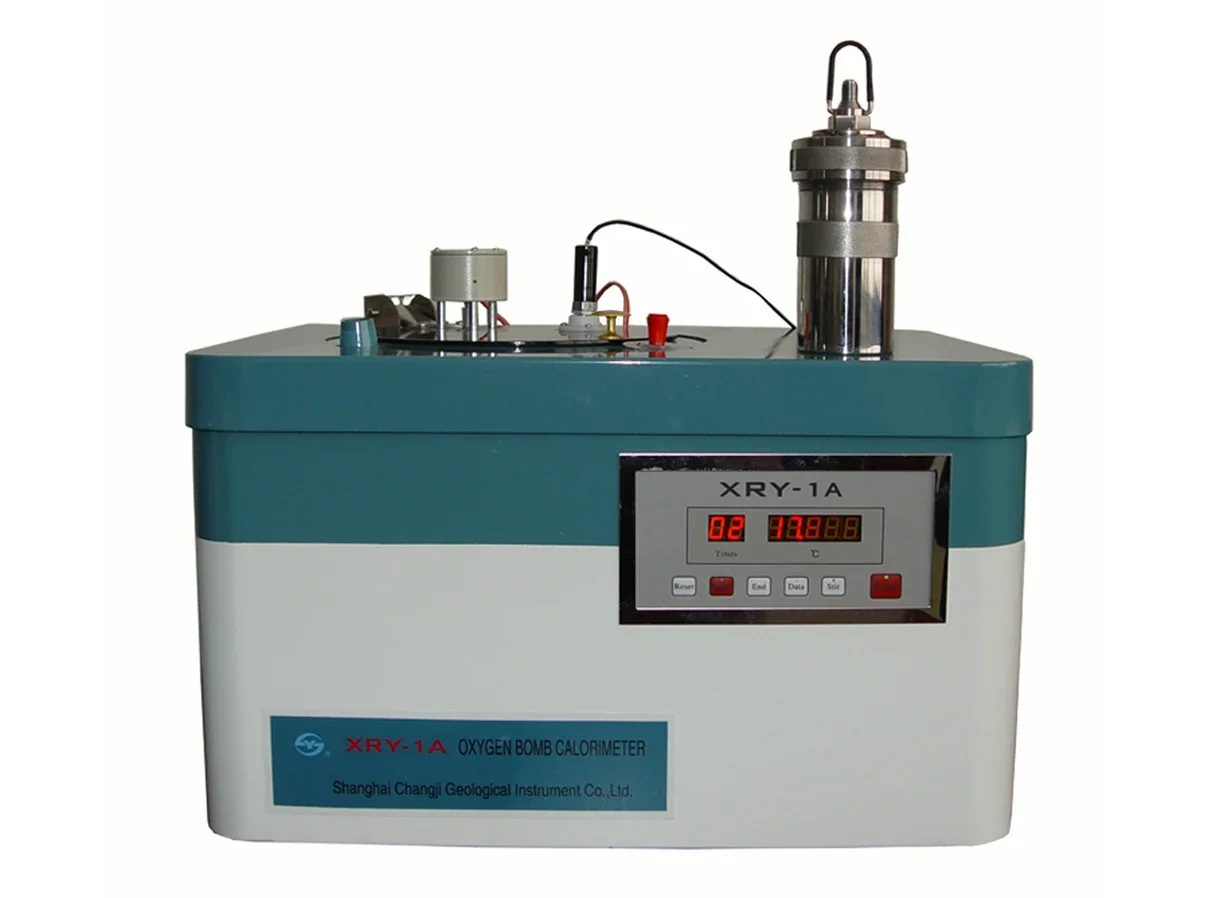
A calorimeter in which a sample burns completely in pure oxygen inside a sealed steel vessel immersed in insulated water, giving accurate enthalpies of combustion.
An insulated container in which a reaction heats or cools a known mass of water or solution so that the heat transferred can be measured.
The measurement of the heat transferred in a chemical or physical change, usually from the temperature change of a known mass of water or solution.
A graph of potential energy against reaction coordinate showing the reactants, the transition state and the products, with the activation energy and .
The heat content of a system at constant pressure, symbol
Almost every chemical reaction gives out or takes in energy. Burning methane heats homes and cooks food, while an instant cold pack used on a sports injury gets cold because the solid inside absorbs energy as it dissolves. Measuring these energy changes, usually by following a change in temperature, is the starting point for understanding why reactions happen and how much energy they can supply.
122 exam-style questions on this subtopic, written in the style of the IB papers. The first has its markscheme open. Counted on
Which change of state is exothermic?
In deposition a gas changes directly to a solid. Attractions form between the particles as they come together, so energy is released: the change is exothermic.
Melting, sublimation and vaporization all separate particles by overcoming attractions between them, so they absorb energy (endothermic).
The answer is C.
Which pair of changes of state are both endothermic?
One of 61 short multiple-choice questions on R1.1. Pick an answer to see why it's right or wrong.
An experiment gives for a fuel whose literature value is
The official deck for this part of the syllabus.
In thermochemistry, what is meant by the system?
In thermochemistry, what are the surroundings?
The entries of the chemistry data booklet that R1.1 uses. Each opens in the explained booklet.
With a free account, Augment remembers where you stopped and what you have practiced.
The heat transferred between a system and its surroundings at constant pressure, ; negative for exothermic and positive for endothermic changes.
The enthalpy change when an acid and a base react to form one mole of water; about for a strong acid with a strong base.
The enthalpy change when one mole of a substance dissolves in a solvent, usually water, to form a dilute solution; it can be exothermic or endothermic, for example for ammonium nitrate.
Energy transferred between two bodies because of a difference in temperature, from the hotter to the colder; symbol , measured in joules.
The persistence of a substance that is energetically unstable relative to its products but reacts extremely slowly because the activation energy is high.
Energy cannot be created or destroyed, only transferred or converted from one form to another, so the total energy of a system and its surroundings is constant.
The reactant that is completely used up in a reaction, so it determines the amount of product formed; the others are in excess.
The difference between an experimental result and the accepted value, divided by the accepted value and multiplied by 100; a measure of the accuracy of the result.
The absolute uncertainty of a value divided by the value itself and multiplied by 100; it shows how large the uncertainty is compared with the measurement.
Energy stored in a substance because of the arrangement of its particles, in its bonds and the attractions between particles. Lower potential energy means greater stability.
The x-axis of an energy profile, representing the progress of a reaction from reactants to products; it has no units or scale.
A comparison of substances by their potential energy: the one lower in energy is more stable. Products more stable than reactants means the reaction is exothermic.
The energy needed to raise the temperature of 1 g of a substance by 1 K; for water it is .
A pressure of 100 kPa, a stated temperature (usually 298 K) and solution concentrations of , used for quoting standard thermodynamic values.
The enthalpy change, , when the amounts in an equation react under standard conditions with every substance in its standard state; units .
The pure, most stable form of a substance at 100 kPa and the stated temperature, for example , and graphite at 298 K.
Everything outside the system, including the solvent, the container, the thermometer and the air.
The part of the universe being studied, usually the reactants and products of a reaction.
A balanced equation with state symbols followed by its enthalpy change, which refers to the amounts in moles shown in the equation.
The highest-energy arrangement of atoms on the path from reactants to products, at the top of the hump on an energy profile, in which bonds are partly broken and partly formed.
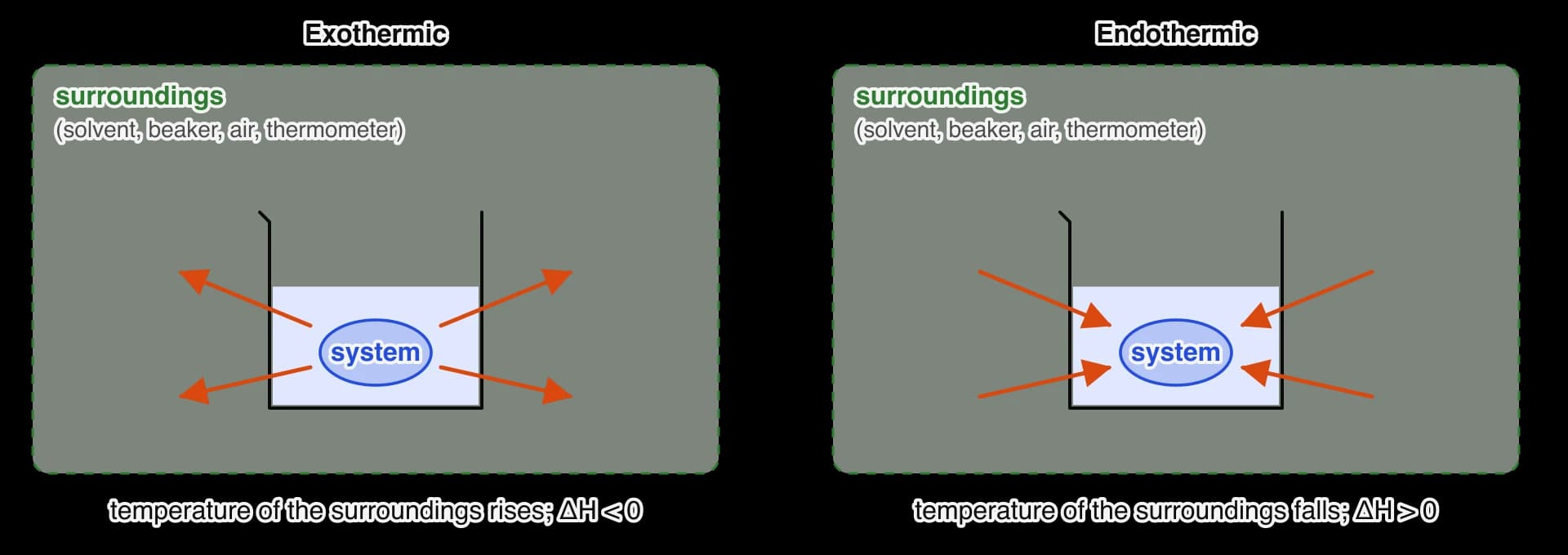
To describe an energy change, chemists divide the universe into two parts. The system is the part being studied: the reacting chemicals. The surroundings are everything else, including the water the chemicals are dissolved in, the container, the thermometer and the air.
The law of conservation of energy states that energy cannot be created or destroyed, only transferred or converted from one form to another. Any energy released by the system is therefore gained by the surroundings, and any energy absorbed by the system is lost by the surroundings. The total energy of the system and surroundings together stays the same.
In practice the system and surroundings are in close contact. When hydrochloric acid neutralizes sodium hydroxide in a beaker, the ions that react are the system, but the energy they release goes straight into the water molecules around them. A thermometer placed in the solution therefore measures the temperature of the surroundings, not of the reacting particles themselves.
The words heat and temperature are often used loosely in everyday speech, but in chemistry they mean different things. Temperature is a measure of the average kinetic energy of the particles in a substance. When a substance gets hotter, its particles move, vibrate or rotate faster on average. Temperature is measured in kelvin (K) or degrees Celsius (°C), and it does not depend on how much of the substance there is.
Heat is energy transferred from one place to another because of a difference in temperature. It always flows from the hotter body to the colder one, until both are at the same temperature. Heat is measured in joules (J) and, unlike temperature, depends on the amount of substance: a swimming pool and a cup of water can both be at 30 °C, but the pool holds far more thermal energy and needs far more heat to warm it by 1 °C.
Heat | Temperature | |
|---|---|---|
What it is | energy transferred because of a temperature difference | a measure of the average kinetic energy of the particles |
Symbol and unit | , joules (J) or kilojoules (kJ) | in kelvin (K), or in degrees Celsius (°C) |
Depends on the amount of substance? | yes (extensive) | no (intensive) |
Measured with | calculated from a temperature change, | a thermometer or temperature probe |
The link between the two is the kinetic energy of the particles. Heat flowing into a substance increases the kinetic energy of its particles, which shows up as a rise in temperature. During a change of state, though, heat can flow in without any change in temperature, because the energy is used to separate the particles rather than to make them move faster.
A temperature in degrees Celsius is converted to kelvin by adding 273: (more exactly, 273.15). The two scales have the same size of unit, so a change of temperature has the same value in both: a rise from 20 °C to 30 °C is a rise of 10 °C, which is also 10 K.
Different substances need different amounts of energy to raise their temperature by the same amount. The specific heat capacity of a substance, , is the energy needed to raise the temperature of one gram of it by one kelvin. Water has an unusually high value, (data booklet), because much of the energy supplied goes into disrupting the hydrogen bonds between its molecules.
Substance | Specific heat capacity / |
|---|---|
water (liquid) | 4.18 |
ethanol (liquid) | 2.44 |
aluminium | 0.90 |
iron | 0.45 |
copper | 0.39 |
Values at about 25 °C. Data: IB Chemistry data booklet (2025) for water; CRC Handbook of Chemistry and Physics for the others.
A substance with a high specific heat capacity warms up slowly. If equal masses of water and copper absorb the same energy, the temperature of the copper rises about ten times as much, because its specific heat capacity is about one tenth of water's. This is why water is used in calorimeters: a large mass of water absorbs a lot of energy with a temperature change that is easy to measure but not so large that much heat is lost.
Reactions are classified by the direction in which energy is transferred between the system and the surroundings.
The definitions describe the exothermic and endothermic cases from the point of view of the system. The sign of the enthalpy change follows the same viewpoint: a system that loses energy has a negative , and a system that gains energy has a positive . The observed temperature change happens in the surroundings, which is why an exothermic reaction makes a beaker feel warm.
Exothermic | Endothermic | |
|---|---|---|
Direction of energy transfer | system → surroundings | surroundings → system |
Temperature of the surroundings | rises | falls |
Sign of | negative | positive |
Enthalpy of products compared with reactants | lower | higher |
Examples | combustion of fuels; neutralization; metals with acids; respiration; calcium oxide with water | thermal decomposition of ; photosynthesis; dissolving ; sodium hydrogencarbonate with ethanoic acid |
Most energy changes are detected by measuring temperature with a thermometer or a temperature probe. Other observations also point to an exothermic reaction: a flame, a glow, a gas igniting, a solid melting from the heat produced, or steam forming. An endothermic reaction in solution makes the container feel cold, and in a strongly endothermic reaction water vapour can condense or even freeze on the outside of the beaker. Endothermic reactions that need a high temperature, such as thermal decomposition, only continue while heat is supplied, and stop when the heating stops.
Two everyday products use these changes directly. Instant cold packs contain solid ammonium nitrate and a separate pouch of water; squeezing the pack breaks the pouch, and the salt dissolves endothermically (), cooling the pack. Self-heating cans of coffee or soup work the other way: water is released onto calcium oxide, which reacts exothermically to form calcium hydroxide.
Physical changes also involve energy transfer. Melting, boiling and sublimation separate particles by overcoming the attractions between them, so they absorb energy and are endothermic. Freezing, condensing and deposition bring particles together as attractions form, so they release energy and are exothermic. The enthalpy-level diagram for water shows that the energy absorbed on melting or boiling equals the energy released on freezing or condensing.
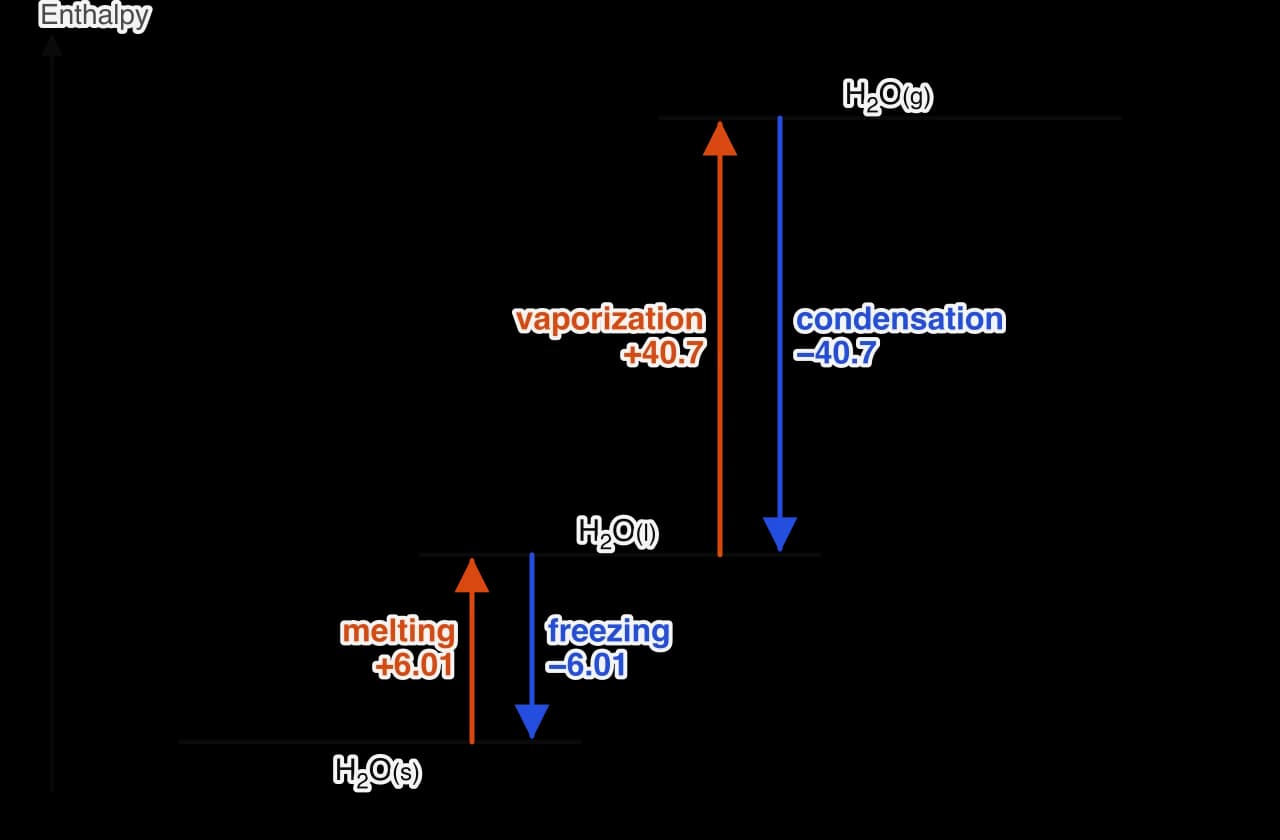
This is why sweating cools the body: the evaporation of water from the skin is endothermic and takes energy from the skin. Dissolving can be either exothermic or endothermic, depending on the balance between the energy needed to separate the particles of the solid and the energy released when they become surrounded by water molecules.
The chemical potential energy stored in a substance comes from the arrangement of its particles: the bonds between atoms and the attractions between molecules or ions. Strong bonds hold particles in low-energy arrangements. A substance at lower potential energy is said to be more stable (energetically more stable) than one at higher potential energy.
The sign of follows directly from the relative stability of reactants and products:
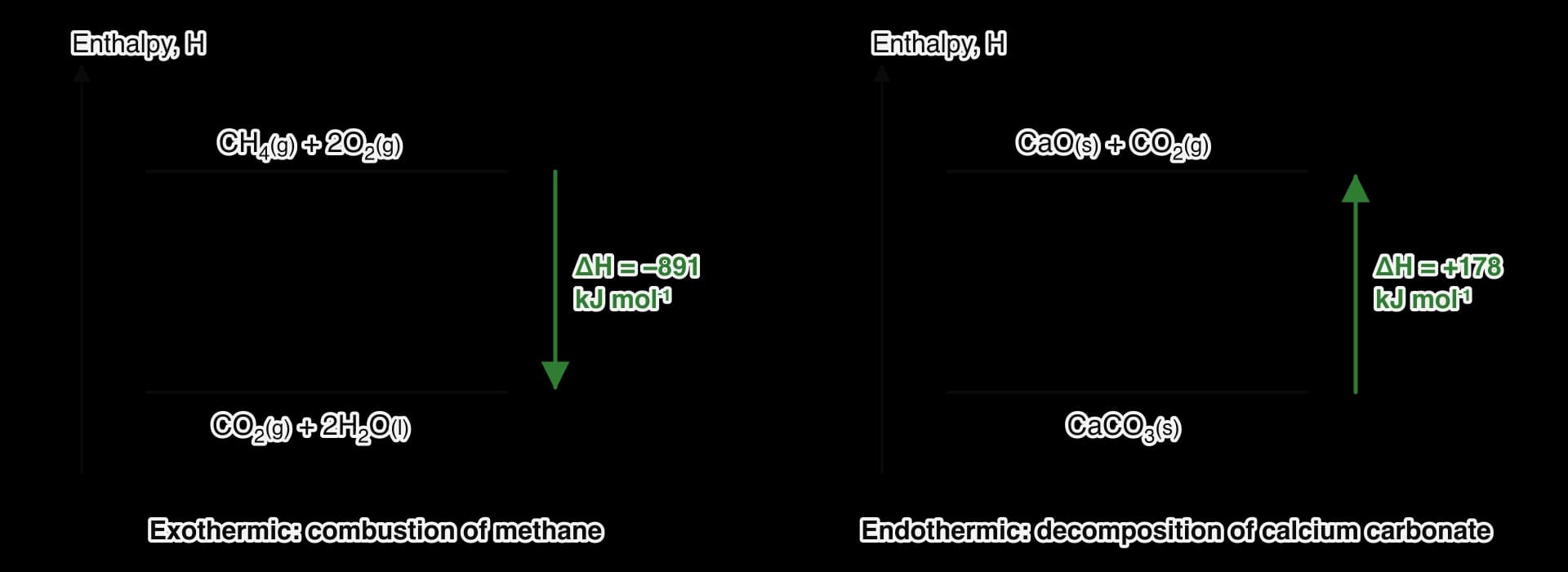
In an exothermic reaction the products are more stable (lower in energy) than the reactants. The difference in energy is released to the surroundings.
In an endothermic reaction the products are less stable (higher in energy) than the reactants. The difference in energy is taken from the surroundings.
An enthalpy-level diagram shows this with two horizontal levels, one for the reactants and one for the products, joined by an arrow labelled with . The combustion of methane and the decomposition of calcium carbonate are typical of the two kinds.
An energy profile adds the path between reactants and products. The x-axis is the reaction coordinate, which represents the progress of the reaction from reactants to products; it has no units and no scale. The y-axis is potential energy. Even an exothermic reaction rarely starts by itself, because bonds must begin to break before new ones can form: the energy first rises to a maximum, the transition state, and then falls to the products.
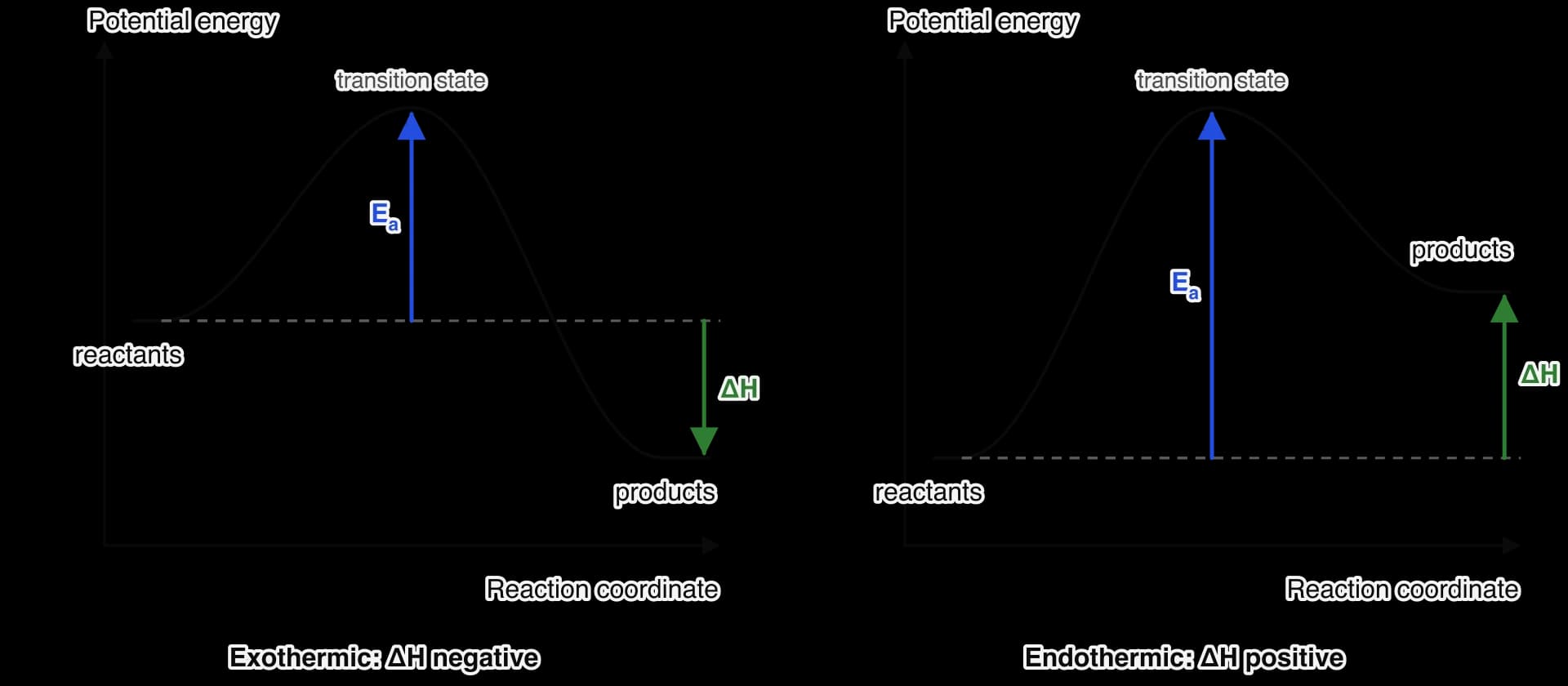
A correctly drawn energy profile has labelled axes, the formulas or names of the reactants and products on their levels, an activation energy arrow from the reactant level up to the peak, and a arrow from the reactant level to the product level, pointing down for an exothermic reaction and up for an endothermic one. The hump is drawn above both levels in every case. Why particles need this energy, and how temperature and catalysts affect the fraction of collisions that have it, is the subject of R2.2.
Combustion reactions are usually strongly exothermic, because the bonds in the products, especially the bonds in carbon dioxide and the bonds in water, are very strong. The "combustion" of nitrogen is an exception:
The nitrogen molecule contains a triple bond, one of the strongest covalent bonds known (, data booklet), and the bonds in nitrogen monoxide are not strong enough to make up for breaking it. The products are less stable than the reactants. Nitrogen and oxygen in the air therefore react only at very high temperatures, such as in lightning or inside a car engine, and the nitrogen oxides formed are an important source of air pollution. Calculating enthalpy changes from bond enthalpies is developed in R1.2.
A substance can be energetically unstable relative to its products and still last for a very long time. Methane and oxygen are much less stable than carbon dioxide and water, but a mixture of methane and air does not react until a spark or flame supplies the activation energy. Diamond is slightly less stable than graphite ( for diamond → graphite), yet diamonds do not turn into graphite at room temperature at any measurable rate.
Such substances are described as kinetically stable: the activation energy is so high that the reaction is extremely slow under ordinary conditions. The sign of says whether products are lower in energy; it says nothing about how fast they form.
The total energy stored in a system cannot be measured directly. What can be measured is the heat transferred when the system changes. Enthalpy, , is the heat content of a system, and the enthalpy change, , of a reaction is the heat transferred between the system and the surroundings when the reaction takes place at constant pressure. Most reactions in a laboratory happen in open containers at atmospheric pressure, so the heat measured in them is an enthalpy change.
A negative means the products have less enthalpy than the reactants (exothermic); a positive means they have more (endothermic).
A thermochemical equation is a balanced equation with state symbols, followed by its enthalpy change. The value refers to the amounts in the equation, read in moles, so the unit means "per mole of reaction as written":
Three rules follow from the fact that enthalpy is a property of the amounts and states present:
Doubling the equation doubles . For , , half the value for two moles of water.
Reversing the equation reverses the sign. The decomposition
State symbols matter. Forming steam, , releases less energy than forming liquid water, because the steam has not yet condensed.
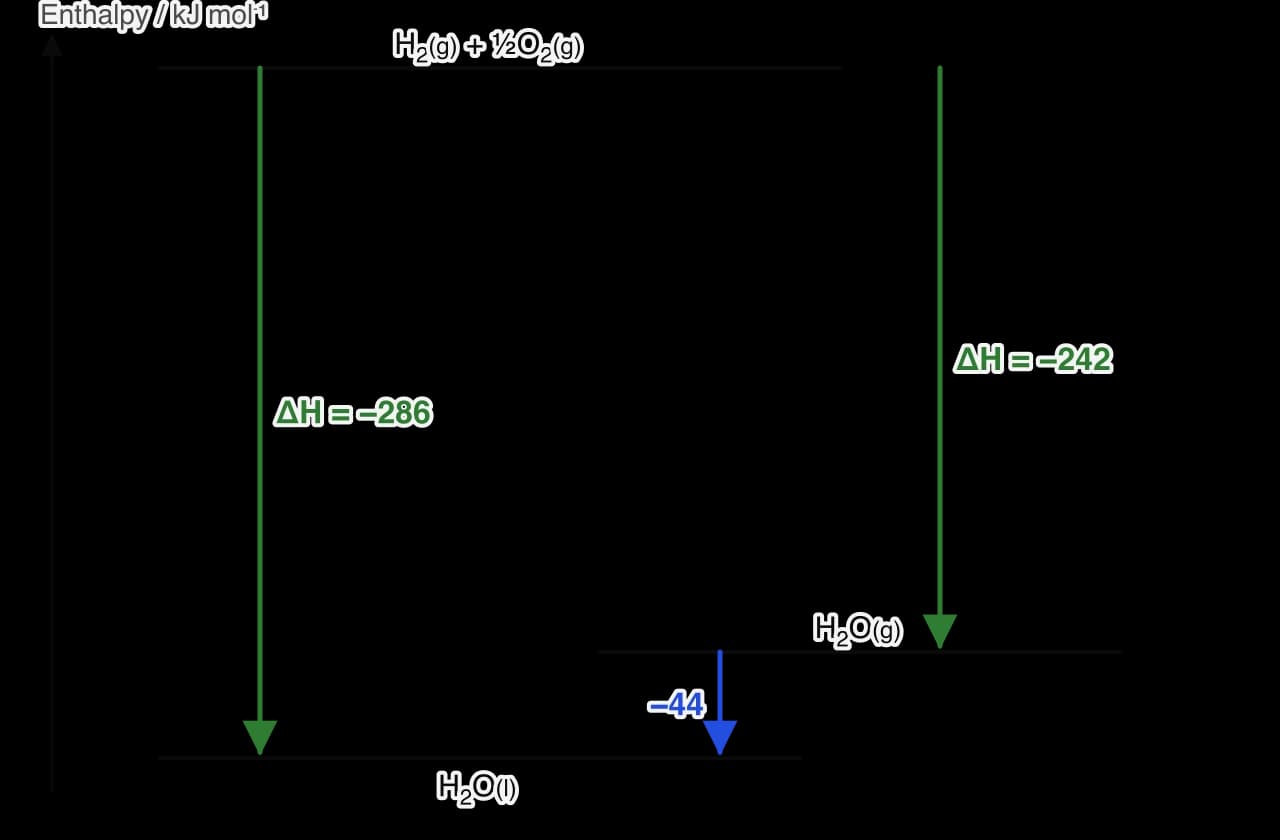
The enthalpy change of a reaction depends on the temperature, the pressure and the concentrations of any solutions. To make values comparable, chemists quote standard enthalpy changes, , measured under standard conditions with every substance in its standard state. The symbol ⦵ (written ) means "standard".
The standard state of water at 298 K is the liquid, of oxygen the gas , and of carbon the graphite allotrope. Standard conditions are not the same as STP (273 K and 100 kPa), which is used for gas volumes. The data booklet's thermodynamic data refer to 298.15 K and 100 kPa. Enthalpy changes are quoted in .
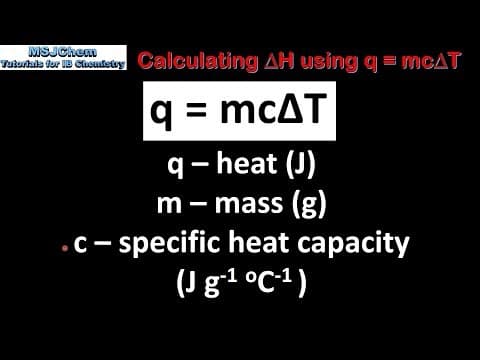
Enthalpy changes are measured indirectly by letting the reaction heat or cool a known mass of water (or of the solution itself) and measuring its temperature change. The heat transferred, , is given by (data booklet):
Symbol | Quantity | Unit |
|---|---|---|
heat transferred to or from the substance | J | |
mass of the substance whose temperature changes (usually the water or the solution) | g | |
specific heat capacity of that substance ( for water and dilute solutions) | ||
change in temperature (final − initial) | K (the same number as in °C) |
With in grams and in , comes out in joules. Divide by 1000 to convert to kilojoules before using it to find in .
The equation can be rearranged to find any of its quantities. A common use is to find the specific heat capacity of a metal block heated electrically, or to predict the temperature rise that a known amount of energy will produce.
 YouTube
The equation also predicts how a temperature change responds to the conditions, without any numbers. For a fixed amount of reaction, the heat released is fixed, so :
The same amounts of reactants dissolved in twice the volume of solution give half the temperature rise, because the same energy is spread through twice the mass.
Doubling the amounts of both reactants in the same total volume doubles the temperature rise, because twice as much reaction releases twice the heat into the same mass.
Doubling the amount of one reactant only, when the other is limiting, changes nothing: the amount of reaction is set by the limiting reactant.
Equal masses of two substances absorbing the same energy: the one with the larger specific heat capacity has the smaller temperature rise.
The heat calculated from is the heat gained (or lost) by the surroundings. The enthalpy change of the system is equal in size and opposite in sign. Dividing by the amount of reaction, , gives the enthalpy change per mole:
The negative sign converts "heat gained by the surroundings" into "enthalpy change of the system". If the temperature rises, is positive and is negative (exothermic). If the temperature falls, and are negative and is positive (endothermic). Here is the amount, in mol, of the substance that the value refers to: the limiting reactant, the fuel burned, or the water formed in a neutralization.
The enthalpy change of neutralization is almost the same for every strong acid with every strong base, because the reaction in each case is ; the other ions are spectators. Weak acids and weak bases give slightly less exothermic values (R3.1).
Many calorimetry experiments use one reactant in excess so that the other reacts completely. The amount of reaction, and therefore , is set by the limiting reactant. A common example is the displacement of copper from copper(II) sulfate solution by zinc powder.
The same three steps apply to an endothermic change, where the only difference is the sign. The temperature falls, so and are negative and comes out positive. Many students prefer to calculate the size of first and then attach the sign by reasoning: the solution got colder, so energy was taken in by the system and is positive.
For a combustion, is the amount of fuel burned, found from the loss in mass of the burner. The result can also be expressed per gram of fuel, by dividing by the mass burned instead of the amount.
The energy content of foods is measured in the same way, and the result is quoted per gram rather than per mole, because a food is a mixture with no single molar mass. Food labels give energy in kJ (and kcal) per 100 g.
The method works in reverse to predict a temperature change from a known . Burning of methane () releases ; if all of it went into of water, the temperature would rise by .
Calorimetry is the measurement of the heat transferred in a chemical or physical change. The apparatus, a calorimeter, is designed so that as much as possible of the energy released (or absorbed) by the reaction goes into a known mass of water or solution, whose temperature change is measured.
Reactions in solution, such as neutralization, displacement and dissolving, are carried out in an expanded polystyrene cup with a lid. Polystyrene is a good insulator and absorbs very little heat itself, so the solution behaves almost as an isolated system.
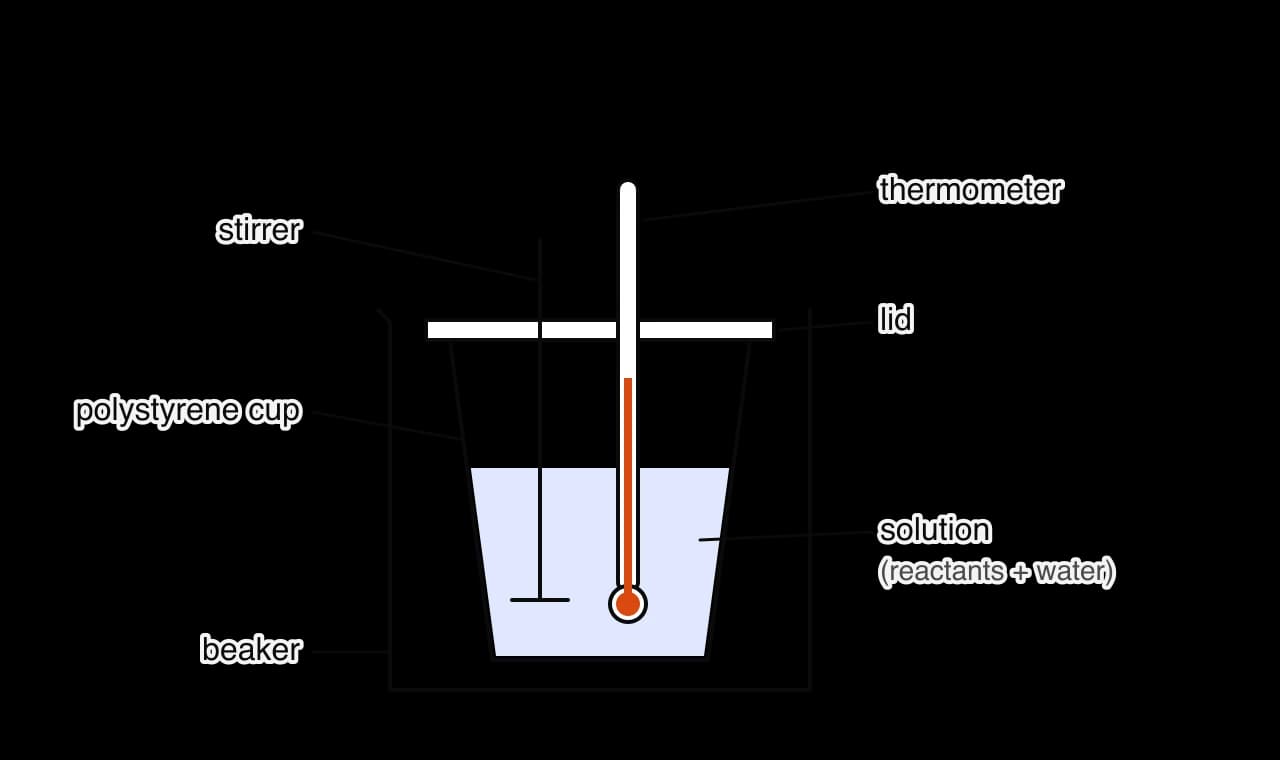
Measure a known volume of one solution (for example with a pipette or measuring cylinder) into the cup, and place the cup in a beaker for stability and extra insulation.
Record the temperature every 30 s for a few minutes to establish a steady starting temperature.
At a recorded time, add the second reactant (a measured volume of solution, or a weighed solid in excess), replace the lid and stir continuously.
Continue recording the temperature every 30 s for several minutes after the maximum (or minimum) has passed.
Plot temperature against time and extrapolate to find the temperature change at the moment of mixing.
The calculation from such an experiment depends on several simplifying assumptions. Each one is a possible source of systematic error to discuss in an evaluation.
The density of the solution is , the same as water, so its mass in grams equals its volume in .
The specific heat capacity of the solution is that of water, .
No heat is exchanged with the surroundings outside the solution, and the cup and thermometer absorb a negligible amount.
The reaction goes to completion (or the substance dissolves completely).
Even in an insulated cup, the solution starts to lose heat to the air as soon as it is warmer than its surroundings. A reaction also takes some time to finish, and heat is lost while it is happening. The highest temperature recorded is reached when the rate at which the reaction releases heat has fallen to equal the rate at which the solution loses heat, so it is always lower than the temperature an instant reaction with no heat loss would give.
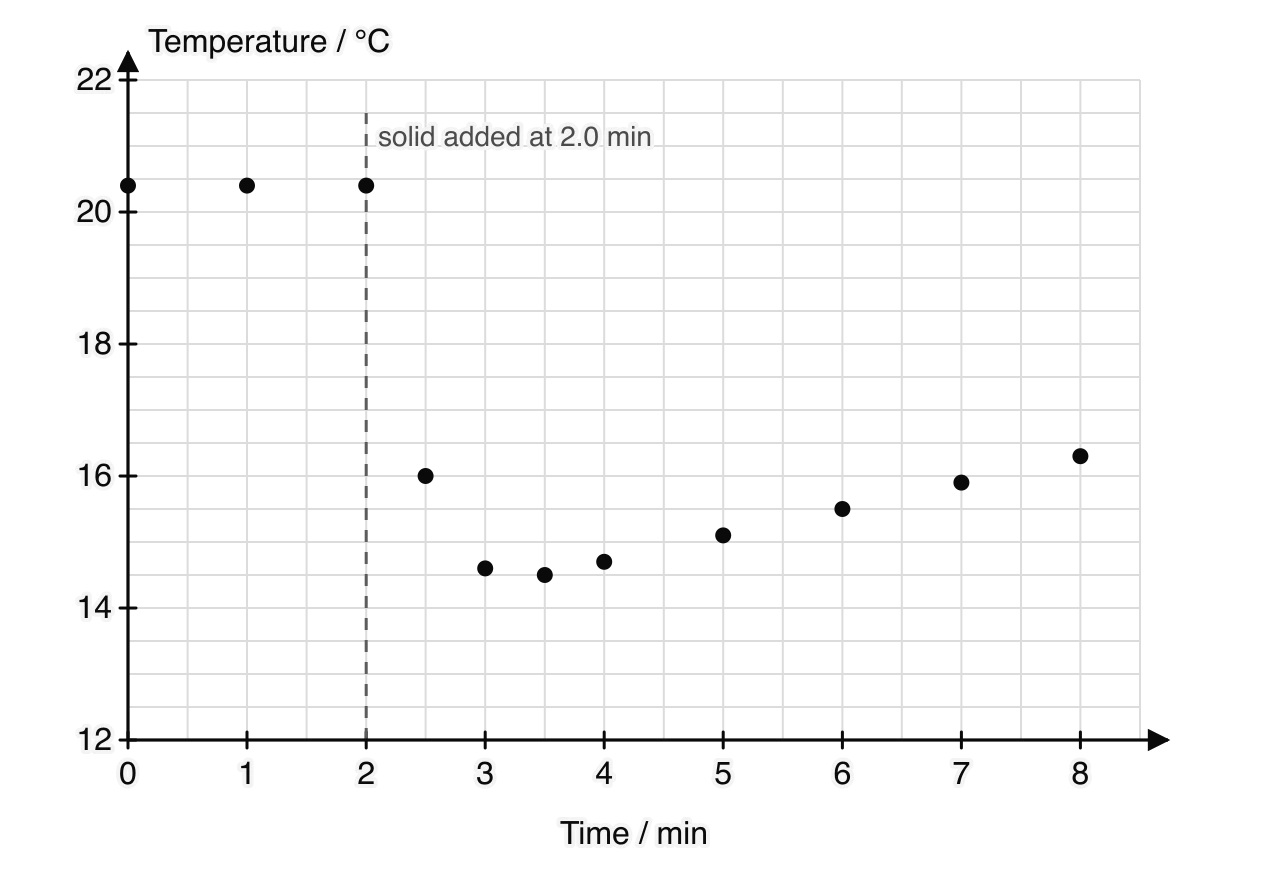
To correct for this, the temperature is recorded for several minutes after the maximum. The cooling part of the graph is close to a straight line. Extending (extrapolating) this line back to the time of mixing gives the temperature the solution would have reached if the reaction had been instantaneous and no heat had been lost.
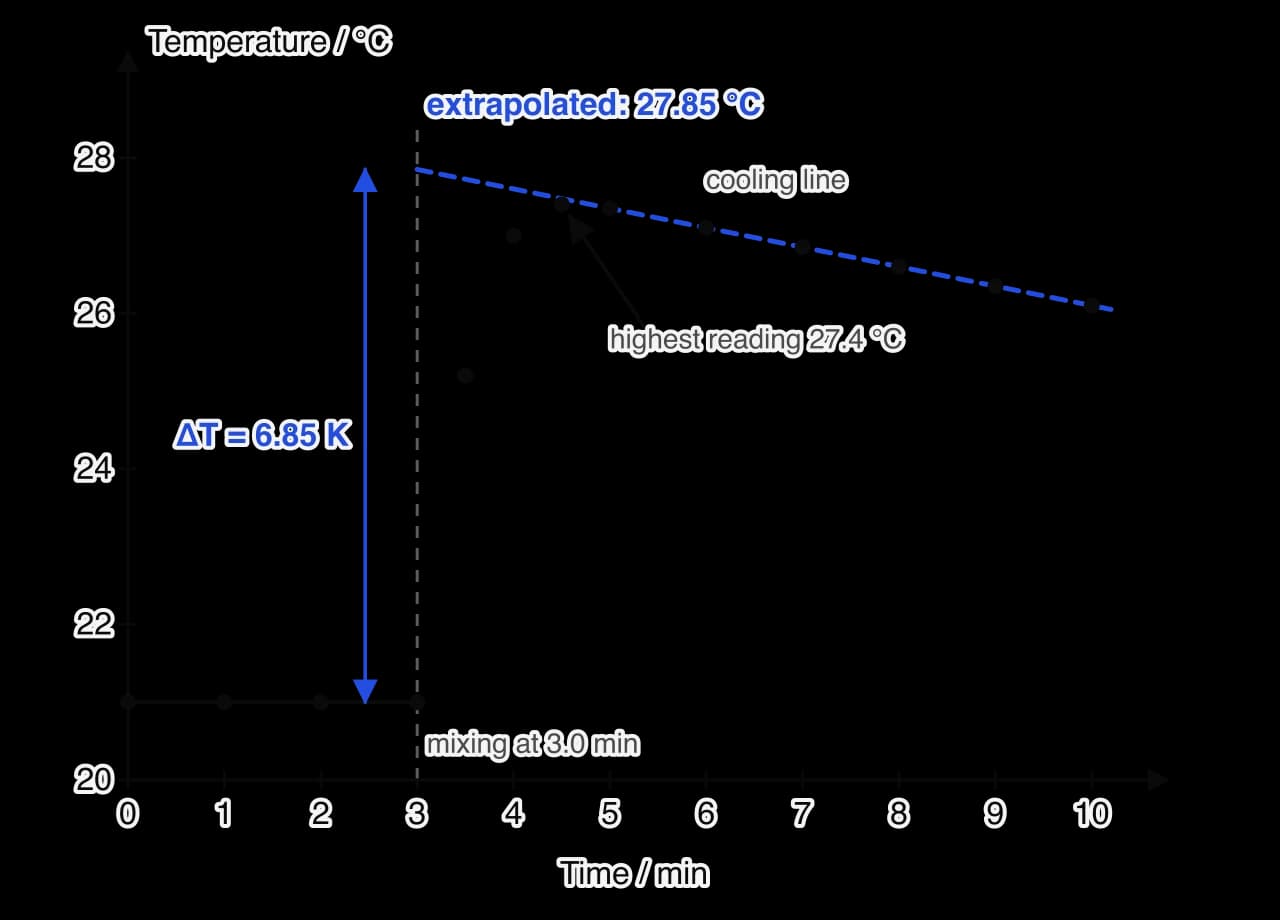
For an endothermic process, such as dissolving ammonium nitrate, the graph is the mirror image: the temperature falls to a minimum and then rises as heat flows in from the surroundings. The warming line is extrapolated back to the time of mixing to find the minimum temperature an instant process would have reached.
The enthalpy change of combustion of a liquid fuel, such as an alcohol, is measured by burning it in a spirit burner under a metal can of water. The burner is weighed before and after burning, and the temperature of the stirred water is recorded before and after heating.
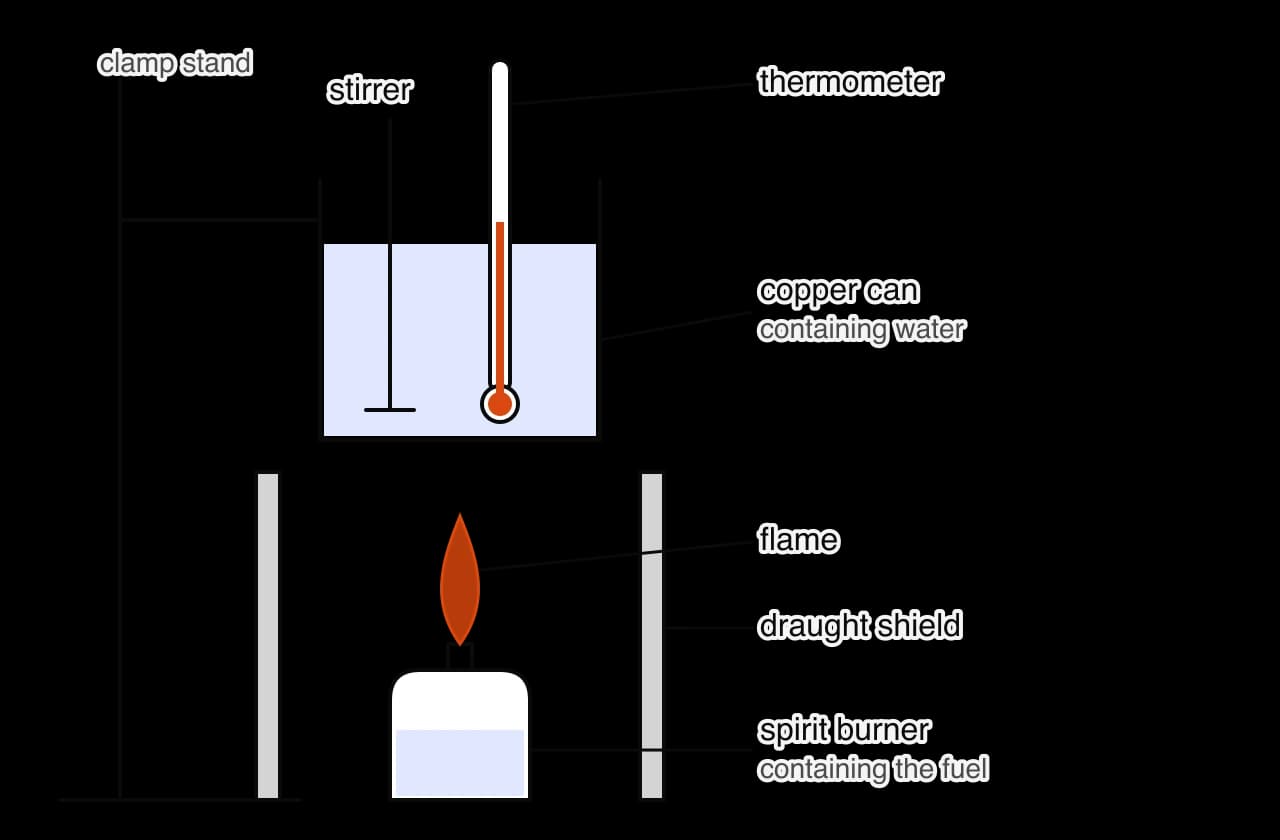
This method is simple but inaccurate. Values for ethanol are typically 40–70 % of the data booklet value, because much of the heat from the flame goes into the air around the can rather than into the water. The same idea, scaled up and with far better insulation, is used to measure the energy content of foods: a weighed sample burns in pure oxygen inside a sealed steel container, a bomb calorimeter, immersed in an insulated water bath. Almost no heat escapes, combustion is complete, and the results agree closely with accepted values.
Calorimetry experiments in a school laboratory almost always measure a smaller temperature change than theory predicts, so the calculated is less exothermic (smaller in magnitude) than the literature value. These are systematic errors: they act in the same direction every time, so repeating the experiment does not remove them.
Source of error | Effect | Improvement |
|---|---|---|
Heat lost to the surroundings (the air, the bench, by convection and radiation) | smaller ; the largest error in combustion experiments | insulate the can or cup; use a lid; draught shields; reduce the distance between flame and can; extrapolate a temperature–time graph |
Heat absorbed by the calorimeter, thermometer and stirrer | smaller | use a polystyrene cup; include the heat capacity of the can in the calculation |
Incomplete combustion (soot on the can, a yellow flame) | less energy released per mole of fuel | ensure a good supply of air; use a bomb calorimeter with pure oxygen |
Evaporation of the fuel from the wick, or of water from the can | mass loss of fuel too large; energy carried away | cap the burner between weighings; weigh promptly; cover the can |
Water formed as a gas rather than a liquid; conditions not standard | less exothermic than , which assumes | compare with values for the actual conditions |
 YouTube
The heat absorbed by the calorimeter itself can be included in the calculation when the mass and specific heat capacity of the container are known. The container warms by the same as the water, so its share is simply added: . In a spirit-burner experiment this correction is small compared with the heat lost to the air, which can be shown by comparing the percentage error of the result with its percentage uncertainty.
The uncertainty in comes from the measured quantities and ( is a data value and has no uncertainty here). For a product, the percentage uncertainties are added. is the difference between two readings, so its absolute uncertainty is the sum of the uncertainties of both readings.
The percentage uncertainty in carries through unchanged to , provided the amount is known much more precisely. A neutralization result of with a 4 % uncertainty is therefore (the absolute uncertainty is 4 % of 55.2, rounded to one significant figure). If the uncertainty in the volumes or concentrations of the reagents is also significant, its percentage is added as well.
A random uncertainty of a few per cent cannot explain a result that differs from the literature value by 20 % or more. A difference much larger than the uncertainty points to systematic errors such as heat loss.
For "evaluate" or "suggest an improvement" questions on calorimetry, name a specific systematic error, state its direction (the value obtained is less exothermic) and give a specific remedy (a lid, insulation, a draught shield, extrapolating the cooling curve). "Human error" and "better equipment" earn no credit.
A student adds of solid ammonium nitrate, (), to of water in a polystyrene cup at 2.0 min, stirs, and records the temperature with a probe (uncertainty ).
I can distinguish between the system and the surroundings, and explain why total energy is conserved in a reaction.
I can explain the difference between heat and temperature.
I can define specific heat capacity and use it to compare the temperature rises of different substances.
I can define exothermic and endothermic reactions, and relate each to the sign of ΔH and the temperature change of the surroundings.
I can give examples of exothermic and endothermic chemical reactions and changes of state.
I can relate the sign of ΔH to the relative stability of reactants and products.
I can sketch and interpret energy profiles, with labelled axes, ΔH and the activation energy, and find the activation energy of the reverse reaction.
I can state the standard conditions and explain what the ⦵ symbol means.
I can write thermochemical equations and adjust ΔH when an equation is reversed or multiplied, or a state symbol changes.
I can calculate heat transferred with Q = mcΔT, using the mass of the water or solution and ΔT in K.
I can calculate ΔH = −Q/n using the limiting reactant, for exothermic and endothermic changes, and express the answer in kJ mol⁻¹ or kJ g⁻¹ with the correct sign.
I can describe solution calorimetry and combustion calorimetry, and the assumptions made in the calculations.
I can extrapolate a temperature–time graph to correct for heat loss.
I can explain why experimental enthalpy changes are usually less exothermic than literature values, and suggest specific improvements.
I can calculate the percentage uncertainty in Q from the uncertainties in m and ΔT, and carry it through to ΔH.
I can include the heat absorbed by the calorimeter, and compare the percentage error with the percentage uncertainty to show that systematic errors dominate.
Sublimation and vaporization
Which statement about heat and temperature is correct?
125 %
80 %
25 %
20 %
The reverse reaction is endothermic, , and has a larger activation energy than the forward reaction.
Heat gained by the solution. The total volume is , so .
Amount of water formed. , so of water forms.
The temperature rose, so the reaction is exothermic and is negative. The accepted value for a strong acid with a strong base is about ; the experimental value is smaller in magnitude because some heat escaped.
Limiting reactant. Zinc is in excess, so copper(II) sulfate is limiting: .
The value calculated from standard enthalpies of formation is about . Using the amount of zinc added, which is in excess, would give the wrong .
Temperature change. . The water lost energy to the dissolving solid.
Amount dissolved. .
The answer is given to two significant figures because (2.5 K) has only two. The literature value is about . Here the mass of the solid is left out of ; including it () gives , and either choice is accepted provided it is stated.
(b) Energy per gram .
The data booklet value of for ethanol is , so this simple apparatus captures less than half of the energy released. The reasons are discussed with the experimental methods.
Energy per gram. Divide by the mass burned, not by an amount in moles:
Comparison. The label value is , so the experiment captured only about 28 % of the energy. A burning peanut held in the open air heats the room far more than the water; some of it also chars rather than burning completely, and the residue is not always weighed. Label values come from bomb calorimetry corrected for the parts of the food the body cannot digest.
From the highest reading. , giving .
The extrapolated value agrees closely with the accepted value of about . Using the highest reading underestimates the magnitude by about 7 %.
Including the can makes the value about 4 % more exothermic, so the can accounts for only a small part of the shortfall.
(b) Percentage error compared with the data booklet value of :
Percentage uncertainty. The mass of ethanol is the difference of two weighings, , which is . is also a difference of two readings, , which is . The uncertainty in the mass of water is negligible. In total, about .
Evaluation. The error (52 %) is far larger than the random uncertainty (3 %), so the difference cannot be explained by the precision of the instruments. It comes from systematic errors, chiefly heat lost from the flame to the air and incomplete combustion. Repeating the experiment would give similar, equally low values. Improvements must target heat loss: a lid on the can, a draught shield all round, the flame closer to the can, or a calorimeter with a heat exchanger in which the hot gases pass through the water.
Uncertainty in . .
The small dominates the uncertainty. Using a thermometer with a finer scale, or more concentrated solutions to give a larger temperature change, would reduce it.
assumption: specific heat capacity of the solution equals that of water OR the mass of solution is the mass of water OR no heat is absorbed from the surroundings ✓
Accept ECF from (b). Award [1 max] for −21.8 kJ mol⁻¹ in M2. Accept (giving ).
«» ✓
Award [2] for correct final answer. Award [1 max] for +1001. Accept ECF from (a).
(c) Any two of:
heat lost to the surroundings/air «so less energy reaches the water» ✓
incomplete combustion «producing soot/CO» ✓
heat absorbed by the copper can/thermometer ✓
evaporation of propan-1-ol from the wick «so mass loss overestimates the fuel burned» ✓
water formed as a gas rather than a liquid ✓
[2 max]. Do not accept "human error" or the same reason twice.
(d)
products drawn below reactants, with a hump between them ✓
arrow from reactants to the top of the hump AND arrow from reactants down to products ✓
Axes labelled potential energy and reaction coordinate are expected.