Construct a SWOT analysis of a real organisation, separate internal from external factors, link it to STEEPLE, use the TOWS matrix to turn it into strategic options, and explain the limits of the tool.
Each is in the Business glossary, with every other term in the subject.
External factors in an organisation’s environment that it could use to its advantage, such as a growing market, new technology, a change in consumer tastes or a competitor leaving the market.
Internal factors that give an organisation an advantage over its competitors or help it to achieve its objectives, such as a strong brand, skilled staff or a sound financial position.
A planning tool that assesses an organisation’s current position by identifying its internal strengths and weaknesses and the external opportunities and threats in its environment.
External factors in an organisation’s environment that could damage its performance or its ability to achieve its objectives, such as new competitors, rising costs, recession or new regulations.
A tool that generates strategic options by matching an organisation’s strengths and weaknesses with the opportunities and threats from a SWOT analysis, giving SO, WO, ST and WT strategies.
Internal factors that put an organisation at a disadvantage compared with its competitors or limit its ability to achieve its objectives, such as high costs, poor cash flow or a narrow product range.
Define SWOT analysis and each of its four elements: strengths, weaknesses, opportunities and threats.
Distinguish between internal factors (strengths and weaknesses) and external factors (opportunities and threats).
Construct a SWOT analysis for an organisation from information in a case or from research.
Explain how a STEEPLE analysis supplies the opportunities and threats in a SWOT analysis.
Apply the TOWS matrix to turn a SWOT analysis into SO, WO, ST and WT strategies.
Explain how SWOT analysis is used in each unit of the course, from growth decisions to marketing and HR planning.
Explain the limitations of SWOT analysis, including subjectivity, the lack of weighting and its static nature.
A SWOT analysis is a simple framework that summarises an organisation’s position by listing its internal strengths and weaknesses and the external opportunities and threats it faces. Managers often use it before important decisions, from launching a product to entering a new country, because it brings the business’s own abilities and its environment together in a single grid.
SWOT analysis is closely tied to the key concept of change. The external half of the grid records how markets, technology, laws and society are changing, and the internal half shows whether the business is ready for those changes. Used well, it also supports creativity, because matching strengths to opportunities often produces new ideas for products and markets.
33 exam-style questions on this subtopic, written in the style of the IB papers. The first has its markscheme open. Counted on
Areco Leather
[1] Curtiembre Areco SA (Areco Leather) is a family-owned company in Buenos Aires province, Argentina. It tans cattle hides and makes belts, bags and saddles, which it sells through 30 shops across Argentina. It employs 180 people, many of them craftspeople trained over decades.
[2] Argentina’s economy has been unstable: inflation was above 100 % in 2023 and 2024, and the peso lost much of its value. Domestic sales of Areco’s products have fallen by a third since 2022. However, the weak peso has made Argentine leather cheaper for foreign buyers, and a fashion house in Milan has asked Areco to supply 5 000 handbags a year.
[3] Areco’s managing director, Lucía Fernández, has proposed a new strategic objective: “to earn 50 % of our revenue from exports by 2030”. Areco has no export experience, and its website is only in Spanish. Its leather has a strong reputation for quality in Argentina.
[4] Tanneries use large amounts of water and chemicals. New European Union rules will require importers to show that leather is not linked to deforestation. Areco buys hides from many small ranches, some of them in the Chaco region, where forest is being cleared for cattle.
Using information in the case, construct a SWOT analysis for Areco in relation to its new strategic objective.
4 marks
Strengths (internal) | Weaknesses (internal) |
|---|---|
|
The official deck for this part of the syllabus.
Define the term SWOT analysis.
What do the four letters of SWOT stand for?
With a free account, Augment remembers where you stopped and what you have practiced.
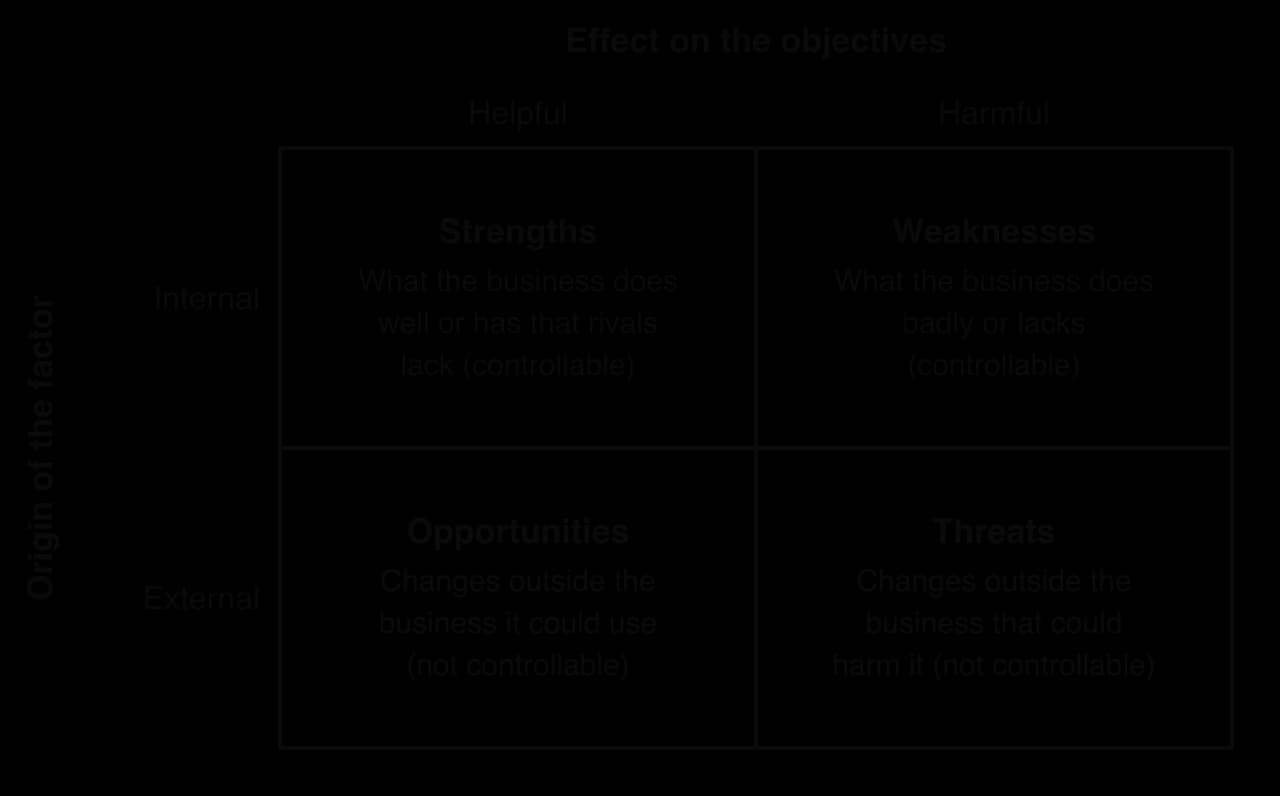
Every organisation has things it does well and things it does badly, and every organisation operates in an environment that can help or harm it. A SWOT analysis sorts these factors into four groups and arranges them in a two-by-two grid. The letters stand for Strengths, Weaknesses, Opportunities and Threats.
The tool is often attributed to work at the Stanford Research Institute in the 1960s, although its origins are disputed, and it is now one of the most widely used planning tools in business, government and the non-profit sector. It is popular because it needs no calculations and can be completed by a small business owner in an hour or by a board of directors over several months.
The grid is built on two distinctions. The rows separate internal factors, which arise inside the organisation and which managers can control, from external factors, which arise in the wider environment and which managers cannot control. The columns separate factors that are helpful to the organisation’s objectives from those that are harmful. Each of the four cells is the combination of one row and one column.
 YouTube
Internal factors describe the organisation itself: its people, products, finances, brand, operations, location and know-how. They exist now and are, at least in the long run, within management’s control. A business can train its staff, cut its costs, redesign a product or raise new finance, so over time it can reduce a weakness or build a new strength.
Strengths are the internal features that give the organisation an advantage over its rivals or help it achieve its objectives. The most useful strengths are those rivals find difficult to copy, such as a well-known brand, a patent, a skilled workforce, a low-cost supply chain or a large base of loyal customers.
A strength should be specific and, where possible, supported by evidence. “Good products” is too vague to guide a decision; “the highest customer satisfaction score among the five largest rivals” or “cash reserves large enough to fund three years of investment” can be used to justify a strategy.
Weaknesses are the internal features that put the organisation at a disadvantage or hold it back from its objectives. Common examples are high costs, a narrow product range, poor liquidity, outdated equipment, high labour turnover, a weak online presence or dependence on one customer or one product.
Weaknesses are often harder to list honestly than strengths. Managers who designed the current strategy may not want to admit its faults, and staff may fear blame. For this reason many businesses ask outsiders, such as customers, consultants or new employees, to help identify weaknesses.
External factors arise outside the organisation, in its market and in the wider economy and society. Managers cannot control them, but they can prepare for them and respond. The same external change usually affects every business in the industry, so what matters is which business is best placed to use it or to defend against it.
Opportunities are external changes or conditions that the organisation could take advantage of to grow, increase profit or achieve other objectives. They include growing markets, new technology, changes in consumer tastes, the removal of trade barriers, government grants and the failure of a competitor.
Threats are external changes or conditions that could harm the organisation’s performance. They include new competitors, rising costs of materials, recession, unfavourable changes in exchange rates, new regulations, changing consumer tastes and technology that makes existing products obsolete.
An opportunity or threat is always a change or condition outside the business, not an action the business could take. “A rising number of older consumers” is an opportunity; “launch a range for older consumers” is a strategy that might follow from it. Keeping the two apart makes the SWOT a description of the current position and leaves the choice of strategy to the next step.
The opportunities and threats in a SWOT analysis come from an organisation’s external environment, and the most common way to study that environment systematically is STEEPLE analysis. STEEPLE groups external factors into seven categories: social, technological, economic, environmental, political, legal and ethical. Each factor found in a STEEPLE analysis is then judged as an opportunity, a threat or neither for the organisation in question.
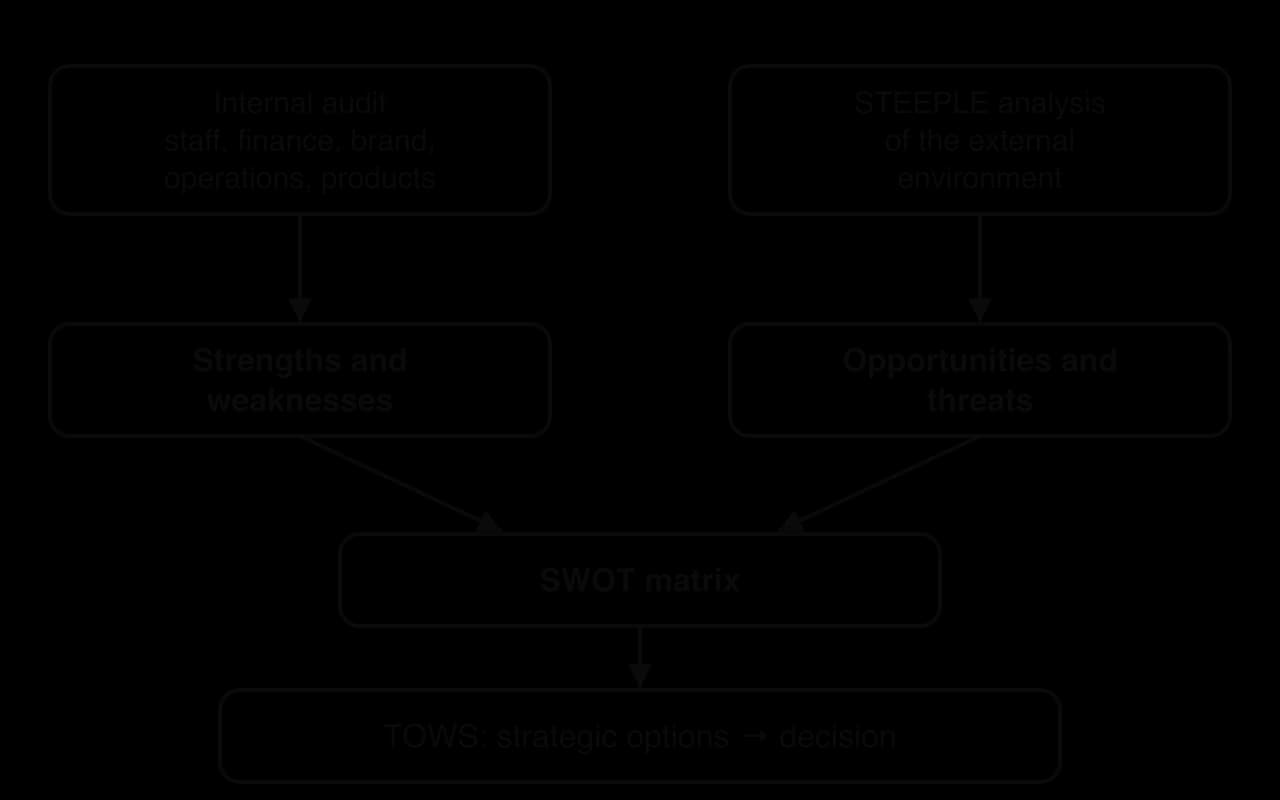
The strengths and weaknesses come from an internal audit: a review of the organisation’s finances (using tools such as ratio analysis), its people, its products and their position in the market, its operations and its reputation. Combining the two reviews gives a complete picture. A STEEPLE analysis on its own says what is happening in the environment, but not whether the business can respond; an internal audit on its own says what the business can do, but not whether the environment rewards it.
The same STEEPLE factor can be an opportunity for one business and a threat for another. Stricter rules on vehicle emissions are a threat to a maker of petrol engines but an opportunity for a maker of electric vehicle batteries. A weaker home currency is an opportunity for an exporter, whose goods become cheaper abroad, and a threat for an importer, whose costs rise. This is why the SWOT must always be written for a named organisation with stated objectives.
STEEPLE category | Example of an external factor | Opportunity for… | Threat to… |
|---|---|---|---|
Social | An ageing population | A private care-home operator | A fashion brand aimed at teenagers |
Technological | Cheap, reliable video calling | An online tutoring company | A business-class airline route used by commuters |
Economic | A rise in interest rates | A bank earning interest on savings | A highly geared property developer |
Environmental | Hotter, drier summers | A maker of air-conditioning units | A farm growing water-intensive crops |
Political | A new free trade agreement | An exporter of goods to the partner country | A domestic producer facing cheaper imports |
Legal | A ban on single-use plastic bags | A maker of reusable bags | A supermarket that gave away plastic bags |
Ethical | Consumer concern over working conditions | A Fairtrade-certified chocolate brand | A clothing retailer with low-wage suppliers |
The table shows that no external factor is good or bad in itself. Its effect depends on the organisation’s products, customers, costs and finances, which are exactly the internal factors in the top half of the grid.
A SWOT analysis is only useful if it is built for a clear purpose. The same business might produce quite different SWOTs when deciding whether to enter a new market and when deciding whether to cut its workforce, because different factors matter to each decision.
State the organisation and the objective or decision. For example: “a family-owned café deciding whether to expand over the next two years”.
Gather information. Internal data (accounts, sales by product, staff surveys, customer feedback) and external data (a STEEPLE analysis, market research, competitors’ prices and plans).
List internal factors and sort each into strengths or weaknesses, judged against rivals and the objective.
List external factors and sort each into opportunities or threats for this organisation.
Make each point specific and supported by evidence, with figures where available.
Prioritise. Keep the three to five most important factors in each cell and remove trivial ones.
Draw conclusions. Use the grid to generate strategic options (the TOWS matrix) and to judge which option fits best.
A plain SWOT treats every point as equally important, but in reality one threat may be far more serious than three others. A simple way to prioritise is to score each external factor for its impact on the business (for example from 1, very small, to 5, very large) and its likelihood of happening (a probability from 0 to 1), and multiply the two. The highest scores show which opportunities and threats deserve attention first.
Scoring makes the reasoning behind a SWOT visible and helps a team agree on priorities. It does not remove subjectivity, because both impact and likelihood are estimates, but it forces managers to state and defend those estimates.
A SWOT analysis describes a position; it does not by itself say what to do. The TOWS matrix, developed by Heinz Weihrich in 1982, turns the SWOT into strategic options by matching each internal factor with each external factor. The letters are reversed to stress that the external environment comes first, because strategy responds to opportunities and threats by using the business’s strengths and reducing its weaknesses.
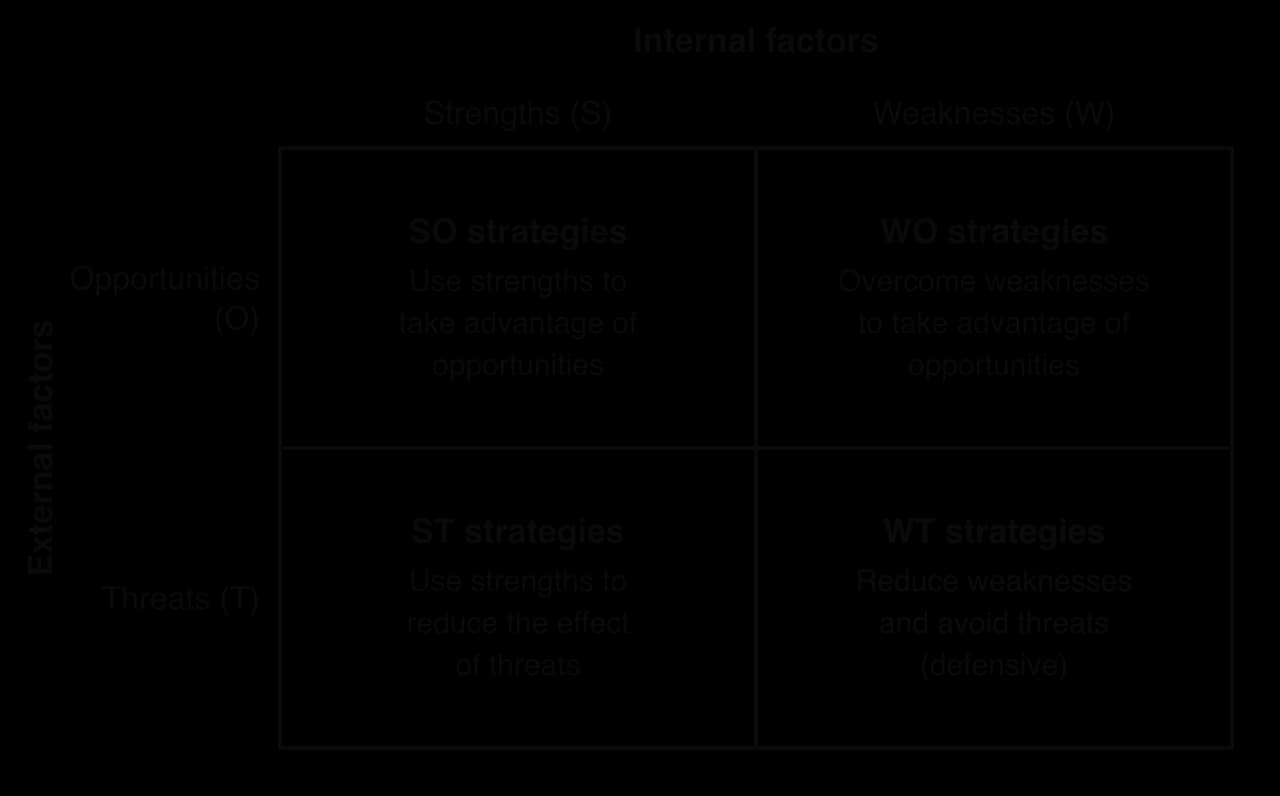
Strategy | Question it answers | Typical approach |
|---|---|---|
SO (strengths–opportunities) | How can the business use its strengths to take advantage of opportunities? | Growth: new products or markets built on what the business already does well. |
WO (weaknesses–opportunities) | Which weaknesses must be overcome to take advantage of opportunities? | Investment, training, partnerships or recruitment to close a gap. |
ST (strengths–threats) | How can the business use its strengths to reduce the effect of threats? | Defending the market position: using a brand, cost advantage or loyal customers against rivals. |
WT (weaknesses–threats) | How can the business reduce weaknesses and avoid threats at the same time? | Defensive moves: cutting costs, leaving a market, selling a division, merging with a stronger firm. |
The TOWS matrix usually produces more options than a business can pursue. Managers then judge each option against the organisation’s objectives, finance and risk, often with other tools such as the Ansoff matrix, decision trees or investment appraisal. SO strategies are often the most attractive, but a business facing serious threats with major weaknesses may need WT strategies simply to survive.
Fujifilm, the Japanese company that grew by making photographic film, shows an SO strategy in practice. As digital cameras replaced film, it used its strengths in chemistry, imaging and precision manufacturing to move into healthcare: it bought Toyama Chemical in 2008, the ultrasound maker SonoSite in 2012 and Yokogawa Medical Solutions in 2019, and built a business making biological medicines for drug companies.
Sources: FUJIFILM Holdings, “History”, holdings.fujifilm.com, fetched 2026.
SWOT analysis is a general tool, so it appears in every unit. In each case the organisation, the objective and the decision change, but the method stays the same.
Unit | Typical decision | How SWOT helps |
|---|---|---|
1 Introduction to business management | Whether to grow, and how (internal growth, merger, joint venture, franchising) | Shows whether the business has the strengths (finance, managers, brand) to use a growth opportunity, and which threats growth would reduce or increase. |
2 Human resource management | Restructuring, a change in leadership, a new HR plan | Identifies strengths and weaknesses in skills, motivation and culture, and external factors such as labour shortages, migration rules or minimum wage changes. |
3 Finance and accounts | Choosing a source of finance or an investment project | Places financial strengths and weaknesses (liquidity, profitability, gearing) beside external factors such as interest rates. |
4 Marketing | Preparing a marketing plan, entering a new market | Forms the situation analysis at the start of the plan; links to market research and to the choice of target market. |
5 Operations management | Changing location, production method or suppliers | Compares the business’s operations (capacity, quality, costs) with external factors such as supply chain disruption, new technology or regulation. |
SWOT analysis is also a starting point for a business plan, where a new business assesses its own position before seeking finance, and for social enterprises, which use it to set out their strengths in serving a community need and the external threats to their funding. For a non-profit organisation, the “objectives” against which factors are judged are social or environmental goals rather than profit.
SWOT analysis is popular because it is quick and easy to understand, but the same simplicity creates weaknesses. Its results are only as good as the information and judgment behind them.
Each factor and its classification are the opinions of the people completing the grid. Managers may overstate strengths and play down weaknesses, especially if they are judged on the current strategy. Two analysts given the same facts often produce different SWOTs. Using data, involving people from outside the management team and testing each point against evidence reduce, but do not remove, this bias.
A basic SWOT gives each point equal space, so a minor weakness (an untidy website) can sit beside a critical one (an overdraft close to its limit) with nothing to show the difference. Long lists can hide the few factors that matter. Scoring factors for impact and likelihood, or keeping only the three to five most important in each cell, helps, but the scores are themselves estimates.
A SWOT analysis is a snapshot of one moment. Markets, technology and competitors change quickly, so a SWOT can be out of date within months: a new competitor, a change in exchange rates or a new law can turn an opportunity into a threat. To stay useful, the analysis must be repeated regularly, which takes time and money, and it gives little guidance on how fast factors are changing.
Many factors do not fit neatly into one cell. A large factory can be a strength (economies of scale) and a weakness (high fixed costs if demand falls). A rapidly growing market is an opportunity but may also attract new competitors, which is a threat. Dependence on a famous founder is both a strength for the brand and a weakness for succession. Where a factor is ambiguous, the best approach is to place it in both cells and explain why.
A SWOT analysis describes a position but does not say which action is best. Two businesses with similar SWOTs might rightly choose different strategies because of their objectives, attitude to risk or finance. The TOWS matrix generates options, but choosing among them needs further analysis, such as investment appraisal, break-even analysis or decision trees, and the judgment of managers.
Advantages of SWOT analysis | Limitations of SWOT analysis |
|---|---|
Simple, quick and cheap; no specialist knowledge or calculation needed. | Subjective: depends on the opinions and honesty of those completing it. |
Brings internal and external factors together, so plans match the business’s real abilities to its environment. | Lists factors without weighting, so the most important ones may not stand out. |
Encourages managers to look outside the business and think about change. | Static: a snapshot that quickly becomes outdated in a fast-changing market. |
Provides a starting point for strategy through the TOWS matrix. | Some factors fit more than one cell, which can confuse the analysis. |
Flexible: works for any organisation, decision or level (a whole company, one product, one department). | Describes the position but does not by itself choose or test a strategy. |
SWOT analysis is most useful when it is built for a specific decision, based on evidence, limited to the most important factors, updated regularly and followed by tools that test the options it produces. It is least useful as a generic list written once and filed away. Its usefulness therefore depends mainly on the quality of the information used and on how honestly managers assess their own business.
Nintendo, the Kyoto-based maker of video game consoles and games, launched its new console, Nintendo Switch 2, in June 2025, more than eight years after the original Switch. A new console is the largest decision a games company makes, because the hardware takes years to develop and the success of the whole business for the next cycle depends on it. Nintendo’s results for the year to 31 March 2026 and its forecast for the following year give the evidence for a SWOT analysis at this decision point.

The chart shows how strongly Nintendo’s performance depends on its consoles. Net sales fell to ¥1,164.9 billion in the year to March 2025, the last full year before Switch 2, and then almost doubled to ¥2,313.0 billion. Switch 2 sold 19.86 million units in its first fiscal year, and Nintendo reported that sales to consumers were higher than the original Switch achieved in its first full fiscal year. Mario Kart World, released on the same day, sold 14.70 million copies, including copies bundled with the console. By 30 June 2026 cumulative Switch 2 sales had reached 23.68 million.
Indicator | Year to 31 March 2025 | Year to 31 March 2026 | Forecast, year to 31 March 2027 |
|---|---|---|---|
Net sales (¥ billion) | 1,164.9 | 2,313.0 | 2,050.0 |
Operating profit (¥ billion) | 282.5 | 360.1 | 370.0 |
Operating profit margin | 24.3% | 15.6% | n/a |
Gross profit margin | 61.0% | 39.3% | n/a |
Hardware share of platform sales | 43.7% | 66.7% | n/a |
Switch 2 hardware sold (million units) | – | 19.86 | 16.50 |
Digital sales (¥ billion) | 326.0 | 407.6 | n/a |
Sources: Nintendo Co., Ltd., Financial Results Explanatory Material, Fiscal Year Ended March 2026 (8 May 2026); Consolidated Results for the Three Months Ended June 30, 2026 (6 August 2026); Dedicated Video Game Sales Units (2026).
Nintendo’s main strength is its intellectual property: characters such as Mario, Zelda and (with its partners) Pokémon that sell games and attract players to its consoles. It controls both its hardware and its most popular software, so it earns on the console and on every game sold for it. It also has a very strong financial position, with ¥1,791.8 billion of cash and deposits at 31 March 2026, which allows it to absorb a weak year without cutting investment.
Its weaknesses are the other side of the same model. The whole business depends on one console family and on a small number of hit games, which makes results swing with the console cycle. The table shows a further weakness: because console hardware earns a much thinner margin than software, the shift towards hardware sales cut the gross profit margin from 61.0% to 39.3%, so profit rose far less than sales.
Nintendo’s opportunities lie partly outside games. Cinema audiences are willing to pay to see films based on video game characters. The Super Mario Galaxy Movie, released on 1 April 2026, took more than US$800 million at the box office in its first four weeks, and such films keep Nintendo’s characters in front of people who do not own a console. Players are also switching from boxed games to downloads, which avoid the costs of manufacturing and shipping, and Nintendo’s digital sales grew 25.0% in a year. Owners of the 156.59 million original Switch consoles sold are a large pool of potential upgraders, especially as Switch 2 plays most Switch games.
The threats are mostly external costs and competition. Nintendo built an estimated ¥100 billion of extra costs into its forecast for the year to March 2027 from rising component prices, particularly memory chips, and from US tariffs. In response it announced price rises for Switch 2: in the United States from US$449.99 to US$499.99 and in Europe from €469.99 to €499.99 from 1 September 2026, and in Japan from ¥49,980 to ¥59,980 from 25 May 2026. Higher prices may reduce demand, and Nintendo forecasts that Switch 2 sales will fall to 16.50 million units. Rival consoles and free-to-play games on smartphones also compete for players’ time and money.
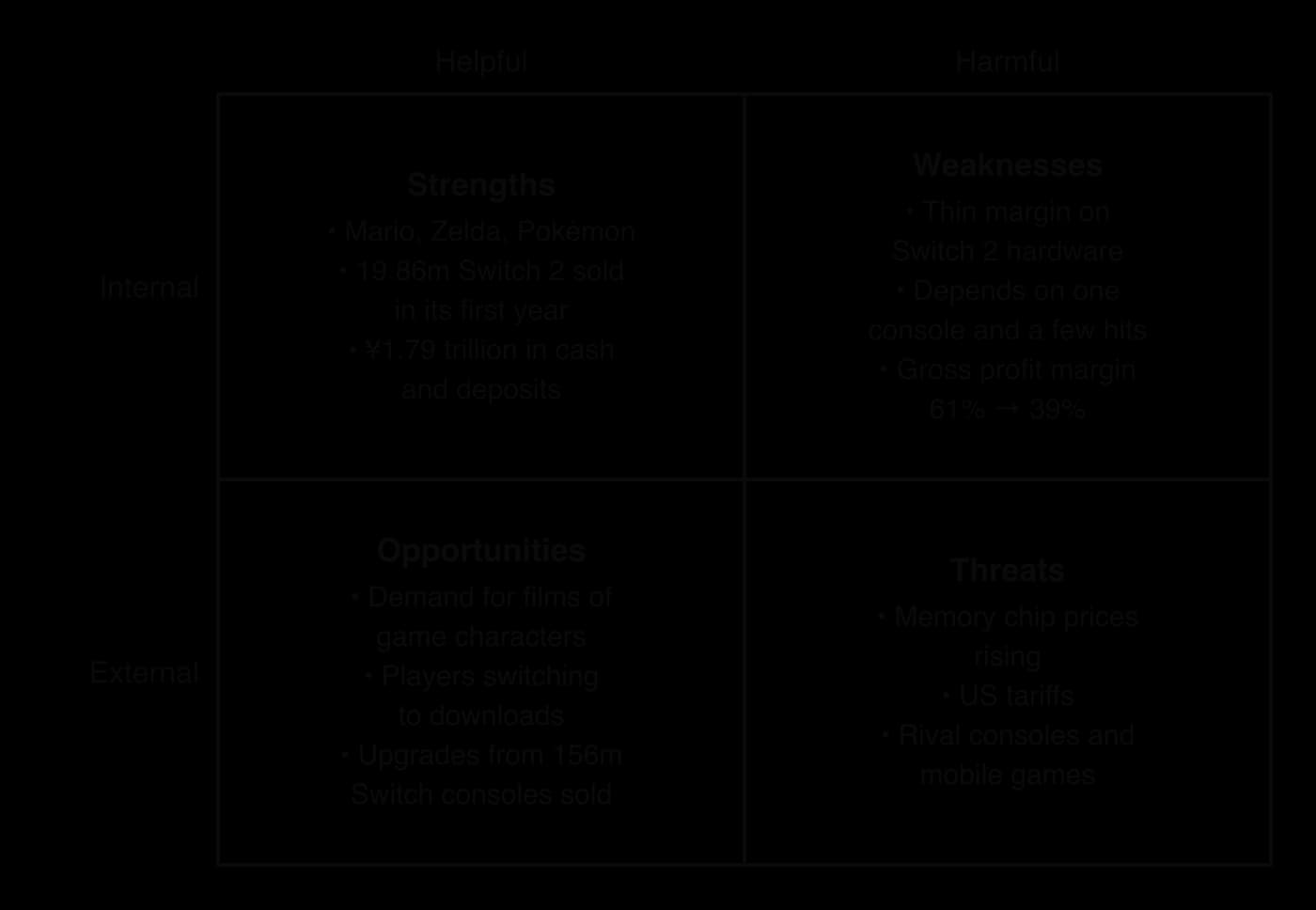
Applying the TOWS matrix to this SWOT gives several strategic options. An SO strategy uses Nintendo’s characters (S) in more films and digital content (O), which earn money without depending on hardware margins. An ST strategy uses its cash reserves (S) to absorb higher component costs (T) rather than raising prices too far. A WT strategy reduces dependence on hardware margins (W) in the face of rising costs (T) by raising the share of software and digital sales, which is the direction the results already show.
The case also shows the limits of the tool. The SWOT is a snapshot: the tariff threat changed during 2026, when Nintendo recorded a refund of US tariffs it had previously paid, and the memory price threat may ease. Some factors fit more than one cell, since the strength of the Switch 2 launch also means that sales were concentrated in its first year, which makes the next year’s comparison harder. Finally, the SWOT does not say how far Nintendo can raise prices before demand falls, which requires data on customers’ responses that the grid does not contain.
The case links to the key concept of change: each console generation is a planned change in Nintendo’s products, made in response to changes in technology, costs and consumer habits, and its success depends on how well the business’s strengths fit the environment at the moment of launch.
Sources: Nintendo Co., Ltd., Financial Results Explanatory Material, Fiscal Year Ended March 2026; Consolidated Financial Highlights, FY ended March 2026 and Q1 FY ending March 2027; Dedicated Video Game Sales Units, as of 30 June 2026.
Explain why Nintendo’s cash reserves are a strength when it faces rising component costs.
Explain why the same factor (strong Switch 2 sales in the launch year) can be seen as both a strength and a source of risk.
Using the TOWS matrix, suggest one WO strategy for Nintendo and justify it with data from the case.
Short questions often ask for a SWOT analysis to be constructed from a case. In the following invented case, each of the four cells must use the case’s details.
A SWOT analysis summarises an organisation’s internal strengths and weaknesses and its external opportunities and threats.
Internal factors can be controlled by the business; external factors cannot, but the business can prepare for them.
STEEPLE analysis supplies the opportunities and threats; an internal audit supplies the strengths and weaknesses.
The same external factor can be an opportunity for one business and a threat for another.
The TOWS matrix turns a SWOT into SO, WO, ST and WT strategies by matching internal and external factors.
SWOT analysis is used in every unit, from growth decisions to marketing plans and HR planning.
Its limitations are subjectivity, the lack of weighting, its static nature, factors that fit more than one cell, and that it does not choose a strategy.
I can define SWOT analysis and each of strengths, weaknesses, opportunities and threats.
I can distinguish internal from external factors and place a factor in the correct cell.
I can construct a SWOT analysis for an organisation from a case, using its details.
I can explain how STEEPLE analysis feeds the opportunities and threats.
I can use the TOWS matrix to suggest SO, WO, ST and WT strategies.
I can prioritise factors by scoring impact and likelihood.
I can explain how SWOT analysis is used in each unit of the course.
I can explain the limitations of SWOT analysis and what its usefulness depends on.
reputation for quality leather
established production and 30 shops
|
Opportunities (external) | Threats (external) |
|---|---|
|
|
Award [1] for each quadrant containing at least one relevant point from the case, up to [4].
Do not award the mark for a quadrant if the point is placed in the wrong quadrant (e.g. the weak peso as a strength).
Explain two tactical objectives that Areco’s departments could set to help achieve the strategic objective.
4 marks
Possible tactical objectives:
Marketing: launch an English and Italian version of the website by June 2026; attend two international leather trade fairs in 2026.
Operations / purchasing: by 2027 buy 100 % of hides from ranches that can prove they are deforestation-free, so that exports to the EU are allowed.
Operations: increase handbag capacity to meet the Milan order of 5 000 a year by the end of 2026.
HR: recruit an export manager with EU experience within six months; train staff in export documentation.
Finance: arrange export finance or currency protection by the end of 2026.
Mark as 2 + 2. For each objective, award [1] for a relevant tactical objective and [1] for explaining how it helps Areco reach 50 % of revenue from exports by 2030.
Award a maximum of [2] if the objectives given are strategic rather than tactical or are not linked to Areco.
Analyse how changes in Areco’s external environment (paragraphs 2 and 4) have influenced its objectives.
6 marks
Answers may use STEEPLE:
Economic: high inflation and falling domestic sales make growth in Argentina unrealistic, pushing Areco from domestic growth towards survival and then export growth; the weak peso creates an export opportunity, leading to the 50 % export objective.
Legal / political: EU deforestation rules mean the export objective depends on new sourcing objectives (traceable hides), changing purchasing and operations targets.
Environmental / ethical: concern about deforestation and tannery pollution means Areco may need environmental or ethical objectives to be accepted by European buyers.
Social: demand from fashion houses abroad for high-quality leather goods.
Interrelationships: the opportunity (weak peso) and the threat (EU rules) affect the same objective, so Areco’s objectives must change at both strategic and tactical levels; if the peso recovers, the export objective could become less attractive.
Award [1]–[2] for a description of one or two external changes with little link to objectives.
Award [3]–[4] for an analysis of how external changes have influenced Areco’s objectives, with some use of the case.
Award [5]–[6] for a balanced analysis that covers changes in both paragraphs, uses the case effectively and shows how they affect strategic and/or tactical objectives.
Sabor Andino
[1] Lucía Quispe worked for nine years as a chef in a large hotel in Arequipa, Peru. In 2024 she left her job and bought a second-hand food truck for PEN 45 000, using her savings and a loan from her brother. Her business, Sabor Andino, sells Andean street food with a modern twist, such as quinoa burgers and stuffed rocoto wraps, to students outside a large university.
[2] Lucía had noticed that the cafés near the campus sold mostly expensive sandwiches and that many students skipped lunch. A food truck cost far less than renting a restaurant, and she could move it to markets and festivals at the weekend. After years of working long shifts for someone else, she wanted to decide her own menu and hours.
[3] The first year has been harder than expected. Getting a municipal street-trading permit took four months, during which Lucía earned nothing. The prices of cooking oil and vegetables have risen, and she cannot easily raise her prices because students are price-sensitive. Sales fall sharply during the university holidays. Two established cafés have started offering a cheaper “student lunch”.
[4] Lucía has 3 400 followers on social media, where she posts the truck’s location each day. The city council has announced a new “Healthy Arequipa” programme that will include a monthly street-food festival.
Define the term entrepreneur.
2 marks
Outline two opportunities that encouraged Lucía to start Sabor Andino (paragraph 2).
4 marks
Explain two challenges that Sabor Andino faces.
4 marks
Construct a SWOT analysis for Sabor Andino.
4 marks
Kallpa Alpaca
[1] Kallpa Alpaca S.A.C. (Kallpa) is a privately held company in Arequipa, Peru, that makes knitwear from alpaca fibre. It buys fibre from 900 herding families in the high Andes and employs 160 knitters, mostly women from nearby communities. Kallpa’s jumpers and scarves are sold under its own brand in Peru and through two online retailers in the United States. Its general manager, Rosa Quispe, says Kallpa’s purpose is “to keep the value of alpaca in the Andes”.
[2] Kallpa has a strong reputation for quality and fair prices paid to herders. However, its designs are seen as traditional, it has little marketing expertise, and sales outside Peru grew by only 3 % last year. Demand for natural, traceable fibres is rising in Europe, but large fashion brands are also starting to buy alpaca fibre directly from Peru, and the exchange rate has made Peruvian exports more expensive.
[3] Brizzi Moda, a fashion house in Milan, Italy, has proposed two ways of working together:
[4] Option 1: a joint venture. Kallpa and Brizzi Moda would form a new company, Kallpa Brizzi S.r.l., owned 50/50, to design and sell a premium collection in Europe. Kallpa would invest US$800 000 and supply the knitwear; Brizzi Moda would provide designers and its network of 40 boutiques. Profits would be shared equally.
[5] Option 2: a strategic alliance. Brizzi Moda’s designers would create a “Brizzi for Kallpa” collection each year, sold under both names in Brizzi Moda’s boutiques. Kallpa would be paid a fixed price per item and would invest nothing. Either business could end the agreement with six months’ notice.
[6] Rosa is concerned that both options would make Kallpa depend on a much larger partner, and some herding families fear that Kallpa will source fibre from other regions to meet European demand.
Define the term strategic alliance.
2 marks
Construct a SWOT analysis for Kallpa.
4 marks
Using your SWOT analysis and other information in the case, recommend whether Kallpa should choose Option 1 (joint venture) or Option 2 (strategic alliance).
10 marks